Responses to hen harrier satellite tag paper: Moorland Association

The publication of the hen harrier satellite tag paper on Tuesday (here) that provided compelling evidence to highlight, yet again, the link between grouse moors and the illegal killing of hen harriers, has resulted in a flurry of responses from various individuals and organisations.

We’ll be looking at these responses in turn.

So far we’ve discussed the responses of Supt Nick Lyall (Chair, RPPDG) (here), BASC (here), Dr Therese Coffey (DEFRA Wildlife Minister) (here) and the Northern England Raptor Forum (here).

This time we’re examining the response of the Moorland Association, the lobby group for grouse moor owners in northern England.

The Moorland Association couldn’t be arsed to publish a statement on its website, nor to tweet about this important scientific publication nor to mention it on its Facebook page. Blimey, anyone would think that grouse moor owners aren’t at all bothered that hen harriers are ten times more likely to be killed on a grouse moor than anywhere else, or that 72% of satellite tagged hen harriers had either been confirmed or suspected of being illegally killed on grouse moors.

And let’s not forget, the Moorland Association is supposedly a willing ‘partner’ on the Raptor Persecution Priority Delivery Group (RPPDG), where it’s supposed to be using every opportunity to raise awareness about the illegal killing of birds of prey and stopping these crimes from being committed. Really impressive partnership work, eh?

We did find a quote from the Moorland Association’s Director, Amanda Anderson, in this brilliantly headlined article in The Independent (“Massive wildlife crime scene” is a Mark Avery quote from a couple of years ago).
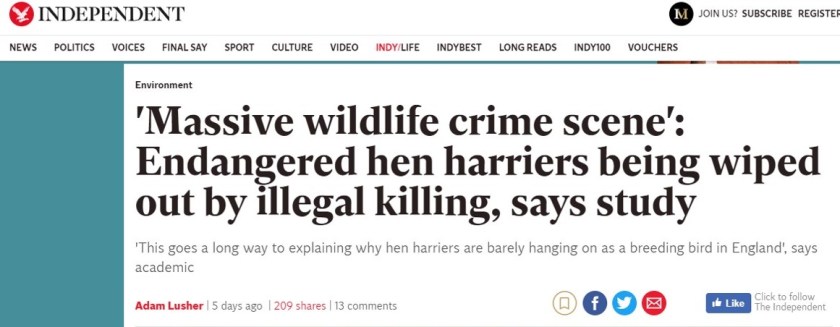
Here’s Amanda quoted in The Independent article:

Amanda Anderson, director of the Moorland Association, which represents grouse moor owners and managers in England and Wales, said the study data, gathered between 2006 and 2017, was before a management scheme put in place as part of Defra’s hen harrier recovery plan.

She said keepers had engaged with tactics such as reporting and monitoring nests and roost sites, as well as reducing conflicts between the birds via feeding strategies.

Ms Anderson said that 2018, the first year of the brood management scheme, was “the most successful hen harrier breeding season in England for over a decade”, continuing: “We know from evidence gathered on the ground there are many areas on grouse moors where hen harriers – with or without satellite tags – are currently thriving.”

But she added: “We want to see more hen harriers on grouse moors. Persecution should not occur and must cease in order to give hen harriers the best chance of survival. Seventy per cent of hen harriers perish in their first year from natural causes. However, when a satellite tag fails unexpectedly, persecution may be a factor.

END

Wow. What’s that saying? More front than Blackpool?

It’s all ok, folks, no need to worry about the extraordinarily high percentage of ‘missing’ (presumed killed) hen harriers on grouse moors, because all that took place before DEFRA’s Hen Harrier Action Plan was put in place. Er, except that in the year after the paper’s data were gathered and the so-called Action Plan was in place (2018), at least 11 satellite-tagged hen harriers all ‘disappeared’ in suspicious circumstances, most of them either on or near a grouse moor, between the months of August and November. How do you explain that, Amanda?

[RPUK map showing the last known locations of 11 satellite-tagged hen harriers that ‘disappeared’ in suspicious circumstances between August – November 2018]

Also according to Amanda, ‘keepers had engaged with tactics such as reporting and monitoring nests and roost sites’. Ah, would that ‘monitoring’ of nest sites include the tactic of repeatedly driving up towards a nesting attempt on a quad bike, disturbing the birds so much that the nesting attempt was abandoned? There are certainly reports of that happening on one particular grouse moor (which was reported to the police).

And would that ‘monitoring’ of roost sites include the tactic of turning up with a gun and a couple of dogs at dusk, to walk around a roost site where three hen harriers had just gone to ground (see here)?

And where is this “evidence gathered on the ground” that shows “there are many areas on grouse moors where hen harriers – with or without satellite tags – are currently thriving”? Have those sites been reported to raptor fieldworkers from NERF, or the RSPB, or Natural England (all partners in the RPPDG), or is this yet another imaginary scene that Amanda’s viewed through her magical kitchen window?

Unfortunately for the Moorland Association, Amanda’s latest episode of propagandist nonsense is looking a lot like a rapidly disintegrating sand castle crumbling in the face of an overwhelming rising tide of evidence.

New satellite tag to detect illegal killing of golden eagles in Cairngorms National Park, eagle-killing hotspot

Press release from Cairngorms National Park Authority (23 March 2019)

Cutting edge technology to provide new insight into lives of Scotland’s golden eagles

An innovative new type of satellite tag has been designed to provide a boost to understanding raptor movements and behaviour, as well as help understand the fate of birds which die in the Cairngorms National Park and more widely across Scotland.

Over the next 18 months some young Golden Eagles in and around the Cairngorms National Park will be fitted with a novel ‘Raptor Tracker’ tag, as part of a trial which will provide key information on movements and behaviour, such as whether a bird is feeding or resting. Most importantly, it will provide an instant fix on any birds which die.

Tags in current use are limited in what information they can provide on the exact location of any bird which dies.  This new tag uses the ‘geostationary Iridium’ satellite network and ensures that signal information is always available. Crucially, it has been developed with multiple sensors; these immediately send a ‘distress’ signal, with an exact location, back to base if unusual behaviour is detected. This early warning system has the added benefit of helping to rapidly identify and recover birds which have died.

[An illegally killed satellite-tagged golden eagle, believed to have been trapped on a grouse moor in the Angus Glens resulting in its legs almost being severed, and then dumped in a layby several km away, inside the Cairngorms National Park, where it was left to die an horrific death. Photo by RSPB]

Environment Secretary Roseanna Cunningham said: This is great news for improving our understanding of eagle behaviours, and in the fight against wildlife crime. The tags should make a real difference in deterring would-be criminals, as well as playing a key role in establishing exactly what happened, should any of these magnificent birds of prey disappear or die in unusual circumstances.”

Grant Moir, CEO of the Cairngorms National Park Authority (CNPA) said: “Raptor conservation and tackling wildlife crime is one of the aims of the recently launched Cairngorms Nature Action Plan 2019-2023. This is an exciting breakthrough in the technology around raptor conservation, understanding the birds and combatting wildlife crime.”

Robbie Kernahan, Head of Wildlife Management, of Scottish Natural Heritage (SNH) added: “This exciting new technology will give us new information on the movements of these iconic birds. This should also be a significant deterrent to anyone thinking of persecuting raptors, as we will have detailed information on birds’ movements in the minutes leading up to their death.”

Charlie Everitt, UK National Wildlife Crime Unit commented: “This new tag is a significant step forward in using technology to research further the intriguing ranging behaviour of Golden eagles. However, the implications for preventing wildlife crime and as an aid to enforcement are also very apparent. I look forward to the trial and working closely with colleagues in CNPA and SNH.“

Phil Atkinson, Head of International Research, BTO said: “BTO has been developing new tagging technologies for several years, working to increase the quality and type of information collected. These new ‘Raptor Tracker’ tags have the potential to reveal new aspects of Golden Eagle behaviour, providing fascinating insights into their lives. We are looking forward to the trial and what it reveals.”

The CNPA and SNH have been working on this for over two years, and for the last six months the British Trust for Ornithology has been involved in developing the new tag. The tags will be placed on birds over the next 18 months to trial them. Changes can be made to the tags remotely to ensure that they are working optimally.

If the trial proves successful, the organisations will look at putting these on more Golden Eagles and also the potential miniaturisation of the technology to allow similar tagging of Hen Harriers and other species.

END

Some of what has been written in this press release is absolute nonsense, in terms of the limitations of some of the highly sophisticated satellite tags currently deployed on golden eagles. However, to focus on that would detract from the bigger picture of what is being proposed, and that’s far more important to discuss.

The development of a tag that can potentially send what amounts to a distress signal from the exact location and at the exact time the tagged eagle is being illegally killed is to be warmly welcomed. If this tag works as the manufacturers claim it will, it will provide wildlife crime investigators with high quality evidence of the precise location of the crime, which currently can only be inferred from tag data depending on the tag’s ‘duty cycle’, which determines when it’s programmed to transmit data to the tag operator (this can vary between a matter of hours and a number of days, depending on tag type). That would be a seriously good development.

What it wouldn’t do is to identify the individual criminal, especially if the crime took place on a large grouse moor estate where multiple gamekeepers are employed (which is where most of the golden eagle killing in Scotland has taken place). In those situations, the wildlife crime investigation wouldn’t get any further than the current situation we see playing out so often today –  that is, the body and the tag removed from the scene and destroyed, “no comment” interviews from all suspects and no way for the police to identify the actual individual responsible. Without that identification, a prosecution cannot proceed.

That’s not to say that the estate would get off scot free though, as they currently do. Conservationists have been arguing that the pattern of evidence from the current raptor satellite tags that suddenly and inexplicably ‘disappear’ should be sufficient evidence for SNH to impose General Licence restrictions on the offending estates. For some reason (unexplained, as far as we can tell), this has not been happening, even though the Environment Cabinet Secretary acknowledges the significance of the data pattern (see her editorial in the Government’s annual wildlife crime report). However, if this new tag can do what is claimed it can do, there’s no question that that information should be accepted by SNH and sanctions should be applied to the estate involved.

It’s great that this tag will be trialled in and around the Cairngorms National Park, given that some of the more intensively-managed grouse moors in and at the edge of the Park are well-known golden eagle-killing hotspots, as shown in this map derived from data provided in the golden eagle satellite tag review in 2017. It’s interesting that none of the people quoted in the press release mentioned this fact!

It is though, very pleasing indeed to see such senior figureheads recognise that the deployment of satellite tags on threatened raptor species is an acceptable and important conservation tool and a helpful investigative tool for detecting wildlife crime. It seems the concerted campaign by several meat heads in the gamekeeping world, which has included disgraceful personal attacks and smears on the integrity of those who fit satellite tags, has fallen on deaf ears.

We look forward to hearing about the field trials on this new tag in due course. Well done to all involved.

Responses to hen harrier satellite tag paper: Northern England Raptor Forum

The publication of the hen harrier satellite tag paper on Tuesday (here) that provided compelling evidence to highlight, yet again, the link between grouse moors and the illegal killing of hen harriers, has resulted in a flurry of responses from various individuals and organisations.

We’ll be looking at these responses in turn.

So far we’ve discussed the responses of Supt Nick Lyall (Chair, RPPDG) (here), BASC (here) and Dr Therese Coffey (DEFRA Wildlife Minister) (here).

This time we’re examining the response of the Northern England Raptor Forum (NERF).

NERF has published a statement on its blog – see here.

It’s a powerful commentary on what has amounted to 15 years of failed partnership working in attempts to get the grouse shooting industry to oust its hen harrier-killing criminals.

The sense of frustration at its failure is palpable.

The NERF statement is a must-read for all those who keep telling us we need to engage with conflict resolution approaches and if only we could all sit down around the same table and sip tea and eat Custard Creams everything will be fine. Read the statement and you’ll understand why it won’t.

The time for more talking with those who represent and shield the criminals has just about run out (for some it already has) but NERF is prepared for one more throw of the dice and is “investing a temendous amount of goodwill” in the apparently rejuvenated RPPDG under the leadership of Supt Nick Lyall.

Hats off to the NERF membership – these are ordinary men and women who voluntarily dedicate huge amounts of time and expertise to study, monitor and try to safeguard birds of prey across the north of England, despite the appalling criminality within the game shooting industry that is allowed to continue year after year after year with devastating impacts on individual and on populations of some raptors. Many would have thrown in the towel a long time ago to avoid the aggravation – thank god the NERF members didn’t.

Grouse shooting lease on wildlife crime grouse moor will not be renewed

The owner of Denton Moor, a company called NG Bailey, has announced it will not renew the grouse shooting lease to its current tenant following a spate of wildlife crime.

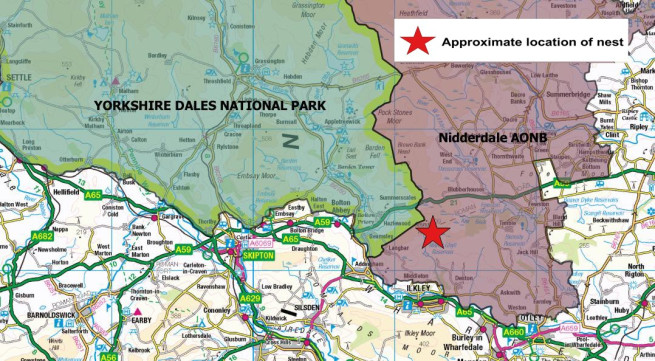
Denton Moor in the Nidderdale AONB in Yorkshire was where the RSPB filmed footage of several armed men, dressed as gamekeepers, shooting at a nesting Marsh harrier and removing eggs from the nest in May 2017 (see here). Despite good efforts from North Yorkshire Police, the armed men have not been identified.

[RPUK map showing the location of Denton Moor]

Last month gamekeeper Austin Hawke was convicted of wildlife crime on the same moor after a badger was found dead in a snare in May 2018 (see here).

Campaigners have been targeting NG Bailey for some time and the recent conviction of one of the shooting tenant’s gamekeepers seems to have been the last straw for the landowner.

David Hurcomb, Chief Exec said:

NG Bailey is aware of the prosecution of Austin Hawke, the gamekeeper who is employed by and works for the tenants. To clarify, Austin Hawke is not employed by Denton Park Estate. As a business, we find this behavior totally unacceptable and do not condone this type of conduct – it is not reflective of the company’s values or ethical practices. We have advised the tenants that under no circumstances will the lease be renewed when it expires”.

Excellent news. Although whether that means it’ll be leased to someone other than the current tenant remains to be seen. We’re not sure when the current lease expires.

The efforts of a wide range of people have led to this result, allowing campaigners to join up the dots and apply pressure. Well done to them all, including the RSPB Investigations team, North Yorkshire police, local raptor workers, the Crown Prosecution Service and local campaigners.

Well done also to David Hurcomb and his colleagues at NG Bailey – this is a very welcome decision.

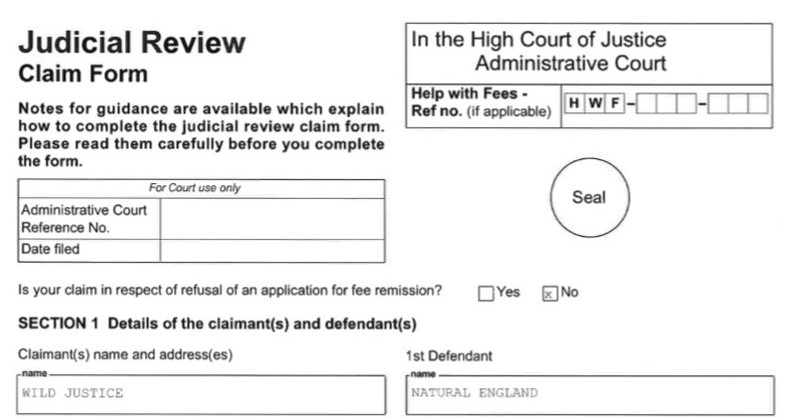
Wild Justice submits application for judicial review (General Licences)

First legal case for Wild Justice challenges Natural England’s licences for bird killing

Environmental organisation Wild Justice has issued legal proceedings in the High Court challenging the lawfulness of the General Licence system used by Natural England to authorise the killing of birds that would otherwise be protected.

Wild Justice, a not-for-profit organisation, was launched in February 2019 with the aim of using the law to further nature conservation and wildlife protection. The proceedings issued today are the organisation’s first legal case.

The judicial review challenge concerns Natural England’s decision in January to issue General Licences 04, 05 and 06 which permit the killing of 15 species of birds, including Jays, Collared Doves, Woodpigeons, Jackdaws, and Ring-necked Parakeets. Without such authorisation the killing of those birds would be a criminal offence under the Wildlife and Countryside Act 1981.

The EU Birds Directive and the Wildlife and Countryside Act 1981 provide strong theoretical protection to all birds but allow in certain circumstances for people to take lethal action. This includes where the killing is intended to meet a specific purpose such as preventing the spread of disease or preserving air safety. However the law states that before issuing a so-called General Licence, Natural England as the competent authority must first properly satisfy itself that no alternative non-lethal means, such as scaring, could provide a satisfactory solution.

Wild Justice will say that Natural England has wrongly put the onus on individual licence users to explore non-lethal methods as part of the licence conditions. Furthermore, there is no method in place for checking that licence users exhaust all non-lethal options before resorting to killing the birds.

Wild Justice will argue that Natural England has no power to issue a licence if it has not met the condition that it must itself first consider whether there are non-lethal satisfactory solutions to killing the birds. If Natural England has not properly made that assessment then the General Licences under challenge are unlawful.

Dr Mark Avery said “Natural England and Defra are allowing the casual killing of millions of birds each year with no monitoring, no control and no justifiable reason. Natural England was set up to protect wildlife, not to turn a blind eye to such slaughter. Mass killing of wildlife under the General Licences has been going on for nearly 40 years – it’s time that this casual killing ended“.

Tom Short, solicitor at Leigh Day, said: “Our client argues that the 2019 General Licences GL04-6 are unlawful as Natural England has no power to issue the licences for the simple fact that it failed to comply with the condition precedent under the Wildlife and Countryside Act 1981. This condition states that before issuing these licences Natural England – and not any other body or person – has to be satisfied that there are no alternative solutions to killing wild birds. Natural England has not done that. It has instead told licence users that they must themselves decide whether alternative solutions are ineffective or impracticable. Wild Justice, and its many supporters, believe this is a travesty for wildlife protection in the UK and our client intends to vigorously challenge it.”

To find out more about Wild Justice and this first legal case in particular, have a listen to this 36 min podcast (here) recorded and produced earlier this week by Charlie Moores who interviewed Mark Avery, one of the Wild Justice directors.

This legal challenge has only been made possible thanks to the overwhelming and generous support of over 1,000 donors who have contributed to the crowdfunder. Less than a week after launching, over £30,000 of a £36k target has already been raised. That’s phenomenal. If you’d like to contribute a couple of quid to help push it over the line, please visit the crowdfunder page HERE.

Thank you.


Responses to hen harrier satellite tag paper: Wildlife Minister Dr Therese Coffey

The publication of the hen harrier satellite tag paper on Tuesday (here) that provided compelling evidence to highlight, yet again, the link between grouse moors and the illegal killing of hen harriers, has resulted in a flurry of responses from various individuals and organisations.

We’ll be looking at these responses in turn.

So far we’ve discussed the responses of Supt Nick Lyall (Chair, RPPDG) (here), and BASC (here).

This time we’re examining the response of the Parliamentary Under Secretary of State at DEFRA, Dr Therese Coffey.

Before anyone gets excited, no, Dr Coffey wasn’t sufficiently embarrassed nor energised by the research findings to make a proactive, stand-alone statement about such devastating results; come on, this is the resolutely wilfully blind Dr Coffey who’s best known to us for her disinterested, apathetic responses whenever the issue of illegal raptor persecution is raised.

However, the paper was mentioned in a Westminster Hall debate on wildlife crime yesterday, at which Dr Coffey attended and spoke. The debate was broad ranging and quite interesting on a number of fronts – no time to go in to those details here but you can watch proceedings on this archived video here or read the transcript here. Well worth your time to see which MPs are not only clued up, but also which ones care about various aspects of wildlife crime. Useful info to have when the current Government implodes and you’re back in the voting booth.

The bit we’re most interested in, obviously, is Dr Coffey’s response to the issue of illegal raptor persecution. Here is the relevant part of the transcript, cut from the link above:

Raptor persecution is one of the UK’s wildlife crime priorities. All wild birds are protected under the Wildlife and Countryside Act 1981, and there are strong penalties for those committing offences. In the five years up to 2017—the latest year for which data is available—there were 107 prosecutions for crimes against wild birds and 75 convictions. The police are leading efforts to prevent the persecution of birds of prey. I praise the work done by North Yorkshire police, particularly on Operation Owl, and I commend police and crime commissioner Julie Milligan in particular. She has been fundamental not only in that work, but in chairing the rural group of police and crime commissioners, she has also made hare coursing a key priority for work across a number of forces.

In addition to activity to disrupt and deter criminality, officers of the North Yorkshire police have worked to raise awareness about raptor persecution among local landowners and members of the public. Only through working in partnership with those living and working in rural communities can raptor persecution be combated. Despite instances of poisoning and killing of birds of prey, populations of many species, such as the peregrine, red kite and buzzard have increased. I fully recognise, however, that some species continue to cause concern.

The Government take the decline in the hen harrier population in England particularly seriously, and we are committed to securing the future of that iconic species. That is why we took the lead on the hen harrier action plan, which sets out what will be done to increase hen harrier numbers in England, including the trialling of brood management. In the recent judicial review into the lawfulness of Natural England’s decision to grant a licence for trials of hen harrier brood management, the claimants’ claims were dismissed. The proposed brood management scheme will continue. It seeks to manage the conflict between the conservation of hen harriers and the grouse shooting industry. That decision means the important work to protect and conserve the hen harrier can continue.

The hon. Member for Workington referred to an article that was published in a journal yesterday; I take that issue very seriously and will be seeking to meet the chair of the raptor persecution group, Superintendent Lyall, to go through it in detail. Although it is not for the Government to tell the police or the Crown Prosecution Service who they should be investigating and charging, we should take a proactive approach, particularly to stamp out the persecution of birds of prey“.

ENDS

It’s good to see Dr Coffey recognising and applauding the recent efforts of North Yorkshire Police and their Operation Owl initiative and it’s very good to hear that she plans to meet Supt Nick Lyall, Chair of the RPPDG.

But hang on a minute, haven’t the devastating results of a peer-reviewed scientific study just been published in a high-ranking journal, detailing one of the most pressing wildlife conservation issues in the UK – the persistent illegal killing of hen harriers on driven grouse moors in northern England? And Dr Coffey, our Wildlife Minister, has nothing specific to say about those results?

That’s shameful.

Yes, the Westminster Government absolutely should be taking a “proactive approach” to stamp out the persecution of birds of prey, but it hasn’t and it isn’t. It’s as simple as that.

Lying in wait: gamekeepers trying to lure raptors to within shotgun range in Peak District National Park?

Some of you may remember the footage of an armed man, believed to be a gamekeeper, lying in wait close to a decoy hen harrier on a grouse moor in the Peak District National Park, back in 2016 (see here).

The footage was so disturbing, and the public reaction so strong, it prompted the National Trust (the landowner) to pull the shooting lease early and replace the shooting tenant with someone else (see here). Incidentally, that new tenant hosted a successful hen harrier breeding attempt last year (see here), even though some of the offspring didn’t survive for very long after leaving the safety of this moor (e.g. Arthur, see here and Octavia, see here).

We’ve also blogged before about what was believed to be the use of a tethered live eagle owl as a decoy on a grouse moor in the Lammermuirs (see here), although the suspected gamekeeper took off pretty sharpish once he realised he’d been spotted.

Well, it seems this method of using to decoys to lure in birds of prey to within close range of a shotgun is more prevalent than we’d thought.

Today the RSPB Investigations Team has published a video of several armed men (identified as gamekeepers by the RSPB) over a period of months spending hours and hours and hours of their time sitting in specially-dug holes in close proximity to a plastic peregrine and a plastic hawk, believed to have been used as decoys to attract other birds of prey. The location? A grouse moor in the Peak District National Park.

Hmm, it’s really no surprise that the Peak District National Park was identified in the recent scientific analysis of hen harrier sat tag data as one of the grouse moor areas where hen harriers were most likely ‘disappear’ in suspicious circumstances (see here).

The RSPB has also written a blog about this footage, and similar evidence of decoy use that has been recorded on other grouse moors in the north of England. Read the eye-opening blog here.

Fantastic investigative work from the RSPB to get such close and clear footage and there’s a strong chance that these gamekeepers won’t be using those particular decoy sites again in the near future!

Responses to hen harrier satellite tag paper: BASC

The publication of the hen harrier satellite tag paper on Tuesday (here) that provided compelling evidence to highlight, yet again, the link between grouse moors and the illegal killing of hen harriers, has resulted in a flurry of responses from various individuals and organisations.

We’ll be looking at these responses in turn.

Yesterday we looked at the response of Supt Nick Lyall, Chair of the Raptor Persecution Priority Delivery Group (here).

Today we’re examining the response from the British Association for Shooting & Conservation (BASC).

BASC was quick to publish a lengthy statement on its website and at first glance it looks convincing. BASC accepts that raptor persecution is a problem and calls for its members to help stamp it out:

The statement starts off very strongly but the message gets progressively lame as you scroll down the page, with BASC feeling the need to justify the ‘benefits’ of grouse shooting and then make some incredulous claims about the so-called ‘success’ of last year’s hen harrier breeding season, which actually looks like something that’s been cut and pasted from the Moorland Association’s website.

Nevertheless, we could forgive BASC its small piece of propagandist nonsense because hey, the main message (about stamping out illegal raptor persecution) is clear and it looks like it’s based on sincerely held views.

But wait a minute! Some of the phraseology in BASC’s statement looks awfully familiar.

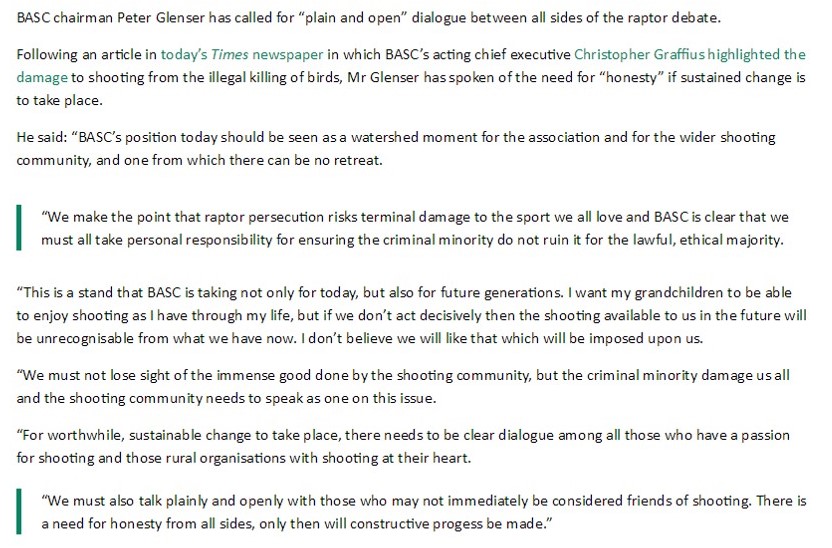
There are criminals among us“, “Terminal damage“, “We must all take personal responsibility“, “Ensuring the criminal minority do not ruin it for the lawful, ethical majority“, “I want my grandchildren to enjoy shooting“.

Haven’t we heard this before? Ah yes, 16 months ago in November 2017 in response to the RSPB’s Birdcrime report, BASC published a strong position statement in The Times (here) (for which BASC earned well-deserved credit) using some of these very same phrases and then a further piece for the BASC website (here) again using some of these very same phrases. For example, here’s what BASC Chairman Peter Glenser wrote for the BASC website at the time:

Sorry, BASC, but it’s just not as convincing when you can’t respond spontaneously to the results of the hen harrier satellite tag paper but instead rely upon regurgitating a previous media statement just because it got you some good press the first time around, and just attribute it to a different member of staff each time.

To be fair to BASC, it is seen by many in the conservation community as the most progressive of the game-shooting organisations although let’s be honest, the bar is set pretty low and some of its individual staff members need to attend a ‘how not to behave in a way that will embarrass your employer and alienate the public on social media and in real life’ course.

But words are just words and they’re easy to churn out (especially if you’re simply cutting and pasting from an earlier piece). What about actions? What action has BASC taken to demonstrate a commitment to rooting out the criminals amongst its membership and wider industry since what it called the “watershed moment” to do exactly that back in November 2017?

Errrrr……boycotting the first meeting of the RPPDG chaired by Nick Lyall in January (see here, here and here)?

Or perhaps appearing to accept a significant donation from a company owned by somebody long-involved with the sporting management of various estates throughout the UK, some of which are notorious for their appalling record of confirmed and alleged raptor persecution crimes?

BASC’s rhetoric might be fooling some, but……

Responses to hen harrier satellite tag paper: Supt Nick Lyall, Chair RPPDG

The publication of the hen harrier satellite tag paper yesterday (here) that provided compelling evidence to highlight, yet again, the link between grouse moors and the illegal killing of hen harriers, has resulted in a flurry of responses from various individuals and organisations.

We’ll be looking at these responses in turn.

To begin with, Police Supt Nick Lyall, the Chair of the Raptor Persecution Priority Delivery Group (RPPDG), a so-called ‘partnership’ tasked with raising awareness of illegal raptor persecution and finding ways to eradicate it.

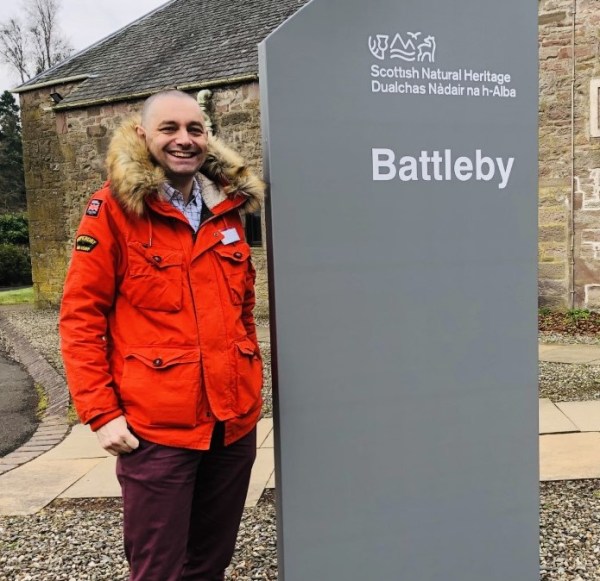
[Nick Lyall and his infamous rapper coat attending the Scottish Raptor Study Group annual conference in Perthshire in February, photo by Ruth Tingay]

Within hours of the hen harrier sat tag paper being published, Nick posted a statement on his blog last night with the heading ‘Time for change‘….. (see here).

He made four key points.

First, an acknowledgement of the high quality of the research and the journal in which it had been published.

Second, an acknowledgement that the research provided evidence of the extent of the raptor persecution issue, which is a significant change from a comment he made five months ago in his first blog about “rogue gamekeepers” (unsurprisingly, written shortly after spending time with the Moorland Association).

Third, and perhaps of greatest importance, that he intended to act upon the research findings via his newly forming RPPDG Enforcement Group, instead of simply discussing the findings and saying ‘Oh, isn’t it all terrible’. Most encouragingly, he also wrote, “I already have a couple of offenders in my sights….”.

Fourth, and the least convincing (to us), was his statement about continuing to work with ‘partners’: “I still firmly believe that an effective partnership response to this issue is the most sustainable way forward“.

We fundamentally disagree with this statement. These are crimes that are being committed – and in our view, serious organised crimes – the people involved should be treated as criminals, not partners.

Nick thinks an effective partnership would be the most sustainable way forward. But in any partnership, no matter what the topic, it will only work if all the partners share the same objectives. The simple fact of the matter is that in the RPPDG, they don’t, and this particular partnership charade has been allowed to continue for ten years without achieving anything of any significance in the world of raptor conservation. Not one thing. Other ‘partnership’ initiatives to tackle illegal raptor persecution go back much further than ten years and they’ve all failed too.

Nick got a taste of the ‘partnership’ at his first RPPDG meeting in January (see here), which was boycotted by several of the so-called ‘partners’ in an attempt to disrupt proceedings simply because they weren’t getting their own way, as they had for the previous ten years. It remains to be seen what will happen at the next ‘partnership’ meeting in April. Our hope is that they’ll get booted out so that the genuine partners, all working towards the same goal, can get on with it without further disruptions. We’ll see.

Regular blog readers will know that we have a huge amount of time for Nick Lyall and for what he’s trying to achieve. There’s no question that he ‘gets it’ and that he understands the challenges ahead, and that he’s working his socks off to start implementing change, most of which (or all of which?) is done in his own time.

Right now, in just six short months, he’s single-handedly putting to shame many of the others in positions of authority who have had, and still do have, the opportunity to bring about change but who have failed, and continue to fail, to even start trying.

At least 72% satellite tagged hen harriers presumed illegally killed on grouse moors

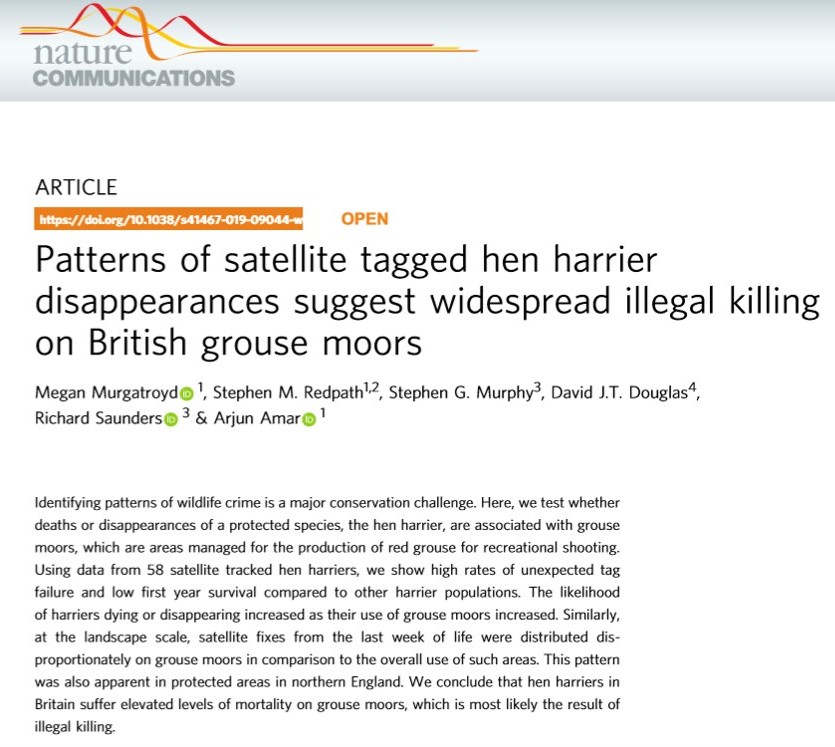
At long last, after years of stalling, hiding, prevaricating and obsfuscating (e.g. see here and here) and 13 years after its publicly-funded study began, Natural England’s hen harrier satellite tag data has finally been analysed and published in a peer-reviewed scientific journal.

The paper is open access and can be downloaded here: Widespread illegal killing of HH on British grouse moors

Here is the abstract:

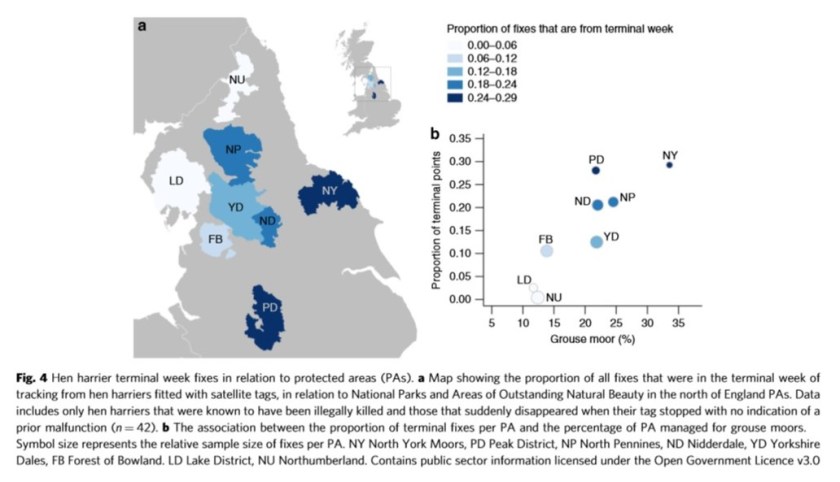
The results? Entirely predictable (hen harriers are highly likely to be killed on grouse moors – gosh, who knew?), and are more likely to be killed inside protected areas such as National Parks and Areas of Outstanding Natural Beauty (AONBs) with large areas of grouse moors than any other type of landuse, especially these protected areas in North Yorkshire, Bowland and the Peak District:

Unfortunately the results do not have the same fine resolution as those of the golden eagle sat tag review, but that is simply a consequence of using different types of satellite tag and duty cycles. E.g. the golden eagle tags, especially the newer GSM solar powered tags, are ‘on’ constantly and are collecting data every minute when fully charged, whereas the hen harrier tags are using the Doppler/Argos system so the tags are less spatially accurate and have frequent periods when they are not ‘on’, thus not collecting data. Nevertheless, even being forced to undertake an analysis at a coarse scale, the results are still damning.

The most devastating result, in our opinion, is the extent of the criminality and this is what should be grabbing the attention of Ministers. Sure, we’ve all known for years that hen harriers are killed by gamekeepers on many driven grouse moors; everybody knows and acknowledges that, but the scale of the killing has always been challenged (or more usually, denied).

But this paper puts an end to those denials. 72% of the Natural England sat tagged hen harriers are presumed to have been illegally killed, versus 9% natural deaths. 72% is the MINIMUM value. If you exclude the tagged birds that are still alive/being tracked (7), and thus just look at the tagged birds with a known end fate, then the maximum value of illegally killed satellite tagged hen harriers would be 82% versus 9.8% natural deaths. It’ll be interesting to add the RSPB-tagged birds to this in due course.

82% of young tagged hen harriers are likely to have been illegally killed, on grouse moors. Compare that to the 31% of satellite tagged golden eagles that ‘disappeared’ in suspicious circumstances on or near driven grouse moors in Scotland. In a direct response to that 31%, Scottish Environment Secretary Roseanna Cunningham ordered an independent review of grouse moor management, specifically to examine opportunities for licensing.

How do you think her Westminster counterparts, Michael Gove & Dr Therese Coffey will respond to the 82% figure? Let’s see, shall we?

A press release has been issued by the partner organisations involved in the hen harrier sat tag analysis, as follows:

STUDY SUGGESTS WIDESPREAD ILLEGAL KILLING OF HEN HARRIERS ON ENGLISH GROUSE MOORS

A new study reveals that young hen harriers in England suffer abnormally high mortality compared to populations in Orkney and mainland Scotland and the study provides compelling evidence that the most likely cause is illegal killing in areas associated with grouse moor management.

Published today in Nature Communications, this paper represents the culmination of a 10-year Natural England study involving 58 satellite tagged hen harriers. The analyses have been led by the University of Cape Town and Aberdeen University with the provision of land use data by the RSPB. The study showed the likelihood of hen harriers dying, or disappearing, was ten times higher within areas predominantly covered by grouse moor, compared to areas with no grouse moor. The study revealed that 72% of tagged harriers were either confirmed or considered very likely to have been illegally killed.

The hen harrier, sometimes called the ‘skydancer’ because of its amazing acrobatic display in the breeding season, is one of England’s rarest birds and is legally protected. Illegal killing of hen harriers has long been thought to limit their population size, but identifying the scale of these crimes and their impact on harrier populations has been difficult because they occur in remote areas and evidence is likely to be destroyed, thus successful prosecutions are rare. This long-term study has enabled patterns of disappearances to be assessed across a large number of birds. This provides overwhelming evidence that illegal killing is occurring on some grouse moors, where some gamekeepers view hen harriers as a threat to their grouse stocks.

Stephen Murphy from Natural England led the data collection and commented: Natural England welcomes the publication of this study, which demonstrates the value of tagging as a legitimate conservation tool. These analyses are a significant step in understanding the fate of tagged hen harriers, and confirm what has long been suspected – that illegal persecution is having a major impact on the conservation status of this bird.”

Dr Megan Murgatroyd, from the University of Cape Town, who is the lead author of the study said: “Natural England’s long-term commitment to this tracking study has yielded an important dataset involving over 20,000 individual fixes. This is a remarkable achievement for a species whose population in England has averaged only a handful of pairs for the last few years. Whilst dead harriers can be disposed of, the pattern of hen harrier disappearances revealed by this data could not be hidden. [Ed: She’s clearly been listening to Dr Hugh Webster – that’s his line!] The multiple levels of analyses of the data have all led to the same robust conclusion that hen harriers in Britain suffer elevated levels of mortality on grouse moors, and this is most likely the result of illegal killing.“

Dr David Douglas, RSPB Principal Conservation Scientist and a co-author on the paper, said: “The high rate of illegal persecution on grouse moors revealed by this study goes a long way to explaining why hen harriers are barely hanging on as a breeding bird in England. Satellite tag data is giving us very valuable insights into what is happening to our birds of prey in the UK. It has already provided compelling evidence of the link between suspicious golden eagle deaths and grouse moors in Scotland and now it has done the same for hen harriers in England.”

Rob Cooke from Natural England said: “Natural England will continue its satellite tracking work to further improve our understanding of hen harrier movements and behaviour, and will continue work to improve the conservation status of the species. Natural England welcomes the support of many landowners in this, and will continue to work with all landowners and other interested parties to find ways of enabling hen harrier populations to increase from their current critically endangered levels in England”. 

ENDS

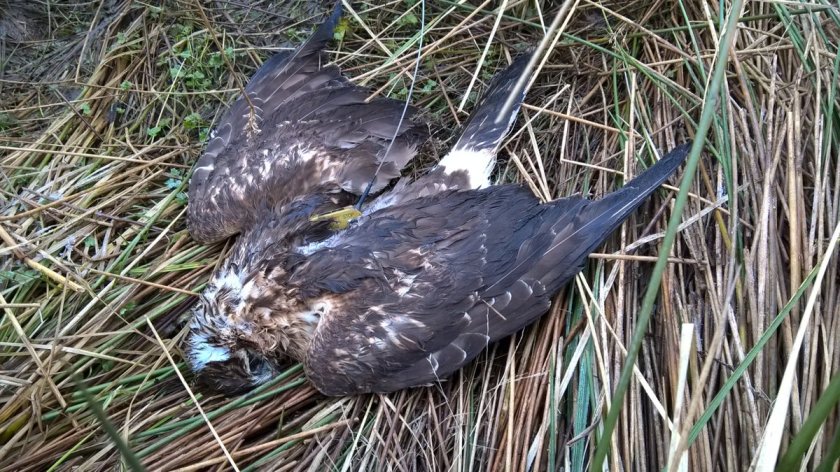
[Satellite-tagged hen harrier Carroll, who’d been shot]

UPDATE 20 March 2019: Responses to hen harrier satellite tag paper: Supt Nick Lyall, Chair RPPDG (here)

UPDATE 21 March 2019: Responses to hen harrier satellite tag paper: BASC (here)

UPDATE 21 March 2019: Responses to hen harrier satellite tag paper: DEFRA Wildlife Minister Dr Therese Coffey (here)

UPDATE 22 March 2019: Responses to hen harrier satellite tag paper: Northern England Raptor Forum (here)

UPDATE 24 March 2019: Responses to hen harrier satellite tag paper: Moorland Association (here)

UPDATE 25 March 2019: Responses to hen harrier satellite tag paper: GWCT (here)