
Remember back in May 2017 when Environment Secretary Roseanna Cunningham commissioned the Werritty Review to examine the environmental impact of grouse moor management and to make recommendations for how the industry might be regulated (see here)?
Part of that announcement also included a commitment to commission additional research in to the costs and benefits of large shooting estates to Scotland’s economy and biodiversity. This research would then be fed in to the Werritty Review.
Well, while we’re still waiting for the Werritty Review to report (not expected until later this year), the other research has now been completed, written-up and has just been published.
The research was undertaken by the James Hutton Institute and Scotland’s Rural College (SRUC), overseen by a steering committee which included representatives from the Scottish Government, SNH, University of St Andrews, BASC, RSPB Scotland and Scottish Land & Estates.
The research has been separated in to four reports and published as follows:
A summary report which can be downloaded here: Summary Report_Final
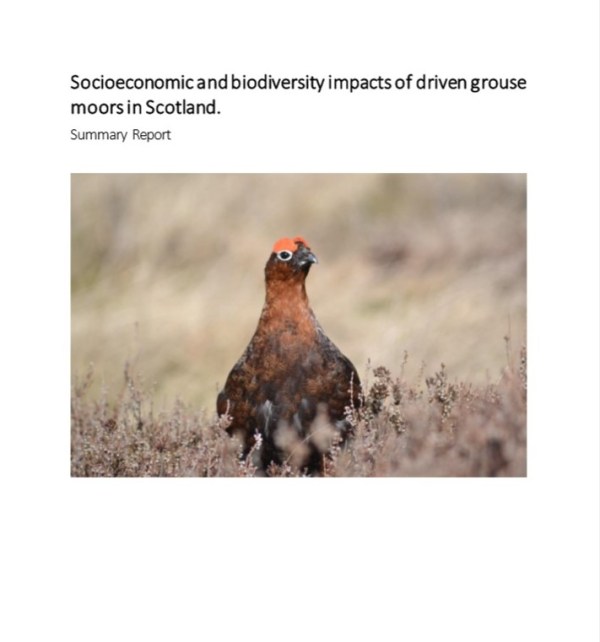
This summary report is a useful and concise guide to the other more detailed three reports and provides an outline of what to expect from those three reports:
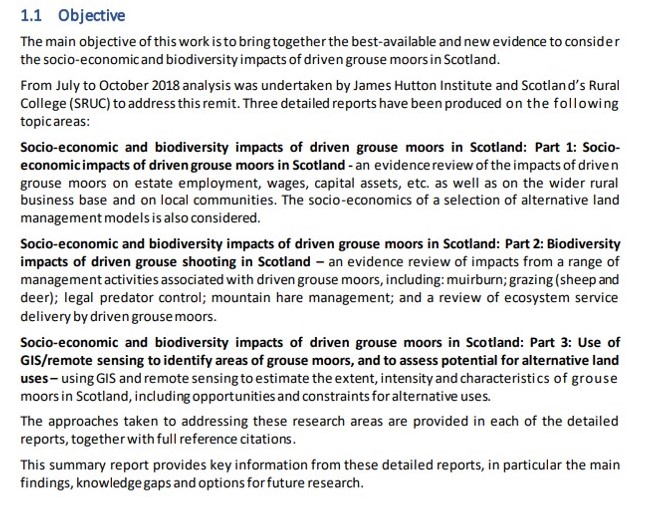
The three more detailed reports can be downloaded here:
Part 1: Socio-Economic Report_Final
Part 2: Biodiversity Report_Final
Part 3: GIS Report_Final
PLEASE NOTE: We have not read any of the reports in detail and due to other commitments we probably won’t get to them for at least a couple of weeks. We hope to comment in due course.
 Raptor Persecution UK
This will be fascinating reading!l
My summary of the summary.
‘Dunno, ask us again in 200 years’.
A quick look through the three reports concludes that there is not enough data to conclude anything…… hopefully I missed something?
I think it just means exactly what it says, and full conclusions even for some of the questions which could be asked are available without huge effort. The employment figures gave an indication of the likely poor economic basis, and other pointers as to the biodiversity issues are there. I’m sure however that the Revive coalition report ‘Back to Life: Visions for Alternative Futures for Scotland’s Grouse Moors’ had the correct answer, even if the full scientific answer may well take 200 years.
Having read the entire report ……
Like a wonderful swirling moorland fog of a thing……
Always important to concentrate on the wider picture…..
What do nations aspire to in their iconic uplands ….
Why are subsidies used to further increase the capital value of intensive driven grouse moors ?
Since the management of the single species of grouse is of very little economic value to wider society, why are the massive negative results eg raptor persecution allowed to continue.[ Large raptor – rich moorlands not being suitable for intensive driven grouse shooting ] ?
What use is a report that deals only with legal predator control,when it is published independently of the report on illegal persecution of raptors that underpins the industry ?
In a Europe or world view our small uplands are really gardens where apex predators and most woodland / forest were removed long ago and meso – predators dominate in an environment where the owners can pour money in to intensify the gardening.
Regardless of views on sport shooting, dense small predator populations do have big impacts on ground nesting birds and hares in some situations. Without bear, wolf,lynx, eagle owl etc. , foxes and crows and deer etc. proliferate and have impacts.
Over a lifetime of work in the raptor conservation,study, research, environment,forestry and other land use fields [ and fully accepting the acceptability of sustainable hunting for food ] I am very pleased with the massive increase in large raptors in UK outside grouse moors and some intensive lowland shoots.
This improvement is just the start and change in the uplands will take generations.
Grouse moors are sinks for large raptors and are therefore not viable in the modern world.
Oh yes….. and burnt strips of heather produce high hare density but hares don’t significantly pass disease to grouse but they can hold back woodland regen.
Golden eagle can survive as specialists or generalists but tend to disappear on intensively managed grouse moors along with peregrine, harrier and others !
An endless stream of thoughts is generated by such reports amongst those of us with the experience and longevity to appreciate them, but I’ll leave it at that for now …….
[ But…. looking at the recent total recovery of species such as White t eagle and wolf in Poland shows what is possible when the wider population is onboard and laws are enforced.]
Sorry to ramble on …..
Keep up the pressure !
‘This improvement is just the start and change in the uplands will take generations.
If you are referring to raptor crime that is a very depressing thought!
I suspect that without a ban or strict licensing with severe penalties and a low threshold of burden of proof, it is true.
I started looking today….it will take a while to unpick the misleading language.