
The RSPB is advertising a number of job vacancies to help monitor and protect birds of prey in England this year, with a particular focus on the beleagured hen harrier.
This is an opportunity to work on the very frontline of raptor conservation in the UK.
SEASONAL FIELD ASSISTANT, BOWLAND, LANCASHIRE
The RSPB is looking for a skilled and dedicated Field Officer to help monitor and protect birds of prey on the United Utilities Estate in the Bowland Fells. Located in Lancashire, the Bowland Fells are designated as a SSSI and SPA for their blanket bog and upland heath habitats and for the suite of exciting species that breed there.
The focus of this role is on monitoring and protecting Hen Harriers, Merlins, Peregrines and Short-eared Owls. Historically, Bowland was at one time the most important area in England for Hen Harriers, and the RSPB is working with Unitied Utilities and other partners to restore the population of this species to its SPA designation and back towards its historical population level. Excellent field skills and experience of monitoring and protecting upland birds of prey (including nest finding) are essential, particularly of the four named focal species. You will also have a thorough understanding of bird of prey ecology and the challenges associated with bird of prey conservation in the uplands, and apply this knowledge to your work accordingly.
Reporting to the Project Officer, you will work with him to organise the field work schedule following best practice monitoring protocols as well as health and safety protocols and have the leadership skills required to oversee the project in the event of his absence.
Closing date: 1 February 2019
For further details and how to apply, please click here
[Hen harrier photo by Mark Hamblin]
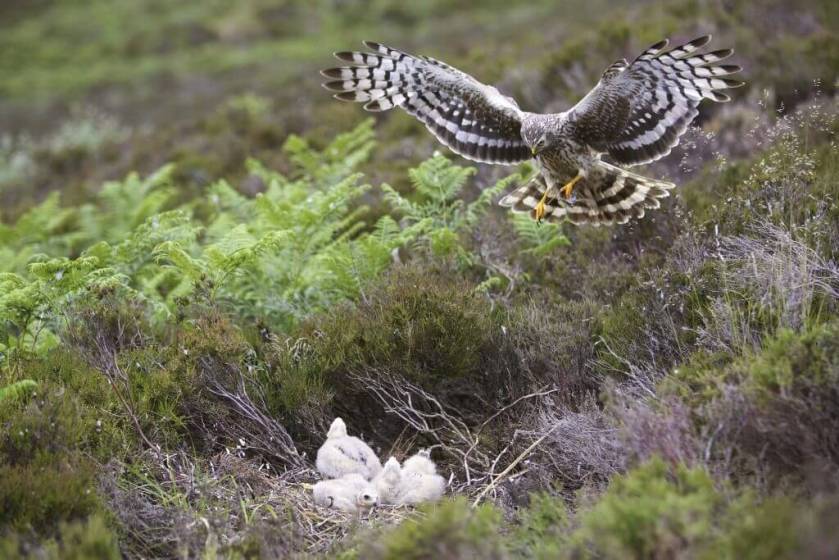
HEN HARRIER NEST PROTECTION OFFICER (x6) (NORTHERN ENGLAND)
RSPB Northern England region is looking for six seasonal flexible contract staff for the overnight nest protection of hen harriers. The posts will most likely be based in Northumberland, Cumbria or Lancashire, but with the flexibility to move elsewhere dependent on the location of a nesting attempt. The contract will be over 5 months starting around April but this will flexible depending on the nesting.
The main purpose of this team is to monitor nesting attempts to ensure the hen harrier nests have the best chance of success. This may involve carrying out overnight shifts, the time and length of these shifts to be coordinated by the line manager for the site.
Work will require long and unsociable hours in the field, often in adverse weather conditions. The nest monitoring team will need to work closely with volunteers, stakeholders, farmers and landowners on whose land part of the work may be carried out, as well as members of the general public. The nest monitoring team will need to ensure that this work is carried out in a safe manner which minimises any disturbance to the birds.
Closing date: 25 February 2019
For further details and how to apply, please click here
 Raptor Persecution UK
“The nest monitoring team will need to work closely with volunteers, stakeholders, farmers and landowners on whose land part of the work may be carried out, ”
Actively documenting and investigating those “stakeholders” too, or just keeping their heid down and see-no-evil rules?
Don’t be a twat! When has RSPB ever operated the way you suggest? proof not hearsay.
Would it be so hard to be civil, Paul?
Nah, it is fair enough. I probably deserved that. I’ve been overly grumpy lately, I don’t know why, so I probably needed pulling up like that. Sorry everyone, I’ll try harder to be less crabbit.
Sorry, but having worked, (admittedly along time ago) in Bowland for RSPB it rather wound me up and I didn’t feel it deserved a civil response. It was a crass remark, All RSPB staff and contract workers there did and still do work damned hard without fear or favour, whoever does the job deserves our support.
Agree with above post
I’d like to put in a word for those who apply for and get the jobs, and all those who have done it in the past. We know that, as happens every year, even if the parent birds are allowed to breed and raise young, in the few months after the young fledge, all with their (I hope) fitted satellite tags, we and they will be fed information about the demise of the majority, several not from natural causes.
It must be extremely dispiriting, after having worked conscientiously for such a long time in inclement conditions, to keep the birds safe, for their hopes to be dashed.
Hi I’m falconer in west Yorkshire (not at all fare from the stated location) and currently fly a red tail hawk. I have worked on United utilities sites in my current line of work ( ground works and digger driver) I would love nothing more than to help wild birds of prey In the wild, and to do this whilst still supporting my family would be my dream job…. if I could be considered as a candidate you could contact me on my partners email address as I don’t currently have my own…. it’s xxxxxxxxxxxxxxxxxxxxxx