
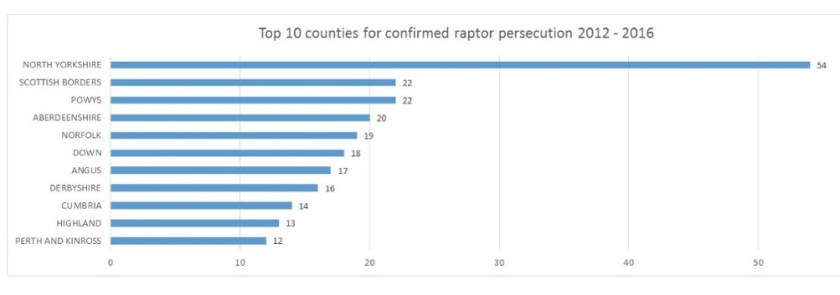
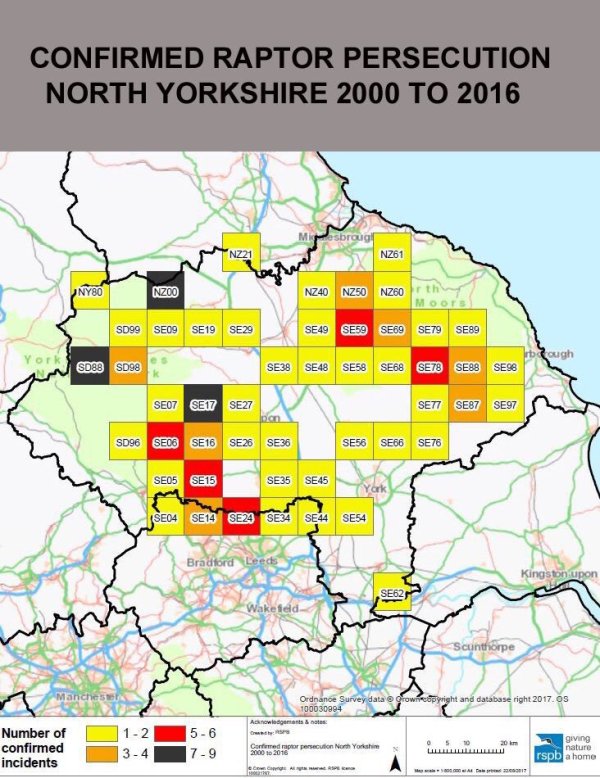
A few days ago we blogged about a proposal by the North Yorkshire police watchdog to implement an inquiry in to why the county has the worst record for raptor persecution crimes in England and why efforts to crackdown on the criminals have failed (see here).

This proposal was due to be discussed at the North Yorkshire Police and Crime Panel meeting last Wednesday.
That discussion did take place, and although we’ll have to wait until September for the official minutes to be published and to find out what the panel agreed to do, a couple of articles have since appeared in the media.
The following is an amalgamation of two of those articles, one published in The Northern Echo (today) and one in The Yorkshire Post (yesterday). The articles were almost identical apart from a few minor differences, so we’ve joined them together to ensure all the information is available in one post:
The Crown Prosecution Service (CPS) has been accused of failing to take bird of prey persecution seriously in a county with an “appalling” record over the crime, a meeting has heard.
A leading councillor has been backed by North Yorkshire Police and Crime Commissioner Julia Mulligan in calling for the CPS to revisit how it tackles offenders, ahead of a National Rural Crime Summit in Harrogate on Wednesday.
A meeting of the North Yorkshire Police and Crime Panel heard there had been 70 convictions in the county for poaching over the last year, 54 of which went to court, and there had been others for badger-baiting, but none for raptor persecutions.
Last November, the RSPB said the county’s history of bird of prey persecution was “appalling” and has repeatedly claimed the crimes are linked to land managed for intensive driven grouse shooting.
Panel members were told techniques being used to develop the persecution cases were the most advanced used by the police and there had been no bird of prey persecutions reported since the force and wildlife experts launched Operation Owl, in which officers are sent to raptor persecution hotspots, in February. Panel members were told there were, however, some prosecutions ‘in progress’.
The panel’s deputy chairman, Councillor Peter Wilkinson, praised the professionalism and enthusiasm of wildlife officers.
He added: “I do believe the police are handicapped by the lack of proactivity from the Crown Prosecution Service. I’m not convinced they take it seriously. I’m not convinced they have the resources or capability to tackle this.
I was given an example of the CPS turning up with a solicitor that had had the paperwork for half a day and they were faced with a QC that had already spent £200,000 on preparing a defence for that case.”
He added legislative change was needed to mirror Scottish law, in which landowners can be held legally responsible for wildlife crimes on their land, even if they were committed by other people.
Mrs Mulligan responded: “With regard to the Crown Prosecution Service I agree with you. I chair the Local Criminal Justice Board in North Yorkshire and I have brought this up previously with the LCJB and will bring it up again with the Crown Prosecution Service.”
A CPS Yorkshire spokeswoman said it was unable to issue an immediate response but would do so in the coming days.
ENDS
This might sound odd, given the lengthy criticisms of the CPS (and its Scottish counterpart, the Crown Office & Procurator Fiscal Service, COPFS) that have appeared on this blog over the years, but we don’t think the fundamental problem lies with the CPS. Sure, there have been some unfathomable decisions and displays of what look like dumbfounding incompetence over the years, and the prosecutors’ subsequent refusal to discuss or explain these decisions has been exasperating, but all this has to be set in context of the criminal justice system which is, according to many leading lawyers, “at breaking point”. [For an excellent analysis we’d recommend reading The Secret Barrister: Stories of the Law and How It’s Broken (Macmillan, 2018)].

Central to this ‘breakdown’ is a lack of resources which leads to chronic understaffing which then has a knock-on effect for individual public prosecutors and the cases they are working on.
As an example, last week we met a CPS solicitor at a court in northern England. She’d travelled some distance to be there first thing and said she’d been up until 1am that morning prepping her cases. Her schedule for that day alone included two separate trials and one other hearing to deal with complex legal argument. Imagine how soul destroying that must be for someone who spent all those years studying hard for a qualification, who is diligent, committed and wants to do a good job, but just isn’t given the time to prepare in full.
Now imagine that one of those cases she’s dealing with is a prosecution for alleged raptor persecution on a grouse moor. The accused’s employer will have stumped up hundreds of thousands of pounds to engage the services of a top QC, and the main evidence is likely to be covert video footage captured by the RSPB’s Investigations team (it won’t be police footage because the police are not permitted to undertake covert surveillance for what is officially regarded as a low-level crime). The QC will have had the luxury of several (many!) months to focus on getting the case thrown out on a technicality, and, as we’ve seen with increasing regularity, the QC’s painstakingly-crafted argument will win. The hard-working-but-pushed-for-time CPS solicitor doesn’t stand a chance.
Calls for a change in the legislation to introduce vicarious liability for raptor crimes in England are understandable, but what would that achieve? Before a prosecution for alleged vicarious liability can proceed, you first have to demonstrate that the original offence was committed by a named individual working under the supervision of the person being accused of vicarious liability. As we keep seeing, identifying (let alone convicting) a named individual for the original offence is becoming increasingly difficult, especially in cases involving grouse shooting estates that employ multiple gamekeepers where they’ve all given ‘no comment’ interviews to the police.
And even if you did get to the unusual stage of convicting the original offender, a subsequent prosecution for vicarious liability is not straightforward. As we’ve seen in Scotland, where vicarious liability for raptor persecution was introduced on 1 January 2012, there have been only two convictions in six and half years! A third prosecution wasn’t possible because the landowner couldn’t be identified (here) and a fourth prosecution was dropped by the Crown Office because, apparently, ‘it wasn’t in the public interest to proceed’ (here).
So what is the answer? There are those who would argue for a specialist wildlife crime prosecution unit in England, and there are definite merits in that, but again, look at the experience of Scotland where a specialist wildlife crime unit was set up at COPFS in 2011. Has this led to an increase in successful prosecutions for raptor persecution? No, it hasn’t.
There are those who would argue for a specialist environmental court – again, there are definite merits in that but as someone pointed out to us during a discussion on this topic just the other day, what happens if, within the small pool of judges available, one or several of them has vested interests in gamebird shooting and/or strong links to the ‘establishment elite’ (many of whom are involved in grouse shooting)? It doesn’t take much imagination to predict the outcome.
It’s a difficult issue if we’re going to rely upon the justice system to solve the problems although a few of us will be sitting down with some very bright legal minds in the near future to discuss exactly that.
Another option of course is to stem the problem at source – just ban driven grouse shooting. That seems a long way off but an interim step of licensing driven grouse shooting (and thus being able to withdraw the licence of those estates that persist with the illegal killing of raptors) is becoming an inevitable outcome, at least in Scotland.
We look forward to hearing the suggestions put forward by the North Yorkshire Police and Crime Panel about how they intend to address the ongoing problems in their county.










 We blogged about the launch of the BGA a few weeks ago (



 Raptor Persecution UK