
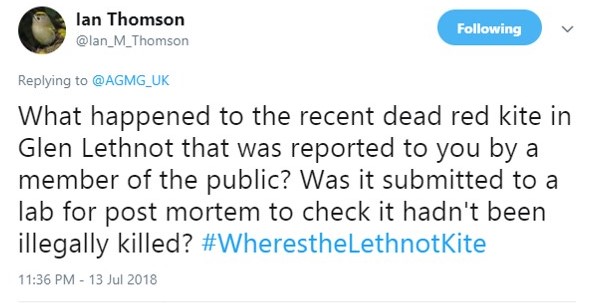
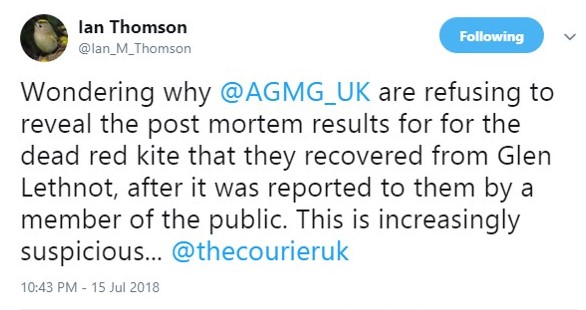
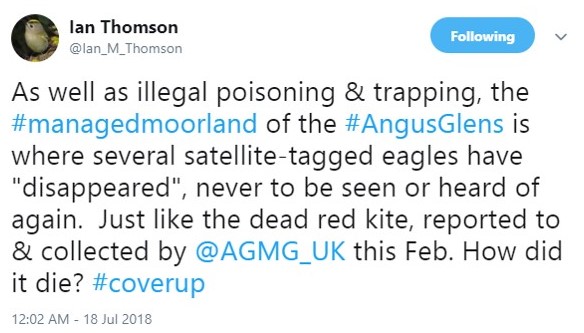
A series of questions have been asked of the Angus Glens Moorland Group about a dead red kite that was found by a member of the public in February 2018.
The dead kite was found in Glen Lethnot and reported to the gamekeepers, who apparently then collected the corpse.
What happened next remains a mystery as the Angus Glens Moorland Group is refusing to provide answers to questions posed by Ian Thomson, Head of Investigations at RSPB Scotland.
Why are they being so coy?



 Raptor Persecution UK
I’m probably not alone in knowing not to report something that may be wildlife crime to a local gatekeeper. It reminds me of the BBC reporting without checking or caring what the RSPB thought of a press release by the Invercauld Estate. Not that much of the Scottish media cares about what goes on in estates to be honest.
Have been seeing numbers of apparently good conditioned rats dead on the roads and tracks in Angus Glens over the past few years. Could they have eaten rodenticides and “found” their way onto the roads to be eaten by Kites and Buzzards?
More of the same silence by those in the know of this incident and who have a responsibility to report such events to Police Scotland.
Thanks to RSPB Investigation team for following this up and to you for publishing the story so far.
Handing a dead bird of prey to a gamekeeper is much the same as finding a bag if drugs and handing them into a local drug dealer!
I’m being cynical of course….. at least some media has come from it unlike what would have happened if handed to the local police wildlife officer?
Isn’t concealing evidence of a[n alleged] crime an offence in and of itself?
If the Red Kite was indeed shot by a gamekeeper, perhaps he merely thought it was a Raven and shot it by mistake! It appears to be open season on Ravens just now, following the fatal error made by Scottish Natural Heritage to licence the so-called wader preservation society. I wouldn’t disagree with Tom Gun that “some media” has resulted from this incident, but yet again, is it enough? I make no criticism of RPUK on the issues of investigation and achieving a wider spread in news coverage, but when is someone going to take a more active role as a press officer? Why don’t we hear the RSPB speaking out more vociferously? (No offence to Ian Thomson, who is a dedicated and professional Head of Investigations.) We need to get serious if we want to achieve success in educating politicians and public alike, not to mention SNH.
Iain
I agree with your feelings but it is blatantly obvious that very few media outlets are prepared to get behind consistantly publishing wildlife crime articles and perhaps this is because this type of story doesnt sell newspapers but does attract heat from politicians and influential persons with vested interests.
Landward and Countryfile are clearly to much swayed to the establishment to risk upsetting them.
The broadsheets either are clearly involved with landowners and the sporting industry and the tabloids readers are not engaged sufficiently in environmental matters.
Part of the problem may be having to continually report bad news stories is not what the general public want to hear or read.
Thats what makes RPUK such an important outlet. It has consistently shown itself to be a very well written, accurate and up to date source of the true extent of what is really happening to in our countryside.
It is truly amazing that more journalists don’t pick up on some of the stories.
In particular the mass organised killing of golden eagles.
Tom, I’m glad you agree with my feelings and I tend to share your realistic cynicism regarding press lethargy on the subject. I also agree with you that RPUK is an important outlet and source of scientific facts and expressions of opinion. I’d easily go as far as to say that it is the most accessible public resource of information exposing raptor persecution in my lifetime. However I’d be more convinced of raising wider public awareness, if someone would at least try to promote the message more effectively through press releases. I’d be prepared to attempt it if asked, but feel there are others within RPUK and RSG who could deliver this more effectively than myself. RSPB has an excellent team working on communication, but they continue to be over-cautious (in my opinion) when it comes to criticising the game shooting industry. I do a lot of talking to bird clubs and birdwatchers, but even there I sense little knowledge of the problems, and a quite depressing shortage of passion about what’s happening to our raptors. Hardly anyone I’ve spoken to at random, has an interest in birds extending further than spending what I consider to be excessive travel costs to seek out rarities ‘advertised’ on bird information services. That’s their choice, and I can think of worse ways to spend money, but in the meantime, many haven’t donated a penny to the Raptor Study Group’s campaign for a judicial review on the current Raven culls. Otherwise, many who follow the RPUK blog have generously donated considerable sums.
There is no end to the things that go on in the Angus Glens. During the past two weeks I came upon approximately fifteen life-size dummies,with clothes on, propped upright in prominent parts of Sturdy Hill and Bulg in Glen Esk. Public art, a bit of fun or maybe a deterrent to nesting birds? I also came upon three gas guns on Bulg. I have a photo of one of the dummies if someone can tell me how to submit it.
Phil, they are undoubtedly a form of deterrent ,( purportedly) , for the loathed Raven. However Ravens are far too intelligent to be phased by noise and dummies. Red Kites and Hen Harriers, being more deficient in brain cells, are possibly more likely to be discouraged from settling down in these areas. We do have a couple of breeding pairs of Kites putting up with the decoys and noise, but considering the numbers of Kites present in winter and spring , you would expect the breeding population to increase markedly, but it’s been very slow to pick up.
On the subject of Ravens which are hated by keepers almost as much as Hen Harriers, it seems that the Angus glens have been geographically adopted into Strathbraan! Ravens have been steadily Increasing as a breeding bird in Angus , over the last 30 years or so. In all my years checking raptors and Ravens in Angus I’ve never seen Ravens anywhere near ewes or lambs at lambing time. They stay away from the farmsteads where the sheep are kept on the inby ground for ease of feeding and checking. As for wader predation by Ravens, this is restricted to the higher marginal farmland and moors.They have only in the past 5 years or so started to move onto mixed farmland at lower altitudes, mainly on the foothills of the glens. Or they were , until May 2017, when Regular sightings of Ravens suddenly ceased. Clearly they had been taken out. On the higher ground they will undoubtedly take eggs and chicks of lapwings,oystercatchers,curlews and golden plover. However these birds are well adapted to their chosen habitats , having cryptically camouflaged eggs and chicks , so the Ravens will have to work hard to locate them. One exception might be golden plovers which having a liking for nesting in fresh muirburn may find their pale coloured eggs and chicks, a disadvantage, on the.dark burnt background.
Incidentally, Golden Plovers have been declining for decades, and gradually retreating to higher and higher ground. This has been happening in the absence of Ravens, at least in Angus. As for wader populations on the lower ground, the main problem is lack of decent habitat and the pace of modern farming. In the more relaxed days of the horse , farmhands had time to lift lapwing clutches , rather than plough them in. The tractor spelt doom for lapwings, clutches being systematically ploughed in or rolled. During the” Raven Cull” debaucle some SNH staff seemed to infer that deliberate rolling of nests could be illegal. If this is the case , an awful lot of farmers face prosecution. Another problem for low ground waders has been the moving away from mixed farming to purely arable. The few lapwings that managed to hatch their eggs then had nowhere to lead their chicks to find food, the chicks dying in the cold ,wet, dewy nights/dawns in the ever deepening cereal swards. Even now in the remnants of habitat left , athe fields are becoming greener and greener , with the constant addition of lime, rendering any chicks more and more vulnerable due to their cryptic camouflage being compromised. Buzzards,Carrion Crows, Gulls and now Kites are the more likely predators , rather than Ravens.
Big Eck , I saw a freshly killed rat on the road near “The Retreat”, just the other day, and it seemed pretty well intact – I’ll pay more attention in future. I’ve heard from a couple of sources that rats are increasing in areas where the Grouse Industry is waging wholesale war against foxes , wild cats , stoats , weasels and pine martens. Even though rats are also victims of bridge-traps,etc, with the paucity of predators , allied to their breeding capacity, we might see rats becoming very common in these areas.
Crypticmirror , I put that point to our local WIldlife Crime Officer who seemed to agree that it was an offence. As far as I’m aware, nothing has bee done. If a gang of youths were involved in a stabbing and they all clammed up, they would collectively be charged with the offence. That manoeuvre strangely loosens tongues. Surely the same should apply in the case of the Kite that’s been stashed away. It’s even more gaulling when it’s quite likely that some of these guys will be special constables.
Just come back from Southern Germany, lots and lots of Red Kites seen flying around including over villages. Very sad we don’t enjoy the same spectacle here in Perthshire, sadly it is many years since I saw one near Findo Gasket / Dupplin.
I did not get the details but understand that those who shoot deer are seemingly licensed and am pretty sure there is no grouse shooting there. The other nice thing was that the majority of hills were tree covered with a mixture of species not just impregnable monoculture.