
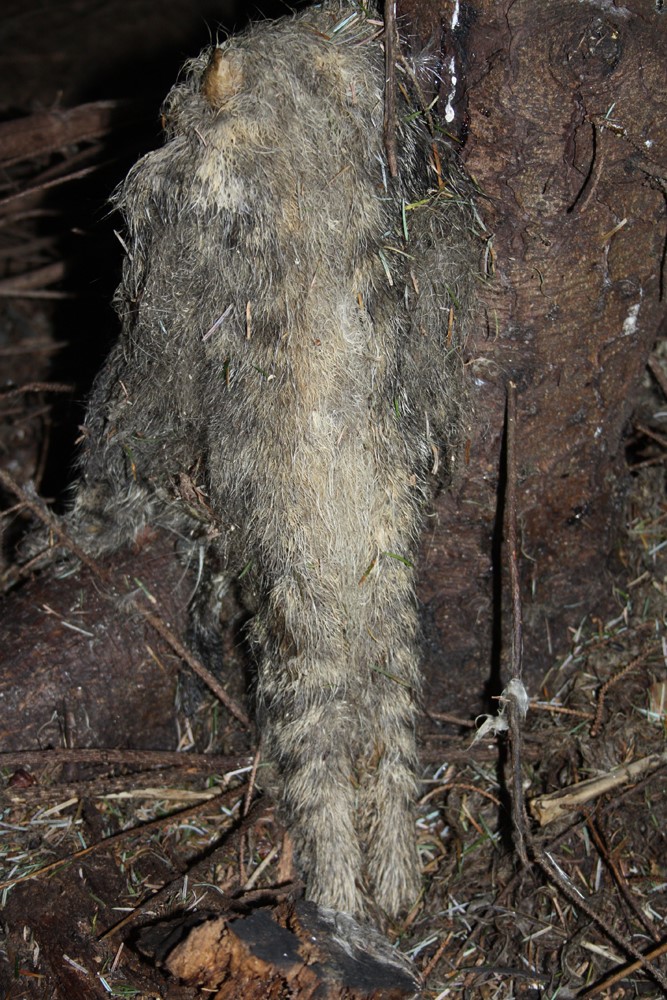
Thanks to the blog reader who sent us these gruesome images of wildlife destruction (aka 21st Century grouse moor management), photographed on a grouse moor in the Angus Glens.
Fox, rabbits and a cat:


Cat slung over a tree above a stink pit:
A song thrush:


A stoat:

Amusingly, the Angus Glens Moorland Group (part of the Gift of Grouse propaganda campaign) is launching what it calls a ‘wildlife campaign’ this weekend, presumably in an effort to get favourable press coverage as the opening of the grouse shooting season draws ever closer. They’re asking the public to post images of wildlife on to social media platforms using the hashtag #WeHaveWildlife.
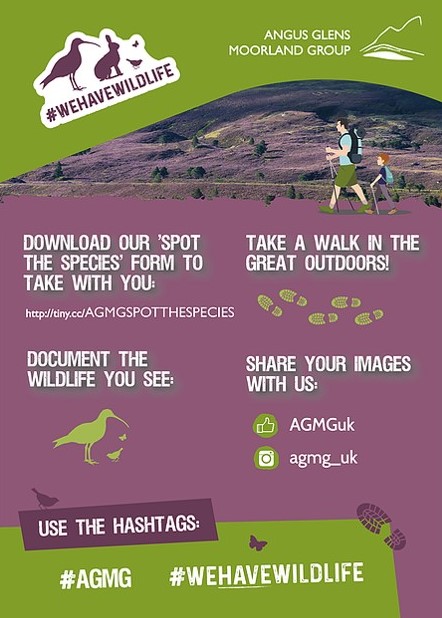
Wouldn’t it be awful if these images of what really goes on (#We Have Wildlife But We’ll Kill It If It Threatens Our Grouse Shooting Profits) were to be seen instead?
 Raptor Persecution UK
These photos are absolutley disgusting. What will it take for the Scottish government to wake up and smell the stench of the grouse shooting ‘industry’ that does nothing but shame Scotland and threaten our native wildlife.
The Angus Glens is one of the six priority areas in Scotland for wildcat conservation – designated by Scottish Wildcat Action (an important project aimed at conserving our most threatened British mammal). I wonder if the two tabby type cats in the photos above have any wildcat genes, now lost to the population?
Yes, it would be a great shame if these and other images were shared on the hashtag ‘we have wildlife’. I’m just off to take a look. :-)
How ironic also that on the AGMG’s downloadable “Spot the Species” chart, of the 11 bird species one is supposed to spot, there are 2 that are openly the target of control on grouse moors (Raven and Jackdaw) and up to 6 more that are probably or definitely illegally killed on some grouse moors (all birds of prey). It strikes me that even if I did count these species on an Angus moorland, the last people I would want to tell are those with a vested interest in exterminating them.
The supposed ‘tunnel’ in the Song Thrush images is the most pathetic effort I have ever seen. It is clearly formed from thin, pliable, wire and there’s been barely any attempt at all to limit the access to whatever the target species may have been. Moreover, the length of the tunnel is barely sufficient to safely enclose the trap. With mesh this size, the thrush could have got in through the side. I find it strange that birds should try to get into these traps anyway. Makes you wonder whether they’re being baited. I hope that the person who found this trap will report it to the Police, SNH and the BASC.
As soon as the Angus Glens Moorland Group enter the world of public relations they have to expect the public to take the opportunity to re-introduce them to reality when it’s not as they say it is. They just cant be allowed to have the public image they would want to have when this is going on and condoned. Even the supportive politicians could do little to contain this – they certainly can’t allow themselves to be seen to be ignoring it.
Could anyone say with absolute certainty that the cat positively isn’t a Scottish Wildcat ?
Spot The Species. Tell us and where. We’ll then go and kill it!!!
Please please spread these photos far and wide, let the truth be told for once, those poor innocent animals just killed for greedy mindlessness. How carelessly some ones beloved cats are tossed aside like so much trash, heart breaking waste of lives
The role of gamekeepers in the decline of the Scottish Wildcat has been little examined. They have always killed all cats, domestic, feral and wildcat. The feral population however is constantly replenished while the wildcat population is not and the declining ratio of wildcat to feral cat populations must be a factor in interbreeding and the genetic problem identified as the main cause of wildcat decline. The big decline in wildcats also seems to have taken place in the last 30 years, the period of much more intensive grouse moor management, with much more sophisticated equipment for killing ground predators.
Exactly. I don’t mind them killing the wandering moggies (keep domestic cats as indoor cats, the rest of the world is moving to accepting that) but killing and destroying the genuine Scottish Wildcat is a sin that the keepers (and farmers, lets not excuse them either) have wilfully and knowingly indulged in.
I’m glad I’m not the only person who highlights the fact that wildcat conservation is largely in vain, so long as we have gamekeepers in the Highlands of Scotland. News of any presence soon gets around and any attempt by these animals to restore their former range is soon prevented in the crudest possible way. The keepers are more than happy that conservationists in general provide a convenient scapegoat in blaming feral domestic cats. Gamekeepers wiped out most of the wildcats well before hybridisation became a recognised problem.
I’m not sure anyone is ‘moving to accepting’ that gamekeepers can indiscriminately kill cats, which is, in practice, what you are supporting, given the standards which gamekeepers apply.
I attended a court case thirty years ago, which came to court thanks to the dedication of an elderly lady whose cat had been shot by a ‘keeper in the early morning 100 yards from her home. She eventually found her cat in the estate stink pit and moved heaven and earth with the police to get action. The Procurator, equally determined to see justice, after a full days trial eventually convicted the ‘keeper of criminal damage. The estate defence was that all cats became ‘vermin’ when they were loose on estate land, emphasising their right to indiscriminate killing. Many many domestic pets are killed by gamekeepers every year in the same way.
You cannot make exceptions when the activities of these thugs happen to coincide with your own preferences. They respect nothing.
I’m not going to get into the issue of how to deal with free ranging cats, not here, I’m just going to note they are an environmental problem in general and a very specific threat to wildcats in particular. There is a problem, it does need dealt with, but how we deal with them is a discussion for another time and place.
Criminal Damage Act, S1 Destroying or damaging property.
http://www.legislation.gov.uk/ukpga/1971/48/section/1
(1) “A person who without lawful excuse destroys or damages any property belonging to another intending to destroy or damage any such property or being reckless as to whether any such property would be destroyed or damaged shall be guilty of an offence.
shall be guilty of an offence.”
Criminal Damage Act, S10 Interpretation.
http://www.legislation.gov.uk/ukpga/1971/48/section/10
S10(2) Property shall be treated for the purposes of this Act as belonging to any person—
(a) having the custody or control of it;
(c) having a charge on it.
Pets are property of their owners. Therefore, a person attempting to kill a pet, without first obtaining the permission of the owner, would be committing criminal damage. IIRC, one of the shooting organisations recommends that gamekeepers try to track cat owners down to get prior permission to kill problem cats.
Thanks again lizzybusy for this helpful legal advice. It seems that fundamentally we need to create a wider understanding that many gamekeepers, possibly a large minority, are a law unto themselves. Nearly every gamekeeper I’ve ever known regards his patch as exempt from laws affecting mere mortals. Comments condemning feral cats, as if they are the main reason for widespread extinction of wildcats, are too simplistic and ignoring the real problem. The main question is, is it already too late to save the genetically pure wildcat? It may be impractical, but there is no way to answer this question so long as gamekeepers continue to break the law, and reduce the wildcat gene pool to such an extreme vulnerable status. The only faint hope is that feral cats roaming wild are far scarcer in general than they used to be, partly due to greater regard for the welfare of pet cats. The other factor is that gamekeepers kill any feral cats on sight, but that doesn’t help the wildcat as the keepers are even more determined to render them extinct. Gamekeepers are far more ruthless and a threat to our wildlife than most people realise.
An abandoned kitten, allegedly Wildcat, was handed in to our local Wildlife Rescue Centre not long ago. A blood sample was found to indicate a hybrid, which made me wonder, how does a gamekeeper shooting a cat manage to distinguish between an individual which looks like a feral cat, but is actually a genetically pure Wildcat? The answer is rather obvious – they’ll shoot anything, which would include any pure-bred Wildcat. Why we (as a society) don’t do more to reverse the decline in Wildcats is a mystery. Or is it? Can SNH not concentrate on something useful, instead of licensing the killing of Ravens and White-fronted Geese?
Yes a lot of these traps are baited with eggs ,certainly in my part of the World ie walshaw Moor,and of course when the eggs are broken they attract lots of insects which then attract Birds which easily get through the inadequate mesh wire diameter,and this must be just the tip of the iceberg as to the destruction of our Wildlife upon these grouse moors !
As a resident of this area and having lived in four of the Angus Glens I can say that this has been the norm for many years. Hedgehogs are also caught in these traps. This is an area where I have seen a wildcat on more than one occasion and in more than one location. Snares used to lie unchecked for months on end, hung from the bottom strand of any fence that was around. Some snares had nothing left in them but shrivelled rabbit skins with a few bones portruding here and there. Whether this still goes on I have no idea but what I do know is that the denial has taken on a different look. Whereas previously they just hushed these things up, technology has forced them to conduct a campaign presenting the animals they persecute and abuse in a light that would appear that they are now regarded by them as valuable pieces of the glens biodiversity. Nothing could be further from the truth. This is simply an attempt to fool those with no deep interest in blood sports or knowledge of upland ecology while erradications continue as before. They seek to use the photogenic attraction and the romantic view that many people have of the Scottish Uplands by placing a completely unrepresentative view of the reality on the ground… which is the continual killing of species they see as affecting both the income and the bizarre form of pleasure it brings to their masters. The new development of asking folk to send in photographs of animals and birds brings to mind the relatively new practise of “astro-turfing” where comments and photographs purporting to be from members of the public are highlighted but, in reality, are not. Certainly worth keeping an eye out for.
One must ask, however unpleasant it might be, how does this killing of animals and birds on a daily basis over many years affect the mindset of these individuals? Deception prior to killing appears to be the main skill required so simply combine that with the long history of lies by these people in respect to raptor persecution and ask oneself, will it ever be possible for these people to tell the truth in this area?
The appearance of foreign experts and PR companies to boost their image while admitting to none of the past history seems designed to effect more of the same rather than any genuine attempt to change.
I know at least one retired wildlife cop who would think the trap with the song thrush in it illegal, as there is no real attempt to properly restrict the entrance. The cats to me look very suspicious, very wild cat looking even down to the relatively short tail. a DNA sample might prove very interesting.
Reminds me of a dilemma in North Yorkshire, indeed anywhere along the Polecat colonisation front. I know of keepers regularly catching Polecat like animals claiming they are Polecat-ferrets and not the real thing. Even experts cannot agree a legal definition so what are probably Polecats are regularly illegally trapped.
Have a look at this extract from a certain organisation’s letter dated Feb 2007 re CONSULTATION ON PROPOSALS TO AMEND SCHEDULE 9
AND THE USE OF AN ORDER MADE UNDER SECTION 14A
OF THE WILDLIFE AND COUNTRYSIDE ACT 1981
– notice the incredible double standards in treatment between polecat/ferret, ferret and the genuine native polecat. Doesn’t the wild polecat eat rabbits too? There’s anecdotal evidence from Essex that the returning polecat is knocking mink numbers down a bit – so maybe with continued otter and polecat recovery the water vole could make a comeback? Fat chance if some people had their way.
B – FERRET AND POLECAT-FERRET
We believe these species should be removed from the list. Ferrets have been widely used
as working companions for centuries, and ferreting remains a popular field sport in Scotland.
Ferreting is an important means of controlling rabbits – a pest species that annually causes
millions of pounds of agricultural damage. The practice of ferreting involves the intentional
release of captive bred or polecat-ferrets into the wild. These animals usually return to their
handler after a ferreting exercise but inevitably ferrets and polecat-ferrets can become lost.
Whilst we recognise that lost ferrets can become feral and live on to have a detrimental
impact on ground nesting bird species and small mammals, they can be easily trapped using
legal methods of pest control. Ferreters and their sport should not be compromised by
having ferrets and polecat-ferrets added to Schedule 9, part 1.
No research has been conducted on the likely repercussions of polecat hybridisation with
escaped ferrets and we feel that the focus of attention should be on being allowed to control
polecats, given their continued spread in Scotland and the increasing likelihood of their
causing damage to penned game and livestock as the species’ range expands.
Beware of anyone, including ‘optimistic’ scientists, who claim that polecats or polecat ferrets are “responsible” for the localised demise of American Mink, or indeed Water Vole. In my long experience of chatting to anglers to determine their attitudes towards non-native species, supplemented by my own knowledge of distribution, indicates that this is just another example of lazy interpretation of false impressions or skewed data. I was already aware of this phenomenon when I first started employment as Senior Ecologist with Glasgow City Council, following years of observing Water Voles at several colonies close to my home (pre-1975). Interestingly, the view of every local naturalist with whom I discussed the status of Water Vole in the City was of the opinion that the species was virtually extinct. My surveys of various suitable waterbodies proved this was an under-awareness of their status and (lack of) distribution. I generated an interest, and fortunately the University of Glasgow showed an interest and initiated a project to research Water Voles in the City, based upon my preliminary findings. Sceptics were pessimistic, but the project (search Glasgow Water Vole Project) was almost immediately successful in discovering a healthy population around the City and in some parks. These included ‘normal’ Water Voles, and the much rarer so-called ‘fossorial’ form of Water Vole, which has a darker coat, and surprisingly inhabits dry grassland habitat of a particularly uncommon type. Predators included Foxes, Kestrels, Buzzard, and even a Peregrine, but not Mink to any significant degree. In water-bodies the Mink were observed taking fish and possibly amphibians, but so far have not been recorded taking Water Voles, which are abundant at several communal sites. It seems that the impact of American Mink upon Water Voles has been exaggerated by research bias, most study sites having been openly visible riverbanks with less vegetation than the species really requires. In my opinion the Mink’s aggressive nature as a predator has been greatly exaggerated, and conservation biologists should direct their attention towards appropriate habitat creation and management to encourage the recovery of threatened indigenous species. Sadly his point of view seems to be widely disregarded by hunters and fishermen, and disappointingly, too many biology graduates who are not quite fully familiar with nature.
I am so sickened by this. Until I started following your blog, I had no idea how bad it is. Thank you for publicising this appalling hypocrisy and cruelty. I live in the west of Ireland, and as you probably know, birds of prey have a tough time over here as well.
Had a look at the Photos the one with the Fox Cat and Rabbit ..
The Cat is actually a Wild Cat
(endangered species)
Have you seen what the bastards do with the PETA ‘Shoot selfies not animals’ slogan? Let’s give them a taste of their own medicine.
Was up the Angus glens last week – horrible to see the intensity of grouse moor management up there.
I feel sorry for all these animals but the fox looks like it has had an agonising death – is its neck broken? I’m fucking incandescent with rage!
For me, a stoat is just as much a part of the moorland ecosystem/biodiversity as a hen harrier. We need to make it known that the moors are broken and depleted without them.
Agreed, circusmaxim. So are Mountain Hares, Ravens, Foxes and numerous other species of plants and animals, especially invertebrates (in terms of species diversity). We mustn’t forget the plants, which some might say suffer more than any other biotic group, yet provide a primary food supply. Heather moorland is much derided by some ‘rewilding’ tree-loving naturalists, but I regard this as slightly naive, as heather and raised bog are special in their own rights. Biodiversity and conservation of all habitats are essential.
Angus Glens is one of the worst places in Europe for wildlife crime and has been for a great many years.
This is in part caused by the lack of any police enforcement. Your photographs are shocking by the true scale of what is occurring is much much bigger. The population of species is being seriously effected.
I would be very interested to hear what the police and NWCU are doing to address this issue which is clearly organised crime for serious financial gain.
The cats are likely to be shot at night with a high powered light how is it possible to determine if it’s a wildcat or not.
The cat in the photograph could well be a wildcat.
Control of cats in areas likely to have wildcat populations should only be carried out by selective methods namely live catch traps.
” The Highland Tiger” project and the plight of the wildcat in general is being used by some in the sporting industry to falsely claim they are supporting wildcat conservation. Your photographs suggest otherwise.
All traps and snares disgusting ,killing animals just so the game keepers can protect birds ,that are going to be shot,for sport,is truly twisted,
This practice is unnaceptable and damages our wildlife for the purposes of so-called sport.
Let’s got one thing clear, and we all know this. Grouse moors, other managed shoots, and their employees gamekeepers, are only given a free pass, because of the social status of grouse shooters, and grouse moor owners. For no other sector of society, would a blind-eye like this be turned. Just how many photos of have we seen of legally protected species trapped in these barbaric tunnel traps? If this was some yobs from a sink estate doing this, the tabloids would be full of articles condemning them, and a crack-down would follow, However, when was the last time you ever saw one of these images published in the mainstream media?
Supposedly everyone is treated equally before the law, and supposedly government applies policy is a fair way. What we see about the actions of shooting estates and their employees on a weekly basis, says this is absolute rubbish. Clearly there is one law for ordinary people, and a complete different application of the law for the privileged few. This is nothing do to with class envy, or any of these meaningless terms. It is about the authorities and the media turning a deliberate blind-eye to the anti-social behaviour and wildlife crime of the privileged few. We constantly hear phrases like “it’s a legitimate activity” as though this somehow explains them breaking the law, and engaging in socially unacceptable behaviour on a regular basis. These people are protected, because of their social status. This is corruption, because the authorities are not supposed to operate or apply the law or policy on the bases of perceived social status.