Moorland Association giving false hope for an end to raptor persecution in Peak District National Park

The Moorland Association’s long-term ability to deny and undermine the proven link between illegal raptor persecution and driven grouse moor management is legendary (see here for just one of many examples).

Never far from the headlines, they’ve been churning out the propaganda again, this time during an interview on BBC Radio 4’s Today programme, broadcast 2 May 2018, in response to the recently published scientific paper linking illegal raptor persecution in the Dark Peak area of Derbyshire’s Peak District National Park with driven grouse moor management.

The interview is available on iPlayer for the next 21 days here (starts at 53:15 mins).

Here’s the transcript:

John Humpries: There’s new research seems to show a clear link between grouse shooting and the decline in the number of birds of prey, specifically the goshawk and the magnificent peregrine falcon, the fastest bird in the world. Mark Thomas of the RSPB has done the work, Amanda Anderson is the Director of the Moorland Association. They are both on the line.

Mr Thomas, haven’t we heard this before?

Mark Thomas: We have, John, lots of times. The difference here is you’ve got a National Park, a place where the public can go, 10m visitors a year.

John Humphries: The National Park being ?

Mark Thomas: The Peak District National Park. It is highly protected yet half of the park, the northern bit with the grouse moors, are a no go zone for the very birds that you’ve just discussed.

John Humphries: Because?

Mark Thomas: Because we’ve done some research and what we’ve done is we’ve looked at all the crimes against birds of prey. So this is shot peregrines, poisoned buzzards, shot buzzards, pole trapped ospreys, it goes on and on, and all those crimes, we’ve matched them statistically with the area used for driven grouse shooting in the Dark Peak, the northern area.

John Humphries: But I’m not quite sure how you link the crimes, as you put it, to legitimate grouse shooting.

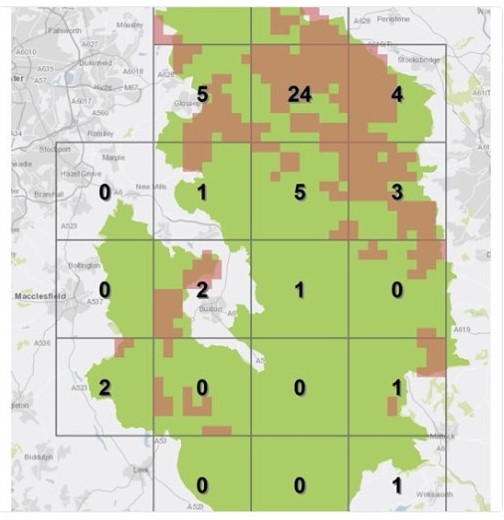
Mark Thomas: Because what we’ve basically done is we’ve matched the places where the crimes occur and then we’ve put a layer on showing where the grouse moors are and statistically that is significant. It overlays each other and we’ve proven a correlation between the two. If you are a bird of prey, you do not want to be in the Dark Peak.

[RSPB map from the new scientific paper showing the number of confirmed raptor persecution incidents in the Peak District National Park 2000-2016 overlaid with areas managed for grouse shooting]:
John Humphries: Amanda Anderson, do you accept that?

Amanda Anderson: Good morning John, good morning Mark. I have to refute that Mark thinks the northern area is a no go zone for birds of prey. The National Park is a massive area, the size of London, and in the north of the park this year we have 8 pairs of peregrines and 7 or 8 pairs of goshawk. Now it’s early in the season, it’s a very cold late spring, I’m sure you’ll agree, so we can’t guarantee that these pairs will turn into nests and eggs turn into chicks.

John Humphries: But it’s this correlation between the crime and the areas where grouse shooting happen.

Amanda Anderson: One incident of a bird of prey being persecuted is too many but we must look at the instances of this, the amount of crimes reported. I don’t know the definition of a confirmed crime but it is over a 16-year period so there are 3-4 incidents per year and there have been 2 prosecutions in the area that Mark refers to and bird of prey numbers are now increasing.

John Humphries: That presents a slightly different picture, Mark.

Mark Thomas: That’s not exactly right. When you look nationally, 69% of all people convicted for killing birds of prey, gamekeepers, let’s get to it, they are the people killing birds of prey in this park. And, as I’ve said, we have a whole catalogue of incidents. The confirmed ones is when we’ve got a body, we’ve physically got a body where nobody can refute that that bird has not been poisoned, hasn’t been trapped. In terms of the birds that are there at the moment, we’ve had this situation year on year. At the beginning of the season it looks good. Ask Amanda. Last year not one single peregrine falcon was successful in the northern Dark Peak where the grouse moors are.

Amanda Anderson: That’s absolutely true. Last year peregrine were very disappointing. As I say, this year it’s looking very exciting with about 8 pairs on the go at the moment.

John Humphries: So there we are, that’s it, it does fluctuate, doesn’t it Mark?

Mark Thomas: It does but what our data is looking at is over a long period of time. Amanda’s reflecting on one year. We must acknowledge Amanda has tried very hard with her moorland managers to self regulate but that is not working.

John Humphries: So what would you do? Would you ban grouse shooting?

Mark Thomas: No, the RSPB is not saying that and we are not going as far as that. We are saying we want licencing. If a shoot has committed a crime then the licence to shoot on that moor is removed for a period of time. That would focus and we think that would solve this problem.

John Humphries: And would you accept that, Amanda?

Amanda Anderson: If a shoot has committed a crime then somebody should be in court and prosecuted and that is a fair system and is working. The conclusion the RSPB draw to legislate to help birds of prey is flawed when the population is increasing.

ENDS

Wow. Amanda’s final comment deserves a whole blog to itself but that’s for another time.

For now, we want to concentrate on Amanda’s claim that this year is “looking very exciting with about 8 pairs [of peregrines] on the go at the moment” and “7 or 8 pairs of goshawk“.

That sounds promising, doesn’t it? But just how accurate are these figures?

Not very, according to local raptor group fieldworker Mike Price from the Peak District Raptor Monitoring Group.

We asked Mike to comment and here’s his response:

“Thank you for your email. Whilst we are not able to publicly share the figures of breeding, highly threatened raptor species at this point in the season, we can tell you that the activity of Peregrine Falcons has followed the pattern of previous years, with several sites occupied earlier in the season. Approximately 50% of these sites are no longer occupied. 

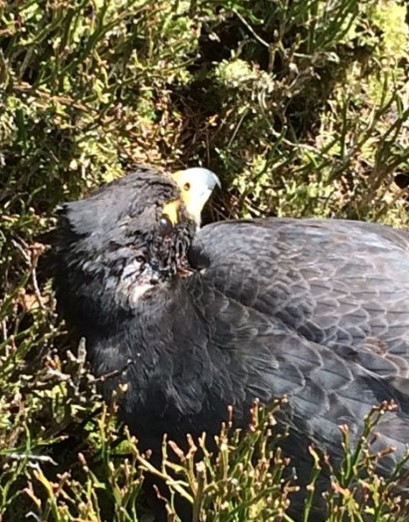
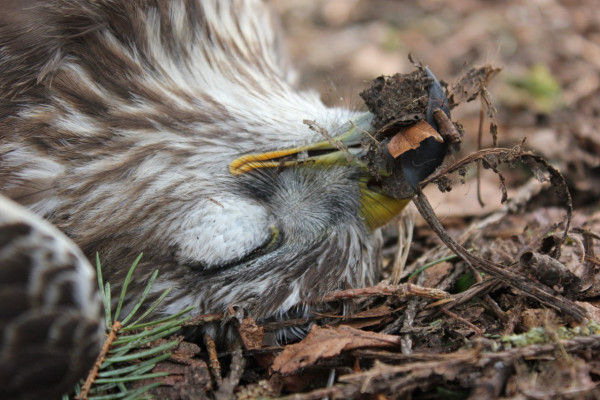
We know that there has been an incident near to one site that led to an injured bird being photographed by a member of the public. It was described as immobile, on the ground and covered in blood. Unfortunately, despite extensive searching the bird has not been recovered and we do not know what caused the bird’s injuries.

[Photos of the injured peregrine, found 14 April 2018, published on Twitter by @RSPBBirders]

Occupied Goshawk sites appear to be lower than in 2017, although known breeding pairs remain in line with 2016 and 2017. Several sightings of pairs exhibiting breeding behaviour at historic breeding sites appear to have fizzled out and at a number of sites this appears to be happening annually and without any reasonable explanation.

With all of that in mind the figures quoted by Amanda Anderson for the north of the Peak District National Park, are in our opinion, inaccurate. We would welcome a recovery for both Peregrine and Goshawk in the area mentioned but after seven years of failed collaborative working we are understandably cautious”.

Hmm, this report paints quite a different picture to the one Amanda was suggesting, doesn’t it?

To be fair though, Amanda did say it was still early in the season and it’d been a cold, late spring so there was a chance that not all the peregrine and goshawk breeding attempts would be successful. That’s true, and the weather may well have played a role in some of these early failures (we’ll find out when the 2018 report is published). But take a look again at that bloodied, injured peregrine laying in the heather. Was that a victim of the cold, late spring?

It’s a critical time for breeding birds, and especially for breeding raptors in the Peak District National Park. According to a statement made by the Peak District National Park Authority in January this year, it is “looking for an increase in birds in the breeding season before committing to working with the other organisations in the Peak District Bird of Prey Initiative beyond 2018″.

It’s no wonder the Moorland Association is keen to pretend things are on the up.
Alison Johnstone MSP lodges parliamentary motion on raven cull licence

Further to yesterday’s blog about a series of Parliamentary questions lodged by Claudia Beamish MSP (Labour, South Scotland) on the raven cull licence (here), another MSP has also raised political concerns.

Alison Johnstone MSP (Scottish Greens, Lothian) lodged the following Parliamentary motion on 30 April 2018:

Motion S5M-11986

That the Parliament expresses concern that Scottish Natural Heritage (SNH) has granted a licence to the Strathbraan Community Collaboration for Waders, which authorises the killing of 300 ravens; notes that this will take place in an area of Perthshire where eagles, which have been satellite-tagged have, it understands, previously disappeared and where the illegal persecution of raptors is believed to be well-documented; understands that this is as part of an experiment, which reportedly has no control measure in place, to assess the impact of such a cull on the wader population; regrets what it sees as the lack of consultation with expert organisations, including the Scottish Raptor Study Group and the RSPB; understands that these groups maintain that there “is no justification for this extreme course of action”; believes that there is a lack of robust scientific evidence to support this action; understands with regret that it is only now, following a notable and concerted public outcry, that SNH is calling on its Scientific Advisory Council to scrutinise the cull, and calls for the withdrawal of the research licence and the removal of the open general licence in this area as a matter of urgency.

Well done, Alison, and thank you for doing what every politician should be doing – holding power to account on behalf of the public.

Meanwhile, the public petition calling for a halt to this raven cull licence has now reached over 147,000 signatures. If you haven’t yet signed it, please consider adding your name HERE

Three dogs & two buzzards die after being ‘deliberately poisoned’ in Perthshire

BBC News article (8 May 2018):

DOGS AND BUZZARDS DIE AFTER BEING DELIBERATELY POISONED

Police in Highland Perthshire are appealing for information after three working dogs and two buzzards were deliberately poisoned.

The incidents took place between October 2017 and April this year in and around the Edradynate and Pitnacree Estates area.

The poisons used to kill the dogs and birds are banned in the UK.

[Photo of a poisoned buzzard found in the area in 2015, by RPUK]

A Police Scotland spokesman said the animals’ owners were “understandably upset” at the loss of their dogs.

He said: “Once again, we also find ourselves investigating the illegal killing of raptors and this is extremely disappointing.

We have searched the areas and our investigations to date would suggest that there is not a wider threat to public safety.

However, all members of the public in the area are asked to remain vigilant and report any suspicious behaviour, especially during the hours of darkness.”

ENDS

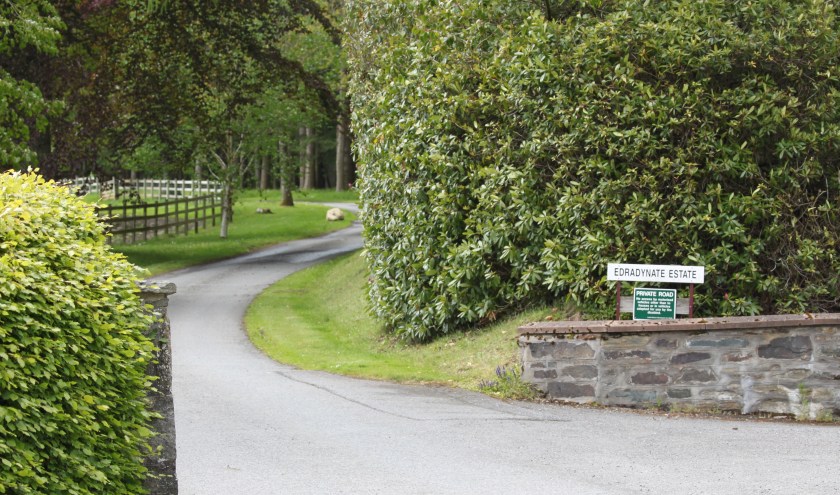
Hmm. Edradynate Estate has been at the centre of investigations for alleged wildlife crime for a very, very long time. It’s well worth reading an earlier summary we wrote (here) which includes some fascinating commentary about the estate by former RSPB Investigator Dave Dick, who claimed as far back as 2004 that the estate was “among the worst in Scotland for wildlife crime“, and commentary by former Police Wildlife Crime Officer Alan Stewart, who said in 2005, “Edraynate Estate has probably the worst record in Scotland for poisoning incidents, going back more than a decade“. The details involve a disturbingly high number of poisoned birds and poisoned baits that were found over the years, as well as a number of dropped prosecution cases (nobody has ever been convicted for any of the alleged offences). The summary also includes information about links between the estate and the Scottish Gamekeepers’ Association.

[Edradynate Estate, photo by RPUK]

More recently, in March 2015 two dead buzzards were found near to the estate. Toxicology tests revealed they’d been poisoned with a banned substance (although the name wasn’t revealed). A police raid of the estate uncovered a third dead buzzard. A thorough police investigation followed but in May 2017 the Crown Office rejected a plea from Police Scotland to bring proceedings against an estate gamekeeper (see here). The Crown Office has so far not provided a clear explanation for this decision.

However, in September 2017 SNH imposed a three-year General Licence restriction on Edradynate Estate, presumably in response to the alleged buzzard poisonings in 2015 (see here). Some felt sympathy for the new gamekeeper who would now be subjected to these restrictions even though he’d only just begun his employment following the ‘retirement’ of the previous Head gamekeeper in February 2017.

And talking of that previous Head gamekeeper, you may remember last year he was charged with a number of offences including the alleged malicious damage of crops on Edradynate in April 2017 (it is claimed he poisoned them by spraying with an unknown substance, causing them to rot and perish) and the alleged theft of a thermal imaging spotting scope (see here). This resulted in some court proceedings that were mysteriously shrouded in secrecy (here).

Presumably he has pleaded not guilty as we now know a trial will take place at Perth Sheriff Court on 11 June 2018 for alleged ‘malicious mischief’.

Parliamentary questions lodged on raven cull licence

Public anger continues to grow over SNH’s recent decision to grant a raven cull licence to a bunch of grouse moor owners and gamekeepers (masquerading under the name Strathbraan Community Collaboration for Waders) ‘just to see what happens’.

The petition against the raven cull licence has now reached 134,000 signatures (see here).

So far, SNH has swerved some fundamental questions about this licence and the process taken to approve it (e.g. see here, here). It won’t be able to avoid answering the following Parliamentary questions, lodged on 5 May 2018 by Claudia Beamish MSP (South Scotland, Labour):

S5W-16445

To ask the Scottish Government how Scottish Natural Heritage will ensure that the number of ravens killed by the Strathbraan Community Collaboration for Waders does not exceed the figure set out in its lethal control licence.

S5W-16446

To ask the Scottish Government how many lethal control of raven licences have been issued by Scottish Natural Heritage in each year since 2016, broken down by the (a) reason for issue and (b) number of ravens covered by each licence.

S5W-16447

To ask the Scottish Government what non-lethal alternatives were considered prior to Scottish Natural Heritage granting the lethal control of ravens licence to the Strathbraan Community Collaboration for Waders.

S5W-16448

To ask the Scottish Government which stakeholders were consulted prior to Scottish Natural Heritage granting the lethal control of ravens licence to the Strathbraan Community Collaboration for Waders.

S5W-16449

To ask the Scottish Government when the review of the lethal control of ravens licence that was granted to the Strathbraan Community Collaboration for Waders will be completed; what aspects of the licence will be reviewed and whether the review will consider repealing the licence.

S5W-16450

To ask the Scottish Government what lethal methods Scottish Natural Heritage has allowed the Strathbraan Community Collaboration for Waders to use under its control of ravens licence.

The expected answer date for these questions is 21 May 2018.

Well done, Claudia, and thank you.

UPDATE 23 May 2018: Raven cull update: Scientific Advisory Committee not being asked to repeal licence (here)

UPDATE 23 May 2018: Raven cull: Parliamentary questions and answers (here)

“Let’s have more trials [culls] whether it’s about ravens or other things”, says SNH

Every time Scottish Natural Heritage tries to take back control of the narrative surrounding its appalling decision to issue a raven-killing licence to a bunch of grouse moor owners and gamekeepers, ‘just to see what happens’, it digs itself deeper and deeper in to a disastrous PR hole.

Just when you thought SNH couldn’t cock this up any more than it already has, and with a public petition against the raven cull now standing at over 90,000 signatures, this happened:

On Saturday, BBC Radio Scotland’s Out of Doors programme aired an interview with Nick Halfhide, Director of Sustainable Development at SNH, whose briefing had obviously included the instructions ‘Make sure you talk about saving waders. Waders, waders, waders. Don’t worry about the science, because there isn’t any, just talk about saving waders’.

The programme is available on iPlayer for the next 27 days (here, starts at 35:33 mins).

Here’s the transcript:

Euan McIlwraith: ….Earlier this week I spoke to Nick Halfhide, Director of Sustainable Development for SNH on that decision to grant the licence.

NH: We’ve given a licence, a one-year licence, to control up to 69 ravens down in Strathbraan in Perthshire to remove ravens, but it’s actually about saving waders, that’s what this is about. Wader numbers have declined by more than 50% in the last 20 years and they’re a red-listed species. Ravens, taking 69 out of a population of over 15,000 won’t make a dent in that at all so this is about saving waders.

EM: How often do you issue a licence for the culling of raven?

NH: We’ve issued a number of licences in recent years to cull ravens for agricultural purposes, for lambing and that sort of thing, this is the first one we’ve issued specifically for waders. But we do issue under General Licence for control of other corvid birds so that’s crows as well as other birds that are having a strong impact on things like waders.

EM: We’re on a moor at the moment, a heather-clad moorland. What is the problem with ravens? What’s the impact they have?

NH: What they do, and you’ll have heard this from gamekeepers, in some areas they come as a flock and they will sweep down and they will take away either the eggs or slightly later the chicks from breeding waders and they’ll take out that year’s population of new birds. That’s essentially the problem here.

EM: There’s two levels of argument going on here. One it’s legitimate protection for wading birds. The other one is for grouse, because the ravens will take grouse chicks and grouse eggs as well, so the shooting estates will benefit.

NH: They will undoubtedly benefit from them although as I understand in that part of the world grouse are doing rather well, but what we’re concerned about as a conservation organisation are the waders and as I said, they’ve reduced by 50% in the last 20 years and that’s very significant. Red-listed, can you imagine going up into the hills and not hearing that distinctive curlew cry and seeing that wonderful display that you get from lapwings and that’s what, that’s our main focus here.

EM: Is it lapwing, curlew habitat, you know, because part of the problem is the circle that draws around this protection area or this cull area includes three rather large grouse moors.

[Map showing amount of grouse moor in the Strathbraan raven cull area, by RPUK]:

NH: Yeah but this is prime habitat we’re talking about here for lapwing and curlew. There are good populations there at the moment, we wanna make sure they remain good and they export birds out in the future. The fact it’s a grouse moor, it is a grouse moor but there’s also improved agricultural land, there are, these habitats are intertwined and that’s where the lapwing and curlew are strong at the moment and we want to keep it that way.

EM: So you don’t feel you’ve been duped then?

NH: No not at all. We’re delighted that we’ve got land managers helping us to save these birds and ultimately it’s great that we can maintain populations on small reserves but its the people out in the countryside, gamekeepers and farmers, we need to get them on board because they’re the future of these birds, not just keeping them on small reserves with fences around them, that isn’t the future.

EM: Were you surprised at the reaction from both sides of the argument?

NH: We were surprised that it got this high profile but we understand that there are passionate people in this field and we got lots of support for this action but we’ve also heard lots of people who find it difficult, and we understand killing things is difficult. But we also understand that if we’re gonna save these waders, we do need to kill some birds, whether they be ravens, and indeed the conservation NGOs regularly kill other birds, crows, on a much larger scale than we’re talking about here, so it’s a well-known tool to help our most endanagered birds.

EM: ‘Cos one of the criticisms that was suggested to me was why not study them in depth, do the science, before a cull, rather than seeing the impact after the cull?

NH: Yeah, there’s lots of science on this already and the science in 2010 showed there was maybe a weak link but still one that was worth, worth further investigation. So we had a choice, we can either do more science, which is always welcome, or, we can get on and do it. Science is partly about rigorous scientific studies but its also the knowledge of people who work on the land on a day to day basis, and what they’re telling us, the evidence they give us, is that ravens are causing a problem here, so let’s trial it, and this is just a trial, see what happens, and we’re gonna have some really comprehensive monitoring. Is there a link that says yep, we’ll carry on with the trial and we maybe need to do some more science to look at this in more detail alongside it.

EM: Has it got the potential to be rolled out across Scotland, across many grouse moors because as you say, it is waders’ habitat as well?

NH: We need to look and see what this trial comes up with first. I think rolling it out it’s far too early to say, this is fairly site-specific, but what we would welcome is other groups of land managers on a large scale coming forward and saying, you know, we’ve observed a particular problem in our land, can we trial it and see if we can get these waders, ‘cos this is about waders not about ravens.

EM: Yeah but would it not make more sense for all the groups to get together like the RSPB, the Raptor Study Groups, and the landowners, to put in a joint application? It seems to be folk either side of the fence which naturally leads to conflict.

NH: Yeah, we would welcome a joint application but I think we need to wind back a little bit here, 2016 we did get everyone around the table, Understanding Predation, and that was about bringing together that various different interests. The hard science, the experience of people on the ground, the conservation bodies, the public sector, to agree the way forward and one of the things that that agreed was we did need to do more trials to see what happens and we can learn from that as well as continuing with the hard science, the hard evidence gathering.

EM: You’re kind of piggy in the middle here, there’s some pretty heavy politics.

NH: That’s our role, we’ve here to help bring everyone together because, you know, we’re Scotland’s leading nature body, our role on behalf of Government and behalf of the people of Scotland, is to get some of these more polarised discussions in a safer place so that we can do difficult things, because, it’s all about the waders, and that was what Understanding Predation was about and our role is to push that through, get people to the table, but not also to shirk from making difficult decisions, when it’s in the interest of the waders.

EM: Is this going to happen, because lots of people are lobbying Ministers, from either side of the argument?

NH: Well that’s what we need to try and move this forward, we need to take the heat out of this, we need to take the personalities out of this, we need to stop people sending in some really vicious stuff to us about this, let’s cool it all down, let’s move forward, let’s bring the evidence together, and great, get everyone round the table, let’s have more trials whether it’s about ravens or other things so we can really test to see what we can learn from this kind of approach.

ENDS

Good grief.

What on earth is going on at SNH? Since when has this supposed scientific statutory agency ignored peer reviewed science, sidelined important stakeholders, and instead made policy decisions based solely on made up stories spewed out by an industry with a well-known reputation for its hatred and intolerance towards predators?

Well, since now, judging by Mr Halfhide’s comments.

What next? A cull of sea eagles because they might take small children and babies (see here)? A cull of goshawks because they’re “non-native” (see here)? A cull of red kites because they’re “annihilating sand martins” (see here)?

Please keep writing (politely) to Environment Secretary Roseanna Cunningham, urging her to intervene and suspend the raven cull licence, even temporarily, while we await the findings of the SNH Scientific Advisory Committee’s licence review. Emails to: cabsececclr@gov.scot

And if you haven’t already signed the petition against the raven cull, please consider adding your voice to 90,000 others here.

Raven cull: next steps to take as SNH blunders on

Since our last blogs revealing the identity of the false flag Strathbraan Community Collaboration for Waders (predominantly it’s the grouse shooting industry with a few sheep farmers thrown in for good measure – see here, here) who have been given a licence to cull ravens by SNH on the pretence that it will help waders, quite a lot has happened.

On Wednesday, the BBC ran an article on its website (here), on BBC Radio Scotland (Good Morning Scotland, here) and on TV (BBC Reporting Scotland). Once again, the incompetent BBC used footage of rooks to illustrate the story, as it has previously (see here).

[Screengrab from Reporting Scotland, 2 May 2018]

In this piece we heard from Nick Halfhide, Head of Sustainable Development at SNH who failed miserably to address the many questions that have been asked about the scientific justification for this cull and the flawed process used by SNH when considering the licence application.

Mr Halfhide’s weak logic was exposed when he compared the RSPB’s use of the General Licence (to kill corvids) with the raven-specific cull licence, which has been issued without supportive scientific evidence but rather on the basis of ‘let’s see what happens when we kill a load of ravens’, based on old wives’ tales straight from the mouths of gamekeepers with a long-documented hatred of ravens. The two licences are totally incomparable, as Mr Halfhide well knows.

Then yesterday (Thursday), we all received a generic email from Mike Cantlay (SNH Chair) in response to the questions that have been raised about this licence over the last two weeks.

The content of Mr Cantlay’s email was tragically inept. Mark Avery has shredded it with ease on his blog this morning (see here), which saves us the job, but the bottom line is that, once again, SNH has failed to address any of the questions and concerns raised about this licence and the process used to approve it.

And then today (Friday), The Times ran an article about an alleged death threat received by Mike Cantlay in relation to the raven cull. Astonishingly, The Times has attempted to link the alleged death threat to the email Chris Packham sent to Mr Cantlay last week in which he criticised SNH’s decision to approve the raven cull licence:

Since when is Chris Packham (or anyone else) responsible for alleged death threats by those stupid enough to make them?

Did Chris’s email begin, ‘Good morning Mr Cantlay, I wish you were dead, and I hope someone kills you for presiding over the raven cull’?

Of course it didn’t. It began, ‘Good morning Mr Cantlay, I hope you are well’.

Chris has responded to The Times article as follows:

Nice try at deflection, SNH, but it doesn’t wash. The simple fact remains that two weeks after the news broke, SNH has failed to answer a single question or concern raised about the raven cull licence, and even though a somewhat devious attempt has been made to suggest there is a ‘rethink’ going on at SNH (there isn’t, see here and here), the fact also remains that this licence is still currently active and ravens are being killed for no other reason than to ‘see what happens’.

Public anger continues, and will no doubt have been fuelled by SNH’s unacceptable refusal to address the legitimate questions that have been raised.

It’s also clear that SNH intends to try and ride out the storm and it has not suspended the licence pending the findings of its Scientific Advisory Committee’s review of the licence (we don’t know when that group will report).

So what is the next step?

As SNH has refused to engage, the next step is to ask the Scottish Government to suspend the raven cull licence with immediate effect, pending the findings of the licence review.

Please send (polite) emails to Environment Secretary Roseanna Cunningham and ask her to use her Ministerial position to intervene in this embarrassing fiasco. She will be well aware of the unfolding situation and, given her legal background, will be fully aware that should this farce result in a judicial review (which is quite likely, the way things are going), SNH and the Government will not have a leg to stand on given the complete lack of consultation with all stakeholders during the licence application process. Emails to: cabsececclr@gov.scot

Jason North convicted for disturbance & egg theft from raptor nests

RSPB press release (3 May 2018):

EGG COLLECTOR RECEIVES SUSPENDED SENTENCE AND FINE FOR OFFENCES AGAINST RARE BIRDS

An egg collector, who was previously unknown to police, has pleaded guilty to taking osprey eggs and disturbing rare breeding birds in Devon and Scotland.

Today (3 May 2018), Jason North, 49, from Plymouth appeared at Plymouth Magistrates Court and pleaded guilty to nine charges relating to the taking of osprey eggs from Highland Scotland, and the disturbance of golden eagle, osprey, peregrine falcon and little-ringed plover during 2016.

He received a 6-week jail sentence on each charge suspended for one year and a fine of £665 for taking the osprey eggs. He was also put in a 10-week curfew to ensure he remains at home between 9pm-6am. Maps, books and equipment were also confiscated.

The four species involved are all rare breeding birds listed on Schedule 1 of the Wildlife and Countryside Act 1981. Offences against these birds can result in up to six months in prison and/or an unlimited fine per offence.

[Jason North leaving court yesterday, photo by Penny Cross]

In December 2016, Devon and Cornwall Police, assisted by RSPB and NWCU officers, searched the home of Mr North at Haddington Road, Plymouth. They seized a number of items including hand-written notes, diaries and a computer. Following forensic examination of the computer, hundreds of digital images and video clips were recovered showing eggs and nests. The evidence indicated that North had been routinely making unlicensed visits, over a number of years, to the nests of rare breeding birds in Devon and Scotland. There were also images of eggs which had been removed from nests and put into display cases. The location of these eggs remains unknown.

A detailed investigation by Wildlife Crime Officer (WCO) PC Joshua Marshall, supported by RSPB and others, located several of the nest sites shown in the images. Evidence from people monitoring those sites, supported by expert evidence, confirmed that eggs had undoubtedly been taken in some cases. All the evidence clearly indicated that North, in addition to making unlicensed visits to take photographs, was also involved in taking eggs and it is believed these were then added to a collection.

PC Joshua Marshall of Devon and Cornwall Police said:

North was unknown prior to this investigation and only brought to account for his illegal activities via a number of diligent members of the public reporting to police confidentially. The public have such an important role to play in bringing wildlife criminals like this to justice. Please be vigilant while out in the countryside and report any suspicious behaviour, especially around nest sites, to the police on 101.

It also serves as a warning to potential or active offenders that you stand a high risk of being brought to account for any illegal activity you commit in respect to wild birds.

I would like to thank all those involved with the investigation including CPS, the expert witnesses and RSPB Investigations Officer Guy Shorrock.”

Jenny Shelton from the RSPB’s Investigations unit added: “These days, thankfully, egg collecting is by and large a thing of the past. However, there are still some active collectors targeting our rarest birds, and it is particularly worrying when new egg collectors come to light showing that the everyone needs to remain vigilant. We are grateful for the fantastic work by Devon and Cornwall Police plus the support from the CPS, NWCU and numerous people involved in monitoring and protecting these nest sites.

It’s hard to understand why someone would prefer to take the eggs of these incredible birds rather than see the birds flourishing in the wild.”

If you notice any suspicious behaviour around birds’ nests or breeding sites, including people looking in bushes or wading out to islands, often at unsociable hours, please call police on 101 and RSPB Investigations on 01767 680551.

ENDS

UPDATE 9 May 2018: A good blog about this case from the RSPB’s Investigations Team (here)

4th raptor poisoning in south Scotland this year

From BBC News (2 May 2018):

RED KITE POISONINGS IN SOUTH WEST SCOTLAND INVESTIGATED

A police investigation has started following the discovery of three dead red kites in Dumfries and Galloway.

Tests have confirmed that two of the birds were illegally poisoned with examinations ongoing on the third.

It takes the number of birds killed by illegal pesticides in the region since the start of the year to four.

Police said the use of poisoned bait was “illegal and totally unacceptable” and could have “devastating consequences” for wildlife.

The incidents in the region since the start of the year are:

  • a red kite discovered poisoned in Kirkpatrick Durham in January
  • a buzzard found dead in Mossdale in March
  • a second red kite killed at a separate location in Kirkpatrick Durham in April
  • another red kite poisoned in April at Old Bridge of Urr
  • a further red kite death with the cause yet to be established at Gelston in April

Specialist Wildlife Crime Officer PC Alan Steel said police were working closely with SAC Consulting and Science and Advice for Scottish Agriculture (SASA) to investigate the cases.

What we have established is that illegal pesticides have been used to kill four of the birds,” he said.

The pesticides identified have been banned in the UK for many years, but despite this there would still appear to be those who leave out poisoned bait, whether that is to target crows, foxes, raptors or other wildlife.

The use of such poisoned bait is illegal and totally unacceptable and those responsible should understand that their unlawful activities not only serve to have devastating consequences on their intended targets but also on various other forms of wildlife.”

He said they were “absolutely determined” to put a stop to the killings and find the people responsible.

They are working with a number of landowners and farmers and liaising with RSPB Scotland as part of the investigation.

We have also carried out a number of land searches in the vicinity of where the birds have been located with a view of trying to locate poisoned bait at these locations,” he added.

It is anticipated that further land searches will take place in the near future.”

A red kite trail in the region is reckoned to be worth millions of pounds to the local economy.

A study last year said the Galloway Kite Trail had generated more than £8.2m since it was launched in 2003.

ENDS

Red kite found poisoned in North Yorkshire (yes, another one)

Press release from North Yorkshire Police (2 May 2018):

WILDLIFE POISONING WARNING AFTER RED KITE FOUND DEAD NEAR KNARESBOROUGH

Police are appealing for information after receiving confirmation that a red kite, found dead near Knaresborough in December 2017, had been poisoned with a pesticide.

The discovery has prompted a warning from North Yorkshire Police – as part of the force’s Operation Owl campaign – about the cruel, illegal and dangerous practice of lacing animal carcasses with poison to kill other wildlife.

The dead kite was found by a member of the public just outside the village of Ferrensby between Knaresborough and Boroughbridge in North Yorkshire. The bird was in good physical condition and there was no evidence to indicate the cause of death. The finder was concerned that the bird may have been killed illegally, and reported it to the police.

Specialist wildlife crime officers at North Yorkshire Police had the bird x-rayed and this ruled out any cause of death due to physical injury. The police then arranged with Natural England for the bird to be sent away for a post mortem and toxicology tests.

The results showed the bird had significant amounts of chloralose, a pesticide, in its kidney – and it was concluded that this was the cause of death. The post mortem could not identify the nature of the kite’s last meal. The bird would have succumbed within a few minutes of consuming the poison. The location where the kite picked up the poison is not known.

Officers need to hear from anyone who has any information about the illegal use of pesticides to poison birds of prey in North Yorkshire. The practice of lacing animal carcasses with poison to kill other wildlife is both cruel and illegal. It is also poses a serious risk to members of the public and their children or pets if they come into contact with them.

Operation Owl is an ongoing initiative by North Yorkshire Police, the RSPB and the RSPCA, together with the North York Moors and Yorkshire Dales National Parks, the Nidderdale Moorland Group, and others, to reduce the number of illegal attacks on birds of prey. As part of the operation, police carry out surveillance checks on known raptor persecution hot-spots at random times to disrupt offender activity. Officers are also calling on the public to be the ‘eyes and ears’ of the police when out in the countryside.

Sergeant Kevin Kelly, of North Yorkshire Police’s Rural Taskforce, said:North Yorkshire’s wonderful countryside is host to many specially-protected birds of prey, including red kites. It is completely unacceptable that people think they can ignore the law and subject these birds to poisonings and other forms of persecution without consequence.

Like other forms of rural crime, raptor persecution is not a problem that the police can tackle alone. If everyone keeps their eyes open for illegal traps and poisoned bait, it will be a massive boost to our surveillance operation. Operation Owl is a real opportunity to reduce the number of wild birds that suffer and die unnecessarily, and send a clear message to offenders that we will not tolerate this crime in our countryside.”

Howard Jones, RSPB Investigations Officer, said:We are deeply saddened to hear of another illegally poisoned red kite in North Yorkshire. Although the re-introduction of this species into the region has been a conservation success, there continues to be an unacceptable level of persecution towards these majestic birds. Kites are struggling to expand their range into upland areas such as the Yorkshire Dales and, in this case, it is clear that they are not safe in other areas of the county either. We will continue to work closely with North Yorkshire Police and Yorkshire Red Kites to tackle the issue of illegal killing.”

Doug Simpson, Yorkshire Red Kites Co-ordinator, said:I am particularly concerned about this case, it being the first recorded kite death from illegal poisoning in this particular area. It is yet another instance of a red kite persecution victim having been found by someone out walking in the countryside, 22 of our 42 confirmed illegally killed or injured kites having been found in this way.”

Anyone with any information about this incident is asked to call North Yorkshire Police on 101, choose option 1 and be ready to quote reference 12170217776.

Alternatively email bill.hickson@northyorkshire.pnn.police.uk If you wish to remain anonymous, call the RSPB’s confidential Raptor Crime Hotline for free on 0300 999 0101.

ENDS

Strathbraan Community Collaboration for Waders: who’s involved?

Following on from yesterday’s blog, where we learned, according to the Scottish Gamekeepers Association, that the raven cull licence “is not about grouse and it’s never been about grouse“, but that approx 75% of the cull area just happens to be managed for driven grouse shooting (see here), we said we had a bit more information about the mysterious raven cull licence applicants, the Strathbraan Community Collaboration for Waders (SCCW).

We know very little about the membership of the SCCW, other than what we’d gleaned from the licence application:

‘[The SCCW]….represents some of the local land management (farmers, gamekeepers) and private interests in the area who value wading birds for their biodiversity, social and economic value to the area and to Scotland more widely. The application is supported by the Scottish Gamekeepers Association and technical advice and support, notably data gathering and interpretation, is being provided by the Game & Wildlife Conservation Trust (GWCT)’. 

We do know that the GWCT is heavily involved. We also believe the involvement of the SGA is probably more extensive than suggested in the above paragraph. For example, we know that the SGA and GWCT propose to have meetings with SNH “to review the operation of the licence“, according to the information provided in the licence application. And if the SGA wasn’t heavily involved, why would they put up a representative (Kenneth Stephen, PR & Communications Officer) to be interviewed about the licence by the BBC’s Radio Scotland Out of Doors programme?

So who else is involved? Kenneth did his best to avoid giving a detailed answer when Euan McIlwraith asked him directly about the membership of the SCCW, and instead focused on sheep farmers rather than grouse moor owners and gamekeepers. However, shortly after he’d recorded his interview on Friday 27th April 2018, Kenneth wrote the following email, which reveals a bit more about who might be involved and how much trouble everyone is going to to not mention grouse:

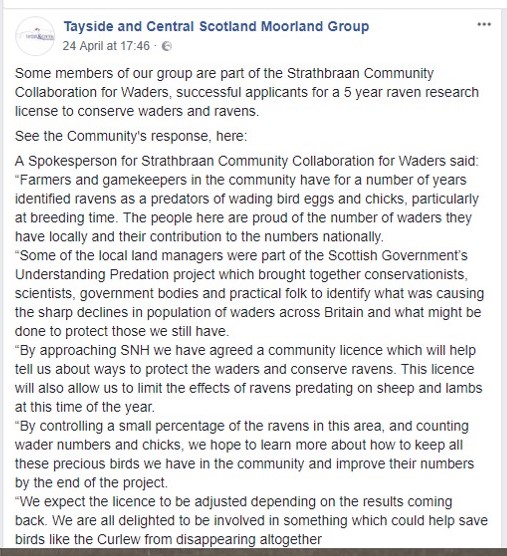
The recipient of this email (Caitlin) is the coordinator of the Tayside & Central Scotland Moorland Group. This group is one of several regional moorland groups that appeared on the scene a couple of years ago, as part of the Gift of Grouse propaganda campaign, supported (and potentially funded) by the Scottish Moorland Group, which is part of Scottish Land & Estates. These regional moorland groups were designed to use social media to counter the adverse news stories about illegal raptor persecution and other environmentally-damaging practices associated with intensive grouse moor management, and many of them are administered by the local gamekeepers’ wives.

So, are members of the Tayside & Central Moorland Group also members of the Strathbraan Community Collaboration for Waders? Indeed, some of them are, according to this Facebook post:

What was particularly interesting about Kenneth’s email to Caitlin was who he had cc’d in to his correspondence: Tim (Kim) Baynes, Director of the Scottish Moorland Group, and Gary McQueen, who we believe to be a senior consultant at Media House, a well-known public relations outfit whose clients include Scottish Land & Estates.

Does this indicate that the Scottish Moorland Group (and therefore Scottish Land & Estates & the Gift of Grouse) is also involved with this so-called ‘community collaboration’? It’d be interesting to find out.

Unfortunately, SNH is still not answering the very reasonable questions that have been asked about this raven cull licence, 11 days after the news first broke. And it’s not just us who have concerns about this lack of transparency – have a read of this excellent blog, written by independent PhD student Isla Hodgson, who specialises in conservation conflict. Her structured and thoughtful criticism of SNH’s approach to this raven cull licence is very powerful.

Maybe we’ll get some answers on the next episode of BBC Radio Scotland’s Out of Doors. Presenter Euan McIlwraith told listeners last Saturday that he had an interview lined up with SNH to discuss the raven cull licence, to be broadcast this coming weekend. We suspect there’ll be a large audience.

UPDATE 7 May 2018: “Let’s have more trials [culls] whether it’s about ravens or other things” says SNH (here)