
A new scientific paper has just been published that suggests anti-coagulant rodenticide poisoning, illegal pesticide poisoning, and lead poisoning ‘may be slowing the recovery of red kites in England’.
The paper, ‘Poisoning of reintroduced red kites (Milvus milvus) in England’ has been authored by scientists from the Institute of Zoology, Natural England, FERA Science Ltd and the NERC Centre for Ecology and Hydrology and was published online today in the European Journal of Wildlife Research.
The full paper can be accessed here
Photo of a poisoned red kite by Marc Ruddock

The research was undertaken on 162 red kites collected between 1989-2007, so these are pretty old data and the game-shooting apologists will undoubtedly claim that illegal persecution is no longer a problem, ten years on.
However, regular blog readers will be well aware of the long list of confirmed red kite persecution incidents (illegal poisoning and shooting) in England since 2007 (e.g. see here) which is restricting the kite’s population range in some parts of England, just as it is in some parts of Scotland (see here).
Illegal poisoning, coupled with secondary poisoning from anti-coagulant rodenticides and lead poisoning was a problem for the newly-reintroduced red kites and, along with illegal shooting and trapping, still remains a problem 28 years on.
Same shit, different decade.
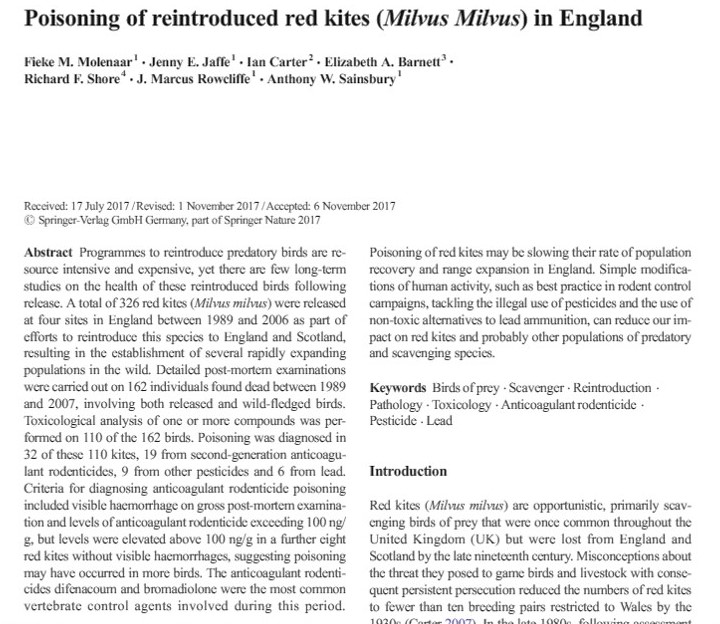
Here’s the abstract from the new paper:
 Raptor Persecution UK
You know they say that to make a mistake is human, to make the same mistake twice is foolish, no real surprise then that the fools seem to be plentiful !! Add to that the obvious planned and planted poisoning’s, it’s a recipe for dismay !! Again !!
It’s worth noting that this paper will greatly underestimate the number of deaths from illegal poison baits because where poisoning was strongly suspected the dead birds will usually have been dealt with through the WIIS scheme rather than sent to ZSL. This ZSL/NE data gives an excellent broad overview of the key mortality factors but will underestimate illegal poisoning. Someone with decent stats skills could have a go at estimating the overall number of kites killed by illegal poisoning in the UK since the start of the reintroduction – based on overall mortality rates (ie total number that have died since 1989) and the proportion of the birds actually found (a very small subset) that were poisoned. My guess is that figure would run into the thousands.
Ian – would you say the same precautionary note goes for lead poisoning too? ie, these are underestimates
Rob – There is not quite the same bias in the data for lead poisoning because lead (as with rodenticide) tends to kill slowly. Unlike birds found close to an illegal bait, dead birds would not therefore be considered as obvious poison victims and so sent via WIIS rather than ZSL. But as for illegal poison cases, only a tiny minority of dead birds are ever found so that a pm can be carried out. Every known death from lead, rodenticide or illegal bait is going to equate to many, many more that die the same way but go unreported. Someone should really work out an estimate. It could be done for kites because there is decent population data and good information on the relative frequencies of different causes of death. It would make for a rather shocking headline figure and reflect the truth far more than the small number of cases that get detected.
Here in south west Herefordshire, I have caught my sheep farming neighbours with raised shotguns under an occupied red kite nest, intervening in the nick of time but damaging neighbourly relations more than a little. The police paid a visit but no action taken – subsequently other pairs have come to the area only to disappear after shots near dusk. I have also witnessed the only remaining kite in the district at that time circling a closely related farm with 12 foot hedges – he went down but did not come back up, so I strongly suspect poisoned bait was being used. Some farmers here are convinced they take lambs – perhaps they haven’t watched them grazing on newly sown meadow.
How can we raise the visibility of this criminal persecution ?
Depressing that such entrenched ignorance remains among a section of our farming community:(
Legal rodenticide use in the countryside is another area where shooting interests can play havoc with our wildlife. One of the reasons that barn owls fail to prosper, even in areas of suitable habitat, is the practice of baiting areas around game bird rearing pens and feeding stations. And, yes, of course , farmers also use them in and around farm buildings, a more justified use but, nevertheless, one which also creates a risk of secondary poisoning for owls, kites and kestrels.
All those Barn Owl boxes & Red Kite sightings create good PR but sadly the reality of poisons on agricultural land is shocking.
Time for an end to rodent poisoning in the wider countryside & a switch to non – toxic shot.
Huge quantities of rat poison have also been used illegally to kill Badgers with knock – on effects in the rodent & raptor populations nearby.
Oh, I nearly forgot – game shoots also need to stop shooting & poisoning Kites,Buzzards, Goshawks,Harriers,Peregrines,Eagles ….etc….etc.
Keep up the pressure !
there was a lone red kite around the severn estuary and I saw circling around Stincombe hill maybe 3 times but it has gone now. there’s so much shooting going on. The dullards cannot stop themselves.