
Following the news on Friday that ten conservation and outdoor organisations have renewed a joint call on the Scottish Government to provide greater protection for mountain hares (see here), Scottish Green Party MSP Alison Johnstone has now lodged a Parliamentary motion calling for ‘urgently required’ action:
Motion S5M-08225: Alison Johnstone, Scottish Green Party, Date lodged: 12/10/2017.
That the Parliament acknowledges the concerns of a coalition of 10 conservation and outdoor organisations regarding the poorly-known status of mountain hare in Scotland, which they believe is threatened by heavy culls on intensively-managed grouse moors, and considers that a moratorium on these culls is urgently required.
Parliamentary motions are used by MSPs as a device to initiate debate or propose a course of action. Other MSPs can sign up in support of lodged motions. Motions remain current for six weeks and in order to progress they require support by at least 30 supporters from more than two political parties.
For Scottish blog readers, please consider emailing your MSP to ask them to support this motion. If you’re not sure who your MSP is, you can find out here.
The pressure on the Scottish Government to act on this issue is not going away. Well done Alison Johnstone MSP, well done to those ten conservation/outdoor organisations who have asked, again, for a temporary ban on mountain hare culling, and well done to animal welfare charity OneKind whose petition calling for greater protection of mountain hares is still under consideration by the Parliament’s Petitions Committee.
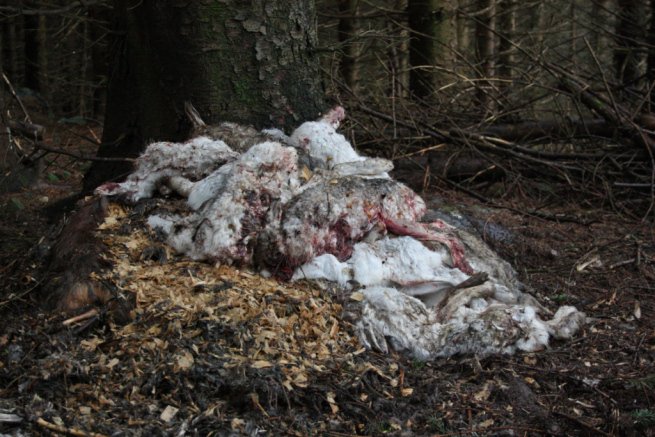
Photo shows a pile of bloodied mountain hare corpses that were being used as a stink pit on an Angus Glens grouse shooting estate.
 Raptor Persecution UK
Open Letter; Some Wider Contexts for the Re Wilding debate
I am not sure where to put this statement but I want you guys to see it. The context is mid Wales but the call for a better deal for the uplands across UK is pertinent and its context.
1)A brief look at the history of the CAP reform post 1980 might be helpful. The BBC at Bristol ie Country File , Nat Hist Unit or Panorama in London has never in my lifetime and to my knowledge seriously addressed farm subsidy economics or regional disparities in subsidy distribution. The bias in subsidy has been to scale and the significant economic driver where 80% of subsidy goes to less than 20% of farmers to quote the Small and Family Farmers Union. It is notable that traditional British wildlife and landscape is linked to traditional, mixed farm systems having smaller fields, more hedge and copse and the loss of farmland birds can be significantly linked to intensification/specialisation here and the disappearance of the small mixed farm is in parallel. The role of the abolition of the Milk Marketing Board has gone entirely undebated with regard to the loss of the value of traditional mixed farm systems and their wildlife. The significant European High Natural Value debate ie capping and modulating off large farms towards upland HNV areas carried forward by French and UK small farm unions and UK environmentalists and supported latterly by the EU Commission has never been widely publicised and was not supported by the large charitable countryside Trusts and Societies with many millions of members. This EU Commission strategy was finally opposed and vetoed by UK Conservative PM Cameron (family interest; large scale eastern arable farmer) at the EU Summit in 2013. It is notable that CAP receipts have never been a requirement of the Financial Register of Interests of either House of Parliament. I would state that the uplands, with the significant share of HNV areas, National Parks, rural low incomes etc, have to have a significantly larger slice of the 3.3 billion British ex CAP cake now with a key support for small, mixed HNV farms. How do we help mobilise this debate across the upland fringe re a new greater British settlement supporting HNV areas?
2) My own view is that within Wales rewilding should largely be defined as increases in areas of wood pasture or frydd with large animal graziers both wild and domestic WITHOUT large predators ie wolves. Powys should be branding itself as the re-wilding centre of Wales with a forest pasture strategy with its role in carbon capture at its core. A wild forest pasture in the Cambrians from Plynlimmon to Llandovery (The Forest of the Dragon vis Drygarn Fawr) based on deep molinia areas can capture carbon, largely retain traditional grazing and provide a branding to mid Wales tourism ie “A Wild Well or Forest Well” (bla, bla). Direct sale of “Wild and Free” lamb and beef to Birmingham should be encouraged via Dwr Cymru. For the “ record” I am not opposed to hunting with dogs which I regard as an ancient tradition of the Britons going back to well before Finn MacColl and King Arthur nor rough shooting, wildfowling or stalking but driven grouse management has such issues of monoculture scale that it lacks diversity and requires far higher levels of “wood pasture” in mosaic and in England an entirely new management culture re avian predators and hares.
3)Outside the EU farm protectionism and market are there now significant likelihood of “restructuring” in scale and inherent risks to the traditional small farm landscape of upland Wales and Welsh speaking areas ? Is it agreed by this meeting that to remain within the EU market is now a best option ? The ageing of Powys farmers risks ever growing likelihood of abandonment re European uplands and/or ranches and there are likely falls within land value re removal in EU support. Within this scenario there are advantages for “rewilding” but also I am calling for 5% of all farm sales to be sold in smaller land parcels to facilitate new small entrants to the land or alternatively if any farm seller could be encouraged to bequeathe 5% of sales of land to land trusts so something can be re established on the old County Council farm model that would be great (or such areas could be acquired for more forest area re the balance of payments deficit in timber). This action would be most patriotic and forever honoured. Greater national food security is to be supported and welcomed and small scale self sufficient operations are surely a key part of any strategy for food self reliance.
4)It is time to note that the post Rio 1992 strategy and process re reducing anthropogenic CO2 has failed. The climate is now becoming more dangerous. The current deep fallacy of the post Rio 1992 global strategy as CO2 soars endlessly has to be addressed as we climb over 400ppm . There is a clear need to start a new twin track UN approach with atmospheric carbon capture removing CO2 from the atmosphere industrially and ecologically; while we continue to de carbonise power generation; thus moving CO2 back towards 350ppm and a greater post industrial anthropogenic stability. All the ecological indicators are warning us re current CO2 trajectory ie glacier and north polar ice retreat, coral reef bleaching, migration timings, the carbon sinks of seas and forest are saturated, acidification of the seas continues, while methane and nitrate release from warming seas and melting tundra can accelerate exponentially and methane is starting to release from Siberia tundras. Methane and nitrogen are the powerful green house gases that can motivate, accelerating feed back loops that can swiftly change everything in a few decades. The urgency of this situation can not be underestimated.
5)The Re Wilding of UK uplands can play a role capturing carbon with some reintegration of farming and forestry systems both above and below the tree line. Hopefully the realisation with regard to a new twin UN approach re atmospheric CO2 capture within the Paris Accord will now swiftly build across the world . The insurance industry will be supportive.
6)We live in hope.
IAbsolutely delighted Alison Johnstone has done this- will certainly write to my MSPs and ask them to support- and if not outline why not
Wrote to all my local and regional MSPs regarding this. My first and only response so far was from a Tory MSP (who to be fair responded very promptly) that stated she had spoken to the SGA and that a need to cull hares was important because of the intense pressure that some hares are putting on rare flora such as juniper, sphagnum moss and tree planting schemes. Surely a ‘well managed’ grousing moor thats been nicely drained and with regular burning has already put intense pressure on juniper and sphagnum! They did also include the spreading of sheep ticks as a factor, but not, in my interpretation, in relation to grouse. They did acknowledge that concerns exist, but the SGA have clearly been on an early charm (mis-information) offensive.
None of this comes as a shock, and 50% of my listed MSPs are Tory, so I would expect a similar response overall. But it will be interesting to see if there is any support from labour. The SNP are not represented in my area, and I presume support from Alison’s Green colleagues.
Trees for Life has an interesting analysis of the threats to Junipers in Scotland (see below). The threats to its survival are, apparently, “THE BURNING OF MOORLAND and grazing of the leaves by red deer and rabbits” (but not hares!).
https://treesforlife.org.uk/forest/juniper/
“Juniper foliage is eaten by mammals such as red deer (Cervus elaphus) and rabbits (Oryctolagus cuniculus), and the current excessive populations of both of these species has contributed to the current decline in juniper’s distribution in the UK. The burning of moorland also limits the ability of juniper to regenerate.”
Which raises questions as to why SNH grant licences for muirburns especially in SSSIs for juniper and why they permit hare culls in such areas without very strong evidence that it is impossible to protect the Juniper by Jon lethal means.
S13 of the Wildlife and Countryside Act 1981 provides legal protection to some wild plants which include various mosses but not Juniper.
S13(1)”Subject to the provisions of this Part, if any person—
(a)intentionally or recklessly picks, uproots or destroys
(i) any wild plant included in Schedule 8; or
(ii)any seed or spore attached to any such wild plant; or
(b)not being an authorised person, intentionally or recklessly uproots any wild plant not included in that Schedule, he shall be guilty of an offence.”. Burning and draining should not be taking place in areas where legally protected plants are known to be growing.
As for the killing of hares, the application form issued by SNH to “control” (ie kill) mountain hares during the closed season asks applicants to “Provide details of what measures you have taken to prevent serious damage by hares (include details of scaring or preventative methods used and their effectiveness and numbers of any hares shot during the open season).” You’d think SNH would insist that estates should first attempt to construct hare/rabbit proof fencing around the Juniper woodland or control hare numbers by supporting natural predators – especially those protected in law.
I’ve been to lectures on grants for woodland management and one of the main suggested criteria was fencing woodland off to protect the saplings from grazing farm animals. Building roads to the woods to enable access was another so fencing off Juniper woodland to protect the trees from grazing hares seems perfectly feasible .