
 Continuing on from recent blogs (here, here and here) about a series of updates on the proposed ‘reintroduction’ of hen harriers to southern England, here’s some more news gleaned from the latest FoI response from Natural England.
We know from previous FoI responses from Natural England that the Southern England Reintroduction Team has been scouting around looking for a donor population of hen harriers (see here). They’re not allowed to use any hen harrier eggs or chicks that might be ‘brood-meddled’ in northern England so they’ve been looking elsewhere in Europe. The Netherlands, Spain and Poland all said ‘no’ but France seemed to be a distinct possibility, which was a surprise given that the French hen harrier population is showing a long-term declining trend.
Earlier this year Adrian Jowitt (Natural England) wrote to researchers in France about a potential visit. This was to learn more about the captive rearing and release scheme (hen harrier & Montagu’s harrier) that the French have been undertaking for genuine conservation purposes, as the birds are threatened by industrial harvesting machinery before the young are able to fledge the nests in agricultural fields. The French team collects the birds, keeps them in captivity until the harvesting period is over, and then releases them back to the wild once the threat has ended.
Incidentally, the UK grouse-shooting industry often argues that this French conservation project is ‘proof’ that hen harrier brood meddling is a tried and tested conservation tool and they use it as justification for the UK brood meddling scheme. What they don’t seem to understand is that the two situations are incomparable. In France, the threat to the harriers is temporary (just during the crop harvest) and so the birds can be safely released back to the wild whereas in the UK, the threat to hen harriers is year-round, on the grouse moors and, increasingly, at winter roosts. There is no ‘safe’ time to release brood-meddled hen harriers in the UK.
Anyway, back to the France visit. Here’s a copy of Adrian’s email to the French researchers: Planning visit to France_May2017
It makes for quite an amusing read, as Adrian’s choice of words tries to minimise the scale of the problems the proposed project is facing in the UK – he mentions “small pockets of resistance” from some landowners (actually strong enough resistance that the Project Team is now suddenly keen to explore Dartmoor National Park as an alternative release site) but emphasises the ‘positives’ such as the Chair of Natural England declaring that he wants to see more hen harriers in England within the next three years. Yep, that’s what the grouse shooting industry claims too – talk is cheap.
In June this year some members of the Project Team did visit the French project and here’s Project Manager Simon Lee’s thank you email to the French researchers:
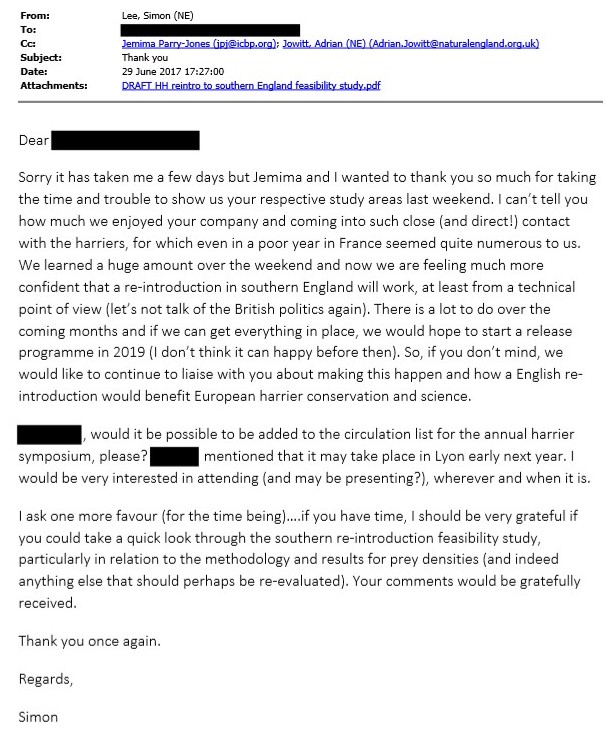
Simon says “Let’s not talk of the British politics again“. He probably didn’t mean this in a literal sense, rather it was likely just an acknowledgement that they’d spent a good deal of time talking about it during the visit. But talk of it he, and the rest of us, must, because whether the project is technically feasible or not isn’t the issue here; the ‘politics’ (i.e. legislation & ethics) is still the main issue to be addressed.
We’re not convinced that a reintroduction is legal. The IUCN guidelines are clear: ‘There should generally be strong evidence that the threat(s) that caused any previous extinction have been correctly identified and removed or sufficiently reduced‘. This criterion cannot possibly be met when the current hen harrier population is on its knees, showing no signs of recovery (see results from 2016 national survey), and the main cause of the decline (illegal persecution) has not been dealt with. We used the same argument against the planned re-stocking of golden eagles in southern Scotland, although in that scenario there is a counter argument that golden eagles in the Highlands (the proposed source birds) are just as likely to be killed in the north as they are in the south, whereas hen harriers in France would have much better survival prospects if they remained in France as opposed to being sent to persecution-rife England. (So, sorry, Simon, but your notion that this reintroduction could possibly “benefit European harrier conservation” is just ludicrous).
As for the ethics of reintroducing hen harriers to southern England, well we’ve talked about that over and over and over again. The proposed reintroduction is clearly a plan to move the focus away from the real problem (illegal persecution on grouse moors) – shove a load of hen harriers in the south, hope they survive, and then shout about how the species’ conservation status has improved, whilst ignoring the on-going illegal slaughter in the north. Job done.
And talking of ethics, here’s a rather confusing message from Jeff Knott (RSPB) to the new Southern Reintroduction Project Manager Simon Lees:
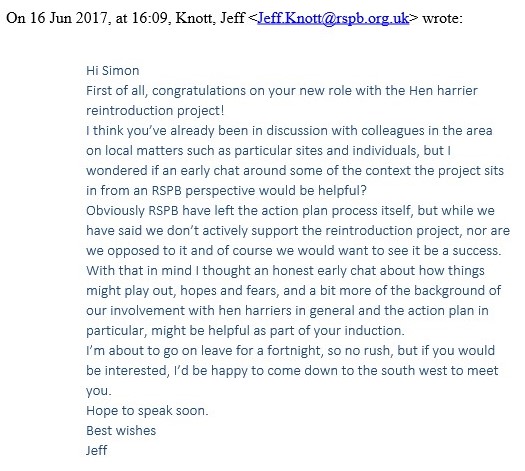
“While we have said we don’t actively support the reintroduction project, nor are we opposed to it and of course we would want to see it be a success“. Eh?
Photo of hen harrier nestlings by Andrew Sandeman.
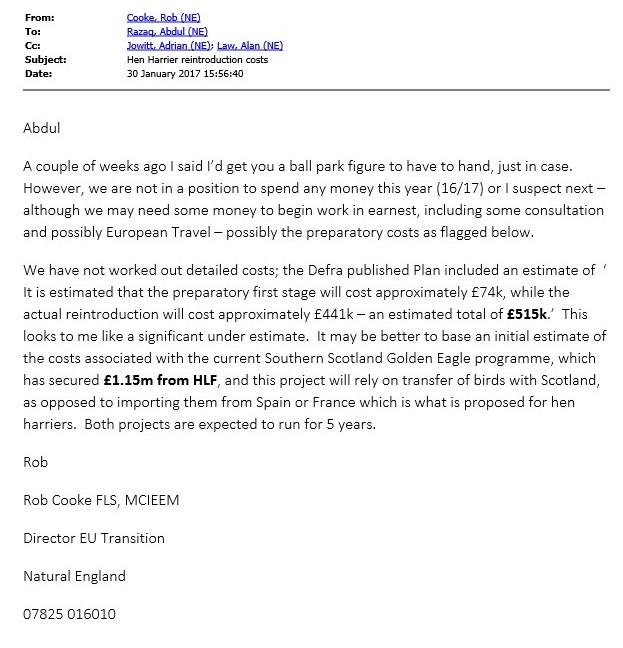

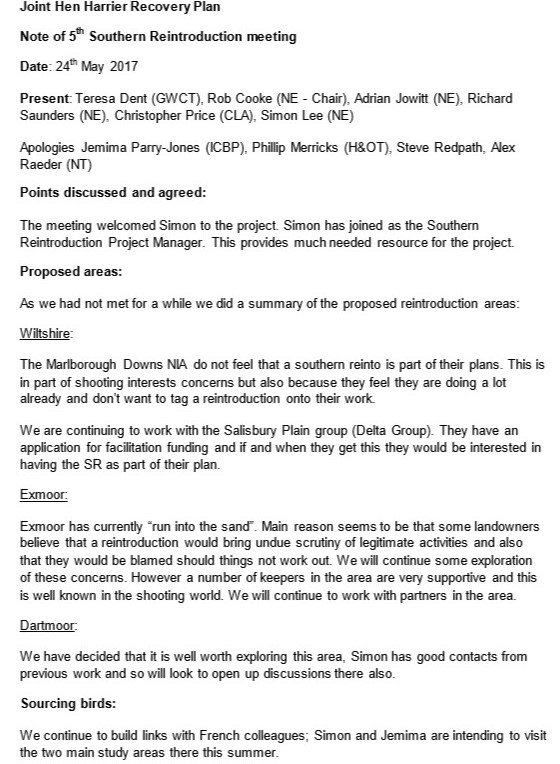

 It’ll be interesting to see who is invited to serve on the technical group. As Mark Avery pointed out at the beginning of the year (

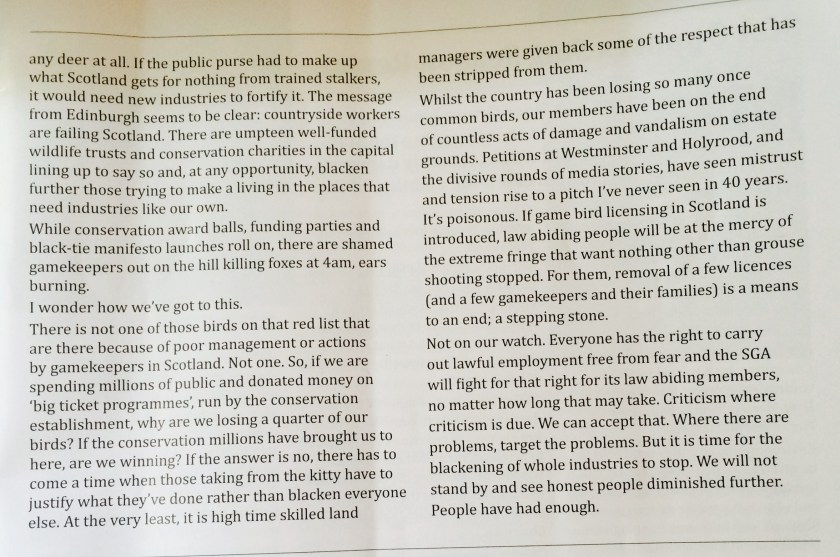
 We always look forward to the publication of Scottish Gamekeeper, the quarterly rag for members of the Scottish Gamekeepers’ Association. As you can imagine, it’s often stuffed full of bright intellectual commentary and an appreciation of birds with hooked beaks and sharp talons.









 Raptor Persecution UK