
Some welcome conservation news for a change:
Press release from charity Birds of Poole Harbour:
Eight Osprey chicks from Scotland have safely arrived in Poole Harbour as part of a five-year translocation project, aimed at re-establishing this species on its former breeding grounds on the south coast of England.
The project which is being run by Birds of Poole Harbour, The Roy Dennis Wildlife Foundationand local wildlife technology company Wildlife Windows, was given the go-ahead this spring and it is hoped that over the next 4-5 years Ospreys will adopt Poole Harbour as their new home and recolonise the south coast. Osprey pass through Poole Harbour every year on migration, attracted by the abundance of fish such as Mullet and flatfish. In late August, the harbour can host up to six Ospreys as birds fatten up before their long migration down to west Africa.
Photo: three of the eight osprey chicks (photo by Roy Dennis)
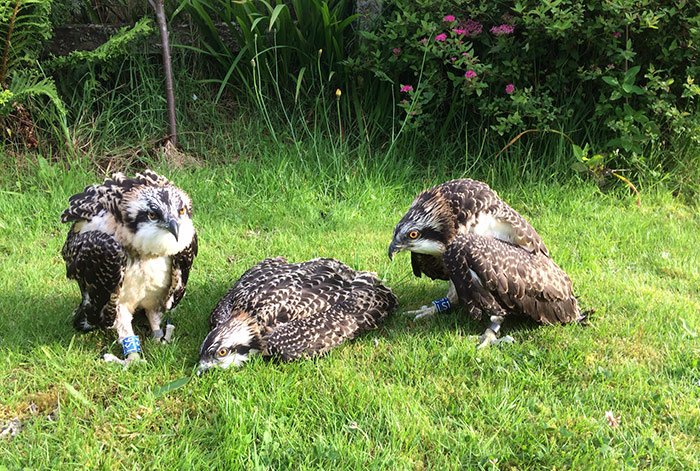
Paul Morton from Birds of Poole Harbour said, “We’re so pleased to see the chicks finally arrive in Poole Harbour. It’s been a long few months waiting for this moment, so to see them in the pens has made the whole project very real now. The public support we’ve received has been over-whelming and the offer of help from Storm restaurant has been key to making this part of the process run smoothly and efficiently“.
Pete Miles, owner of Storm restaurant and local fisherman added, “It’s a real privilege to be involved in the project and to help the Osprey team out. Anything that helps promote and educate local environmental stories is always good news. We’ve already got all the facilities to prep fresh fish so it made sense to offer help, plus I’m really looking forward to seeing these birds out flying around the harbour in years to come whilst I’m out on my fishing boat”.
Roy Dennis said, “We are delighted that this exciting and important project is underway. Establishing a population of Ospreys on the south coast will restore the species to an area where it was once common and also help to link expanding populations in central England, Wales and northern France. We are moving the birds to the best possible location given the abundance of fish found in Poole Harbour and the plethora of potential nest sites in the surrounding area. I’m particularly excited about this project because I was born in the New Forest”.
Once the chicks look ready and strong enough to fly, the Osprey monitoring team will open the pens, allowing the chicks to take to the wing for the first time and explore their new area. It is expected that the young Ospreys will remain in the harbour for a further 3-5 weeks after release before they begin their long migration to West Africa. The released Osprey will then remain in Africa during the summer and winter of 2018 and won’t think about flying north to the UK until late spring 2019. It is hoped that the first breeding will take place around 2021.
ENDS
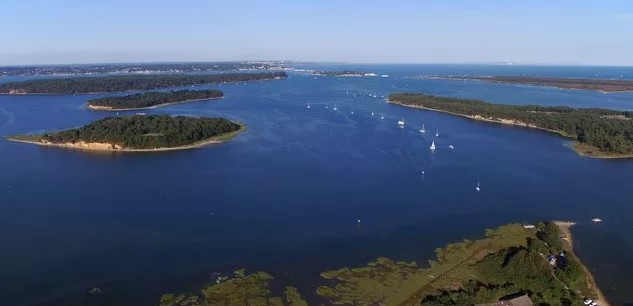
Photo of Poole Harbour by Michael Harpur
 Raptor Persecution UK
An ambitious community-based project which deserves to succeed.
Great news: I await the howls of anguish from the trout farms on the rivers Test and Itchen.
Was just going to post similar, the notion that they will just hunt in the harbour is fanciful.
Of course they’ll hunt the rivers, and whyever not? Mainly they’ll stick to the estuaries though .
Have you guts seen the latest edition of The Land and the efforts to map land ownership that are detailed there ? it would be worth circulating the articles ?
I need to be convinced this is a good idea. Over the last 5 years 60 Ospreys have been translocated to Spain and up to now only 1 pair have attempted to breed. I assume a similar number will be translocated to Poole over the next 5 years. Surely this is affecting the natural range expansion from Scotland into England and Wales, which I know is happening anyway, but this could be slowing this down considerably. Is there any evidence that the birds translocated stay where they have been taken to ? Or are there any that have found their way back ‘home’ to Scotland ? Are there any statistics available to assess what is happening with these birds ?
There have been a number of nest platforms constructed to try and attract Ospreys to nest naturally in Poole. These have been used on the birds Spring passage, but have not stayed to nest. For some reason the birds don’t fancy it. I think sometimes there’s to much meddling when nature seems to be doing fine on it’s own.
I entirely agree with you, Duncan. Far more appropriate to let the birds decide for themselves where to settle. This is not a species in need of our assistance and I feel projects like this just detract from urgent conservation issues.
I guess that depends on what you mean by ‘doing fine on its own’, and maybe on how old you are!
The unassisted rate of spread of the Scottish Osprey population has been estimated at 4 km per year, so (without the translocated population at Rutland Water) it would take over a century for them to reach the south coast without help.
I’m not an expert on Ospreys but I have every confidence in Roy Dennis, and he feels that the translocations to Spain and Poole will not damage the donor populations. In the case of the Red Kite reintroductions to England, the key was that most kite pairs lay more eggs that ever normally fledge, so removal of 1 or even 2 eggs usually has absolutely no detrimental effect on the number of kites that fledge each year. If done properly, you really can get something for nothing in this way.
Do you have a view on the White-tailed Eagle reintroductions? That took quite a few years and lots of birds, but now seems to be very successful.
As a species driven to extinction through persecution the re-introduction of the white-tailed eagle was a fully justified conservation project, though some might suggest it could have been more carefully planned in the initial stages. I can’t see any real comparison with the osprey project.
My understanding is that the Osprey was also persecuted to extinction in the UK (by about 1840 in England, by about WW1 in Scotland). One difference is that egg collection was perhaps a more important factor in the persecution of Ospreys, and of course they are very different birds, but I think there are close parallels.
Am I missing something?
Yes, Alan, but the ospreys re-established themselves when legal protection was put in place combined with active nest guarding in the early days. Following this appropriate attention the population went from strength to strength.
I fail to see that my age, ( 56 ), has any relevance. Please explain. It is also my understanding that the ‘natural’ expansion rate of Ospreys is 11 km per year, perhaps someone can confirm the correct rate with some hard evidence. I was talking specifically about Ospreys, not White-tailed Eagles, or Red Kites. ( Though Red Kite reintroduction success does seem to depend on whether the birds are artificially fed or not, and then numbers become unnaturally high, and then people start talking about culling ).
What I really want to know is, are these birds monitored after release ? are they happy to stay in their new ‘home’ ? and if so, why, after five years, have only one pair attempted to breed ? and why is this deemed to be a success story ?
Sorry to have been so opaque. I agree, different spread rates have been quoted in different places. The relevance of age is that, whichever value you take, the unaided spread of Ospreys to southern England (which was part of their former range) is likely to take a very long time, and some of us don’t have that that much time left!
Rather than my trying to re-hash the arguments, you might try some of these articles:
https://www.birdsofpooleharbour.co.uk/poole-harbour-osprey-translocation-project-start-summer
http://www.roydennis.org/2017/06/20/poole-harbour-osprey-project
And especially:
Click to access Ospreys.pdf
Thanks for these articles, especially: https://www.birdsofpooleharbour.co.uk/sites/default/files/Ospreys.pdf
Makes for very interesting reading. I am still undecided as to whether translocation is a valid method as I can see both augments for and against. Maybe the best method, with minimal disturbance, would be to construct nest platforms in suitable locations throughout the country and just see what happens.
If time is a concern for you, might I suggest you translocate to the Ospreys rather than waiting for them to come to you !
Good point!