 We’ve come to expect outlandish propaganda from the Gift of Grouse campaign group, designed to portray driven grouse moors as models of excellence for raptor conservation. But this time they’ve exceeded all expectation. Forget their usual unsubstantiated post-truth drivel, wholly disconnected to reality, because that’s got nothing on their latest effort, which takes the stretching of credibility to new depths.
The following press release from the Gift of Grouse is set to hit the headlines tomorrow:
ENCOURAGING NUMBERS OF BIRDS OF PREY SIGHTED ON SCOTTISH MOORLANDS
An increasing number of birds of prey are thriving on Scottish grouse moors due to gamekeepers’ conservation efforts.
More than 10 different raptor species including golden eagles, red kites and hen harriers have been identified on prominent grouse moors this year. They are among the 86 bird species that have been recorded on estates in the Angus Glens.
A snap shot from a range of estates across the Angus Glens Moorland Group highlighted encouraging evidence with gamekeepers on Invermark Estate in particular sighting nine raptor species including buzzards and golden eagles. Some of these are nesting and successfully breeding on the estate.
A number of other estates also reported healthy numbers with Ballogie Estate, Royal Deeside, revealing a total of 15 buzzards regularly hunting on the moor. Figures from the Speyside Moorland Group were equally as strong with 12 species of birds of prey recorded on Strathspey Estate alone. Atholl Estate in Perthshire are also monitoring 12 different raptor species.
Garry MacLennan, head gamekeeper on Invermark Estate, said: “Scottish grouse moors are far from being raptor deserts, as some opponents of shooting claim. We have monitored a growing number of buzzards, kestrels, golden eagles and white-tailed eagles. Keepers and estate managers do recognise there are some areas of the country where there are fewer raptor species but there is plenty of hard evidence to show that raptors are successfully nesting on grouse moors.”
The findings from Invermark are part of annual surveys undertaken using SNH guidelines. These surveys were conducted by Taylor Wildlife, an ecological consultancy specialising in upland environments.
Richard Cooke, manager of Invermark Estate, said: “The survey is an extremely helpful way for us to monitor the biodiversity of the estate and which species are benefitting the most from our habitat management practices. Throughout the year we carry out rotational muirburn and control predation under the general licence, including foxes, stoats and other mustelids in particular. This is to the benefit of many ground nesting birds and is reflected in the rich birdlife recorded by the annual audit.”
The Tayside Moorland Group has also carried out species monitoring at a number of estates throughout the region with Glenturret Estate in Perthshire recording no less than 12 different raptor species hunting and nesting on the moorland this year. The estate tally included several breeding pairs of hen harriers, a nesting pair of peregrine fledging four chicks, short eared owls and numerous red kites.
Conservation training, conscientious moorland management and favourable weather conditions can all impact positively upon species numbers found on Scottish moorland.
Figures revealed in Wildlife Estates Scotland’s latest annual report show that 11 accredited estates reported the presence of golden eagles, with seven of these reporting 19 pairs. Eleven estates also recorded sightings of hen harriers with four reporting 18 breeding pairs. Buzzards were also reported on 20 estates, with a total estimated population of over 920 birds.
It was also recently revealed in a national survey that golden eagle numbers have surpassed 500 pairs giving them a ‘favourable conservation status’ in the UK. Eagles have made a home on several moorland estates across Scotland with Millden Estate, a member of the Angus Glens Moorland Group, recording a particularly high number of sightings.
Jason Clamp, head gamekeeper on Millden Estate, commented: “We are fortunate enough at Millden to have regular sightings of golden eagles. Seeing several of these magnificent birds on a daily basis has to be one of the highlights of my job. We are also very careful to leave a sustainable population of mountain hares for birds of prey, such as golden eagles, to hunt.
At Millden our team of gamekeepers has taken a proactive role in ensuring that we have a suitable breeding habitat for various birds of prey such the merlin, of which we currently have four nesting pairs. This has been brought about through controlled heather burning ‘muirburn’, which creates micro habitats suited to ground-nesting birds like the merlin.
We are delighted that the golden eagle, a species of conservation concern, amongst many other species, has found a safe and suitable environment in which to flourish in such impressive numbers, where careful moorland management has been imperative.”
ENDS
Wow! Where to start with this? It’s such ludicrously far-fetched bollocks it could have come straight from the mouths of gamekeepers and grouse moor managers. Oh, hang on…
Perhaps the idiots behind the Gift of Grouse campaign didn’t see the results of the latest national golden eagle survey, published just a few short weeks ago. You know, the survey that showed breeding golden eagles are still largely absent from driven grouse moors in the Eastern Highlands, just as they were in the last national survey conducted in 2003. Only 30% of known territories were occupied in this area – that’s a pathetic 34 out of 91 territories.
Perhaps the idiots behind the Gift of Grouse campaign didn’t see the results of the recent study on northern red kites, showing that illegal persecution on driven grouse moors in this region is just as bad now as it was in 1989.
Perhaps the idiots behind the Gift of Grouse campaign didn’t read the recent scientific paper showing hen harriers have suffered a ‘catastrophic decline’ on the driven grouse moors of NE Scotland.
Perhaps the idiots behind the Gift of Grouse campaign didn’t read the scientific paper showing peregrines continue to suffer a ‘long-term decline’ on the driven grouse moors of NE Scotland.
It’s all very well saying that raptors have been ‘sighted’ on grouse moors – of course they’ve been seen there – they are drawn to those areas precisely because of the absence of territorial breeding adults (as well as an abundant food supply). Nobody disputes that you can see raptors over these moors – the crucial distinction, which the Gift of Grouse idiots have carefully avoided, is how many raptors are breeding there? Remember, no breeding hen harriers in the Angus Glens for ten years!
It’s interesting that this press release refers to the grouse moors of the Angus Glens – a well known hotbed of illegal raptor persecution for over a decade. Here’s a map to illustrate the point:
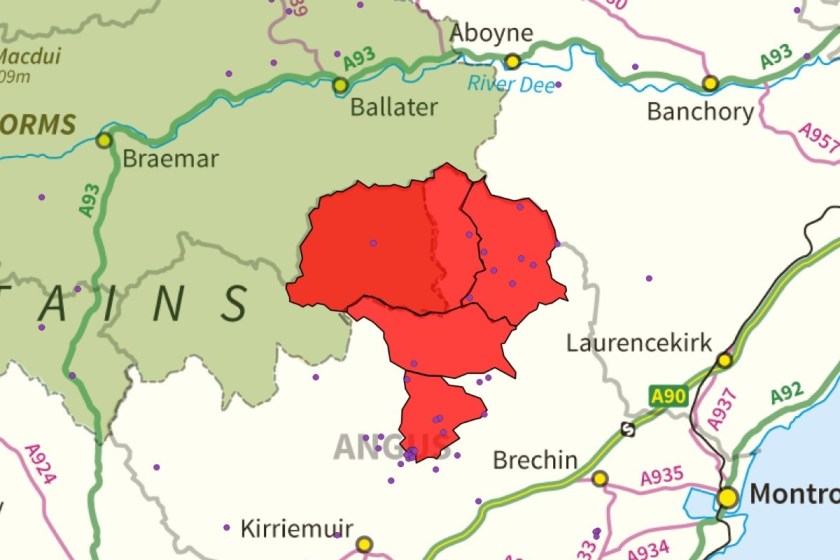
Four grouse moor estates are highlighted in red (Invermark, Millden, Hunthill, Glenogil [with thanks to Andy Wightman’s Who Owns Scotland website for estate boundaries]). You see those purple dots? They represent confirmed illegal raptor persecution crimes. Are we seriously being asked to believe that raptors are ‘thriving’ in this region?
It’s also interesting to note that the ‘data’ behind the Gift of Grouse propaganda come from an ‘annual audit’ carried out by Taylor Wildlife consultancy. We’ve blogged about this group before – these are the ‘experts’ who claimed to have recorded 81 species of birds ‘feeding or breeding’ on an Angus Glens grouse moor last year. The problem is, their survey methods didn’t adhere to the usual industry standard – rather than conduct their breeding bird survey between March and June, when you’re supposed to do it, they conducted their survey between June and August, which is, er, after the breeding season!
Will we get to see this year’s report to scrutinise the methods and results? Highly unlikely – we’re still waiting to see their 2015 report but apparently it’s a secret and we’re not allowed to read it. Can’t think why.
Also of note in this latest press release is the reference to Glenturret Estate in Perthshire, another well-known driven grouse moor. We’ve blogged about this estate before, when it was claimed that Hen Harrier Day protesters might ‘disturb’ hen harriers – a species that has consistently failed to breed successfully on this moor. This year, they are claiming to have ‘several breeding pairs of hen harriers’ amongst other species. That’s interesting, because according to monitoring data from the Scottish Raptor Study Group, there was only one hen harrier breeding attempt on Glenturret this year, and, as has so often happened here in recent years, the nest failed for ‘unknown reasons’. Unfortunately it’s not possible to work out why hen harriers keep failing here because the estate has apparently refused to allow nest cameras to be installed.
Glenturret used to have lots of successfully breeding raptors, but these days, not so much. They certainly don’t have breeding golden eagles anymore because the eagle’s eyrie was burnt out last year. Here’s a photograph of the cliff face, taken in April 2015 – note the blackened hillside. Spontaneously combusting eagle eyries are a common problem on some Scottish grouse moors. Either that or golden eagles need to learn to discard their fag butts with more care.

We’ll add updates to this blog tomorrow when we see which newspapers have swallowed the Gift of Grouse guff hook, line and sinker. We’ll be particularly interested to see whether SNH issues a statement to rebutt the claims being made – SNH has access to the actual raptor breeding data via the Scottish Raptor Monitoring Scheme – let’s see them put it good use.
UPDATE 5 December 2016: “Risible, make-believe tosh”: RSPB responds to Gift of Grouse propaganda (here).


 RSPB Scotland has responded to the ridiculous claim (see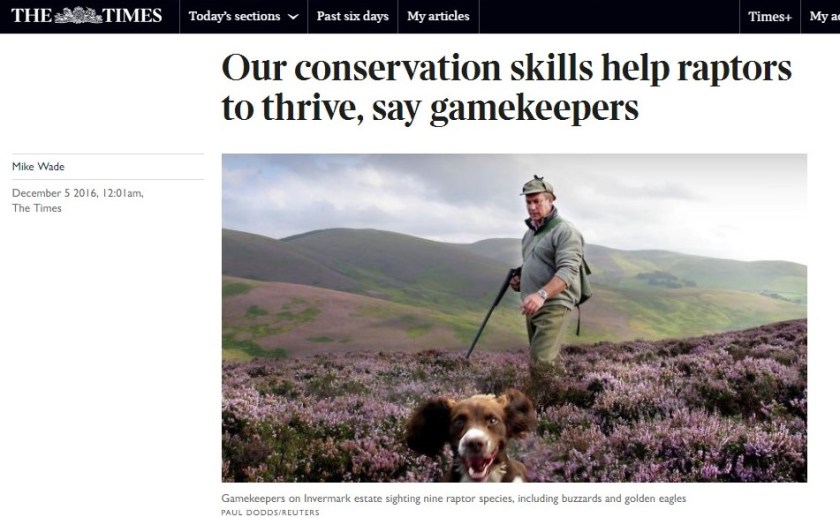
 In July we blogged about the discovery in June of a critically-injured Common gull that had been found caught in two illegally-set spring traps on Invercauld Estate in the Cairngorms National Park (see
  Raptor Persecution UK