
Last year we wrote a blog called The red grouse and medicated grit scandal: it’s hard to swallow (here). The opening paragraph of that blog went like this:
‘Just when you thought that all the detrimental environmental and health hazards associated with driven grouse moor management had been exposed, and just when you thought you understood the extent of corruption and/or incompetence by the government agencies responsible for preventing the detrimental environmental and health hazards associated with driven grouse moor management, along comes something else to make your jaw drop. This time it’s medicated grit‘.
The blog was about the unregulated and unlicensed use by grouse moor managers of super-strength medicated grit (used to treat red grouse against infestations of the parasitic Strongyle worm) and how the Government agencies responsible for food safety were not testing to see whether the active drug (Flubendazole) was reaching the human food chain because those agencies ‘didn’t know where to find red grouse for testing’. Unbelievable, literally.
Well, it doesn’t end there. We’ve now uncovered another potential health hazard associated with eating driven red grouse and this time it’s pesticides.
Last month a blog reader (thank you) sent us this clipping from the April 2016 edition of Countryman’s Weekly:

This young lad works on the Cabrach Estate in NE Scotland. In the article he talks about how busy he’d been in April, catching up red grouse at night to force a tube down their throats to administer a powerful veterinary drug (Levamisole hydrochloride) to kill the parasitic strongyle worm.
Amazingly, catching up grouse at night to administer medication is legal in Scotland throughout the year (except between 16 April – 31 July) under an SNH General Licence. Interestingly, it is only permissible in England during the grouse-shooting season (12 August – 10 December), although this raises serious concerns about the high probability of the drug entering the human food chain via shot birds (see here). It is NOT permissible to catch up red grouse to administer medication during the closed season in England, according to recent advice from Natural England. This is important – we’ll come back to it.
Now, back to the article. What we’re particularly interested in is the last three sentences. These are not direct quotes from the young trainee gamekeeper, but have been inserted by the article’s author who we believe was someone called Linda Mellor. Linda Mellor is a professional freelance writer, specialising in writing articles for the game-shooting industry, so we might expect her to know what’s going on on the ground:
‘Two go out on a quad at night; the passenger uses a net to catch up the grouse, typically females first, and ties a pesticide leg band onto the bird. This protects her directly and indirectly protects her chicks as they acquire some pesticide while brooding. There has been a marked increase in grouse survival rates through this type of tick prevention‘.
Eh? Leg bands impregnated with pesticides are being attached to the legs of female red grouse (in Scotland) to protect them and their chicks from ticks which can transmit Louping Ill Virus (and thus enhancing grouse productivity)? Really? That’s astonishing!

What type of pesticide is being used? What strength of pesticide is being used? For how long does the pesticide last? What is the effect on predators that may ingest a pesticide-treated red grouse? Is the pesticide licensed for use on wild birds that will later enter the human food chain? What about the statutory 28-day withdrawal period of all veterinary drugs prior to an animal entering the human food chain? Remember, the General Licence in Scotland does not permit the catching-up of red grouse until after 31st July, but the grouse-shooting season opens on 12th August. That means that these pesticide leg bands will not be removed in time to comply with the statutory 28-day withdrawal period. That makes the use of these pesticide leg bands illegal.
We’d not heard of this particular aspect of grouse moor management (perhaps it’s one of those that the GWCT is so keen to ‘keep under the radar‘) so we did a bit of digging. It turns out that several years ago various trials took place (in Scotland) to test the efficacy of this technique, some by independent researchers (e.g. see: Mougeot et al 2008 acarcide leg bands) and some by the GWCT.
There’s a useful article in the GWCT’s 2008 Annual Review (here – see pages 48-49), that concluded these pesticide leg bands did appear to reduce the tick burden of grouse chicks but that further research was required to confirm the findings.
There’s also a fascinating published thesis on the subject, that explains, among other things, how the active drug (in this case Permethrin, commonly used as an insect repellent and also used to treat scabies and pubic lice!) circulates through the body of the grouse via the bloodstream and how Permethrin-impregnated wing tags have also been trialled. It concludes that further research is required to test the effectiveness of these pesticide leg bands on the productivity of large scale grouse populations: Thesis 2011 acaricidal treatment red grouse
Now, all this research took place several years ago so we were interested in what ‘advice’ the GWCT may be giving out about the use of pesticide leg bands in 2016. Here’s what we found (downloaded from the GWCT website on 14th April 2016):
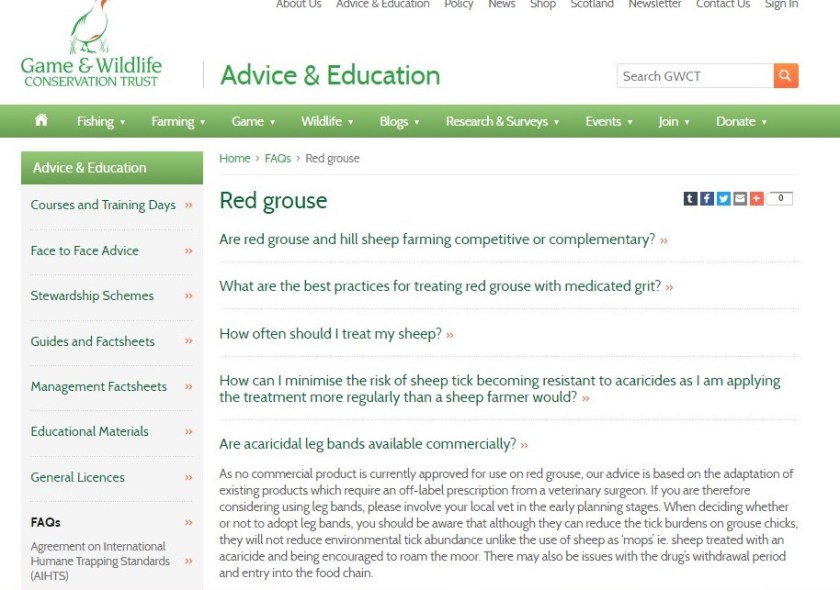
So, GWCT acknowledges that pesticide leg bands are not currently licensed for use on red grouse, but they suggest that grouse moor managers can adapt ‘existing products which require an off-label prescription from a veterinary surgeon’. In other words, find yourself a tame vet and do what you like, in exactly the same way grouse moor managers get around the licensing restrictions of using super-strength medicated grit (see here).
What’s also interesting about this GWCT advice is that it doesn’t make any reference to the restrictions of catching up grouse in England outside of the shooting season. Therefore their advice implies that it’s ok to do this in England, despite clear warning from Natural England that catching up grouse to administer medication between 11 Dec – 11 August is illegal (see here).
So, on the day when Marks and Spencer announced they’re preparing to sell red grouse in their stores this year (see here and here), on the advice of the GWCT(!), here are some of the ‘healthy’ things M&S can tell their customers they’ll be consuming as they tuck in to their ‘healthy and natural’ M&S red grouse:
- Excessive amounts of toxic poisonous lead (over 100 times the lead levels that would be legal for other meat – see here)
- Unknown quantities of the veterinary drug Flubendazole (see here)
- Unknown quantities of the veterinary drug Levamisole hydrochloride (also used in chemotherapy treatment for humans with colon cancer – see here)
- Unknown quantities of the pesticide Permethrin (used topically to treat scabies and pubic lice; probably not that great to ingest)
- They should also know that their red grouse may also be diseased with Cryptosporidiosis (see here).
Yum!
And then there’s all the environmentally-damaging effects of driven grouse moor management, as well as all the associated wildlife slaughter, both legal and illegal, but this blog is long enough already.
Ban driven grouse shooting: please sign the petition HERE
UPDATE 13 May 2016: Update on pesticide leg bands being attached to red grouse here
 Grant Moir, Chief Executive of the Cairngorms National Park Authority, has today issued a
 Last month we blogged about a dead peregrine that had been found at a well known persecution hotspot on 11th April 2016 (see
  In other election news, we’re delighted to see that Andy Wightman has been elected to Holyrood as a Scottish Greens MSP. Best known for his long-term research and outspoken campaigning on land reform issues, his new role probably won’t be welcomed by many of the country’s large estate owners or their representative bodies because there is nobody better informed (and now well placed) to hold the SNP to account over their land reform measures. Andy is also extremely well-informed about the environmental and social problems associated with the intensive management of driven grouse moors, as he demonstrated as senior author
  On 21st April 2016, a new red kite nest was discovered in woodland near Alwoodley Lane in the Eccup area of Leeds, West Yorkshire. Hanging in a tree next to the nest was the corpse of a dead kite.
 Raptor Persecution UK