Decision pending in Scottish gamekeeper’s conviction appeal

Last month we blogged about how a Scottish gamekeeper, William (Billy) Dick, was appealing against his conviction for killing a buzzard (see here).

A quick recap:

In August 2015, gamekeeper William (Billy) Dick, now 26, was found guilty of killing a buzzard on the Newlands Estate, Dumfriesshire, in April 2014. Two witnesses had observed him striking the buzzard with rocks and then repeatedly stamping on it (see here). In September 2015 he was sentenced: £1,500 fine for killing the buzzard and £500 for possession of the dead buzzard (see here).

Dick had maintained his innocence throughout the trial and had claimed he was elsewhere when the offence took place (see here).

His appeal was due to be heard in April but was then delayed. His appeal was heard at the High Court on 13th May 2016:

Billy Dick high court appeal May 2016 - Copy

The three presiding judges have reserved judgement. This means they’ll consider the appeal and produce a written judgement in due course.

How long before we can expect to hear their decision? We have no idea. Apparently there’s no time limit and much will depend on the quantity and complexity of the evidence heard, and how busy the three judges are! See here for an enlightening blog about waiting for a reserved judgement.

The decision will impact on the current prosecution against Newlands Estate landowner Andrew Duncan, charged with being vicariously liable for gamekeeper Dick’s crimes. The case against Andrew Duncan has encountered frequent delays while Dick’s appeal was underway. The next court hearing in the vicarious liability case is scheduled for 3rd June 2016 (see here). We can expect further delays if the judgement on Dick’s appeal has not been delivered by then.

Scottish gamekeeper charged in connection with shooting of hen harrier

Court proceedings began at Elgin Sheriff Court yesterday against gamekeeper Stanley Gordon who has been charged in connection with the shooting of a hen harrier in June 2013.

Stanley Gordon, 60, of Cabrach, Moray, did not enter a plea and the case was continued until 16th June 2016.

Local council gives increased powers to SSPCA – now what about the Scottish Government?

sspca logoA few days ago a Panorama programme was aired on BBC Scotland about the illegal puppy trade (see here). It showed some pretty horrendous footage that had been secretly filmed at a puppy farm in Northern Ireland and one in the Irish Republic, as well as some undercover surveillance of puppies being brought over on the ferry and sold on to unscrupulous dealers in Scotland. It was harrowing stuff.

So what’s this got to do with raptor persecution? Actually, quite a lot. In a subsequent BBC article (here), it emerged that ferry company Stena Line was taking action to crack down on this illegal trade and was working in partnership with the SSPCA in a multi-agency approach, code-named Operation Delphin.

Nothing unusual about that, but what’s really interesting is that to help facilitate this crack-down, Dumfries & Galloway Council has, this year, conferred additional investigatory powers to the SSPCA which authorises the SSPCA to stop and search suspects’ vehicles and also allows them to seize anything believed to be evidence, including puppies, documentation and mobile phones. These additional powers have been authorised by D&G Council under The Trade in Animals and Related Products (Scotland) Regulations 2012.

All credit to D&G Council for creatively using the full extent of their legislative powers to tackle this disgraceful industry.

What interests us most about this is that the illegal puppy trade is a multi-million pound industry, managed by some pretty hardened criminals, some of whom are involved in serious organised crime. D&G Council had no problem giving additional investigatory powers to the SSPCA to enable them to work, in partnership with other agencies including the police, HMRC and local councils, to address these crimes.

Now, compare the Council’s approach with that of Police Scotland and the organisations involved with game bird shooting in Scotland who all objected, vociferously, to the idea that the SSPCA could be given additional powers to help investigate wildlife crime. Among other things, they claimed that the SSPCA was ‘unaccountable’, that it didn’t have the training and competence to cope with additional powers, that additional powers would amount to ‘quasi-policing’, that ‘only the police should investigate crime’, and that additional powers would ‘destabilise trust’ between PAW partners (see here for more details of these ridiculous objections).

What’s even more fascinating is that the SSPCA isn’t even asking for stop and search powers to help tackle wildlife crime – it’s simply asking for powers that would enable officers to investigate wildlife crimes that don’t involve a live animal in distress. So for example, the additional powers would allow the SSPCA to investigate wildlife crime where the victim is already dead, or where a victim may not be present, e.g. an illegally-set pole trap (see here for further details). Under the current legislation the SSPCA is not permitted to investigate these incidents and must call the police, who may or may not attend depending on who’s available and how busy they might be with other police duties.

So the question is, how come D&G Council has faith in the SSPCA’s investigative abilities to deal with serious organised crime, so much so that additional powers have been granted, but Police Scotland and the game-shooting industry claims the SSPCA is so incapable and untrustworthy that moderate additional powers to tackle wildlife crime (including the illegal persecution of raptors on game-shooting estates) should not be conferred?

Quite revealing isn’t it? Could it be that the game-shooting industry is objecting to additional powers because if the SSPCA is granted those powers, then obviously the chances of the criminals being caught will increase? As for Police Scotland, it’s still quite baffling why they would object. It’s not as though the SSPCA would be taking over the investigation of all wildlife crime – they’d still be working in partnership with the police and the police could still investigate if they had officers available to attend. Could it be that Police Scotland is still objecting because if increased powers were conferred, the SSPCA’s success rate might prove rather embarrassing for Police Scotland?

Hopefully this long, drawn-out fiasco will soon be over, one way or another, now the new Cabinet Secretary for the Environment is in place (here) and increased pressure is being applied by Scottish Greens MSP Mark Ruskell (see here).

No junior ministerial role for Environment

Following today’s earlier post about Roseanna Cunningham MSP being appointed the new Cabinet Secretary for Environment, Climate Change and Land Reform (here), it appears that the former junior position of Minister for Environment has either been chucked, or has been merged with Roseanna’s new role.

Nicola Sturgeon has announced the appointment of other junior Ministers (see here) and there is no mention of a specific Environment Minister. Although obviously, Roseanna Cunningham, as a Cabinet Secretary, is also technically a Minister.

This news can be viewed in two ways. It could be argued that the loss of a junior Environment Minister position could be detrimental (depending on the effectiveness of that junior Minister, of course!) because it means there’s only one person responsible for the Environment portfolio instead of two. However, it could also be argued that the junior Minister (again, depending on who it was) could quite easily cause the Cabinet Secretary to take their eye off the ball of a particular issue if they thought the junior Minister had things in hand, and that junior Minister could then quite easily ‘dilute’ any progress that otherwise might have been made.

The very good news is, as we suggested earlier, Roseanna Cunningham is experienced, strong and decisive. And although her portfolio has been separated and former responsibilities such as agriculture, fisheries, crofting, and food & drink have now been given to another Cabinet Secretary (Fergus Ewing MSP), her remit is still pretty wide but has added emphasis on the Environment. We have every confidence she’ll rise to the challenge and do a better job on her own than the ineffective team of Aileen McLeod and Richard Lochhead.

We look forward to seeing what she can achieve.

Roseanna Cunningham MSP is new Cabinet Secretary for Environment

Well this is good news!

In today’s Cabinet reshuffle, Roseanna Cunningham MSP has just been appointed the new Cabinet Secretary for Environment, Climate Change and Land Reform, following the departure of Richard Lochhead.

Interestingly, the title of this position, and the portfolio remit, has been changed. Roseanna’s responsibilities will be for climate change, flood prevention, water quality, land reform, physical and marine environment, sustainable development, biodiversity, natural heritage, environmental protection, environmental and climate justice, National parks, and Scottish Water.

The other responsibilities previously associated with this post (Rural Scotland, agriculture, forestry, fisheries, aquaculture, food and drink, and crofting) are now the responsibility of newly appointed Cabinet Secretary for the Rural Economy and Connectivity, Fergus Ewing MSP.

This might not be the best news for those working in conservation within the agricultural sector but it’s very good news for us. It means that Roseanna Cunningham will be able to take a closer interest in environment/wildlife issues than could her predecessor, as well as land reform. She’s definitely seen as left-of-centre of her party and is no friend of the big landed estates, so they won’t be happy with this new appointment.

Roseanna brings a lot of experience to her new role, having formerly been the Environment Minister between 2009-2011. During her time in that role she was responsible for introducing an amendment to the WANE bill for the addition of vicarious liability for estates where raptor persecution was still prevalent (see here) and she also was pretty firm that the Scottish Government would not entertain the idea of introducing licences to kill protected raptors (see here).

It wasn’t all plain sailing though. She was the Minister who rejected an amendment to the WANE bill for increased powers for the SSPCA, although she did temper this by saying that the issue should first go to public consultation. This was procedurally cautious, although in hindsight was a fair move. Little did she or we realise that five years later we’d still be waiting for the Government to act on this issue (see here).

We welcome Roseanna’s appointment and trust she will bring a new level of leadership to the table. However, much will depend on who becomes her junior Minister for the Environment (still to be announced).

UPDATE 6pm: No junior ministerial role for Environment (here).

Mark Ruskell MSP asks parliamentary questions about wildlife & wildlife crime

Mark Ruskell MSPNewly-elected Scottish Greens MSP Mark Ruskell has hit the ground running by lodging a series of parliamentary questions relating to wildlife and wildlife crime:

Question S5W-00044, Mark Ruskell (Mid Scotland and Fife, Scottish Green Party); Lodged: 09/05/2016:

To ask the Scottish Government what its position is on the culling of mountain hares on estates practising driven grouse shooting.

Question S5W-00043; Lodged 09/05/2016:

To ask the Scottish Government what its position is on the reintroduction of the European beaver to Scotland.

Question S5W-00042: Lodged 09/05/2016:

To ask the Scottish Government how many European beaver autopsied since January 2016 were (a) pregnant and (b) lactating.

Question S5W-00029: Lodged 12/05/2016:

To ask the Scottish Government when it will announce its decision regarding the reintroduction of the European beaver and what steps it has taken to ensure that the decision complies with the EU Habitats Directive.

Question S5W-00031: Lodged 12/05/2016:

To ask the Scottish Government, further to the answer to question S40-05291 by Aileen McLeod on 21 January 2016 (Official Report, C8), what plans it has to implement each of the recommendations of the Wildlife Crime Penalties Review Group and when it will do so.

Question S5W-00030: Lodged 12/05/2016:

To ask the Scottish Government when it will announce its decision regarding extending the powers of the Scottish SPCA to tackle wildlife crime.

The answers to all these questions are due 26/05/2016.

Mark Ruskell MSP was already on our radar as someone who’d be likely to stand up for the issues we care about (e.g. see here) so we’re pleased to see, now he’s been elected, he’s getting down to business and applying some political pressure.

The new Environment Minister (yet to be appointed) had also better be prepared to hit the ground running.

All change for environment portfolio at Holyrood as Lochhead stands down

scotlandThe Cabinet Secretary for Rural Affairs, Food & Environment in Scotland, Richard Lochhead, has announced his resignation in advance of Nicola Sturgeon’s impending cabinet re-shuffle (see here).
This means there will be a clean sweep across the board for the Holyrood environment portfolio, following former Environment Minister Dr Aileen McLeod’s recent failure to secure re-election (see here).

This should be interesting, especially as some probing parliamentary questions about the Government’s stance on various wildlife issues have already been lodged as this parliamentary session gets underway (more on those questions shortly).

Are we going to see a new Cabinet Secretary with relevant experience and expertise? This is a position with wide-ranging responsibilities, not only for environmental protection, environmental justice, biodiversity, natural heritage, national parks, water quality, flooding, forestry, fisheries agriculture, but also food and drink, sustainable development, crofting, climate justice and then the small matter of land reform.  And will the new Cabinet Secretary’s junior Environment Minister be capable of actually doing something or are they going to sit on their hands and bleat out the usual fatuous platitudes for the duration of their term?

We’ll find out soon enough.

UPDATE 5pm: Roseanna Cunningham MSP is new Cabinet Secretary for Environment & Land Reform (here)

SNH responds to query re: use of gas guns on grouse moors

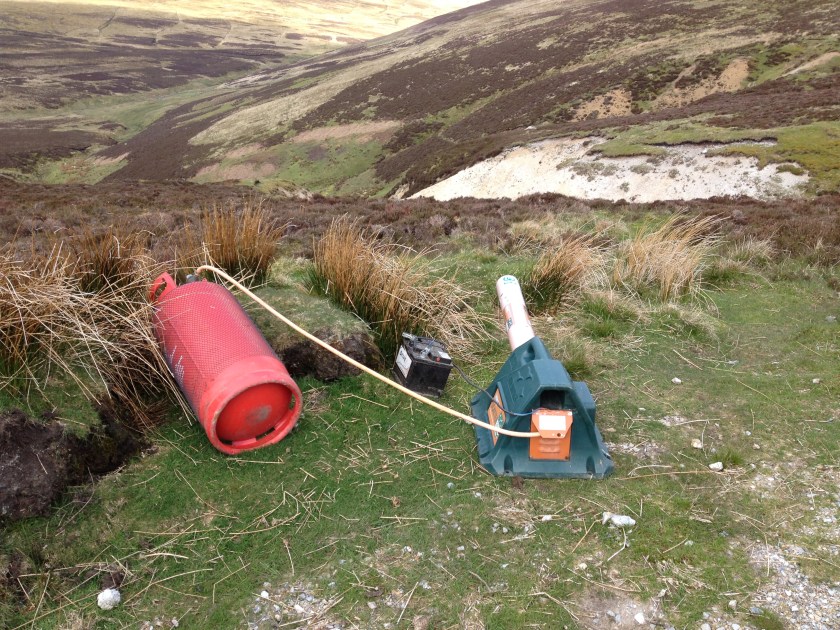
Last week we blogged about the deployment of gas guns on grouse moors and how we were still waiting for guidance on their use from SNH and Natural England; guidance that had been promised before the start of the 2016 breeding season (see here). We were/are concerned that these devices were/are being used to deter hen harrier breeding attempts. If they were/are, this would constitute an offence of causing reckless or intentional disturbance.

Bird scarer 1 - Copy

SNH has responded with the following statement:

Thank you for your email.

I note your concerns about the use of propane gas guns, which may have the potential for disturbance of protected bird species. We are not in receipt of specific evidence of an impact on breeding or nesting birds but we would welcome any information you may have regarding this or any related concerns of improper use of gas guns. This information should be forwarded to andy.turner@snh.gov.uk. Intentional or reckless disturbance of Schedule 1 nesting birds is an offence, and any suspected incidents of this through gas gun use should be reported directly to Police Scotland on 101.

Although we do not have specific information, we are working with Natural England to provide best practice guidance on the use of this equipment to minimise the likelihood or potential of disturbance in the vicinity of protected species. We currently expect to make this available later this month. The use of gas gun equipment is regulated by Local Authorities under the Environment Act and we are not currently considering separate licensing under the Wildlife & Countryside Act. We will, however, continue to assess on a case-by-case basis any licence application to disturb scheduled birds.

Thank you for your concern.

Andrew Bachell, Director of Policy & Advice, SNH

We found this statement to be contradictory and confusing. SNH says it doesn’t have any evidence of an impact on breeding or nesting birds. Has SNH investigated any of the previous reports it has received about these gas guns being used on grouse moors? If SNH hasn’t investigated, then of course no evidence will be available.

SNH says it wants to hear about any concerns but then says improper use could constitute an offence which should be reported to Police Scotland. Can anyone imagine Police Scotland investigating the use of a gas gun in the middle of a remote grouse moor? No, neither can we. And if the schedule 1 bird has already been ‘disturbed’ by the gas gun and has since cleared off, then if the police did miraculously attend, there’d be nothing to see anyway and therefore no evidence of an offence.

SNH says gas gun use is regulated by local authorities under the Environment Act. But this legislation relates to statutory nuisance, ‘noise emitted so as to be prejudicial to [human] health or a nuisance’. This legislation does not relate to the illegal disturbance of Schedule 1 birds.

SNH says it is working with Natural England to provide best practice guidance, but in a later response to one of our blog readers (see comment from blog reader Andrew here), SNH says ‘there is insufficient evidence to warrant the production of guidance’ and then admits that ‘SNH guidance is not enforceable by law should an individual decide not to adhere to it’.

SNH says it is not considering separate licensing under the Wildlife & Countryside Act ‘but will continue to assess on a case-by-case basis any licence application to disturb scheduled birds’. But if gas gun use is unlicensed, then nobody will be submitting a licence application for use because they don’t need to.

Confused? We are.

The best advice we can offer to anyone who finds a gas gun in use on a grouse moor in Scotland is to report it to RSPB Scotland. Email: _InvestigationsSHQ@rspb.org.uk [please note the underscore at beginning of email address] Tel: 0131-317-4100.

We’re still waiting for a response from Natural England about their gas gun ‘guidance’.

Update on pesticide leg bands being attached to red grouse

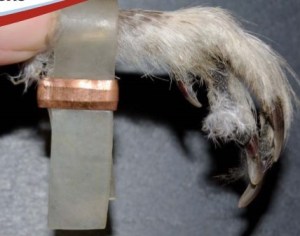
Acarcidal leg band GWCT 2008 - CopyFollowing yesterday’s blog about pesticide legs bands being attached to female red grouse to deter ticks (see here), Countryman’s Weekly has been in touch:

We’d like to point out that we printed a correction to the article above in our edition of April 20 (we are a weekly title), which stated that the shoot “does not use pesticides in their dosing process“”.

Ah, so it’s just the chemotherapy drug Levamisole hydrochloride that they’re using then? What a huge relief that will be to everyone considering eating red grouse from this estate.

However, just because Cabrach Estate isn’t using pesticides to dose their red grouse (if you believe Countryman’s Weekly), that doesn’t mean that other grouse moors are not using them. The author of the original article (Linda Mellor) clearly believes pesticide leg bands are commonly used as a grouse moor management technique, otherwise she wouldn’t have written:

There has been a marked increase in grouse survival rates through this type of tick prevention‘.

As we pointed out yesterday, Linda is a professional freelance writer specialising in the game-shooting industry – if anyone should know, it would be her.

And if pesticide leg bands are not commonly used, why would the GWCT include specific advice on their website about how to use them (even though they’re unlicensed for use), as recently as last month?!

The thing is, just like this industry’s use of super-strength medicated grit with added de-wormer drugs, their use of toxic & poisonous lead shot, and their use of chemotherapy drugs, who is monitoring their use of pesticides to dose red grouse?

Er, that’d be nobody.

To say the grouse shooting industry is unregulated would be the understatement of the century.

Sign the petition to ban driven grouse shooting HERE

Trial date set for Angus Glens gamekeeper for alleged pole-trapping offences

Last month we blogged about court proceedings in the case of an Angus Glens gamekeeper, Craig Graham, who is facing accusations of alleged pole-trapping offences on the Brewlands Estate (see here).

Graham, 51, is accused of setting and re-setting a pole trap, baited with a pheasant carcass, between 9-17th July 2015.

At a third hearing at Forfar Sheriff Court yesterday, Graham pleaded not guilty to the charges.

This has now triggered a trial, provisionally set for 9th September 2016, with an intermediate diet to be heard on 16 August 2016.