
 The latest quote from Scottish Gamekeepers’ Association Chairman, Alex Hogg, is one of those classics that can be added to his other fantastical claims such as, “Professional gamekeepers do not poison raptors” (see here) and, “It is unfair to accuse gamekeepers of wildlife crime” (see here) and, when asked whether gamekeepers are involved with the poisoning, shooting and trapping of raptors: “No they aren’t. We would dispute that” (see here).
His latest claim, “In the last ten years we have stamped out poisoning” is extraordinary. Why make such a statement in the full knowledge that poisoning figures are freely available in the public domain for anyone to see? Perhaps he’s suffering from memory loss (too much lead in his bloodstream?) or perhaps he’s just deluded.
His claim was made during a BBC Radio Scotland interview, broadcast last week, about the potential for landowners and gamekeepers who are suspected of committing wildlife crime to have their General Licences removed. Also interviewed was Environment Minister Paul Wheelhouse, who confirmed our concerns (see here) that the removal of a General Licence doesn’t necessarily mean that estates will be prevented from carrying out their ‘vermin’ control activities – they can simply apply for an individual licence and carry on as normal.
Here is the transcript of the programme:
Presenter: Over the past few years, certainly far too often, we’ve reported on birds of prey which have been illegally killed. Now, there are laws in place for putting guilty offenders behind bars but so far this hasn’t happened. I’m not sure that’s true, I think one did. [RPS Ed: Nope, not a single raptor killer has received a custodial sentence].
As you may have heard on BBC Scotland news this week, there’s now a new tool available to those fighting this crime and the right for estates to control birds which predate on grouse and pheasants could be removed, potentially affecting their income stream. There are some who feel this measure could result in gamekeepers losing jobs. We take a look at the implications of the new legislation.
A tranquil rural scene, but, there’s anguish and anger in this area. Red kites were reintroduced here, starting 20 years ago. They’re popular with local people and visitors alike. But these illegal killings have wiped out 10% of the fragile population.
[Cut to Brian Etheridge, RSPB Scotland]: “I’m just gutted. This for me is just the worst two weeks I’ve had in this job. Going out and responding to calls from members of the public……”
Presenter: Brian Etheridge of the RSPB in Craig Anderson’s BBC Scotland report on the mass poisonings of red kites in the Black Isle. And it was cases like this that prompted the Environment Minister, Paul Wheelhouse, to call for Scottish Natural Heritage to come up with a different way of tackling the crimes.
At the start of the whole process, I spoke to the man in charge of developing those new initiatives, Robbie Kernahan, Head of Wildlife Operations at SNH.
Robbie Kernahan: “Well, the Minister in July asked us to scope out the possibility of restricting General Licences on estates and properties where we feel that wildlife crime may be taking place, and we’ve spent a bit of time trying to better understand some of the practicalities associated with that, and it’s a difficult one because General Licences are there to allow people to undertake activities such as crow control, corvid control, to prevent damage to, conserve wild birds and also agricultural crops but at the same time they are a privilege, they’re not a right, and they are a form of very light-touch regulation. I think it’s reasonable for us to look at how best to restrict those licences where we have got concerns about the potential for raptor persecution taking place”.
Presenter: So what would be the impact on an estate if the licence was not re-issued?
Robbie Kernahan: “Well, I mean corvid control is a pretty fundamental requirement for most moorland management, certainly if you’re interested in grouse productivity, certainly if you’re interested in conserving wild birds too, the corvid control is an important part of that. So withdrawing an ability for an estate to actively manage crows could be quite detrimental”.
Presenter: The new process of potentially restricting a General Licence is now up and running. But will it work to stop the killings? Environment Minister, Paul Wheelhouse:
Paul Wheelhouse: “Well we will only know in due course. I hope it has a deterrent effect because it will increase the hassle for land managers who are needing to control particular species, they will have to apply for individual licences, so I know there is some concern about jobs on the part of gamekeepers and other estate workers, but, they’ll still be able to control, assuming that they apply successfully for an individual licence. What we’re doing is taking away the privilege of a General Licence and I hope…..”
Presenter: Sorry, can I just nail this on the head? There are a lot of gamekeepers out there who are seriously concerned that if an estate loses its licence then their jobs are on the line. You’re saying the gamekeeper can apply for an individual licence?
Paul Wheelhouse: “Well we’re saying that to SNH the land manager can apply for a licence to control individual species they feel it’s necessary to protect livestock, you know, crows, corvids, other species they feel as necessary, we’re just not going to allow them the luxury of having a General Licence which is a privilege, not a right, and that they will have to go through a more onerous process to get permission, and it can’t guarantee that they will get permission, but clearly that’s a possibility, they can apply for an individual licence”.
Presenter: What about the other serious worry that because up until now, the lack of people in jail rams home how difficult it is to get a conviction in this sphere. By lessening the amount of proof that’s needed, are you not in danger of punishing an estate that might be innocent?
Paul Wheelhouse: Well these are factors that obviously the police and SNH would take in to account, when police, through an information-sharing protocol, share information with SNH about a landholding that they suspect perhaps wildlife crime has been on, they will take these factors in to account and they will look at the weight of evidence there is and whether the balance of probabilities that that wildlife crime has been committed , that’s how civil burden of proof works, on the balance of probabilities rather than the definitive, if you like, basis that beyond all reasonable doubt which is where the criminal law comes in to effect”.
Presenter: The change in the legislation has come about because it is just so difficult to get a successful prosecution in cases involving birds of prey. A source of frustration for the police, SSPCA and RSPB investigators. RSPB Scotland investigator Ian Thomson:
Ian Thomson: “I think it’s a positive step, it’s certainly something that we welcome because what this mechanism that has been announced by SNH does is it uses a civil burden of proof, which is a lower burden of proof that is needed to obtain a criminal conviction, so rather than beyond all reasonable doubt, this is on the balance of probabilities, and frankly, where you have areas of Scotland unfortunately repeatedly seen to be involved in the illegal killing of birds of prey, then this is hopefully going to be a useful tool. Obviously the proof of the pudding is in the eating and it may take us several years to know how effective this is being”.
Presenter: But it’s got the potential though to, for a miscarriage of justice for want of a better expression.
Ian Thomson: “I don’t think SNH are taking this at all lightly, but the fact of the matter is there are many areas in Scotland where we know birds of prey are being killed, we have a pretty good idea of who is doing it, and certainly a group of individuals who are doing it, and so I think if the evidence is presented by the police to SNH, then ultimately they will make a decision. There is an appeal process in this, and if that process finds that there isn’t sufficient evidence then the licence will be reinstated. It’s SNH’s decision at the end of the day, but something we very much welcome, it’s another tool to tackle this on-going problem”.
Presenter: I approached Scottish Land and Estates for their reaction to the new policy but failed to get a response. But the folk at the sharp end of this whole debate are the gamekeepers, many of which fear for their jobs if a General Licence is withdrawn. A licence which people like Alex Hogg of the Gamekeepers’ Association feel is an essential part of estate management, both for game and for wildlife.
Alex Hogg: “It’s so important because it means it might take the right away to trap carrion crows in the spring of the year, which is vital to remove them for the sake of your ground-nesting birds. But, more so, you could have maybe six keepers working on an estate, as a team, the whole lot could lose their licence because they’re applying it [the General Licence restriction] to the ground, on suspicion, and then you’ve got no work for them. You know, they could end up out of their homes, and young families, stuff like that. Would it happen with plumbers and joiners, if a plumber misbehaved would they take all the licences away in the town for every other plumber? It’s absolutely ridiculous, really”.
Presenter: So if a licence was taken away, is it a sweeping statement to say they wouldn’t need keepers on an estate?
Alex Hogg: “Aye. I mean, you know, we can trap stoats, and weasels and rats, and the fox population we can keep on top of, but it disnae allow us to trap birds, and that’s a really important issue for us”.
Presenter: You’re saying you want to protect curlews and lapwings, but is the reality not that you want to protect grouse and pheasants, you know, because this is a money-maker for an estate? You guys, your employers, estate owners, aren’t running charities here.
Alex Hogg: “No, no, we’re running businesses and it should be recognised as such, but we can work round a lot of the issues to do with pheasant poults, and buzzards and things, which we’ve had to do, but let’s get right back to the things we cannot work round and that’s your waders. We feel we’ve been really done, badly done by. We’ve had raids on houses, dawn raids, you know, at 6 o’clock in the morning, 50 policemen, the wives have had their cupboards searched, the kids’ medicine bottles have been taken away, all to no avail. Now, in the past ten years, we have stamped out poisoning. We have come down so hard on it. We’ve had meetings up and down the countryside, we’ve absolutely finished it, and I think that if the police got murder, house-breaking down to the numbers we’ve got it down to, which is a minimal, below half a dozen this year apart from the Ross-shire incident, you know, we feel we’ve done our job. So the next part of the process should have been licensing, where you can apply for a licence to control a species that’s having a detrimental effect on another species”.
Presenter: But there are many people who’d say one poisoned bird is one too many. You’re saying you’ve sorted it, I would say you haven’t sorted it.
Alex Hogg: “One bird is too many but you’ve got to get it down to a minimum and we feel we’ve done that”.
END
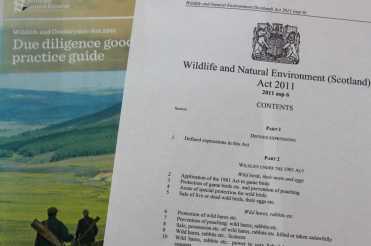 Regular blog readers will know that we’ve been interested in the first prosecution of a landowner under the vicarious liability legislation for some time now….in fact ever since the legislation was enacted as part of the WANE Act on 1st January 2012 (see
  In March this year, the Scottish Government finally launched the long-awaited (and long overdue….by three years) public consultation on whether the investigatory powers of the SSPCA should be increased to allow them to formally investigate more types of wildlife crime than their current remit (see
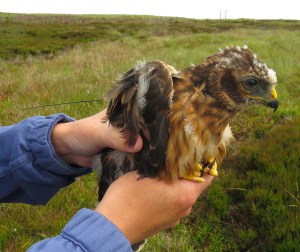 Sid was one of the successfully-fledged hen harriers at Langholm this year. He was satellite-tagged on 3rd July and his movements have been mapped and shared on the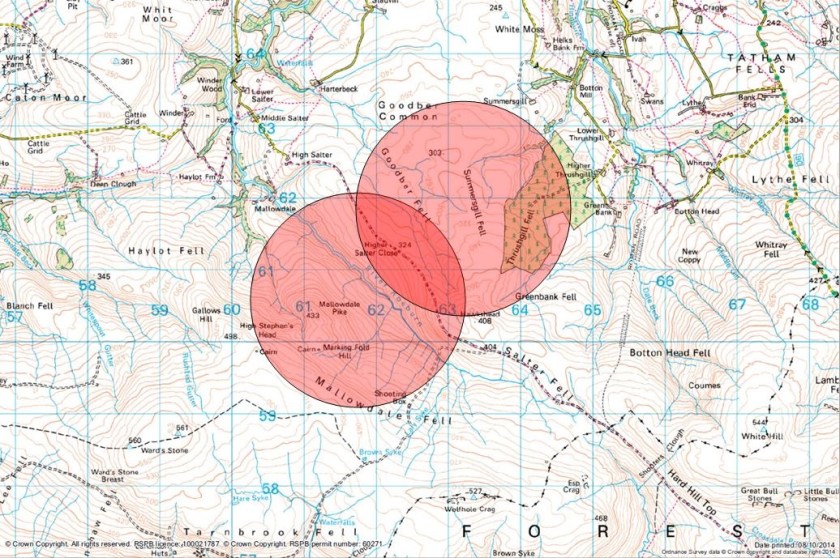
 Raptor Persecution UK