Natural England release limited info about their sat-tagged hen harriers 2007-2014

Bowland HH Jude LaneYesterday, Natural England (NE) published some information about their hen harrier satellite tagging programme, which has been running since 2007. Their press release, entitled: “Initial findings of Natural England’s hen harrier tracking programme 2007 to 2014” can be read here.

The key word here is “initial”. What they’ve released is extremely limited and to be frank, doesn’t tell us much that we don’t already know.

It’s a difficult situation for them, because part of the funding for this project has come from us (tax payers) and so NE has an obligation to inform us how our money has been spent and the results of the research that we’ve helped fund. However, this research has been undertaken as part of a PhD study and so the doctoral candidate (Stephen Murphy) is entitled to retain his data until he’s ready to submit his thesis and, ideally, has produced some peer-reviewed papers. No researcher worth his/her salt would wish to release their data, prematurely, in to the public domain, in case someone nicks the data and takes intellectual credit for the work.

The problem in this case is exacerbated by the controversial topic (and thus the high level of public interest and clamour for information), the poor survival rate of the study species (which is bound to have impacted on the research design seeing as the research is specifically aimed at examining hen harrier dispersal ecology; quite hard to assess if your harriers are killed just a few months after fledging), and also the length of time it has taken for this PhD study to be completed. We understand Mr Murphy’s studies began in 2006 – that’s eight years ago. That’s a very long time. We do have some sympathy with Mr Murphy, for the first two reasons outline above – but, we do know that he has given numerous public presentations on his research over the years and so we should have seen at least SOME of his findings published by NE well before now.

So, what information did NE release yesterday? Or more to the point, what information didn’t they release?

We now know that NE has attached sat tags to 47 young hen harriers between 2007-2014. There are at least a further six tags that have been fitted and monitored by other organisations. Of NE’s 47 harriers, only four are known to be still alive. That’s a pathetic 8.7%.

Of the 47 harriers, six have been found dead.

Of the 47 harriers, a staggering 37 (78.7%) are listed as ‘missing’.

Of the 37 ‘missing’ harriers, 34 were under a year old when their sat tag stopped functioning. Two were between 1-2 years old, and only one was more than two years of age. The vast majority went ‘missing’ in the months of September and October, with a smaller peak in July and August.

NE has provided some technical information about the sat tags, stating that they are programmed to emit signals on a ten hour cycle with a subsequent 48-hour re-charging cycle. They point out that just because a harrier’s last signal came from a particular location, the harrier could have subsequently moved a considerable distance (within that 48-hour period).

Viewing the case of each ‘missing’ harrier in isolation, that’s quite a plausible possibility. However, when you combine ALL the cases of ALL the missing harriers, it’s not quite so plausible. NE states that tag failure is “uncommon”. Incidentally, so did the Dutch researchers who were commenting on the ‘missing’ sat tagged Montagu’s harrier earlier this year, whose last signal came from the Queen’s Sandringham Estate in Norfolk (see here). Sure, you might expect the odd one to fail, but when you’ve got a 78.7% failure rate, and you’re told that tag failure is “uncommon”, it’s very hard to conclude anything other than foul play.

When you also add in the known fact that breeding hen harriers are missing from almost every driven grouse moor in England and Scotland, it becomes blindingly obvious what’s going on.

Unfortunately, the newly-released data provided by NE don’t include detail of where these hen harriers have gone ‘missing’. They’ve given 100km2 grid references, which are utterly meaningless. They say they don’t want to release any finer detail because there is concern from the raptor study groups that sensitive locations will be publicised. That’s a little ironic (clearly the harrier killers know where to find these birds) but it’s also understandable. However, NE could have easily provided a column showing the habitat type of where these birds went ‘missing’ without compromising site security. Those data would have been very interesting and, we think, pretty damning. Perhaps that’s why they were excluded?

As NE quite rightly points out, the circumstances that led to the loss of these harriers’ tag signals can only be ascertained if the bird’s corpse is recovered. That’s also a statement that has repeatedly been put out by the game-shooting lobby – “No dead bird, no evidence of persecution”. Now, we expect some natural mortality – not all the sat-tagged harriers are going to survive, that’s basic biology. But wouldn’t you think, if all these sat-tagged harriers had died a natural death, their corpses (or at least part of a corpse) would be found, as would the tags?

Of those 37 ‘missing’ harriers, only one tag has been recovered. Amazing, eh?

So what have we learned? Not much. 78.7% of sat tagged hen harriers are ‘missing’. ‘Somewhere’.

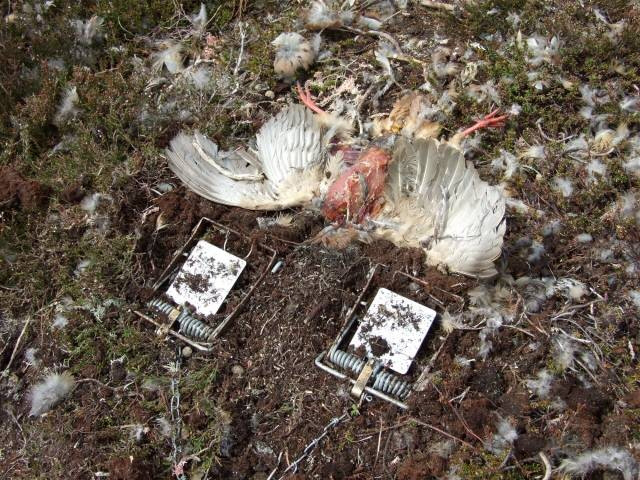
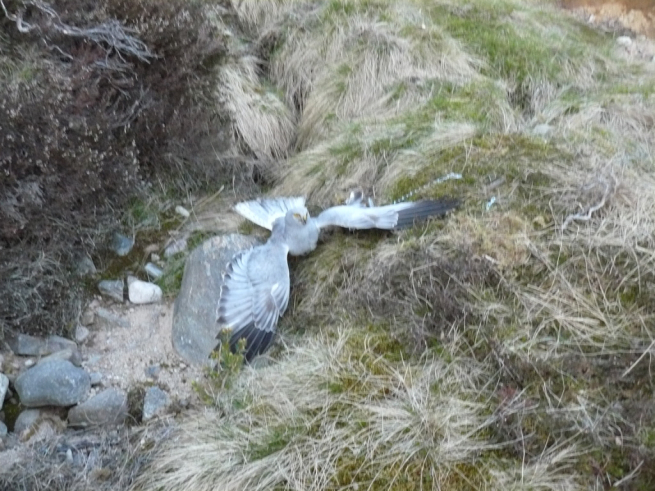
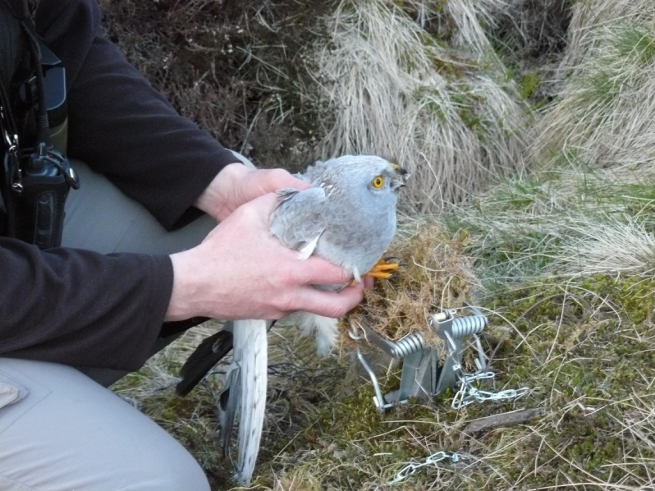
Here’s a reminder of what happens to some hen harriers on some driven grouse moors. Please sign the petition to ban driven grouse shooting here.
hh trap1

hh trap2

hh trap3


Senior police face wildlife crime grilling at Holyrood

RACCEThe Scottish Government’s Rural Affairs, Climate Change & Environment Committee (RACCE) will tomorrow hear evidence from two senior Police Scotland officers about the Government’s latest annual report on wildlife crime in Scotland.
The two officers are Assistant Chief Constable Malcolm Graham (Major Crime and Public Protection), and Detective Chief Superintendent Robbie Allan (Wildlife Crime Portfolio Holder).

Following them will be Patrick Hughes, Head of Wildlife & Environmental Crime Unit, Crown Office & Procurator Fiscal Service.

This hearing is fairly routine – the RACCE took evidence last year from the Environment Minister following the publication of the Government’s first report on wildlife crime, and the Minister is set to give evidence again next week (Nov 5th) now that the second annual report has been published.

However, in light of recent events, we hope that the police will be asked to account for their actions on (a) their outrageous statement that the 22 raptors poisoned in the Ross-shire Massacre seven months ago were “not deliberately targeted”, and (b) their staggeringly hypocritical response to the consultation on whether the SSPCA should be given increased investigatory powers.

We’re still awaiting a formal response from the RSPB’s Head of Investigations, Ian Thomson and the SSPCA’s Head of Special Investigations Unit, Mark Rafferty as to whether they agreed with Police Scotland’s claim that the Ross-shire Massacre was ‘accidental’, although they have said that they’ve contacted Police Scotland for an explanation and will respond to blog readers in due course. We can assume then, that neither the RSPB or the SSPCA were party to that Police Scotland press release, even though they are supposedly ‘partners’ in this investigation.

In the meantime, we asked RSPB Scotland Director, Stuart Housden, what his thoughts were. Yesterday he tweeted the following response:

To use a poisoned bait(s), placed in the open is an indiscriminate and illegal act aggravated by the use of a banned chemical“.

It seems that Mr Housden is, quite rightly, not impressed with Police Scotland’s statement. Note also he mentioned ‘poisoned bait(s)’ and ‘a banned chemical’. These are carefully chosen words. If those 22 birds had been killed by the accidental use of rodenticide, as some members of the game-shooting lobby are claiming on social media, Housden would probably have said ‘a controlled substance’, because rodenticides are NOT a ‘banned chemical’. Interesting stuff.

You can watch the RACCE wildlife crime hearing live on Holyrood TV tomorrow. The session starts at 10am although the first item on the agenda is consideration of the South Arran Marine Conservation Order 2014. The wildlife crime session will follow that. You can watch by clicking this link to Committee Room 5.

For those who can’t watch it, we’ll post the minutes from the session on this blog as soon as they become available (usually within 24 hours of the hearing).

UPDATE 29/10/14: For those who missed the live tv broadcast, HERE is the archived video. A full transcript will follow (within 24 hours) plus our analysis of the evidence heard.

UPDATE 4/11/14: The official transcript of the hearing is now available here.

UPDATE 4/11/14: What we learned from the RACCE Committee hearing here.

Ross-shire Massacre: SLE complains about media speculation

A letter has been published in the Herald today, penned by Tim (Kim) Baynes of Scottish Land and Estates:

Speculation around bird of prey deaths has become more hysterical

The announcement by Police Scotland that the 20 raptors found poisoned in March near Conon Bridge were “not deliberately targeted” raises number of serious matters.

Despite the trend of crimes against birds of prey having gone down in the last 3-5 years, particularly by poisoning, the speculation around each case has become more hysterical; the RSPB even tried to link the Conon Bridge incident to grouse moor management. There are now websites and bloggers and organisations involved in police investigations who are not slow to feed information to the media and promote speculation.

This speculation is having a corrosive knock-on effect on many other aspects of land management, severely straining the relationship between land managers and conservation bodies.

This also brings into focus the new measure whereby General Licences to control pest birds may be withdrawn where there is only a suspicion of wildlife crime, rather than it being proven in court.

Any deliberate killing of a bird of prey is illegal and is to be condemned but it is not in anyone’s interests that various activists and organisations can leap to conclusions without any evidence to support their point of view which in turn is afforded political and media credence. It would be a major step forward if government and other interested organisations were to take a lead in ensuring that reckless speculation should be discouraged. If everyone sticks to the facts and works more constructively together then the interests of conservation will be better served.

Tim Baynes,

Scottish Moorland Group,

Scottish Land & Estates,

Stuart House,

Eskmills Business Park,

Musselburgh.

So our Kim wants everyone to “stick to the facts”. His own track record on sticking to facts isn’t very impressive (e.g. see here, here, here).

His latest letter was written in response to Police Scotland’s outrageous announcement last Friday that the illegal poisoning of 22 raptors at Conon Bridge seven months ago was “not deliberately targeted” (see here). That idiotic statement was pure speculation – is Kim complaining about that?

Earlier this year, Jamie McGrigor MSP speculated, during a televised parliamentary debate, that the Ross-shire Massacre could have been the result of accidental food contamination at the Tollie Red Kite feeding station (see here). Did Kim complain about that?

Kim & Co had better batten down the hatches – speculation is bound to be rife when Police Scotland consistently fail to provide timely, and accurate, updates about such appalling crimes.

Understandably, Kim and his mates would probably prefer everyone to just shut up about raptor persecution crimes. It’s a bit too late for that.

Oh, and by the way, Kim, seeing as how you love facts, here’s one: It was twenty two dead raptors at Conon Bridge, not twenty. And here’s another fact: the Government’s 2013 wildlife crime report showed an increase in raptor persecution crimes. And guess what? The 2014 figures will also show an increase, because the ‘Conon Bridge 22’ will be included in those stats.

In other news, tissue sales are set to increase in Musselburgh.

There’s also an article in the Herald, based around the content of Kim’s letter and how he thinks that the speculation has ‘sullied’ the reputation of SLE members (here).

SSPCA consultation responses: the hypocrites laid bare

sspca logoA few days ago, the Scottish Government published (some of) the responses they’d received to their public consultation on whether the SSPCA should be given increased powers to allow them to investigate more wildlife crimes than their current remit allows.

As a quick recap, the SSPCA’s current authorisation (under animal welfare legislation) limits their investigations to cases that involve a live animal in distress. The proposed new powers would also allow them to investigate wildlife crimes under the Wildlife & Countryside Act legislation, e.g. where the victim is already dead, and also incidents where a victim may not be present (e.g. an illegally-set pole trap). See here for further detail.

Note: the Government’s consultation document stated: ‘The SSPCA has indicated that they would not require, or use, powers to stop and search people or powers to arrest people’. This statement is important, and you’ll see why later in this blog post.

We knew, in the long three-year lead up to the consultation, that certain organisations would object to the new increased powers, so it wasn’t any great surprise to read the majority of the responses, although there were a couple of surprises. Here is a list of which organisations were in support of the new powers, and which were not (NB: the responses of ‘individuals’ are excluded from this analysis).

Those in support:

Buglife, Durham Bird Club, Scottish Badgers, OneKind, RSPB, Scottish Raptor Study Group, Animal Concern Advice Line, Law Society of Scotland, Scottish Wildlife Trust, League Against Cruel Sports, National Trust for Scotland.

Those not in support:

Altnaharra Estate, Glenfalloch Estate, Alvie & Dalraddy Estates, Scottish Gamekeepers’ Association, Scottish Land & Estates, Songbird Survival, BASC Scotland, GWCT, Scottish Countryside Alliance, Craigswood Game & Deer Management, Scottish Association for Country Sports, National Working Terrier Federation, NFU Scotland, Bat Conservation Trust, Scotland for Animals, Police Scotland.

Those not expressing an opinion:

COPFS, British Deer Society.

The surprises, for us at least, were the Bat Conservation Trust and Scotland for Animals. We would have predicted both of these organisations to have been in the ‘supportive’ camp. Their explanations (as put forward in their formal responses) are a bit bizarre but there you go.

Anyway, those two anomalies aside, it’s pretty obvious that the huntin’ shootin’ fishin’ brigade, who all claim to be dedicated to stamping out wildlife crime, are united in their opposition to the SSPCA being given more powers to er, help stamp out wildlife crime. Oh, and Police Scotland is also opposed. Between them all, they’ve put forward a number of similar (actually, mostly identical) reasons to explain their opposition. Those reasons include:

  • Accountability (the SSPCA is a charity, not a public body and therefore it’s not publicly accountable);
  • Impartiality (the SSPCA campaigns for a ban on snares so therefore couldn’t possibly remain impartial when investigating crimes involving snaring);
  • There’s apparently no need for “radical new powers” because there has been a “significant reduction” in wildlife crime;
  • Training & competence (SSPCA inspectors don’t undergo the same “rigorous training, selection & vetting” as police officers so they shouldn’t be allowed to undertake criminal investigations);
  • SSPCA inspectors don’t have access to forensics, DNA and fingerprint databases, or the Scottish Intelligence Database, which would compromise their investigations and also compromise any on-going police investigation of which the SSPCA may be unaware);
  • The SSPCA is “already stretched” and couldn’t cope with more investigations;
  • Giving the SSPCA more powers amounts to “un-official policing” and “quasi-policing”;
  • Only the police should investigate crime;
  • Giving them more powers would “destabilise trust” between PAW partners;
  • The SSPCA is “unequipped” to deal with RIP(S)A regulations (Regulation of Investigatory Powers Act 2000 which puts strict controls on when surveillance operations are permitted and how they are to be conducted. These regulations only apply to public bodies, e.g. police, customs);
  • There may be resistance from the public, who view these powers as a traditional remit of the police;
  • There is concern about whether the SSPCA is subject to the Scottish Crime Reporting Standard;
  • It’s just not fair.

The last reason isn’t explicitly stated in the consultation responses but it’s pretty much the subtext of what is being said.

Now, to the casual observer, many of these explanations may sound reasonable and legitimate. “Yeah, only the police should investigate wildlife crime, not a civilian”, right? Wrong.

hypocrisyWhat all of these huntin’ shootin’ fishin’ organisations (and Police Scotland) conveniently failed to mention was the role, and powers, of the water bailiff.

What’s a water bailiff?

A water bailiff is someone appointed by a District Salmon Fishery Board (DSFB) (or sometimes by Scottish Ministers if a DSFB doesn’t exist in a particular area) to enforce certain national fisheries legislation, amongst other duties, and their remit includes tackling (fish) poaching. Poaching is one of the six national wildlife crime priorities.

There are 41 DSFBs in Scotland, and the members of these Boards are predominantly land owners and/or those who own propriety fishing rights. We’d thoroughly recommend you check out the Board membership lists of some of these DSFBs (using the link above) – there are some familiar names, including certain estate owners, certain estate factors, and certain SLE Directors and representatives! Representatives of other bodies (e.g. SNH, SEPA, National Park Authority) may be invited to join the Boards, but in a non-voting capacity.

The water bailiff is basically appointed to serve the interests of the landowners and fishing rights proprietors. The role of the water bailiff is “virtually that of a policeman”, according to the Water Bailiff training manual. Water bailiffs have statutory powers of entry, search, seizure, and arrest. Yes, you read that correctly – water bailiffs have the authority to arrest someone, and they are also authorised to use handcuffs during the process of arrest. Some may also carry batons!

To become a water bailiff, all you have to do is to read the Water Bailiffs manual and sit a written test based on your knowledge of the training manual. That appears to be it. However, passing this ‘test’ is apparently not a legal requirement; it is simply a policy in the DSFB’s Code of Good Practice.

So, in light of this information, let’s now re-visit the excuses reasons given by the huntin’ fishin’ shootin’ brigade (and Police Scotland) as to why they object to the SSPCA being given wider powers.

  • Accountability. Water bailiffs are accountable to DSFBs, which are not public bodies, in the same way the SSPCA is not a public body. The huntin’ shootin’ fishin’ brigade don’t seem to have a problem with the lack of public accountability of water bailiffs/DSFBs, just with the lack of accountability of the SSPCA. Interesting.
  • Impartiality. Water bailiffs are acting in the interests of landowners and fishing proprietors, who have undeniable vested interests, thus, it can be argued that they are not impartial. The SSPCA may well campaign for a ban on snaring but that hasn’t affected their professional ability to successfully investigate crimes involving the illegal use of snares. Here’s one they did just this week.
  • The proposed new powers for the SSPCA are not “radical” – nowhere near. They’re merely a small extension to the powers the SSPCA have been using (successfully) for over a hundred years. ‘Radical’ powers might include, say, giving them the power of arrest without a warrant, and authorising the use of handcuffs without a warrant. Now that’s radical.
  • There has not been a “significant reduction” in wildlife crime. Far from it.
  • Training & competence. Water bailiffs do not undergo the same “rigorous training, selection and vetting procedures” as police officers, even though they have similar powers to the police, and far greater powers than those of the SSPCA, who, remember, “do not require, or use, powers to stop and search people or powers to arrest people”. Interesting that the huntin’ shootin’ fishin’ brigade (and Police Scotland) don’t object to such a weak training regime for water bailiffs.
  • Water bailiffs don’t have access to forensics, DNA and fingerprint databases, or the Scottish Intelligence Database, which doesn’t appear to compromise their investigations or compromise any on-going police investigation of which the water bailiff may be unaware.
  • The SSPCA does in fact have access to forensics, and this tool is frequently used in badger-baiting and dog-fighting investigations, when animal DNA evidence has been used by them to secure a conviction.
  • If the SSPCA was ‘already stretched’, they probably wouldn’t have offered their services, free of charge to the public purse, to investigate a wider suite of wildlife crimes. How thoughtful, though, of the huntin’ shootin’ fishin’ brigade (as well as Police Scotland) to show their concern for SSPCA officers’ welfare!
  • The role of the water bailiff is arguably “quasi-policing” and “un-official policing” and yet the huntin shootin’ fishin’ brigade (and Police Scotland) don’t seem to have a problem with that.
  • Water bailiffs investigate wildlife crime (well, poaching, which many would argue is more about stealing than anything else) so their argument that (wildlife) crime should just be a police matter presumably means the huntin’ shootin’ fishin’ brigade will be calling for the  withdrawal of water bailiff powers in the very near future.
  • There is no trust between PAW partners to “destabilise”.
  • Water bailiffs are not equipped to comply with the RIP(S)A legislation because DSFBs are NOT public bodies. However, water bailiffs routinely undertake ‘surveillance’ operations, and indeed their training manual explains how to set an ‘ambush’ for suspected poachers! The huntin shootin’ fishin’ brigade don’t seem to have a problem with this.
  • There doesn’t seem to be much (any?) resistance from the public towards water bailiffs enforcing the legislation.
  • Are water bailiffs subject to the Scottish Crime Reporting Standard? We doubt it.

So there you have it. The hypocrisy, and the hypocrites, have been exposed.

We await with great interest the Minister’s decision on increasing the SSPCA’s investigatory powers.

Ross-shire Massacre: unbelievable press release from Police Scotland

RK7Following the mass poisoning of raptors (16 red kites & 6 buzzards) at Conon Bridge, Ross-shire, seven months ago, Police Scotland has this evening put out the following press release:

Appeal for information in relation to death of raptors

Police Scotland has issued a further appeal for information relating to the deaths of raptors in various locations across the Ross-shire/Black Isle area earlier this year.

Following investigation Police Scotland can now confirm that the birds, 12 red kites and four buzzards, were most likely not targeted deliberately but instead were the victims of pest control measures. The raptor deaths occurred over March and April this year.

The criminal investigation into their deaths is still ongoing and Police Scotland continues to work closely with partners.

Detective Superintendent, Colin Carey, said:

“Investigations into the suspicious deaths of wildlife and especially raptors can be difficult and prolonged. The areas covered can be vast and it is seldom immediately apparent why a bird may have died.

“We work closely with partners to identify and thoroughly investigate all wildlife crime. The death of the raptors in Ross-shire remains an on-going investigation during which we are endeavouring to establish all of the circumstances around this crime. We would ask anyone who may have further information to come forward.”

A significant reward is being offered for witnesses or further information.

Partner agencies would seek to remind members of the public that if anyone finds any further dead birds or animals in the area they are asked to make a note of its location and inform the police on 101. Under no circumstances should anyone touch or attempt to recover any dead animal.

If anyone has any information regarding this matter please contact Dingwall Police Station, telephone 101.

END

This police statement is staggering. Pay close attention to the second paragraph: Police Scotland can now CONFIRM…..

How can they possibly CONFIRM this, without a full confession from the person who laid out the poison baits? Does this CONFIRMATION mean that they’ve got the poisoner? That he/she has been arrested? That he/she has been charged?

The truth of the matter is, they haven’t got the poisoner, so they cannot possibly CONFIRM whether the poisoner meant to target raptors or meant to target a legitimate ‘pest’. Besides, the only legitimate method of poisoning ‘pests’ is by the controlled use of rodenticides. We already know that the poison(s) involved in this case included a banned poison – the police said so months ago. According to the Vice President of the RSPB, the poison used was Carbofuran. We don’t know that for sure because Police Scotland has refused to say, and the Government toxicology lab who would normally publish this information has mysteriously chosen not to on this occasion. We also know that poisoned baits were picked up at the crime scene – as reported here and here. How can this possibly be classified as a ‘non-deliberate’ poisoning?! It’s illegal to even possess these banned poisons, let alone to use them!

What on earth are Police Scotland playing at? This press statement is a disgrace. If we applied their logic to every other raptor that has been poisoned by a banned poison over the last ten years, then they’ve all been accidental! An unfortunate mistake by someone carrying out pest control measures! What sort of message does this police statement send to those who continue to use banned poisons to kill wildlife? ‘Ah don’t worry lads, we know you didn’t mean to deliberately target that golden eagle/red kite/buzzard with your illegal poisoned bait’.

WTF?

Somebody needs to be asking questions about this. It’s pointless us trying to ask Police Scotland – we’ll just get the stock response of “It’s a live investigation so we can’t comment”. So much for police accountability, eh? All this guff about how the SSPCA shouldn’t be given extra powers because they’re ‘unaccountable’ – Jesus.

So seeing as we have no confidence in Police Scotland to be (a) accountable, (b) competent or (c) trustworthy about this case, how about we ask the partner agencies “working closely” with the police on this case, whether they agree with Police Scotland’s CONFIRMATION that this incident was accidental?

Let’s ask Ian Thomson, Head of Investigations at RSPB: ian.thomson@rspb.org.uk and let’s ask Mark Rafferty, Head of Special Investigations Unit at SSPCA: mark.rafferty@scottishspca.org We’re not asking them to reveal any confidential information about the case, just whether they agree with Police Scotland’s assertions that these poisoned birds were not deliberately targeted, and if so, on what basis has the assertion been made?

Interesting bedfellows

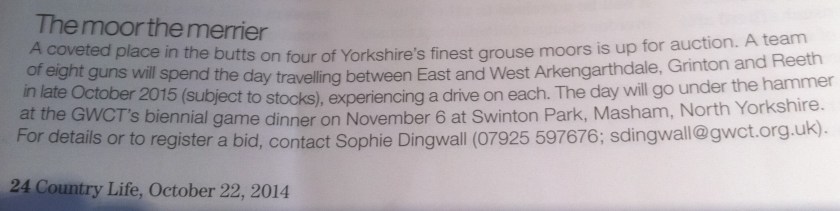
From Country Life Magazine, October 22nd 2014, page 24:

A coveted place in the butts on four of Yorkshire’s finest grouse moors is up for auction. A team of eight guns will spend the day travelling between East and West Arkengarthdale, Grinton and Reeth in late October 2015 (subject to stocks), experiencing a drive on each. The day will go under the hammer at the GWCT’s biennial game dinner on Nov 6 at Swinton Park, Masham, North Yorkshire“.

Fascinating stuff.

Swinton Park is linked with the Swinton Estate. Swinton Estate was where the shot corpse of hen harrier Bowland Betty was discovered in 2012 (see here), although that was likely just an unfortunate coincidence as there was no evidence to link her death to anybody, let alone anyone associated with the estate. According to the Countryside Alliance, she wasn’t shot at all (see here).

A different incident confirmed criminal activity by a Swinton Estate employee. Earlier this year, gamekeeper Ryan Waite was convicted of illegally setting a spring (pole) trap on Swinton Estate (see here).

What an interesting choice of venue for the GWCT to select for their prestigious event, eh?

SSPCA Consultation responses now published

sspca logoThe Scottish Government has now published the respsonses to its consultation on whether the SSPCA should be given increased investigatory powers to allow them to investigate a wider suite of wildlife crimes than their current remit allows.

There were 233 responses, although not all of them have been published as some respondents exercised their right to have their response withheld.

There are a lot of responses from ‘individuals’, and although some have exercised their right to remain anonymous, others have allowed their names to be shown. Some of these are hilarious – including one respondent who has the same name as an SGA committee member, and another respondent who has the same name as a (now retired) wildlife crime police officer. Unsurprisingly, both slag off the SSPCA.

There are also responses from organisations with game-shooting interests (GWCT, SLE, SGA etc), as well as from Police Scotland and one now retired sheriff – unsurprisingly, they are un-supportive of the SSPCA being given more powers.

We’ll be analysing all the responses and will blog about this in due course.

In the meantime, pour yourself a cup of coffee and settle yourselves in for some entertaining reading  by checking out the responses for yourselves: HERE.

Case against gamekeeper George Mutch: part 12

Well, well well. Today was the first day in the much-anticipated trial of Scottish gamekeeper George Mutch.

Mutch, 48, of Kildrummy Estate, Aberdeenshire, has been accused of various wildlife crimes relating to the alleged capture and subsequent killing or injuring of two goshawks and a buzzard in 2012. He has denied the charges and we’ve seen this case drag on and on and on…..

The dragging on looks set to continue….

The trial was halted today after the Sheriff (Annella Cowan) decided to stand down. Why did she decide to stand down? According to the BBC (here) it was because the defence counsel argued that as Sheriff Cowan was a member of the RSPB, she shouldn’t hear the case because the RSPB had been involved in the criminal investigation in to Mutch’s alleged activities.

Yes, seriously!

We thought a Sheriff was supposed to be considered as being ‘above bias’? The defence counsel, Mr Moir, apparently said that he wasn’t suggesting that Sheriff Cowan would be biased – so why then did he say she shouldn’t hear the case?! What a joke.

What’s an even bigger joke is that another (now retired) Sheriff, one Kevin Drummond, was never considered to be ‘unsuitable’ to hear cases against gamekeepers accused of wildlife crime, even though his hobbies apparently included shooting, and prior to becoming a Sheriff he had worked as a defence QC for……er, gamekeepers! (see here).

Fascinating, eh? You couldn’t make this stuff up.

Anyway, back to Mutch’s trial. It’s no big problem that Sheriff Cowan has decided to stand down – the case will be decided on the merit of the evidence presented against Mutch – and THAT is where our interest lies. Whether it’s Sheriff Cowan or another Sheriff who hears the case is largely irrelevant; it’s just irritating that yet another delay has been introduced to this case. Still, we can wait.

We understand the trial will re-start in December.

New five-year hen harrier project launched

A £1.8 million five-year project has been launched, aiming ‘to achieve a secure and sustainable future’ for hen harriers in northern England and parts of southern and eastern Scotland.

Funded by the EU LIFE scheme, this project will include elements of monitoring (at nests and key winter roosts as well as funding a national hen harrier survey in 2016), satellite tagging, habitat management, investigations work (two new RSPB Investigation Officer posts have been funded), community engagement, community consultation and stakeholder engagement.

The project will focus on seven so-called Special Protection Areas (SPAs) designated for breeding hen harriers, two in England and five in Scotland. These are:

Bowland Fells

North Pennine Moors

Glen Tanar

Forest of Clunie

Muirkirk and North Lowther Upland

Langholm-Newcastleton Hills

Glenn App and Galloway Moors

However, given the tiny breeding population in these areas, it’s quite likely that project work will extend in to other areas, too.

RSPB press release here

BBC news article here

It’s good to see that the project is being managed by Blanaid Denman, who led the RSPB’s (award-winning!) Skydancer Project in northern England and did an excellent job of raising awareness about this species’ plunge towards extinction in that region. It’s also good to see that satellite-tagging will play a prominent role – let’s hope the RSPB will allow us to follow the movements of the tagged harriers and that they’ll publicise the locations of where the birds’ transmitters suddenly cease (which of course is bound to happen), unlike Natural England who have failed miserably in this respect for the last 12 years. Given that the RSPB recently published the last known locations of Bowland harriers Sky and Hope, who ‘disappeared’ on a grouse moor in Lancashire last month (see here), we’re optimistic that this information will again be forthcoming with the newly tagged birds.

We were particularly interested in the BBC’s report about this new project (see link above). That article includes the following statement:

The birds continue to face threats. In June 2014 two orphaned hen harrier chicks were hand-reared by wildlife experts after the female bird was illegally shot in East Ayrshire‘.

Why is that statement interesting? Well, because at the time of this harrier’s death, Police Scotland refused to reveal the cause of death (see here). They said:

Whilst at this time we cannot divulge how the bird was killed, we do believe it was the result of a criminal act and we need to establish why this has happened“.

Wonder how their ‘investigation’ is going, and whether they’ve yet worked out why this harrier was found shot on a grouse moor? Idiots.

Talking of investigations in to illegally-killed hen harriers, wonder how this one is coming along – a hen harrier found shot dead on an Aberdeenshire grouse moor a year ago.

Or how about this one? The alleged ‘coordinated hunting’ of a male hen harrier on another Aberdeenshire grouse moor, nearly 18 months ago.

Or how about this one? The allegation that ‘someone’ killed a hen harrier ‘somewhere’ in Aberdeenshire in June 2013. This case was passed to the Crown Office ten months ago….no news since.

The press release about this new EU-funded project is pretty much focused on ‘let’s get everyone working together to help our hen harriers’. Whilst that’s a noble aim (and we sincerely wish Blanaid and her team the best of luck with that), it’s probably not going to happen. The killing will continue, the killers will deny all knowledge and they’ll more than likely get away with it. Where this project may have a greater impact is the bringing forward of more evidence of the killing; not that more evidence is needed – we all know it’s happening and where it’s happening. But more evidence from more satellite tags and more evidence from more investigators on the ground. That evidence can only add to the current evidence base, and to the growing anger, and will help us to apply more pressure on the politicians who have the ultimate responsibility for protecting these birds.

Hen harrier photo by Gordon Langsbury

Case against Scottish gamekeeper William Dick: part 3

Criminal proceedings continued yesterday in the case against Scottish gamekeeper William Dick.

Mr Dick, 24, is accused of bludgeoning and repeatedly stamping on a buzzard. The alleged offences are reported to have taken place in Sunnybrae, Dumfries in April 2014. Mr Dick has denied the allegations.

Yesterday a notional diet was heard at Dumfries Sheriff Court. The case was continued for another notional diet, scheduled for 4th November 2014.

Previous blogs on this case here and here.