

What we learned from last week’s RACCE mtg on wildlife crime

RACCELast Wednesday, the Scottish Government’s Rural Affairs, Climate Change and Environment Committee (RACCE) met to hear evidence on wildlife crime from two senior Police Scotland cops and a senior Fiscal from the Crown Office.

We’ve already blogged about what was said during the meeting about that ludicrous Police Scotland press statement on the Ross-shire Massacre (here). Needless to say, we were unimpressed.

But the discussion on that press statement was only a small part of a two-hour hearing. There was plenty of other discussion about various aspects of wildlife crime enforcement in Scotland and we learned a lot. For those of you who were unable to watch the video, the official transcript of the meeting has now been published in full: HERE.

So what did we learn? For a start, we learned that the RACCE Committee is full of very well-informed MSPs. They asked a lot of good questions and in some cases were quite dogged about pushing the Police for a proper answer. What was less impressive was their sometimes ready acceptance of what can only be described as weak and unsubstantiated responses from the Police and the Crown Office. Nevertheless, it was good to see both the Police and COPFS being asked to be accountable for a change – let’s hope we see more of that.

If you haven’t watched the video, we thoroughly recommend you take some time to read the minutes. Here are a few things that caught our attention:

1. In future years, the Government’s annual wildlife crime report will use data from calendar years instead of a mish mash of calendar and financial years, which makes any sort of analysis near impossible. That’s good.

2. Police Scotland are of the view that the wildlife crime figures are “not the tip of the iceberg“. Their view is apparently based on a “feeling” as opposed to hard evidence. Assistant Chief Constable Graham said:

I do not have the sense that we are dealing with the tip of the iceberg, but I do have a sense that there are undoubtedly crimes that are not reported to the police and therefore go unrecorded. I could not judge what level that is at, but it does not feel as if we are getting only the tip of the iceberg“.

Detective Chief Superintendent Robbie Allan said: “I agree that the numbers are not the tip of the iceberg“.

Unfortunately, the Committee did not question them further on their “feelings” – it would have been interesting to have asked them how they account for the absence of breeding golden eagles and hen harriers on most land that is managed for driven grouse shooting, how they account for entire populations of raptors being constrained from their full distribution potential in prime breeding habitat that just happens to be managed for driven grouse shooting, how they account for all the unoccupied historical breeding sites, many of which just happen to be on driven grouse moors, why the majority of ‘missing’ satellite-tagged raptors are just happening to ‘disappear’ on driven grouse moors, and why most academics who publish on national and international wildlife crime enforcement widely accept that under-reporting is one of the main obstacles in the way of tackling wildlife crime.

Apparently under-reporting is not an issue in Scotland, because “it doesn’t feel that way” to Police Scotland.

3. The Police and SNH will meet monthly, starting in early November, to share information that could lead to the restriction of General Licences on land where wildlife crime is suspected. That’s very good. Although we still maintain that the General Licence restriction is not a restriction at all – it can easily be circumvented by the landowner/sporting agent/gamekeeper by them simply applying for an individual licence – we blogged about this here. The withdrawal of the General Licence is not a restriction at all; its simply a minor inconvenience which will mean the landowner/sporting agent/gamekeeper having to fill in an extra form. That’s it.

4. The admissibility of video evidence was discussed. Apparently it’s all about “proportionality and necessity” and “Police Scotland will not be routinely deploying these tactics“. In other words, The Untouchables are free to carry on as usual.

5. There was some discussion about the training of police wildlife crime officers. We’ll leave this one for now because we intend to examine this subject in greater detail in the near future.

6. Patrick Hughes from COPFS claimed: “The majority of animal welfare cases that we see are reported to us by Police Scotland, although some come from the SSPCA“. Really? That would be staggering. Unfortunately, Mr Hughes was not asked to substantiate this claim with any data. This would be a ripe topic for anyone with a mind to submit an FoI to the Crown Office: _EnquiryPoint@copfs.gsi.gov.uk (take note of the underscore at the start of this email address).

7. The subject of water bailiffs was discussed (pleased to see that some of those MSPs, and/or their advisors, are reading this blog!). We recently blogged about the substantial powers that water bailiffs have, including the power of arrest (see here). These bailiffs are appointed by landowners, to act in the landowners interests, they are not publicly accountable and have only the merest hint of any ‘training’. Why then, is there such opposition to extending the investigatory powers of the SSPCA, which wouldn’t even include the power of arrest, and whose inspectors already use wide powers when investigating animal welfare crimes? Well, according to Police Scotland (who, you’ll remember, objected to the proposed increase of powers to the SSPCA), the water bailiffs’ powers “are not used routinely” and “We do not have experience of water bailiffs who think that they are in a position to apprehend people“. Strange, then, that to ‘qualify’ (term used loosely) as a water bailiff, the candidate is encouraged to sit a test on the contents of the water bailiff training manual, which includes a considerable amount of detail about their powers of search and arrest.

8. Patrick Hughes of the Crown Office confirmed that currently two cases are proceeding under the vicarious liability legislation. According to him, the VL provision is “effective”….because the landowners have told him it is. On that basis, he’ll no doubt believe that raptor poisoning has stopped because Alex Hogg said the SGA had ‘stamped it out’ (see here).

Tomorrow, the Environment Minister will be giving evidence on wildlife crime to the RACCE Committee. You can watch live from 10am HERE.
First vicarious liability prosecution: part 3

Criminal proceedings continued today against Ninian Robert Hathorn Johnston Stewart in the first known vicarious liability prosecution under the WANE Act 2011.

Mr Johnston Stewart, the landowner of Glasserton & Physgill Estates, is charged with being vicariously liable for the criminal actions of Glasserton gamekeeper Peter Bell, who was convicted in 2013 of laying poisoned bait which killed a buzzard (Carbofuran) and possession of three banned pesticides (Carbofuran, Strychnine and Alphacloralose) (see here).

Today’s hearing was continued for an intermediate diet on 8th December 2014.

Previous blogs on this case here and here

Case against Scottish gamekeeper William Dick: part 4

Criminal proceedings continued today against Scottish gamekeeper William Dick.

Dick, 24, of Whitehill Cottages, Kirkmahoe, Dumfries is accused of bludgeoning and then repeatedly stamping on a buzzard. The offences are alleged to have taken place in Sunnybrae, Dumfries in April 2014. Dick has denied the charges.

Today’s hearing was a notional diet and the next hearing will be an intermediate diet on 24 February 2015. A provisional trial date has been set for 23 March 2015, pending the outcome of the intermediate diet in February.

Previous blogs on this case here, here, here

SGA: “The Ukip of the natural world”

Jim CrumleyThere’s an interesting piece in today’s Courier written by Jim Crumley, discussing the number of raptors killed by wind turbine collision versus illegal persecution (see here for earlier blog post on this issue).
Crumley is no fan of wind farms, but is even less enamoured with the Scottish Gamekeepers’ Association, who he describes as “The Ukip of the natural world, and with whom I agree about almost nothing at all“.

Read the Courier article here

Visit Jim Crumley’s personal website here

‘Record breaking’ grouse season: but at what cost?

A ‘leading’ sporting agency is predicting that the 2014 Scottish grouse-shooting season will be one of the best for years, with ‘record bags’ being recorded on grouse moors across the country (see here).

It’s unfortunate that the grouse-shooting industry continues to measure a ‘good’ season based on the number of birds that are killed, not on the ‘quality’ of the shooting.

You can only get ‘record’ bags if the grouse are kept at artificially-high densities. That artificial high density is only possible if natural predators are removed (killed) on a massive scale. As we know, this happens on driven grouse moors both legally (e.g. stoats, weasals, corvids, foxes etc) and illegally (e.g. hen harriers, golden eagles, peregrines, buzzards, goshawks etc).

You can look at today’s headline one of two ways. Wouldn’t it be interesting if the names of the ‘record-breaking’ grouse moors were made public, so that their track record on raptor persecution can be cross-referenced?

Of course, the grouse-shooting industry will deny all involvement and/or knowledge of illegal raptor killing. If that was true, then wouldn’t it show that there’s no need to issue licences to kill protected species as the industry seems to be doing very well without them?

Ross-shire Massacre: more on that Police Scotland press release

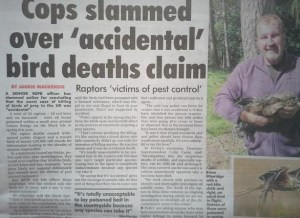
Brian Etheridge statementA week ago, Police Scotland issued a ludicrous press statement concerning the illegal poisoning of 22 raptors in Ross-shire. They said that they could CONFIRM that the birds “were most likely not targeted deliberately but instead were the victims of pest control measures“.
We’ve blogged quite a bit on that press statement already (see here, here, here, here). Our main issue with it is that the police appear to have ruled out intent (i.e. inferring the birds were accidental victims) before they’ve even identified a suspect. How could they possibly know what the intent was without first having a confession from the poisoner? We also take issue with them citing ’16’ victims instead of 22 victims. It may well be that they only have confirmed poisoning results from 16 of the 22, but to completely ignore the other six birds merely diminishes the scale of this crime.

We are not alone in this view. An article in the North Star quotes the RSPB’s Brian Etheridge (he’s the guy who has worked with the Black Isle red kite population for 19 years and was heavily involved in the discovery of the poisoned birds) as folllows:

It’s a very stupid statement. That’s almost justifying the killing. It’s like saying that a drunk driver who kills somebody didn’t go out with the intention of killing anyone. He was just drunk and it was an accidental death“.

Last week, we invited blog readers to contact two of the partner agencies involved in this investigation (RSPB Scotland & SSPCA) to formally ask whether they agreed with the content of the Police Scotland statement. The SSPCA is yet to respond, but Ian Thomson, Head of Investigations at RSPB Scotland has issued the following statement:

The use of poisoned bait, deliberately placed in the open countryside, is an indiscriminate and criminal act, whatever the intention of the perpetrator, and is aggravated in this case by the fact that an illegal chemical was used.

Whether these birds were killed deliberately or otherwise is irrelevant. Someone placed a fast-acting and very toxic poison out in the open, in an area well-known as being frequented by protected birds of prey, including a significant part of the north of Scotland red kite population. The resulting deaths were an entirely predictable result. It is very fortunate that the members of the local community who discovered poisoned birds did not become victims themselves.

The placing of poisoned bait, just a few miles from the popular Tollie red kite feeding station, was not only a reckless attack on local wildlife but also on the local tourist economy.

 I hope this provides clarification of our position”.

END.

Now, while Mr Thomson’s statement doesn’t really answer directly the question he was asked (and to be fair, we’d have been surprised if he had, given that the RSPB has to work in partnership with the police), it is nevertheless very revealing. He specifically mentions poisoned bait – something Police Scotland has so far failed to do, but more importantly, if you read between the lines, it’s pretty obvious that RSPB Scotland isn’t too happy about the Police Scotland statement: “Whether these birds were killed deliberately or otherwise is irrelevant” and “The resulting deaths were entirely predictable“. Indeed.

The Police Scotland statement came in for further scrutiny at the Scottish Government’s Rural Affairs Committee hearing on Wednesday. The session was all about wildlife crime and two senior police officers, as well as a rep from COPFS, gave evidence to what turned out to be an impressively well-informed Committee. We’ll be blogging more on what was said at that hearing in due course, but suffice to say it was extremely illuminating. The official transcript apparently won’t be available until Monday, but in the meantime we thoroughly recommend you watch the video of the hearing (available here).

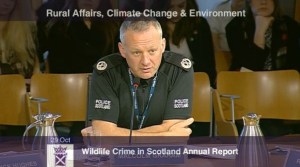
Malcolm GrahamSo, what was said about the Police Scotland press statement during that hearing? Quite a lot! The discussion on this specific item lasted for 18 minutes (see video 01.20-01.30 and then 01.34-01.42) and those well-informed Committee members clearly expressed their concern about the Police Scotland statement.

The police officers (ACC Malcom Graham, pictured left, and DCS Robbie Allan) tried to defend their position – notably, they didn’t apologise for any of the confusion their statement had caused – but their defence wasn’t very impressive. They did state, clearly, that they hadn’t intended to infer the poisonings were accidental, and they did confirm a criminal investigation was on-going. That was good, but they couldn’t justify why they thought the birds “were most likely not targeted deliberately” and quite surprisingly, they claimed that their partner agencies had been in support of the press release! Here’s part of what Assistant Chief Constable Malcolm Graham had to say:

 “We put out information into the public domain that we thought was going to clarify what we thought our best assessment was, lay behind the intent of the acts that we’re investigating, and from everything that we have done, in combination with a number of other agencies who are active in this field AND WHO SUPPORTED THE PRESS RELEASE THAT WE PUT OUT [Emphasis by RPS], we wanted to say that it didn’t appear that the activity had sought to deliberately target the birds that had been killed“.

We find it very hard to believe, given the formal press statement issued by RSPB Scotland, that they were in any way supportive of the Police Scotland statement. So who were these “other agencies who are active in this field” who “supported the press release“? We’re very interested in this and perhaps Assistant Chief Constable Malcolm Graham would like to be given the opportunity to explain, given how keen on public accountability Police Scotland claim to be. Perhaps he wouldn’t like to explain, but we’ll never know unless we ask. Emails to: ACC.CrimeMCPP@scotland.pnn.police.uk

Disingenuous SGA uses flawed analysis to misrepresent raptor crime data

There’s a shockingly poorly-researched article in today’s Telegraph, penned by Scottish journalist, Auslan Cramb.

He claims that ‘Wind turbines have killed more birds of prey than persecution‘ this year. The basis of his flawed claim is his analysis of the latest SASA data, covering the period Jan-June 2014.

Cramb states that, “Four raptors were killed by turbines between January and June. Over the same period, two birds were confirmed to have been poisoned or shot“.

Dear God. Let’s just have a closer look at the SASA data, shall we?

March 2014: Dead peregrine found in Strathclyde – Carbofuran poisoning.

April 2014: Dead peregrine found nr Stirling – [shot on the nest].

April 2014: Dead buzzard found in Fife. Poisoned [“banned poison” not named by police].

June 2014: Dead hen harrier found in Muirkirk – [shot].

That’s four confirmed illegal killings in the report. Can’t Mr Cramb count? There’s also a further entry:

January 2014: Dead rook, rabbit bait & hare bait (Carbofuran) found in Strathclyde. Not a raptor, granted, but its misleading not to mention this incident especially as Carbofuran-laced baits are routinely used to kill raptors. This incident is no less serious than a poisoned raptor.

But what’s missing from the SASA report? According to our research, the following:

January 2014: 1 dead bird [species unidentified] & suspected poison bait, South Lanarkshire.

March 2014: 16 red kites poisoned in Ross-shire [“banned poison” not named by police].

March 2014: 6 buzzards poisoned in Ross-shire [“banned poison” not named by police].

April 2014: 1 dead buzzard, allegedly shot, bludgeoned and stamped on, Dumfries & Galloway. A criminal trial is underway.

That makes a total of 27 confirmed illegally-killed raptors between Jan-June 2014, plus one rook and one unidentified bird.

Now, it’s quite possible that Mr Cramb is unaware of some of those additional persecution incidents (although if he was a half-decent journalist he would have done some homework – information about all of those crimes can be found on this blog).

However, it is inconceivable that the 22 raptors poisoned in the Ross-shire Massacre in March this year escaped his attention. He’s a journalist – it’s his job to keep abreast of the news.

Sure, the 22 poisoned raptors are not listed in the SASA report because mysteriously, SASA has chosen to exclude them, probably at the request of Police Scotland – we blogged about this exclusion here and the ramifications of their secrecy just keep coming, as evidenced here), but it’s very poor journalism for him to have excluded them from his analysis on windfarm deaths vs persecution deaths.

Cramb’s poor research skills are one thing. However, his flawed analysis appears to have been readily accepted by the Scottish Gamekeepers’ Association, and used by them to misrepresent the truth about raptor persecution stats. In the article, Cramb says this of the SGA:

A spokesman for the SGA said the report revealed the truth behind the “prejudice” aimed at landowners and farmers which painted the shooting industry as “guilty until proven innocent“.

He added: “It is important the public can understand for themselves the true picture regarding wildlife crime.

“After the appalling finger-pointing at the shooting and farming industries following Conon Bridge this year by the highly politicised conservation movement, we will be interested to see if those groups now call for the same licensing measures against the government-backed wind farm industry”‘.

So, the SGA have accepted Cramb’s analysis even though they are fully aware that the 22 illegally-poisoned raptors at Conon Bridge are not included in his results. They can’t deny knowledge of the Ross-shire Massacre because the SGA spokesman even mentioned it in his quote!

We would argue that the SGA is being disingenuous, readily accepting Cramb’s flawed analysis because it suits their agenda to keep denying the extent of raptor persecution crimes in Scotland. That’s outrageous. Why is this organisation still allowed to sit on the PAW Scotland Raptor Group, whose objective is to raise awareness of raptor persecution, not to deny it? They’re a disgrace.

Telegraph article here

UPDATE 3rd November 2014: RSPB Scotland has also blogged about this here

Ross-shire Massacre: Police Scotland, see what you’ve done?

Last Friday, Police Scotland put out an idiotic press release stating that they could now CONFIRM that the 22 raptors illegally poisoned in the Ross-shire Massacre seven months ago “were most likely not deliberately targeted“. It was an astonishing statement, not least because they had ruled out criminal intent before they’d even got a suspect, and despite the fact that those birds are known to have been killed with a banned poison. We blogged about it here and we’ll be blogging further on this shortly, following the grilling that senior police officers received during yesterday’s Scot Gov RACCE Committee hearing (see here).

Following that Police Scotland press statement, Tim (Kim) Baynes of Scottish Land & Estates wrote a letter to the Herald complaining about media speculation and stating (falsely) that raptor persecution crimes had declined (see here).

In response to that letter, yesterday Duncan Orr-Ewing of RSPB Scotland set out the facts about the increase in raptor persecution crimes (see here).

Today, another letter has appeared in the Herald, in response to Duncan Orr-Ewing’s letter. This letter was tweeted by the SGA this morning, with the following statement: “Herald letter from Ayrshire reader on the legal concept of innocent until proven guilty”.

Here’s the letter:

Thursday 30 October 2014

RSPB has its own agenda

DUNCAN Orr-Ewing, Head of Species and Land Management for RSPB Scotland, does not let the facts get in the way of his argument (Letters, October 29).

I would remind Mr Orr-Ewing that he stated in this very journal that a crime had been committed with the poisoning of raptors on the Black Isle and he then proceeded to promote his agenda against gamekeepers and shooting estates. Police Scotland has stated that no crime was committed, but that has not stopped RSPB advocating regulation which would allow it to attempt to criminalise legal businesses.

Rather than being a positive, the involvement of RSPB in police investigations creates a massive question about impartiality. This underlines the danger of allowing bodies with their own agendas to be involved in criminal investigations. They appear willing to ignore the fact that in this country we are all innocent until proven guilty.

David Stubley,

22 Templeton Crescent, Prestwick.

So Mr Stubley thinks that the Ross-shire Massacre was not a crime. This is precisely why Police Scotland should never have issued their press statement. Although their press statement did say: “The criminal investigation into their deaths is still ongoing”, those seeking to diminish this crime as something ‘accidental’ have been given the perfect fodder to perpetuate their ignorant claims which many average members of the public will likely believe.

As for the SGA re-tweeting this letter, with no mention that the Ross-shire Massacre was indeed a crime, well that speaks volumes, doesn’t it?

Mr Stubley is no stranger to muddying the water about the Ross-shire Massacre. In May he wrote another letter to the Herald about this crime:

Wednesday 21 May 2014

Falling prey to an accident?

I NOTE that immediately after the discovery of several dead raptors on the Black Isle many people jumped to the conclusion that they had been poisoned by a gamekeeper, even though there was not a shred of evidence to back up this assumption.

Several weeks later and despite a large reward being offered no-one has been charged. I have a suggestion for a possible cause of the poisoning.

Those responsible for the reintro­duction of red kites and other birds set up feeding sites where the birds know they will be fed and therefore congregate in large numbers. The birds are fed on agricultural beasts which have been killed, roadkill or, during the shooting season, gamebirds which cannot be sold. Could one of those food sources have been exposed to poison by accident? This would surely explain the concentration of dead birds and the lack of anyone to blame.

David Stubley,

22 Templeton Crescent, Prestwick.

We wonder if Mr Stubley is a member of the SGA? Just sayin’……

Police Scotland’s media strategy about this high profile crime has been appalling. They complained yesterday during the RACCE Committee hearing that media speculation hadn’t been helpful. They could easily have alleviated that speculation by publishing clear, timely and precise information about this crime, without jeopardising their criminal investigation.

More on this shortly.

Killing with impunity: Birdcrime 2013 published

Birdcrime 2013The RSPB has published its latest annual report on crimes against birds in the UK in 2013.

Their press release here.

The killing goes on, with impunity.

76 individual birds & other animals were confirmed illegally poisoned in 2013. This is more than double the figure from 2012 (29 confirmed victims).

Poisoning victims in 2013 included 30 buzzards, 20 red kites, 1 golden eagle and 1 white-tailed eagle.

68 confirmed incidents involved the shooting or destruction of birds of prey. Victims included two hen harriers, two marsh harriers and 5 peregrines.

These are just the confirmed incidents. A total of 338 incidents were reported to the RSPB in 2013, with North Yorkshire once again being the worst location. There’s also a worrying number of incidents from Powys in South Wales, seemingly relating to poisoned baits.

Birdcrime 2013 is a thoroughly depressing read. The RSPB calls on the shooting industry, again, to clean up its act. Judging by the contents of this report, that’s a seemingly futile request.

Well done and thanks to the RSPB for not only compiling these thorough statistics but importantly, for sharing them in the public domain.

Download Birdcrime 2013: Birdcrime 2013

Hen harrier Bowland Betty, found shot dead on a grouse moor in North Yorkshire. (Photo by Natural England).

Bowland Betty

RSPB spells out the facts to Tim Baynes

duncan-orr-ewingThree days ago Tim Baynes of the Scottish Land & Estates Moorland Group penned a letter to the Herald complaining about media speculation over the cause of the Ross-shire Massacre. He also (falsely) claimed that crimes against raptors had decreased.

Duncan Orr-Ewing of RSPB Scotland sets the record straight in his response letter:

The Herald 29 October 2014

Mr Tim Baynes of the Scottish Land and Estates Moorland Group accuses wildlife charities of speculating on the illegal poisoning case in spring 2014 involving the death of 16 red kites on the Black Isle, in his words “straining the relationship between land managers and conservationists” (“Landowners hit out at wildlife group claims on raptor killing”, The Herald, October 27 and Letters, October 27).

He also suggests that crimes against birds of prey are declining. Neither is correct.

We have long experience of supporting police wildlife crime investigations, and have a strong interest in ensuring that cases lead to successful prosecutions. We work within protocols agreed with the police. This appalling episode on the Black Isle has rightly caused public outrage, and there is intense frustration that justice is not being seen to be done.

The majority of the crime that is impacting on the status of bird of prey populations in Scotland occurs on land managed for driven grouse shooting. This is a fact supported by a substantial evidence base. Most land managers in Scotland act responsibly and have no involvement with wildlife crime. The Black Isle incident, which occurred on farmland, is by its location, very much the exception to the general rule. Due to the evidence of the systemic illegal killing of raptors and other unsustainable land management practices that occurs on some moors, we now consider that the voluntary approach has failed, and tighter regulation of driven grouse shooting is required.

As director of Scottish Land and Estates Moorland Group, Mr Baynes could perhaps do more with his own audience to help tackle the crimes that are impacting on the populations of golden eagles and hen harriers, and marginalise bad practice. The flouting of national laws designed to protect our most vulnerable wildlife is what under­mines the relationship between conservationists and grouse moor owners, and it also tarnishes the reputation of those land owners who observe best practice.

The latest Scottish Government statistics, issued only a fortnight ago, show an increase in the number of reported wildlife crimes against birds of prey in 2013 in comparison to 2012. In addition, the monitoring of bird of prey populations in Scotland still highlights that species such as hen harriers and golden eagles are absent or fail to breed successfully in large swathes of the central and eastern Highlands and Southern Uplands, where driven grouse shooting takes place. Golden eagles and other birds of prey fitted with GPS satellite tags, allowing accurate tracking by researchers, are also either being found illegally killed or poisoned or “disappearing” in these very same areas.

It is surely time for Mr Baynes to help his members take a responsible stance, thus resolving this serious problem soon.

Duncan Orr-Ewing,

Head of Species and Land Management,

RSPB Scotland,

2 Lochside View,

Edinburgh Park, Edinburgh.