
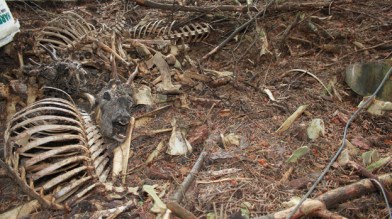
 Following on from yesterday’s blog entry about the conviction of ‘qualified’ gamekeeper Brian Petrie (here), more information has emerged.
The estate where Petrie committed his crimes has been reported by the Herald (see here) as Logie Estate, near Forres. The Herald article says: “The estate was not aware of Petrie’s actions and had cooperated fully in the SSPCA’s investigation“. We’ve been told by a local informant who wishes to remain anonymous that Petrie had previously operated a sporting lease (for pheasant shooting) on Logie Estate but apparently did not have the lease at the time his offences were commited. In other words, it seems he had no permission to be setting snares on Logie Estate at that time.
We asked yesterday whether Petrie was a member of the Scottish Gamekeepers’ Association. A statement on the SGA website this morning suggests he was not (see here) and the SGA has strongly condemned his criminal activities (good). They also go on to try and justify the use of snares but clearly miss the point – yes of course if you remove predators then their prey will increase, probably to artificially-high levels – that’s primary school stuff – but the debate is not whether predators should be removed (that’s a whole other argument!) but it’s the way in which they’re removed, and the welfare implications, that are key. For those interested in the snaring debate we recommend OneKind’s SnareWatch web page here. This site includes some useful reports about the use of snares and also provides a facility for the public to report the illegal use of snares. We’d also point readers to our earlier blog entry about how to recognise an illegally-set snare here.
The next case against gamekeepers accused of alleged snare crimes will be heard at Dornoch Sheriff Court next Monday, which is another hearing in the case against three gamekeepers from the Morvich Estate in Sutherland (see here and here for previous blog entries).
 Raptor Persecution UK
Well done SSPCA. Way past time SSPCA got those extra powers. The inspectors are spread throughout Scotland, they are equipped for the job, they deal with animal welfare law every day and they are professional and committed in the job that they do. Come on Scottish Government, you know it makes sense.
Here is a quote taken from a talk given by a senior member of the Scottish Gamekeepers Association, teaching game keepers about snaring.
“If you’re setting the snares properly the chances of that animal being injured are slim. I’ve done a lot of badgers in my days for various reasons and they are not the easiest thing to injure. If you get them around the neck (by a snare), the chances are – I’ve had them in the snares, I’ve killed them and I’ve skinned them – and there’s hardly a mark, I mean they’re so tough. That was in the days when you got away with these things right. Because folk used them for sporrans and things like that. There’s no way that you’re going to hurt that animal. It will just run around in circles (in the snare). It could however; if it gets itself caught around the Oxter (under the front leg) and cuts itself and is injured you have then got to make the decision, is that animal injured enough to be shot or should I let it go, but you’re not a vet man. There’s nobody here who is a vet and so you have got to make that executive decision. I would just let it go. If it’s bleeding a wee bit it will heal itself, it will heal itself, but it will not be injured if it’s caught around the neck. Again that goes for a wild cat or and a ‘mog’ (domestic cat) and again that’s your call. You have got to make a decision on the day by yourself.”
Hmm, I think some wildlife experts and vets would query this advice. Here we have a senior member of Scottish Gamekeepers Association who is not only condoning, but advising snare operators to shoot a protected species (in this case badgers and a wild cats) and to release a protected species from a trap, knowing that it is injured. Here is yet another example why we must get these snares made illegal as soon as possible and out of the hands of these people.
On a recent educational field research trip, post April 1st, it didn’t take long before I was finding snares set unlawfully. On one estate I found two snares that had been tagged, but strangely the rest of the snares set and positioned nearby, approximately fifteen, had not been tagged as the law in Scotland now requires. One set snare was also attached to a drag pole, a practice which was outlawed three years ago, whilst another set snare was found by a pheasant pen and half buried in a patch of snow. This would indicate that it was not being checked. Police were informed and I was disappointed by the response when the officer asked why I hadn’t informed the local gamekeeper about the snares when I found them. Two weeks later after discovering these snares a police officer visited the estate, but mysteriously all the snares had vanished, but not before I recorded them all and which will soon be going up on the OneKind ‘SnareWatch’ website along with a report. Other reports to follow.
ALL snares in Scotland, whether they are set or not, if they have been placed in position, MUST have an ID tag attached. The ID will have a letter F (fox), BH (brown hare) or R (rabbit), along with some numbers identifying the snare operator. If an operator of snares cannot be bothered to tag his snares then in my opinion he will not be bothered to check them regularly either. Even within the twenty four hour period when a snare must be checked in accordance with Scottish law a trapped animal can easily become seriously injured or die, but there is an added welfare risk to a snared animal if the snare that it is in is not being checked within that required time and so I would therefor advice anybody finding a snare which has no tag to inform the SSPCA as well as the police (Police Scotland is now 101). When reporting snaring incidents to the police always try to get a reporting or incident number from them for your records so you can call 101 at a later date to check up on progress of the incident. There are many other ways a snare could be set unlawfully or in itself be illegal and so if in doubt I would advise calling the SSPCA or us here at OneKind where we could give advice .
This quote, from the SGA statement is quite interesting;
“We would like to make it clear that, if anyone within our own membership was found to be operating snares in this thoughtless and illegal manner, they would no longer be a member of the SGA.”
So Steve, was this talk recorded in any way, and if so has this individual lost his job? Surely, if the SGA are a law-abiding organisation, then this person should be sacked from the role and thrown out of the organisation? But then again, we all know that serious criminal activity and gamekeeping go hand in hand.
On the issue of the SGA’s ridiculous statement, here we have another quote;
“Where snares are used properly, it keeps abundant predators in balance, benefiting gamebirds and declining birds such as conservation-listed lapwing and golden plover, whose eggs and young are taken by predators such as crows, foxes, stoats and weasels.”
There is something odd about this statement. Why, when commenting on the use of snares and their “beneficial” use for ground-nesting birds, would they include crows amongst the predators?
And a final quote;
“Gamekeepers and wildlife managers use approved snares, under strict licensing conditions, to reduce abundant countryside predators that prey on ground nesting birds.
There is no such thing as “abundant countryside predators”, unless there is an abundant prey supply. And perhaps the SGA should revisit the need for them to release this statement in the first place, and they will soon realise that the first part of this quote is not entirely true.