
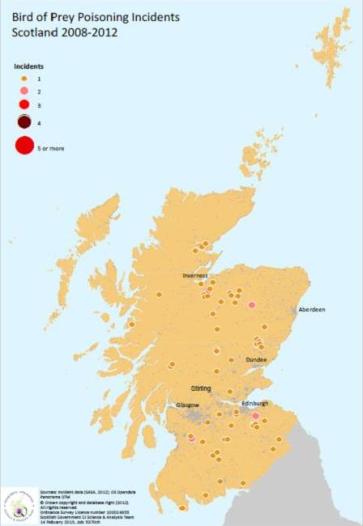
 The ‘official’ 2012 incidents of confirmed poisoned raptors in Scotland have just been published and show a marked decline in the number of poisoning incidents. According to the latest figures, the number of reported poisoned raptors fell from 16 in 2011 to three in 2012 (one golden eagle and two buzzards).
PAW Scotland press release here
BBC news article here
Are these figures an accurate reflection of what’s going on? We don’t think so. In fact we know they’re not. What the latest poisoning maps fail to show is the number of poisoned baits that were discovered in 2012, the number of other bird species that were poisoned in 2012, and the number of other animals that were poisoned in 2012. And obviously the maps don’t show the poisoning incidents that went undetected/unreported in 2012.
We know for certain that missing from this map is a poisoning incident recorded in the ‘Border’ region in May 2012. According to the published SASA statistics, a poisoned raven and crow were found, along with meat bait and two rabbit baits. This incident is listed as being subject to an ‘on-going police investigation’. Notably, this incident was not reported in the press. Why not? More importantly, why is this incident missing from this map? Why is the focus just on the number of confirmed poisoned raptors? Yes, the illegal poisoning of raptors is of huge concern, but it’s not just raptors that are victim to this barbaric practice. By excluding the discovery of poisoned baits and other types of poisoned species, the wider picture is not being shown. Why is that?
For example, we also know from the SASA stats that a horse and a dog were poisoned with Strychnine in January 2012, a cat was poisoned with Carbofuran and Isofenphos in March 2012, and another cat was poisoned with Carbofuran and Isofenphos in July 2012. None of these incidents appear on this map. There may well be others but the published SASA stats only go up to September 2012 – there’s the customary six-month delay in publishing more recent incidents. Obviously it’s not in the public interest to know where and when lethal poison is being laid out until many months after the event.
On a similar note, has anyone noticed the dot on the map in the Whithorn region (SW Scotland)? Could this possibly be the dead buzzard we blogged about last week (see here)? All we were told was that a man had been arrested following an investigation into a dead buzzard that had been found on the Glasserton Estate. Why didn’t the police press statement mention that the forensic tests confirmed it had been poisoned? Why are we not warned when potentially lethal poisoned baits are being placed out in areas where we might visit with our children and our pets? Why is it so difficult to tell the public what’s actually going on?
On a superficial level then, the latest figures suggest that all those people who’ve been busily poisoning our raptors for the last 100+ years have suddenly stopped. It’s highly implausible, but of course it is possible. Other possibile explanations include (a) the illegal poisoners have just got better at hiding the evidence; (b) they’ve switched to a new type of poison that isn’t currently being screened for in the SASA lab; (c) they’ve switched from poisoning as their method of choice to other methods that are less detectable, such as shooting and trapping.
Fortunately, the authorities are wise to point (c). Environment Minister Paul Wheelhouse said: “There has been real progress but we will not be complacent. I am determined to stamp out these practices once and for all and will remain vigilant to any change in approach being taken by those who seek to persecute raptors“. Of course, this statement is almost a carbon copy of statements made by previous Environment Ministers, going back several years, all of whom were ‘determined to stamp out illegal raptor persecution’ and all of whom failed. The current Minister has recently been presented with three perfect opportunities to make a stand: the dead golden eagle found on Deeside with two broken legs which is believed to have been caught in an illegal trap on an Angus grouse moor before being dumped further north away from the estate (we’ll be blogging more about this case in the next few days); the shot and critically injured golden eagle found on a grouse moor in Dumfries and Galloway; and the shot hen harrier that was found dead on another sporting estate in Grampian. It’ll be interesting to see how many more of these incidents he will tolerate before stronger sanctions are applied. Or, more to the point, how many more incidents we will allow him to tolerate.
 Raptor Persecution UK
All I can say is they must be getting special training in covert operations and cover ups. It can only mean one thing, we need to be more diligent and report every underhand stroke they pull, make life as difficult as possible for them, they deserve it.
In any period of time there is bound to be changes in the number of detected incidents , the number of reported incidents and , even, the lapse in time between detection and confirmation of poison in a carcase. I remain totally unconvinced by these figures……if they reflected a situation over ten years , then maybe they represent a change. For the Environment Minister to claim “there has been real progress” is naive spin and nothing else! Progress in what, detection rates, usage of poison rates, the efficacy of those involved!! Let’s see what arises in a year’s time and decide then. And remember, we are talking of poisoning,…….a single weapon in the armoury of persecution!!
Existing legislation is failing to protect raptors, so why not concentrate on removing the motive to persecute them in the first place?
We need a Wildlife Welfare Act to protect grouse / pheasants / etc from the game shooters, (since the Animal Welfare Act 2006 does not apply, apparently).
I for one do not believe any official stats over recent years regarding reported wildlife crime, I suspect its only those cases proven and convicted in the courts at best. Those not proven or out of time, lack of evidence despite video footage, poisoned birds etc are obviously not part of these ridiculous numbers we are led to believe. Now we have the added confusion by SNH granting licenses to kill problem birds and whatever else???
I have read that in this area of Argyll SNH has had 40 granted for the past two years to kill fully protected Ravens…it has to be asked, what other species, to who and why?. A crazy situation where farmers here are claiming grants for protecting habitats to assist rare butterflies and legally killing wildlife as they go. Now there’s a pile of figures not included in the survey of misleading stats throughout the country. Our Ravens are drastically down and Buzzards are following in the annual decline of raptors especially in some areas…wonder why?.
Its as easy as getting a bus pass it would seem, if you just fill the forms in to go out killing legally. Only two or three mind you…we trust you of course.
It really does show the levels of interest that the Scottish Government have for anything the RSPB has to offer, when they can’t get the RSPB representative’s name correct. In fact, they don’t even come close. But maybe I’m wrong. Perhaps Duncan has recently changed his name through deed poll.
And it’s been blogged about before, but are there other poisons that SASA are not testing for. It’s a bit like the recent horse meat scandal. Those performing the tests were only testing for horse meat or pig meat. For all we know, there could have been cat, dog, kangaroo or giraffe in products labelled as beef
Anyway, another plea to the RSPB – please distance yourselves from this ineffectual partnership that is heavily weighted in favour of the game shooting industry and its criminal activities.
On another note (http://www.birdguides.com/webzine/article.asp?a=3663), perhaps we should all consider abandoning all methods of vehicular transport for six months each year. Or maybe that decision will be made for us by the combined efforts of DEFRA, Natural England and SNH.
Overall very positive and progressive news on the poisoning front – just think of the consequences if we could reduce major crime in society by 70%.
This is positive news and hopefully even better news for our raptors however I remain sceptical as to the long term decline in poisoning cases. I wonder how much the weather last year put gamekeepers and the like off from committing these offences?
Its a pointless statistic, watch for the word poisoning incidents being changed to persecution incidents in the shooting press, criminals evolve to stay ahead of the game its only the dumb ones that get caught. ten years ago there were roughly 450 pairs of Golden Eagless today there is still only 450 pairs, These birds have the capacity to produce at least 300 fledged young in a year, natural mortality in young birds is much lower when there are vacant good territories as there is in Scotland, 3000 young Eagles have gone missing over ten years
I’d just like to point out that 2012 was a terrible year for the weather and this may have resulted in less people being out and about and a reduction in visibility for those that did venture out, if we see a sustained reduction in poisoning then we can congratulate them in the future. Even better if we can see an improvement in the breeding success of raptors in areas linked with driven grouse shooting then we might feel that there has been a change worth shouting about.
If you ever want to know what’s really going on speak to the guys on the ground, ask the local raptor workers if there has been any improvement in relationships or improved breeding success in these areas.