
The long-running hare snare trial is expected to end today if Sheriff Abercrombie has reached a verdict.
We’ve blogged a lot about this case as the verdict could have far-reaching consequences on the way our uplands are managed, with a particular impact on grouse moor management practices.
Earlier posts can be read here (and see links within).
Two weeks ago the court heard the final pieces of evidence from the defence team, which consisted of a string of gamekeepers insisting that the type of snare used in this case is ‘selective’ (i.e. it doesn’t trap any species other than the target species). It must be a magic snare.
Many thanks to the contributor who send us a copy of the Badenoch & Strathspey Herald, dated 22 November 2012, with a summary of the evidence heard in court:
Gamekeepers tell trial of ‘selective’ snares
THREE gamekeepers have given evidence at the trial of a colleague facing allegations of illegal snaring of mountain hares on Lochindorb Estate more than three years ago.
The keepers told Sheriff Ian Abercrombie they had used the type of snare set by David Taylor and caught nothing other than mountain hares.
Former Lochindorb keeper Alexander McConnachie (66), Stuart Kennedy (45), from Tomatin, and Alan Hodgson (54), head keeper at Dalmagarry and a committee member of the Scottish Gamekeepers’ Association with special responsibility for snaring issues, told the trial they had all used the “W” shaped snare, also known as a bow snare, as a means of controlling mountain hares on high ground on their estates.
David Taylor (65), who recently retired from his role as head keeper at Lochindorb, was charged with setting snares on April 14, 2009 on land at Lochan-t-Sidhie which were indiscriminate in which animals they could catch, contrary to the Conservation (Natural Habitats) Regulations which became law in 1994.
The trial, which started in March, reached its sixth day on Friday [16 Nov 2012] when the evidence was concluded.
Sheriff Abercrombie has agreed to written submissions being provided by both the Crown depute fiscal Iain Smith and the defence agent David McKie.
In evidence, Mr McConnachie said he was head keeper on Lochindorb between 1972 and 1993 before the new legislation came into place. He told the trial that where the snares were set, 1,500 feet above sea level, there were very few other species to be found.
Wildlife expert Hugo Straker (57), a senior adviser with the Game and Wildlife Conservation Trust and an expert on snaring law in Scotland, had earlier told the trial that the snares could be selective depending on how and where they were set. He also differentiated between a trap and a snare. In his opinion he said a trap was a spring-loaded device which can kill or trap an animal live while the snare was a “restraining device” which can kill.
Mr McConnachie told the court snares are never referred to as traps. ‘A trap is a mechanical device’, he said. Often they were concealed in a box to trap the targeted species and for the protection of other mammals. Wire cage traps, known as Larsen traps, were also used to control crows.
He said he used the “bow” snare used by Taylor extensively between 1990 and 1993 on Lochindorb because of the increase in tick of the moor.
Asked if he had ever found other animals caught in the snares he replied: “No, never. They are very selective, very humane and highly visible. I never caught anything else in them”.
He said you would get the occasional fox or roe dear [sic] at that level but it was quite rare to see a golden eagle.
Asked by depute fiscal lain Smith if an animal broke a snare how he would know it was a hare that did this. He said there was always evidence of hare fur nearby if a snare broke.
Mr Hodgson said the snares were perfectly legal at the time but gamekeepers had stopped using them because of this court case. He commented: “I would use them again in a minute. They were a brilliant tool. Easy to carry, easy to set and highly visible”.
Mr Hodgson said foxes and deer avoid them because they have forward vision. However, he said: “Hares have blind spots because their eyes are on the side of their heads, unlike predators”. He said he used them for nine years and never once found another species in them.
The trial was told by Mr Straker that since the alleged offence there had been major changes in law governing the use of snares going through parliament and all snares must have stops so mammals caught are not throttled and can be put down humanely. Everyone using them will require to be trained and certificated by a Scottish Government approved body and, from April next year, every snare will carry the operators certification number.
Police Constable Eric Sharkey (45), a wildlife officer with Northern Constabulary, inspected the site after a tip-off from a member of the public.
 Thanks to the contributor who sent us a recent copy of the following article published in the Press & Journal (dated 28 Nov 2012) -:
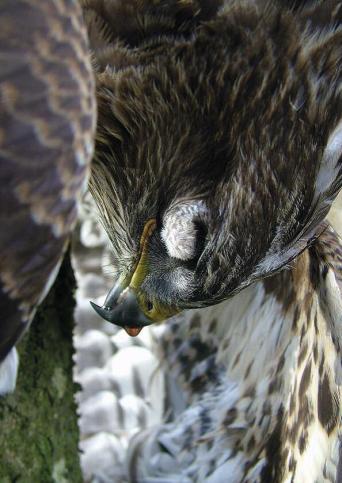 RSPB Scotland has just published its latest report, The Illegal Killing of Birds of Prey in Scotland in 2011. You probably won’t be surprised or shocked by the content, especially if you’ve read the previous 17 annual reviews. In fact, when you read this 18th review, you might get a strong sense of déjà vu.
 Once again the occupations and interests of those convicted for illegal raptor persecution crime have been analysed (data from 2003-2011 inclusive). 87% of them were gamekeepers (7% pigeon racers, 3% pest controllers, 3% farmers).
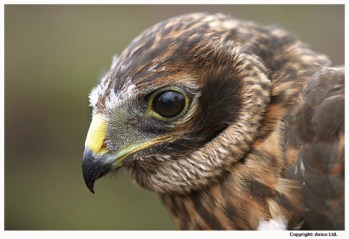 Regular blog readers will know we’ve been following the story of the two Langholm hen harrier chicks since the summer: the female chick, ‘Blae’ was reported dead in early September and her sibling, ‘Barry’ was reported ‘missing’ just a couple of weeks later. Since then we’ve been critical of the lack of information that’s been made available to the public (previous blog entries
  Following on from yesterday’s blog entry, The curious incident of the eagle in the night-time (see
  Before we discuss their comment, we’d like to acknowledge Tayside Police for engaging in the discussion. Although they have a duty to respond to emails sent to them by members of the public, they aren’t obliged to post comments on blogs or a similar forum and they deserve some credit for doing so in this instance.
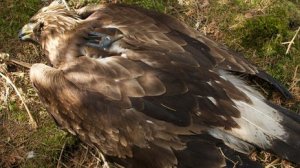 And finally, we go back to the Environment Minister’s statement about this incident. In whose interest was it to suggest that this was not a criminal offence? Who advised the Minister that the eagle’s injuries could have been the result of anything other than a criminal offence? It probably wasn’t the RSPB Investigations Unit given they put out a press release stating that they believed the eagle had been caught in an illegally-set trap (see press release
 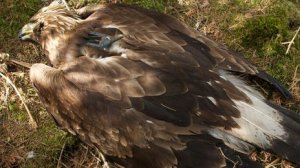 Six months ago, a dead golden eagle was found close to a lay-by on a quiet road in Aberdeenshire. The bird’s satellite-tracking data showed it had remained motionless on an Angus grouse moor for 15 hours, before inexplicably moving 15km north to the lay-by, in the dead of night, where it was found dead several days later. A post-mortem conducted by the Scottish Agricultural College laboratory in Aberdeenshire concluded that the eagle had suffered two broken legs due to trauma “that could be consistent with an injury caused by a spring type trap“. The SAC said the severity of the eagle’s injuries “would prevent the bird from being able to take off“.
 Here’s
 Raptor Persecution UK