
 Following yesterday’s blog on the lack of prosecution for the apparent crow-beating incident (here), a comment made by Libby Anderson (acting CEO of animal protection charity OneKind) raises a pertinent question that deserves to be followed up.
Libby wrote the following comment on the OneKind blog (and we hope she doesn’t mind us reproducing it here) –
“It is frustrating that such compelling evidence has not been allowed to get into court. And ironically, the Partnership Against Wildlife Crime (PAW) Scotland has just issued guidance to the public about reporting wildlife crimes – including looking out for suspicious vehicles and taking photographs or video. But wouldn’t that be “surveillance” too …? ” (Her comment can be viewed here on the OneKind blog).
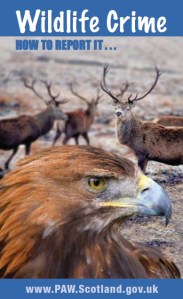
This is an important and timely question. As Libby points out, PAW Scotland has, quite rightly, recently made a very big deal about providing advice to the public on how we should report incidents of suspected wildlife crimes. PAW Scotland has funded a big publicity drive on this issue, led by Grampian Police, who produced an information card called ‘Wildlife Crime: How to Report It’ (see here to view the card). They printed 30,000 of these cards, for distribution across Scotland (see here for our earlier report on this initiative). The advice on these cards is, amongst other things, to video or photograph the scene.
PAW Scotland has also added a new section to its website, specifically explaining the law that governs the use of traps and snares, and the action that should be taken if a member of the public suspects illegal activity. This action includes getting photographic evidence (see here).
If you’ve read the OneKind blog, written by the investigator who filmed the alleged crow-killing incident, it appears he followed the PAW Scotland advice: He suspected illegal activity, he filmed it, and he reported it to the police. It seems the police shared his suspicions, otherwise why would they have passed the evidence to the COPFS?
So, why then did COPFS (and the Lord Advocate) decide not to prosecute? Their official reason, according to the OneKind blog, was:
“This decision was made because the prosecutors believed that I was carrying out surveillance on the estate when in fact my visit, which I had made very clear to the procurator Fiscal, was of an education one and was to gather film and photographic material of the various ways legal snares are set to capture wild animals.”
Is this the sort of treatment that any of us can expect if we see suspicious activity and decide to report it to the police? If it is, then we would suggest the system needs urgent revision. It is clear that PAW Scotland (which happens to be chaired by the Scottish Environment Minister, Stewart Stevenson), needs to provide clarification on this issue as a matter of urgency if we are to have any confidence in the reporting system currently in place.
The Minister could ask COPFS to provide a detailed explanation of why, in this case, a decision not to prosecute was made, especially in light of the OneKind investigator’s statement of why he was on that land at the time he witnessed the alleged offences. We think there is precedent for COPFS to provide an explanation – see here, section 7).
The issue here is not whether the alleged actions of the gamekeeper were lawful or unlawful (that can only be decided by a court, and obviously in this case, the opportunity for a court hearing is not going to happen). The issues here are:
1) who is eligible and who is ineligible to report a suspected wildlife crime, and
2) what standard of response can the public expect to receive from the law enforcement authorities when they report an incident of suspected wildlife crime?
If you want to send an email to Environment Minister (and Chair of PAW Scotland) Stewart Stevenson, to ask for clarification on these issues, here’s his email address: ministerforenvironment@scotland.gsi.gov.uk
Questions to ask him might include:
1. Can I expect to be accused of lying if I report a suspected wildlife crime to the police?
2. Can I expect my integrity to be questioned if I report a suspected wildlife crime to the police?
3. If the answer to the above two questions is ‘no’, why was a decision not to prosecute made in the alleged crow-battering incident (you’ll need to provide a link to the OneKind blog so the Minister knows to which case you are referring).
4. Please can you provide me with a definitive list of legitimate reasons that allow me to be on a piece of land, recording a suspected wildlife crime?
5. Please can you provide me with a definitive list of illegitimate reasons for being on a piece of land, recording a suspected wildlife crime?
 Raptor Persecution UK
“This decision was made because the prosecutors believed that I was carrying out surveillance on the estate when in fact my visit, which I had made very clear to the procurator Fiscal, was of an education one and was to gather film and photographic material of the various ways legal snares are set to capture wild animals.”
Even if the observations were carried out as per a preconceived plan exactly what is wrong with “surveillance”. Plenty people keep a watch on those they suspect to be involved in criminal activity and often photograph the action.
Have we reached the position where criminals only need to fear being seen when it happens by coincidence and not when right minded citizens set out to obtain evidence.
Great question, Craig.
Hopefully folk will take a couple of minutes to email the Environment Minister and ask for clarification. There is clearly much confusion surrounding the legality of filming suspected wildlife crime and this needs to be addressed, urgently.
I totally agree , in my opinion cruelty is clearly seen here yet that is apparently ignored . The favour of the alleged abuser given the go ahead. The video seems clear cut in evidence, yet ignored.
Theres no confusion in my mind…it has been done repeatedly in the past with absoloutely no problem [except in the infamous Macleod case…which should therefore be seen as an exception not the rule…and should have been appealed?]…the only difference as far as I can see is in the people making those decisions..
Without going into all the arcane detail “surveillance” in this context relates to the powers given [or not given in many cases!] to authorities such as the police…OneKInd [or indeed the RSPB] are not an authority nor of course is any other member of the public who in Scotland has every right to walk on open land.
As Ive said before it appears that the only people a member of the public is unable to film committing a crime…and have his evidence used in court…are gamekeepers. I wonder why?
Lastly…if anyone brings up the red herring of single witness evidence as an excuse not to prosecute…eye witness + film can be enough to corroborate a crime in Scotland.
Thanks wingandaprayer373,
We too thought it was clear, after the precedent-setting cases of the past, but apparently confusion does still reign. As you probably know, the OneKind man is not the first person to have his motivation questioned – we know of at least one other person (member of the public) who, after reporting suspected wildlife crime, was apparently questioned at length about his reasons for being on the land in the first place.
So, let’s have some clear guidance, once and for all and from the man at the top (Environment Minister) – who is eligible (and ineligible) to film suspected wildlife crime, as recommended by PAW Scotland, and report said suspected wildlife crime to the police?
Thank you very much for pursuing this here – certainly don’t mind at all! I am also writing to Stewart Stevenson and will be sure to let you know of the response.
Thanks Libby. Kudos to OneKind for publicising the issue in the first place.
There was me thinking that we now had the right to roam in Scotland with or without a camera. I always have a camera with me when I walk the Hills and Glens of our beautiful country. I would not hesitate to use it to film any wrong doings that I stumble across and would gladly pass it on to the Police as I hope any Citizen would. However I would be very angry at being questioned by the police as to what I was doing walking, as is my right, and taking photos of a crime. Last I looked this was a free country and as long as I don’t cause any damage while out walking in the country then I am free to Roam. And any Environment Minister/Police/Court/Fiscal who says otherwise can get stuffed. I am trying to be polite.
Very polite, Stewart, considering!