
How many of the eight Scottish police forces have a dedicated wildlife crime unit? How many of them have a full-time Wildlife Crime Officer? How many of them have a Wildlife Crime Education Officer? How many of them publish quarterly wildlife crime statistics for their region? Answer = not many. But one of them has all of the above, and more.
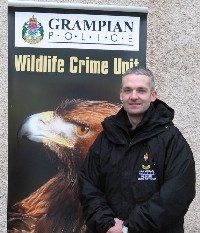 Grampian Police Force, covering the north-east region of Scotland, is way ahead of all the other Scottish police forces when it comes to tackling wildlife crime. This police force has employed a full-time Police Wildlife Crime Officer since 2006 – the excellent and highly effective Dave MacKinnon, who apparently stepped down earlier this year. Much of the Grampian Police Wildlife Crime Unit’s success is as a result of Dave’s hard work and commitment. In addition, there are up to 11 part-time Police Wildlife Crime Officers spread throughout the Grampian region.
In July 2010, Grampian Police appointed the UK’s first ever Wildlife Crime Education Officer to the Unit. Andy Turner, a former National Nature Reserve Manager with SNH, took on the three-year secondment to raise awareness of wildlife crime and to provide educational inititatives to schoolchildren and communities throughout the region.
As far as we know, Grampian Police is the only force that publishes quarterly wildlife crime statistics (see here), although oddly, these figures do not explicitly include raptor persecution incidents. The North East of Scotland has been recently reported as having some of the highest rates of wildlife crime in the UK (see here).
But the Grampian Police Wildlife Crime Unit is not content with just regional coverage of its own area. In recent months, it has worked to produce resource material that is useful to other police forces as well as to the general public. For example, it has produced a set of 11 ‘Aide-Memoir’ cards that have been issued to Wildlife Crime Officers throughout Scotland. These cards cover issues such as raptor persecution, badger persecution and deer poaching. Each card provides basic information on the subject, straightforward instructions on how to deal with alleged incidents, and contact details for specialist advice (see here).
In addition, it has produced an information card called ‘Wildlife Crime: How to Report It’. This card provides simple information, including a list of essential do’s and don’ts when at the scene of a suspected wildlife crime, as well as a list of contact details for every police force in Scotland. With the help of a PAW Scotland grant, Grampian Police has printed an initial 30,000 cards that are being distributed throughout Scotland (see here).
 Grampian Police deserve recognition for their proactive stance on tackling wildlife crime. This police force puts many of the other Scottish police forces to shame. The Grampian Police Wildlife Crime Unit isn’t perfect, but then who is? What’s important is that this group has taken giant steps towards a zero tolerance policy on wildlife crime. Some might say, ‘Well, it’s their statutory duty to deal with wildlife crime so why are you congratulating them for doing what they’re supposed to be doing?‘ It’s a fair point, but when you compare what Grampian Police has been doing with what most of the other Scottish police forces have (or haven’t) been doing, then we would argue that Grampian Police has actually gone further than its statutory duties and has demonstrated a meaningful commitment far greater than any other police force in the UK, let alone in Scotland.
For further information about the Grampian Police Wildlife Crime Unit:
Grampian Police (wildlife crime) website here
Introduction to Andy Turner, Grampian Police Wildlife Crime Educator here
Aug 2011 article about Grampian Wildlife Crime published in Aberdeen Voice here
 Raptor Persecution UK
I do congratulate Garmpian on all of this and I do respect the work of Dave McKinnon…
NE position at the head of the crime statistics is without doubt due to the fact that they are encouraging reporting and then actually recording it…all too often much has gone unreported across Scotland..
But…[there’s got to be a but!!!] given the high rate of “unsolved” estate-based wildlife crime in Scotland…other Forces dont need to have all that infrastructure in place to start fighting raptor crime, they just need to encourage all police officers when they get involved….and the Fiscals/Crown Office need to encourage them too..