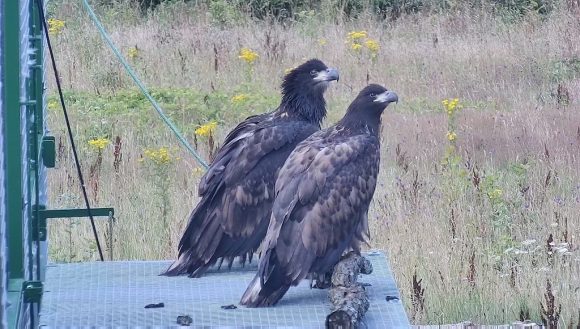
Does your elected representative ‘welcome birds of prey’?

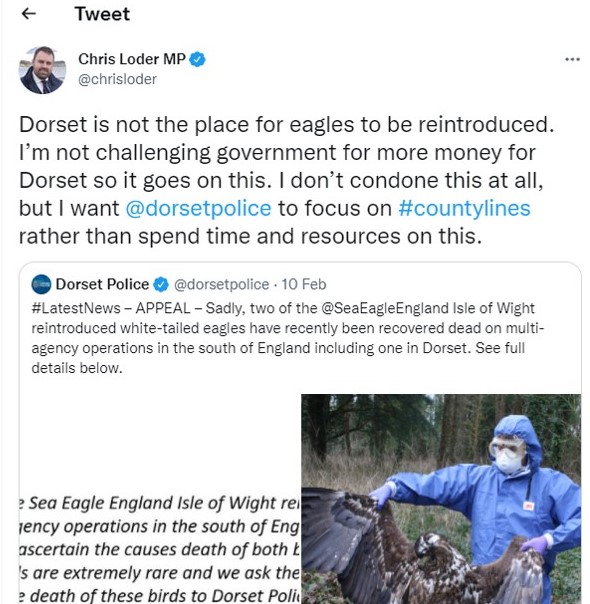
Ten days ago, following the news (here) that two white-tailed eagles from the Isle of Wight Reintroduction Project had been found dead in suspicious circumstances (one in Dorset, one in Sussex), Dorset Conservative MP Chris Loder published an extraordinary statement on Twitter, whipping up some Victorian anti-eagle hysteria by declaring that ‘Dorset is not the place for eagles to be reintroduced‘ and suggested that Dorset Police shouldn’t waste ‘time and resources‘ on investigating (see here and here).

Twitter went in to meltdown and the story was picked up by several national newspapers, including the Independent and the Guardian.

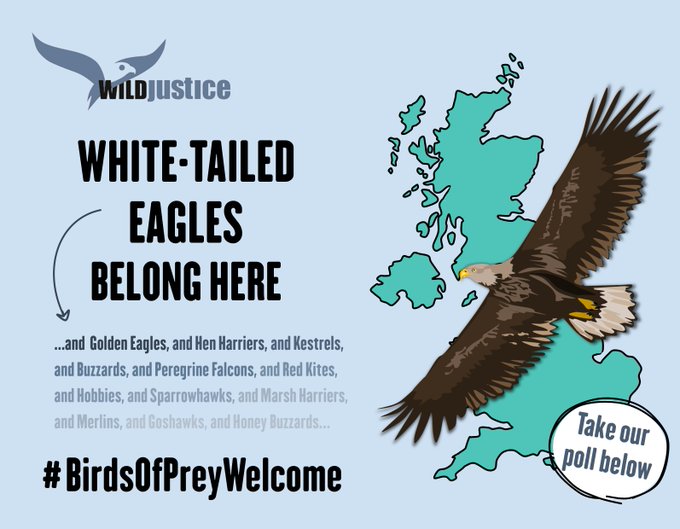
The story prompted a new hashtag on social media, #BirdsOfPreyWelcome, with people from around the country sharing stories about how welcome birds of prey are in various locations.

Conservation group Wild Justice launched a Twitter poll (runs for three more days, here); the results so far indicate overwhelming support for birds of prey.

But given the ongoing persecution of raptors across the UK, Wild Justice is also asking members of the public to email/write to their elected representatives, whether they be in England, Scotland, Wales or Northern Ireland, to ask whether they, too, support birds of prey.

Wild Justice has provided some guidance about what your email/letter might look like (here).

I’d encourage as many of you as possible to participate. We know that letter-writing campaigns like this can be incredibly powerful when enough people get involved. It sends a clear message to our elected representatives that raptor persecution is an issue of concern that needs addressing.

Thank you

Dorset MP Chris Loder’s farming connections may explain his anti-eagle hysteria

Yesterday, Dorset MP Chris Loder’s Twitter notifications must have been off the scale as hundreds of angry people took him to task for his shocking comments (here) about not wanting Dorset Police to investigate the suspicious death of a white-tailed eagle, found dead on a Dorset shooting estate in January (here).

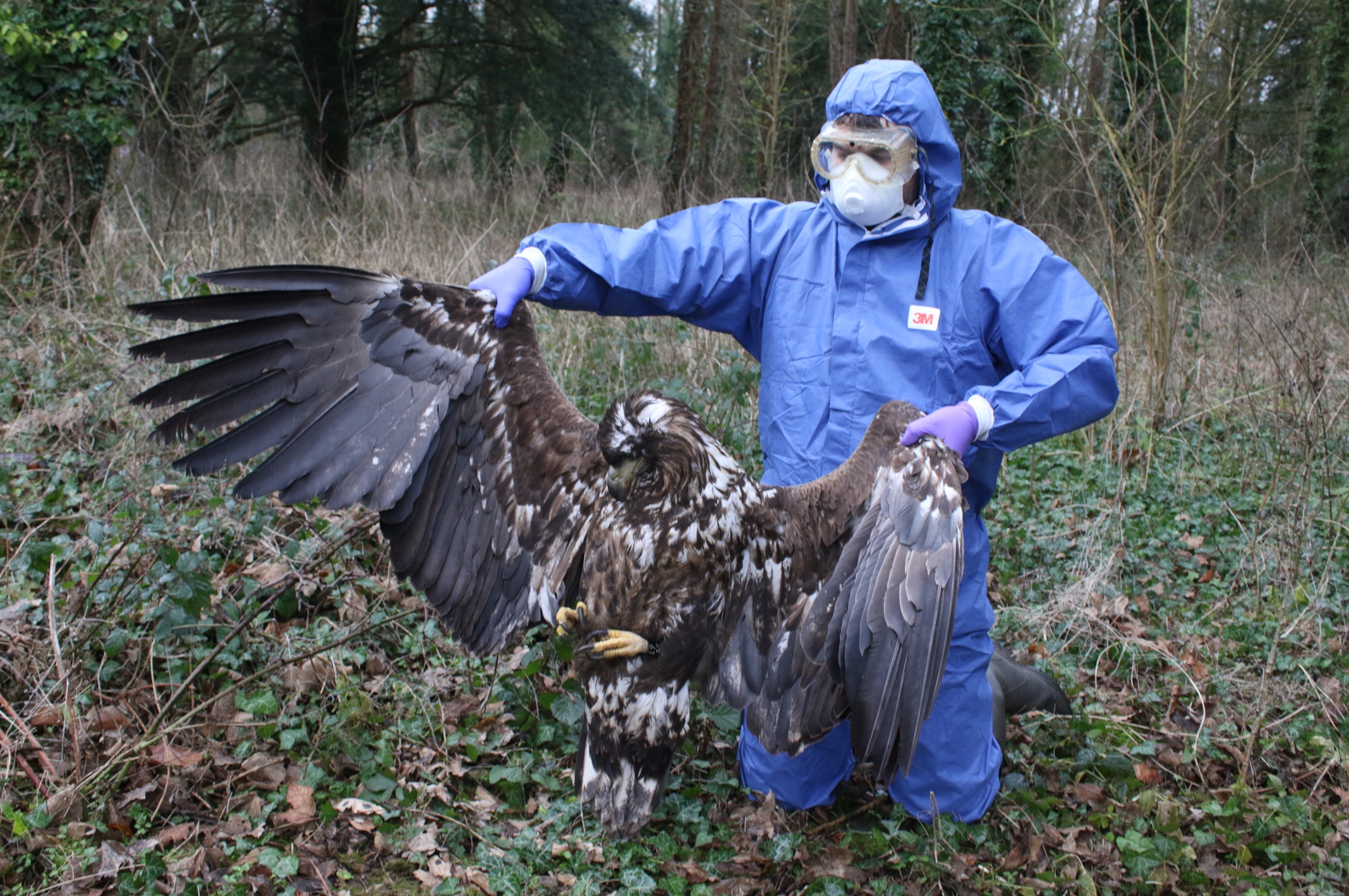
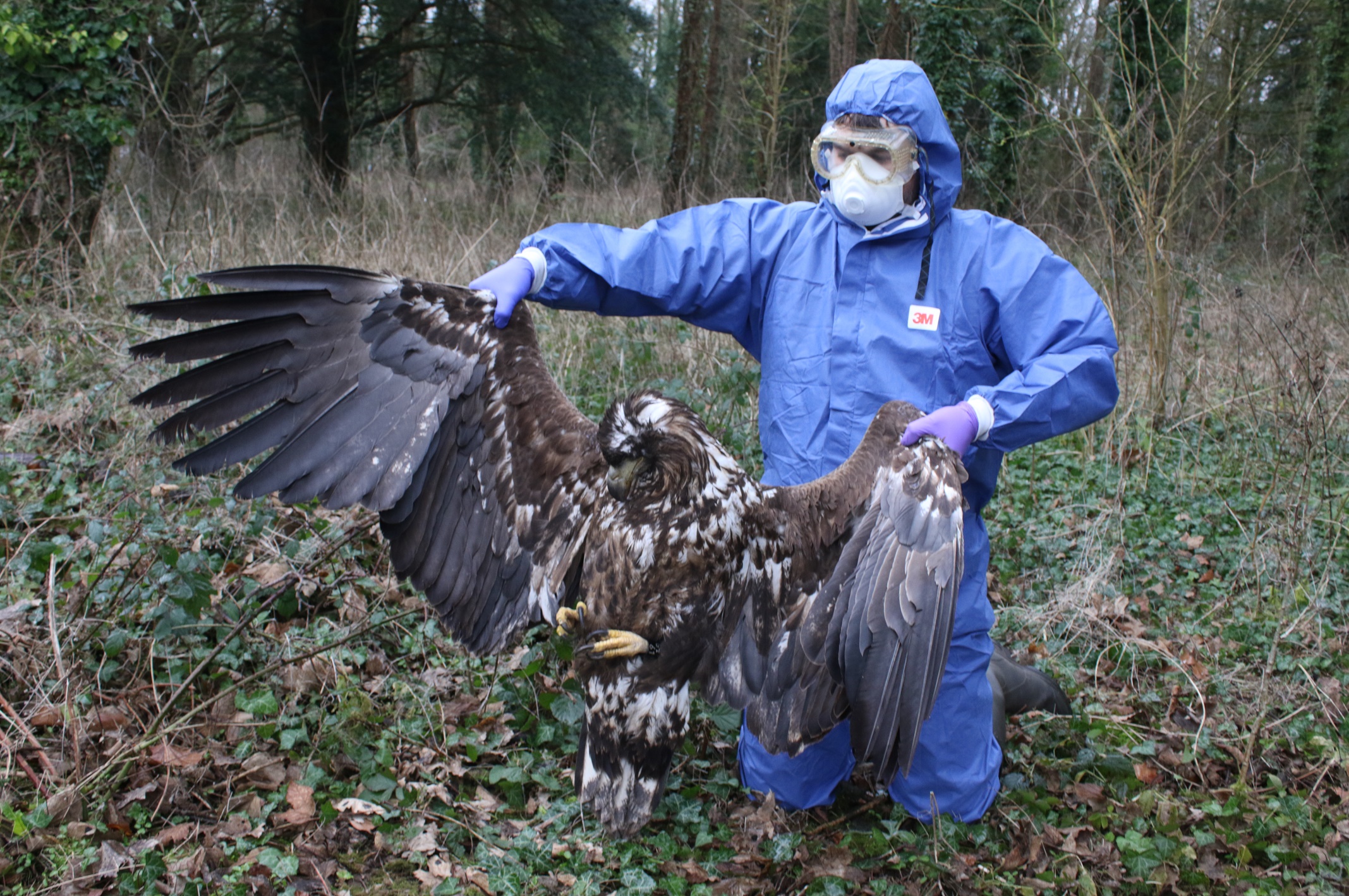
[The dead white-tailed eagle being collected for post mortem. Photo by Dorset Police]

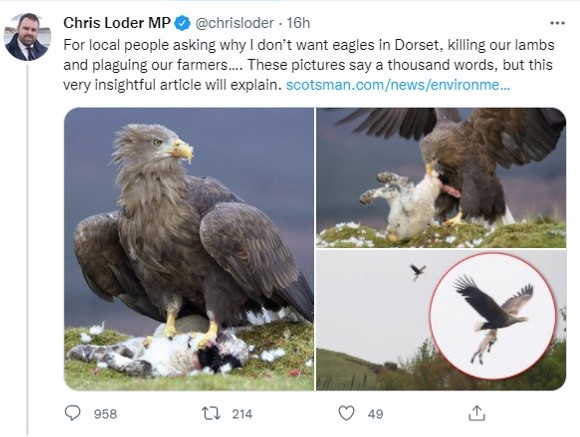
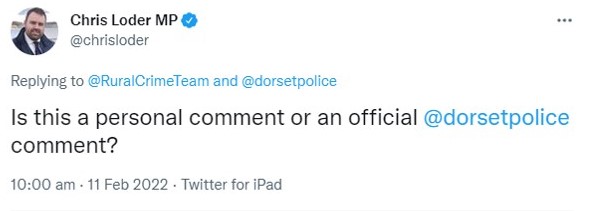
Last night Chris Loder added fuel to the fire by posting this on Twitter:

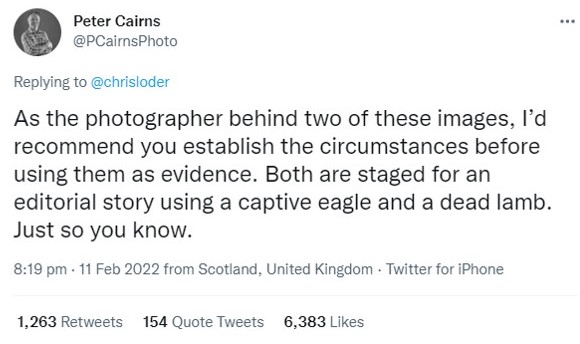
This ridiculous statement (“plaguing our farmers“, FFS!) attracted plenty of well-deserved ridicule but it also generated even more anger and in some cases, unfortunately, personal abuse towards Mr Loder. But even when photographer Pete Cairns pointed out that the two photos of the eagle with a lamb had been staged, by Pete, for a separate project and then mis-used to illustrate the Scotsman article to which Mr Loder was referring, (this was a captive eagle with an already-dead lamb placed in front of it), Mr Loder was not for backing down.

It’s a familiar argument, of course, to those of us who have listened for years to prejudicial-driven hysteria about white-tailed eagles, although typically this has come from the Scottish Gamekeepers Association (who remembers them writing to the Scottish Government warning that sea eagles might not be able to distinguish small children from prey?!) but to hear it from an elected MP in southern England was quite a shock, especially a Conservative MP whose senior Ministers keep pretending that bird of prey conservation is important to them (e.g. see here and here).

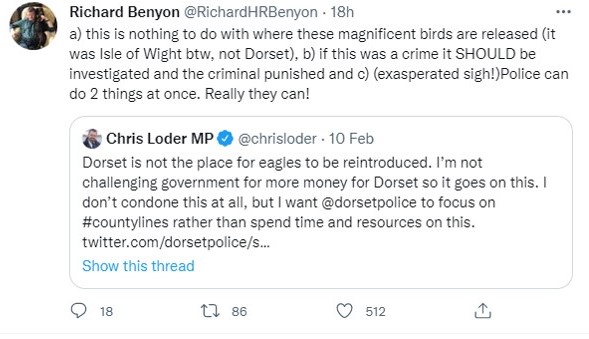
However, even DEFRA Minister Richard Benyon could read the room on this one and yesterday typed a suitably-exasperated tweet to Chris Loder, which was probably code for, ‘Shut up, you’re not doing us any favours here’:

I’d speculated yesterday that perhaps Chris Loder’s dissatisfaction that Dorset Police’s time and resources were being put towards an investigation into the suspicious death of the sea eagle might have something to do with the fact that the Conservatives have received substantial local party donations, over a number of years, from a prominent Dorset estate that just happens to be owned by a very wealthy landowner who appears to be part of the hunting set and whose spouse appears to have played a prominent role with the Countryside Alliance (here).

That may well be part of the story, but it’s also clear from his posts last night and from online information about his farming background that he’s susceptible to, and believes in, the anti-eagle propaganda routinely pumped out by the National Farmers Union, an organisation who refused, formally, to support the Isle of Wight Eagle Reintroduction Project because of a perceived fear of the impact the eagles would have on livestock, despite extensive consultation and evidence-based assurances by the project team that live sheep would not be at high risk. [But note that not all farmers agreed with the NFU’s stance and a number are supportive of the project].

This morning I’ve been sent some more information that suggests Chris Loder’s position may also be influenced by his family’s farming connections. Detailed research undertaken by Guy Shrubsole (author of the brilliant website Who Owns England) has revealed that Chris Loder’s family appears to run a tenanted farm on a large Dorset estate (a different estate to the one that’s been making donations to the local Conservative party) and on that estate there’s also a sizeable pheasant shoot.

As before, there is no suggestion whatsoever that either Chris Loder, his family, or the estate on which his family runs a tenanted farm, has anything whatsoever to do with the death of the white-tailed eagle in Dorset. What I am suggesting is that it is worth bearing in mind that when Chris Loder is proclaiming eagles as the farmers’ enemy and pronouncing that the police shouldn’t be spending time and resources on investigating the suspicious death of one of those eagles, found dead on a Dorset game-shooting estate, it’s worth remembering these vested interests of his.

And as interesting as this all is, I think it’s also a distraction from the main topic of interest here, and that is, when are we going to see the toxicology report of the dead eagle found on a game-shooting estate in Dorset in January and the dead eagle found on a game-shooting estate in Sussex last October?

And on that same subject, when will Natural England release the post mortem results of the two satellite-tagged hen harriers found dead in October last year (see here)? Or tell us about the investigation into the satellite-tagged hen harrier that probably had its wings pulled off 11 months ago (see here)?

Dorset MP Chris Loder doesn’t want Police to investigate suspicious death of white-tailed eagle

Further to yesterday’s news that two reintroduced white-tailed eagles have been found dead in suspicious circumstances on game-shooting estates in southern England and that Dorset Police are investigating the circumstances of the one found in Dorset (here), local conservative MP Chris Loder has made an extraordinary statement on Twitter this morning.

[The dead white-tailed eagle found in Dorset. Photo from Dorset Police]

Here’s his tweet:

Is this guy for real?

This is a suspected wildlife crime of a very serious nature. The three most common methods for killing birds of prey on UK game-shooting estates are shooting, trapping (and then clubbing to death) and poisoning. We don’t know which of these methods, if any, have been deployed in this case but all are potential features of the case. The fact that Dorset Police have stated the eagle has gone for toxicology analysis suggests that poisoning is a possibility.

The poisons most frequently used to kill birds of prey in this country are highly toxic substances – banned in many countries because they’re so dangerous that just a tiny amount is enough to kill a human. The effects of using poisonous baits are indiscriminate. Not only may the baits kill the target species but any other species that happens to come into contact with it, or any pet dog, or any inquisitive human, including a child.

If the eagle has been shot, there’s a dangerous armed individual on the loose in Dorset.

If the eagle has been trapped and clubbed to death, there’s a dangerous psychopath on the loose in Dorset.

Why on earth wouldn’t Mr Loder MP want Dorset Police to spend time and resources investigating this incident?

It wouldn’t have anything to do with the local conservative party receiving donations from a prominent Dorset estate, would it? [Note: I am not in any way suggesting that the donor estate is linked to the death of this eagle, I’m pointing out that on the Parliamentary register of interests Mr Loder has listed substantial party donations from a Dorset estate whose owner appears to be linked to ‘country sports’].

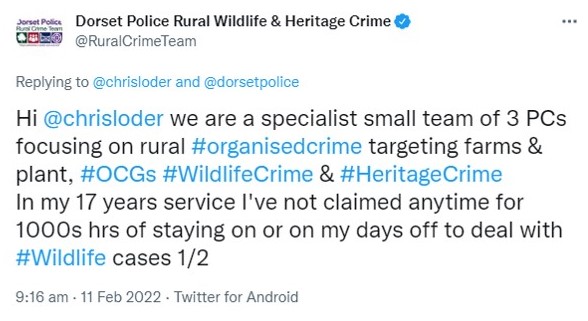
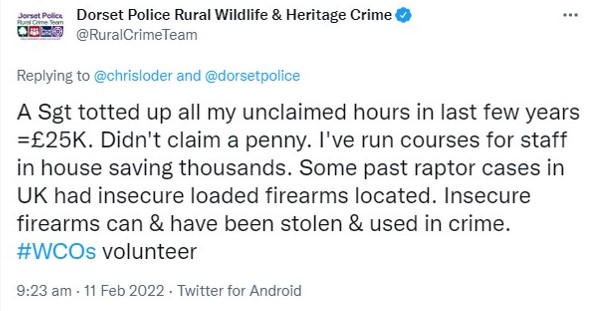
Dorset Police’s Rural Crime Team have hit back at Mr Loder:

Mr Loder’s response:

FFS. As if it isn’t difficult enough for under-staffed, under-resourced police officers to investigate wildlife crime. Imagine being on this rural crime team, which, by the way, has a deserved reputation for being diligent and sincere when dealing with alleged raptor persecution crimes, trying to get to the bottom of what will be one of the highest profile cases this year, under huge public pressure to deliver results (quite rightly, IMHO), and the local MP publishes demoralising tosh like this.

I hope his inbox is flooded with complaints.

UPDATE 12th February 2022: Dorset MP Chris Loder’s farming connections may explain his anti-eagle hysteria (here)

UPDATE 14th April 2022: Dorset Police refuse FoI request for correspondence between them and Chris Loder MP on poisoned eagle (here)

UPDATE 5th March 2025: Natural England quietly releases intriguing grouse moor location where two shot brood meddled hen harriers found dead (here)

Two reintroduced white-tailed eagles found dead in suspicious circumstances on game-shooting estates in southern England

Well it took longer than I expected but it’s happened.

Two of the reintroduced white-tailed eagles from the Isle of Wight Project have been found dead in suspicious circumstances on game-shooting estates in southern England.

The fact they were discovered during multi-agency searches is a clear indication that criminality is suspected. One was found in Dorset in January and the other one is believed to have been found in Sussex last October.

Toxicology results are awaited for both eagles, although why it’s taken four months for the results from the first bird is not yet clear.

[The dead white-tailed eagle found on a game-shooting estate in Dorset. Photo by Dorset Police]

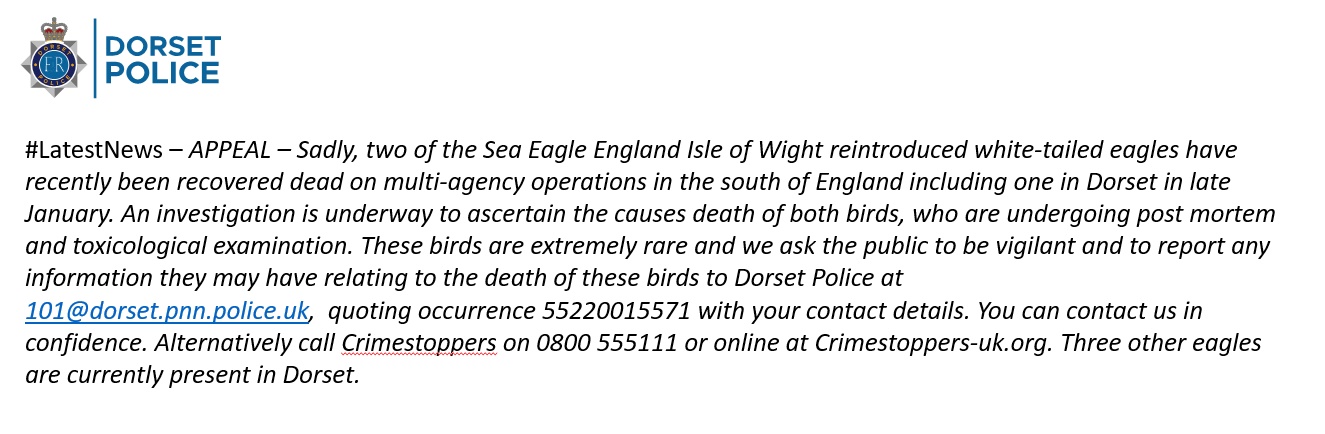
There is huge concern for the safety of three other white-tailed eagles currently in Dorset, which I imagine is why the police have decided to issue this statement:

UPDATE 11th February 2022: Dorset MP Chris Loder doesn’t want Police to investigate suspicious death of white-tailed eagle (here)

UPDATE 12th February 2022: Dorset MP Chris Loder’s farming connections may explain his anti-eagle hysteria (here)

UPDATE 15th February 2022: Police investigate after sudden death of white-tailed eagle on Isle of Wight (here)

UPDATE 27th April 2022: White-tailed eagle poisoned with banned pesticide on a game-shooting estate in West Sussex (here)

“These crimes are being covered up”: RSPB Scotland speaks out as bird crime soars

Bird crime soared across the UK in 2020, and RSPB believes Scotland’s native birds of prey will continue to be persecuted, according to two new articles published yesterday in The Courier and The Press & Journal:

Birds of prey such as hawks, eagles, kites, buzzards, harriers, falcons and owls are protected by the Wildlife and Countryside Act 1981.

The RSPB’s annual report revealed that 2020 was the worst year on record for bird crime across the UK.

There were 137 known and confirmed incidents of birds of prey being killed, the highest number in 30 years.

This trend has continued in 2021, according to Ian Thomson, RSPB Scotland’s head of investigations.

He said: “Bird crime covers a whole manner of crimes against wild birds, but what is particularly of concern are those crimes that have an impact on the populations and ranges of a variety of species.”

According to Mr Thomson, bird crime, also known as raptor persecution, is particularly rife in the north-east, with the hen harrier population being a fraction of what it was 20 years ago.

He also explained that golden eagles are only occupying around a third of the breeding territories that they ought to; meanwhile, peregrines have largely disappeared from the uplands in the north-east.

Mr Thomson believes that these low population numbers are largely down to the persecution of birds of prey for the intense land management of grouse moors.

Birds of prey are at the top of the food chain and they hunt and eat grouse and pheasants.

In an attempt to maximise the number of game birds available for clients to shoot, grouse moor managers will eliminate any threats to their birds.

This can include burning patches of heather moorland and releasing clouds of smoke into the air, leaving medicated grit out in the open and hare baiting.

The National Golden Eagle Survey shows that across Scotland the population as a whole is doing well and that there are significant increases in the west where there are no grouse moors.

Mr Thomson said it is the east of Scotland where the populations are a fraction of what they should be.

Scientific reports show that the illegal persecution of golden eagles, hen harriers, red kites and peregrines are largely happening in areas managed for game bird shooting.

Unfortunately, these findings are largely happening in the middle of nowhere,” Mr Thomson said, “out of sight, out of mind, where witnesses are very far and few between.

But, occasionally, an incident occurs that is detected.

In 2020, about a week into lockdown when the entire population of the country was told to stay indoors or to exercise within five miles of your house, we had a young white-tailed eagle poisoned on a grouse moor in Strathdon, in an area with an appalling history of crimes against birds of prey going back 10-plus years.”

Mr Thomson explained there have been cases of birds of satellite-tagged birds disappearing under “suspicious circumstances”.

In March a golden eagle was illegally poisoned on the Invercauld Estate, a grouse moor in the Cairngorms.

Last year a satellite transmitter that had been fitted on a golden eagle was found at the side of a river.

It was wrapped in lead sheeting and thrown into the river where it lay for four years until a walker found it on the bank.

Mr Thomson said: “This is the efforts that people are going to cover up these crimes, they don’t want to be caught.

The problem is, as I say, these crimes are seldom witnessed; to actually get any idea of the scale of it we’re really depending on doing population studies.

We’re never going to find all the victims because, needless to say, if someone shoots a golden eagle they’re not going to leave it around for the RSPB or the police or a hillwalker to find.

These crimes are being covered up.”

The RSPB Scotland’s head of investigations explained that there are other factors that have impacted the populations of birds of prey.

He said that all birds face challenges “just surviving”, through natural mortality, starvation, and loss of habitat due to the intensification of land management or agriculture.

Because of this, populations are much lower than what would be ideal, and so deliberate and illegal killing is adding extra strain to the populations.

As well as being important for biodiversity, birds of prey are an attraction for tourists visiting Scotland.

People interested in photography travel from all over the world to capture Scottish wildlife, bringing millions to the economy.

Mr Thomson highlighted that, on the Isle of Mull, around £5 million a year goes into the island from people going to see white-tailed eagles.

The Scottish Government plans to introduce licensing to grouse moors, which Mr Thomson described as a “game-changer”.

He believes the loss of a license to shoot will introduce a significant deterrent to the estates that do persecute birds of prey.

There are places you wouldn’t want to take your dog for a walk in case it gets caught in a trap or eats something poisonous,” he said. “It’s not just birds that are dying, it’s people’s pets.

Perish the thought that some day some small child will come into contact with chemicals like this, it could have absolutely devastating effects.

It’s not only illegal but it’s reckless and indiscriminate.”

ENDS

Update on raptor persecution investigations in Scotland from National Wildlife Crime Unit

A couple of weeks ago I attended the Scottish Ornithologists’ Club’s (SOC) virtual annual conference. One of the speakers I was keen to hear was PC Gavin Ross, an Investigative Support Officer at the National Wildlife Crime Unit (NWCU).

Gavin is the ISO for Scotland and has been in post for a year (see here).

His presentation opened with an explanation of the differences between the NWCU and Police Scotland (essentially the NWCU is an intelligence gathering unit but it also has other functions, particularly supporting the police with wildlife crime investigations). He went on to describe the seven national wildlife crime priorities and the importance of partnership-working in tackling wildlife crime. In fact he mentioned the importance of partnership-working quite a few times and encouraged attendees to report anything suspicious as this information all helps to build an intelligence portfolio around certain areas and individuals.

The subject of raptor persecution was prominent in this presentation, as you might expect for an audience with the SOC.

We learned that this year alone there had been police enquiries into the death and /or disappearance of 14 eagles: 11 golden eagles and 3 white-tailed eagles. It was emphasised that as only a small proportion of eagles are tagged, this figure was likely the tip of a much larger iceberg.

Six of the 14 investigations related to satellite-tagged birds (whose tags had stopped suddenly without any indication of a technical malfunction, and are therefore considered suspicious).

Two of the 14 investigations are considered ‘historical’ in that they relate to the discovery of items (tags!) that had been cut off eagles and dumped in a river or a loch in previous years (e.g. see here and here for previous examples of this).

As these are ongoing investigations much of the detail was redacted from the presentation. That’s fair enough for a while, to protect the integrity of the investigations, but I hope Police Scotland will be publicising the circumstances of these incidents in due course.

Gavin also talked about what he called ‘Operation Stoop, aka Operation Tantallon’, which is the ongoing investigation into the theft and laundering of wild peregrines. This is a multi-agency operation involving the police, Scottish SPCA, NWCU and SASA, with additional support from members of the Scottish Raptor Study Group. So far three people have been charged, including a serving police officer (see here), but as it’s a live case many details are currently being withheld.

Gavin didn’t reveal any details but talked about the wide range of investigative techniques deployed so far, including surveillance, peregrine DNA analysis, searches under warrants, bankers warrants, cyber crime and the Proceeds of Crime Act.

I think the breadth of this investigation and the resources being thrown at it is testimony to the seriousness and extent of this particular crime, and from what I hear it’s certainly not just restricted to Scotland. I’m sure we’ll be hearing more in due course.

Overall this was an interesting and well-delivered presentation. I hope the NWCU will consider doing more of these and making them freely available on their website.

UPDATE 16 December 2023: Part-time gamekeeper & son plead guilty to peregrine laundering charges; serving police officer cleared (here)

New release location being sought for white-tailed eagles in Norfolk

Following last week’s news that the Wild Ken Hill Estate in Norfolk has inexplicably backed out of hosting a project for the restoration of white-tailed eagles in East Anglia, which was due to start next year (see here), project leaders at The Roy Dennis Wildlife Foundation have announced that the search is on for a new release location.

A statement posted on the Roy Dennis Wildlife Foundation website reads:

We are very disappointed that Wild Ken Hill do not wish to proceed with the White-tailed Eagle reintroduction project that Natural England licenced earlier this year. The early results from the Isle of Wight project are extremely encouraging, and we continue to believe that East Anglia is highly suitable for the second stage of the restoration of the White-tailed Eagle in England, as detailed in the Ken Hill feasibility report.  As such, we are now seeking an alternative location, and are in consultation with Natural England about this. We hope to report more news in due course‘.

Given the number of pheasant and partridge shooting estates in Norfolk, including the royal Sandringham Estate with its reputation for hosting raptors (ahem), and the game-shooting industry’s repeated claims about how raptors are always welcome, there shouldn’t be any difficulty finding a new venue to support the planned release of young eagles.

Should there?!

Wild Ken Hill Estate in Norfolk pulls out of sea eagle restoration project

Well this is all a bit odd.

The Wild Ken Hill Estate has pulled out of hosting a white-tailed eagle restoration project in west Norfolk.

Earlier this year, the progressive rewilding estate was hailed by conservationists as news emerged that the estate had joined forces with the Roy Dennis Wildlife Foundation to release up to 60 white-tailed eagles, donated by Poland, over a ten year period to help restore the species to its former range in East Anglia.

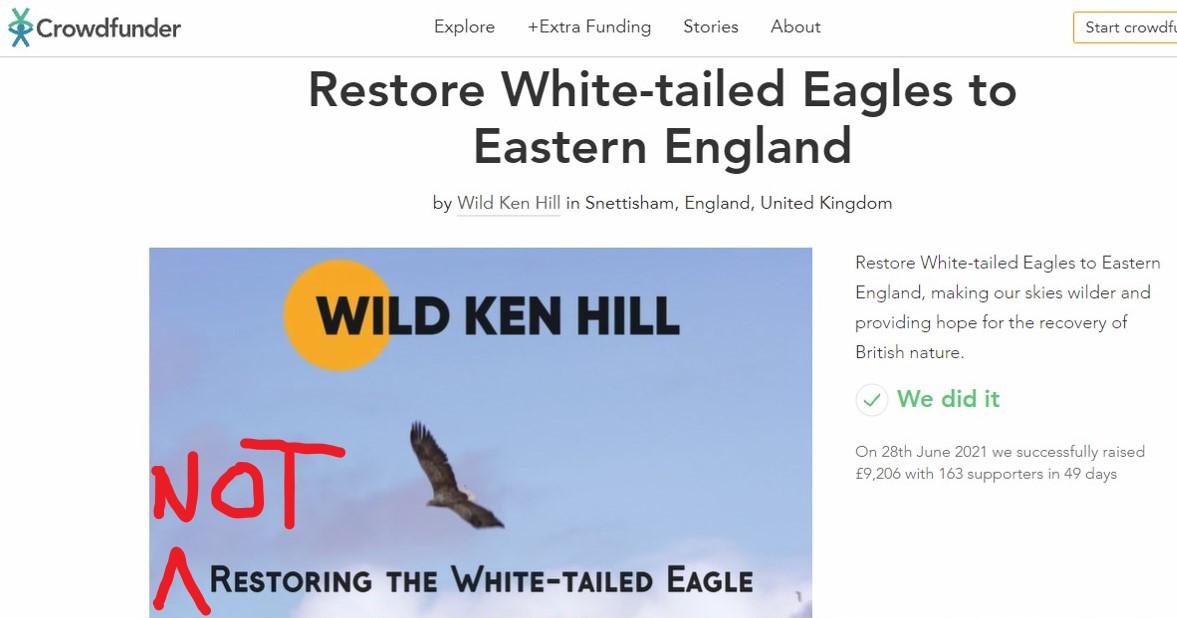
Public support was in place (91% of respondents to a consultation were in favour of bringing the eagles back), even the neighbouring Sandringham Estate was reported to be ‘supportive’ (here), Natural England had agreed to licence the project (here) and a crowdfunder had raised over £9,000 to help pay for logistics (here).

Everything looked to be going ahead for the first eagles to be released in 2022 until a recent announcement on Wild Ken Hill Estate’s blog saying the project was ‘on hold’:

Eagle project on hold

We have reluctantly decided that we will not reintroduce White-tailed Eagles at Wild Ken Hill in 2022 as planned.

We continue to believe that the restoration of White-tailed Eagles to Eastern England is an important and inevitable conservation goal, and also that the original plans for a release beginning in 2022 could have been delivered very successfully in partnership with the Roy Dennis Wildlife Foundation.

We have, however, taken the difficult decision to focus on other aspects of our nationally-significant nature and regenerative farming project. In particular, we feel it is worth putting our full weight behind the pioneering innovations we are making as part of our regenerative farming approach. The greater biodiversity, carbon sequestration, and improved profitability demonstrated at Wild Ken Hill with this approach over the last 3 years have the potential to have a huge impact across the UK if adopted by others; we feel it is therefore imperative to focus on these. In addition to regenerative farming, Wild Ken Hill supports beavers and is a release site for Natural England’s curlew headstarting project.

We are sure that the restoration of the White-tailed Eagle to England will continue successfully on the Isle of Wight, and we hope that dispersing juvenile eagles continue to visit Wild Ken Hill and the Norfolk Coast, attracted by the area’s suitable habitat.

We wanted to specifically and publicly offer our apologies to the Roy Dennis Wildlife Foundation, who have been exceptional project partners to date and a pleasure to work with.

We also would like to thank and apologise to those that supported this project when participating in the consultation, particularly the 91% of the general public that offered their support and the many landmanagers and conservation organisations that did the same.

We will shortly be in touch with those that supported the Crowdfunding campaign to offer a full refund.

ENDS

That’s all a bit odd, isn’t it?

Mark Avery has suggested that some birding, landowning and shooting interests may have been ‘leaning on some members of the family’ (see here) and there is certainly some evidence of that here.

Was that enough to make Wild Ken Hill Estate buckle? It’s pretty disappointing, if it was, especially as real and potential concerns were carefully considered in the project’s comprehensive feasibility report, published in April 2021:

What has been said, and/or what threats have been made since then, to force Wild Ken Hill Estate to reconsider its involvement?

The most ridiculous thing in all of this is that the eagles are already making their way back to Norfolk, including visiting the Wild Ken Hill Estate, as they disperse from the release project on the Isle of Wight.

How long until the first poisoning incident, do you reckon?

12 more white-tailed eagles released on Isle of Wight

Twelve more white-tailed eagles (also known as sea eagles) have been released on the Isle of Wight as part of a licensed project to reintroduce the species to southern England.

Formerly resident in parts of England, the sea eagle was extirpated a few hundred years ago thanks to persecution. The same thing happened in Scotland but the eagles have since been successfully reintroduced there after Norway generously donated young birds for the project, first for the Isle of Rum (1975) and then later in Wester Ross (1993-1998).

The reintroduction project in southern England is led by the Roy Dennis Wildlife Foundation and Forestry England, and began in 2019 by releasing six eagles in the first year and seven birds last year, bringing the total released so far to 25.

The aim is to release up to 60 birds over a period of five years with the objective of creating a small breeding population in the region after an absence of over 240 years.

Young eaglets are being collected by experts from the Scottish Raptor Study Group, under licence, from selected nest sites in western Scotland and are taken down to special release aviaries on the Isle of Wight where they’re cared for until ready for release. Each eagle is carrying a satellite transmitter so the team can monitor and track their progress.

[Two young sea eagles released from the holding aviary and considering their first flights. Photo by Forestry England]

Roy Dennis, MBE, Founder of the Roy Dennis Wildlife Foundation said: “We are now three years into this reintroduction project, and it is extremely encouraging to see just how successfully white-tailed eagles are settling into the English landscape. Highlights for me have included watching the birds learn how to successfully fish all year round and the growing interactions between the birds. I am also always fascinated in tracking some of their huge exploratory flights across England and Europe and their ultimate return back to the Isle of Wight.” 

We have seen from other reintroduction programmes that returning lost species offers real benefits for the health of our environment, and to people and local economies. None of this would be possible without the support of many people and I would like to thank everyone who has helped us again with this year’s release and ongoing monitoring of the birds.” 

Steve Egerton-Read, White-Tailed Eagle Project Officer, Forestry England, said: “Over the last three years we have closely tracked the progress of these incredible birds. It’s been brilliant to see how well they are fitting into the landscape and we are hopeful that before too long they will breed in England again.” 

It’s been particularly rewarding to hear from people across the country who are delighted to have seen the birds in their local area. It’s still a real thrill for me to see these incredible birds in the skies above the Isle of Wight and I look forward to the day that they are re-established right across southern England.” 

For more information about the project and to keep updated about the eagle’s movements, please visit the Roy Dennis Wildlife Foundation website here.

Golden eagles have been illegally killed on Scottish grouse moors for 40+ years but apparently we shouldn’t talk about it

In response to the news that Police Scotland are investigating the circumstances of five eagles found dead in the Western Isles earlier this month (see here), Scottish Land & Estates (SLE), the grouse moor owners’ lobby group has issued what I’d call a staggeringly disingenuous statement, where the blame for ongoing raptor persecution appears to be being projected on to those of us who dare to call out the shooting industry for its ongoing war against birds of prey.

Here’s SLE’s statement in full, dated 20 August 2021:

Response to raptor fatalities should not depend on location or landuse

Reports of five eagles being found dead on the Western Isles are very serious. 

Police Scotland has said that officers are investigating and it is to be hoped that the facts of these potentially shocking incidents are established as quickly as possible.

The birds – four golden eagles and a white-tailed sea eagle – were found at separate locations on Lewis and Harris and it is said that, at this stage, they are not linked.

No grouse shooting takes place on the Western Isles and we wholeheartedly support the police’s appeal for information and anyone who can help should call Police Scotland on 101, or make a call anonymously to the charity Crimestoppers on 0800 555 111.

It has been suggested that intraguild predation – where one species predates on another – may be one possible explanation in these cases but equally we accept there is the prospect that a terrible wildlife crime has been committed to protect livestock.

If that is the case, outright condemnation is the only rightful response.

That applies wherever raptor persecution takes place.

The response from some quarters thus far to the incidents on the Western Isles is in sharp contrast to what happens over alleged incidents that occur in areas where land is managed for grouse shooting. In these cases organisations and campaign groups are very quick off the mark to point fingers. If a wildlife crime takes place on land managed for shooting, livestock farming or any other land use (and such incidents are thankfully rare, becoming more so all the time) then it must be investigated and the culprits should face the full force of the law. It can be difficult to prosecute but Scotland now benefits from some of the most stringent laws against raptor persecution in Europe. A lot more could be achieved with less finger pointing and more constructive collaboration on the ground. Scotland is fortunate to have historically high numbers of golden eagles and we want to see even more of them.

ENDS

So SLE is unhappy that campaigners keep ‘pointing fingers’ at the grouse-shooting industry whenever an illegally shot / poisoned / trapped bird of prey is discovered dead or critically injured on, er, a driven grouse moor?!!!!!!!!!

Or when satellite-tagged hen harriers and golden eagles keep ‘disappearing’ in suspicious circumstances, on or close to driven grouse moors.

If these crimes were just a one-off, once-in-a-blue-moon occurrence then yes, perhaps SLE would have a point. However, the connection between the driven grouse shooting industry and the illegal persecution of birds of prey has been clear for decades, and backed up with endless scientific papers and Government-commissioned reviews (here are the latest for golden eagle and for hen harrier).

Here’s an example of how long this has been going on – a scientific paper published in 2002, using data from 1981-2000 – demonstrating an indisputable link between grouse moors and illegal poisoning:

1981 – that was 40 years ago!!

And yet here we are in 2021 and still illegally poisoned golden eagles are being found dead on grouse moors and still nobody has ever been successfully prosecuted in Scotland for killing a golden eagle. The most recently confirmed poisoned eagle was this one inside the Cairngorms National Park, right next door to the royal estate of Balmoral. In fact this eagle is believed to have fledged on Balmoral a few months before it flew to neighbouring Invercauld Estate (an SLE member, no less) where it consumed a hare that had been smothered in a banned pesticide and laid out as a poisoned bait. The person(s) responsible for laying this poisoned bait have not been identified.

[Poisoned golden eagle laying next to poisoned mountain hare bait, Invercauld Estate, Cairngorms National Park. Photo by RSPB Scotland]

Such is the extent of illegal persecution on some driven grouse moors, it is having (and continues to have) a population-level effect on some species, including golden eagles, hen harriers, red kites and peregrines.

And such is the extent and quality of this scientific evidence, the Scottish Government has committed to implementing a licensing scheme for grouse shooting in an attempt to try and rein in the criminal activity that underpins this so-called ‘sport’ because Ministers recognise the grouse-shooting industry is incapable of self-regulation.

I don’t know what SLE means when it says it wants ‘more constructive collaboration on the ground‘. Perhaps it means that gamekeepers will step forward and provide more than ‘no comment’ interviews when the police are investigating the latest crime on a grouse-shooting estate, instead of offering the usual wall of silence?

Perhaps it means the estate owners will refuse to employ the sporting agents and head gamekeepers whose methods are well known to include routine raptor persecution? (These individuals are well known – it’s no secret within the industry who they are).

Or perhaps it means that the shooting industry itself, including the game-shooting organisations, the shooting press etc will blacklist those estates known to still be killing birds of prey, instead of accepting funding donations from them and pretending that they don’t know what’s going on there?

That’d be useful, constructive collaboration, wouldn’t it?

Until all of that happens, SLE and the rest of the grouse shooting cabal can expect people like me and my colleagues in the conservation field to continue shining a bloody great big megawatt spotlight on this filthy industry.