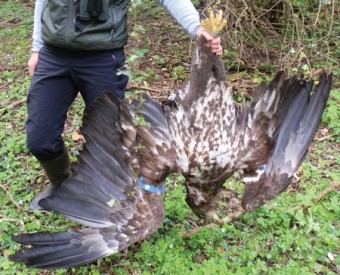
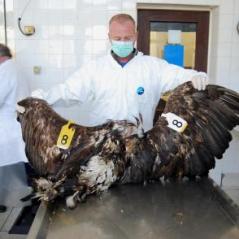
Two more sea eagles poisoned in Ireland

And so it continues….

Two more sea eagles have been found poisoned in Ireland, one in County Mayo and one in County Donegal. One of the birds had also been shot.

Article in Irish Examiner here

Article in Mayo Advertiser here

The Director of the Golden Eagle Trust (the group behind the reintroduction of golden eagles, white-tailed eagles and red kites to Ireland) says he fears a pair of nesting golden eagles which have ‘disappeared’  from County Donegal may also have been poisoned (see here).

Bits and blogs

Some sad news from the Irish Republic – the white-tailed eagle pair who were the first sea eagles to attempt to breed in Ireland for over 100 years (see here) has failed. The birds abandoned their nest on Tuesday evening. In a double blow, the remains of a young satellite-tagged sea eagle have been discovered in County Mayo. The cause of death is still being investigated (see here for a report in the Irish Examiner).

In other news…Mark Avery has come out fighting over the English hen harrier debacle. This morning’s blog (here) focuses on Natural England’s lack of transparency over the results of their ten-year hen harrier satellite tracking project. Good for him, and much stronger than the blog he wrote on Monday (here) where he discussed the poisoned red kites found in the Chilterns. He asked readers to connect the dots but when they did, he claimed he couldn’t see the same picture. Perfectly understandable of course but totally improbable that Mark hadn’t joined the dots within about five seconds flat.

There’s another blogger in town. Stuart Housden is the Director of RSPB Scotland and has kicked off his own [RSPB] blog this month. It was pleasing to see that his third post was about wildlife crime sentencing in Scotland (see here). We’re waiting to see whether he blogs about this weekend’s inaugral Scottish Birdfair. As RSPB Scotland Director, it was probably Stuart’s ill-informed decision to co-host the event at Hopetoun; we’ve blogged before about this incredible lack of judgement (see here and here).
If anyone is attending the Scottish Birdfair this weekend, you might want to pay a visit to the Scottish Land and Estates table (the Scottish landowners’ representative body) and ask them whether any of the following are (a) members of their organisation and (b) signed up the Wildlife Estates Initiative:

Aswanley Estate, Auch Estate, Blythe Farm, Breconside Farm, Culter Allers Farm, Dunecht Estate, Edradynate Estate, Farr and Kyllachy Estate, Glenbuchat Estate, Glenlochy Moor Estate, Glenogil Estate, Glenturret Estate, Innes House Estate, Invercauld Estate, Inverinate Estate, Lawesknow Farm, Leadhills Estate, Lindertis Estate, Lochindorb Estate, Millden Estate, Morvich Estate, Moy Estate, Raeshaw Estate, Redmyre Estate, Seafield Estate, Skibo Estate, Sluie Estate….

Why these particular estates? Oh no special reason, just randomly selected from across the country…If the SLE is unable to give you a credible answer you could always ask them to explain why the organisation supports government-issued licences to kill buzzards.

Scottish willdife management: have your say

Here’s your chance to have your say on how Scotland’s wildlife is managed. Scottish Natural Heritage (SNH) has commissioned an on-line survey to find out what people think.
SNH says the questionnaire is primarily aimed at individuals and organisations with a direct interest or involvement in wildlife management activities, such as gamekeepers, stalkers, farmers and recreational shooters. An SNH spokesman is reported to have told the BBC: “It is important that we provide a service that best meets the needs of our customers“. We would argue that SNH  ‘customers’ include every member of the public whose taxes go towards SNH running costs and who have an interest in how Scotland’s wildlife is managed. If SNH restricts the survey to the game-shooting lobby then the results will be all-too predictable – “There are too many raptors and we want licences to kill them”.

So, if you want to tell SNH how badly you think they’re performing in their statutory duty to protect some of Scotland’s iconic raptors on Scottish grouse moors (see recent publications on the conservation status of golden eagles and hen harriers, for example), but to congratulate them on their support of other species such as the white-tailed eagle reintroduction, then this is your chance. You might also want to comment about the annual slaughter (sorry, ‘management’) of an estimated 25,000 mountain hares on Scottish shooting estates for no good conservation reason (see here for background info), or the continued wholesale slaughter of so-called ‘vermin’ (basically any predator) on shooting estates, all in the name of gamebird shooting.

The questionnaire will be available from 5-19 March 2012 and we will provide a link to it when the survey goes live.

BBC News story here

Alleged snaring offence on award-winning Lochindorb Estate

Two men have been charged with laying snares to trap mountain hares on the Purdey Award-winning Lochindorb Estate, according to the BBC (see here) and STV (see here) websites. David Taylor and Kevin Begg are alleged to have used 24 snares on April 19th but both deny setting the traps, according to the website reports, and their three day trial will begin on 28th March 2012 at Inverness Sheriff Court.

It is not illegal to kill mountain hares by shooting them, but it may be illegal to use an indiscriminate trap (e.g. a snare) to kill them unless the snare operator has a specific SNH licence to do so (see SNH wildlife law leaflet here, and SGA Snaring Practioners Guide 2010 here). The new Wildlife and Natural Environment (Scotland) Act 2011, once commenced, also introduces a new closed season for mountain hares (1 March – 31 July inclusive).

Lochindorb Estate was the joint winner of the 2008 Purdey Gold Award for game and conservation management (see here). The industry’s top honour was awarded for imaginative conservation to improve habitat for both reared and wild game birds (Purdey Awards website here).

Lochindorb was in the news earlier this year when it was reported that a dead white-tailed eagle had been discovered on the estate. By the time the police arrived to investigate, the dead eagle had ‘disappeared’. The police were unable to determine how the bird died as they did not have a body to examine (see here and here).

According to the STV report, Lochindorb was owned by Alasdair Laing (GWCT’s Scottish Committee Chairman) at the time of the alleged snaring offence but has since ‘sold the estate on’.

Game & Wildlife Conservation Trust (GWCT) Chief Questioned over Dead Sea Eagle.

Mr Alasdair Laing, the Game and Wildlife Conservation Trust’s Scottish committee chairman, has been questioned by police, according to The Scotsman, following the discovery of a dead sea eagle on his Logie Estate, Morayshire, which was joint winner of the Purdey Award for Shooting and Conservation in 2008.

The dead eagle (released in East Scotland in 2008 as one of the reintroduced birds from Norway) was apparently found by an employee of RSPB Scotland whilst walking  in the snow on 15th December 2010.  The dead bird was reported to Northern Constabulary the same day but when officers returned to investigate the incident the following morning the carcass had mysteriously disappeared.

Police have launched an investigation into the incident but say they are unable to determine how the bird died without a body. Gamekeepers at the Morayshire estate, as well as Mr Laing, are understood to have been spoken to by investigators. The head keeper has been previously described as ‘a prominent  member of the SGA committee’ and has been praised for his conservation work (see here). Alasdair Laing was a signatory to the May 2010 SRPBA letter to the Environment Minister, one of over 200 landowners who condemned illegal raptor poisoning.

A spokesman for Northern Constabulary said “An investigation was launched by the area wildlife crime officer, but to date no remains have been recovered. There is also no evidence as to how the bird died, given the fact there was no body”

It seems strange that this incident happened on 15th Dec 2010 and this is the first media report about it. It seems to fly in the face of other investigation techniques where evidence is gathered as soon as possible whilst events are clear and fresh in potential witnesses minds.

Full story here – http://www.scotsman.com/environment/Conservation-chief-questioned-by-police.6720123.jp?articlepage=1

Alasdair Laing’s letter of response published in The Scotsman: http://news.scotsman.com/letters/Letter-Estate-work.6720703.jp

An interesting insight into how the Lochindorb Shoot (on Logie Estate) is managed, including the culling of mountain hares: http://www.shootingtimes.co.uk/features/387120/The_Lochindorb_Shoot.html

Another sea eagle poisoned in the Irish Republic

Just when you thought that 2010 couldn’t get any worse for reports of poisoned eagles, we hear that yet another sea eagle has been killed in Kerry, Republic of Ireland.

This young female, only released into Ireland in the summer as part of the re-introduction scheme, is the 9th eagle since 2007  to be illegally killed in Ireland. This one was poisoned in a notorious sheep-farming area known locally as The Reeks, where another eagle had been previously shot.

The poisoning is despite strict legislation banning poisoned bait to control foxes, introduced in October after an outcry by conservation groups and representatives in Norway (who have donated the eagles for release) over the recent spate of poisonings in Ireland.

The police are investigating and are understood to be following a definite line of enquiry. Sounds familiar? Sounds like another soundbite to me – no doubt that this eagle’s killer will never be brought to justice, just like all the other eagle killers in Ireland and Scotland – nobody has ever been convicted of killing one of these magnificent creatures. Why is that? Perhaps John Scott MSP was right – perhaps they are all just imaginary crimes….

Full news story from the Irish Times: http://www.irishtimes.com/newspaper/breaking/2010/1222/breaking37.html

Irish government finally bans poisons used to kill raptors

This 3 yr old sea eagle was poisoned in Ireland earlier this year

New regulations came into force in the Irish Republic yesterday, finally banning the use of all poisons for pest control, apart from those used for rats and mice.

This has been a long time coming, and full credit should be given to The Golden Eagle Trust, who have long campaigned for this ban as they try to re-introduce the golden eagle, white-tailed eagle and red kite to their former ranges across the country.

Whilst the ban will not stop poisoning incidents (look at the continued number of poisoning incidents in Scotland and England where the ban has been in force for several years), it does send a clear message from the Irish government that they wish to address the issue of illegal raptor persecution. Kudos to them for taking this important step.

At least 12 re-introduced raptors have been killed by poison in Ireland this year alone, including golden eagles, sea eagles and red kites. Both the Scottish and Norwegian governments, who licence the capture of eagles in their countries for release in Ireland, have expressed grave concern at the poisonings, and failure to tackle the problem could result in the governments withdrawing their co-operation. This is quite a laughable position for the Scottish government to take, given their complete inability to effectively address raptor persecution in this country. So far, at least. They do have a chance to make significant improvements with the forthcoming WaNE bill, but the bill is still only in Stage 1 of the legislation process so there’s a long way to go yet.

A side-benefit of the new Irish legislation may be in reducing the amount of illegal poison that arrives in Scotland each year, believed to be smuggled in from Ireland where, prior to the new legislation, poison could be bought legally. Clearly it will take some time for all the poison currently in circulation in Ireland to be disposed of, but the long-term view is optimistic.

For the news story click here: http://www.independent.ie/national-news/ban-for-poison-used-to-kill-birds-of-prey-2383731.html

The Golden Eagle Trust website here: http://www.goldeneagle.ie/

more sea eagles set for release in Ireland despite poison fears

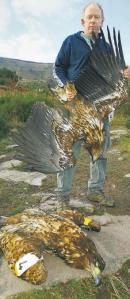
Project Manager Dr Allan Mee with two poisoned sea eagles

The Norwegian authorities have cautiously agreed to provide Ireland with 20 more white-tailed sea eagles later this month, despite the on-going poisoning that threatens the viability of the project.

So far, 14 of the 55 sea eagles given by Norway to Ireland as part of the re-introduction project have been found dead, and at least 7 of these were confirmed to have been poisoned. Earlier this year, 3 sea eagles were found poisoned in County Kerry in the space of just four weeks. All had fallen victim to eating poisoned baits.

The Golden Eagle Trust (the organisation leading the re-introduction effort on white-tailed eagles, golden eagles and red kites) believe that the majority of sheep farmers in the region are supportive of the project, but that a small minority of landowners are still laying out poisoned baits that are having such a devastating effect.

Full story: http://www.independent.ie/national-news/poison-fear-wont-halt-the-release-of-20-eagles-2210414.html

Golden Eagle Trust website: http://www.goldeneagle.ie/

sea eagle shot on lough neagh

Oct 2009. A white-tailed sea eagle which was found dead in Lough Neagh, County Antrim, is suspected to have been shot.

The bird, a protected species, was released into Killarney National Park in Co Kerry as part of a reintroduction programme which began two years ago.

Dr Allan Mee, who is in charge of the project, said there were two pellet holes in the animal’s transmitter.

The transmitter was retrieved from the eagle by two canoeists, who were in the Lady’s Bay area, on 17 October.

Dr Marc Ruddock of the NIRSG, who coordinated searches for the bird, said: “The resources, time and enthusiasm that go into the re-introduction program is phenomenal, the loss of even one of the white-tailed eagles is devastating.”

Full story. http://news.bbc.co.uk/1/hi/northern_ireland/8368178.stm