Five eagles found dead in Western Isles – Police Scotland open investigation

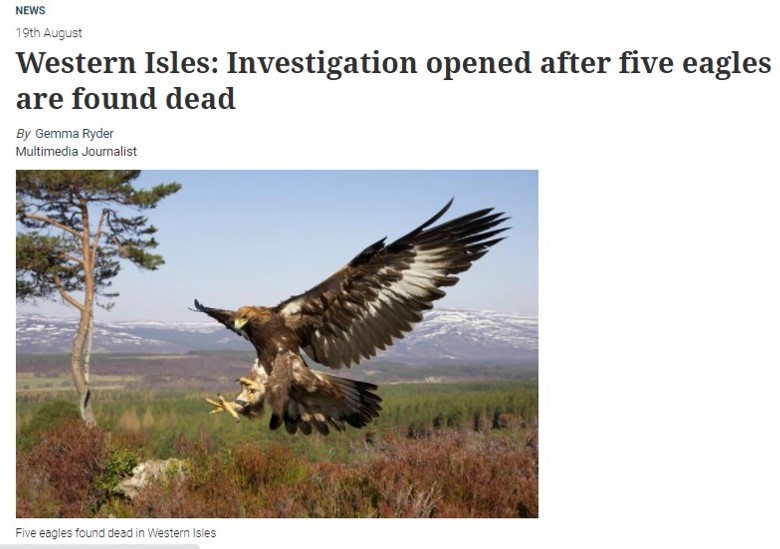
Police Scotland have opened an investigation on the Western Isles after the discovery of five dead eagles within the space of a week.

Two golden eagles and a white-tailed eagle were found dead on the Isle of Harris on 7th August, and another two golden eagles were found dead on the Isle of Lewis on 14th August 2021.

This article about the discoveries appeared yesterday in The Herald:

Police say they are investigating after five eagles were found dead in the Outer Hebrides in a space of a week. 

Two golden eagles had been found dead two miles south of Bragar on the Isle of Lewis on August 14. 

While two golden eagles and white tailed sea eagle were found dead near Bowglass on the Isle of Harris, a week before on August 7. 

The birds found on August 7 were significantly decomposed but forensic work is being undertaken to try to establish how they died.

Although the eagles were found dead in similar circumstances, the incidents are not being treated as linked.

Inspector Jane MacKenzie said: “Around 1.25pm on Saturday 14 August 2021, officers received a report that two golden eagles had been found dead two miles south of Bragar on the Isle of Lewis. Enquiries are ongoing to establish the full circumstances.

Enquiries are also ongoing after two golden eagles and white tailed sea eagle were found dead near Bowglass on the Isle of Harris on Saturday, 7 August, 2021. They were significantly decomposed but forensic work is being undertaken to try to establish how they died.

Eagles are protected birds of prey and Police Scotland will always investigate reports of these birds being found dead. It can be highly complex, requiring detailed scientific work, but we will always strive to bring anyone responsible for this type of wildlife crime to justice.

Anyone with information about these birds, or any wildlife crime, can contact Police Scotland on 101, or make a call anonymously to the charity Crimestoppers on 0800 555 111.”

ENDS

That police quote is fairly circumspect, which is perhaps understandable given the investigation is still in the early stages and this isn’t an official police press release. However, local information provided to me suggests the investigation into the first incident is much further ahead than has been indicated here. Based on that information, I’m very surprised to see the journalist claim the incidents are not being treated as linked (presumably that information came from the police?). Hmm, I wonder…..

Although if a crime is confirmed, don’t expect the investigation to result in a prosecution. Despite Inspector MacKenzie’s fine words, which undoubtedly were given with genuine sincerity, I’m not aware of anybody being convicted for killing an eagle in Scotland.

Ever.

If you have information about these five dead eagles, please contact Police Scotland on 101.

New golden eagle satellite tags being tested in Cairngorms National Park, an eagle-killing hotspot

Press release from Cairngorms National Park Authority (3rd August 2021). My commentary is below that.

High tech tags to give insight into lives of golden eagles in Cairngorms National Park

Three golden eagle chicks in the Cairngorms National Park have been successfully tagged using the latest innovative technology. Three estates in the Cairngorms National Park – including two in Strathspey – are part of this latest raptor tagging initiative, a partnership project that has been developed and funded by the Cairngorms National Park Authority and NatureScot.

The ‘Celltrack’ tags being used have come from the USA and are among the leading technology in raptor tagging. They will provide a better understanding of the species’ movements, habitat preferences and mortality.

The birds’ movements are tracked in real-time by CNPA staff and partners with transmissions coming in daily, providing a multitude of data that can help better understand the life of juvenile golden eagles, with an inbuilt alert system should mortality occur, whether through natural causes, persecution or other anthropogenic influences. The tags have the ability to detect unusual behaviour and send alerts with accurate locations.

‘Celltrack’ tags make use of an innovative dual communication system with data being sent over the mobile phone network as well as through a network of (ARGOS) satellites. By using this hybrid communication system, the large quantity of location fixes acquired each day can be transmitted over the mobile phone network, with the additional security of satellite communications when birds are out of signal.

Dr Ewan Weston, an independent research ecologist, has been in charge of tagging the golden eagle chicks under licence. He commented: “Having been involved in fitting tags to eagles for 14 years, the technological advances in the tags we use now bring data that was previously unimaginable. The data we receive, feeds into wider research on the species and covers aspects of golden eagle biology and environment, providing an insight into aspects of their lives in incredible detail. This work has included aspects of their dispersal behaviour, interaction with the landscape and developments such as wind farms.”

Dr Pete Mayhew, Director of Nature and Climate Change at the CNPA said: “The more we know about golden eagles in the Cairngorms National Park – from fledging through to acquiring their own territories – the better we can conserve and enhance their populations for the future. This is another excellent conservation partnership project involving government bodies and private estates who all wish to see a healthy future for our raptor species.”

The CNPA set out plans for a golden eagle tagging project in 2019, which included the use of British Trust for Ornithology-provided tags; however, delays in production, technical issues and the impact of the Covid-19 pandemic has seen the project switch to using ‘Celltrack’ tags. However, partners will continue to work closely with BTO over the coming months, including sharing data from the three recently tagged golden eagle chicks.

Seafield & Strathspey Estates are a partner in the project – their Chief Executive Will Anderson said: “We are very proud of our raptor populations here and as a result we are involved in several tagging projects. We are particularly pleased to be partnering with the Park Authority in this initiative as the type and volume of data collected is likely to be incredibly beneficial to be able to plan for the future with the birds needs in mind.”

The RSPB Scotland has also had one of their young golden eagles tagged as part of this project. Fraser Cormack, RSPB Scotland Abernethy Warden said “With raptors still being persecuted in Scotland the data that these tags provide could be crucial in helping to stop such crimes. Also with this potentially being a new territory it will be great to see the chicks movements after fledgling and where it disperses to in the future.”

Andy Turner, NatureScot Wildlife Crime officer, added: “NatureScot are providing strong support to the CNPA on this project. This innovative technological development will strengthen our understanding of golden eagle movements, aiding both research and hopefully acting as a deterrent to illegal persecution. The ability for instant alerts and complex motion data will provide welcome new insights into the movements of these special birds.  If this is successful, I hope we can deploy this technology more widely.”

Licenses to tag Golden Eagles are granted on behalf of NatureScot by the British Trust for Ornithology who look at various criteria, especially animal welfare. Tag data will be managed by a small, dedicated team at the CNPA and Dr Ewan Weston, NatureScot, and Police Scotland’s Wildlife Crime Unit.

ENDS

Hmmm. In principle, I am fully supportive of the continued satellite-tagging of golden eagles in Scotland because of the incredible insight they have provided in to the lives of this often elusive species.

Researchers have been able to provide tag data to influence conservation policy, based on new information about these birds that would previously have been almost impossible to find out (e.g. see here for a fantastic piece of modelling, based on satellite tag data, to predict how young dispersing golden eagles in Scotland will use specific landscape features, and here for the most recent scientific paper, again based on satellite tag data showing how young golden eagles in Scotland are actively avoiding wind turbines).

This sort of research is fundamental to our ability to conserve golden eagles and the quality of the research undertaken in Scotland is held in high regard by fellow scientists in Europe and North America.

I’m also very pleased to see the Cairngorms National Park Authority (CNPA) and NatureScot continue to recognise the importance and significance of golden eagle satellite-tagging, and be willing to put their money where their mouths are by funding this tagging sub-project, despite the best attempts of the grouse-shooting industry to derail this type of research. The shooters object because as well as ecological and biological insights, these tags are also providing illuminating information about the locations where golden eagles are still being illegally killed, almost 70 years after they became a protected species.

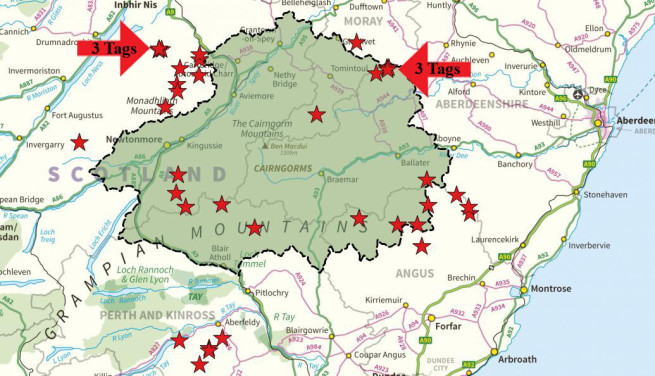
Significantly, the satellite tag data have allowed researchers to identify several geographical clusters where golden eagle persecution still takes place and more often than not, these are on or very close to moors being managed for driven grouse shooting. Unfortunately for the CNPA, some of those clusters are actually inside the Cairngorms National Park:

[This map shows the last known locations of satellite-tagged golden eagles that have either been found illegally killed or have disappeared in suspicious circumstances between 2004-2016. Data from the SNH report Analyses of the fates of satellite-tracked golden eagles in Scotland (2017) authored by Dr Alan Fielding & Dr Phil Whitfield]

It’s clear then, that the CNPA (and NatureScot) are in an embarrassing position and want/need to be seen to be doing something about the ongoing persecution. And ongoing it is, as we’ve seen with an illegally poisoned white-tailed eagle being found on a grouse moor inside the National Park last year (here) and yet another illegally poisoned golden eagle being discovered on another grouse moor inside the National Park earlier this year (see here). The subsequent bad press from these crimes is difficult for the CNPA to deal with (e.g. here).

And that leads me to be cynical about the timing of this latest press release. If you remember, back in 2019 the CNPA issued a similar press release (see here), stating that a new type of tag had been developed and would be fitted to golden eagles in the National Park over the forthcoming 18 months. The CNPA claimed this new tag would ‘provide an instant fix on any birds which die’.

The reality was somewhat different. The ‘new tag’ wasn’t developed to a sufficient standard that it could be trialled and thus was not fitted. That 2019 press release was considerably premature and I’m going to stick my neck out again and say this latest press release is similarly premature. Although this time a ‘new tag’ has actually been fitted and deployed on three young birds, it is far too soon to know whether the tag actually works as is being claimed, not least whether it will provide an ‘instant alert’ when an eagle dies. The ‘new tag’ being deployed this time is collecting the same type of data as the tags we currently deploy on golden eagles, and it has been used to track raptors in North America, but it is not the tag that we were told was being developed, with public funding, to specifically help detect illegal persecution of golden eagles in Scotland.

So why might the CNPA be keen to put out this press release prematurely? Well, if you’re a cynic like me, you might think that the CNPA has recently received a barrage of criticism for its inability to prevent the illegal killing of golden eagles (and other raptors) inside the National Park, sparked by the discovery of the poisoned golden eagle on Invercauld Estate earlier this spring, and so they’re keen to try and turn that around:

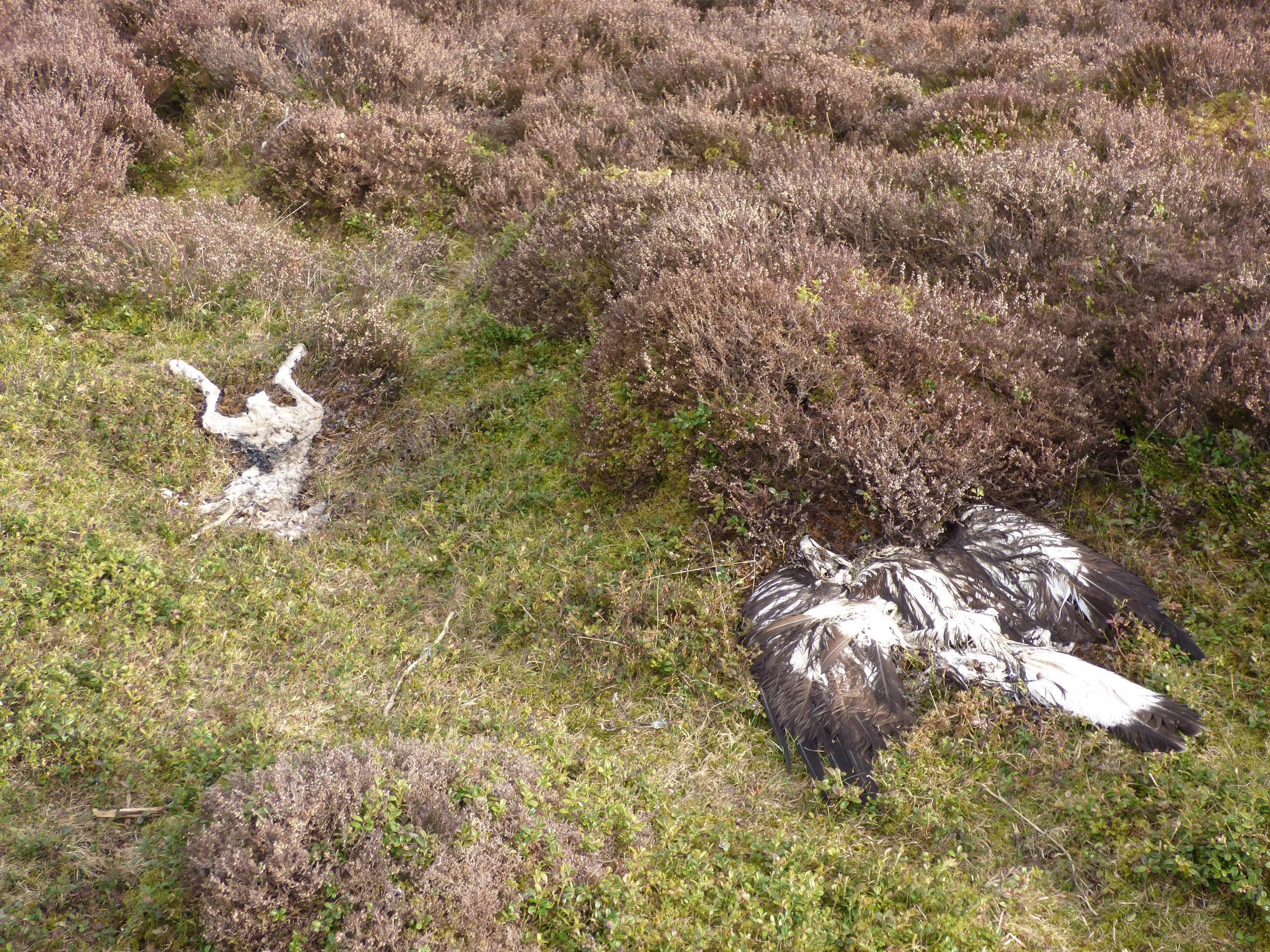
[The deliberately poisoned golden eagle, next to a poisoned mountain hare bait. Photo by RSPB Scotland]

The timing of the press release might also have a lot to do with the CNPA’s forthcoming five-year management plan, where it will have to report on its failures to meet the previous plan’s raptor conservation-based objectives. If the CNPA can chuck in a few ‘positives’ in to the new plan, such as the deployment of these new tags, it might act as a sweetener to those who will, quite rightly, be criticising the Park’s lack of progress on this issue.

Having said all that, I wouldn’t be alone in being delighted if this tag does function as is being claimed, and provides an ‘instant alert’ when an eagle dies, whether that be from natural causes or from illegal persecution. Any technological advance that would help the police to identify the criminals would be warmly welcomed by all (except for the criminals, obviously).

It’ll be interesting to see what happens with this new tag once the young eagles disperse during the autumn and travel into grouse moor areas where eagles are still not tolerated.

Incidentally, there will be short film about golden eagle persecution in Scotland being shown during this weekend’s live broadcast for Hen Harrier Day (Saturday 7th August 2021). If you want to hear more about this and what else is coming up, please sign up for Wild Justice’s event notification here.

Rare breeding success for sea eagles in Cairngorms National Park but outlook for chick is bleak

The Cairngorms National Park Authority has issued the following press release today (6th July 2021). My commentary on this news is below the press release:

Raptor breeding successes for East Cairngorms Moorland Partnership

The productivity of breeding raptors in the east of the Cairngorms National Park this season is encouraging and includes the hatching of a sea eagle chick on Balmoral, the first time that the species has successfully bred on the estate.

The breeding pair of sea eagles – also known as white-tailed eagles – have been observed on Balmoral for the last few years. Both adult birds carry satellite tags and close collaboration with the Royal Society for the Protection of Birds (RSPB) has allowed the Balmoral Ranger Service to follow their weekly movements during the breeding season. A healthy male chick has now hatched and been ringed. Three golden eagle chicks have also recently been ringed as part of long-term monitoring on Balmoral.

Balmoral Estate is a member of the East Cairngorms Moorland Partnership (ECMP) which has seen breeding success for golden eagles, hen harriers, red kite, osprey, peregrine and merlin, as well as short-eared owls, in 2021, across the various land holdings.

[The young white-tailed eagle chick on the nest at Balmoral. Photo by North East Scotland Raptor Study Group, a member of the Scottish Raptor Study Group]

Richard Gledson, Estate Manager at Balmoral Estate said: “All at Balmoral Estate are delighted that sea eagles have nested successfully for the first time. A previous nesting attempt in 2017 on the same site sadly failed and we have had our fingers crossed since then. The birds have been with us for a couple of years, and we have been working closely with the North East Scotland Raptor Study Group who ringed the chick last week and with the RSPB who have been sending data from their satellite tags.”

Glenavon Estate – which is home to three pairs of golden eagles, including one of the highest nesting sites in Scotland – has had a golden eagle chick satellite tagged for the first time in recent years. Satellite tags are used by biological researchers on a variety of species including eagles and harriers, and provide valuable insight into their movement and survival. Golden eagle chicks have also been tagged on the Glenlivet Estate and Mar Lodge Estate.

Furthermore, Mar Lodge has hosted six hen harrier nests in 2021. One pair failed early in the season, but the other five nests all have chicks. Two hen harrier chicks have been satellite-tagged in collaboration with the RSPB. Evidence from satellite tags fitted to some of the harriers which are now breeding shows that the birds range widely, foraging across ground on neighbouring ECMP estates.

Last year, Mar Estate witnessed the first successful breeding attempt of sea eagles in Deeside for 200 years, but the relatively inexperienced pair failed this season at the hatching stage, with poor weather likely a contributing factor, however hopes are high for success with continued breeding efforts next season and beyond.

Dr Ewan Weston of the North East Scotland Raptor Study Group, who has carried out much of the satellite tagging on ECMP estates, commented: “This year’s raptor tagging on ECMP estates builds on a positive collaboration with the estates over recent years. Despite a very wet, snowy May, the general picture in the area is that raptors, particularly golden eagles, red kites and hen harriers have done well.”

The East Cairngorms Moorland Partnership is a landscape-scale collaboration between five sporting estates and the Cairngorms National Park Authority. The partnership seeks to deliver private interests alongside public benefits, including improving the conservation status of raptors, demonstrating best practice muirburn management, expanding areas of woodland and scrub and peatland restoration. Partners have been collaborating with a wide range of ecologists in the National Park.

Xander McDade, Convenor at the Cairngorms National Park Authority, said: “We are delighted to hear that productivity of raptors in the east of the National Park looks good for 2021. However, we know that we can still do more for the birds and are committed to finding ways of improving the conservation status of moorland raptors, along with other red and amber moorland bird species. This includes working closely with the five estates that make up the ECMP on a range of conservation measures.”

ENDS

First of all, the breeding success of this pair of white-tailed eagles on Balmoral Estate is obviously very good news and long, long over due.

Norway donated 85 sea eagles for a reintroduction project in eastern Scotland between 2007-2012, although over a quarter of those didn’t survive (the main known causes of death included illegal poisoning, illegally shot, accidentally electrocuted and being hit by trains). The East Coast reintroduction was the third phase of a national reintroduction project that started back in 1975 on the west coast of Scotland, after the species was extirpated from Britain thanks to persecution in the late 1800s and early 1900s.

The first successful breeding attempt in east Scotland in 2013, the first for over a century, was an historic milestone in the project and was hoped to be the beginning of a new and vibrant population in the east, mirroring the successful population growth in the west.

So far though, progress has been incredibly slow and ongoing persecution has been at the centre of that (e.g. see here for the news that a sea eagle’s nest tree was deliberately felled on a grouse moor in the Angus Glens, also in 2013-nobody was prosecuted).

A number of young satellite-tagged sea eagles have ‘disappeared’ in suspicious circumstances on or next to grouse moors since then, and only last year a young sea eagle was found dead, illegally poisoned, on another grouse moor inside the Cairngorms National Park (see here). Nobody was prosecuted for that crime.

[A police officer examines the corpse of the illegally poisoned sea eagle found dead on a grouse moor in the Cairngorms National Park in 2020. Photo by Police Scotland].

So yes, it’s excellent news that Balmoral Estate has hosted a successful breeding attempt this year – well done to the team there – but it’s only half of the story. What happens when that young eagle fledges and disperses from Balmoral later this year?

Will it meet the same fate as this young golden eagle, which fledged from a nest site in the eastern Cairngorms last year and was found dead, ‘deliberately poisoned’ on a grouse moor on Invercauld Estate earlier this year?

[An illegally poisoned golden eagle, laying next to a poisoned mountain hare bait, found dead on a grouse moor in the Cairngorms National Park in 2021. Photo by RSPB Scotland]

I can see why the Cairngorms National Park Authority would want to issue this press release – not just to deservedly celebrate the successful breeding attempt on Balmoral Estate but probably more cynically, to try and undo some of the reputational damage that has been caused to the Park Authority and to its Eastern Cairngorms Moorland Partnership (ECMP) after the discovery of the poisoned golden eagle earlier this year on one of the ECMP’s partner estates (now no longer a partner) and the deserved criticism that the Park Authority has received for refusing to publish the correspondence it had had with the ECMP about the future of Invercauld Estate as a member of the ECMP following the discovery of the poisoned eagle (see here). This is the same tactic the Park Authority employed a few years ago when illegally-set traps were found on Invercauld Estate (here).

The ECMP can thank its lucky stars that one of its (now five) member estates is Mar Lodge, owned by the National Trust for Scotland, and with a glowing reputation for raptor conservation, especially for breeding hen harriers. Without Mar Lodge’s efforts, the ECMP’s raptor conservation efforts would be looking pretty feeble to date.

Although I noted the irony of the statement in the Park Authority’s press release that, ‘Evidence from satellite tags fitted to some of the harriers which are now breeding shows that the birds range widely, foraging across ground on neighbouring ECMP estates‘.

Er, yeah, but they forgot to mention how many of those hen harriers subsequently ‘disappear’ in suspicious circumstances on grouse moors in the ECMP and beyond (e.g. see here).

It doesn’t matter how far the Park Authority tries to spin the very welcome but too infrequent ‘good news’ stories like the breeding white-tailed eagles on Balmoral – the bottom line remains that large areas of the Cairngorms National Park are still raptor persecution hotspots and until that changes, the outlook for this young sea eagle is bleak.

23 more white-tailed eagles donated by Norway for release in Ireland

Phase two of the reintroduction of white-tailed eagles in the Irish Republic continued last week with the arrival of 23 young eaglets from Norway.

These young birds, collected under licence by the Norwegian Institute for Nature Research, arrived at Kerry Airport on a chartered flight on Friday and they’ll be looked after in specially-made flight pens until their release in to the wild in August.

After being driven to extinction in Ireland in the early 20th century, an ambitious reintroduction project began in 2007 as a collaborative effort between the National Parks and Wildlife Service in Ireland, Norwegian Institute for Nature Research in Norway, the Golden Eagle Trust in Ireland and a lot of volunteer farmers and supporters on the ground.

[Project Manager Dr Allan Mee with a young white-tailed eagle during phase one of the reintroduction]

100 young white-tailed eagles were released in the Killarney National Park during phase one between 2007 and 2011 and this has resulted in at least ten breeding pairs becoming established in Kerry, Galway, Clare, Tipperary and Cork producing at least 30 chicks between them.

However, a recent scientific review of the reintroduction project indicated the small population is still vulnerable to factors such as illegal poisoning and the breeding population was negatively impacted by Avian Influenza in 2018 and storm Hannah in 2019.

A decision was made to conduct supplementary releases over a period of three years to bolster the existing population. Ten eagles were reintroduced last year (see here), this latest batch of 23 new arrivals will be released this year and more are expected to be released next year.

It’s an interesting time for this species. With the on-going reintroduction project on the Isle of Wight attracting widespread support and interest, an apparent green-light to begin a reintroduction in Norfolk met with mixed support and antipathy, a lot of interest in a proposed reintroduction to Wales, on-going persecution issues in eastern Scotland and general hysteria generated by the National Farmers Union Scotland, the Scottish Gamekeepers Association and parts of the media about the perceived damage supposedly being caused by sea eagles in parts of western Scotland (more on that topic soon), it’s not clear to me how the white-tailed eagle will fare over the coming years.

If it’s still not even safe for one to fly over the Cairngorms National Park without becoming victim to a poisoned bait (e.g. see here) then we have to recognise there is still much work to do.

Desperate & delusional: Scottish Land & Estates’ grand plan for tackling raptor persecution

Cast your mind back to August 2020 for a minute. We were still waiting for the Scottish Government’s response to the Werritty Review (would they licence grouse shooting or not?) and bad news linking raptor persecution and grouse shooting was all over the press in the run up to the Inglorious 12th, the opening of the grouse-shooting season.

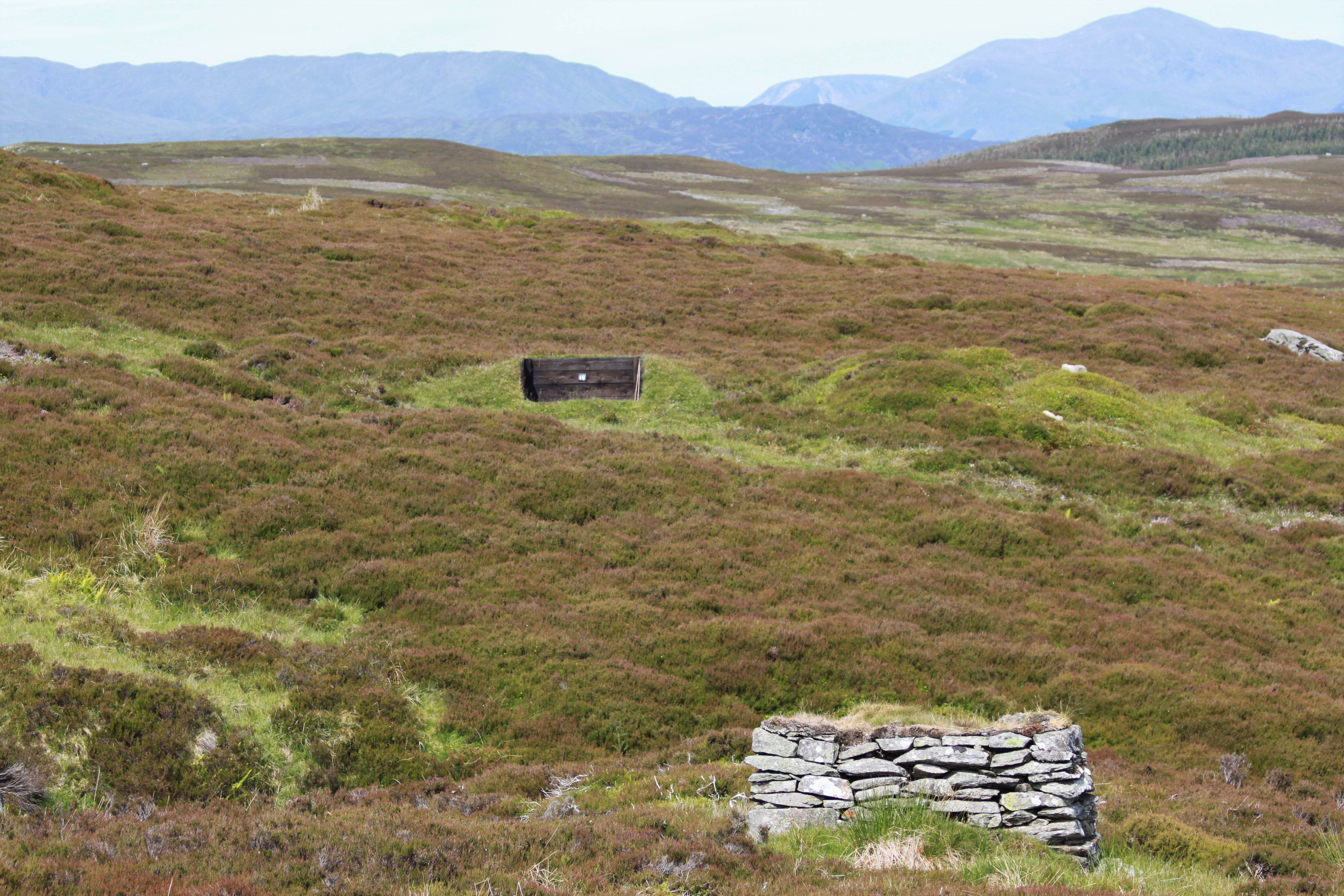
[Grouse-shooting butts in Strathbraan. Photo by Ruth Tingay]

For example, Chris Packham pressing First Minister Nicola Sturgeon to take action after the discovery of a poisoned white-tailed eagle on a grouse moor in the Cairngorms National Park (here), Hen Harrier Day going online and attracting an audience of around 150,000 (here), an e-action by the RSPB, Hen Harrier Action and Wild Justice mobilising over 120,000 people to put pressure on their politicians to take action on raptor persecution (here), police investigated more wildlife crime allegations at Leadhills Estate (here), the suspicious disappearance of yet another satellite-tagged golden eagle (‘Tom’) on a grouse moor in Strathbraan (here), Nicola Sturgeon having to discuss raptor persecution during First Minister’s Questions (here), Cabinet Secretary Roseanna Cunningham being forced to make a statement about the ongoing killing of raptors on grouse moors after thousands of letters pour in from the public (here), a parliamentary motion prompted by the suspicious disappearance of golden eagle Tom (here), a shocking new report by the League Against Cruel Sports suggesting that up to a quarter of a million animals may be killed (legally) on Scottish grouse moors every year to increase the number of red grouse available to be shot (here), a damning article in The Times reporting on the atrocities at Leadhills and the local community’s horror (here) etc etc.

You get the picture. The pressure was on, of that there’s no doubt.

So what do you think the grouse moor owners’ lobby group, Scottish Land & Estates (SLE) was making of all this? New information, released in an FoI this week, is pretty revealing.

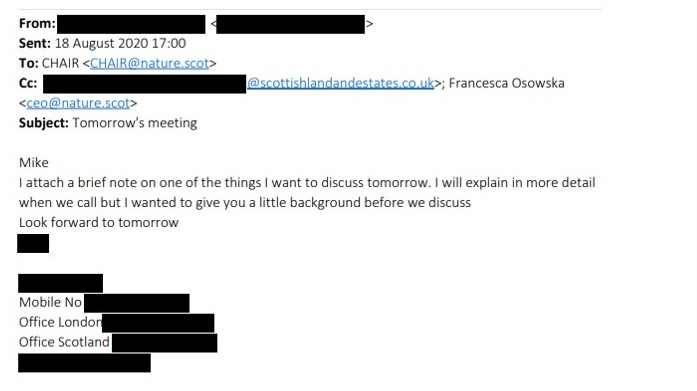
Here is a copy of an email sent to Mike Cantlay, Chair of NatureScot, on 18th August 2020. It was sent either by Tim Baynes (Moorland Director, SLE) or Mark Tennant (Chair, SLE). I know this because of the way my FoI was worded and even though NatureScot has redacted the sender’s name, my money would be on Mark Tennant.

Aside from the breath-taking arrogance, this letter reveals the desperation and delusion of SLE’s position.

The opening line is the standard position of denial we’ve come to expect from SLE whenever raptor persecution is raised – I’ve blogged about it time and time and time again. There hasn’t been any ‘real progress’ on the prevention of raptor persecution and no matter how many times SLE claims there has, it doesn’t change the fact that there hasn’t! That is precisely why the grouse shooting industry is under so much scrutiny and pressure – because it has been unable to self regulate and boot out the criminals that seem to be allowed to operate in plain sight.

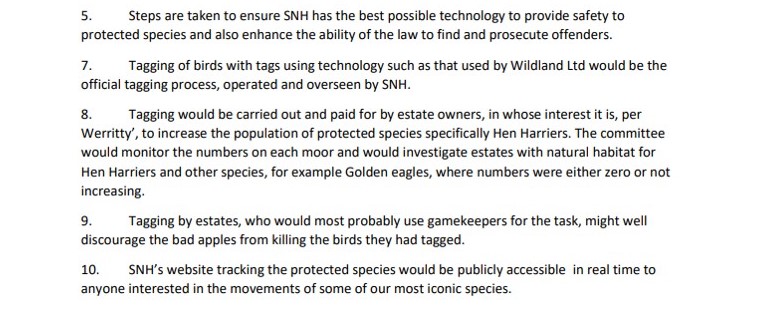
The idea of removing one dysfunctional group (PAW Scotland Raptor Group) and replacing it with another dysfunctional one (COPBAN) is hilarious. I did laugh, a lot, when I read about those plans. And by the way, SLE, nobody has asked Wild Justice whether it’d be interested in participating and I guess nobody has asked the groups already serving on the (dysfunctional) PAW Raptor Group how they’d feel about being side-lined. I’m pretty sure BASC, GWCT, Scottish Raptor Study Group etc would all have something to say!

The idea that estates would fund raptor satellite tagging (presumably excluding all legitimate scientific researchers??) and that gamekeepers would fit the tags demonstrates the high level of ignorance about how satellite tagging is regulated in the UK. There is currently only a handful of expert taggers in the UK, probably less than 20, who are sufficiently qualified, licensed and experienced to fit satellite-tags to birds of prey. Quite rightly, it takes years and years and years to reach the high standards required by the licensing authority. That SLE still hasn’t grasped this very simple concept is jaw-dropping.

And as for having a public website showing the live positions, day and night, of highly-threatened species like golden eagles and hen harriers – yeah, what could possibly go wrong?!

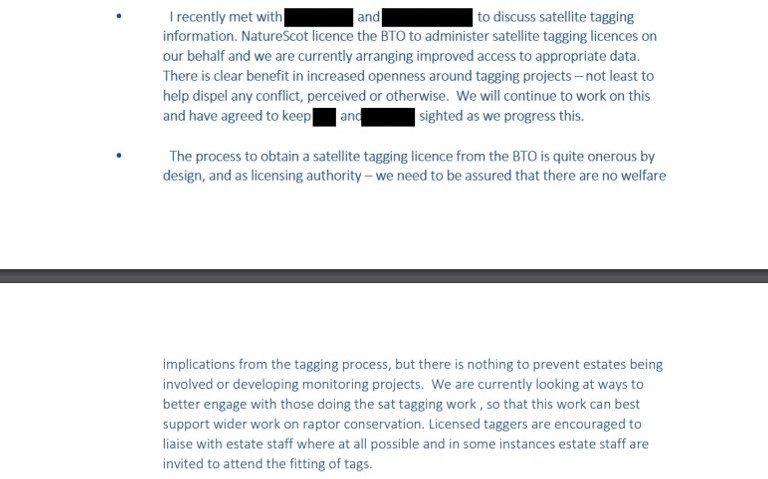
Here is NatureScot’s response to this outlandish proposal from SLE:

I’ll be blogging about some more communications between these two organisations in due course, also uncovered via FoI and related to grouse moor management, the Werritty Review and raptor satellite tracking.

Online protest tomorrow about ongoing raptor persecution on Scottish grouse moors

Tomorrow (Friday 19 March 2021) is the online protest organised by the Scottish Gamekeepers Association (SGA) and seven regional moorland groups, who represent grouse shooting estates and their gamekeepers across Scotland.

This is the protest that the SGA has been threatening since November when the Scottish Government had finally had enough with the decades of criminality in the grouse-shooting industry and promised to bring in a grouse moor licensing scheme as soon as possible (see here).

The protest has been named the Rural Workers Protest in an attempt to garner more support from other industries and will be using the hashtag #RWP21 on social media.

It’s still not clear what the SGA et al are protesting about, other than progress and modernisation, although I keep reading that they’re not being listened to, which is an interesting concept given the tv coverage and media column inches they’ve had this last week, as well as the vocal support of a number of MSPs and their ‘friend in Parliament‘, Cabinet Secretary Fergus Ewing.

We do know that Alex isn’t happy about the drink driving laws being applied in rural areas because it ‘affected social cohesion in the countryside’, according to the speech he read out at the SGA AGM a couple of weeks ago. That’s an interesting position given the display of empties lining the walls in the bothy from which Alex was speaking.

What, you don’t remember seeing them? Well that’s maybe because someone might have angled the camera to make sure they were carefully obscured. Compare and contrast these two photos….. the first one was a screengrab from the actual AGM. The second photo, from the SGA’s facebook page, shows a slightly different camera angle from the day before when Alex and his team were preparing the scene.

It’s also interesting that Scotland’s seven regional moorland groups are co-hosting the event, especially when grouse moors in five of those seven regions have been in the last three years, or currently are, under police investigation for alleged raptor persecution crimes (grouse moors in the regions covered by the Angus Glens Moorland Group, Grampian Moorland Group, Tomatin Moorland Group, Tayside & Central Moorland Group and the Southern Uplands Moorland Group). Do you think tomorrow’s protesters will be shouting about the illegal killing of birds of prey, on their grouse moors, right under their noses but apparently without any of them seeing anything suspicious? Or will they be arguing for getting licences to kill birds of prey, as we know that’s what the SGA has been campaigning for for years.

Not to worry. A number of us will be joining the online protest tomorrow, not to complain about modernisation or progress, nor to call for licences to be issued to kill raptors so more gamebirds can be produced for the guns. No, we’ll be there to protest about the ongoing illegal killing of birds of prey, on grouse moors, in Scotland. We’ll also be using the #RWP21 hashtag and we’ll be sharing information and photos with the general public who may not previously have been aware of what is going on. Join us if you can.

[This young white-tailed eagle was found dead on a grouse moor inside the Cairngorms National Park in April last year. It had been poisoned to death with a banned substance. Nobody has been prosecuted for this crime. Photo by Police Scotland]

Raptor intolerance, writ large!

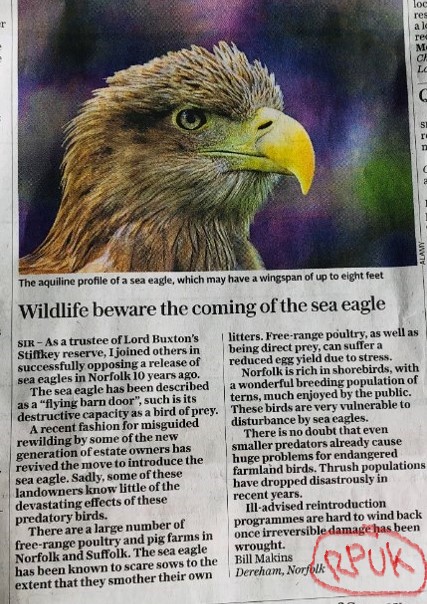
I don’t really know what to say about this.

The letter was published in The Telegraph today (thanks to the blog reader who sent it to me).

If ever you’ve wondered why birds of prey are killed so frequently in the UK, here’s your answer.

Bill Makins is 89 years old. I wouldn’t be surprised to find he was a fully signed-up member of Songbird Survival.

For those who want a more up-to-date perspective on the reintroduction of white-tailed eagles to England, based on scientific evidence and hard-earned experience instead of wild hysteria and 200-year-old rural myths, you might be interested in this presentation by Dr Tim Mackrill, who is one of the conservationists behind the reintroduction of white-tailed eagles to the Isle of Wight (here) and is advising on the proposed reintroduction to Norfolk (see here), where fortunately there are a fair few more enlightened landowners these days.

Tim delivered this presentation three days ago to the Leicestershire and Rutland Wildlife Trust and they’ve made it available for everyone. Let’s hope someone shows it to Bill Makins.

Sandringham Estate ‘supportive’ of proposed white-tailed eagle reintroduction

A proposal to consider the reintroduction of white-tailed eagles to Norfolk has been making the news for a couple of weeks now, ever since the Wild Ken Estate launched a public consultation, backed by a number of local landowners, to gauge opinion and support (see here).

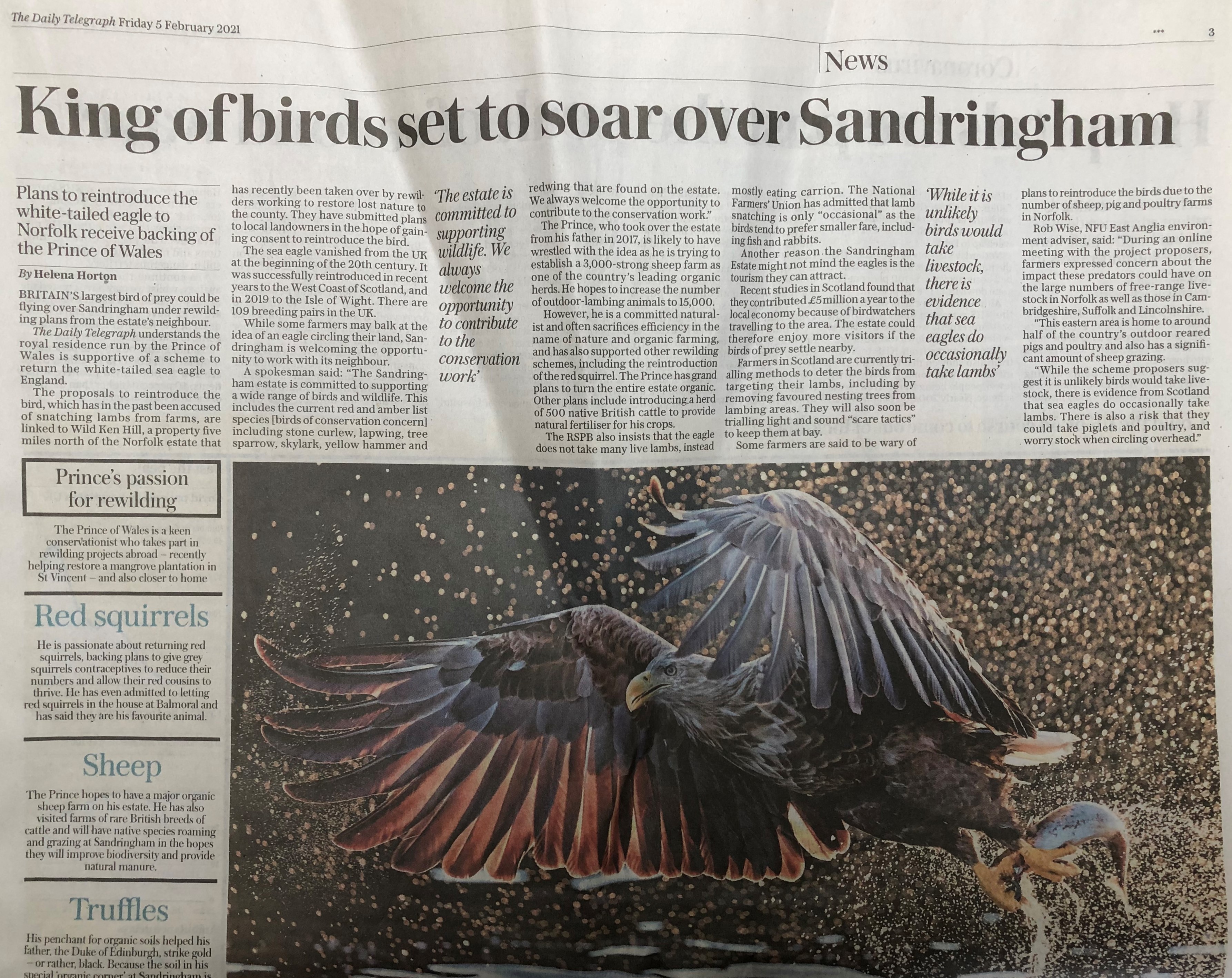
Not wanting to miss an opportunity for a bit of a Royal love-in, The Telegraph published this puff piece on Friday:

As so often with the Telegraph, there’s very little substance to support its claims, in this case that Sandringham and/or Prince Charles actually does ‘support’ a proposed reintroduction of white-tailed eagles to Norfolk. All it says is ‘The Daily Telegraph understands the royal residence run by the Prince of Wales is supportive of a scheme to return the white-tailed eagle to England‘.

Even the quote from the Sandringham Estate fails actually to mention sea eagles!

But perhaps things ARE changing at Sandringham. Perhaps the Sandringham Estate has moved on since being at the centre of numerous police investigations relating to birds of prey (e.g. see here, here, here, here). And perhaps if Charles really is in to conservation we’ll start to see some improvement in the management of his grouse moor in the Cairngorms National Park (e.g. see here and here) as well as at Sandringham.

We can but hope.

Meanwhile, folk would do well to continue to view the Telegraph’s level of understanding with healthy scepticism. Have a look at this ridiculous map, published alongside the Sandringham piece:

I don’t know where the Telegraph is getting its ‘facts’ from but it doesn’t appear to be from someone with any insight.

Why on earth would juvenile eagles be ranging 100km offshore in the North Sea??

And if they think that 200km is the ranging distance of a dispersing white-tailed eagle they need to take a look at the behaviour of some of the eagles reintroduced to the Isle of Wight – one travelled over 400 miles to hang out in southern Scotland for a while!

Sea eagles: talk of reintroduction to Norfolk & of cull in Scotland

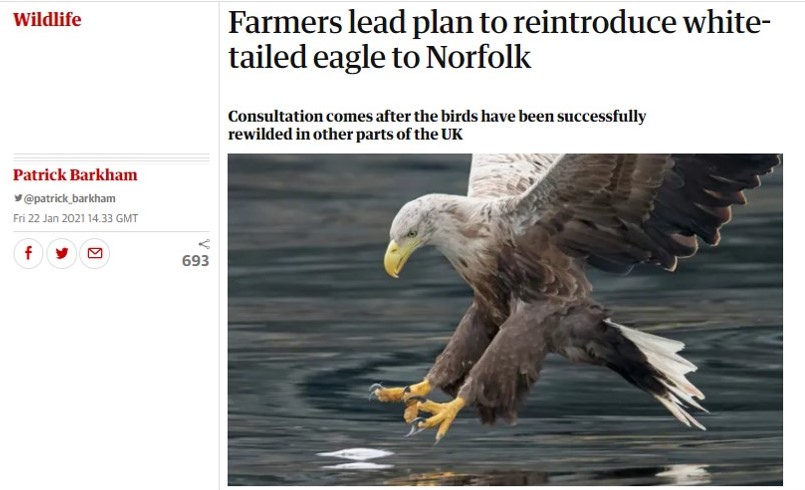
White-tailed eagles were in the news yesterday after it emerged that the progressive Ken Hill Estate has launched a public consultation to consider the reintroduction of sea eagles to Norfolk (there’s a good article in the Guardian about it, here).

This is quite a story, as journalist Patrick Barkham points out, given that ten years ago some Norfolk pig farmers vehemently opposed a reintroduction proposal but this time a number of them are on board, no doubt reassured by their recent experiences with visiting eagles from the Isle of Wight reintroduction project.

There’s a long way to go before a decision is made, of course, and Norfolk’s appalling reputation for the continued illegal killing of birds of prey will need to be carefully considered, but have a look at the Ken Hill Estate website (here) where they’ve published useful background information and provided links to the public consultation and opportunities for people to sign up to forthcoming webinars. It’s impressive stuff.

Meanwhile in Scotland, there is still talk of culling white-tailed eagles. This isn’t anything new – there have been persistent calls for a cull from certain quarters for years, fuelled by sensationalist nonsense from the Scottish Gamekeepers Association who even wrote to the Government calling for a public enquiry about the ‘threat’ that sea eagles posed to babies and small children (I kid you not – see here).

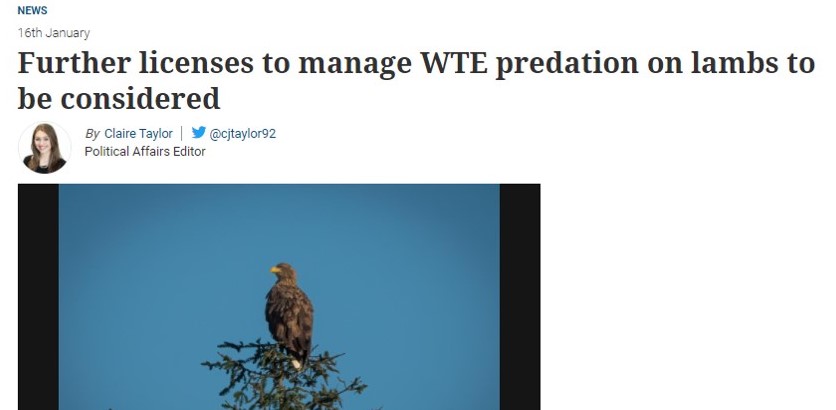
The latest call stems from the recent news in the Scottish Farmer that Nature Scot’s sea eagle action plan review ‘may also include further licensed activities’ (see here).

Although those potential ‘licensed activities’ are not defined, and may not involve lethal control at all, the Scottish Farmer’s editor, Ken Fletcher, has written an editorial suggesting that ‘there is a growing feeling that management will, indeed, mean that in some areas a cull will have to take place‘.

Here’s the relevant part of his editorial from 14 January 2021:

Natural Balance

RE-WILDING has become a noisy topic both on-line and in the national press, but there is a temptation to argue that it’s very much a minority that is seeking to drive change.

For want of a better expression, it would appear that the Great British (Scottish) public don’t give a monkeys about beavers, sea eagles and lynx. Yes, they would probably like to see them on their way to littering our countryside, but it cannot be argued that their life would be immeasurably worse off without them.

So, it’s nice to see that there is more of a balance in the stakeholder input into curbing so-called rogue individual birds by the sea eagle management scheme. It’s now readily accepted that some birds do severe damage to livestock in certain areas and equally that farmers accept their managed right to be in their locale. The key is in the word ‘managed’.

It’s a thorny and potentially politicised subject that will probably not raise its head above the parapet until after the Scottish elections later this year, but there is a growing feeling that management will, indeed, mean that in some areas a cull will have to take place.

Some argue that this should involve relocation as being an option, instead of a lethal solution. But, in the same way the ludicrous notion that not producing beef in Scotland will save the planet thus seeing production ‘exported’, then sending difficult birds to new locations will only transpose the problem.

It’s also been hinted that beavers should not be shot – as they are allowed to be under licence at the moment – but re-located instead.

We have a ready-made solution. Send them to Knapdale, in Argyll, where the original and sanctioned re-wilding project seems to need ‘topping up’ on a regular basis as they keep disappearing. It seems that they don’t like the wild west!

ENDS

Grouse moors – ‘a birdwatchers’ paradise’ according to Chair of Scottish Gamekeepers Association

Don’t laugh.

Actually, do laugh.

Alex Hogg, Chair of the Scottish Gamekeepers Association, was interviewed last week and he said some pretty baffling things about gamekeeping and grouse moor management, including the fantastic statement, “This is a birdwatchers’ paradise“.

Yep, he really did.

[An illegally poisoned white-tailed eagle, found dead on a grouse moor in the Cairngorms National Park earlier this year – see here and here. What a birdwatchers’ paradise!]

Alex was talking to a presenter on ITV’s regional news programme Representing Border on 2nd December 2020. The programme featured a piece on the Scottish Government’s recent decision to introduce a licensing scheme for driven grouse shooting (here) and it’s well worth five minutes of your time.

The programme is available here (starts at 15.49 mins, ends 22.01).

There was more baffling commentary from Alex, including this unfathomable statement on the effect a licensing scheme would have on gamekeeping:

We’ve done it for 200 years, we’ve kept a balance in the wildlife, and if we, it’s like a three-legged stool, if they take the leg away, we’re gone“.

Eh? I’ve no idea what ‘the leg’ is that he thinks is being ‘taken away’ and why he thinks a licensing scheme means gamekeepers will be ‘gone’. They’ll be gone if they breach the conditions of the licence (assuming it’s effectively enforced) but if they’re not doing anything illegal why would a licence cause them difficulties?

Unfortunately the presenter didn’t follow up on this, or if he did it was edited out. It’s also a shame he didn’t pick up on Alex’s statement about 200 years worth of ‘balancing the wildlife’ and ask him questions about why several species of raptors became extirpated from the UK about 100 years ago? And although some have made a brilliant comeback (with some help), why some populations are still struggling, notably in areas managed for driven grouse shooting? He could also have asked this question of Liz Smith MSP (Scottish Conservatives) who said she didn’t think that “fairly draconian” licensing was needed now!

Other interviewees were much more lucid, including Ian Thomson (RSPB Investigations, Scotland), Claudia Beamish MSP (Scottish Labour) and Mairi Gougeon (Environment Minister), who gave a robust argument for bringing in a licensing scheme now instead of sitting around for another five years doing nothing, including this statement:

There are still persistent problems out there with the illegal persecution of our birds of prey“.

It’s good to see this statement from a Scottish Minister. Can you imagine a similar comment from a Minister at Westminster?