Some comments on last night’s ‘Inside Out’ programme on hen harrier persecution

So, what did we learn from last night’s Inside Out programme on the illegal persecution of hen harriers?

According to Martin Gillibrand, the Moorland Association’s secretary, there is ‘no evidence’ that gamekeepers have been involved in hen harrier persecution, and the cause of their near extinction as a breeding species in England is “as a result of some very bad springs, breeding productivity has fallen off and the numbers have gone down“. Ah, so climate change is the real problem then. So if we all turn down our central heating and get our lofts insulated the hen harriers will be ok. It’s the same old story – give any explanation for the demise of the hen harrier except for the most obvious one.

Funny that he didn’t mention an earlier Moorland Association statement, given as written evidence during the recent parliamentary audit on wildlife crime (see here) –

“Until a full set of special rules allowing the positive management of hen harriers breeding on grouse moors is forthcoming from the Environment Council’s Hen Harrier Dialogue, moorland owners are within their rights and the law to deter the birds from settling on their moors to breed.”

Nor did he mention previous correspondence between the Moorland Association and DEFRA minister [grouse moor owner] Richard Benyon, discussing the possibility of derogations from international law that would allow for the legal ‘management’ of hen harriers (see here).

What else did we learn? Well, as predicted, the recent introduction of vicarious liability legislation in Scotland was touted as the solution to end raptor persecution. Unsurprisingly, this view was presented by Des Thompson of SNH – an organisation with a vested interest in making everyone believe that they’re dealing with the on-going (59 years and counting) problem of illegal raptor persecution. According to Des Thompson:

We are seeing some real signs of success. There are indications now that the recorded incidents of poisoned birds of prey is declining“.

He went on: “We were despairing in Scotland a couple of years ago but things have got a lot better“.

Have they? Yes, the number of recorded poisoning incidents has dropped, but does that mean poisoning has dropped, or poisoning is still going on but it’s now better hidden, or that recorded poisoning incidents have dropped because other methods of persecution are now being employed? Here are three examples that suggest things have not ‘got better’ (see here, here and here).

It’s interesting that SNH should interpret the drop in recorded poisoning incidents as a ‘success’, when the only true measure of success will be if raptor populations (especially hen harrier and golden eagle) recover. If they do recover, it will take several years to see it. Sorry, but to suggest at this early stage that vicarious liability has been a ‘success’ is utter rubbish – it’s a statement with more spin than a Zanussi.

Yesterday we blogged about how vicarious liability isn’t the solution to solving the issue of illegal raptor persecution, mainly because the crux of the vicarious liability concept is that the individual criminal first has to be identified before his/her employer can be charged under the new legislation. However, this was written from a Scottish perspective, where evidence such as covert video surveillance (identifying an individual actually committing the crime) is so often banned as admissable evidence in court. However, in England, this type of evidence is frequently accepted in court and has been used very successfully to convict criminal gamekeepers. So, in this context, vicarious liability, if it was to be introduced in England, might just work.

If you missed last night’s programme you can watch it on iPlayer (here) for a limited period.

We’ll be blogging later today about the latest development from the Hen Harrier Dialogue…

For anagram fans: A SAD MORONS COALITION / MOORLAND ASSOCIATION

Your chance to comment on proposed wildlife law changes

The Law Commission has opened a public consultation to assess ways of modernising wildlife legislation. Here are the Law Commission’s explanatory notes:

“The current law regulating wildlife is spread over a collection of Acts dating back to 1831. The original purpose of much of the law was to govern activities such as hunting and fishing, including poaching. Over the years it has expanded to conserve certain species, ensure the welfare of wildlife and protect local biodiversity from invasive species.

The result is a legal landscape that is out of date, confused and often contradictory. For example, the hunting, management and welfare of pheasants is governed by four separate statutes. Much of the older legislation is out of step with modern requirements, and the principal modern Act – the Wildlife and Countryside Act 1981 – has been amended to such a degree that it is difficult for any non-specialists to use.

The proposals we are putting forward in this consultation aim to simplify the existing complex framework, placing wildlife law into a single statute. The new regime would reduce the current dependency on criminal law, by allowing an appropriate mix of regulatory measures such as guidance, advice and a varied and flexible system of civil sanctions – such as fines and bans”.

The consultation period opened on 14 August 2012 and will close on 30 November 2012. The Law Commission’s recommendations are not expected to be published until mid-2014.

Although the consulation paper may look complex and daunting, it actually isn’t when you look at it section-by-section. The paper poses specific questions e.g. Do consultees think that the current sanctions for wildlife crime are sufficient? as well as more general questions, e.g. Do consultees think that there should be a wildlife offence extending liability to a principal….? (in other words, they’re asking for your view on vicarious liability).

The consultation only covers a review of wildlife legislation in England and Wales – not Scotland. However, this limited scope does not exclude any Scottish participants, so if you’ve got views on wildlife laws, this is the time to be heard. Already, the huntin’, shootin’, fishin’ brigade are mobilising their troops to encourage a mass response. You can imagine what their responses to most of the questions will be. It’s essential that the conservationists are heard with equal force. Don’t just leave it to the big groups (e.g. RSPB) to speak out – have your own say and let’s make sure the Law Commission reviewers understand our collective strength of feeling.

The Law Commission’s wildlife law consultation paper here

Blundering Benyon gives evidence at wildlife crime inquiry

Everyone’s favourite Minister Richard Benyon has been giving evidence at the House of Commons Environmental Audit Committee’s inquiry into wildlife crime (see here, here and here for earlier blog posts about this inquiry).

Some of the topics on which Benyon was questioned included #buzzardgate, hen harriers, the introduction of vicarious liability in England, the legislation concerning possession of illegal poison, and the independence of Natural England.

So how did he do?

He started off badly when questioned about the need for legislation to criminalise the possession of certain poisons. The legislation is already in place in Scotland but a loophole in the English legislation means that ‘possession’ (rather than ‘use’) is still not an offence – see here for an RSPB press release last year on this very topic. Bungling Benyon suggested that the current legislation was adequate and didn’t require updating. He was picked up on this a bit later by the Committee Chair, who insisted on clarifying whether there was a difference between ‘possession’ and ‘use’ in the legislation. Benyon chose the safe option and asked whether he could make the clarification in writing at a later date, presumably to give himself time to actually go and read the legislation.

On the issue of whether to introduce vicarious liability legislation in England for raptor persecution crime, Benyon commented that there were no plans to introduce VL but he will watch the impact of it in Scotland. That’s fair enough. Why waste time and funds to introduce something that may be completely useless as a tool to combat raptor crime until you’ve seen whether it can make a difference in Scotland. It was suggested to Benyon that some might say the Scottish government takes wildlife crime more seriously than their English counterparts. Benyon rejected that and said there are wildlife crime measures that are making a difference and the legislation is adequate. Unfortunately he didn’t give any examples.

When asked about #buzzardgate, he basically said he loved buzzards but that some of the people protesting about the ‘study’ had misunderstood the research. Er, what was there to misunderstand? Benyon and his game-shooting cronies wanted to spend our money removing native buzzards from the wild, on private shooting estates, for the benefit of mass-introduced non-native species that are bred for the sole purpose of being killed for sport. “I recognise that it hit a wall of credibility“, said Benyon. Too bloody right it did.

When asked whether he was doing anything specific to protect the hen harrier, Benyon stated, “Yes, we are“. He said he was looking at the possibilty of a project that might work, but he didn’t want to provide any specific details because “it is at a very conceptual stage“. Hmm. Could this be the controversial plan to introduce a so-called ‘ceiling’ for hen harrier numbers, a concept that has been knocking around since 2008 (see here and here)? We’ll have to wait and see.

Benyon was then asked: To what extent are you satisfied that Natural England is making sufficient use of its civil enforcement powers in relation to SSSIs? Benyon’s response: “…….It is also very important that Natural England is an arm’s length body with the neccessary statutory basis that they have, and that they are able to operate the laws and sanctions that they have freely and unencumbered“. Now that’s an interesting statement! If you’ve been following Mark Avery’s superb analysis of what went on in the Walshaw grouse moor fiasco (see here for his 23rd blog entry on the subject), you’d be hard pressed to believe that Natural England acted “freely and unencumbered”. There’s still plenty more to be uncovered about what happened between Natural England and Walshaw Moor Estate but rest assured that Mark Avery will have a good go at getting to the bottom of it. Benyon’s statement may just come back to haunt him.

To read the full transcript of Benyon’s evidence to the Environmental Audit Committee, see here. Bear in mind that this is the uncorrected version; the corrected version should be posted shortly.

The EAC has now finished compiling the written and oral evidence in this inquiry and a report should be published in due course.

Wriggling out of vicarious liability?

Regular blog readers will be well aware that the concept of vicarious liability in relation to raptor persecution became enacted in Scotland on January 1st 2012 as part of the WANE Act. For new readers, some background can be found here. Vicarious liability has had its critics but until the first test case in court, nobody really knows just how strong, or weak, the new legislation will prove to be.

An interesting comment about vicarious liability was received on the blog at the end of last week; it suggests legal loopholes may be being exploited to avoid possible conviction. Given the interest in VL, we’ve decided to re-post the comment here. Thanks to Steve from OneKind for submitting it:

Information gathered by Onekind suggests how some estate owners may try to avoid vicarious liability in the future by sending their game keepers on all the trapping and best practice courses there are going. According to our intelligence, top lawyers are being hired to travel around the country lecturing to gamekeepers on the law related to wildlife crime. Our information suggests that the idea behind this action, being taken by landowners and worked on by these top Lawyers, is that if a wildlife crime were to occur on their land by one of their keepers then the landowner can say that he put his keeper through the relevant courses and that he doesn’t know why the keeper did what he did. They hope that this will be enough to persuade the court that they were not complicit with the crime carried out on their land. Further information we have acquired tells us that a well-known land owner has been urging other landowners to take this idea on and which will probably be up and running properly within the next few months“.

I guess we’ll wait and see whether this defence is used if/when charges of vicarious liability are ever brought against anyone. It’s an interesting one because what they are allegedly proposing to do is not illegal, but its hardly in the spirit of moving towards the elimination of raptor persecution from the game-shooting industry, is it? In its defence, some will probably argue that we should all be thankful that gamekeepers are receiving such excellent training, but some may argue that some of the training is far from excellent. For example, OneKind has concerns about the adequacy of the snare training courses and suggests there may be an ulterior motive for running them (see here).

The use of legal loopholes to avoid possible conviction is a well-known tactic in many areas of crime, not just wildlife crime, although wildlife crime does have its fair share of examples. A recent one was reported in a newspaper at the beginning of July (sorry, no URL available) concerning the case of a gamekeeper on the Airlie Estate at Kirriemuir, Angus. He was accused of alleged criminal activity after the discovery of three buzzards inside a crow cage trap. However, he was acquitted after Sheriff Kevin Veal decided that the keeper was not given proper information about why he was being interviewed by an SSPCA inspector and a Tayside Police wildlife crime officer. Some lawyers are very good at their jobs.

It certainly pays to employ a professional lawyer rather than a pretend one. An employee from a very well-known organisation recently sent an email to a group (no, not us!) who publish the names of convicted gamekeepers and other wildlife criminals on their website. The email suggested that certain names should be removed from the website because the convictions were considered spent. The email explained the relevant law under which the names should be removed and went into some detail about how the law applied. The employee signed off with an impressive number of letters after their name, including LLB (a law degree). Uncannily, the information that the impressively-qualified employee wrote about this particular law bore an incredibly close resemblance to a Wikipedia entry on the same subject. Hmm, not quite so impressive now!

2012 wildlife crime conference: Stewart Stevenson (Scottish Government)

This is the fourth blog in the series focusing on presentations made at the recent police wildlife crime conference in Scotland, this time from Stewart Stevenson MSP, the Scottish Environment Minister. The following comprises the first two thirds of his presentation; the final third isn’t really relevant here.

Stewart Stevenson, Scottish Environment Minister

[Some jovial preamble that isn’t relevant here]…”This conference doesn’t, er, stand in a vacuum, it’s, er, carrying on from terrific effort over many years to create what is in effect, er, the biggest and most successful, er, wildlife, er, crime event in the UK and I’m sure that under the new management we’ll see, er, us building on past successes in that regard.

And of course, wildlife crime is something which in resource terms is comparatively small, er, in, in the, in the big picture so many people in this room and beyond who are engaged in fighting wildlife crime are doing so as an addition to, er, broader responsibilities, er, that, that constitute regular, er, day jobs and indeed many, er, make huge contribution in unpaid work outside hours, er, to get the job done, get the results and get the convictions, er, that are very important in sending out the right kind of messages, er, to people involved in, er, wildlife crime, but of course again as the Assistant Chief Constable made reference to, it’s often the case, er, that the Mr Bigs of our crime networks, erm, are engaged in wildlife crime, there’s correlation when you look at the maps often between where the Mr Bigs live and clear demonstration of wildlife crime, er, taking place in an area and unlike their activities as Mr Bigs, protected behind lawyers and accountants, really Boards of Management, their engagement perhaps in wildlife crime is, is less protected and may often be a very good way of getting into criminal, criminal networks and more broadly disrupting them so I hope that, er, when the police make operational decisions, because it’s only for me to seek to persuade but not to direct, er, that that is, er, part of the, the, the thinking.

I’ve been the Minister for Environment and Climate Change for coming up for a year now and I’m absolutely gobsmacked as I go across Scotland by the, the work that’s going on in the environment generally, whether it’s conservation work on red squirrels, whether it’s protecting our small number of capercaillies, whether it’s innovative technologies out to produce cleaner sources of fuel, it’s all based on the commitment of dedicated individuals and we in government are immensely, er, proud that people make that commitment and very grateful indeed.

Now this is the first, er, Tulliallan conference since the passage of the Wildlife and Natural Environment Bill in 2011, the Act does contain, er, a number of new provisions that are very relevant to this conference and I know that, er, the Sheriff for example will be explaining the WANE Act, er, a bit later, I’m not over-egging the pudding, Sheriff, I hope, erm, I, er, won’t be able to, to listen to it myself but then I’m not part of the enforcement agency. There was a passionate debate in Parliament about many aspects of it and I think at the end of the day we achieved, er, a good and equitable balance, there was a huge cross-party support, er, for the final form that it took. But the passage of that Bill is a very clear indication, er, that Parliament, er, takes an important view of this and, er, the, the, the importance that, er, the BBC Radio Scotland this morning gave to this conference and the publication, er, of, erm, the poisoning figures for, er, raptors shows that the media see this as an important agenda as well.

The new legislation, er, a number of things are relevant to this conference, comprehensive revision of the law relating to game and the poaching of game, new closed seasons for hares, new regulations for snares, a major revision of the Deer Act backed up by a new code of practice, a new approach to invasive non-native species, I’ll just say a little something, one of the things I tripped over, just to illustrate, er, the issue of invasive non-native species…[goes into anecdote about American Signal Crayfish]…There’s new offences, a new code of practice to come on, on this regard, and there’s a new requirement that we provide an annual report to Parliament on wildlife crime.

Now, I’m not going to talk through the legislation, others are better equipped to do that. There are officials here from the Scottish Government who’ll be happy to interact with you, er, on the subject. But let me just pick up a couple of issues from it – during the course of the Bill it was apparent that there was a prevailing feeling among MSPs that we needed to take some tougher legal powers to combat the problem of illegal raptor persecution in Scotland. Er, it’s been a high priority since we took office, it is of course an issue that not only threatens some of our rarest wildlife such as the hen harrier, but it casts a disproportionately unpleasant shadow on our reputation as a country known for its high quality natural environment. The environment is a key part of our identity, it’s part of our brand and it’s vital to our export success, er, in many ways and of course wildlife tourism is a very important economic contributor.

So, the concept of an attractive, well-managed, er, natural environment can be badly damaged by any idea that it’s a place where some people can still put out dangerously toxic materials to poison some of our more spectacular wildlife. And of course, when you put poisons out in the environment, you never know what the effect will be; a dog walker can be exposed to them, domestic animals can be poisoned and indeed human beings without knowing, er, what’s going on. It is a tiny minority but it disproportionately, er, scars, er, our landscape so we’re continuing to work with our partners in PAW to change attitudes, make that minority even smaller in future, and eventually see it disappear.
So part of our response has been to introduce vicarious liability, er, provisions. There are two aspects to that. That small minority in the past of land managers who may have given a nod and a wink to their employees in relation to persecution of birds of prey, that addresses that issue, those who turn their back on doing the right thing. But now there is no doubt that their behaviour will not escape the reach of the law, they risk finding themselves in the dock as well as the unfortunate employee, the gamekeeper, whoever.

The second aspect is probably more important in the long run. We want to send a message to all land managers that inaction, benign or otherwise, is simply not good enough. Land managers need to be proactive in ensuring all employees and contractors understand legal obligations and responsibilities, they have to take all reasonable steps and exercise due diligence. And I want to pay a tribute to Scottish Land and Estates, because they have been very supportive in getting that message out, working with government, er, to develop guidance for land managers. So this is not about the industry as a whole being a problem, quite the opposite, they are a huge contributor, er, to determining best practice, to getting the message out, achieving a proportionate and proper legal balance between the many interests that there are in, in, in the country and they’ve been enormously helpful. It is just a tiny minority, and they want to see them eliminated as much as everyone else, er, does.

We’re certainly not looking for a string of prosecutions, indeed, I will measure success if there are none, because that would be absolutely ideal in a context of, of good behaviours in, in our countryside. Sustained improvement, proactive management, especially in areas that we’ve identified as being at high risk where previous history show there’s been bird or prey prosecution, we know that this is one of a range of measures in itself it doesn’t, er, solve the problems.

Now I don’t want to just speak about, er, raptor persecution, a couple of, er, other aspects of, of the work that I want to speak about, the first is the annual poisoning hotspots maps which are published today which show a significant reduction, er, in the number of birds, er, poisoned in the last year, and that’s very, very welcome but there’s still too many, er, it’s not necessarily an inescapably a long-term trend although the suggestions are that it probably is. We want to get to a position where it’s zero, ah, we’re not quite there yet. Partnership working is an important part of making sure that we get the outcomes, the input of the RSPB and Scottish Land and Estates working together give this annual exercise and reporting credibility, demonstrates that shared commitment that’s going to make a real difference, and I particularly like when I see the pack that you have as delegates to have material from RSPB and Scottish Land and Estates, showing that shared commitment, er, to this agenda.

Second, er, raptor related point, just to say something about the success of the Raptor Persecution Priority Delivery Group, it’s been working extremely well and I thank Alan Smailes, formerly of Grampian Police, my local police force, for his tireless commitment and role, he brought energy and frankness to the group and made, er, a real difference. Since, er, Alan’s recent retirement, Superintendent Ewen West from Tayside has taken over the reigns and continues where Alan left off. Real progress is being made, er, as meetings are held usually every six weeks, er, with excellent attendance. There are some developments in the pipeline in the group that have the potential to have a real impact on, on unlawful raptor pred persecution and again it’s partnership working that will make the real difference.”

[On the whole Stewart did quite well, and when you compare his attitude to that of his counterparts in England, he is streets ahead in that he at least acknowledges that raptor persecution is a problem. However, this oft-repeated insistence that raptor persecution is only being carried out by a ‘tiny minority’ is simply not supported by the facts.

There was also concern about his apparent brown-nosing of SLE that didn’t quite fit in with the fact that his government introduced vicarious liability specifically because they recognised that many land owners and land managers are often the instigators of illegal raptor persecution (if it was just a tiny minority then surely the government wouldn’t have bothered with all the hassle of introducing new legislation to combat it). In an interview on BBC Radio Scotland on the morning of the conference, Stewart took every opportunity to promote SLE and in doing so, carefully side-stepped some rather well-informed questions from the interviewer. See here for the full transcript recently posted on the SLE website. He also seems to have conveniently forgotten the communication he had last autumn with SLE Director Lord Hopetoun, who seemed to have a different view to Stewart about the benefit of vicarious liability legislation – see here].

The next instalment in this series will focus on the presentation given by Des Thompson (SNH), who also has an apparent aversion to criticising land owners.


Vicarious liability – what’s it all about?

There’s been a lot of talk recently about the new offence of vicarious liability and whether it will finally address the issue of illegal raptor persecution in Scotland. Some see it as the ultimate enforcement tool that will stamp out raptor persecution on shooting estates once and for all. Others see it as an unnecessary burden on purportedly law-abiding landowners, land managers and gamekeepers who have managerial responsibilities. The truth is that nobody knows for certain just how effective this new legislation will be, and until there have been some ‘test’ court cases, that uncertainty will remain.

We had hoped that the Scottish Government would provide detailed information and advice about the new legislation, but they haven’t. The following overview is our current understanding of the issue and has been put together after reading various articles and documents and we’ve included a list of useful links for further reading at the end of this blog post.

The new offence of vicarious liability in relation to the persecution of wild birds (where one person may potentially be legally responsible for the actions of another person) came in to force on 1 January 2012, as a provision in the Wildlife and Natural Environment (Scotland) Act 2011. It was introduced as an amendment to the draft WANE Bill in November 2010 by former Scottish Environment Minister, Roseanna Cunningham. It was a direct response to the unrelenting problem of illegal raptor poisoning and the apparent inability/unwillingness of the game shooting lobby to get their own house (grouse moors) in order (see here and here for background).

Interestingly, upon its enactment on 1 January 2012, it was widely touted as being aimed at ‘the few’ or ‘the minority’ who are persistently culpable in this area of wildlife crime (see press statements from Scottish Government, Scottish Land & Estates and National Wildlife Crime Unit here). Strange that the actions of a ‘few’, or the so-called ‘minority’, could cause the creation and introduction of a new offence, don’t you think? Isn’t it more likely that the government recognised that these crimes are carried out by so many, and to such a wide extent, that new legislation had to be brought in as the only measure capable of dealing with crime on this scale? Anyway, we digress….

When will the offence of criminal vicarious liability apply? According to the provisions in the WANE Act, it will apply to certain wildlife offences, but not all. There are three main areas of wildlife crime for which a person can be held vicariously liable:

1. Intentionally or recklessly killing, taking, disturbing wild birds and their nests.

There are exceptions, such as killing certain game birds or other species that are permitted to be killed, taken or disturbed under a general licence (e.g. crows), but in general, it is an offence to interfere with certain wild birds (including raptors), their nests and their nest contents, and it is also an offence to obstruct or prevent these birds from using their nests.

2. Prohibited methods of killing or taking wild birds.

This relates to the setting or placing of articles that could cause bodily injury to a wild bird. This includes the setting of various traps (including spring traps), snares, hooks, lines, birdlime, electrical devices for killing, stunning or frightening, and any poisonous, poisoned or stupefying substance.

3. Possession of pesticides.

Anyone found in possession of a pesticide containing at least one prohibited ingredient will be guilty of an offence (unless they have a specific approval order for its use). Prohibited ingredients currently include Aldicarb, Alphachloralose, Aluminium phosphide, Bendiocarb, Carbofuran, Mevinphos, Sodium cyanide and Strychnine (as named in the Possession of Pesticides (Scotland) Order 2005).

We understand that the maximum penalty for any of the offences is six months imprisonment and/or a £5,000 fine. If the offence was committed in respect of more than one bird, nest or egg etc, they will be treated as separate offences and carry separate penalties. In other words, the maximum penalty applies to a single offence only. So if someone is convicted of being vicariously liable for the killing of two protected birds, they could face up to 12 months imprisonment and/or a £10,000 fine etc.

Who can be prosecuted for the offence of vicarious liability? Well, that will depend very much on the circumstances of each individual case, and specifically the managerial involvement of each individual person. In general terms, however, anyone who either has the legal right to kill or take wild birds, or manages or controls the exercise of that right, and anyone who secures the provision of certain shoot-related ‘services’ from someone else may be vicariously liable for offences committed by another person. This could include, either singly or in combination, landowners, trustees, directors & officers (such as in a limited company), farmers, crofters, shooting tenants, shoot syndicate members, factors, agents, gamekeepers and contractors who procure or provide services relating to habitat management or shoot management.

Before somebody can be prosecuted for the offence of vicarious liability, the prosecutor must demonstrate that the primary offence took place and that the offence was committed by a third party who has a specific relationship to the person being charged with vicarious liability. The person who committed the primary offence need not be prosecuted in order for a prosecution to be brought against the person in management or control. This seems a bit odd though, because if it can be shown that the primary offender committed the offence, then why wouldn’t he be prosecuted? Although perhaps it covers situations such as the primary offender emigrating, or dying, or having a plea-bargaining agreement with the prosecutor whereby he doesn’t get prosecuted in return for providing information about another crime or another person.

There is, of course, a defence to the charge of vicarious liability. The accused has to demonstrate to the court that:

(a)    he did not know the offence was being committed; AND

(b)   he took all reasonable steps AND exercised all due diligence to prevent the offence being committed.

It is not yet known what a court will accept as reasonable steps and due diligence, but the word ‘all’ may be significant (as in ‘all’ reasonable steps and ‘all’ due diligence). Much will depend on the specific circumstances of each case, but what does seem clear is that doing nothing will not be an adequate defence. As a minimum, the defendant should be able to show, with written documentary evidence, that work procedures have been evaluated, risks have been assessed, training has been offered if deemed necessary, a system of checks are in place and that regular reviews have been undertaken. These procedures are not dissimilar to the way a health and safety system operates so it should not be beyond the capabilities of someone with managerial responsibilities to undertake this type of procedural audit.

There is a significant amount of interest in how effective the new legislation will be, and we will watch with interest as the (inevitable) cases are brought before the courts.

It should be noted that the offence of vicarious liability (in relation to the persecution of raptors) is only currently applicable in Scotland. Other parts of the UK have not yet adopted this approach, although it has been reported that legislators in England are watching to see how well it works in Scotland. As illegal raptor persecution is just as much of a problem in England, conservationists have launched a petition to have the issue of vicarious liability debated in the English Parliament. The petition needs 100,000 signatures to trigger the parliamentary debate – please visit the petition site (here) and sign it!

FURTHER READING

Wildlife and Natural Environment (Scotland) Act 2011 (the full text of the Act here).

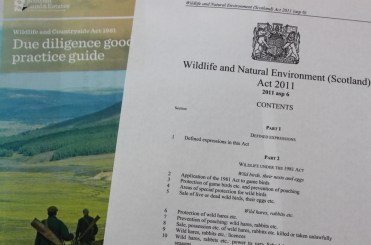
Scottish Land & Estates, the representative body of Scottish landowners, has written a guide about the issue of vicarious liability called ‘Due Diligence Good Practice Guide’. It has a foreword by Scottish Environment Minister Stewart Stevenson and it is said to have been endorsed by the PAW Scotland Executive. You might think that such endorsements would mean the guide is freely available, but you’d be wrong. It’s only free to SLE members; if you’re an interested member of the public you have to pay the princely sum of £30 (thank you to the three contributors who each sent us a free copy!). It is an interesting read though, and is by far the most useful guide we’ve seen so far.  Especially helpful is the presentation of various case studies involving different sectors of the shooting sector (e.g. large grouse moor, medium-sized owner occupied mixed estate, farm syndicate shoot etc) and the discussions about who might be liable to prosecution in each scenario. It’s been prepared by several ‘legal eagles’ who specialise in wildlife law but perhaps most surprisingly, thanks are given to James Hodge of Baikie Hodge Ltd. Would this be the same Baikie Hodge Ltd. with connections to Millden Estate (see here) and also Leadhills Estate (see here to download the PDF)? Interesting! If you want to pay £30 for a hard copy of the guide, contact SLE via their website here.

Solicitor Robert Scott-Demspter’s article on vicarious liability in the Scottish Field here [Scott-Dempster is also acknowledged as a contributor in the SLE’s guide].

Law firm Lindsay’s rural bulletin on vicarious liability here.

Law firm Turcan Connell’s briefing note on vicarious liability here.

Law firm Brodies’ article on vicarious liability here

An article on VL in The Journal of The Law Society of Scotland (Aug 2012) here

Bye, then

In a feature article in the latest edition of Shooting Times, the Chairman of the National Gamekeepers Organisation, Lindsay Waddell, laments the sale of Millden Estate in Angus (see our earlier story about the sale here).

He questions the reasons behind the sale, “just as the moor is coming good“. It’s a strange description for an estate where two-year-old golden eagle Alma was found poisoned in 2009 (see here). His theory about why Millden has come on the market goes like this:

It would appear the answer lies in the recent legislation passed by the Scottish Parliament which holds landowners liable for the actions of their staff [vicarious liability], and that is something, it appears, some will not entertain at any cost. So it’s sell up, and get out. It may well turn out to be a sad day for the inhabitants of many glens if more and more of the modern-day owners decide to take the same course of action“.

Interesting.

Waddell goes on to acknowledge that there are still landowners (he says “a few”, we say ‘too many’) who won’t manage their land without the use of [illegal] poison and says these individuals have to shoulder a lot of the blame for the introduction of vicarious liability. No disagreement there, Lindsay – the criminals within your industry are finally having to face the music after 60 long years of relentless and systematic illegal raptor persecution.

He also comments that the new legislation (vicarious liability) is ‘open to abuse’. He writes: “It is all very easy for items to be ‘found’ on a piece of land“. By ‘items’, does he mean poisoned birds and poisoned baits, and enormous caches of illegal poison? Much like what was found on Skibo Estate in 2010? The ‘items’ that Dean Barr, sporting manager at Skibo Estate, claimed in the press had been planted by the RSPB (see here)? Obviously his press statement was made before he was found guilty of possessing 10.5 kg of Carbofuran – the UK’s biggest haul of this banned pesticide to date (see here).

Waddell continues by suggesting that Millden may be the first of many Scottish sporting estates to be sold. Let’s hope so. I can think of more than just ‘a few’ whose closure is long overdue.

Shooting Times article here

No vicarious liability for England

Richard Benyon MP, the DEFRA Minister for the Natural Environment and Fisheries, doesn’t see any need to follow Scotland’s lead of introducing vicarious liability to make landowners legally responsible for incidents of raptor persecution that occur on their estates.

On 30 June 2011, Labour MP Angela Smith (Penistone & Stocksbridge, South Yorkshire) asked the following question: Only two weeks ago, a gamekeeper was convicted for illegally killing birds of prey in my constituency. Is it not time to think about introducing a vicarious liability offence to ensure that landowners and estate managers supervise their gamekeepers more closely and more effectively?

Richard Benyon’s response: There are very good laws in place to punish the illegal killing of any animal. If they are not being effectively enforced, they must be and we will take steps to make sure that happens. However, this is a good opportunity to applaud gamekeepers for the wonderful work they do in providing excellent biodiversity across our countryside.

It was reported in the Telegraph last year that Mr Benyon is a ‘keen grouse-shooter’ (see here).

Perhaps Mr Benyon hasn’t looked at the national poisoning statistics of the last few years. If he had, he couldn’t have failed to notice how many of these confirmed incidents were now listed as ‘closed’ before any enforcement action was taken! (see here for 2008-2011 database).

Perhaps we should all be writing to Mr Benyon, to point him in the direction of these official statistics and to ask him what ‘steps he will take’ to ensure that effective law enforcement is taking place? Here’s his email address: richard@richardbenyon.com

Vicarious liability for raptor poisoning featured on forthcoming tv programme

The issue of vicarious liability for raptor poisoning incidents will feature in a forthcoming episode of ‘Landward’. It includes an interview with SGA chairman Alex Hogg, who will probably discuss his on-going (but so far thwarted) campaign to legalise raptor killing.
The 30 minute programme airs on Friday 27 May 2011 at 7 pm on BBC 2 Scotland. Also available on Channel 990 for Sky viewers, and BBC iPlayer shortly after transmission.

Landowner Liability: In Scotland, poisoning raptors is a criminal offence punishable with a fine and a jail sentence, yet the slaughter continues. Arguments over birds of prey have raged for decades, but are now coming to a head with the inclusion of vicarious liability for landowners in the Wildlife and Natural Environment (Scotland) Bill, recently introduced by the Scottish Parliament. This means that landowners will be held legally responsible for birds poisoned on their land. Dougie Vipond investigates how this new clause will affect land management in Scotland“.

http://www.bbc.co.uk/programmes/b011lg7s

Wishy Washy WANE Bill

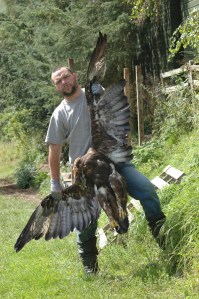
We can expect to see more images like this in the coming years

The long-debated WANE Bill (Wildlife and Natural Environment [Scotland] Bill) was finally passed by the Scottish Parliament on Wednesday 2nd March 2011. Talk about a missed opportunity to crack down on an industry that continues to flout the law when it comes to wildlife crime! “The Scottish Government is not prepared to tolerate continued persecution of our magnificent birds of prey. This government is prepared to act to introduce new measures to combat wildlife crime”, said a pig as it flew over Inverness Police Station.

A concise overview of how the final Bill relates to the continuing illegal persecution of our so-called protected raptors can be found here:

http://www.scottishraptorgroups.org/news.php

While some aspects of the new Bill are to be welcomed, including the introduction of vicarious liability, other measures that could have had a greater impact were refused. One such measure, estate licensing, was turned down in favour of allowing the sporting estates an opportunity to introduce voluntary self-regulation. This manifests itself in the form of the ‘Wildlife Estates Initiative’, dreamt up by the SRPBA in the later stages of the WANE Bill proceedings when it looked like they were under threat from the introduction of a licensing system. Who believes that this ‘initiative’ will work? Isn’t it crystal clear, after five decades of systematic raptor persecution, that the shooting industry has proven itself incapable of voluntary self-regulation? Will the new ‘initiative’ be as lacking in credibility as their May 2010 letter to the Environment Minister that 200+ estate owners signed to say that they opposed raptor poisoning? (The same letter that proved to be highly embarrassing just a few weeks later when multiple poisoned raptors were found on Moy Estate, one of the letter’s signatories). We look forward to watching how their latest ‘initiative’ rolls out, and particularly whether they actually publicise the names of the estates that have signed up to it (information that they have so far failed to make public). If they wish to be taken seriously then transparency will be essential.

In summary, there is as much chance of the current WANE Bill being an effective deterrent to illegal raptor persecution as there is of the SGA opening a wildlife sanctuary. However, full credit should go to Peter Peacock MSP for doing his utmost to secure a safe future for our declining raptor populations. He will be sorely missed when he steps down from politics in May, although we are pleased to note that he intends to lobby his colleagues from the sidelines. RSPB Scotland and the SRSGs also deserve credit for their lobbying efforts throughout the WANE Bill process. Some credit should be given to Roseanna Cunningham for sticking to her guns on the vicarious liability issue, although she loses points for stamping all over some of the other proposals that really could have made a difference.

As we approach the Scottish elections in May, you may want to know how your MSP voted on the raptor persecution issue during the WANE Bill. Check out the official report here:

http://www.scottish.parliament.uk/apps2/business/orsearch/ReportView.aspx?r=6146&mode=html#iob_55286