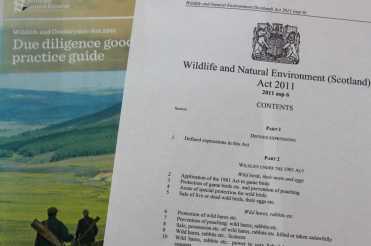
First vicarious liability prosecution: part 4

Criminal proceedings continued yesterday against Mr Ninian Robert Hathorn Johnston-Stewart in the first known vicarious liability prosecution under the WANE Act 2011.

Mr Johnston-Stewart, the landowner of Glasserton & Physgill Estates, is charged with being vicariously liable for the criminal actions of Glasserton gamekeeper Peter Bell, who was convicted in 2013 of laying poisoned bait which killed a buzzard (Carbofuran), and for possession of three banned pesticides (Carbofuran, Strychnine and Alphacloralose) (see here).

Yesterday’s intermediate diet was continued, with another intermediate diet scheduled for 23rd December 2014.

Previous blogs on this case here, here and here

Last night’s Countryfile

Last night’s Countryfile featured a section on raptor persecution and was actually fairly well balanced, in terms of the amount of air time given to both ‘sides’ of the debate.

First up was Bob Elliot, the RSPB’s Head of Investigations. He talked about the effect of persecution on certain raptor populations and the need for better legislation, vicarious liability, estate licensing and greater penalties for those convicted of illegally killing raptors. It was a well-delivered performance.

The presenter, Tom Heap, claimed that there is “some evidence that vicarious liability has reduced the illegal killings of birds of prey” in Scotland. Rubbish. That’s what the landowners would like everyone to believe because then it makes it more difficult for the Government to introduce even further measures against them. As the (now former) Environment Minister Paul Wheelhouse said recently, there isn’t any evidence to suggest that vicarious liability  has reduced raptor persecution. Indeed, the latest Government statistics show that raptor killing is actually back on the increase in Scotland, which demonstrates that so far, vicarious liability is not having the deterrent effect that we’d all like.

Next we heard from a poor guy whose dog had died after it had minimal contact with a poisoned bait whilst out on a walk on a Yorkshire moor. This was followed by North Yorkshire Police Wildlife Crime Officer Gareth Jones, who discussed another poisoning incident he’d investigated that involved a poisoned fox, crow and two red kites.  This was a bit strange because he mentioned that a local gamekeeper had put out a poisoned rabbit bait to target a fox that had been eating his pheasant poults and that the keeeper hadn’t intended to kill the kites, only the fox. But then we heard that there wasn’t enough evidence to make a ‘definitive link’ to the culprit and so there wasn’t a prosecution. Eh? If the keeper had admitted putting out the bait to target a fox, surely that’s the link? If the keeper hadn’t admitted targeting the fox, how did the Police know the kites hadn’t been deliberately targeted? Very odd.

Duncan Thomas BASCNext up was Duncan Thomas from BASC. What he had to say was quite interesting, but not as interesting as what he didn’t say (or maybe he did say and it was just edited out). For context, it’s worth bearing in mind that before joining the BASC payroll, Mr Thomas was a Police Wildlife Crime Liaison Officer with Lancashire Constabulary, and his patch included the Forest of Bowland, a well-known raptor persecution hotspot.

We were told that he’d been involved with game-bird shooting at Bowland for 20 years and he was filmed waxing lyrical about one of this year’s successful hen harrier nests in Bowland. But no mention of the ‘disappearance’ of two of the nest’s sat-tagged fledglings, Sky and Hope, both vanishing without trace on the Bowland moors just a few weeks after fledging (see here and here).

When asked about the RSPB’s call for game-shooting leaders to acknowledge the role of gamekeepers in raptor persecution, Mr Thomas said:

I think that some of the press releases are quite unfair and they don’t represent a true and accurate picture of what goes on here. If you show me direct evidence that leads to the conviction of a gamekeeper for doing that then those people are not welcome within our community. All the shooting organisations, their stance is very clear, we would expel them from any of our organisations“.

So here we have a former police officer claiming that the only convincing measure of criminal activity is a conviction! On this basis, the UK should be considered as a virtually crime-free zone. All those murders, rapes, assaults, burglaries etc for which nobody has been convicted simply didn’t happen because, er, there weren’t any convictions.

Oh, and all that guff about convicted gamekeepers not being welcome….that’s simply untrue. A classic example is the gamekeeper who was convicted for having a banned poison in his vehicle, home and pheasant pen, and yet went on to enjoy the support of the National Gamekeepers’ Organisation who helped him to apply successfully for licenses to destroy buzzard nests and eggs to protect his pheasants!

Mr Thomas was then asked how he felt “when the RSPB seems to be tarring the whole shooting industry“. He said:

Frustrated. And angry. The RSPB appears to be using some EXTREMELY isolated cases to colour us all bad“.

Hmm. Those ‘extremely isolated’ cases actually amount to over 100 gamekeepers convicted of raptor persecution between 1990 – 2010. Not what we’d call ‘extremely isolated’. Our definition of ‘extremely isolated’ would be if, say, a District Nurse had been convicted. There she was, trundling over the uplands on her way to see another patient when she decided to pull over, whip out a shotgun from her medical bag and take a pop at a passing hen harrier. If that had ever happened, then it would clearly be seen as an ‘extremely isolated’ incident and not at all indicative as being representative of her entire profession. But over 100 gamekeepers? Well, those facts speak for themselves. In fact, in the last four years alone, a further 27 gamekeepers have been convicted of wildlife crimes, and at least a further five cases are currently pending. Knowing how difficult it is to actually secure a conviction for wildlife crime, these can only be considered the tip of the iceberg. Here are the latest 27:

Feb 2011: Gamekeeper Connor Patterson convicted of causing animal fights between dogs, foxes and badgers.

May 2011: Gamekeeper Ivan Mark Crane convicted of using an illegal trap.

May 2011: Gamekeeper Ivan Peter Crane convicted of using an illegal trap.

May 2011: Gamekeeper Dean Barr convicted of being in possession of a banned poison.

May 2011: Gamekeeper James Rolfe convicted of being in possession of a dead red kite.

June 2011: Gamekeeper Glenn Brown convicted of using an illegal trap.

October 2011: Gamekeeper Craig Barrie convicted of illegal possession & control of a wild bird

Dec 2011: Gamekeeper Christopher John Carter convicted of causing a fight between two dogs and a fox.

Dec 2011: Gamekeeper Luke James Byrne convicted of causing three animal fights and possession of three dead wild birds (heron, cormorant, buzzard).

Jan 2012: Gamekeeper David Whitefield convicted of poisoning 4 buzzards.

Jan 2012: Gamekeeper Cyril McLachlan convicted of possessing a banned poison.

April 2012: Gamekeeper Robert Christie convicted of illegal use of a trap.

June 2012: Gamekeeper Jonathan Smith Graham convicted of illegal use of a trap.

Sept 2012: Gamekeeper Tom McKellar convicted of possessing a banned poison.

Nov 2012: Gamekeeper Bill Scobie convicted of possessing and using a banned poison.

Jan 2013: Gamekeeper Robert Hebblewhite convicted of poisoning buzzards.

Feb 2013: Gamekeeper Shaun Allanson convicted of illegal use of a trap.

Feb 2013: Gamekeeper (un-named) cautioned for illegal use of a trap.

May 2013: Gamekeeper Brian Petrie convicted for trapping offences.

June 2013: Gamekeeper Peter Bell convicted for poisoning a buzzard.

July 2013: Gamekeeper Colin Burne convicted for trapping then battering to death 2 buzzards.

Sept 2013: Gamekeeper Andrew Knights convicted for storing banned poisons.

Dec 2013: Gamekeeper Wayne Priday convicted for setting an illegal trap.

Feb 2014 Gamekeeper Ryan Waite convicted for setting an illegal trap.

May 2014 Gamekeeper Derek Sanderson convicted for storing five banned poisons.

July 2014 Gamekeeper Mark Stevens convicted for setting illegal traps.

October 2014 Gamekeeper Allen Lambert convicted for poisoning 11 raptors, illegal storage and use of pesticides & possession of a poisoner’s kit.

The final contributor to the Countryfile piece was Amanda Anderson of the Moorland Association, discussing DEFRA’s proposed Hen Harrier Recovery Plan and the ridiculous ‘brood management’ scheme, which we believe is nothing more than legalised persecution. We are supposed to believe that the Moorland Association loves hen harriers (ahem) and that the recovery plan would help prevent hen harriers “eating themselves out of house and home“. Good god. Somebody send her on a basic ecology course, please.

This episode of Countryfile is available on BBCiPlayer for 29 days here.

The petition to ban driven grouse shooting is here.

Environment Minister gives evidence on wildlife crime to RACCE Committee

Wheelhouse RACCEA couple of weeks ago, Police Scotland and COPFS gave evidence to the Scottish Parliament’s Rural Affairs, Climate Change and Environment (RACCE) Committee about wildlife crime (see here).

Last week it was the turn of Environment Minister Paul Wheelhouse. The archived video can be watched here and the full transcript can be read here.

So what did we learn? Quite a lot.

1. The Minister is “confident” that surveillance cameras can be used in wildlife crime investigations and the Lord Advocate has made it clear that the option is available to Police Scotland. (Interestingly, Police Scotland were not quite so keen when they were asked about it two weeks ago).

2. The Minister will shortly be announcing a forthcoming pesticide disposal scheme (he made it clear it was not an amnesty) – no further details available.

3. The committee reviewing wildlife crime penalties (led by Prof Poustie) will report back early in the New Year, and not in December as originally planned.

4. The Minister recognises the “wall of silence” that so often prevents the reporting of wildlife crime. Good.

5. Two weeks ago, Police Scotland claimed that the number of reported wildlife crimes was more than just the tip of the iceberg. The Minister disagrees with that and cited the large areas of suitable and yet unoccupied raptor habitat as evidence of widespread unreported wildlife crime. However, he suggested that more research was necessary to understand why raptors may be missing from those areas. Eh? What about the twenty years of high quality research that has shown time and time again the link between driven grouse moor management and raptor persecution?

6. The Minister recognises that the (police) response to every wildlife crime incident isn’t perfect. However, he believes that everyone in the law enforcement community takes wildlife crime seriously. He said that with a straight face.

7. On the new General Licence restrictions, the Minister explained that he was taking a ‘targeted approach’ to try and avoid penalising those who are not involved in wildlife crime. He accepts that the restriction measure could easily be by-passed by someone simply applying for an individual licence, although he maintains that SNH may not issue one – each case will be judged on its merit. He has more faith in SNH than we do but time will tell.

He also said that he expects GL restriction cases to be listed publicly on SNH’s website “on a live basis” because he wants the restriction to be used as a ‘reputational driver’. Good.

He made an interesting statement about who is probably responsible for poisoning birds:

In most cases in which we find a dead poisoned bird on a landholding, we can be reasonably confident that the poisoning took place on that landholding and that the bird died on the landholding as a result of that poisoning“.

That’s very encouraging to hear.

8. On the idiotic Police Scotland press release about the Ross-shire Massacre, the Minister said “unfortunately” he didn’t have any input into the wording of the statement and he urged the Committee not to read too much into the statement, but instead to focus on the fact that 16 of the 22 dead birds are confirmed to have been poisoned and that a criminal investigation was continuing. You can read between the lines – he didn’t think much of the police statement.

9. On the SSPCA consultation, the Minister said he hadn’t yet made up his mind about whether to increase their investigatory powers and he was waiting for an analysis of the consultation responses before he decided. He expected to receive the analysis “early next year at the latest“.

10. When asked whether he was considering further measures to tackle wildlife crime, the Minister said he didn’t have a definitive timescale but wanted to give the current measures time to take effect. However, he did say that he had already commissioned a review of game-shoot licensing in other countries, in preparation for consideration of further measures. He wants to know what options are available to him should he decide to take a harder line. The review will be undertaken by Prof Poustie as soon as the wildlife crime penalties review has been completed in the New Year. Excellent.

11. The Minister said he would try to incorporate further data in the next wildlife crime annual report, including reports of illegal traps (but with no apparent victim) and poisoned baits (with no apparent victim). Good.

12. Two weeks ago, COPFS claimed that vicarious liability was already proving to be an effective deterrent against raptor crime (based on what the landowners had been saying). The Minister disagreed, citing on-going wildlife crime as a clear indication that not everyone is deterred by the threat of vicarious liability. He thinks that may change if/when there is a successful VL conviction. Good.

All in all, we think the Minister did pretty well. He may be a bit too light-handed and cautious for many of us, but it’s clear that he has taken a personal interest in addressing wildlife crime, he’s incredibly well-informed, he’s not fooled by the cries of denial from the wildlife killers, and his measures are heading in the right direction, albeit slowly. He thinks the GL restrictions will be the most important step in the process but we disagree. His defining moment will come when he makes the decision on whether to increase the SSPCA’s powers. That decision, and that decision alone, will tell us all we need to know about how seriously committed this Government is to tackling wildlife crime.

What we learned from last week’s RACCE mtg on wildlife crime

RACCELast Wednesday, the Scottish Government’s Rural Affairs, Climate Change and Environment Committee (RACCE) met to hear evidence on wildlife crime from two senior Police Scotland cops and a senior Fiscal from the Crown Office.

We’ve already blogged about what was said during the meeting about that ludicrous Police Scotland press statement on the Ross-shire Massacre (here). Needless to say, we were unimpressed.

But the discussion on that press statement was only a small part of a two-hour hearing. There was plenty of other discussion about various aspects of wildlife crime enforcement in Scotland and we learned a lot. For those of you who were unable to watch the video, the official transcript of the meeting has now been published in full: HERE.

So what did we learn? For a start, we learned that the RACCE Committee is full of very well-informed MSPs. They asked a lot of good questions and in some cases were quite dogged about pushing the Police for a proper answer. What was less impressive was their sometimes ready acceptance of what can only be described as weak and unsubstantiated responses from the Police and the Crown Office. Nevertheless, it was good to see both the Police and COPFS being asked to be accountable for a change – let’s hope we see more of that.

If you haven’t watched the video, we thoroughly recommend you take some time to read the minutes. Here are a few things that caught our attention:

1. In future years, the Government’s annual wildlife crime report will use data from calendar years instead of a mish mash of calendar and financial years, which makes any sort of analysis near impossible. That’s good.

2. Police Scotland are of the view that the wildlife crime figures are “not the tip of the iceberg“. Their view is apparently based on a “feeling” as opposed to hard evidence. Assistant Chief Constable Graham said:

I do not have the sense that we are dealing with the tip of the iceberg, but I do have a sense that there are undoubtedly crimes that are not reported to the police and therefore go unrecorded. I could not judge what level that is at, but it does not feel as if we are getting only the tip of the iceberg“.

Detective Chief Superintendent Robbie Allan said: “I agree that the numbers are not the tip of the iceberg“.

Unfortunately, the Committee did not question them further on their “feelings” – it would have been interesting to have asked them how they account for the absence of breeding golden eagles and hen harriers on most land that is managed for driven grouse shooting, how they account for entire populations of raptors being constrained from their full distribution potential in prime breeding habitat that just happens to be managed for driven grouse shooting, how they account for all the unoccupied historical breeding sites, many of which just happen to be on driven grouse moors, why the majority of ‘missing’ satellite-tagged raptors are just happening to ‘disappear’ on driven grouse moors, and why most academics who publish on national and international wildlife crime enforcement widely accept that under-reporting is one of the main obstacles in the way of tackling wildlife crime.

Apparently under-reporting is not an issue in Scotland, because “it doesn’t feel that way” to Police Scotland.

3. The Police and SNH will meet monthly, starting in early November, to share information that could lead to the restriction of General Licences on land where wildlife crime is suspected. That’s very good. Although we still maintain that the General Licence restriction is not a restriction at all – it can easily be circumvented by the landowner/sporting agent/gamekeeper by them simply applying for an individual licence – we blogged about this here. The withdrawal of the General Licence is not a restriction at all; its simply a minor inconvenience which will mean the landowner/sporting agent/gamekeeper having to fill in an extra form. That’s it.

4. The admissibility of video evidence was discussed. Apparently it’s all about “proportionality and necessity” and “Police Scotland will not be routinely deploying these tactics“. In other words, The Untouchables are free to carry on as usual.

5. There was some discussion about the training of police wildlife crime officers. We’ll leave this one for now because we intend to examine this subject in greater detail in the near future.

6. Patrick Hughes from COPFS claimed: “The majority of animal welfare cases that we see are reported to us by Police Scotland, although some come from the SSPCA“. Really? That would be staggering. Unfortunately, Mr Hughes was not asked to substantiate this claim with any data. This would be a ripe topic for anyone with a mind to submit an FoI to the Crown Office: _EnquiryPoint@copfs.gsi.gov.uk (take note of the underscore at the start of this email address).

7. The subject of water bailiffs was discussed (pleased to see that some of those MSPs, and/or their advisors, are reading this blog!). We recently blogged about the substantial powers that water bailiffs have, including the power of arrest (see here). These bailiffs are appointed by landowners, to act in the landowners interests, they are not publicly accountable and have only the merest hint of any ‘training’. Why then, is there such opposition to extending the investigatory powers of the SSPCA, which wouldn’t even include the power of arrest, and whose inspectors already use wide powers when investigating animal welfare crimes? Well, according to Police Scotland (who, you’ll remember, objected to the proposed increase of powers to the SSPCA), the water bailiffs’ powers “are not used routinely” and “We do not have experience of water bailiffs who think that they are in a position to apprehend people“. Strange, then, that to ‘qualify’ (term used loosely) as a water bailiff, the candidate is encouraged to sit a test on the contents of the water bailiff training manual, which includes a considerable amount of detail about their powers of search and arrest.

8. Patrick Hughes of the Crown Office confirmed that currently two cases are proceeding under the vicarious liability legislation. According to him, the VL provision is “effective”….because the landowners have told him it is. On that basis, he’ll no doubt believe that raptor poisoning has stopped because Alex Hogg said the SGA had ‘stamped it out’ (see here).

Tomorrow, the Environment Minister will be giving evidence on wildlife crime to the RACCE Committee. You can watch live from 10am HERE.

First vicarious liability prosecution: part 3

Criminal proceedings continued today against Ninian Robert Hathorn Johnston Stewart in the first known vicarious liability prosecution under the WANE Act 2011.

Mr Johnston Stewart, the landowner of Glasserton & Physgill Estates, is charged with being vicariously liable for the criminal actions of Glasserton gamekeeper Peter Bell, who was convicted in 2013 of laying poisoned bait which killed a buzzard (Carbofuran) and possession of three banned pesticides (Carbofuran, Strychnine and Alphacloralose) (see here).

Today’s hearing was continued for an intermediate diet on 8th December 2014.

Previous blogs on this case here and here

First vicarious liability prosecution: part 2

wane1Last week we blogged about what we believe to be the first prosecution under the 2011 vicarious liability legislation (see here), relating to poisoning offences that took place on the Glasserton & Physgill Estates in December 2012. Gamekeeper Peter Bell was convicted in June 2013 for those crimes, including the laying out of a poisoned bait that subsequently killed a buzzard, and the possession of three banned poisons (Carbofuran, Strychnine and Alphachloralose) which were found in his tool shed and in his home (see here).

The vicarious liability prosecution was adjourned yesterday and the next hearing is due in November.

Definitely one to watch.

Update on first vicarious liability prosecution

wane1Regular blog readers will know that we’ve been interested in the first prosecution of a landowner under the vicarious liability legislation for some time now….in fact ever since the legislation was enacted as part of the WANE Act on 1st January 2012 (see here for background info on what vicarious liability is and to what wildlife crime offences it can be applied).

We believe the first prosecution relates to the employers of gamekeeper and (now ex) SGA member Peter Bell, who was convicted in June 2013 of various poisoning offences that took place in December 2012 on the Glasserton & Physgill Estates. Those offences included laying a poisoned bait that subsequently killed a buzzard, and the possession of three banned poisons (Carbofuran, Strychnine and Alphachloralose) found in his tool shed and in his home (see here).

We’ve been asking whether there would be a vicarious liability prosecution against Bell’s employers for over a year, but each time we asked, various obstructions were put in our way (see here and here). However, in May this year, Environment Minister Paul Wheelhouse announced during a parliamentary debate on raptor persecution that vicarious liability proceedings had commenced (see here).

Since May, we’ve heard nothing at all, which we find surprising given the high level of public interest in how this new (well, nearly 3-year-old now)  and significant legislation will work.

We’ve been doing quite a lot of research since then and have finally discovered that this case is indeed in progress, and the next court hearing will take place next week. It won’t be an evidence-led hearing – it’s a special hearing that is designed to hear legal arguments. What happens next will depend on what the Sheriff decides at the end of the hearing. We’ll keep you posted.

We’ve also heard that there is a second vicarious liability case underway…..more on that in due course.

Poisoned bird found on former DEFRA Minister’s grouse moor: why no publicity?

In February 2009, a dead raven was found on a Scottish grouse moor. Nothing surprising about that.

The dead raven was sent off to SASA for toxicology tests and their investigation concluded the bird had died from ingesting the banned poison, Carbofuran. Nothing surprising about that.

There wasn’t any subsequent publicity about this incident. Nothing surprising about that.

There wasn’t any subsequent prosecution. That’s kind of what we’ve come to expect so no surprises there, either.

However, this wasn’t just any old Scottish grouse moor. This was a grouse moor on Glenmazeran Estate in Inverness-shire. Glenmazeran Estate is, according to Andy Wightman’s brilliant website ‘Who Owns Scotland‘, owned by the Englefield Estate Trust Corporation Ltd, c/o Englefield Estate Office, Theale, Reading.

According to further information provided by the Who Owns Scotland website, “Englefield Estate Trust Corporation Ltd is a company registered in England No. 02065923. One of the beneficial owners is Richard Benyon, the Environment & Fisheries Minister in the UK Government (data accurate at August 2011)”.

At the time of this poisoned bird’s discovery, Mr Benyon MP was the Shadow Minister for the Environment, Food and Rural Affairs, until the 2010 general election when he entered Government. He was subsequently appointed the Parliamentary Under Secretary of State at DEFRA, with special responsibility for biodiversity and the natural environment, amongst other things, until he was booted out in Cameron’s reshuffle in October 2013.

While Mr Benyon was in post at DEFRA, the government sanctioned the controversial buzzard ‘management’ trial and committed £375k of taxpayers money to help support it (see here), although they swiftly backtracked after a huge public outcry against the plan (see here). However, the following year Natural England, acting on behalf of DEFRA, decided to go ahead and issue a licence (to a gamekeeper with a past conviction for wildlife crime) to destroy buzzard eggs and nests to protect pheasants (see here).

Mr Benyon also decided there was no need to introduce vicarious liability to England because “there are very good laws in place to punish the illegal killing of any animal. If they are not being effectively enforced, they must be and we will take steps to make sure that happens. However, this is a good opportunity to applaud gamekeepers for the wonderful work they do in providing excellent biodiversity across our countryside” (see here and here).

Mr Benyon also refused to criminalise the possession of the poison Carbofuran in England (see here and here).

These actions can be seen in a whole new light given what we now know was discovered on Glenmazeran Estate back in 2009.

Of course, the discovery of the poisoned raven on Glenmazeran doesn’t mean that Mr Benyon or anyone else connected with the estate was responsible. Some gamekeepers on some estates are known to place poisoned baits along the boundary of an estate, presumably to make any police investigation that much more difficult and to potentially deflect attention on to someone else. Glenmazeran is not known to us as an estate where frequent raptor persecution takes place, but it is situated in a notorious raptor persecution area and several other estates in the area are suspected to be regularly involved with criminal activity and some of them even have convictions for these offences.

What’s intriguing about the Glenmazeran incident is the complete silence about this case. Did the police (it would have been Northern Constabulary at the time) investigate? Did they search Glenmazeran or other nearby estates? Why didn’t they issue any media statements about this discovery? Would public knowledge of this incident have jeopardised Mr Benyon’s political career? It shouldn’t have, as he was never implicated in the crime, so why was it kept quiet?

What we do know is that the ‘landowner’ (whoever that was) was informed about the crime. This from the SASA report:

Raven found dead in remote area. The analytical investigation established that carbofuran poisoning was responsible for the bird’s death. The police have informed the landowner of the incident but the source of the chemical has not been established“.

Fascinating stuff.

Disappointing radio debate on wildlife crime in Scotland

bbc radio scotlandThere was a radio debate yesterday about zero tolerance of wildlife crime in Scotland. The debate was hosted by the Good Morning Scotland programme and for those who missed it, here is the transcript:

Presenter: This week the Scottish Wildlife Trust called for zero tolerance when it comes to wildlife crime. It says that the current punishments aren’t enough to deter people. In recent months 22 raptors have been found dead, 12 of them have been confirmed as poisoned. So what would zero tolerance look like and do we need it? Joined now by Tim Baynes from the Scottish Moorland Group, part of the Scottish Land and Estates, and Mike Flynn, Chief Superintendent of the Scottish SPCA.

Mike Flynn, first of all, you approve of the idea of zero tolerance?

Mike Flynn: Well I don’t think anybody disapproves of it, I mean even if you’re talking about Scottish Land & Estates, they’ve roundly come out saying that all these kind of acts have got to stop and what we really need is some of the people that are linked with those involved to come forward so they can be dealt with.

Presenter: What would it look like though, Mike Flynn?

Mike Flynn: Well, what it’d look like is we’d have a lot more wildlife going about, you wouldn’t be getting organisations like the landowners and gamekeepers being instantly castigated every time some of these incidents happen and you can’t just point the finger at any organisation, this could be down to single individuals and they’ve got to be stopped.

Presenter: Well Tim Baynes from the Scottish Moorland Group, what’s wrong with enforcing the law?

Tim Baynes: Well absolutely nothing at all and I agree with what Mike says there. I think that zero tolerance is one of these quite easy phrases to use but in fact there is already zero tolerance for wildlife crime; zero tolerance within the law and the range of measures that are there to deal with it, zero tolerance within the organisations like ours and the Scottish Gamekeepers, who as Mike says are frequently castigated for this. So it is there, I mean the law governing wildlife crime is tough to start with in the sense that anyone committing a crime could have up to six years in jail, they could be fined for up to £5,000, sorry six months in jail, someone was jailed for poaching recently for 8 months, there is also a law called vicarious liability which deals with an employer or a manager of someone who is convicted, they can face the same penalties. Recently the Minister for the Environment has announced various other new measures, some of them aimed particularly at the land management sector.

Presenter: Well Mike Flynn, some people argue that actually what you should do is have a sort of absolute liability for landowners so that if a raptor or something is found on land the owner could be held responsible and perhaps even fined or sent to jail. Would you agree?

Mike Flynn: Well, Tim’s just said there is an offence now of vicarious liability but you can’t really point the finger at someone if they have absolutely no knowledge of what’s happening. If you’re looking at the crime that Tim just mentioned, poaching, people do not allow poaching on their land but it goes on quite often so you couldn’t blame the landowner for that kind of thing happening.

Presenter: Tim Baynes, it has been suggested, what’s wrong with the idea of, it would certainly focus minds wouldn’t it?

Tim Baynes: Well there is already absolute liability if someone is responsible for a crime on their land and they are absolutely liable. What the problem is that there are a whole lot of different circumstances and it seems to be very difficult for the police ever to find sufficient evidence to secure convictions, and you know, there’s a whole range of things that can go on on the ground that may not be quite so obvious to people looking from outside.

Presenter: What are you suggesting though, if an eagle or a buzzard or something is found on somebody’s moor that, you know, it’s been brought there by somebody else, it’s surely the responsibility of those whose ground it is?

Tim Baynes: Well yes it is, well there are a number of things that have happened and if you look back at some of the recent incidents where, you know, the police, very extensive investigations have gone on and yet they’ve not been able to work out exactly what happened. I mean I think the one, the extraordinary one at Conon Bridge recently as an example, I mean there’s a very big police investigation there but they haven’t managed to work out what happened there…

Presenter: Well we should point out that’s on farmland rather than estates…”

Tim Baynes: Yes but I think the same sort of accusations have been levelled at the landowners there at which quite possibly this incident is nothing to do with certainly anything deliberate that’s been done by the people responsible for managing that land. There are a whole range of different things that can happen and we have to be extremely careful about trying to apportion blame, you know it’s very easy to do but the police have to be given time to conduct these investigations, work out what really happened and then deal with the causes.

Presenter: Mike Flynn, on some readings the conservation movement has actually been extraordinarily successful hasn’t it, in actually bringing back lots of birds of prey, there’s far more around now than it used to be 10 or 20 years ago?

Mike Flynn: Yeah and a lot of that’s down to public awareness, I mean there is far greater awareness now that wildlife crime is illegal; the problem that we’ve got is that there’s so little enforcement and you’ve got to remember, a lot of these wildlife crimes happen in very remote areas, where there’s nobody’s actually around and about to actually witness these things and you do have a kind of anomaly in the law where one part of the Wildlife & Countryside Act a person can be prosecuted on the evidence of one person, and that was kind of brought in because like osprey eggs being stolen, it might be just one hill walker that sees somebody going up the tree, so there is legislation there, what it is is that there’s a lack of enforcement.

Presenter: Mike Flynn from the Scottish SPCA and Tim Baynes from the Scottish Moorland Group, thank you to both.

This debate highlights the importance of having an interviewer who knows the right questions to ask. In our opinion, this one didn’t. Why didn’t he challenge Mike Flynn’s assertion that you can’t blame an organisation when all the official statistics demonstrate very clearly that the majority of these incidents are taking place on land managed for game-shooting? Why didn’t he challenge the poaching example – you can hardly place poaching (a so-called wildlife crime that isn’t actually a wildlife crime at all – it’s based on the principle of ‘theft’) alongside raptor persecution when one ‘crime’ (poaching) is ‘against’ the landowner’s interests and the other crime (raptor persecution) is very much in the landowner’s interest?

Why didn’t he challenge Tim Baynes’ assertion that there already is zero tolerance for wildlife crime in certain organisations when several estates well-known as raptor blackspots, and their employees, are members of those very organisations or provide funding to those organisations?

Why didn’t he challenge Tim Baynes’ assertion that the incident at Conon Bridge was ‘possibly nothing to do with anything deliberate done by the people responsible for managing that land’? He doesn’t know that – the police haven’t yet released information about their investigation.

Why didn’t he challenge Tim Baynes’ assertion that the law governing wildlife crime is tough – how many of those convicted of raptor persecution have ever received the maximum fine for their crimes or received any jail sentence? None of them!

Having said that, we know that there is currently a review underway to assess wildlife crime penalties (a review instigated by the Environment Minister last July). He said in parliament earlier this week that he expected the review group to report their findings by December this year. The group’s remit is this:

“To examine and report on how wildlife crime in Scotland is dealt with by the criminal courts, with particular reference to the range of penalties available and whether these are sufficient for the purposes of deterrence and whether they are commensurate with the damage to ecosystems that may be caused by wildlife crime”.

Interestingly, the identities of the group’s members were revealed this week:

The group’s Chair is Professor Mark Poustie, an esteemed legal academic from the University of Strathclyde.

Detective Chief Superintendent Robbie Allan from Police Scotland.

Hugh Dignon (senior civil servant) from the Scottish Government.

An un-named representative from the Crown Office.

Jeremy Greenwood, former Director of the British Trust for Ornithology.

Hugh Campbell-Adamson, owner of Stracathro Estates.

An interesting line-up. A well-qualified Chair and senior representatives from Police Scotland and the Scottish Government. We’ll reserve judgement on the COPFS rep until we find out who it is. The former Director of the BTO is presumably there to provide scientific expertise about the population-level impact of raptor persecution. But what on earth is the owner of a landed estate doing on this panel when the panel’s remit is to make recommendations for penalties for wildlife crimes, some of which will have been carried out by, er, estate owners?!!!!

What we learned from today’s Parliamentary debate on raptor persecution

ScottishParliamentChamberEarlier today there was a debate in the Scottish Parliamentary Chamber about eradicating raptor persecution from Scotland. The debate stemmed from a motion lodged by Environment Minister Paul Wheelhouse (see here for details of that motion and several suggested amendments).

We very much welcome the Environment Minister’s action of bringing this topic to the attention of Parliament, although given the recent foul catalogue of current crimes against raptors, and the enormous public response to these on-going crimes, he had to be seen to be doing something.

The debate lasted for an hour and twenty minutes, beginning with an opening address from the Minister during which he expressed his “anger, revulsion and utter frustration” that these crimes continue in 21st Century Scotland. He ran through a list of previous measures brought in since 2007, some of which are still to be fully implemented. He said he understood the calls from some quarters for further measures to be introduced now, but insisted that more time was needed to allow these measures to take effect. Here’s one quote that we’ll be reminding him of in due course when we see the next inevitable incident, and the next, and the next:

If and when we judge it necessary, I am committed to taking further action. If that involves licensing certain types of businesses, then we will do so“.

He’s made this commitment before, on many occasions, and there are only so many times that he can make such a commitment before he will be forced to actually follow up his words with action.

During his opening speech he was questioned by Liam McArthur MSP about the alleged police response to the poisoned peregrine incident at Leadhills (see here for info on that incident). The Minister’s response:

We do believe proper procedures were followed“.

Really? How interesting. We look forward to reading the full written response that is now due about this incident following the emails that were sent to him by RPS blog readers in early April. [Incidentally, we haven’t yet received a response – if anyone else has, we’d be interested in reading it]. We’ll also be paying close attention to his written answers to the parliamentary questions that were raised about this issue by Claire Baker MSP and Liam McArthur MSP.

One significant point he made was that proceedings have commenced in the first vicarious liability case at Stranraer Sheriff Court. We believe this case relates to the Glasserton & Physgill Estates buzzard poisoning case in June last year, where gamekeeper and SGA member Peter Bell was convicted of several poisoning offences (see here). The news that this vicarious liability prosecution is going ahead is excellent news and we await the outcome with great interest.

There were a number of other MSPs who spoke during this debate, with many of them being strongly supportive of the consultation to increase the SSPCA’s investigatory powers, and a number of them expressing concerns about the ability of Police Scotland to prioritise wildlife crime.  Dennis Robertson MSP demonstrated a refreshingly sceptical view of the SGA and their claimed attempts to eradicate raptor persecution.

Talking of the SGA, their parliamentary cheerleader, Jamie McGrigor MSP, gave a rousing but wholly irrelevant speech about the SGA’s Year of the Wader project, and mentioned the SGA’s briefing document for today’s debate in which they apparently call for an investigation into the cause of wildlife crime, i.e. the old ‘too many’ raptors routine. Perhaps they mis-read the title of today’s debate as ‘Eradicating Raptors from Scotland’. At one point, Mr McGrigor announced:

Wildlife crime is being perpetrated by a very few individuals, rather than any sector of the Scottish countryside“.

Oh dear. He clearly needs to go back and look at the statistics of where the majority of raptor persecution incidents take place [on land managed for game-shooting] and the occupation/interests of the majority of those convicted for these crimes [gamekeepers].

Mr McGrigor also gave a surprising commentary on the possible cause of the Ross-shire Massacre, in which he suggested that the “hand-fed” (?!!) red kites at Tollie Red Kite feeding station may have been fed contaminated food. He did admit this was based purely on rumour but we were surprised that such speculation on a live police investigation would be allowed during a parliamentary debate.

The Environment Minister ended the debate by saying that he was looking into a poisons amnesty. In our view, a total waste of time and effort – it’s been done before with little, if any, effect. Besides, some of these poisons (e.g. Carbofuran) have been banned since 2001 – that’s 13 years ago – how many more chances are these criminals going to be given to comply with the law? The one saving grace of an amnesty is the potential for anyone found to be in possession of poisons AFTER the amnesty has passed would then face a more severe penalty. That’d be good, if only we could believe that a severe penalty would be handed down. The Minister did mention that there is currently an academic review being undertaken to review the penalties for wildlife crimes and the authors of that review are expected to report in December this year.

Video footage of the debate is available here for about a month [starts at 1:29; ends at 2:49].

The official transcript of the debate can be read here: Minutes of debate: eradicating raptor persecution 6 May 2014