Scottish gamekeeper convicted of killing buzzard

The long-running case against Scottish gamekeeper William (Billy) Dick concluded today with a conviction for illegally killing a buzzard.

Dick, 25, of Whitehill Cottages, Kirkmahoe, Dumfries, had been observed by two witnesses on the Newlands Estate striking a buzzard with rocks and then repeatedly stamping on it, in April last year. The observers were alerted to the scene by the sound of a gun shot. Dick had denied the charges (in addition to two alleged firearms offences, which were subsequently dropped) but was convicted today at Dumfries Sheriff Court.

He will be sentenced in early September.

Well done to the SSPCA and Police Scotland for their investigation and to the Crown Office for a successful prosecution.

We understand that a vicarious liability prosecution will get underway at Dumfries Sheriff Court later this month.

The Newlands Estate offers driven partridge and driven pheasant shooting. This estate has previously donated to the GWCT’s Scottish Auction (see here – page 23).

While we wait for the sentencing hearing, here are some questions you might like to ask:

1. Is/was Dick a member of the Scottish Gamekeepers’ Association? Emails to: info@scottishgamekeepers.co.uk

2. Is Dick still employed on the Newlands Estate? Emails to: awbd@newlandsestate.co.uk

3. Is the Newlands Estate a member of Scottish Land & Estates? They get a mention in the SLE’s 2013 newsletter (here – page 10). Emails to: info@scottishlandandestates.co.uk

The photograph of Billy Dick was sourced from his Facebook page.

Previous blogs on this case here, here, here, here, here, here, here, here, here

New sentencing powers for wildlife crime in England & Wales

cash pile 2Well this is good news!

The following article appears in the RSPB’s latest Legal Eagle newsletter:

New magistrates’ court powers to impose larger fines in environmental offences.

Magistrates’ courts now have the power to impose fines of an unlimited amount on individuals or organisations convicted in England and Wales for criminal offences, which would previously have attracted a fine capped at £5,000 or more. This change to the law came into force in March, and applies to many environmental offences.

This alteration has come about due to provisions in the Legal Aid, Sentencing and Punishment of Offenders (LASPO) Act 2012 coming into force on 12 March 2015.

This is a significant expansion of magistrates’ sentencing powers.

The new provisions apply to all “summary” offences (which are always heard by the magistrates’ courts) and also to “either way” offences when dealt with in the magistrates’ (rather than the Crown) court. They apply to all offences committed after 12 March 2015 where they would previously have attracted a fine capped at £5,000 or more.

Examples of offences affected are:

  • Wildlife offences contained in the Wildlife and Countryside Act 1981, the Conservation of Habitats and Species Regulations 2010 and the Protection of Badgers Act 1992. These summary offences, until 12 March 2015, attracted a fine capped at £5,000.
  • Wider environmental offences under the Environmental Permitting (England and Wales) Regulations 2010. These (mostly “either way”) offences previously imposed fines of up to £50,000 depending on the type and nature of the offence.

In both cases the former maximum sentencing caps have now been removed and fines that can be imposed by the magistrates’ court are unlimited.

The rationale behind the new provisions is to enable more proportionate fines to be imposed on “wealthy or corporate offenders or organisations” and to reduce the number of referrals to the Crown Court for sentencing, which can be time consuming and costly. Only time will tell whether, in the absence of the maximum cap, magistrates will still continue to impose lower fines than the Crown Court.

END

Excellent! Now all we need is to get the cases to court and for the magistrates to accept the evidence…

In related (sort of) news, Westminster MPs are to be given a free vote on changes to the fox hunting laws (see here and especially here). The Countryside Alliance is supporting this move (of course) and says, “These amendments [if approved] will bring the law in to line with Scotland…” Interesting. Does that mean we can expect to see the Countryside Alliance campaigning for the introduction of vicarious liability for raptor persecution offences in England and Wales ‘to bring the law in to line with Scotland’? No, thought not.

Henry’s tour day 61: Balmoral

Weds 8 July Copy

Henry’s back in Scotland and went for a mooch around Balmoral, the Queen’s private residence on the eastern side of the Cairngorms National Park.

The royal family are known to enjoy a spot of grouse shooting when they decamp to Scotland each summer. They have 2,940 hectares of grouse moor at Corgarff, as well as renting 4,688 hectares of sporting rights from the neighbouring Invercauld Estate.

Interestingly, there appears to be a recent intensification of grouse moor management on the leased ground, especially on the Glen Callater and Baddock beats at Glen Clunie. Hmm….

A while ago it was suggested to us that the Queen would be exempt from any vicarious liability prosecution, should any of the pertinent raptor crimes that might lead to a prosecution be uncovered on land she either owns or rents. We’re not sure how accurate this statement is and would be interested to hear from anybody with a more detailed knowledge.

Update on convicted gin trap gamekeeper James O’Reilly

A few updates on some of the questions we asked yesterday following the conviction of Scottish gamekeeper James O’Reilly (see here)….

1. We asked the Cardross Estate whether O’Reilly was still employed as a gamekeeper on their estate. They have issued the following statement:

CARDROSS ESTATE REFUTES WILDLIFE CRIME ALLEGATIONS

(Issued on behalf of Cardross Estate)

Cardross Estate today issued the following statement after the conviction and sentencing of a gamekeeper at Stirling Sheriff Court on offences under the Wildlife and Countryside Act, 1981.

Sir Archie Orr-Ewing, owner of Cardross Estate, said: “The reputation of the estate has been unjustly tarnished by the publicity around these court proceedings. The estate does not have any involvement whatsoever in the sporting management of the land in question. The area of land where these offences occurred is let on a long-term lease to a third party who has full rights and responsibilities for the management of sporting activity. The gamekeeper is employed by the third party and has never been employed by the estate.

“Having co-operated fully with the authorities during their investigation and having been asked to be a prosecution witness, I am bitterly disappointed that the Crown Office did not see fit to clarify the estate’s position in its public statement following the case.

“Cardross Estate is an estate that takes its land managcment responsibilities very seriously and is a business focused on the local community and the delivery of sustainable rural enterprise. In particular, we are committed to contributing to the tourism offering of the Loch Lomond and Trossachs National Park.”

END

According to some media outlets, O’Reilly no longer works on the Cardross Estate and some claim he no longer works in the gamekeeping industry.

2. We asked the Scottish Gamekeepers’ Association whether O’Reilly was a member of the SGA, and if so, has he now been booted out. They have issued the following statement, which seems to carefully avoid answering the question:

SGA RESPONSE

Responding to the sentencing of a former gamekeeper, who used an illegal gin trap to catch a buzzard, a spokesman for The Scottish Gamekeepers Association said: “This is the first we have heard about this case but, as an organisation, we are appalled. These actions have no place in modern gamekeeping and show ignorance of the legal requirements which are involved in being in the profession. They are an affront to all those who advocate high standards and take their responsibilities seriously and with care.”

END

Actually, O’Reilly’s criminal activities didn’t show ignorance of the legal requirements; according to the press statement issued by the Crown Office yesterday, O’Reilly had undertaken the snaring course (run by either GWCT or SGA) legally required for anyone wanting to set snares in Scotland. He’d passed the course so he wasn’t ignorant, he just chose to blatantly disregard the law.

We’re still interested in whether O’Reilly was an SGA member at the time he committed these offences. If you’re also interested, you too can email them again: info@scottishgamekeepers.co.uk

3. We asked Scottish Land & Estates whether the Cardross Estate was a member of their organisation and if so, had it now been booted out.

They haven’t yet made a public statement, although they did respond to a private email from one of our blog readers by saying that the Cardross Estate resigned from their organisation in 2012.

4. We asked Environment Minister Dr Aileen Mcleod when the Scottish Government will publish the recently completed Wildlife Crime Penalties Review, in light of the pathetic sentence given to O’Reilly for his barbaric crimes. One of her civil servants has issued an acknowledgement email, saying someone will respond soon.

On a related note, there’s an article here with further details about why the Sheriff didn’t give O’Reilly a more fitting punishment. It includes a suggestion from O’Reilly’s defence agent that the gamekeeper was ‘under pressure from above’. It’ll be interesting to see whether the Crown Office decides to go for a vicarious liability prosecution.

‘Wildlife crime cannot be tolerated in modern day Scotland’, says Environment Minister

Environment Minister Dr Aileen McLeod has written an article on wildlife crime that has been published in the Holyrood magazine:

WILDLIFE CRIME CANNOT BE TOLERATED IN MODERN DAY SCOTLAND

In the past year, between April 2014 and February 2015, almost 250 wildlife crimes were recorded by Police Scotland.

That’s 250 too many.

The crimes included persecuting badgers, poisoning birds of prey and trading in some of the world’s most endangered species.

There is no room for complacency – last year saw one of the worst ever bird of prey poisoning cases, with the discovery of 12 dead red kites and four buzzards in Ross-shire, which were confirmed by SASA as having been poisoned.

I want to make it abundantly clear that the illegal poisoning of wildlife cannot – and will not – be tolerated in a modern Scotland.

This is one of our priorities which the Scottish Government is continuing to tackle head-on. I recently launched a scheme, with the support of PAW Scotland partners, to get rid of illegal pesticides which could be used to poison wildlife.

The scheme allows those who know, or suspect, they are in possession of certain pesticides which are illegal, to dispose of them safely and confidentially. Arrangements are also in place for SNH to restrict the use of general licences where there is evidence of wildlife crime.

Here in Scotland we have the strongest wildlife legislation in the UK, and in the last few months we have seen the first ever custodial sentence for the killing of birds of prey and the first conviction of a land owner under the vicarious liability provisions, for crimes committed in 2012.

I believe this sends out a clear message to those who continue to illegally target Scotland’s wildlife that their actions will not be tolerated.

Recently I helped Police Scotland launch its new awareness campaign to tackle wildlife crime in Scottish cities, towns and rural areas.

Figures reported by Police Scotland indicated that the detection rate for wildlife crime has increased from the previous year by almost 13 per cent to a 77 per cent detection rate and I’m pleased to see that more is being done to catch those offenders.

As the Chair of the Partnership for Action Against Wildlife Crime in Scotland I am delighted to support this campaign. In Scotland we have long recognised the value of our wildlife and the importance of protecting it.

Police Scotland’s campaign will play a key role in raising awareness about wildlife crime and what people should do if they encounter it.

Investigations into wildlife crime can be difficult so it is essential that we work closely with our partners to get the message out there and raise public awareness to help us prevent it from happening in the first place.

Last year, the Scottish Government’s second annual wildlife crime report was published in a bid to develop the bigger picture of what offences are occurring in Scotland. Figures in the report showed that the largest volume of wildlife crime in Scotland is poaching related – fish, deer and coursing offences.

While poaching is the most commonly recorded offence, crimes against our rare birds of prey and vulnerable freshwater pearl mussel populations are of most serious concern in terms of damage to Scotland’s ecosystems and our reputation.

We must continue to work with stakeholders to raise awareness and therefore ensure prevention, so that these crimes decrease and stop. We are not there yet but with the help of the PAW Scotland partners and the actions of the public I am confident that we are moving in the right direction.

Dr Aileen McLeod, Minister for the Environment, Climate Change and Land Reform

END

It’s good to hear from the Environment Minister on this issue. Five months in to her tenure as Environment Minister, she’s been relatively quiet. Perhaps that’s a bit unfair, as we’re comparing her perceived (public) involvement on this issue with that of her predecessor, Paul Wheelhouse, who clearly was very engaged with the subject. She also has a wider portfolio of responsibilities than Wheelhouse had, so of course her time is going to be squeezed. Nevertheless, we haven’t yet seen much evidence that Dr McLeod is coming in with all guns blazing.

Whilst the above article, and sentiment, is to be welcomed, what does it actually amount to? Not very much, to be honest. It’s the same old rhetoric that we’ve been fed for years: ‘it’s a priority’; ‘it won’t be tolerated’; ‘there’s no room for complacency’, yada yada.

Meanwhile, raptor persecution continues and Police Scotland are doing their level best to keep the details from the public domain. We’re aware of several crimes against raptors that have taken place within the last 12 months that still have not been publicised – and we probably don’t know the half of it. It’s interesting to compare this policy of secrecy with the policy of openness being displayed by North Wales Police. One of their wildlife crime officers, Sgt. Rob Taylor, is frequently telling his Twitter followers what wildlife crimes he’s currently investigating. More power to him. His openness doesn’t seem to be affecting the investigation of those offences so what’s the real reason for Police Scotland hiding the facts about the crimes they’re supposedly investigating?

There have been a couple of big success stories in Scotland – the first vicarious liability conviction of a landowner and the first custodial sentence for a raptor-killing gamekeeper. These were both excellent results, there’s no doubt about that, but they were both a long, long time coming and, so far, have proved the exception rather than the rule.

How about the Environment Minister telling us whether the SSPCA will be granted increased investigatory powers? The public consultation closed almost 8 months ago! What’s the decision?

How about the Environment Minister giving us an update on the Govt-commissioned report from Professor Poustie on his review of wildlife crime penalties? That was due ‘early in the New Year’. Where is it?

How about the Environment Minister telling us why SNH haven’t yet publicised any General Licence Restriction Orders for estates where raptor persecution is believed to be taking place? They’ve had the power to enforce such restriction orders since September 2014, for incidents that have taken place since 1st January 2014. What have they been doing for the last seven months? Have they imposed any restriction orders or not? If not, why not?

And please, Minister, will you stop implying that the Ross-shire Massacre only claimed 16 victims. Twenty two raptors were found dead in that one incident. Sure, only 16 have been confirmed as victims of poisoning but the remaining six birds did not all just die of natural causes at the same time, in the same fields where the confirmed poisoned corpses were found. And by the way, can you tell us why Police Scotland has not yet released the name of the poison(s) used to kill those protected species?

More publicity needed for wildlife crime-related subsidy withdrawals

VL subsidy removal Sunday Mail 22 March 2015 - CopyRegular blog readers will know how difficult it is to find out whether farms and shooting estates that have a proven link with wildlife crime have had any of their agricultural subsidies withdrawn as a result of their non-compliance with the subsidy regulations.

A good example is the ridiculous on-going saga of Stody Estate in Norfolk – blog readers have, for the last six months, been asking the Rural Payments Agency about any potential subsidy withdrawal, ever since their gamekeeper Allen Lambert was convicted of poisoning 11 birds of prey last October (see here for blog posts). We’re still non the wiser.

You’d think, given the potentially large sums of money involved, that the authorities would be shouting about these penalties from the rooftops. The realistic threat of having thousands of pounds of public money removed from your business is an excellent deterrent and is far greater than the typically pathetic fine imposed by the criminal justice system.

Another case in point is that of Ninian Johnston Stewart, the first landowner in Scotland to be convicted under the vicarious liability legislation. Johnston Stewart received a puny £675 fine for his crimes (see here). His gamekeeper, Peter Bell, convicted of poisoning a buzzard and having a stash of banned poisons capable of killing 10,000 birds received a £4,450 fine. Johnston Stewart’s miserable fine is hardly likely to see other landowners quaking in their tweeds.

However, in March we were able to blog about Johnston Stewart’s subsidy penalty, which amounted to almost £66,000 (see here). Now THAT’S a deterrent!

But where did we get this information from? We didn’t read about it in a Government press release. We didn’t read about it in the mainstream media. Nor did we read about it on SLE’s website.

The place we found it was in the RSPB’s Legal Eagle newsletter; an excellent publication but one of specialist interest that is probably mostly only read by those with a special interest in crimes against birds of prey.

Here it is: Legal Eagle 75 March 2015

Since then, we’re only aware of a couple of other publications that have mentioned it. One, authored by RSPB Scotland’s Head of Investigations Ian Thomson, appeared in another specialist journal, Scottish Justice Matters Vol 3(1). This can be downloaded here:

SJM Vol 3 March 2015

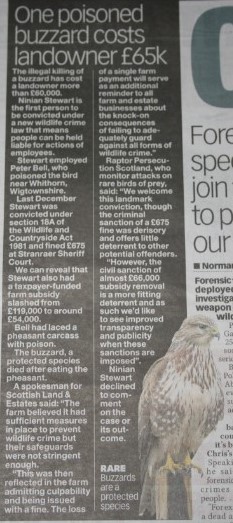
The other publication that we’re aware of was much more mainstream – the Sunday Mail (22nd March 2015) had a headline-grabbing article, ‘One poisoned buzzard costs landowner £65k’.

We were pleased to be quoted in this piece, as follows:

We welcome this landmark conviction, though the criminal sanction of a £675 fine was derisory and offers little deterrent to other potential offenders. However, the civil sanction of almost £66,000 subsidy removal is a more fitting deterrent and as such we’d like to see improved transparency and publicity when these sanctions are imposed“.

Well done to the RSPB for getting the info out there in the first place, and thanks to journalist Billy Briggs for reading this blog and taking the story to a wider audience.

Convicted vicarious liability landowner loses nearly £66,000 in subsidies

In January we blogged about the subsidy penalty given to Ninian Johnston Stewart, the first landowner to be convicted under vicarious liability legislation in Scotland after his gamekeeper laid out poisoned bait that killed a buzzard in 2012. At the time of Johnston Stewart’s conviction we knew that he’d lost some of his agricultural subsidy but we didn’t know how much. The only information in the public domain was the following quote from his defence agent, David McKie, who was discussing Johnston Stewart’s (derisory) fine of £675:

He [Johnston Stewart] had already been penalised substantially via a high five-figure deduction to his Single Farm Payment“.

The size of his subsidy penalty has now been revealed in the latest edition of the RSPB’s Investigations newsletter, Legal Eagle:

In 2012, Johnston Stewart’s business received nearly £120,000 in Single Farm Payments. Under ‘cross-compliance’ there is a requirement to comply with a number of conditions in order to receive payments. The poisoned bait and buzzard were found on land used for agriculture by the business and consequently he lost nearly £66,000 of the 2012 payment“.

That’s a good result, although you have to question why his entire 2012 subsidy (nearly £120,000) wasn’t withdrawn.

In other subsidy penalty news, regular blog readers will be aware that we’ve been trying to find out (unsuccessfully so far) whether the Stody Estate (Norfolk) has also received a subsidy penalty, following the conviction of gamekeeper Allen Lambert for poisoning 11 raptors (10 buzzards and a sparrowhawk) in 2012 and a series of other related crimes (see here, here, here, herehere and here). According to our reckoning, Stody Estate has potentially breached two Statutory Management Requirements: SMR1 (intentional killing of wild birds) and SMR9 (use of pesticides).

Thanks to the determination of one of our blog readers, here’s the latest response from the Rural Payments Agency:

12 February 2015

Ref: XXXXXX

Dear XXXXX

Re: Freedom of Information – Information Request

Thank you for your request for information dated 15 January 2015 which has been dealt with under Freedom of Information Act 2000 (FoIA).

To answer your questions:

1. Has the illegal poisoning of birds of prey carried out by an employee of the Stody Estate been reported to the RPA as a possible breach of Cross Compliance SMR1?

We can confirm that members of the public approached RPA following the media reporting of the prosecution, with several suggesting that SMR1 had been breached.

2. If the answer to the above question is yes, how many individuals have reported the potential breach to the RPA?

RPA can confirm that we have received e-mails from 20 individuals mentioning a possible breach in RPA regulations by the Stody Estate.

3. Is the RPA currently investigating a reported breach in cross-compliance at the Stody Estate relating to SMR1?

We previously answered a similar question in our response to you, reference XXXXX, and advised we do not hold any information that answers this question. RPA is obliged by European legislation to follow up these reports. We can assure you that RPA will take action, including cross compliance reductions to CAP subsidy payments, if this is found to be appropriate.

If you are not happy with the way we have handled your request, you can ask for an internal review. These requests should be submitted within two months of the date of receipt of the response to your original letter and should be addressed to: Access to Information, Rural Payments Agency, North Gate House, 21-23 Valpy Street, Reading, RG1 1AF.

Yours sincerely

Rural Payments Agency

You’d think that it would be a lot easier for members of the public to find out how their taxes have been spent, or more importantly, whether they’ve been withdrawn from those involved with criminality, wouldn’t you?

Who owns Kildrummy Estate?

Following yesterday’s news that Kildrummy Estate gamekeeper George Mutch has been jailed for four months for his raptor-killing criminal activities, a common question we’ve heard is, ‘Will there now be a vicarious liability prosecution?’

We think that there is the potential for a prosecution, although obviously we’re not privy to any evidence that the Crown might have available when they make a decision whether to proceed or not. We’ll just have to be patient and see what happens.

Let’s assume the Crown does decide that there is sufficient evidence to proceed, and that it would be in the public interest to prosecute, then the question becomes, ‘Who would be charged?’

That will depend on who was in the chain of command above Mutch and what managerial responsibilities they had at the time he committed his crimes (see here for our interpretation of how vicarious liability works). For example, if there was a Head Gamekeeper then perhaps he/she might be the one charged. If there was an Estate Factor then perhaps he/she might be the one charged. Perhaps there wasn’t anyone in a hierarchical managerial role between Mutch and the landowner, in which case, the landowner may be the one charged. But in this case, that might be a bit difficult.

Why? Have a read of Andy Wightman’s brilliant blog here and you’ll understand!

Subsidy penalty for convicted vicarious liability landowner

Last month we blogged about the Scottish landowner who was the first to be convicted under the new vicarious liability legislation which came in to force on 1st January 2012.

Ninian Robert Hathorn Johnston Stewart of the Physgill & Glasserton Estates was found guilty of being vicariously liable for the actions of his gamekeeper, Peter Finley Bell, who had laid out a poisoned bait which killed a buzzard. Bell was also found to be in possession of three banned poisons (see here).

The landowner’s conviction was met with mixed feelings. Many of us were pleased to see a successful prosecution in what was a landmark case, but there was widespread disappointment in the derisory fine of just £675.

A number of blog commentators asked whether the landowner would also be hit by a Single Farm Payment penalty for cross compliance breaches. We weren’t able to answer that at the time, although we knew that the use of a banned poison to kill a protected wild bird would certainly merit a penalty.

Well, it turns out that Mr Johnston Stewart was indeed hit with a subsidy penalty. According to his defence agent (David McKie),

He [Johnston Stewart] had already been penalised substantially via a high five-figure deduction to his single farm payment“.

We don’t know what that “high five-figure deduction” was (presumably somewhere between £10,000 – £99,999), nor do we know how it was calculated, nor what percentage it was of his annual subsidy payment. Nevertheless, it’s good to hear that a penalty was imposed so well done to SGRPID (Scottish Government, Rural Payments & Inspections Directorate) for being on the ball.

Wouldn’t it be good if this sort of detail was easily available in the public domain? We’d like to know how these public subsidies are being distributed (or revoked) and it surely has a deterrent value for other landowners who might just be persuaded to take a closer look at what their gamekeepers are up to. A section on this in the Scottish Government’s annual wildlife crime report wouldn’t go amiss….

First conviction in landmark vicarious liability case

The first ever prosecution under the new vicarious liability legislation concluded today with a conviction at Stranraer Sheriff Court.

Landowner Ninian Robert Hathorn Johnston Stewart pleaded guilty to being vicariously liable for the criminal actions of Glasserton & Physgill Estates’ gamekeeper Peter Bell, who was convicted in 2013 of laying poisoned bait (Carbofuran) which killed a buzzard, and for possession of three banned pesticides (Carbofuran, Strychnine and Alphachloralose). Bell was fined a total of £4,450 (see here). On conviction, Bell was expelled from the Scottish Gamekeepers’ Association and the Glasserton & Physgill Estates were expelled from the landowners’ representative organisation, Scottish Land & Estates.

So, what was the penalty in this landmark vicarious liability conviction? A pathetic £675! We don’t know the full details of Johnston Stewart’s plea, or if there was any mitigation, but nevertheless, a £675 fine is extremely disappointing, especially when you consider that the maximum penalty for this offence is £5,000 and /or a six month prison sentence.

Will a derisory fine of £675 act as a suitable deterrent to others? No, of course not; that’s pocket change to a wealthy landowner. It’s yet another example of why there needs to be a complete overhaul of the penalties for wildlife crime and we look forward to reading Professor Poustie’s review on this issue, which is due to be submitted to the Scottish Government early next year.

What might act as a deterrent is the reputational impact of the conviction, but only if the conviction is widely publicised. We haven’t seen anything in the press, yet. Hopefully some of the journalists who follow this blog will get something out there….

So, although this is a disappointing penalty, the fact that there has been a conviction and thus a demonstration that the legislation works, is to be welcomed. Well done to the Fiscal and all those involved with bringing this case to court.

We now have information on the second vicarious liability prosecution currently going through the system and we’ll be blogging about that one in the new year.

UPDATE 19.15hrs. The following press release has been issued by the Crown Office:

copfs logoFIRST WILDLIFE VICARIOUS LIABILITY CONVICTION IN SCOTLAND

Landowner Ninian Stewart sentenced today after pleading guilty to being vicariously liable for Peter Finley Bells’ crime of poisoning and killing of a wild bird.

Ninian Robert Hathorn Johnston Stewart was convicted at Stranraer Sheriff Court on 23 December 2014 and fined a total of £675 today for four offences under Section 15A(1) and Section 18A(1) and (2) of the Wildlife and Countryside Act 1981. Section 18A(2) makes the accused guilty of the original offence and liable to be punished accordingly.

This is the first prosecution and conviction in Scotland under section 18A of the Wildlife and Countryside Act 1981. This section came into force on 1 January 2012.

Section 18A(2) created a new vicarious liability offence meaning that a person (B), who has shooting rights on or over land, or who manages or controls the exercise of such rights, can be found guilty of a relevant offence(s) committed by a person (A) while acting as the employee or agent of B.

This provision is designed to encourage landowners and employers with varying levels of responsibility in connection with shooting to be diligent and proactive in countering wildlife crime.

Stewart, the landowner of Glasserton & Physgill Estates, was convicted of being vicariously liable for the criminal actions of Glasserton gamekeeper Peter Bell on land owned by Stewart and on which he held the shooting rights.

Bell was a full time Gamekeeper in the employ of Ninian Stewart when he committed the poisoning offence on 23 December 2012 at Glasserton Home Farm. He had laced the carcass of a pheasant baited with Carbofuran and set the bait in a field. A birdwatcher passing the farm saw something flapping in the field and on closer inspection found that it was a common buzzard, lying on the ground, in the last throws of life. Subsequent forensic work showed that the buzzard had died as a result of ingesting the poisoned bait.

Under section 18A(3) it is a defence for B to show that B did not know that the offence(s) was being committed by A, and that B took all reasonable steps and exercised all due diligence to prevent the offence being committed.

In this case, while there was no indication that Mr Stewart instructed the commission of the offences or that he even knew about them being committed, there no evidence that Mr Stewart took any steps to exercise due diligence in respect of shooting on his Estate.

Sara Shaw, Procurator Fiscal, Wildlife and Environment said:

“There is a proactive responsibility placed on those who employ game keepers to run shooting estates, to ensure that is done within the parameters of the law.

“These offences were committed almost a year after the vicarious liability offence (under section 18A of the Wildlife and Countryside Act 1981) was introduced. Mr Stewart had adequate notice and time in which to take advice and put appropriate measures in place.

“Mr Stewart failed in his responsibilities and as a result stands convicted of the killing of a wild bird.

“The law specifically protects wild birds. Those who seek to poison wild birds, or continue to possess stocks of illegal poison, and those who employ or engage the services of such persons and tolerate the commission of these offences, or who do so without taking all reasonable steps and exercising all due diligence to prevent them being committed, can fully expect to be brought to account before the courts.”

ENDS

Notes to Editor

  1. Ninian Robert Hathorn Johnston Stewart (DOB 18/02/1948) of Newton Stewart pleaded guilty on 23 December 2014 at Stranraer Sheriff Court to four offences under the Wildlife and Countryside Act 1981 as below.

(001) on 23rd December 2012 on or in relation to land at Glasserton Home Farm, Whithorn, Newton Stewart, Peter Finley Bell, a person then acting as your employee or agent, did commit a relevant offence as defined by Section 18A(6)(a) of the aftermentioned Act, namely an offence under Section 1(1)(a) of the aftermentioned Act, in that he did intentionally or recklessly kill a wild bird, namely a common buzzard in that he set the carcass of a pheasant baited with poison, namely carbofuran after which said buzzard did ingest said Carbofuran and did poison said buzzard whereby you NINIAN ROBERT HATHORN JOHNSTON STEWART, being a person who has and who manages or controls the exercise of a legal right to kill or take a wild bird on or over that land, are guilty of an offence;

CONTRARY to Section 1(1)(a) and Section 18A(1) and (2) of the Wildlife and Countryside Act 1981 as amended

And it is hereby certified in terms of section 20 of the aforementioned Act that evidence sufficient in the opinion of the prosecutor to warrant proceedings came to his knowledge on 17th July 2013

Charge 1: £150 (reduced from £200)

(002) between 23rd December 2012 and 5th March 2013 both dates inclusive on or in relation to land at Physgill Cottage, Glasserton Home Farm, Whithorn, Newton Stewart, Peter Finley Bell, a person then acting as your employee or agent, did commit a relevant offence as defined by Section 18A(6)(a) of the aftermentioned Act, namely an offence under Section 15A(1) of the aftermentioned Act, in that he did have in his possession a pesticide, namely Carbofuran containing a prescribed ingredient within the terms of the Possession of Pesticides (Scotland) Order 2005/66, Article 2 and the Schedule, namely Carbofuran whereby you NINIAN ROBERT HATHORN JOHNSTON STEWART, being a person who has and who manages or controls the exercise of a legal right to kill or take a wild bird on or over that land, are guilty of an offence; CONTRARY to Section 15A(1) and Section 18A(1) and (2) of the Wildlife and Countryside Act 1981 as amended

And it is hereby certified in terms of section 20 of the aforementioned Act that evidence sufficient in the opinion of the prosecutor to warrant proceedings came to his knowledge on 17th July 2013

Charge 2: £225 (reduced from £300)

(003) on 05 March 2013 on or in relation to land at Physgill Cottage, Glasserton Home Farm, Whithorn, Newton Stewart, Peter Finley Bell, a person then acting as your employee or agent, did commit a relevant offence as defined by Section 18A(6)(a) of the aftermentioned Act, namely an offence under Section 15A(1) of the aftermentioned Act, in that he did have in his possession a pesticide, namely Strychnine containing a prescribed ingredient within the terms of the Possession of Pesticides (Scotland) Order 2005/66, Article 2 and the Schedule, namely Strychnine whereby you NINIAN ROBERT HATHORN JOHNSTON STEWART, being

a person who has and who manages or controls the exercise of a legal right to kill or take a wild bird on or over that land, are guilty of an offence;

CONTRARY to Section 15A(1) and Section 18A(1) and (2) of the Wildlife and Countryside Act 1981 as amended

And it is hereby certified in terms of section 20 of the aforementioned Act that evidence sufficient in the opinion of the prosecutor to warrant proceedings came to his knowledge on 17th July 2013

Charge 3: £75 (reduced from £100)

(004) on 05 March 2013 on or in relation to land at Physgill Cottage, Glasserton Home Farm, Whithorn, Newton Stewart, Peter Finley Bell, a person then acting as your employee or agent, did commit a relevant offence as defined by Section 18A(6)(a) of the aftermentioned Act, namely an offence under Section 15A(1) of the aftermentioned Act, in that he did have in his possession a pesticide, namely alphachloralose containing a prescribed ingredient within the terms of the Possession of Pesticides (Scotland) Order 2005/66, Article 2 and the Schedule, namely alphachloralose whereby you NINIAN ROBERT HATHORN JOHNSTON STEWART, being a person who has and who manages or controls the exercise of a legal right to kill or take a wild bird on or over that land, are guilty of an offence;

CONTRARY to Section 15A(1) and Section 18A(1) and (2) of the Wildlife and Countryside Act 1981 as amended

And it is hereby certified in terms of section 20 of the aforementioned Act that evidence sufficient in the opinion of the prosecutor to warrant proceedings came to his knowledge on 17th July 2013

Charge 4: £225 (reduced from £300)

  1. Peter Finley Bell (DOB 11/02/1951) from Whithorn, Newton Stewart was fined £4,450 on 18 June 2013 after pleading guilty to four charges contrary to the Wildlife and Countryside Act 1981: one contravention of section 1(1)(a) (killing a wild bird) and three contraventions of section 15A (possession of an illegal pesticide). He was fined £2,450 for killing the buzzard (reduced from £3,500 to reflect his plea of guilty); £1,400 for possession of Carbuforan (reduced from £2,000) and £300 on each charge for possession of Strychnine and Alphachloralose (reduced from £500 on each charge).

END

MEDIA COVERAGE

BBC news here

Galloway Gazette names Sheriff Kenneth Robb here

Scottish Land & Estates: an extraordinary statement here. Glasserton & Physgill Estates were expelled from SLE in 2013, following the conviction of gamekeeper Bell (see here). Reading SLE’s defensive response to the conviction of landowner Johnston Stewart, you have to wonder…..

Journal of the Law Society of Scotland here

Scottish Daily Mail here

UPDATE 6th January 2015: Landowner hit with a five-figure subsidy penalty (here)