
SGA donor owns estate ‘among the worst in Scotland for wildlife crime’

SGA donors 2014 EdradynateThe Scottish Gamekeepers’ Association publishes a quarterly magazine for its members. The latest edition (winter/spring 2014) includes a list of recent donors. We were intrigued to see the following entry:

MDCC Campbell Edradynate Estate (Donation: £1720)

Could this be Michael David Colin Craven Campbell, who resides in Hampshire but owns Edradynate Estate? So why would this entry be intriguing? Why wouldn’t they accept funding from Mr Campbell, who was awarded an MBE in 2008 for services to charity, was appointed by the Queen to become High Sheriff of Hampshire 2008-2009 and has an entry in Debretts? No reason whatsoever to reject a generous donation from such an upstanding and distinguished gentleman whose Debrett’s entry lists ‘shooting’ and ‘escaping to Scotland’ amongst his recreational activities. Right?

Edradynate Estate near Aberfeldy in Perthshire was described in 2004 by the then RSPB Investigations Officer Dave Dick as being “among the worst in Scotland for wildlife crime” (see here).

In January 2005, the then Police Wildlife Crime officer for Tayside Police, Alan Stewart, described Edradynate Estate as follows:

Edradynate Estate, which is owned by an absentee landlord from Hampshire, has probably the worst record in Scotland for poisoning incidents, going back more than a decade. In 14 separate incidents since 1998, 16 poisoned victims (9 buzzards, 1 cat, 1 tawny owl, 2 sparrowhawks, 1 common gull, 1 polecat and 1 carrion crow) and 12 poisoned baits (rabbits, wood pigeons and a pheasant) have been found, with traces of the pesticides Mevinphos, Carbofuran and Alphachloralose” (see here, page 3).

These two prominent wildlife crime investigators were commenting following the collapse of a case against two gamekeepers from Edradynate Estate. In 2002, the Head gamekeeper and an under keeper had been charged with nine offences relating to the alleged use of poisoned baits and bird cruelty, including the use of spring traps. These charges followed a police raid on Edradynate Estate where three rabbit baits, a dead buzzard and a dead crow had been found. Lab tests detected Carbofuran and Alphachloralose. A game bag and a knife seized during the search showed traces of these poisons when swabbed.

On 22 July 2004, two years after the original arrests and 13 court hearings later, the Fiscal dropped the case following a series of adjournments called by both the defence and the prosecution. A Crown Office spokeswoman admitted that the time taken to prepare the case for trial had been a major factor in the decision to drop the case.

The 2002 raid was the second police search on Edradynate Estate. In Alan Stewart’s book, Wildlife Detective, he writes the following:

This would be our second major search of the estate under warrant and we hoped this time to find sufficient evidence to bring to an end the catalogue of poisoned baits and victims that had turned up on the estate with the worst record by far not just in Tayside but in Scotland”.

The crimes didn’t end there.
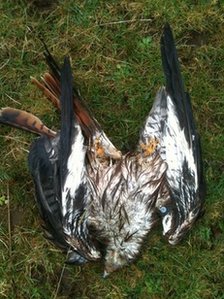
a dead red kiteIn July 2010 a poisoned red kite was discovered in the area (see here). According to Tayside Police, ‘five buzzards and a tawny owl met with the same fate in the same area in the last year’.

In September 2010, an un-named gamekeeper from Edradynate Estate, a self-proclaimed member of the SGA, talked to the Courier about the discovery of the poisoned red kite:

As a member of the Scottish Gamekeepers’ Association, I am against anything illegal. Anybody who does this should be jailed because it’s not on and I have never done anything like this in my life. To find a poisoned bird on my ground is just wrong because I don’t use poison and wouldn’t know how to.

There is something funny about this and I think someone else has killed this bird and planted it on my estate. Why they have done that, I don’t know. We have never seen a red kite, living or dead, in the Strathtay valley so I don’t know where this has come from. The laird is so upset about it, as am I, because it besmirches our reputation and it’s reflecting badly on me.

I am a professional person and I have worked hard for all these years on the estate and never had anything against my name. This is causing me a lot of stress and strain because I don’t know what is going to happen next. I’ve never been involved in anything like this before.

It’s very reassuring to know that I have the full support of the laird because this job is something I love doing.” (see here).

In March 2011 two poisoned buzzards and two poisoned crows were discovered, along with two poisoned pheasant baits. Carbofuran was detected this time. Tayside Police conducted another search (their third on this estate?) and it was reported that a 62 year old man was taken in for questioning but was released pending further enquiries (see here). We’re not aware of any other media statements about this incident.

In September 2013, the Crown deserted a case against Edradynate Estate’s Head gamekeeper on alleged firearms and explosives charges. The reason for this desertion was not made public (see here).

Nobody has ever been convicted for any of the alleged offences on Edradynate Estate.

Alan Stewart wrote about a 1995 incident on Edradynate Estate in his Wildlife Detective book, concerning the discovery of a poisoned cat belonging to the occupier of a cottage on Edradynate Estate. A search in a nearby wood had recovered a poisoned pheasant bait and a poisoned tawny owl – later all found to contain traces of Mevinphos. A further search had recovered two wood pigeon baits and a poisoned sparrowhawk, all found inside a pheasant pen. They all contained traces of Mevinphos. Stewart wrote:

I visited a number of residents on the estate and was absolutely shocked at what I learned. According to the interviews I carried out, my suspect had, at various times, set up a gun with a string attached to the trigger to pepper with wheat any intruder who brushed against the string. He had allegedly driven into Perth to the workplace of a person who lived on the estate, to remonstrate with him after a pheasant had been knocked down and killed by the person’s car. He had allegedly poisoned a tenant farmer’s collie, and also shot dead the dog of a visitor to a neighbouring estate after the dog had run off and was being pursued by its owner. I was taken aback by the vitriol these people had for my suspect but their hatred was tempered with fear and all interviews were ‘strictly off the record’. All those I spoke to were in tied houses and none wanted to become involved in a prosecution. News of my investigation had travelled fast and out of the blue I received a telephone call from a former factor for the estate. He had anticipated the reluctance of those who could potentially help, wished me the best of luck, but doubted that my enquiry would ever result in court proceedings”.

A prosecution in this case was attempted but the case was deserted after it became time-barred due to a lack of available evidence to link the individual suspect to the alleged offences.

Alan Stewart wrote:

The following week [just after the case had been deserted] I learned that another employee had borrowed the suspect’s Land Rover but it had broken down. In his search for tools to repair it, he had lifted up the passenger seat to search the compartment underneath as the most likely place for tools to be stored. Instead of tools there were three dead sparrowhawks. I am sure this would have clinched the case but naturally the employee wanted to keep his job and his house and the information came to me via a third party”.

Stewart wrote about another incident in 2001 – the discovery of a poisoned buzzard on the estate that had been killed by Carbofuran:

The usual enquiries were made and the usual suspect interviewed, but his involvement could not be established……..In the investigations on Edradynate Estate, we could prove beyond reasonable doubt that baits and dead birds and animals were being found with monotonous regularity on the estate. We could prove beyond reasonable doubt that the baits were laced with particular pesticides and that the victims had been poisoned after having consumed part of these baits. What we were so far unable to prove was who set the baits”.
Case against Lloyd Webber’s gamekeeper moves to trial

The case against a gamekeeper employed on Andrew Lloyd Webber’s estate in Hampshire has moved to trial.

Mark Stevens, 42, is accused of a series of trapping offences alleged to have taken place on the Sydmonton Court Estate, Hampshire, in August and September last year. He has denied the charges.

His trial will take place in July 2014.

See here for previous blog.

SGA Chairman claims he was “stitched up” by Channel 4 News

Mod Game coverbRemember last month when Channel 4 News did a piece on raptor persecution on grouse moors in Scotland? The one where SGA Chairman Alex Hogg was asked whether gamekeepers were poisoning, shooting and trapping birds of prey and he replied:
No they aren’t. We would dispute that“.

Yes, THAT programme (see here and here for previous blogs).

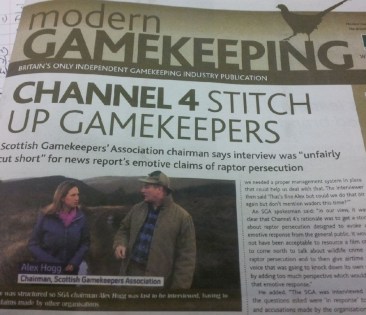
Well according to the monthly game keeping rag Modern Gamekeeping, Hogg reckons Channel 4 News stitched him up.

According to the article, Hogg said that during a one-hour interview he was asked the question of whether gamekeepers were killing raptors at least half a dozen times. “By the time the interviewer asked it the last time, I was so annoyed I just said ‘No’ and didn’t give a reason“.

Sounds like he stitched himself up, telling a blatant lie that he must have known was going to be challenged with irrefutable evidence that gamekeepers have been convicted for illegally killing raptors, including members of his own organisation.

He also complains about being interviewed last (after Ian Thomson of RSPB Scotland, Dominic Dyer of Care for the Wild, and Logan Steele of the Scottish Raptor Study Group), and therefore having to respond to ‘claims’ [aka given facts] made by the other interviewees, and not being allowed to talk about waders [and presumably the unproven, non-evidenced claims that raptors are wiping them out and therefore keepers should be able to cull raptors].

He also says, “There were also a lot of figures used that were not official figures held by the police or the Scottish Government“. Really? The figures used were based on scientific evidence and official court records, accepted by every person and organisation in the country except for those with a vested interest in the grouse-shooting industry.

He goes on to argue that the finished programme was “extreme”, designed to provoke an emotional response from the public, and didn’t fairly represent what he was trying to say. How you can misrepresent, “No they aren’t. We would dispute that” in response to a simple question of whether gamekeepers are persecuting raptors is a mystery. Did he mean to say, ‘Yes, we are illegally killing raptors’?

All the Hogg nonsense aside, there is a particularly interesting paragraph in the article, presumably written by the rag’s editor. It reads:

Presenter Cordelia Lynch then quoted RSPB figures to claim that hen harriers were ‘close to extinction’ on the grounds that none had bred last year in England – ignoring the fact that the bird is categorised as ‘Least Concern’ worldwide with a global population of more than 1,300,000 and its major threat is stated to be ‘habitat loss’. It is also said to be ‘highly vulnerable to the impacts of potential wind energy developments’ (source: BTO)“.

Now, this claim of the species being classified as ‘Least Concern’ is often trotted out by those trying to downplay the seriousness of the species’ conservation status in the UK. It is an accurate statement in as much as this is what is written on the species’ IUCN Red List entry (from where the quote is taken), with the addition of one important statement conveniently left out by the Modern Gamekeeping editor – under the heading ‘Major Threats’:

“Persecution is an important threat locally, notably on game preserves in Scotland (del Hoyo et al. 1994)”.

The species’ IUCN listing is fine to use if you want to stick to a species’ global conservation status and ignore its European and UK conservation status. If you look at the IUCN global status for the three wader species that Hogg and friends are up in arms about, their listings also give little cause for concern:

Lapwing – listed as Least Concern. Estimated population c. 5,200,000-10,000,000 individuals. Major threats include land use intensification, pollution and hunting. [Note, no mention of raptors being a major threat].

Curlew – listed as Near Threatened. Estimated population c. 77,000-1,065,000 individuals. Major threats include afforestation, agricultural intensification and hunting. [Note, no mention of raptors being a major threat].

Golden Plover – listed as Least Concern. No population estimate given. Major threats include cultivation and afforestation, severe weather conditions and hunting. [Note, no mention of raptors being a major threat].

So, on the basis of suggesting that the hen harrier’s conservation status is of ‘least concern’ on a global scale [and therefore why all the fuss of losing an entire breeding population in England?], the statement is equally as applicable to those three wader species, right? We shouldn’t be concerned about any of them because on a global scale they’re all doing just fine, right?

Wrong.

Fortunately, government and non-governmental organisations are a lot more clued in and understand the concept, and importance, of national, regional and local biodiversity. Indeed, the Westminster and Scottish Governments have a statutory responsibility for ensuring that national biodiversity targets are met and maintained (although you wouldn’t know it by their continuing failure to address illegal raptor persecution). Rather than use the broad-based IUCN Red List as guidance, they look to more detailed and relevant assessments such as the UK ‘Birds of Conservation Concern’ scientific review (see here). In this document, the hen harrier and lapwing are red listed, and the golden plover and curlew are amber listed.

It’s quite telling, isn’t it, that those with a vested interest in grouse-shooting should continue to not only deny their involvement in the catastrophic loss of an entire breeding population (hen harriers in England), but also continue to downplay its conservation significance.

SNH refuses to recommend golden eagle as national bird

Fearnan2Last month, the Scottish Parliament’s Public Petitions Committee took oral evidence on the petition to designate the golden eagle as Scotland’s National Bird.

Evidence in support of the petition was provided by Duncan Orr-Ewing (RSPB Scotland) and wildlife cameraman Gordon Buchanan. The hearing descended into farce when Tory MSP committee member Jackson Carlaw suggested that the eagle was an unsuitable candidate as it was symbolic of the Nazi regime (see our blog here).

The hearing was available to watch on Scottish Parliament TV but for those who missed it, you can read the official report here: Public Petitions Committee official report 28 Jan 2014

The hearing ended with the Petitions Committee agreeing to seek written advice from key organisations including the Scottish Raptor Study Group and SNH.

That written advice has now been submitted.

SNH advice: SNH response to petition 1500 Feb 19 2014

SRSG advice: SRSG response to petition 1500 Feb 23 2014

SNH, the Government’s statutory conservation agency, has refused to recommend the golden eagle to be Scotland’s National Bird. They say it is a contender, but suggest that other species are also worthy of consideration, such as the Scottish crossbill, crested tit, various sea birds, golden plover, curlew, osprey, white-tailed eagle, and wait for it….the red grouse.

Yeah, brilliant suggestion – let’s have the red grouse, a species that is intensively managed on an industrial scale (kept at artificially high densities and repeatedly dosed with toxic medications) across wide swathes of the Central, Eastern and Southern uplands at the expense of every predator with teeth, claws or a hooked beak. Predators that are ruthlessly and systematically killed, both legally and illegally, just so some grouse moor owner can impress his cronies with a large ‘bag’ of dead red grouse.

In stark comparison, the Scottish Raptor Study Group expressly supports the designation of the golden eagle as Scotland’s National Bird and makes clear that this designation would go some way to reducing the current illegal persecution of this species.

SNH (who quite tellingly didn’t once mention persecution in their response) has missed an important opportunity to promote the conservation of the golden eagle and send out a clear message to those who continue to poison, trap and shoot this species as part of grouse-management activities. They have actually sent out a message, just not one that’s fitting of a conservation agency that knows, through its own commissioned research, that this species needs all the help it can get.

The next stage of the petition process will likely be a public consultation. We’ll post links in due course.

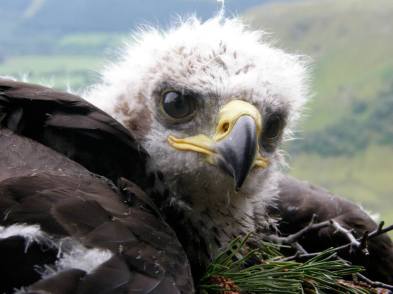
Photo of young golden eagle ‘Fearnan‘ taken in his Perthshire nest by Keith Brockie. Two years later (Dec 2013) he was found dead on an Angus grouse moor. He had been illegally poisoned.

Link between grouse moors & raptor persecution based on ‘ill-informed rumours’, apparently

Fearnan Angus Glens Dec 2013Last month a letter written by Logan Steele was published in the Scotsman, urging the government to introduce a licensing system for grouse shooting estates (see here).

This came on the back of the news that the Scottish Raptor Study Group and RSPB Scotland had written to the Environment Minister to call for estate licensing (see here) following the discovery of poisoned golden eagle ‘Fearnan’, found dead on an Angus grouse moor in December 2013 – the latest in a very long line of victims.

This month, the Scotsman published a response letter, penned by Tim Baynes, the Director of Scottish Land & Estates Moorland Group (a group chaired by Lord Hopetoun [Leadhills Estate] and comprising moorland owners and representatives of GWCT and the SGA – see here).

It’s perhaps then of little surprise to read the content of Mr Baynes’ letter – read it here. Basically, Mr Baynes is suggesting that Logan Steele’s assertions of a strong link between grouse moor management and the illegal persecution of raptors is ‘probably based on ill-informed rumours’.

GE Cons FrThose ‘ill-informed rumours’ no doubt include the following peer-reviewed scientific publications, some dating back over ten years (so the results have been available for a long time), which have all shown a direct link between driven grouse moor management and raptor persecution (and this list is by no means exhaustive – it’s just the ones we have to hand):

Etheridge et al (1997). The effects of illegal killing and destruction of nests by humans on the population dynamics of the hen harrier in Scotland. Journal Applied Ecology 34: 1081-1105.

Stott (1998). Hen harrier breeding success on English grouse moors. British Birds 91: 107-108.

Green & Etheridge (1999). Breeding success of the hen harrier in relation to the distribution of grouse moors & the red fox. Journal Applied Ecology 36: 472-483.

Whitfield et al (2003). The association of grouse moors in Scotland with the illegal use of poisons to control predators. Biological Conservation 114: 157-163.

Hardey et al (2003). Variation in breeding success of inland peregrine falcon in three regions of Scotland 1991-2000. In Thompson et al [Eds] Birds of Prey in a Changing Environment. SNH.

Whitfield et al (2004). The effects of persecution on age of breeding and territory occupation in golden eagles in Scotland. Biological Conservation 118: 249-259.

Whitfield et al (2004). Modelling the effects of persecution on the population dynamics of golden eagles in Scotland. Biological Conservation 118: 319-333.

Whitfield et al (2007). Factors constraining the distribution of golden eagles in Scotland. Bird Study 54: 199-211.

Whitfield et al (2008). A Conservation Framework for Golden Eagles: Implications for their Conservation & Management in Scotland. SNH.

Summers et al (2010). Changes in hen harrier numbers in relation to grouse moor management. In Thompson et al [Eds] Birds of Prey in a Changing Environment. SNH.

Redpath et al (2010). People and nature in conflict: can we reconcile hen harrier conservation and game management? In Baxter & Galbraith [Eds] Species Management: Challenges and Solutions for the 21st Century. SNH.

Smart et al (2010). Illegal killing slows population recovery of a reintroduced raptor of high conservation concern – the red kite. Biological Conservation 143: 1278-1286.

McMillan (2011). Raptor persecution on a large Perthshire estate: a historical study. Scottish Birds 31: 195-205.

Amar et al (2012). Linking nest histories, remotely sensed land use data and wildlife crime records to explore the impact of grouse moor management on peregrine falcon populations. Biological Conservation 145: 86-94.

Watson (2013). Golden eagle colonisation of grouse moors in north-east Scotland during the Second World War. Scottish Birds 33: 31-33.

Those ‘ill-informed rumours’ must also include all the reported incidents of illegally-killed or illegally-injured birds of prey that have been discovered on grouse moors over the last few decades (see here for a list of reported persecution incidents in the Angus Glens and here for a list of reported persecution incidents in South Lanarkshire).  These lists relate to reported incidents from grouse moors at Glenogil, Invermark, Millden, Airlie and Leadhills but don’t include other grouse moors in other parts of the country where illegally-killed raptors have been discovered, such as Farr & Kyllachy, Moy, Skibo, Cawdor, Corrybrough, Glenbuchat, Cabrach, Raeshaw, Invercauld, Glenlochy, Dinnet & Kinord, Glenfeshie, Dunecht, Strathspey and Glenturret, for example. And again, this list is by no means exhaustive.

Mr Baynes is being disingenuous at best to point to the  fact that two months on from the illegal death of Fearnan there is no evidence to link the crime to anyone on a grouse moor. While his assertion is technically correct, it is not an indication that anyone on a grouse moor was NOT responsible. Viewing one incident in isolation is also misleading – and the results of this police ‘investigation’ are more reflective of ineffective policing than anything else – there are many many examples of this ineptitude and include police actions such as delayed appeals for information (often up to 4-6 months after the discovery of a crime against raptors), issuing cryptic police statements about the type of crime and its location, arriving at scenes of crime in highly visible marked police vehicles instead of a covert entry, and failing to undertake timely follow-up searches of associated land, vehicles and buildings to search for evidence. This police ineptitude, followed by plea bargaining and failures to accept evidence by the Fiscals, means that few of the incidents listed above have resulted in a prosecution (although there are some notable exceptions including convictions of gamekeepers at Skibo, Moy, Dinnet & Kinord, Invercauld and Leadhills).

Added to this mix is the legal advice given to gamekeepers should they find themselves at the centre of a police investigation. This legal advice undoubtedly thwarts any attempt by the police to investigate an alleged raptor persecution crime. This from the SGA to their members:

Accordingly, it is the advice normally given by solicitors to clients that they need make no reply to any allegation and that they should not in fact give any further information than their name, address and date of birth in answer to any police questions“.

This advice is technically correct but is it what the public would expect from an organisation that is purportedly committed to partnership working to stamp out illegal raptor persecution?

We would suggest that Mr Baynes takes some time to read the above peer-reviewed scientific publications that demonstrate a clear and unequivocal link between driven grouse moor management and the illegal persecution of raptors, as well as taking the time to read up on the many reported incidents of raptor persecution on grouse moors, before he writes any more embarrassingly ignorant statements of denial in the national press.

Some comments on that Channel 4 News report

Channel-FourFor those who missed it, the Channel 4 News report on the illegal persecution of raptors on Scottish grouse moors can be watched here for a few days.

First of all, we need to be celebrating that raptor persecution has been featured on a national mainstream TV news channel. What a long way this subject has come. The awareness-raising power of a news report like this should not be underestimated. Since the programme aired four hours ago, we’ve already been contacted by three journalists whose interest has been piqued. Well done Channel 4 News.

There were excellent interviews with Ian Thomson, Head of Investigations at RSPB Scotland, who referred to “an absolute catalogue of illegal killing” over the last few years in the Angus Glens (e.g. see here), and Logan Steele of the Scottish Raptor Study Group, someone who has decades of first-hand experience recording the deaths of illegally-killed raptors in this area and beyond.

But perhaps the best interview was that with Scottish Gamekeepers’ Association Chairman, Alex Hogg. We couldn’t have wished for a better performance. Telling lies on national telly is never a good strategy. Especially when you deny that gamekeepers are involved with the poisoning, shooting and trapping of raptors, knowing full well that there is a public record of gamekeepers who have been convicted for doing just that, as well as committing other wildlife crimes. Here is a quick list of 14 convicted gamekeepers just covering the last two years (full details of each case can be found elsewhere on this blog) –

Jan 2012: Gamekeeper David Whitefield convicted of poisoning 4 buzzards.

Jan 2012: Gamekeeper Cyril McLachlan convicted of possessing a banned poison.

April 2012: Gamekeeper Robert Christie convicted of illegal use of a trap.

June 2012: Gamekeeper Jonathan Smith Graham convicted of illegal use of a trap.

Sept 2012: Gamekeeper Tom McKellar convicted of possessing a banned poison.

Nov 2012: Gamekeeper Bill Scobie convicted of possessing and using a banned poison.

Jan 2013: Gamekeeper Robert Hebblewhite convicted of poisoning buzzards.

Feb 2013: Gamekeeper Shaun Allanson convicted of illegal use of a trap.

Feb 2013: Gamekeeper (un-named) cautioned for illegal use of a trap.

May 2013: Gamekeeper Brian Petrie convicted for trapping offences.

June 2013: Gamekeeper Peter Bell convicted for poisoning a buzzard.

July 2013: Gamekeeper Colin Burne convicted for trapping then battering to death 2 buzzards.

Sept 2013: Gamekeeper Andrew Knights convicted for storing banned poisons.

Dec 2013: Gamekeeper Wayne Priday convicted for setting an illegal trap.

There are a further six cases either currently under way or due to start, all involving gamekeepers and all accused of alleged persecution including the poisoning, shooting, trapping and battering to death of birds of prey.

After lying about the involvement of gamekeepers in raptor persecution crimes, Hogg then went on to say that gamekeepers want a system in place whereby “if the populations [of raptors] are too high all over the United Kingdom” then a decision needs to be taken as to whether the species needs to be culled on grouse moors. But, “We don’t want to cull them; we’d rather the government done it”.

If anyone can explain to us (a) what is a “too high” population? and (b) why a species’ national population size should have any bearing on a proposed cull of that species on a particular grouse moor, please do enlighten us.

The final interview was a very short one with the Environment Minister, who was asked why he won’t “just fully regulate the [game-shooting] industry like other countries”?

His answer: “We want to avoid putting in place something that might be seen as a draconian response, or too restrictive a response. We’re not saying we wouldn’t do this, eventually…”

In other words, giving current measures ‘time’ to take effect (without actually defining the time scale) is just an excuse to do nothing and appease the mighty landowners.

Gamekeepers aren’t persecuting raptors, says SGA’s Chairman

Channel-FourHere’s a preview to tonight’s story on Channel 4 News….watch the video of SGA Chairman Alex Hogg responding to the reporter’s question about whether gamekeepers are poisoning, shooting and trapping birds of prey:

No they aren’t. We would dispute that“.

He can dispute it all he likes – the growing list of convicted gamekeepers tells a different story, and there are currently six on-going court cases to boot, including allegations of illegal trapping, poisoning, shooting and battering.

C4 News article and accompanying 3 video clips available here, including a preview of an interview with RSPB Scotland’s Head of Investigations, Ian Thomson.

Watch Channel 4 News this evening at 7pm for full story.

UPDATE 23.55hrs: Read our comments on the full report here

Parliamentary motion about poisoned golden eagle Fearnan

Fearnan Angus Glens Dec 2013The Scottish Parliament is taking note of the illegal killing of golden eagle Fearnan, who was found poisoned on an Angus grouse moor in December.

The following parliamentary motion has been lodged:

Motion S4M-08715: James Dornan, Glasgow Cathcart, Scottish National Party, Date Lodged: 07/01/2014

No Place for Wildlife Crime

That the Parliament notes the poisoning of the golden eagle named Fearnan and believes that the killing of birds of prey has no place in modern Scotland; believes that the golden eagle population is of national interest, as demonstrated by a recent poll in which the species was voted the country’s favourite animal; supports efforts by Police Scotland to bring wildlife criminals to justice, and commends the Scottish Government’s commitment to end raptor persecution.

Supported by: Joan McAlpine, Stuart McMillan, Chic Brodie, Adam Ingram, Christina McKelvie, Mike MacKenzie, Bill Kidd, Patrick Harvie, Kenneth Gibson, David Torrance, Aileen McLeod, Colin Keir, John WilsonR, Roderick Campbell, Nigel Don, Dennis Robertson, Liam McArthur, Colin Beattie, Fiona McLeod, John Finnie, Jean Urquhart, Rob Gibson, Richard Lyle, Christine Grahame, Graeme Dey, Maureen Watt, Kevin Stewart, Sandra White, Mark McDonald

What’s significant about this motion is not necessarily that one has been lodged – there was a similar motion lodged in 2012 by Nigel Don MSP following the discovery of the now infamous dead ‘Deeside Eagle’ (see here), with an amendment to that motion made by Claudia Beamish MSP following the shooting of a golden eagle in South Lanarkshire (see here).

James Dornan MSPThe significance of this latest motion is that it’s been lodged by an MSP that doesn’t live in the region where Fearnan was killed and isn’t especially well-known for addressing raptor persecution issues – James Dornan MSP, representing  Glasgow Cathcart. We view this as an important indication that the raptor persecution issue is being brought to the attention of people who may previously have been unaware.

Well done, James Dornan. Let’s see how many more MSPs sign up to support this motion. Has yours signed?

Latest measure to tackle raptor persecution now in place

Last July, following a series of raptor persecution incidents, Environment Minister Paul Wheelhouse announced his intention to introduce ‘further measures’ to tackle the ongoing problem (see here).

One of those measures has recently come in to force (as of 1st Jan 2014).

That measure is an enabling paragraph in some of the 2014 General Licences that says this:

SNH reserves the right to exclude the use of this General Licence by certain persons and/or on certain areas of land where we have reason to believe that wild birds have been taken or killed by such persons and/or on such land other than in accordance with this General Licence.

First of all, we applaud Paul Wheelhouse’s intentions, at least, and his determination to make sure this measure has been enacted. Good for him. However, as we blogged at the time, we really don’t see how this latest measure can be enforced (see here for our reasons).

For once, it seems that many of the game-shooting organisations are in agreement with us. Before SNH issued the 2014 General Licences, they had their usual consultation period and asked for comments about this new enabling paragraph, amongst other things (see here). They have just published those consultation responses and all the respondents from within the game-shooting lobby raised many of the same concerns as us.

So, even though this new measure is now in place, it is highly unlikely that it will ever be effectively deployed….a bit like the legislation relating to vicarious liability. We might be wrong, of course, but only time will tell.

In general terms, the 2014 General Licences are not much better than the 2013 General Licences in that many of the previous concerns raised (going back several years!) have still not been addressed. We’ve blogged about this a lot (e.g. see here, here, here, here, herehere, here, here, here, here) and don’t intend to go over all the points again….not just yet, anyway. We understand that SNH is intending to organise further research in 2014 to address many of the concerns, although they said that when they issued the 2013 General Licences and yet here we are, another year gone by and we’re still waiting for that research.

While we wait, it’s worth you having a look at the responses to the 2014 General Licence consultation – especially the response from the Scottish Gamekeepers’ Association, who once again are asking for ‘quota systems’ for buzzards, ravens, pine martens and badgers.

Download the PDF here: Consultation responses to General Licences 2014

Naturally, we’ll be watching with interest to see whether SNH has cause to withdraw the use of the General Licences, on the basis that they have ‘reason to believe’ that wild birds have been illegally taken or killed. The enabling paragraph probably cannot be used retrospectively so we’ll just have to wait until we see the next incident of criminal activity, which probably won’t be too far off, and then we’ll see what happens.


Case against Scottish gamekeeper James Marsh to continue in Feb

Criminal proceedings against Scottish gamekeeper James Marsh continued at Stirling Sheriff Court last Thursday (19th December 2013).

Marsh, 49, of Middle Ballewan near Blanefield, Stirling is facing charges related to alleged wildlife crime and animal welfare offences which are said to have taken place near Duntreath Castle in April 2012.

The charges, which Marsh has denied, relate to the alleged trapping of a Tawny owl and other associated offences.

His case was continued on Thursday and is expected to conclude in February 2014.

Previous blog post here.