Police Scotland explain failure of vicarious liability in Kildrummy case

waneLast month we blogged about the failure of the Crown Office to initiate a vicarious liability prosecution in the Kildrummy case (see here).
A quick re-cap: in December 2014, Kildrummy Estate gamekeeper George Mutch was convicted of a series of wildlife crime offences that took place on Kildrummy Estate in 2012, including the trapping of a goshawk which he then beat to death with a stick (see here). In January 2015, Mutch was sentenced to four months in prison – the first gamekeeper in the UK to receive a custodial sentence for raptor persecution crimes (see here).

In September 2015, the possibility for a vicarious liability prosecution against Mutch’s employer became impossible as the case had become legally time-barred (i.e. three years had elapsed since the commission of his crimes). We wanted to find out why a vicarious liability prosecution had not been brought in this case so we asked the Crown Office for an explanation. They responded by saying that as nobody had been reported to them for consideration, they couldn’t take forward a prosecution. We speculated (here) about the reasons why nobody had been reported, and thought that it probably had something to do with the fact that Kildrummy Estate is registered as an off-shore company (in Jersey) and thus identification of the actual owner was well hidden; this situation had been expertly uncovered by Andy Wightman’s research earlier this year – see here. However, to find out if this really was the reason why nobody had been reported to the Crown Office, we really needed to hear from Police Scotland, so last month we asked them why they hadn’t reported anyone from Kildrummy Estate to the Crown Office for consideration of a vicarious liability prosecution.

Police Scotland has now responded with a cryptic masterpiece, but if you look closely at their carefully-worded reply it is actually quite revealing:

Police Scotland is committed to tackling wildlife crime whilst recognising that these investigations can often be challenging and prolonged. In 2013, a report about George Mutch was submitted to the Wildlife and Environmental Crime Unit (WECU) at the Crown Office and Procurator Fiscal Service (COPFS) alleging the unlawful taking and killing of birds of prey at Kildrummy Estate, Aberdeenshire in 2012. Following a criminal prosecution Mr Mutch was convicted and sentenced to 4 months imprisonment in January 2015.

In parallel with the investigation surrounding the activities of George Mutch, enquiries were made to establish whether any further charges could be brought in terms of Vicarious Liability legislation (Section 18A of the Wildlife & Countryside Act 1981). However, this legislation does require an offence to have been committed and therefore charges can only be formally libelled once a conviction has been confirmed. Significant international investigations were undertaken by Police Scotland but after consultation with COPFS it was established that due to insufficient evidence the additional charge of Vicarious Liability could not be libelled.

The experience of this case has, however, identified opportunities for refining future Vicarious Liability investigations, a matter currently being explored with COPFS. Please be assured that Police Scotland will continue to ensure that robust and modern investigative tactics are utilised to bring those committing wildlife crime to justice. Police Scotland’s wildlife crime commitment is additionally reflected in our membership of PAW (Partnership for Action Against Wildlife Crime) Scotland.

I hope the above information addresses the issue raised by you in your correspondence.

Yours sincerely,
Sean Scott, Detective Chief Superintendent”.
END
For the purposes of our interest, the first paragraph can be ignored. Where things start to get interesting is in paragraph two. Pay close attention to the wording:
Significant international investigations were undertaken……..it was established that due to insufficient evidence the additional charge of Vicarious Liability could not be libelled“.
International investigations” can only relate to an enquiry about either the land owner, or Mutch’s employer, or who owned the shooting rights; in other words, the individual who could be liable for a potential vicarious liability prosecution. “Insufficient evidence” implies that Police Scotland knew who was responsible for managing Mutch, but just couldn’t prove it. Why? Because the details are hidden in an off-shore holding.
It is apparent then, in the Kildrummy case, that justice has been defeated because the details of land ownership (or at least the hierarchical management structure from Mutch upwards) are concealed. This has big implications for any future vicarious liability prosecutions on estates where the land is registered as an off-shore company (a convenient ploy to escape a potential criminal prosecution) and we’re pretty sure Andy Wightman will have something to say about this in terms of his work on the Land Reform Bill currently being considered by the Scottish Parliament. (Update: Andy Wightman has blogged abut this latest development – see here).
The first line of paragraph three, (“The experience of this case has, however, identified opportunities for refining future Vicarious Liability investigations….“) is interesting and we’ll watch to see what this ‘refinement’ might entail.
As an aside, we were interested to read that Police Scotland thinks that vicarious liability charges “can only be formally libelled once a conviction has been confirmed“. That’s not actually what the legislation says. The legislation allows that the person who committed the primary offence need not be prosecuted in order for a prosecution to be brought against the person in management or control (see here). We’re a bit bemused by Police Scotland’s interpretation of this in their above statement, but, as we say, it’s a bit of a side issue in this case because even if Mutch hadn’t been convicted but an attempt was still made to undertake a vicarious liability prosecution, presumably Police Scotland would still have faced the same issue of being unable to identify the person in management or control because these details are squirreled away in an office in Jersey, apparently beyond the reach of Police Scotland.
So, even though vicarious liability has failed in the Kildrummy case, we feel it’s important to acknowledge that in this case, as far as we currently understand what went on, the failure is through no fault of Police Scotland or the Crown Office. This failure is, though, an indication that Vicarious Liability is not the panacea the Scottish Government would like us to believe it is for putting an end to raptor persecution crimes. Since vicarious liability was introduced as an option on 1st January 2012, there has still only been one single successful prosecution. In almost four years, that’s not a good return rate by anyone’s standards.

Raeshaw and Burnfoot Estates to appeal General Licence Restriction orders

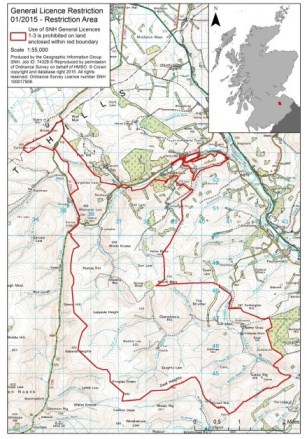
Raeshaw Corshope GL restriction map 2015Further to last week’s news that SNH has suspended the use of General Licences on four estates for what it said was “clear evidence that wildlife crimes have been committed on these properties”, which includes the discovery of poisoned raptors and illegal traps (see here and here), two of the estates involved are set to appeal.

According to quotes in this week’s Scottish Farmer, defence agent David McKie, representing Raeshaw Estate in the Borders, said: “We are disappointed by this decision and will be vigorously challenging it“.

A spokesman for Burnfoot Estate said: “We absolutely dispute the conclusions reached by SNH and consider the decision to be unfair. We will be appealing the decision“.

Meanwhile, a spokesperson for Scottish Land & Estates is quoted: “Our concerns about the level of evidence and robustness of process, which were raised previously along with other land management organisations, remain. We will be working with key industry stakeholders to learn more about the circumstances surrounding these new restrictions“.

A spokesman for the Scottish Gamekeepers’ Association is quoted: “It is up to the estates involved to take counsel and make a case if they feel there is insufficient evidence for the measure to proceed. When this measure was initially subject to consultation, the SGA opposed it, not in the spirit of what it was trying to do, but rather that it was simply not a good proposal“.

Article in Scottish Farmer here

Wonder if Raeshaw Estate or Burnfoot Estate is a member of the SLE?

SNH reveals reasons for general licence restrictions on Raeshaw & Burnfoot Estates

Raeshaw Corshope GL restriction map 2015Last week we blogged about the implementation of General Licence restrictions on parts of four properties: Burnfoot Estate & Wester Cringate Estate in Stirlingshire, and Raeshaw Estate & Corsehope Estate in the Borders (see here).

At the time, SNH did not reveal the reasons for the General Licence restrictions, other than to say “There is clear evidence that wildlife crimes have been committed on these properties” [since 1st January 2014, when the new regulations were enacted].

We speculated that the General Licence restrictions at Burnfoot and Wester Cringate in Stirlingshire were related to the poisoning of a red kite (July 2014), a poisoned peregrine (Feb 2015), and the illegal trapping of a red kite (May 2015).

We had no idea why the General Licence restrictions had been implemented at Raeshaw and Corsehope in the Borders, because there hadn’t been any publicity about any recent raptor persecution crimes in this area.

However, last Saturday (7th November 2015), a bit more information was revealed during an interview with SNH Wildlife Operations Manager, Robbie Kernahan, on the BBC Radio Scotland Out of Doors programme.

Amongst other things, the presenter asked Mr Kernahan directly about the reasons for General Licence restrictions on these four properties. Here’s what Mr Kernahan said:

Stirlingshire GL restrictions:Relates to some issues associated with poisoning birds of prey, birds of prey being found poisoned in that location, and illegal use of traps“.

Borders GL restrictions:There are issues about the illegal placement of traps“.

No further explicit detail was provided, although there was a general wider discussion about the use of General Licence Restrictions and their deterrent value in tackling raptor persecution.

The interview can be heard here for the next 26 days (starts at 02:15; ends at 09:06).

No vicarious liability prosecution for Kildrummy Estate

Last month we blogged about whether anyone from the Kildrummy Estate in Aberdeenshire would face a vicarious liability prosecution for the criminal actions of Kildrummy gamekeeper George Mutch.

Mutch, as you may recall, was convicted in December 2014 for various wildlife crimes he committed on the Kildrummy Estate in August and September 2012, including the trapping of a goshawk which he then beat to death with a stick (see here). In January 2015, Mutch was sentenced to four months in prison; a landmark custodial sentence for a raptor-killing gamekeeper (see here).

In September 2015 we noticed that time was running out for a subsequent potential vicarious liability prosecution because after three years from the date the crime was committed, the case becomes ‘time-barred’ and a prosecution is no longer possible. We decided to ask the Crown Office for information about any pending vicarious liability prosecution (see here) but to be honest, we weren’t expecting much of a response.

However, the Crown Office has surprised us by issuing the following unusually open response:

Wildlife and environmental crime is a priority for the Crown Office and Procurator Fiscal Service. Such cases are investigated and prosecuted by our specialist Wildlife and Environmental Crime Unit, WECU. A report was submitted by the police against George Mutch alleging the unlawful taking and killing of birds of prey by him at Kildrummy Estate, Aberdeenshire in dates in August and September 2012 and considered by WECU. Following further investigation, a criminal prosecution was raised. Mr Mutch pled not guilty but was convicted of the offences after trial and in January 2015 he was sentenced to four months imprisonment.

Despite further investigations including investigations which focused on establishing vicarious liability, no-one else has been reported to COPFS in relation to the events which took place in Kildrummy Estate in 2012 and accordingly, no further prosecution, including any prosecution for a vicarious liability offence, has taken place“.

FAILSo, just to be clear, a vicarious liability prosecution is not underway, and as this case has now become time-barred (because the offences were committed in Aug/Sept 2012), as we understand it there won’t be a vicarious liability prosecution for this case in the future. Massive fail.

This will be a huge disappointment to all those who have been following this particular case, and especially for those who worked so hard to secure the initial conviction of Mutch. But perhaps more importantly, this is yet further evidence that the new and much-lauded Government measures to tackle raptor persecution are simply not working as well as they should be.

So what went wrong, and what are the potential ramifications for future vicarious liability prosecutions?

Let’s go back to that statement from the Crown Office, and particularly the first part of the sentence in the last paragraph:

Despite further investigations including investigations which focused on establishing vicarious liability, no-one else has been reported to COPFS…..”

It’s clear from this that attempts were made to identify somebody for a vicarious liability prosecution. There are at least three possible explanations for what happened next:

  1. An individual was identified but they were able to show that they had exercised ‘due diligence‘ in that they had written records demonstrating that they did not know the offences were being committed AND they had taken all reasonable steps AND exercised all due diligence to prevent the offences being committed. This is possible, of course, but in this particular case is fairly implausible given that during the trial, Mutch was asked, quite pointedly by the Fiscal Tom Dysart, whether he had received training [from his employer/supervisor] for the use of his traps, to which Mutch had replied ‘No’. Given Mutch’s claim, if his employer/supervisor had subsequently claimed due diligence as a defence to a vicarious liability prosecution, the case should have been heard in court where the Fiscal could challenge the veracity of the employer’s/supervisor’s claims.
  2. Police Scotland ran out of time for their investigation. This is plausible, seeing as Mutch was only convicted in December 2014 leaving just nine months before the case became time-barred. Having said that, if this is what happened it would reflect badly on Police Scotland because they should have been thinking about, and planning for, a potential vicarious liability prosecution way back in 2012 when they were first made aware of these crimes. The legislation enabling vicarious liability prosecutions was enacted on 1st January 2012, to much public fanfare, so the police can hardly claim they didn’t know about it at the time they were initially investigating these crimes in September 2012.
  3. It was impossible for Police Scotland to identify a suspect for a potential vicarious liability prosecution due to the complexity of ownership at Kildrummy Estate. On the one hand, this seems a pretty implausible explanation. Mutch, surely, knew who employed him and who paid his wages. But on the other hand, this explanation could be highly plausible given the convoluted information about ownership of the Kildrummy Estate as revealed by Andy Wightman’s excellent investigation earlier this year – see here. If this is indeed what happened in this case, it has far-reaching implications for future vicarious liability prosecutions. All an estate owner has to do to avoid a potential prosecution is register his/her land in an offshore tax haven because then the landowner becomes untraceable. Genius. For a fascinating and detailed explanation of how these tax havens work, and how the Scottish Government has so far refused to legislate against them despite recommendations, have a read of Andy’s latest blog – here.

Given the faith that the Environment Minister has placed in the use of vicarious liability prosecutions as an effective tool to tackle illegal raptor persecution (and thus sees no need to introduce further measures), and given the failure to prosecute in this particular case, as well as the huge public interest, an explanation is required about what did (or didn’t) happen here. The Crown Office has said it didn’t prosecute because Police Scotland didn’t report anybody for a potential vicarious liability prosecution. So, the next port of call for an explanation has to be Police Scotland. They can’t use their usual get out clause of saying ‘Sorry, can’t comment, it’s a live investigation’ because this case is no longer live. It’s very much dead in the water. So will they show some transparency and accountability here? Let’s hope so.

To ask Assistant Chief Constable Malcolm Graham why nobody was reported for a vicarious liability prosecution in relation to raptor persecution crimes at Kildrummy Estate in 2012, please email: ACC.CrimeMCPP@scotland.pnn.police.uk

What grisly fate awaits these two satellite-tagged hen harriers?

Bowland HH Jude LaneAs part of the RSPB’s Hen Harrier Life+ Project, the movements of two satellite-tagged hen harriers can now be followed online – see here.

The two birds are called ‘Holly’ and ‘Chance’.

Holly had her satellite tag fitted in June this year by members of the Scottish Raptor Study Group, assisted by the MOD Police and was one of three chicks from a nest located on high security MOD land at Coulport. She was named after a member of the production crew from BBC Scotland’s Landward programme after appearing in a special feature about hen harriers and the threats these birds face from illegal killing (see here). Holly fledged in August and has since left her natal area, moving in to the uplands of central Scotland.

Chance had her sat tag fitted in June last year by members of the Scottish Raptor Study Group and was named by RSPB Scotland staff. She travelled south from her nest in SW Scotland to the RSPB Wallasea Reserve in Essex at the end of October (2014), before crossing the Channel to spend the winter months in western France. Chance came back to the UK in spring this year but has since returned to France via Wales.

The RSPB’s explanation for sat tagging these two hen harriers (and others) is: ‘To better understand the threats they face and identify the places they are most at risk‘.

To be frank, there is already a very good understanding of the threats they face and of the places they are most at risk; it’s been known for at least 20 years that these birds are illegally killed by gamekeepers on driven grouse moors. It’s no mystery and it’s no secret.

However, that’s not to say that continued satellite-tagging is without purpose. There’s a very important reason for continuing to do it, and that is to raise public awareness by getting people ‘involved’ with these individual birds (hence, giving them names) and showing people the birds’ movements (via online maps) so that when they are eventually shot, trapped, poisoned, or they simply ‘disappear’ in grouse moor areas (it’s inevitable), the public outcry will be considerable and the subsequent pressure on the authorities to actually do something about it will be greater. That is, assuming the police decide to publish the information, but it’ll be harder for them to keep quiet if we all know the birds have stopped moving.

There are already plenty of examples of satellite-tagged hen harriers either ‘disappearing’ or being found shot, so nobody should expect anything different for Holly and Chance. Here are some of the well-known individuals from the last few years:

Hen Harrier Annie – found shot dead on a Scottish grouse moor in April 2015 (here).

Hen Harrier Heather – found shot dead at a winter roost site in Ireland in January 2015 (here).

Hen Harrier Sky – ‘disappeared’ on a grouse moor in Lancashire in September 2014 (here).

Hen Harrier Hope – ‘disappeared’ on a grouse moor in Lancashire in September 2014 (here).

Hen Harrier Sid – ‘disappeared’ on a grouse moor in North Yorkshire in September 2014 (here).

Hen Harrier Blue – ‘disappeared’ somewhere (location not revealed) in October 2013 (here).

Hen Harrier Bowland Betty – found shot on a grouse moor in North Yorkshire in July 2012 (here).

Hen Harrier Tanar – ‘disappeared’ on a grouse moor in Aberdeenshire in June 2011 (here).

Hen Harrier (unnamed) – ‘disappeared’ on a grouse moor in southern Scotland in October 2011 (here).

And then there were the 47 hen harriers that Natural England sat-tagged between 2007-2014. Last year we were told that four were still known to be alive, six had been found dead, and a staggering 37 birds (78.7%) were ‘missing’ ‘somewhere’ (see here). Natural England has been persistently coy about telling us us where those 37 birds went missing, even though the satellite tagging project has been funded by us taxpayers.

Bowland Betty

And of course it’s not just hen harriers that we’ve watched meet a premature death. Other species have also been sat-tagged in recent years including Montagu’s harrier ‘Mo’, who ‘disappeared’ on the Queen’s Sandringham Estate in Norfolk last year (here) as well as at least eleven golden and white-tailed eagles (listed here), including some very high profile cases such as golden eagle Fearnan (found poisoned on a Scottish grouse moor here), golden eagle Alma (found poisoned on a Scottish grouse moor here) an unnamed golden eagle that had been illegally trapped on a Scottish grouse moor before being dumped in a lay by (here) and the first fledged white-tailed eagle in East Scotland for over 200 years who ‘disappeared’ on a Scottish grouse moor (here).

So, contrary to the belief of the Hawk & Owl Trust who earlier this year told us that fitting satellite tags to hen harriers “would prevent any gamekeepers from shooting them in the sky” (see here), gamekeepers don’t give a toss whether the bird in their gun sight is carrying a transmitter or not because they know full well that they are highly unlikely to get caught, let alone prosecuted. Not one of the above cases has resulted in a prosecution. So, no, the purpose of tagging isn’t to directly save the bird, but indirectly it just might, if enough of us follow the online movements of Holly and Chance and all the other tagged harriers that will be part of the RSPB’s Hen Harrier Life+ Project and then shout from the rooftops when each bird is illegally killed. It’s going to happen, and we are going to shout.

Top photo: Bowland Betty alive (photo Jude Lane).

Bottom photo: Bowland Betty dead (photo RSPB).

Misleading conclusions from Scot Gov’s 2014 wildlife crime report

Wildlife Crime in Scotland 2014 reportYesterday the Scottish Government published its latest report on wildlife crime: ‘Wildlife Crime in Scotland: 2014 annual report’ (see here).

It was accompanied by a Government press release (here) with a headline statement claiming ‘ Recorded wildlife crime dropped by 20 per cent in the period 2013-2014‘. This claim has been regurgitated, without real examination, in much of the national press, which will give the public the impression that all’s going swimmingly in the fight against wildlife crime in Scotland. This couldn’t be further from the truth.

Let’s start with the report’s name. It claims to be the ‘2014 annual report’, but actually the period covered by the report is the 2013/14 financial year: April 2013 to March 2014. That means the majority of the data are from 2013 (9 months worth) – these are wildlife crimes that took place as long ago as 2.5 years and the most ‘recent’ took place 18 months ago (March 2014). Many more offences occurred during the nine months between April-Dec 2014 but they are not included in this report. Although the report itself does explain the reasons behind this odd time-frame selection, the report’s title does not, which means anyone just browsing the headline news will be given a false impression of how recent these findings are. It’s a small point, but it’s an important one.

However, there are bigger issues than just a misleading report title.

If you take the report’s data at face value (which we don’t – more on that in a second) and accept that it’s representative of all reported wildlife crime in Scotland between April 2013 and March 2014, you might also accept that the claim of a 20% reduction in recorded wildlife crime is accurate. But if you look at the data (Table 1), you’ll notice that this supposed broad reduction (i.e. reduction of recorded wildlife crimes in general) is actually almost entirely due to a large reduction in one particular area of wildlife crime: specifically, fish poaching. To then apply this reduction of a specific wildlife crime to all other types of wildlife crime in a broad sweeping statement is wholly misleading.

Our main issue with this report, as with previous reports, is the Government’s insistence on only using crime data that has been recorded by the Police. Although this report does attempt to address this problem by including separate sections on data collected by others (e.g. Scottish Badgers, SSPCA), these data are still not included in the overall analysis of wildlife crime trends because these incidents weren’t recorded on the Police national crime database. A good example of this is shown in Table 10, which details the number of wildlife cases investigated by the SSPCA. The report accepts that cases investigated solely by the SSPCA (as opposed to cases where the SSPCA has assisted the Police) are not included in the ‘official’ recorded crime data because ‘they are not recorded on the police national crime database’. So in effect, 69 cases that were investigated solely by the SSPCA during the period covered by the report are absent from the national figures. It seems bizarre that even though these data are available (of course they are, they appear in this report, albeit in a separate section!) they are still excluded from the main analysis. This blatant exclusion immediately reduces our confidence in the robustness of the ‘national’ data.

Another blatant exclusion of data is demonstrated in Table 17 in the Raptor Persecution section. This table identifies only 16 bird of prey victims from the mass poisoning in March 2014 known as the Ross-shire Massacre, excluding the other six victims that were found. The report justifies this exclusion by explaining that evidence of poisoning was not found after examinations of those six raptors. That’s fair enough, but surely we’re not expected to believe that those six victims all died of natural causes, in the same small area, and at the same time, as the 16 confirmed poisoning victims? They don’t appear in the figures because a crime couldn’t be identified, but they still died as a result of this crime and to pretend otherwise is nonsense.

An additional problem that erodes public confidence in the accuracy of the ‘national’ data is the issue of how carefully wildlife crimes are recorded. A report published earlier this year (which includes part of the period covered by this latest Government report) revealed systemic problems with the under-recording of several types of wildlife crime as well as failures by the police to undertake follow-up investigations on reports of suspected wildlife crimes (see LINK report here). If the police don’t follow up with an investigation, the incident is unlikely to be recorded as a crime. Until these issues are suitably addressed, the accuracy of ‘official’ ‘national’ wildlife crime data will inevitably be viewed with suspicion.

So, we don’t have much confidence in this report’s data and we certainly don’t agree with the Government’s claim that (overall) recorded wildlife crime has reduced by 20%, but there are some positives. It’s clear that more thought has been put in to the material contained in this year’s report and there is definitely more clarity about the sources used. That’s good progress.

There are also a couple of things in this report that we are particularly pleased to see.

First, let’s go back to Table 10 (SSPCA data). You may remember (if you have a long memory) that in March 2014, the Government opened its consultation on whether to increase the investigatory powers of the SSPCA. That consultation closed in September 2014 and, over a year later, we’re still waiting for a decision. It’s our understanding that one of the main sticking points is with Police Scotland (who, as you’ll recall, strongly objected to an increase of powers – see here). Apparently, the current sticking point is that Police Scotland are worried that they’ll be excluded from wildlife crime investigations because the SSPCA ‘refuses to work with them’. However, if you look at Table 10, you’ll notice that 50% of all wildlife cases taken by the SSPCA during the period covered by this report were undertaken in partnership with the Police. That’s 50%. Does that look like an organisation that is refusing to work with the Police? It doesn’t to us.

The second point of interest in this report appears in Table 18b. This table provides information about recorded bird of prey crimes between April 2013 and March 2014. Have a look at the 7th entry down:

Species: Hen Harrier

Police Division: Aberdeenshire and Moray

Type of Crime: Shooting

Date: June 2013.

Why is this of particular interest? Well, cast your mind back to January 2014 when we blogged about a vague Police Scotland press release that stated a man had been reported to the Crown Office ‘in relation to the death of a hen harrier’ in Aberdeenshire that took place in June 2013 (see here). So it turns out this hen harrier had been shot. Amazing that it took over two years for this information to be made public. But that’s not the most interesting bit. For this unnamed individual to be reported to the Crown for allegedly shooting this hen harrier means that the Police have some level of evidence that they think links him to the crime. If they didn’t have evidence, he wouldn’t have been reported. So, the alleged crime took place 2.4 years ago. The Crown Office was notified 1.9 years ago. What’s happening with this case? Is there going to be a prosecution? Why such a long delay for a crime that is deemed a ‘priority’ by the Scottish Government?

Kildrummy Estate: vicarious liability prosecution?

On 11th December 2014, Scottish gamekeeper (and SGA member) George Mutch was convicted of four wildlife crime offences that he’d committed on the Kildrummy Estate, Aberdeenshire in 2012 (see here).

On 12th January 2015, Mutch was given a four month custodial sentence for his crimes; the first gamekeeper to be jailed in the UK for killing raptors (see here).

Both his conviction and sentence were widely welcomed across the conservation community, not least because video evidence had been deemed admissible in this case and because the agencies involved in the investigation and prosecution had worked exceptionally hard to achieve these results.

Hopes were high that a subsequent vicarious liability prosecution would follow, especially when a journalist friend told us that Fiscal Tom Dysart had made a point of asking Mutch in court whether he’d received any training for the use of his traps, to which Mutch had replied, “No”. That response would indicate that a defence of ‘due diligence‘ wouldn’t stand up to scrutiny for anyone charged with being vicariously liable for Mutch’s crimes. All good so far, although Andy Wightman cast doubt over the feasibility of charging someone from Kildrummy Estate given the difficulty of establishing ownership there (read his blog here).

So seven months on, what’s happening now?

Well, it all gets a bit interesting around about now.  As we understand it, for offences committed under the Wildlife & Countryside Act, criminal proceedings MUST begin within three years from the date of the commission of the offence (two years in England & Wales). After three years, the case becomes ‘time-barred’ and it is no longer possible to prosecute.

Mutch was convicted of four offences, and the dates those offences were commissioned are as follows (info from COPFS press release, January 2015) –

  1. On 14 August 2012 & 15 August 2012, Mutch did intentionally or recklessly kill or take a wild bird, namely a goshawk.
  2. On 23 August 2012 and 24 August 2012, Mutch did intentionally or recklessly take a wild bird, namely a buzzard.
  3. On 28 August 2012, Mutch did intentionally or recklessly kill, injure or take a wild bird, namely a goshawk.
  4. Between 6 August 2012 – 13 September 2012, Mutch did use a trap to catch two goshawks and a buzzard.

Pay close attention to those dates. The first three offences are now time-barred (unless someone has already been charged) because it is over three years since they took place. The final offence is not quite time-barred, but will be by this Sunday (13 Sept 2015).

So, two big questions:

  1.  Has somebody from Kildrummy Estate been charged for a vicarious liability prosecution for the first three offences, and if not, why not?
  2. Is the Crown Office intending to charge someone (before Sunday) from Kildrummy Estate for a vicarious liability prosecution for the fourth offence, and if not, why not?

This case is of huge public interest and we don’t think it unreasonable to be asking questions, especially when successive Environment Ministers keep telling us that the effectiveness of Government policy against the raptor killers will be measured by the success of approaches such as vicarious liability.

If, like us, you’re curious about what’s happening with this case, you can email the Crown Office and ask them. The usual response when we ask about criminal cases is ‘As this case is on-going it would be inappropriate to comment’. It’s a handy ‘get out’ option when the authorities want to keep the public in the dark. The Crown Office could legitimately respond like this in this case, if they’ve already charged somebody. However, if they haven’t charged anybody, then the case is now time-barred and therefore cannot be said to be ‘on-going’.

Let’s see how transparent and accountable they wish to be. Emails to Helen Nisbet, Head of Wildlife & Environmental Crime Unit, Crown Office & Procurators Fiscal Office: Helen.Nisbet@copfs.gsi.gov.uk

Satellite-tagging golden eagles in Scotland

ge GUARDIAN pics 2015

There is a series of absolutely stunning photographs in the Guardian (photographer Dan Kitwood/Getty Images) of golden eagles being satellite-tagged in the Scottish Highlands – see here.

They feature the work of some of the top class fieldworkers from the Scottish Raptor Study Group, notably Justin Grant and Dr Ewan Weston. These two, along with a handful of others, are among the best in the world – they have spent years monitoring, ringing and sat-tagging white-tailed and golden eagles (as well as many other species!), all under licence, and it’s thanks to their expertise and dedication that not only have we learned a lot about the dispersal movements of these iconic species, but we’re also now able to see where many of them are being poisoned, trapped, shot, or simply ‘disappearing’ – see here.

Gamekeeper’s trial collapses after District Judge rules RSPB covert video “disproportionate”

A Shropshire gamekeeper has been cleared of charges relating to the alleged illegal use of a trap after the District Judge pronounced the RSPB’s use of covert surveillance “disproportionate”.

Neil Wainwright had been accused of using a Larsen trap, illegally baited with two live quails, to trap birds of prey. The trap, set near to a pheasant pen, had been seen by an RSPB investigator (whilst walking on a public right of way), who had returned the following day to install covert video (on private land) to determine the identity of the trap user.

Footage from the camera had identified Wainwright, who was also reportedly seen carrying a dead buzzard. The RSPB then alerted the police who began an investigation, resulting in the Crown Prosecution Service taking the case to court.

This case featured several court hearings, and during one of these Wainwright had admitted using the trap baited with live quail but had claimed he was targeting mink, not birds of prey. So his use of the trap wasn’t in question (because he hadn’t denied using it); just his purpose for using it (which was the basis for some of the charges against him).

It’s very strange then, that the District Judge, Kevin Grego, should then exclude the video evidence and claim its use to be “disproportionate” because the RSPB didn’t have the landowner’s permission to film there. This implies that the RSPB should have sought the landowner’s permission, which would have been a complete non-starter because for all they knew, the landowner and/or the agent may have been complicit with any alleged offences so asking for permission to film would have defeated the objective of filming. It may also imply that the judge thought that the RSPB should have approached the police before setting the camera. However, for the police to have been involved they would have needed to seek authority to film under the Regulation of Investigatory Powers Act 2000. The chances of them getting that authority for what may be considered a minor offence (in terms of the scale used to categorize the seriousness of all crimes, not just wildlife crimes) on private land would be pretty slim.

In which case, any trap user intent on illegal activity to trap and kill birds of prey on private land can be assured that the chance of being prosecuted is virtually non-existent. In other words, they’re untouchable.

This is the second time this year that RSPB video footage in relation to the alleged mis-use of a trap by a gamekeeper has been ruled inadmissible in England – see here for earlier case. These are interesting developments because covert video footage has long been accepted as admissible in the English courts, as opposed to the difficulty of having it accepted by the Scottish courts. And although neither of these two recent cases set a legal precedent, you can bet your house that defence lawyers in future English cases will be pointing to these findings as they try to justify having similar evidence dismissed.

These examples serve to demonstrate, once again, just how high the odds are stacked against securing a conviction for wildlife crimes that take place in relatively remote areas where direct witnesses are few and far between.

Wainwright’s case wasn’t a complete failure though. He was convicted of three other offences which wouldn’t have come to light without this investigation in to the alleged mis-use of the trap: failure to properly store ammunition (two offences, for which he was fined a total of £300) and failure to store a dangerous chemical securely (Phostoxin, a highly toxic fumigant used to gas moles, rabbits etc) which was found in his vehicle (one offence, for which he was fined £200). He was also ordered to pay £85 costs and a £30 surcharge.

Previous blogs on this case here, here and here.

BBC news article on Wainwright’s trial here

Trial against gamekeeper Neil Wainwright gets underway

The trial against Shropshire gamekeeper Neil Wainwright got underway on Tuesday.

Wainwright, 55, of Norbury, Bishop’s Castle, is accused of baiting a Larsen trap with live quail to catch birds of prey. The offences are alleged to have taken place at Birch Hill Wood in Gatten, Stipperstones, in July 2014. Wainwright has denied these charges, but at an earlier hearing pled guilty to three other charges relating the storage of firearms, ammunition and poison (see here and here).

According to an article published yesterday in the Shropshire Star (see below), Wainwright’s defence is that he was using the Larsen to trap a mink, not birds of prey.

We always enjoy reading the far-fetched explanations of gamekeepers who have been accused of alleged wildlife crimes. Rarely plausible, they often push the boundaries of credibility. Recently-convicted Kildrummy Estate gamekeeper George Mutch’s explanation was a classic – he claimed he’d killed the goshawk he’d caught in his Larsen trap as a mercy mission because it was injured. The Sheriff in that case called it “a convenient lie”. Recently-convicted Swinton Estate gamekeeper Ryan Waite claimed the two illegal pole traps he’d set were for targeting squirrels, not raptors. Recently-convicted Stody Estate gamekeeper Allen Lambert claimed the 11 poisoned raptors found on his estate had been dumped there by someone with a vendetta against him.

It’s not just gamekeepers, either.

Following the discovery last month of 16 fox cubs found inside a barn in North Yorkshire in suspicious circumstances, Lord Middleton, a local landowner and hunstman reportedly suggested that the cubs ‘were being cared for by the Hunt for kind reasons’ (see here).

Wainwright’s trial will continue on 29th June 2015.

The Shropshire Star published an article yesterday about the first day of the trial although the article has now vanished from their website. Here’s a copy:

From Shropshire Star 17 June 2015

Neil Gordon Wainwright a gamekeeper used a metal Larsen trap designed to catch magpies, crows and jays he had baited with two live white quail to catch birds of prey at Birch Hill Wood in Gatten, near the Stiperstones, Shrewsbury, Magistrates Court were told by the RSPB. An inspector for the Royal Society for the Protection of Birds noticed the trap while walking on a public way and set up two covert cameras to record who came to attend to it.

Wainwright, 55, of Norbury, near Bishop’s Castle, denies charges of using a trap to kill or take a wild bird, possessing an article capable of being used to commit an offence, and failing to take steps to ensure that the needs of an animal were met.

The offences are said to have taken place between July 21 and 31 last year.

District judge Kevin Grego heard yesterday that an RSPB inspector had visited Birch Hill Wood on July 23 and believed that an offence was being committed.

Mr Richard Davenport, prosecuting, told the court that the inspector noticed that a Larsen trap had been baited with two white quails and set close to a pheasant release pen.

Howard Jones, RSPB inspector, said he had been walking on a public right of way when he saw the pheasant pen. He found the Larsen trap and then returned a day later to install the cameras.

Mr Jones said he and another inspector had checked the footage and over the course of several days the defendant was seen going to the trap.

At one point Wainwright was seen with a dead buzzard in his hands. The incidents were reported to the police and a warrant to search Wainwright’s home and outbuildings was carried out on August 5. Expert witness Dr Rodney Calvert, from Natural England and a specialist on trapping, said he had never known of a Larsen trap being used to catch anything other than crows or magpies.

Wainwright’s defence is that he was using the trap to catch mink and stoats which had been taking his game birds.

Dr Calvert said that using live quail as bait would not attract such animals but would be likely to attract wild birds.

Wainwright, who has several captive peregrine falcons and an owl at his home, said he had used the quail as bait “as an act of desperation”. He said he had been targeted by a mink and had decided to bait the trap to try and catch it.

The trial was adjourned until June 29 and will be heard at Telford Magistrates Court.