Why other evidence was also ruled inadmissible in the Bleasdale Estate case

This is the third blog in a series about the recent failed prosecution of a Bleasdale Estate gamekeeper.

Gamekeeper James Hartley was accused of nine offences in relation to the alleged killing of two peregrines at a nest site on the Bleasdale Estate, Bowland, in April 2016. He denied all charges.

In blog 1, we outlined the prosecution’s case against Mr Hartley, and the skeleton argument put forward by the defence (see here).

In blog 2 we examined why the judge ruled the RSPB’s covert video evidence inadmissible (see here).

In this blog we examine why other evidence was also ruled inadmissible by the judge. This relates to two points: (1) the legality of the first search of the nest site and surrounding grouse moor on 21 April 2016, and (2) the alleged breach of the Data Protection Act in relation to the way the RSPB handled the ‘data’ (recordings made by the video camera).

Let’s start with the land search. Here is an extract from the judge’s ruling on this point:

Basically Mr Rouse QC for the defence argued that the Police and the RSPB breached Code B of the Police and Criminal Evidence Act (PACE) because they did not notify the landowner of their intention to search the nest site area and surrounding grouse moor.

It seems to us that the Police and RSPB did not notify the landowner due to the exemption listed under 6.4 (iii) (see above) because ‘there are reasonable grounds for believing that alerting the occupier or any other person entitled to grant access would frustrate the object of the search….’

This exemption is routinely used by the police in wildlife crime cases like this one, for obvious reasons. If the landowner, or an employee, was suspected of either committing, or being complicit to an alleged wildlife crime, telling them in advance that a search was about to be conducted would alert any potential suspect who could then hide any evidence in advance of that search.

In this specific case, had the landowner been notified of the search in advance, what do you think would be the chance of the police finding the tool bag & equipment, found on a later search of the defendant’s house and outbuildings, and found on subsequent forensic DNA analysis to contain peregrine DNA?!

That’s an obvious point, isn’t it?

Well apparently not. Mr Yip for the prosecution did not raise this point and nor did he call for a live witness to explain to the court why the exemption applied in this case. The judge was left with no option but to rule a breach of the PACE code.

The other line in the defence’s argument was that the RSPB Investigator (name redacted) had breached the Data Protection Act as he wasn’t a registered data controller:

Mr Yip for the prosecution submitted that the RSPB Investigator did not need an individual licence of registration as he was operating lawfully under the collective registration licence of the RSPB. He wasn’t acting an an individual, but as an employee of a registered organisation. Unfortunately, the collective registation document was not submitted to the court as evidence. As the judge said in her ruling:

Without the evidence, and in the absence of live witnesses to address the point, how am I supposed to be satisfied that what the Crown say is indeed correct?“.

Again, she was left with no other option than to rule a breach of the Data Protection Act.

What a bloody shambles.

As you’ve seen from blog 2 and this blog, the collapse of this case on a series of technicalities was wholly avoidable had the prosecution got its act together.

Now we wait to see whether legal advice will allow the RSPB to release the video footage, which is believed to show one of the peregrines frantically struggling for more than ten hours on the nest ledge as it tried to escape the jaws of an allegedly illegally-set trap clamped around its leg.

Perhaps when the public sees this footage they’ll understand why the defence went to such lengths to have this evidence ruled inadmissible.

And perhaps when the public sees the footage they’ll gain an insight as to why peregrines are doing so badly on many driven grouse moors in northern England and Scotland.

UPDATE 16 April 2018: Grouse-shooting industry’s reaction to the failed Bleasdale Estate prosecution (here)

Why the video evidence was ruled inadmissible in the Bleasdale Estate case

We’ve been reporting on the case against Bleasdale Estate gamekeeper James Hartley since September 2017 (see herehereherehere for previous posts).

The case against Mr Hartley collapsed recently after the judge ruled the RSPB’s video evidence inadmissible.

In a series of blogs we’re examining what happened in this case.

In part one (here), we set out the nine charges against Mr Hartley relating to the alleged shooting of a peregrine and the alleged spring-trapping of a second peregrine on the Bleasdale Estate, Bowland, in April 2016. We outlined the evidence as presented to the court by the Crown Prosecution Service, the defence’s skeleton argument calling for the video evidence to be ruled inadmissible, and other technical issues relating to further evidence which the defence argued should also be ruled inadmissible. We also commented on the quality of the presentations by both the CPS barrister and the defence QC.

In this blog we discuss the legal argument surrounding the admissibility of the RSPB’s video evidence and the judge’s explanation for why she ruled the evidence inadmissible. In later blogs we’ll discuss the other issues raised, including the RSPB’s alleged breach of the Data Protection Act and the alleged breach of the Police and Criminal Evidence Act during the police search of the nest site and surrounding grouse moor.

Before we get in to the details of the legal arguments for and against the admissibilty of this particular video evidence, it is worth bearing in mind the statement made to the court during the first court hearing in September 2017, by the defendant’s solicitor, Tim Ryan:

My client did not carry out the alleged offences and is not the person shown in the video footage“.

Unfortunately the strength of this argument and the evidence to support it remains untested in a court of law.

It’s also worth noting the judge’s comments to the court before her ruling on the admissisbility of the video evidence:

I must remark that reaching a decision in this case has been made all the more difficult by the Crown declining to call live evidence [i.e. RSPB witnesses], despite the court inviting the Crown to consider doing so. The CPS website when addressing cases of this type states:

‘…Where surveillance product is to be relied upon, the question of whether that surveillance was overt or covert and was carried out at the initiation of or with the encouragement of the police in circumstances likely to result in private information being obtained, are questions of fact to be determined in each individual case…’

Even with that guidance, the Crown in this case ask the court to make such findings on the basis of written evidence alone. They have given no explanation as to why they do so. I find that approach most unusual“.

That statement alone probably summarises all you need to know about this particular case. The video evidence was crucial to the prosecution’s case, and yet the prosecution barrister missed opportunity after opportunity to challenge the defence QC’s legal arguments against its use.

On to the legal argument.

We’ve prepared an edited version of the court’s ruling on the admissibility of this particular video evidence, as delivered by District Judge Goodwin on 14 March 2018. We have redacted several names of witnesses and the peregrine nest site name, for obvious reasons.

This document summarises the defence’s argument against the admissibility of the video evidence, the prosecution’s counter-claims (such as they were), and the judge’s consideration of each point.

Download it here: Bleasdale RIPA_RPUK copy

A few thoughts….

The defence accepted that as the RSPB was not a public authority it was therefore not subject to RIPA (Regulation of Investigatory Powers Act 2000) whereby authorisation would be required for covert surveillance on private land. However, Mr Rouse QC (for the defence) painted a picture of the RSPB and police “working hand in glove” and being “inextricably entwined” and that the two RSPB investigators involved in this case were both ex-police officers [not actually true] and thus should have known that RIPA authority should have been sought for the installation of this camera and by not doing so they were “deliberately flouting the rules“.

Mr Yip (for the prosecution) argued that no breach of RIPA had occured because the RSPB is not a public authority, is not listed on the RIPA Schedule, and had been monitoring this nest for a number of years as a matter of routine. He also pointed to many other similar cases that had been reliant on covert video evidence where there hadn’t been an issue with its admissibility or where there had, the court had used its discretion to accept the evidence because the actual trial process, where the evidence is tested, still ensures the defendant receives a fair trial.

Mr Rouse suggested to the court that if the [RIPA] law doesn’t apply to the RSPB then it shouldn’t apply to others, “…for example, Fathers for Justice, who could put bugs and cameras in hospitals, schools, bedrooms“.

In our opinion, Mr Rouse stretched this point beyond its limit. To compare the action of the RSPB placing a covert camera aimed at the nest of a protected Schedule 1 peregrine (to which only those in possession of a Sched 1 disturbance licence are permitted to visit) in the middle of a grouse moor far away from any homes and dwellings, with the placing of bugs/cameras in hospitals, schools and bedrooms, is simply ludicrous. Of course you would expect to capture ‘private’ information about people if you bugged hospitals, schools and bedrooms. You would NOT expect to capture private information about anybody if you pointed a camera at a Sched 1 nest site in the middle of a remote moor because nobody should have been there unless they held a disturbance licence.

Mr Yip should have been all over this and highlighted the obvious difference in circumstances, but he didn’t, other than to say the camera was not placed near a dwelling. Indeed he couldn’t take the argument apart, because as he told the court, he had not watched the video footage and nor did he have a copy available when the judge asked to see it (presumably she asked to see it to help determine the position of the camera and the view being recorded).

Mr Rouse argued that the RSPB’s placement of the camera did fall under the definition of ‘directed surveillance’ as defined by RIPA because even if it hadn’t captured ‘private’ information, the camera was CAPABLE of capturing private information (audio and visual) because the grouse moor was open access and the “public is entitled to privacy when out and about“. Again, had Mr Yip seen the video footage (it was nowhere near a private dwelling) and understood the restriction on visiting the nest sites of Schedule 1 species, he could have put this argument to bed.

The defence argued that the RSPB should have sought RIPA authority via the police for the placement of the camera, and pointed to a previous case, reported in Legal Eagle 2006, where this had been done. The judge asked Mr Yip what his view was on that case. Mr Yip said he didn’t know the details of that case but the circumstances would have been case specific. Had Mr Yip been familiar with that case, he would have known that it was a police-led investigation whereby the police had requested the assistance of the RSPB, not the other way around, that the landowner’s consent had been granted for the placement of a camera (it was a quarry owner) and therefore RIPA authority was easily obtained. [RIPA authority is not available for what are considered ‘low level’ offences such as wildlife crime, UNLESS the landowner’s permission is granted for the placement of a camera]. The judge asked Mr Yip why the RSPB had not sought the landowner’s consent for the Bleasdale camera and when he couldn’t answer she invited him to consider calling a ‘live’ witness [from the RSPB] to explain. Mr Yip did not accept the invitation, for reasons unknown, thus depriving the RSPB of an opportunity to explain.

Mr Rouse QC also drew the court’s attention to an open letter written last year by the Crown Office (Scotland) detailing its reasons why several prosecutions, all reliant on RSPB covert video footage, had recently been dropped [the alleged shooting of a hen harrier on Cabrach Estate & the alleged setting of a pole trap on Brewlands Estate]. Mr Rouse argued that this letter proved the RSPB had been told not to use covert cameras in Scotland “but the RSPB has decided to go on in England and take their chances“, referring to the current Bleasdale case. However, the Crown Office letter was written in May 2017, over a year AFTER the camera was placed on the Bleasdale Estate, so it was disingenuous of Mr Rouse to suggest the RSPB had ignored advice “and decided to go on in England and take their chances” at Bleasdale. Mr Yip missed this point entirely.

There’s no denying that the interpretation and application of RIPA is complex, is dependent upon the particular circumstances of a case, and we do not pretend to be experts on its use. Far from it. However, what is clear, not just from the Bleasdale case but also several others where covert footage was central to the prosecution, is an inconsistency of approach. Some courts allow it without question, others do not, and recently in Scotland the decision hasn’t even been made by the court because the Crown Office has ruled it inadmissible instead of allowing a Sheriff to consider the specific circumstances of each case.

So where does this leave us, apart from with an ever-increasing sense of injustice and an ever-decreasing confidence in the criminal justice system?

The RSPB and other groups who rely upon using covert video evidence could continue as they have been, and run the risk of cases collapsing on technicalities. That’s not really satisfactory though. Investigators need to be clear about the restrictions in advance, to allow them to take every measure to avoid this outcome and to safeguard the privacy of innocent individuals.

Alternatively, as has been suggested a few times now, the RSPB could simply forget about reporting suspected incidents to the police for a potential prosecution and instead could just place the footage in the public domain for the public to make up its own mind. This would save years of endless delay waiting for a case to reach court and, as we’ve seen in recent failed cases, video footage is a very powerful tool and stirs up public debate far more than a conviction does – the failed Cabrach case is a good example of this, as people are still talking about the injustice of that case collapsing a year on, whereas if there’d been a conviction the case would have been in the news for a few days and then forgotten. This alternative option is not really satisfactory either though. There would undoubtedly be legal issues about privacy and human rights (although it’s not difficult to pixellate a face to avoid identity) and it wouldn’t result in fair justice for either the alleged perpetrators (who wouldn’t have the opportunity of defending themselves in court) nor justice for the victims of these crimes.

Interestingly, as an aside, we’ve yet to see the covert video footage captured at Bleasdale Estate. We’ve heard about its apparent gruesome content, as described to the court, but surprisingly the RSPB has not yet put the footage in the public domain, as it has with other cases. Perhaps the defence is looking at ways of preventing its publication? Time will tell.

Another alternative is to change the law. As mentioned above, RIPA authority, without the landowner’s permission, is only available for what is classed as ‘serious crime’ (defined by the custodial sentence available for that offence). The types of crimes we’re seeing against raptors don’t fall within this definition. However, this might change in Scotland once the Scottish Government implements an increase of penalties for wildlife crime, following its acceptance two years ago of recommendations made in the Poustie Review. Would that mean that RIPA authority could then be sought by the police to investigate suspected raptor persecution crimes? We’re not entirely sure but hopefully some clever lawyers will be looking at that.

Whatever, something needs to change, and fast. It’s quite clear that the current rules permit landowners and their employees to commit whatever crimes they want against raptors, safe in the knowledge that they are unlikely to be held to account. NB: this is not a direct reference to the Bleasdale case, but is a general observation of raptor persecution crimes taking place on privately-owned land.

The next blog on the Bleasdale case will consider the legal arguments put forward against the admissibility of some of the other evidence collected, involving alleged breaches of the Data Protection Act and alleged breaches of the Police & Criminal Evidence Act in relation to the search of the nest site and surrounding grouse moor.

UPDATE 16 April 2018: Why other evidence was also ruled inadmissible in the Bleasdale Estate case (here)

UPDATE 16 April 2018: Grouse-shooting industry’s reaction to the failed Bleasdale Estate prosecution (here)

UPDATE 8 August 2018: Bleasdale video footage finally released (here)

UPDATE 10 August 2018: Moorland Association’s response to peregrine persecution on Bleasdale grouse moor (here)

Injured buzzard rescued from trap, rehabbed & released back to the wild

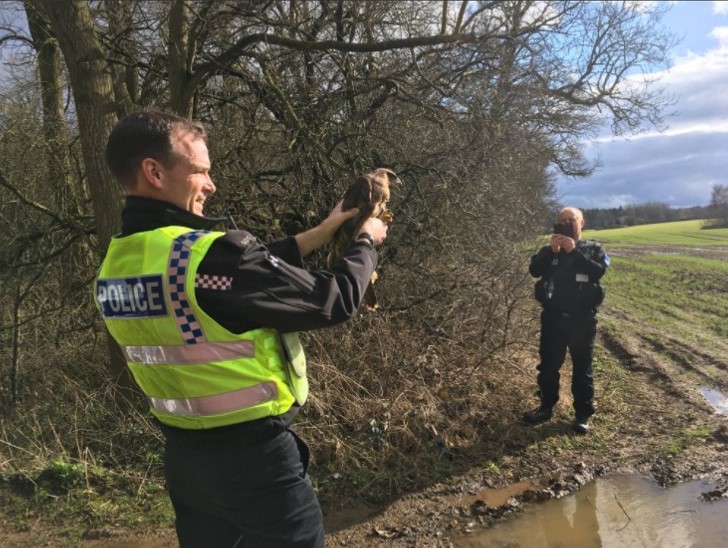
Great partnership working by North Yorkshire Police, RSPCA and Jean Thorpe (Ryedale Wildlife Rehabilitation Centre) resulted in an injured buzzard being released from a trap, rehabilitated and then released back to the wild.

There’s no information about the type of trap, whether it was illegally-set, or the extent of the buzzard’s injuries, but still a job well done by all concerned.

Read the full press release and watch the video of the buzzard’s release on North Yorkshire Police website here

Police Wildlife Crime Officer Jez Walmsley prepares to release the buzzard (photo by Jean Thorpe)

Case against Bleasdale Estate gamekeeper collapses as RSPB video evidence ruled inadmissible

We’ve been reporting on the case against Bleasdale Estate gamekeeper James Hartley since September 2017 (see here, here, here, here for previous posts).

Mr Hartley faced 9 charges as follows:

  1. Disturbing the nesting site of a Schedule 1 wild bird (13/04/2016)
  2. Killing a Schedule 1 wild bird (13/04/2016)
  3. Killing a Schedule 1 wild bird (14/04/2016)
  4. Setting trap / gin / snare etc. to cause injury to a wild bird (between 13-14/04/2016)
  5. Taking a Schedule 1 wild bird (14/04/2016)
  6. Possessing a live / dead Schedule 1 wild bird or its parts (14/04/2016)
  7. Possessing an article capable of being used to commit a summary offence under section 1 to 13 or 15 to 17 (13/04/2016)
  8. Possessing an article capable of being used to commit a summary offence under section 1 to 13 or 15 to 17 (between 12/04/2016 – 27/04/2016)
  9. Causing unnecessary suffering to a protected animal – Animal Welfare Act 2006 (between 14/04/2016 – 15/04/2016)

The case collapsed last week after District Judge Goodwin ruled the RSPB video evidence inadmissible at a hearing at Preston Magistrates Court on 28 March 2018.

Reporting restrictions imposed early on in the case prevented us from blogging in detail until the case had concluded. We’re now able to report what happened.

This blog is the first in a series about this case. In this one, we set out the Crown’s case against Mr Hartley, and the defence’s skeleton argument against the admissibility of the video evidence.

Here are the details of the case as presented to the court by the Crown Prosecution Service (barrister: Mr Yip):

On the 11th April 2016 RSPB Investigations Officer [name redacted], in the presence of RSPB Investigations Officer [name redacted], installed a covert video camera pointed towards a peregrine falcon nest site within the boundary of Bleasdale Game Estate in the Forest of Bowland.

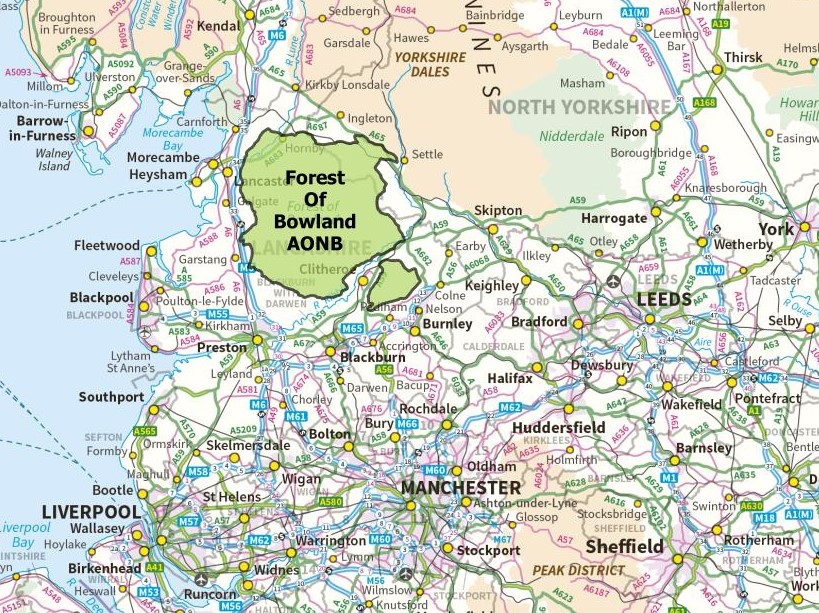
The red star denotes the location of the Bleasdale Estate:

The Bleasdale Estate is owned by Jeremy Duckworth. Mr Duckworth describes the upper moorland as managed for grouse shooting and he employs one gamekeeper for this area, that being the defendant James Hartley.

It is the Crown’s case that the covert camera captured footage which revealed incidents on the 13 and 14 April 2016 where the nest site and birds were interfered with.

The Crown say that a number of clips show that on 13th April 2016 at 19.53hrs an incubating peregrine leaves the nest scrape. This is immediately followed by what appears to be four shotgun discharges. A few minutes later at 19.57hrs a person wearing a camouflage suit and in possession of a hammer attends the nest site for a number of minutes before leaving.

The following morning, 14th April 2016 at 10.29hrs, a peregrine, believed to be the male parent, lands on the edge of the nest ledge and walks in to the nest scrape area. The bird becomes trapped all day in what the Crown say is a spring trap. At 20.25hrs the peregrine is still present. At 23.12hrs a person with a torch visits the site. It is the Crown’s case that the inference is this person had removed the peregrine and the trap as the bird was no longer present the following day.

On 21st April 2016 a number of officers from Lancashire Constabulary and the RSPB attended the nest site area and recovered four eggs and some feathers.

On 26th April 2016 a search warrant was executed and a search was conducted at the defendant’s home address and outbuildings. A green bag containing a number of items was seized from an outbuilding. Forensic DNA analysis from Dr Lucy Webster provides extremely strong support to the proposition that two of the items within this exhibit, an orange handled knife and a wooden handled hammer have been in contact with peregrine falcon.

Between 17.37hrs and 19.11hrs on 24th May 2016 the defendant was interviewed under caution when he declined to answer any questions put to him.

Between 13.16hrs and 13.50hrs on 2nd November 2016 the defendant was interviewed under caution for the second time when he declined to answer any questions put to him.

END

Here is the skeleton argument presented to the court by the defence (barrister: Mr Justin Rouse QC):

The defence seek to exclude the video footage obtained by [RSPB Investigator, name redacted] and the items recovered in the search on the 21 April 2016 under s78 Police & Criminal Evidence Act [PACE] 1984.

S78 PACE provides as follows:

‘…..In any proceedings the court may refuse to allow evidence on which the prosecution proposes to rely to be given if it appears to the court, that, having regard to all the circumstances, including the circumstances in which the evidence was obtained, the admission of the evidence would have such an adverse effect on the fairness of the proceedings that the court ought not to admit it’.

The defence submit that the RSPB have sought to circumvent the provisions of RIPA 2000 [Regulation of Investigatory Powers Act 2000] together with s93 of the Police Act 1997; that they have breached Code B of PACE 1984; that RSPB Investigator [name redacted] was not a data handler for the purposes of the Data Protection Act 1998; that the RSPB chose not to voluntarily adopt the Surveillance Camera Code and/or that the police were bound by that code and that the RSPB were trespassing on the land unlawfully, having failed to seek the permission of the landowner.

END

The full details of the defence’s legal argument will be published in a second blog, along with the judge’s commentary on each of the components of the defence’s argument. For those of us interested in such details it was a fascinating and well-presented argument. And therein lies the crux of this case. In our opinion, the court’s ruling on the video evidence was inevitable, not necessarily because of the strength of the defence’s legal argument, but because of the weakness in the prosecution’s counter-argument against it.

For those of us who sat in the public gallery to observe the legal argument hearing on 14 March 2018, it became apparent, very quickly, that the outcome of this case (and thus, supposed ‘justice’) would be determined by the amount of money available to pay for legal representation.

The representative for the defence was the highly-regarded Mr Justin Rouse QC. We have no idea who paid for his time and expertise (e.g. the defendant? His family? His employer? A representative membership body, e.g. National Gamekeepers Org or BASC?) but whoever it was will no doubt consider it money well spent. It was very clear that Mr Rouse (or his junior) had probably spent a long time in preparation for this case: his presentation was meticulous and thoroughly organised, with every aspect labelled and referenced in a bundle of documents that he’d provided to the judge. On every single point he raised, he was able to tell the judge on which page she should be looking. He was calm, measured and in complete control. A bit of a masterclass.

In contrast, the representative for the prosecution was Mr Yip, who turned up completely unprepared. He arrived without his bundle of evidential documents, muttering something about having left them behind, so he was unable to look up the detail of points raised by the judge. At one point Mr Rouse passed over his own copy of the evidential documents to Mr Yip, to try and help him out. The judge asked Mr Yip several questions about the video evidence and asked to see it (she was particularly interested in the angle of the covert camera and how wide a view it was able to record – a crucial element in deciding whether this was ‘directional’ surveillance, as detailed in RIPA 2000). Astonishingly, Mr Yip told the court he hadn’t seen the video evidence and he didn’t have a copy with him. He was able to produce a couple of still photos from the video but when the judge asked him to point out the position of the nest in the photos, he was unable to do so.

It has been reported on social media that the RSPB “failed to support” this case by “declining” to attend court on 14 March 2018 to answer questions raised by the judge during the legal argument hearing. What utter nonsense. The statement is categorically untrue and is a false claim being made by a group with a long-held and well-documented grudge against the RSPB, presumably with the intention of portraying the RSPB in a bad light. What actually happened was Mr Yip declined to call the RSPB as a witness during that hearing, even after being prompted by the judge, and nor did he ask for an adjournment to allow for him to call an RSPB witness at a later hearing. His reason for this decision is not known (to us) and it proved to be catastrophic for the prosecution’s case.

We think it is fair comment to describe Mr Yip as being ill-prepared for the hearing. However, there may be many reasons for that, beyond his control. It isn’t unusual for the financially-squeezed and under-resourced CPS to drop cases on lawyers at the last minute so for all we know Mr Yip might not have ‘seen’ this case until the night before the hearing. If that is what had happened, it would partly explain the gulf in quality between Mr Rouse’s and Mr Yip’s presentations. That being said, if Mr Yip had not had adequate time to prepare, he could probably have called for an adjournment.

His poor performance did not go unnoticed by the judge and in her ruling delivered to the court on 28 March her criticism was evident. More on this subject in the second blog.

Putting aside for a moment the legal arguments and the standard of presentation, the bottom line is that yet another case of alleged raptor persecution, caught on covert camera, has failed on a technicality (or in this case, several technicalities).

Although the identity of the alleged perpetrator in the Bleasdale case has not been tried and tested in court, there’s no getting away from the fact that the CPS believed the video footage to show that two peregrines appear to have been illegally killed at a nest site on the Bleasdale Estate in 2016. The unidentified perpetrator of this alleged crime will not face justice. Given the catalogue of failed cases under similar circumstances (i.e. covert video footage ruled inadmissible on a technicality), the perpetrators of these crimes have been given yet more impetus to continue, as the chances of successful prosecution these days are almost nil.

No doubt the grouse-shooting industry will jump on this result as an excuse to vilify the RSPB and its approach to investigating raptor persecution crimes. But when the RSPB publishes the video footage of this latest incident, the public will be in a position to judge for itself whether or not the RSPB’s actions were discreditable. Whether the grouse shooting industry likes it or not, public opinion, not court convictions, will ultimately be the deciding factor in addressing the ongoing illegal killing of birds of prey.

UPDATE 13 April 2018: Why the video evidence was ruled inadmissible in the Bleasdale Estate case (here)

UPDATE 16 April 2018: Why other evidence was also ruled inadmissible in the Bleasdale Estate case (here)

UPDATE 16 April 2018: Grouse-shooting industry’s reaction to the failed Bleasdale Estate case (here)

UPDATE 8 August 2018: Peregrine persecution on a grouse moor: Bleasdale video footage finally released (here)

Illegal trap use on GWCT Vice Chair’s shooting estate

Well, well, well.

Last September we blogged about SNH imposing a three-year General Licence restriction on a ‘mystery’ Scottish gamekeeper in response to evidence provided by Police Scotland of alleged raptor persecution crimes. At the time, SNH gave very little information about this case (see here).

After a bit of digging, we worked out that this restriction related to an alleged crime that had happened near Tarland in Aberdeenshire in 2014 where the RSPB had filmed a gamekeeper allegedly baiting an illegal trap close to a goshawk nest:

However, we were unable to establish the name of the estate on which this alleged offence took place and the name of the individual caught on camera setting the trap, as SNH refused several FoI requests and insisted on withholding the information. The name of the individual was withheld under the Data Protection Act – that was fair enough. But we argued that the name of the estate should have been publicised – SNH disagreed.

An article by Severin Carrell in today’s Guardian has finally solved the mystery.

It turns out the individual filmed setting the alleged illegal trap was none other than the Head Gamekeeper of Tillypronie Estate, a grouse and pheasant-shooting estate which at the time was owned by Philip Astor, who was and still is, er, Vice Chair of the Game & Wildlife Conservation Trust (GWCT).

[Estate boundary details from Andy Wightman’s brilliant Who Owns Scotland website]

Gosh, that’s all a bit embarrassing for the GWCT, isn’t it?

Is this why there wasn’t a prosecution and why great efforts were made to keep the details of this alleged crime hushed up?

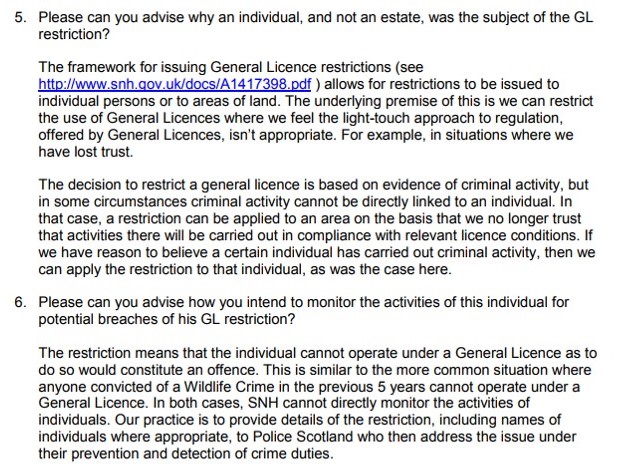
We wonder if this relationship also had any bearing on SNH’s strange decision to impose a General Licence restriction on an individual, as opposed to the usual practice of imposing it on an estate? Astor sold the estate last year – here is the sales brochure: Tillypronie sales brochure Aug 2016 A three-year General Licence restriction hanging over the estate could have caused obvious difficulties for the sale.

Another unanswered question relates to the Head Gamekeeper’s employment status. The alleged crime took place in March 2014, but according to Sev Carrell’s article, the [unnamed] Head Gamekeeper was still employed at Tillypronie in 2016. That seems a bit odd, doesn’t it? Why would a law-abiding landowner continue to employ an individual who had been caught on camera setting an allegedly illegal trap close to a goshawk nest?

And what of Philip Astor’s position as Vice Chair at the GWCT? Business as usual, eh?

Barn owl with horrific injuries found in North Yorkshire

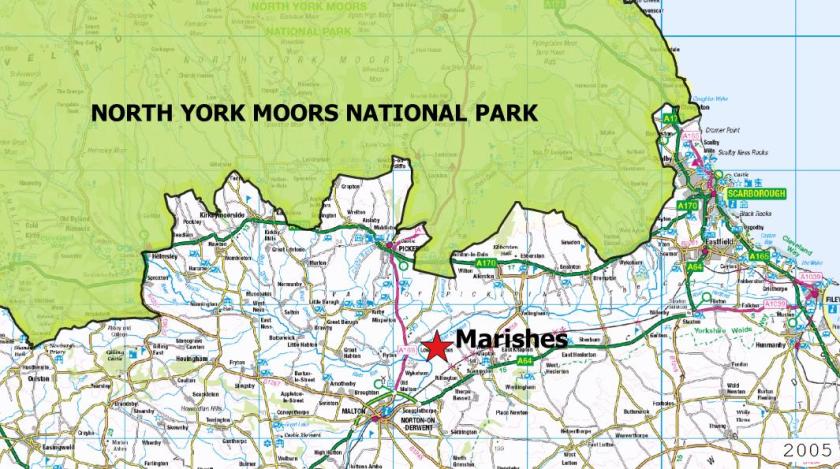
A barn owl with horrific injuries has been found near Marishes in the Ryedale district of North Yorkshire.

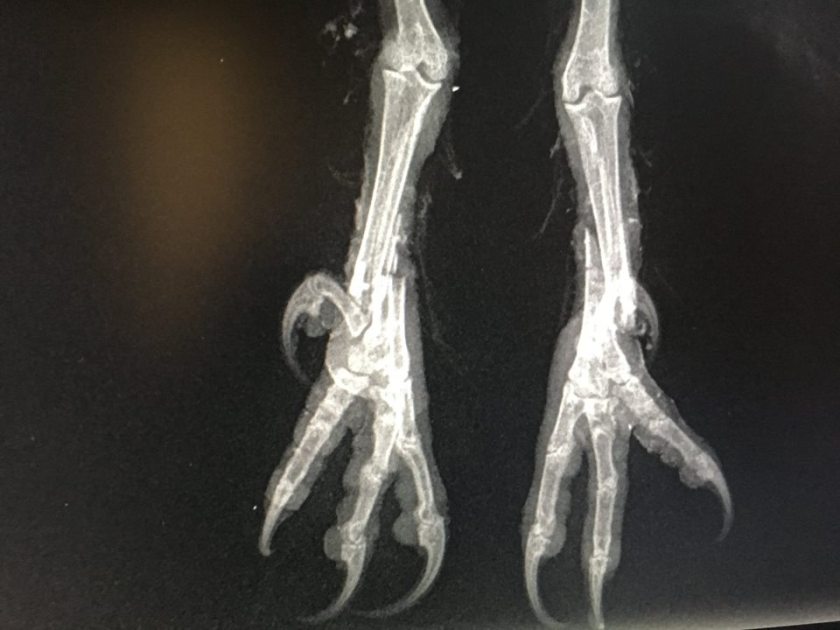
According to expert raptor rehabilitator Jean Thorpe, the barn owl was found close to death. It had suffered two broken legs and its injuries were consistent with having been caught in a spring trap. Jean believes the owl had been released from the trap and then left to die a lingering death, unable to hunt with badly infected wounds.

The owl was taken to Jean’s wildlife centre but died shortly after arrival.

This area is a notorious raptor persecution blackspot. Spring traps are only legal if they are set within either a natural or artifical tunnel to prevent non-target species getting caught in the trap’s jaws.

Anybody with any information about this horrific case please contact Wildlife Police Officer Jez Walmsley at Malton Police Station (Tel: 101).

Photos by Jean Thorpe. Map by RPUK.

Scottish Government announces Grouse moor management review group

Back in May 2017, Cabinet Secretary Roseanna Cunningham announced an intention to set up an independently-led group to review grouse moor management practices, and to advise on the introduction of an estate shoot licensing scheme. This was mainly in response to the publication of the Golden Eagle Satellite Tag Review, which found that almost one third of sat-tagged golden eagles had disappeared in highly suspicious circsumstances on intensively managed driven-grouse moors. But make no mistake, this was also in response to increased public pressure from the SRSG’s petition calling for game shoot licensing and also in response to increasing public anger about the continuing illegal persecution of birds of prey on driven grouse moors.

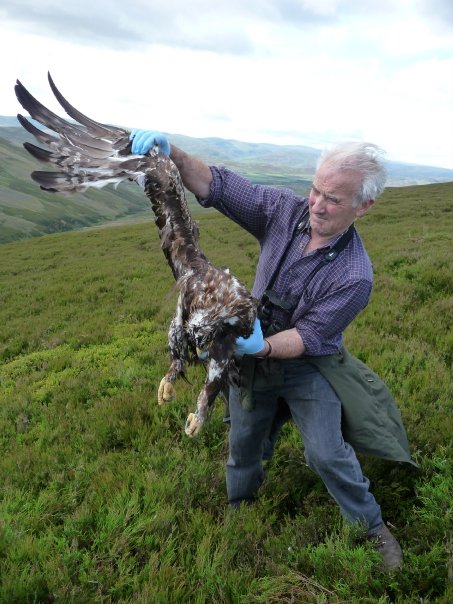
[Photo: Conservationist Roy Dennis with dead golden eagle ‘Alma’ – one of Roy’s first satellite-tagged eagles that was found illegally poisoned on an Angus Glens grouse moor]

Finally, almost six months after that first announcement, the Scottish Government has just released the news about who will serve on this review group.

Here’s the Scottish Government press statement:

New group to focus on sustainability of driven-grouse moors.

Membership of an independent group to ensure grouse moor management practices are sustainable and legally compliant has been confirmed.

The new group will be led by Professor Alan Werrity, who previously chaired a Scottish Natural Heritage review into sustainable moorland management. It includes scientists, moorland managers, regulatory experts and advisers from SNH, Scottish Wildlife Trust, the Game and Wildlife Conservation Trust and the Scottish Environmental Protection Agency.

The group has been set up in response to SNH research that found almost a third of golden eagles being tracked by satellite died in suspicious circumstances and that the majority of cases were where land is intensively managed for driven grouse shooting.

The group will look at the environmental impact of grouse moor management practices such as muirburn, the use of medicated grit and mountain hare culls and advise on the option of licensing grouse shooting businesses.

Environment Secretary Roseanna Cunningham said:

We have been clear that the continued killing of protected species of birds of prey damages the reputation of law-abiding gamekeepers, landowners and the country as a whole.

This new group will look at what we can do to balance our commitment to tackling wildlife crime with grouse moor management practices, so it continues to contribute to our rural economy, while being sustainable and compliant with the law.

The group membership reflects the complex nature and wide range of issues that need to be considered and I look forward to hearing their advice in due course.”

Professor Werrity said:

This is truly challenging work given the traditions underlying moorland management and the concerns coming to light over some mal-practices.

My earlier work chairing the SNH Moorland review also sought to reconcile nature conservation interests with promoting the rural economy. I will be taking an evidence-based approach, and for this we have the right mixture of experience, expertise and knowledge on the group to get to grips with the subject. I look forward to getting started on this review. ”

Background

Read the Golden Eagle Satellite Tag Review

The confirmed membership of the group includes Professor Alan Werrity FRSE, Professor Ian Newton OBE, FRS, FRSE, Professor Alison Hester FSB, (Professor Colin Reid FRSA – see update below) and moorland managers Alexander Jameson BLE MRICS FAAV and Mark Oddy MRICS CEnV MIAagrM.

[Update 28 Nov 2017: Law professor joins grouse moor management review group, here ]

Dr Calum Macdonald (SEPA), Professor Des Thompson (SNH), Dr Adam Smith (GWCT Scotland) and Susan Davies (SWT) will be specialist advisers to the group.

ENDS

Here is the response from RSPB Scotland to today’s announcement:

RSPB Scotland welcomes announcement of grouse moor enquiry

RSPB Scotland has welcomed today’s announcement by the Scottish Government on the grouse moor enquiry panel. Duncan Orr-Ewing, Head of Species and Land Management for RSPB Scotland said: “We very much welcome the announcement of this enquiry and of the independent panel. We look forward to giving evidence to the panel in due course.

The remit of the panel includes consideration as to how grouse moors can be managed sustainably and within the law. There are significant public concerns about how grouse moors are currently being managed in Scotland, including clear evidence gathered over decades of the illegal killing of birds of prey.

In recent years these concerns have broadened to encompass wider grouse moor management practices, as commercialisation has taken place, with an emphasis on producing very large and unsustainable grouse numbers for sport shooting. These practices include muirburn on peatland habitats which are important as carbon stores for combating climate change, the culling of mountain hares and the medication of ‘wild’ red grouse, both designed to prevent grouse diseases and artificially boost grouse bags.

We support the introduction of an effective licensing system for driven grouse shooting, with sanctions including the removal of such licences where illegal practices are confirmed. A licensing system could be supported by a statutory Code of Practice setting out clear management standards to protect public interests and prevent bad management practices. These kind of licensing systems are common place in other European countries and equally support legitimate and well run shooting enterprises.”

ENDS

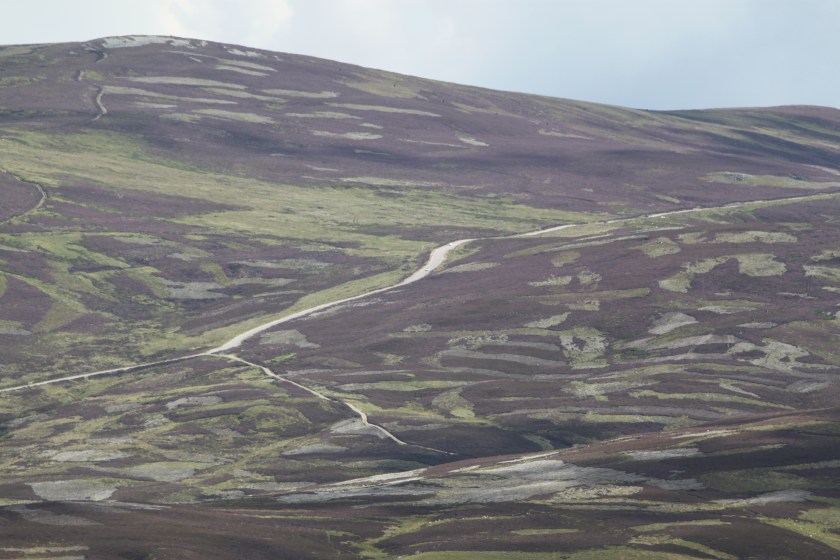
[Photo: the typical landscape of an intensively-managed driven grouse moor in Scotland. Photo by Ruth Tingay]

Here is the response from the Scottish Raptor Study Group to today’s announcement:

Scottish Raptor Study Group warmly welcomes today’s announcement by the Scottish Government on the grouse moor enquiry panel.

Patrick Stirling Aird, Secretary of the Scottish Raptor Study Group said, “We are delighted that the membership of the panel has been announced and look forward to providing evidence when called upon to do so“.

The public have increasing concerns around the way in which grouse moors are being operated with a substantial body of science proving beyond all doubt the widespread and illegal persecution of birds of prey on many such moors.

We support the introduction of licensing for driven grouse shooting with enforceable sanctions where illegal practices are confirmed. Such a licensing scheme could incorporate a statutory code of practice which helps to protect the public interest and to prevent bad management practices. This concept is widespread in Europe and elsewhere and works well with legitimate shooting interests.

ENDS

Here are our first thoughts.

Hallelujah! The panel has finally been announced and presumably its work will now get underway, although notice there is no mention of timescales in the Scottish Government’s statement. That’s not too much of a concern right now – as Roseanna mentions, this work will be complex and it’s in everyone’s interests that it is done thoroughly, so we probably shouldn’t expect any output until at least 2019.

This panel has some serious intellectual heavy weights (Chair, Professor Werrity, and panel members Professors Newton and Hester). All three are at the top of their respective fields and have been for years; their academic achievements and scientific authority are undisputed. We are delighted to see these three involved, especially given Professor Werrity’s intention for having an “evidence-based approach” to the review. Excellent.

The other two panel members (Mr Jameson and Mr Oddy) are a bit of a surprise, to be honest. We didn’t expect to see anybody with such obvious vested interests be part of what had been described as an independently-led review group. Nevertheless, there is probably good reason for having them on board, not least to get buy-in to the review from the game-shooting sector. We know very little about Mr Jameson and only a little bit about Mr Oddy – he’s the chap who, when working for Buccleuch Estates on the Langholm Moor Demonstration Project, suggested that lethal control of buzzards should be a considered option…..but his suggestion was based on no scientific evidence whatsoever, in fact it was the exact opposite of what the science was showing. Hmm.

All in all, just like RSPB Scotland and the Scottish Raptor Study Group, we very much welcome today’s announcement. It is the next step on the road to what many see as the inevitable introduction of an estate licensing scheme in Scotland. We look forward to giving evidence, if invited to do so.

UPDATE 28 November 2017: Law professor joins grouse moor management review group (here)

UPDATE 24 April 2018: Grouse Moor Management Review Group: 1st meeting report (here)

Peak District National Park Authority responds to RSPB’s 2016 Birdcrime report

The Peak District National Park Authority has issued a statement in reponse to the publication of the RSPB’s 2016 Birdcrime report.

Sarah Fowler, chief executive of the Peak District National Park, said: “Killing birds of prey is illegal. I am appalled by the persecution of any protected species, no matter what the circumstances.

The RSPB’s latest Birdcrime report brings the plight of birds of prey to the fore. It shows what we are up against in trying to reverse the fortunes of birds of prey. I welcome the recent acknowledgement from shooting organisations that the killing of raptors to protect game birds is part of the problem. It is – and it is damaging to their interests. I welcome and wholeheartedly support their condemnation of such activity.

Being able to watch birds of prey in the Peak District National Park should be part of everyone’s experience.

We have been working with landowners, gamekeepers and partners since 2011 to remedy the situation locally but it is clear from the results that much more needs to be done.

This year peregrines have failed to breed in the Dark Peak for the first time since they recolonised in 1984 and persecution of these incredible birds has been a factor in this. This has to change.

It is incredibly difficult to catch someone in the act or to collect evidence and make a case for prosecution. I appeal to all users of the countryside to help us bring persecution to an end by reporting anything you feel is suspicious to the police. The best hope we have is for law-abiding people within the game bird industry calling out those who operate outside the law.

The Peak District Birds of Prey Initiative will shortly be publishing a report documenting the fortunes of key birds of prey alongside confirmed or suspected incidents of persecution in the moorland areas of the Peak District during 2016 and 2017. On the back of this report, I will look for a renewed commitment from moorland owners and managers in the Peak District to work with us to reverse the fortunes of birds of prey – and a strengthening of this commitment. We cannot achieve this on our own.”

Anyone with information to report about wildlife crime should contact Derbyshire Police on 101 or Crimestoppers on 0800 555111.

ENDS

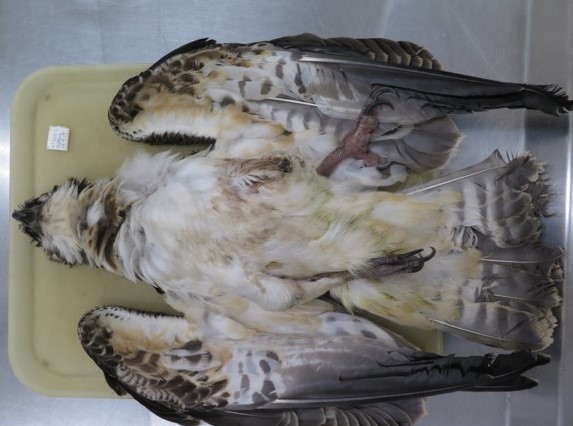
Photo of an osprey found in the Peak District National Park in September 2015. It had two broken legs and succumbed to these injuries soon after being found. The post-mortem stated its injuries were consistent with being caught in a spring trap (Photo by RSPB)

It’s good to see strong condemnation of continued illegal raptor persecution from the Peak District National Park Authority, although, coming a week after the publication of the Birdcrime report it does have a whiff of ‘Oh God, everyone else has commented, we’d better say something too’. Nevertheless, better late than never.

We also appreciate Sarah Fowler’s acknowledgement that the 7-year-long Peak District Bird of Prey Initiative has been a complete and utter failure. She didn’t actually say that – she said, “It is clear from the results that much more needs to be done“, and, with the imminent publication of the Initiative’s 2016 and 2017 annual reports, she said “I will look for a renewed commitment from moorland owners and managers in the Peak District to work with us to reverse the fortunes of birds of prey – and a strengthening of this commitment“.

Hang on. Wasn’t ‘renewed commitment’ from project partners promised in 2015 when the Initiative’s five-year targets had all failed to be met? Ah yes, so it was. And yet, despite that ‘renewed commitment’ we’ve seen continued evidence of illegal raptor persecution within the National Park and now we learn that “This year peregrines have failed to breed in the Dark Peak for the first time since they recolonised in 1984 and persecution of these incredible birds has been a factor in this“.

We don’t want ‘renewed commitment’ from so-called project partners. It’s meaningless bollocks that nobody believes anymore. We’re sick of hearing it and sick of statutory agencies using it to pretend that everything’s going to be ok.

The Peak District National Park Authority needs to start calling out these grouse moor owners, managers and agents, by name, instead of shielding them and their criminal activities within this charade of partnership-working.

SNH refuses to disclose details of individual General Licence restriction

In September 2017 we learned that SNH had imposed a General Licence restriction on an individual for alleged criminal activity in relation to raptor persecution (see here).

This was a highly unusual restriction because it applied to an individual rather than to an estate.

At the time the restriction was announced, SNH provided virtually no information other than to say a General Licence restriction had been imposed and that it would apply for three years.

However, RSPB Scotland released a press statement in relation to this restriction order which included the following quote from RSPB Scotland’s Head of Investigations, Ian Thomson:

The restriction was imposed after RSPB investigations staff passed video footage to police of a gamekeeper allegedly setting illegal traps, baited with a dead woodpigeon, very close to a goshawk nest in NE Scotland”.

Here’s a clip from that video evidence:

From this, we were able to deduce that this alleged wildlife crime took place in March 2014 ‘nr Tarland, Aberdeenshire’, although the specific location was not given.

This alleged offence was reported by Police Scotland to the Crown Office in April 2014 (see here). It is clear, now, that the Crown Office did not prosecute the gamekeeper, probably on the grounds that the video evidence was deemed ‘inadmissible’. That’s the sixth alleged wildlife crime case, that we know about, that the Crown Office has dropped in recent months.

So at this stage we know that an alleged wildlife crime had taken place, we know that a criminal prosecution is not going to happen (because the case is now time-barred), and we know that SNH has imposed an individual General Licence restriction on a gamekeeper as a supposed sanction. The identity of the alleged offender remains a secret, as does the name of the estate where the alleged offence was committed. This lack of transparency is, frankly, appalling, especially when former Environment Minister Paul Wheelhouse had stated when he first introduced General Licence restrictions in 2014 that he expected them to function as “a reputational driver”. Not much chance of that happening when the details of a case are kept secret.

In early October 2017 we submitted an FoI to SNH to try and find out more details about this case. We asked for:

  1. The name of the person who had been given a General Licence restriction (we didn’t expect to be told but thought we’d ask anyway – you never know)
  2. The occupation of that person (we already knew from the RSPB press statement that he was a gamekeeper but we wanted SNH to confirm this)
  3. The name of the county in which this individual resides (we already knew from the RSPB press statement that the alleged offence had taken place in Aberdeenshire but we wanted SNH to confirm this)
  4. The name of the estate from where the Police evidence of alleged raptor persecution had been collected
  5. An explanation about why an individual and not an estate was the recipient of the General Licence restriction
  6. An explanation about how SNH intends to monitor the activities of the individual for potential breaches of his General Licence restriction.

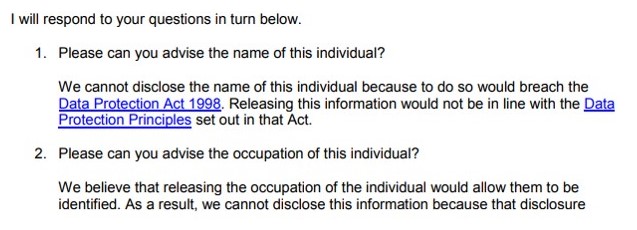
SNH has now responded and it’s astonishing:

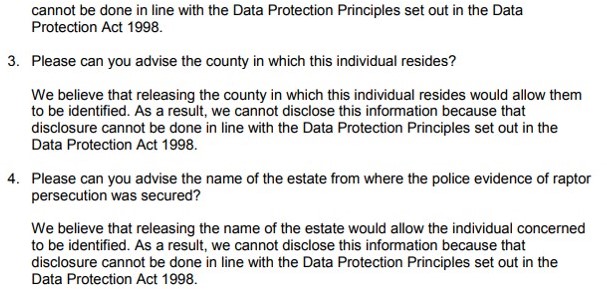
It looks like SNH has been taking lessons from Natural England in the withholding of information that should be in the public domain. It’s understandable that SNH can’t disclose the alleged offender’s identity, but withholding details of his occupation and the county in which he resides because “this would allow them to be identified” is obviously nonsense, and we already know this information from the RSPB press release!

We would argue that it is in the public interest to know the name of the estate on which this alleged offence took place (and we do know from various local sources it was on a game-shooting estate and that this gamekeeper was employed by that estate). Why should that information be kept secret? Who is SNH shielding, and why?

And does anyone actually believe that Police Scotland, no matter how well-intentioned, has the resources to track this gamekeeper’s activities for the next three years to ensure he’s not breaching the terms of his General Licence restriction?!

Whilst this response doesn’t get us any further forward in knowing the specifics of this case, what it does demonstrate, quite clearly, is that the General Licence restriction, introduced as a way of publicly embarassing estates where there is evidence of wildlife crime but, due to perceieved evidential difficulties, the cases don’t ever reach the courts, is simply not working.

Tomorrow’s blog, on another General Licence restriction case, will emphasise this point again but on a whole bigger scale.

Scottish gamekeepers complain about alleged escalation of trap vandalism

The Scottish Gamekeepers’ Association is today complaining about an alleged escalation in the vandalism of animal traps on shooting estates.

This supposed increase has been attributed to ‘activists’ and the SGA wants the law tightened up so that the alleged perpertrators can be prosecuted.

There’s widespread media coverage about it today e.g. in The National (here), The Times (here) and on the SGA website (here).

Photo of an allegedly vandalised trap (from The National)

This isn’t the first time we’ve heard such claims. Back in 2013 it was discussed during a Rural Affairs Parliamentary Committee meeting, when then Environment Minister Paul Wheelhouse acknowledged that trap tampering might be taking place but that there was no hard evidence to show how widespread the problem might be so at that time it was considered all conjecture.

In 2015 the issue was raised again by a Fife landowner and an article in the local press suggested that “Police Scotland is reporting a rise in the number of traps being tampered with“.

We challenged that claim by looking at the results of a year-long trap tampering study carried out across Scotland by BASC between April 2014 and March 2015. The results showed that the issue was not widespread at all, but seemed to centre on a handful of local areas.

Whether the problem has increased since then is hard to tell without independently collected data. The problem might have increased. It’s not hard to understand the motivation that might lead to someone damaging a trap. It might be on animal welfare grounds (someone might see a non-target species dead in a trap). It might be because someone can’t tell whether a trap is legally or illegally-set – it’s not always easy to judge. It might be because someone objects to predator control just to maximise a landowner’s profits. Or the motivation might simply be because so many cases of illegally-set traps rarely result in a prosecution, even when a known gamekeeper has been filmed setting an illegal trap. That doesn’t make trap vandalism ‘right’, we’re just saying it’s easy to understand why it might be happening.

Photo of a young red grouse killed by a lawfully-set trap (photo by RPUK)

It’s equally plausible to suggest that some gamekeepers may be deliberately vandalising one or two of their own traps and then reporting it to the police as the work of ‘activists’ in an attempt to smear those whose campaign to put game-shooting under political scrutiny is gaining such traction.

Whatever might be happening, it’s ironic that the SGA doesn’t make this much noise when cases of illegally-set traps on game-shooting estates are reported in the media.

It’s very hard (virtually impossible) for us to sympathise with the SGA when it remains silent (or concocts outlandish alternative explanations) about the on-going abuse and use of illegal traps, by gamekeepers, to target birds of prey on game-shooting estates.

Speaking of which, we’re still waiting for the findings of the SGA’s inquiries in to who set the illegal traps that were discovered on a grouse moor on Invercauld Estate last year.