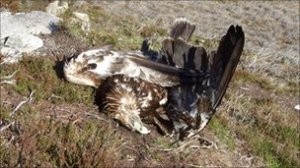
Howden Moor sporting tenant is a Purdey Award winner

Following the conviction this week of gamekeeper Glenn Brown on the National Trust’s Howden Moor in the Upper Derwent Valley, Derbyshire, the sporting tenant has been named on the Birdguides website as Geoff Eyre (scroll to the comments section under the article).

According to The Moorland Association website, Geoff Eyre won the 2005 Purdey Award for Game and Conservation, for his Howden Regeneration Project. (As an aside, scroll down the page to see another 2005 Purdey Award winner, head gamekeeper Jimmy Shuttlewood from the Snilesworth Estate North Yorkshire – who was later convicted in 2008 with two underkeepers for the use of cage traps to capture birds of prey – story here).

Geoff Eyre has had a lot written about his pioneering work to restore Howden Moor to its former glory as a viable grouse moor. Here in 2006 he spoke about the ‘beneficial’ work of his gamekeeper. Also in 2006, this article was written in The Telegraph about the return and then subsequent loss of a pair of hen harriers on Howden Moor. In 2007, he hosted a visit by a DEFRA Minister for Landscape and Rural Affairs, reported here in The Shooting Times, accompanied by gamekeeper Glenn Brown. The Minister was impressed with what he saw, calling the project an ‘inspiration’ and a good use of public money.

One can only assume that Geoff Eyre was completely unaware of the criminal activities of his gamekeeper. You can ask him about it, and whether Brown has been sacked, at National Trust activity days in September 2011 – details here.

More on convicted Derbyshire gamekeeper Glenn Brown’s case

It was good to see so much media coverage following the conviction of criminal gamekeeper Glenn Brown on Monday. It made local, regional, national and international news, probably because he committed his crimes on National Trust property – which isn’t somewhere you’d normally expect to hear about wildlife crime taking place. Let’s hope that the National Trust are reviewing the lease of their land to the ‘un-named third party’ as we speak.

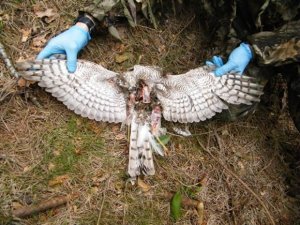
Despite the broad media coverage, very few articles mentioned the dead sparrowhawk that was found close to one of the traps that criminal gamekeeper Glenn Brown was operating.  Also found close by was the body of a white pigeon. Mark Thomas, one of the RSPB investigators involved with catching Brown at it, has written an excellent little piece about the investigation here, alluding to what might have happened to the dead sparrowhawk and dead pigeon.

Thomas also writes that since 2006, goshawk and peregrine productivity in the Derwent Valley has collapsed. By coincidence, gamekeeper Brown is reported to have been employed as a gamekeeper since 2006. Amazing.

Thomas and his colleagues from the RSPB Investigations team deserve a great deal of credit, especially for the innovative techniques they used to catch Brown. So too does Derbyshire Constabulary and the CPS. The resulting punishment for Brown, convicted of seven offences – 100 hours community service – delivered by District Judge Caroline Goulborn (famed for the recent cat-in-the-bin-case) is pathetic, especially when you consider the sentencing options available, which include fines up to £5,000 and a six month prison term for each offence. Had Brown not been ordered to pay £10,000 costs, some might have concluded that he had got off very lightly. Depending on who pays for these costs, and whether he keeps his job as a gamekeeper, some may be certain he got off lightly.

Derbyshire gamekeeper guilty of using illegal trap

The long-running trial that began over two months ago against Derbyshire gamekeeper Glenn Brown concluded today, and he was found guilty of using an illegal trap to try and catch birds of prey on the National Trust’s Howden Moor in the Peak District. The court heard that he was interested in protecting the grouse where he worked. The trial began on 11 April 2011 at Chesterfield Magistrates Court.

Brown was caught after RSPB investigators installed covert cameras overlooking a trap and filmed him over a period of time visiting the trap. He was unlawfully using a pigeon as a lure bird – this is illegal and is an indication that birds of prey were the target species he was trying to catch. He operated traps on land in the Upper Derwent Valley owned by the National Trust but leased by another party between 14 April and 25 May 2010.

Brown was found guilty of seven offences under the Wildlife & Countryside Act 1981 and the Animal Welfare Act 2010.

He was given 100 hours community service and ordered to pay £10,000 costs.

BBC news story here including video

More on this story later. Congratulations to the RSPB investigators for catching another criminal gamekeeper at it, and to Derbyshire Police and the Crown Prosecution Service for seeing the case through to trial. In the BBC news video, it is reported that Brown is the 100th gamekeeper to be convicted of crimes against birds of prey. So, Alex Hogg, Chairman of the Scottish Gamekeeper’s Association, still think it’s “unfair to accuse gamekeepers of wildlife crime“?

“Professional gamekeepers do not poison raptors” says Alex Hogg

Episode 11 of the BBC 2 Scotland ‘Landward’ programme went out on Friday 27 May and included a segment on the new vicarious liability regulation in the Wildlife and Natural Environment (Scotland) Act 2011. The programme is available here for a limited period.

The segment opened with Duncan Orr-Ewing, Head of Species at RSPB Scotland, who told the interviewer, “Bird of prey poisoning is particularly associated with driven grouse moors in the upland of Scotland, in the central and eastern highlands, parts of Perthshire and also down in the southern uplands”.

The interviewer, Dougie Vipond, asked: “So who is doing this? Who is killing the birds?”

Orr-Ewing: “Well, it is estate employees, gamekeepers who are usually involved, but they are only employees, they are acting under the direct instructions so ultimately it is the landowners that are responsible for this”.

A short section followed with a brief interview with Liz Plath, listed as a rural law specialist and a partner at Thorntons Law LLP. Basically she explained in simple terms how vicarious liability brings the landowner or the employer into the frame in cases of raptor poisoning.

Next up was Alex Hogg, chairman of the SGA, whose opening line was: “Professional gamekeepers do not poison raptors”. Funny that, because if you bother to look back at the statistics on raptor poisoning for the ten-year period that Hogg has been in post, you’ll see that raptor poisoning incidents have been recorded on many estates, and yes, ‘professional’ gamekeepers have been convicted.

He then contradicted himself (and not for the first time) by saying: “It’s only a small minority that are still at it. A rogue few if you like”.  Lest we forget, here is the official government map showing confirmed raptor poisoning incidents between 2006-2010. Widespread, I’m sure you’ll agree, and the trend is pointing upwards.

He continued: “And we’ve tried our hardest over the past, I’ve now been in this job for ten years, to impress on everybody that it’s absolutely illegal to poison raptors”. Peer pressure from Hogg and co., while welcome, has been ineffective. It can’t help the situation when he and others from his industry continue to claim that raptors are having a significantly negative effect on game birds, songbirds, waders and lambs. Is there any scientific evidence for this? No, not a shred.

Next up came David Hendry, listed as the proprietor of Cardney Estate, near Dunkeld in Perthshire. Now this was an interesting interview. The piece opened with an introduction to Hendry, and video footage of a diving osprey on his estate. We were told that this estate ‘is home to many endangered birds of prey’. Unfortunately, Hendry was not asked how many and what species of raptors made their home there. The osprey was implied, but of course the osprey only eats fish, not exotic red-legged partridge (also known as French partridge) or pheasant, which are reared and released in large numbers for sport shooting on this estate, according to this shooting directory.

Vipond talked about the belief that the only way to stop poisoning is to introduce a licensing system which would allow landowners to control [kill] raptors. Hendry agreed, and suggested “it should become the gamekeeper’s job for instance to look after the rare raptors like harriers, your merlins, bring on your red kites, but they should also be allowed to reduce buzzards and sparrowhawks to numbers that are sustainable, because what we have today is not sustainable”.

Ok, so this is the first time we’ve officially heard that sparrowhawks are also the landowners’ intended target for licensed killing. Until now, the list has ‘just’ included buzzards and ravens. So what happens if they get the go ahead to kill these species? Will we see goshawks added to the next list? They’re just an over-sized sparrowhawk after all, so why not? And golden eagles? They’re just over-sized buzzards, so why not? Where will it stop?

It’s also very interesting that he thinks the current number of buzzards and sparrowhawks is ‘unsustainable’. According to this shooting website, Cardney Estate offers shooting days where between 200-400 exotic birds (partridge/pheasant) can be shot. That’s 200-400 birds per shooting day, depending on the time in the season. In September 2010, a record 677 birds were shot on one day according to one participant! Sounds to me like this sporting estate is doing very nicely thank you, without the need to kill off any indigenous protected raptors, whatever species they may be.

We then went back to Orr-Ewing, who was asked for his opinion about the need to ‘manage’ [kill] protected raptors. “These birds of prey are rightly protected because they’re vulnerable. We have a history of killing birds of prey in Scotland, many species are just recovering from that situation, there’s no other country in Europe that [legally] kills birds of prey”.

His first three points are accurate, but his last statement is not. In 2008 the provincial government of Lower Austria issued a decree allowing hunters to shoot 1,000 buzzards and 250 goshawks over the following five years. It previously allowed the killing of Montagu’s harriers until the EC stepped in to halt it. The decree allowing the legal persecution of buzzards and goshawks resulted in an international public outcry – the same can be expected if the licensed killing of raptors for the benefit of the game bird-shooting industry is permitted in Scotland.

And of course, it’s not just poison that is used to illegally kill raptors. Unfortunately our government does not produce annual statistics on the other incidences of raptor persecution that take place every single year. Thankfully, the RSPB does. Their annual reports (one covering bird persecution in the UK as a whole, and the other covering incidents in Scotland) are a welcome insight into the extent of the problem. Their 2010 annual reports are due for publication in the very near future. Their efforts to compile and publish these reports are worthy of the public’s gratitude because without them, we would only have Alex Hogg and co’s word about the extent of illegal raptor killing on Scotland’s sporting estates.

Skibo Estate results

Dean Barr, a gamekeeper (and reported elsewhere as being the sporting manager) on the Skibo Castle Estate, has been convicted of having enough illegal poison “to wipe out the entire Scottish golden eagle and red kite populations several times over”. Barr, 44, of East Lodge, Clashmore, Dornoch, admitted possessing 10kg of the banned pesticide Carbofuran. He admitted carrying the poison from his previous job as head gamekeeper on the Raeshaw Estate to Skibo Castle Estate in 2008, because he had ‘not known how to safely dispose of it’.

The Carbofuran haul was discovered in a locked store on the Skibo Castle Estate, for which Barr had the keys. According to the Northern Times and Northern Constabulary, the poison was discovered within premises operated and solely accessed by Barr on Skibo Estate land.

Today he was fined £3,300 “to mark the court’s disapproval”. This was apparently reduced from a £5,000 fine for his early plea.

Despite this conviction, the Crown accepted he had ‘no part’ in the deaths of two poisoned golden eagles and a sparrowhawk (killed with Carbofuran) found on the estate in May 2010 (along with a dead buzzard and a third poisoned golden eagle killed by Aldicarb).

Barr’s defence lawyer said Barr was well regarded personally and professionally by his current and previous employers. “If it was thought that he was involved in the use of this material, they would not be so supportive”.

This is not the last we will write on this case.

The Scotsman news story

BBC news story

STV news story

Derbyshire gamekeeper trial: adjourned until June

The trial of gamekeeper Glenn Brown, accused of seven offences under the Wildlife & Countryside Act & the Animal Welfare Act, came to a temporary close on 13 May 2011. The charges relate to his alleged activities on Howden Moor in the Derwent Valley, Derbyshire. The trial has now been adjourned until 13 June 2011, when a verdict is expected at Chesterfield Magistrate’s Court.

For background info see blog posts 11 April 2011, 27 April 2011, 28 April 2011 and 9 May 2011.

Derbyshire gamekeeper trial extended

The trial of Glenn Brown, the Derbyshire gamekeeper facing 7 charges under the Wildlife & Countryside Act and the Animal Welfare Act, will continue this week at Chesterfield Magistrates Court.

Amongst other things, Brown is accused of using a crow trap to illegally trap raptors on Howden Moor in the Derwent Valley. See blog posts 11 April 2011, 27 April 2011 and 28 April 2011 for background info to this case.

Case against Skibo Castle gamekeeper opens at Inverness Sheriff Court

Following blog post 12 May 2010…

A year on from the discovery of THREE poisoned golden eagles, 1 buzzard and 1 sparrowhawk in or close to the grounds of Skibo Castle Estate, the case against one of the gamekeepers opened today at Inverness Sheriff Court.

The case against Dean Barr, originally from Northern Ireland, is to be continued on 26 May 2011. The charges against him are not yet being reported as he has not yet entered a plea. Last year, Mr Barr made a public statement in The Daily Record suggesting that the dead birds had been ‘planted’ by the RSPB – see blog post 22 June 2010 here: https://raptorpersecutionscotland.wordpress.com/2010/06/22/skibo-gamekeeper-blames-rspb-for-stuff-turning-up/

Poisoned buzzards and bait reportedly found on Edradynate Estate

Following blog posts on 6, 7 and 11 April….

The name of the Perthshire sporting estate raided by Tayside Police earlier this month, following the discovery of poisoned buzzards and poisoned bait in March 2011, has been recently reported on the raptor study group website as Edradynate Estate.

Described by Tayside Police Wildlife Crime Officer Alan Stewart in 2005, “Edradynate Estate, which is owned by an absentee landlord from Hampshire, has probably the worst record in Scotland for poisoning incidents, going back more than a decade. In 14 separate incidents since 1998, 16 poisoned victims (nine buzzards, a cat, a tawny owl, two sparrowhawks, a common gull, a polecat and a crow) and 12 poisoned baits (rabbits, woodpigeons and a pheasant) have been found, with traces of the pesticides mevinphos, carbofuran and alphachloralose”.

His comments were made after the collapse of a trial concerning two gamekeepers from the estate, who were charged with various offences involving the alleged poisoning and trapping of birds of prey. The case was dropped by the Procurator Fiscal, reportedly because of the time taken for the case to be heard. Full story here: http://www.rspb.org.uk/Images/legaleagle43_tcm9-132966.pdf

Since his comments, there have been more discoveries of poisoned birds on this estate, and public denials in the media of any involvement by estate gamekeepers, who claim the dead birds must have been ‘planted’ by someone else. Nobody has ever been convicted for wildlife crime offences on this estate and still the poisoning continues. Let’s hope that Tayside Police are able to detect the perpetrator(s) of the most recent poisoning incident.

Interestingly, it is also reported on the raptor study group website that Edradynate Estate is believed to be a member of the SRPBA and that at least one gamekeeper is a self-confessed member of the SGA. This is difficult to verify though as, conveniently, neither group publicises the names of their members. Both of these groups have made many public statements about how they deplore illegal raptor persecution and how they are working hard to eradicate it. They are both also members of PAW Scotland. It was reported last year that the CEO of the SRPBA paid a visit to Edradynate Estate – perhaps to apply some much needed ‘peer pressure’. If he did, then he is to be congratulated for his efforts, although judging by recent events it would appear that peer pressure was unsuccessful. Or perhaps it was successful, and the latest deaths were attributable to those pesky carcass planters – you know, the ones who have never been seen or heard but who are managing to plant poisoned birds on sporting estates up and down the country…

Update on trial of Derbyshire gamekeeper Glenn Brown

Further to the blog post 11 April 2011….

A few of our readers have e-mailed to ask for an update on the trial of Derbyshire gamekeeper Glenn Brown. The trial started 11 April 2011 and was anticipated to last for 8 working days. We are reliably informed that the trial is now expected to conclude tomorrow (28 April 2011).

Further details to follow…