
In February this year the Scottish Government launched the latest ‘pesticide disposal scheme’ – a free service allowing those who are still in possession of certain banned poisons an opportunity to get rid of them without fear of consequence.
We had mixed feelings about this scheme (see here), not least a sense of frustration that ten years after many of these poisons were banned, the criminals still in possession would have yet another opportunity to escape justice. However, this feeling was outweighed by the importance of removing these substances so they could no longer be (illegally) held / used.
Two and a half months in to the scheme, the Scottish Government has today announced that the scheme will end on 29th May 2015 – press release here.
According to this press release, so far the scheme has received requests for 99 poisons to be collected. These are as follows:
Sodium Cyanide (44)
Strychnine (30)
Aluminium Phosphide (8)
Mevinphos (5)
Carbofuran (5)
(Alpha)Chloralose (4)
Unknown (2)
Aldicarb (1)
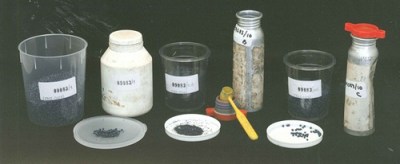
We were particularly interested in the amount of Carbofuran that had been handed in – apparently more than 80kg from just five sites.
80kg of the gamekeepers’ ‘poison of choice’! That’s an incredibly large stash. To put it in context, the largest stash found to date was 10.5kg – recovered during a raid on Skibo Estate in 2010 after the discovery of three poisoned golden eagles. The RSPB calculated that that was enough to kill every single raptor in Scotland six times over (see here). Bear in mind that Carbofuran is so highly toxic that it only takes a couple of grains to kill; imagine how much damage 80kg of the stuff could do – imagine the equivalent of 80 bags of 1kg sugar and the hundreds of thousands of granules inside each of those bags!
It’s frightening to think how much more Carbofuran has been stockpiled on estates and farms across Scotland. If 80kg has been recovered from land users who have no intention of using it, imagine how much is being kept hidden by those who have no intention of handing it in but every intention of continuing to use it.
It’ll be interesting to see just how much more is handed in before the end of the disposal scheme, and even more interesting to see what sort of sentence the next inevitable poisoning case will bring.
The release of today’s information is interesting to us for another reason, too. On 27th March, one of our blog readers submitted an FoI to the Scottish Government to ask for the following information relating to the pesticide disposal scheme:
1. The type and number of poisons handed in since the scheme began on 23 February 2015 to date.
2. The cost of the scheme to date.
3. The first three letters of postcodes from where the poisons had been collected.
Our blog reader knew that all this information was being collated by the Scottish Government and he also knew that the scheme was on-going, so he qualified his questions by adding ‘to date’ at the end.
Here’s the reply he received last week:
Dear XXXXX
REQUEST UNDER THE ENVIRONMENTAL INFORMATION (SCOTLAND) REGULATIONS 2004 (EIRs)
Thank you for your request dated 27 March 2015 under the Environmental Information (Scotland) Regulations 2004 (EIRs).
Your request
You asked to be provided with the following information:
- The type and number of poisons handed in since the scheme began on 23 Feb 2015 to date.
- The cost of the scheme to date.
- The first three letters of postcodes from where the poisons have been collected.
As the information you have requested is ‘environmental information’ for the purposes of the Environmental Information (Scotland) Regulations 2004 (EIRs), we are required to deal with your request under those Regulations. We are applying the exemption at section 39(2) of the Freedom of Information (Scotland) Act 2002 (FOISA), so that we do not also have to deal with your request under FOISA.
This exemption is subject to the ‘public interest test’. Therefore, taking account of all the circumstances of this case, we have considered if the public interest in disclosing the information outweighs the public interest in applying the exemption. We have found that, on balance, the public interest lies in favour of upholding the exemption, because there is no public interest in dealing with the same request under two different regimes. This is essentially a technical point and has no material effect on the outcome of your request.
Response to your request
While our aim is to provide information whenever possible, in this instance an exception under regulation 10(4)(d) (unfinished or incomplete information) of the EIRs applies to all of the information you have requested. This exemption applies because that information is still in the course of completion. We are unable to provide the information you have requested because the scheme has not been concluded. As the scheme has not yet closed the data you have requested is still being collated, some of this work is being undertaken by an external administrator. We intend to publish some details in respect of your points 1 and 3 in a press release ahead of the closure of the scheme; this is likely to be issued before the end of May 2015. When the scheme is formally closed and a final report is given to the Minister for Environment, Climate Change and Land Reform, further information, including costs related to the scheme will be published.
This exception is subject to the ‘public interest test’. Therefore, taking account of all the circumstances of this case, we have considered if the public interest in disclosing the information outweighs the public interest in applying the exception. We have found that, on balance, the public interest lies in favour of upholding the exception. We recognise that there is some public interest in release as part of open, transparent and accountable government, and this will be met by our planned publication. However, this is outweighed by the public interest in ensuring that unfinished or incomplete information which is still in being worked on is not disclosed when it might misinform the public.
END
That’s a fascinating response. They refused to release ‘unfinished or incomplete information’ to an individual member of the public, and yet a week later they publish, er, ‘unfinished or incomplete information’ in an official government press release!
It’s also interesting to note that Scottish Land & Estates published a news article on their website, dated 9th April 2015, stating that more than 80 calls had been taken by the scheme (see here). The question is, how did SLE get that privileged information and did they get it from the Scottish Government?
One rule for one and one rule for another? Surely not.
 Last Friday, Tom McKellar, an employee of Auch Estate, an Argyll sporting estate in Bridge of Orchy, was convicted of possessing the illegal poison Carbofuran and was fined £1,200 (see
  Based on these suspicions, we blogged about the case in January 2011, and suggested that no charges were being brought against anyone for poisoning that eagle. We also encouraged readers to contact the Scottish Government to complain. Many did, and all hell let loose. The Scottish Government responded by saying that the firearms offences were being dealt with separately, at a court with a higher authority than a Sheriff Court, and that the wildlife offences were still ‘being dealt with’. A well-known prosecutor threatened us, indirectly, with legal action. For what? Expressing an opinion? As it turns out, we were right all along, nobody has been prosecuted for poisoning that golden eagle, although we’ve had to wait for over three years to have this confirmed.
 All sounds very convincing and reassuring, doesn’t it? Why is it then that Northern Constabulary has remained tight-lipped about the discovery, 15 months ago, of a poisoned red kite allegedly found on moorland at the boundary of Skibo Estate? We have been told that the satellite-tagged kite was allegedly found in February 2011. SASA documents show that only one red kite from the Highland region was tested in February 2011 and it had been poisoned by Alphachloralose and was the subject of on ongoing police investigation (SASA ref #11020, see
  MAY 2006: A dead adult golden eagle was found on the Dinnet & Kinord Estate, near Ballater, Aberdeenshire. Tests revealed it had been poisoned by the illegal pesticide, Carbofuran. Grampian Police launched an investigation. Five years and 11 months later, nobody has been prosecuted.
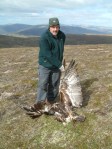 JUNE 2006: A dead golden eagle was found on Glen Feshie Estate in the Cairngorms. Tests revealed it had been poisoned by the illegal pesticide, Carbofuran. Northern Constabulary launched an investigation. Five years and ten months later, nobody has been prosecuted.
 AUGUST 2007: A dead adult female golden eagle was found on an estate near Peebles in the Borders. She was half of the last known breeding pair of golden eagles in the region. Tests revealed she had been poisoned by the illegal pesticide, Carbofuran. Lothian & Borders Police launched an investigation. Four years and eight months later, nobody has been prosecuted.
 AUTUMN 2007: Tayside Police received a detailed tip-off that a young male white-tailed eagle (known as ‘Bird N’) had allegedly been shot on an estate in Angus. The timing and location included in the tip-off coincided with the timing and location of the last-known radio signal of this bird. Four and a half years later, the bird has not been seen again. With no body, an investigation isn’t possible.
 MAY 2008: A one year old male white-tailed eagle hatched on Mull in 2007 and known as ‘White G’ was found dead on the Glenquoich Estate, Angus. Tests revealed he had been poisoned by an unusual concoction of pesticides that included Carbofuran, Bendiocarb and Isofenphos. A police search in the area also revealed a poisoned buzzard, a baited mountain hare and 32 pieces of poisoned venison baits placed on top of fenceposts on the neighbouring Glenogil Estate. Laboratory tests revealed the baited mountain hare and the 32 poisoned venison baits contained the same unusual concoction of highly toxic chemicals that had killed the white-tailed eagle, ‘White G’. Three years and 11 months later, nobody has been prosecuted.
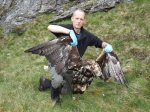 JUNE 2009: An adult golden eagle was found dead at Glen Orchy, Argyll, close to the West Highland Way. Tests revealed it had been poisoned by the illegal pesticide, Carbofuran. Strathclyde Police launched a multi-agency investigation. Two years and ten months later (April 2012), Tom McKellar pled guilty to possession of Carbofuran stored in premises at Auch Estate, Bridge of Orchy. Nobody has been prosecuted for poisoning the golden eagle.
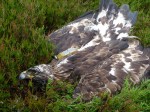 JULY 2009: A two year old female golden eagle known as ‘Alma’ was found dead on the Millden Estate, Angus. Tests revealed she had been poisoned by the illegal pesticide, Carbofuran. Alma was a well-known eagle – born on the Glen Feshie Estate in 2007, she was being satellite-tracked and her movements followed by the general public on the internet. Tayside Police launched an investigation. Two years and nine months later, nobody has been prosecuted.
 AUGUST 2009: A young white-tailed eagle was found dead on Glenogil Estate, Angus. Tests revealed it had been poisoned by the illegal pesticide, Carbofuran. Tayside Police were criticized in the national press for not releasing a press statement about this incident until January 2010. Two years and 8 months later, nobody has been prosecuted.
 MAY 2010: Three dead golden eagles were found on or close to Skibo Estate, Sutherland. Tests revealed they had been poisoned; two with Carbofuran and one with Aldicarb. Northern Constabulary launched a multi-agency investigation. One year later (May 2011), Sporting Manager Dean Barr pled guilty to possession of 10.5 kg of Carbofuran stored in premises at Skibo Estate. One year and 11 months later, nobody has been prosecuted for poisoning the three golden eagles.
 JUNE 2010: Leg rings with unique identification numbers that had previously been fitted to the legs of four young golden eagles in nests across Scotland were found in the possession of gamekeeper James Rolfe, during a multi-agency investigation into alleged raptor persecution at Moy Estate, near Inverness. It is not clear how he came to be in possession of the rings. The bodies of the eagles from which the rings had been removed were not found. No further action was taken in relation to the discovery.
 JUNE 2010: A golden eagle and a white-tailed eagle were found dead on an estate near Farr, Inverness-shire. Tests revealed they had been poisoned by the illegal pesticide, Carbofuran. Northern Constabulary apparently did not search the property until July 2011. One year and ten months later, nobody has been prosecuted.
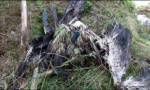 DECEMBER 2010: A decomposing carcass of a white-tailed eagle was found and photographed on Logie (Lochindorb) Estate, Morayshire. It was reported to Northern Constabulary. By the time the police arrived to collect it, the carcass had disappeared. The police said they couldn’t investigate further without the body.
 MARCH 2011: The body of a young golden eagle was discovered on North Glenbuchat Estate, Aberdeenshire. Tests revealed it had been poisoned by the illegal pesticide, Carbofuran. Grampian Police launched an investigation and raided the property in May 2011. One year and one month later, we are not aware of any pending prosecutions.
 APRIL 2011: The body of a white-tailed eagle was found at the base of cliffs on Skye. The person who discovered it (a professional medic) considered it to have been freshly shot with a rifle, decapitated with a sharp implement and thrown from the cliff top. He took photographs and alerted Northern Constabulary and RSPB. There was a delay of two weeks before the now probably decomposed carcass was collected. A post-mortem was inconclusive. This incident was not made public until one year later after a tip off to this blog. We are not aware of any pending prosecutions.
 NOVEMBER 2011: The signal from a satellite-tracked young golden eagle (hatched in 2010) stopped functioning when she was at a location in the Monadhliaths, a well-known raptor persecution black spot in the Highlands. Her last known location was checked by researchers but there was no sign of the bird. Another ‘disappearance’ in suspicious circumstances or a technical malfunction of the satellite transmitter?
 The 2012 annual police wildlife crime conference took place a couple of weeks ago. Quite a few of this year’s presentations were relevant to raptor persecution so we’ll be commenting on these in due course. To start off the series we’ll focus on what Charlie Everitt had to say. Charlie is the Scottish Investigative Support Officer at the UK National Wildlife Crime Unit (NWCU). See
  Two years ago in July 2009, Alma, a two-year golden eagle who had been satellite-tracked across Scotland from her birth place on the Glenfeshie Estate,
 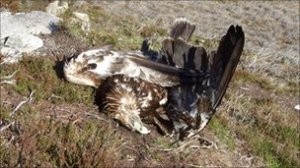 Despite this conviction, the Crown accepted he had ‘no part’ in the deaths of two poisoned golden eagles and a sparrowhawk (killed with Carbofuran)
  Following blog post 12 May 2010…
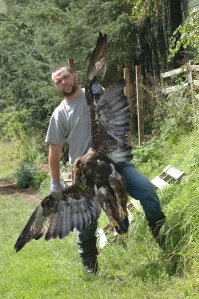 Given the deafening silence on the progress of the Skibo case (see blog report 12 May 2010, where it was reported that three golden eagles, one sparrowhawk and one buzzard had been found on the Skibo Estate in north Scotland), we’ve done some digging around.
 Raptor Persecution UK