East Scotland sea eagle chick fledges: what fate awaits this one?

For the second consecutive year, a young white-tailed eagle has successfully fledged from a nest in east Scotland.

His sibling, who hatched in 2013, un-mysteriously ‘disappeared’ earlier this year in a notorious raptor persecution blackspot in the Cairngorms National Park (see here and here). He was the first sea eagle to fledge in east Scotland in over 200 years but he didn’t even survive to see his first birthday. His satellite transmitter went silent after he’d visited a driven grouse moor where previously a head gamekeeper had been convicted of poisoning offences (2006), a poisoned golden eagle had been found in 2011 (no prosecution), a poisoned buzzard had been found in 2011 (no prosecution), poisoned bait had been discovered in 2011 (no prosecution) and a short-eared owl had been found in 2011 that had been shot and shoved underneath a rock (no prosecution). The police raided the estate in April this year but found no trace of the eagle.

He might not have been the first sea eagle to fledge in Scotland in over 200 years if another east Scotland pair had not had their nest tree felled by someone with a chainsaw (see here – no prosecution).

The BBC is running an article on this year’s fledgling (see here) and includes a telling remark from RSPB Scotland saying they hoped the young bird would avoid areas where birds of prey have been poisoned or trapped. In other words, steer clear of driven grouse moors.

He’s got at least five years in which to run the gauntlet before he becomes mature enough to breed – we don’t rate his chances much.

Go west, kid, go west.

wtse fife 2014 ian francis

Golden eagle found poisoned on Angus grouse moor

A two-year old golden eagle named ‘Fearnan’ has been found dead on a Scottish grouse moor. He had been poisoned with a banned pesticide. The poison hasn’t been named but we’ll take an educated guess at Carbofuran, the gamekeepers’ poison of choice.

Interestingly, there are three separate press releases about this latest disgraceful crime:

One from the government via PAW (here)

One from the police (here)

One from RSPB Scotland (here)

Usually, we’re lucky to see anything for at least 4-5 months after the crime so it’s somewhat surprising to see the scuffle for media attention on this one. Could this be a sign that Environment Minister Wheelhouse has put his foot down and demanded that timely press statements are released? We can’t think of any other reason why the police should suddenly change their tactics from seemingly apathetic to seemingly responsive.

Of course, regular blog readers will already know that Fearnan is not the only poisoned eagle to have been found dead in the Angus Glens. In fact, there’s been a fair bit of raptor persecution over the last nine years. Here’s a list of incidents we’ve compiled from various published reports:

2004 May, near Edzell: long-eared owl and two short-eared owls starved to death in crow cage trap.  No prosecution.

2004 May, Invermark Estate: peregrine nest destroyed. No prosecution.

2006 March, Glenogil Estate: poisoned rabbit bait (Carbofuran). No prosecution.

2006 April, Easter Ogil: poisoned buzzard (Alphachloralose). No prosecution.

2006 April, Easter Ogil: poisoned tawny owl (Alphachloralose). No prosecution.

2006 May, Glenogil Estate: poisoned rabbit bait (Carbofuran). No prosecution.

2006 June, Glenogil Estate: poisoned woodpigeon bait (Carbofuran). No prosecution.

2006 June, Glenogil Estate: Traces of Carbofuran found in estate vehicles & on equipment during police search. No prosecution. Estate owner had £107k withdrawn from his farm subsidy payments. This was being appealed, but it is not known how this was resolved.

2006 July, Millden Estate; poisoned sheepdog (Lindane). No prosecution.

2007 November, Glenogil Estate: Disappearance of radio-tagged white-tailed eagle ‘Bird N’ coincides with tip off to police that bird been shot. No further transmissions or sightings of the bird.

2008 May, ‘Nr Noranside’: poisoned white-tailed eagle ‘White G’ (Carbofuran, Isophenfos, Bendiocarb). No prosecution.

2008 May, ‘Nr Noranside’: poisoned buzzard (Bendiocarb). No prosecution.

2008 May, ‘Nr Noranside’: poisoned mountain hare bait (Carbofuran, Isophenfos, Bendiocarb). No prosecution.

2008 May, Glenogil Estate: 32 x poisoned meat baits on fenceposts (Carbofuran, Isophenfos, Bendiocarb). No prosecution.

2008 October, ‘Glenogil Estate: poisoned meat bait on fencepost (Carbofuran). No prosecution.

2009 March, Glenogil Estate: poisoned buzzard (Carbofuran). No prosecution.

2009 March, Glenogil Estate: poisoned buzzard (Carbofuran). No prosecution.

2009 April, Millden Estate: poisoned buzzard (Alphachloralose). No prosecution.

2009 July, Millden Estate: poisoned golden eagle ‘Alma’ (Carbofuran). No prosecution.

2009 August, Glenogil Estate: poisoned white-tailed eagle “89” (Carbofuran). No prosecution.

2010 May, ‘Nr Noranside’: poisoned red kite (Carbofuran). No prosecution.

2010 September, Glenogil Estate: poisoned buzzard (Chloralose). No prosecution.

2010 October, Glenogil Estate: poisoned buzzard (Carbofuran). No prosecution.

2010 October, Glenogil Estate: poisoned pigeon bait (Carbofuran). No prosecution.

2010 October, Glenogil Estate: poisoned pigeon bait (Carbofuran). No prosecution.

2011 February, Airlie Estate: buzzard caught in illegal crow trap. (see below)

2011 March, Airlie Estate: 3 x buzzard caught in illegal crow trap. Prosecution (!) but dropped after statement from suspect given to SSPCA deemed inadmissible.

2011 April, Millden Estate: shot buzzard. No prosecution.

2012 April, ‘Nr Noranside’: Remains of buzzard found beside pheasant pen. Suspicious death.

2011 June, Rottal & Tarabuckle Estate: dead kestrel inside crow cage trap. No prosecution.

2012 February, ‘Nr Edzell’: spring-trapped buzzard. No prosecution.

2012 February, ‘Nr Bridgend’: remains of buzzard found under a rock. Suspicious death.

2012 May, Millden Estate: satellite-tagged golden eagle caught in spring trap, then apparently uplifted overnight and dumped on Deeside. No prosecution.

2012 May, Glen Esk: disappearance of sat-tagged red kite. No further transmissions or sightings of bird.

2013 January, Invermark Estate: white-tailed eagle nest tree felled. No prosecution.

2013 November, Glen Lethnot: poisoned golden eagle. Prosecution? Highly unlikely!

We think you’ll agree, this is overwhelming evidence that some people in the Angus Glens are systematically persecuting birds of prey, they have been for many years, and those same people are avoiding criminal justice for their disgusting and illegal activities. We call them The Untouchables.

Why have they been able to avoid prosecution for so long?

Now would be a good time to ask the Environment Minister for an explanation. While you’re at it, please also mention your revulsion about the continued practice of illegal raptor persecution on driven grouse moors. The time for estate licensing is here; the game-shooting industry, quite clearly, cannot or will not self-regulate.  Emails to: ministerforenvironment@scotland.gsi.gov.uk

RIP Fearnan.
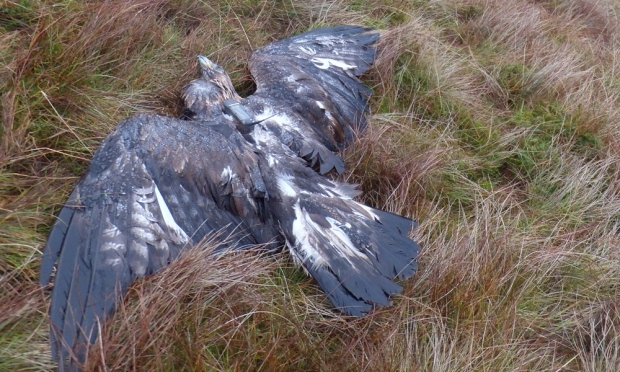
posioned GE Lethnot 2013

North Yorks still worst place for raptor persecution in 2012

The RSPB has published its 2012 Birdcrime report documenting bird persecution throughout the UK.

North Yorkshire has once again come top of the league for the number of reported crimes against birds of prey (34), with Aberdeenshire a close second with 31 reported incidents. Both counties, of course, include large areas of land used for driven grouse shooting.

The 2012 report includes statistics that are all too familiar: confirmed shootings of short-eared owls, sparrowhawks, buzzards, barn owls, tawny owls, hen harriers, golden eagles, marsh harriers, and peregrines; confirmed nest destruction of peregrines, goshawks and barn owls; confirmed illegal spring-trapping of buzzards, golden eagle and peregrine; other types of illegal trapping (including crow cage traps) of sparrowhawks, tawny owls, buzzards and goshawks; and the confirmed illegal poisoning of ravens, red kites, buzzards, golden eagles, marsh harriers, peregrines, cats and dogs.

Remember, these are just the confirmed incidents. Plenty more ‘probable’ and ‘unconfirmed’ cases, and of course there are all the incidents that went undiscovered/unreported.

Does that sound to you like the game-shooting industry is cleaning up its act?

Well done to the RSPB for their meticulous work and especially for their willingness to share these data with the general public.

RSPB press release here

Download the RSPB’s 2012 Birdcrime report here

The photograph shows the shot hen harrier Bowland Betty, found on a North Yorkshire grouse moor in 2012. Nobody has been brought to justice for her death.

RSPB Scotland publishes 2012 persecution report

sam4RSPB Scotland has today published its annual persecution report which documents the known and suspected incidents of  illegal raptor killing throughout Scotland in 2012.

It’s a shame it’s taken so long to get it published, but that minor criticism aside, massive kudos and appreciation to them for their continued meticulous collection of these data and especially their willingness to publish them. Without these reports the general public, and probably the government, would be unaware of exactly what’s going on in our countryside. If we relied upon the ‘official’ figures (i.e. those ‘approved’ by the likes of Scottish Land & Estates, the Scottish Gamekeepers’ Association, Police Scotland etc) we wouldn’t know the half of it.

The 2012 report, just like all the previous 18 reports, makes for grim reading. Sure, it documents a reduction in the number of birds known to have been illegally poisoned last year; some people (guess who?) have spent much of 2013 shouting about this as being evidence of the game-shooting industry cleaning up its act – we know better – the 2013 figures (to date) show no such reduction and in fact show an increase in known poisoning incidents…but more of that next year. Let’s focus on the 2012 report for now.

Three things caught our attention in this report. The first thing was the Foreword by Stuart Housden, RSPB Scotland Director. This is the hardest-hitting Foreword of his that we’ve read. In the past it’s been a bit wishy-washy, with too many platitudes aimed at the landowning and gamekeeping communities and suggestions that the raptor killers are just an unrepresentative minority. This time it’s quite different:

It is evident that a significant number of individuals or estates illegally persecute birds of prey“.

Is this subtle change of language an indication that RSPB Scotland is tiring of the whole ‘partnership-working’ pretensions? Let’s hope so.

The second thing to catch our attention was an entry in Table 3 (page 24): Confirmed incidents of illegal killing or attempted killing (excluding poisoning) of birds of prey in Scotland, 2012

The entry of interest is this:

‘February. Buzzard caught in illegal spring trap. Nr Edzell, Angus’.

There isn’t any further detail about this incident, and it certainly hasn’t been publicised by the Police (no surprise there). However, for reasons that we can’t go in to right now, we are particularly interested in the details of this incident and would ask any blog reader with specific information to contact us, in confidence: raptor.persecution.scotland@hotmail.co.uk

The third thing that caught our attention was the Case Study: Poisoning in Progress (pages 19-20). This case relates to the discovery of poisoned corvids and poisoned bait found in the Borders in May 2012.

We’d blogged about this case in Sept 2012, criticising the Police for not publicising the discovery of poisoned birds and poisoned bait (see here). We also blogged about it in October this year, after the incident was excluded from the ‘raptor persecution’ section in the  Government’s ‘official’ 2012 Wildlife Crime Report (see here). We asked blog readers to contact the Environment Minister and ask why this incident had been excluded. Here is part of the reply received by one of our readers:

You ask why a bird poisoning incident was omitted from the Scottish Government’s first annual report into wildlife crime. I can advise you that the incident in question was not listed in the section on raptor crime because no raptors were involved“.

Now, have a read of the Case Study in the RSPB’s report. Guess what was found at the scene? “The feathers and bones of two dead buzzards, lying beside the old, dried-out carcases of two rabbits, in a wood beside a partridge rearing pen. A dead crow was also found a short distance away“.

That’s a pretty clear indication that raptors were indeed involved.

According to the Case Study report, the rabbits were covered in dead insects (a sure indication of the presence of poison) and they were submitted for toxicology analysis, along with the crow. The buzzards were not submitted as they were considered too decomposed.

The results – all contained the pesticide Bendiocarb.

There was no police follow-up, no search, no nothing. Why not, when there was clear evidence of long-term poisoning at the site? And even better, the site is a very well-known raptor persecution blackspot in the Borders, where many other poisoned raptors have previously been discovered.

It’s just the same old familiar pattern, same shit, same locations, different year. The sooner the Government launches its public consultation on increasing the powers of the SSPCA to allow them to investigate raptor persecution, the better. (Where is that consultation anyway? We heard it would be launched in mid-Oct. No sign yet…)

Anyway, well done and thanks again to RSPB Scotland – funny, lots of poisoning, trapping and shooting incidents but not a single ‘death by tree’ report!!

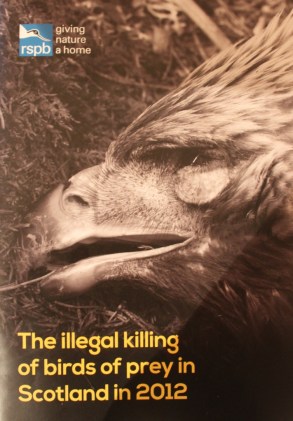
Download the report: The Illegal Killing of Birds of Prey in Scotland 2012

Going to the Scottish Birdfair? Read this first

PrintThere’s an article today in the Sunday Herald about the RSPB’s controversial choice of venue for next month’s Scottish Birdfair. For the second year running, the RSPB has chosen to hold this event at Hopetoun House, the stately home of Lord Hopetoun whose family also owns the Leadhills (Hopetoun) Estate in South Lanarkshire, a grouse moor that has been at the centre of raptor persecution allegations for years. Sunday Herald article here.

Regular blog readers will know we’ve commented on this issue at length: see here, here, here, here, here and especially here.

In today’s article, veteran Scottish Raptor Study Group member Ronnie Graham urges potential Birdfair attendees to “make an informed decision” about going.

The following information might help. This is a list of confirmed persecution incidents listed at Leadhills/Abington between 2003-2011. This information has been sourced from the RSPB’s own annual persecution reports, in addition to Scottish Government data. The list does not include other ‘unconfirmed’ or ‘probable’ incidents, such as the discovery of skeletal raptor bodies found buried in forestry or dead raptors found shoved inside rabbit holes. Data are only available up to 2011, so any incidents that might have occured in 2012 or the first quarter of 2013 are not included. There are 41 confirmed incidents on this list; of these, only a couple have been successfully prosecuted (see here for a good example of why prosecutions fail). The list is a good example of why conviction rates should not be used to indicate the extent of criminal activity.

2003 April: hen harrier shot

2003 April: hen harrier eggs destroyed

2004 May: buzzard shot

2004 May: short-eared owl shot

2004 June: buzzard poisoned (Carbofuran)

2004 June: 4 x poisoned rabbit baits (Carbofuran)

2004 June: crow poisoned (Carbofuran)

2004 July: poisoned rabbit bait (Carbofuran)

2004 July: poisoned rabbit bait (Carbofuran)

2005 February: poisoned rabbit bait (Carbofuran)

2005 April: poisoned buzzard (Carbofuran)

2005 June: poisoned rabbit bait (Carbofuran)

2005 June: poisoned rabbit bait (Carbofuran)

2006 February: poisoned buzzard (Carbofuran)

2006 March: poisoned buzzard (Carbofuran)

2006 March: poisoned pigeon bait (Carbofuran)

2006 April: dead buzzard (persecution method unknown)

2006 May: poisoned rabbit bait (Carbofuran)

2006 May: poisoned rabbit bait (Carbofuran)

2006 May: poisoned egg baits (Carbofuran)

2006 June: poisoned buzzard (Carbofuran)

2006 June: poisoned raven (Carbofuran)

2006 June: 6 x poisoned rabbit baits (Carbofuran)

2006 June: poisoned egg bait (Carbofuran)

2006 September: 5 x poisoned buzzards (Carbofuran)

2006 September: poisoned rabbit bait (Carbofuran)

2006 September: poisoned rabbit bait (Carbofuran)

2007 March: poisoned buzzard (Carbofuran)

2007 April: poisoned red kite (Carbofuran)

2007 May: poisoned buzzard (Carbofuran)

2008 October: poisoned buzzard (Carbofuran) [listed as ‘Nr Leadhills’]

2008 October: poisoned rabbit bait (Carbofuran) [listed as ‘Nr Leadhills’]

2008 November: 3 x poisoned ravens (Carbofuran) [listed as ‘Nr Leadhills’]

2009 March: poisoned rabbit bait (Carbofuran)

2009 March: poisoned raven (Carbofuran)

2009 April: poisoned rabbit bait (Carbofuran)

2009 April: poisoned magpie (Carbofuran)

2009 April: poisoned raven (Carbofuran)

2010 October: short-eared owl shot

2011 March: illegally-set clam trap

2011 December: buzzard shot

Landowners & gamekeepers claim ‘misrepresentation’ on BBC’s The One Show

One-Show-smallScottish Land and Estates and the Scottish Gamekeepers’ Association have written a letter of complaint to the BBC, claiming ‘misrepresentation’ on The One Show programme.
The programme (see here and here) included a feature on golden eagle persecution and during a studio interview, the RSPB’s Stuart Benn laid the blame firmly at the door of gamekeepers on Scottish grouse moors.

Doug McAdam, Chief Exec of Scottish Land & Estates, took great exception to that statement and wrote a hilarious letter of complaint, on behalf of SLE and SGA, to The One Show’s executive editor, Sandy Smith.

Here is his letter: SLE SGA complaint about BBC One Show

According to dear old Doug, there have only been four dead golden eagles found since 2010 and no charges [for these deaths] have been brought against anyone involved in grouse moor management. Conveniently, he failed to include the other known incidents of dead raptors turning up on grouse moors since 2010 (including white-tailed eagles, red kites, hen harriers, buzzards, short-eared owls, sparrowhawks, peregrines, kestrels), or the critically-injured golden eagle found shot and left to die on a grouse moor, or indeed the satellite-tagged raptors (particularly golden eagles and hen harriers) who have all gone ‘missing’ after their last known signal was received from, er, a grouse moor. There may well be more of these ‘missing’ birds but of course we’re no longer allowed to hear about them after the introduction of the new PAW Scotland ‘protocol’ that aims to keep these incidents away from the public’s gaze (see here).

Apart from trying to play down the extent of persecution incidents on grouse moors, and inferring that a lack of criminal convictions is a good indicator that gamekeepers are not involved with the illegal killing of golden eagles on grouse moors, Doug goes on to emphasise the SLE’s involvement with PAW Scotland, as though membership of that ‘partnership’ should be a measure of good behaviour. We’ve all seen how effective these ‘partnerships’ can be, following the near-extinction of breeding hen harriers on English grouse moors during the six-year Hen Harrier Dialogue ‘partnership’ designed to resolve the conflict. Indeed, three raptor conservation organisations have now resigned from that particular ‘partnership’ because they recognised it could be used as a convenient political cover by certain organisations with grouse-shooting interests.

Doug makes an astonishing claim about the PAW Scotland partnership: “Our combined efforts with the police, rural communities, the RSPB and over 120 other relevant stakeholders have been universally acknowledged as a key factor in reducing the number of raptor persecution incidents“.

Talk about misleading! For a start, there are not 120 ‘relevant stakeholders’ in relation to addressing raptor persecution. Many of the stakeholders have absolutely no involvement in directly addressing raptor persecution – they are there to specifically address other types of wildlife crime such as poaching, theft of freshwater pearl mussels, bat persecution and badger persecution.

Secondly, where does this notion come from that work by PAW Scotland has been ‘universally acknowledged as a key factor in reducing the number of raptor persecution incidents’? Has it been ‘universally acknowledged’? We don’t think PAW Scotland has had any demonstrable impact whatsoever on the number of raptor persecution incidents – where’s the evidence? Perhaps by ‘universal’ he means those with a vested interest in having people think that illegal raptor persecution is being dealt with effectively (e.g. the police, SNH, Scottish Government, SLE, SGA etc etc).

Doug finishes by saying, “Owners of moorland estates all over Scotland look after golden eagles” (ahem) and he invites Sandy Smith to visit a grouse moor “to find out for yourself the valuable conservation measures being implemented“. Let’s hope Sandy takes him up on his offer. Ooh, which grouse moor to choose? We could give Sandy quite a few suggestions….

Sandy Smith responded with a letter of his own: One Show’s reply to SLE

He says he’s sent an email to all One Show staff and suppliers “asking them to ensure they don’t make assumptions about gamekeepers based on out of date or inaccurate assumptions“.

Interestingly, Sandy Smith was the former executive editor of Panorama – a programme recognised for its investigative journalism and an ability to differentiate between fact and PR. Let’s hope he’s taken those qualities with him to The One Show.

We’ve sent a letter to Sandy, giving him the URL of this blog, to ensure his staff are kept up to date and are not basing their work on inaccurate assumptions (spin). You may wish to do the same – send your email, marked for the attention of Sandy Smith, to: TheOneShowEmails@bbc.co.uk

If you think grouse moor owners and their gamekeepers need to be held to account for their activities, please sign this e-petition and share it with your friends and colleagues: SIGN HERE.

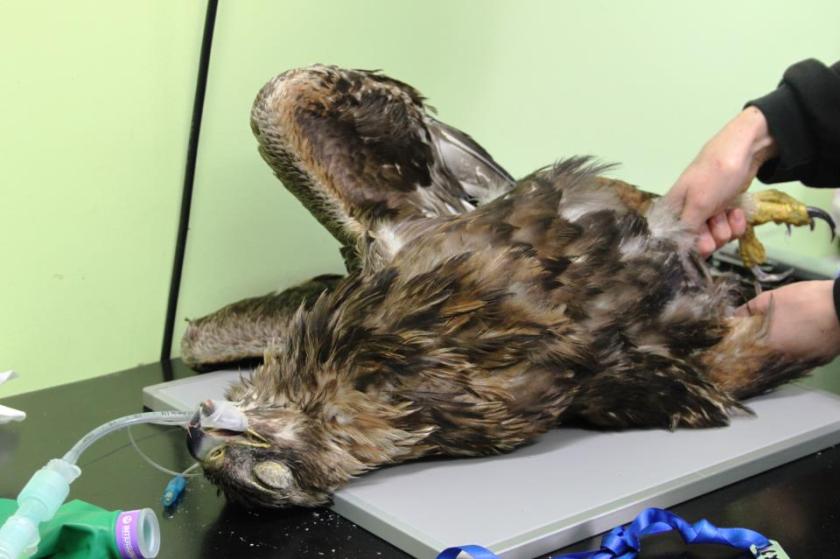
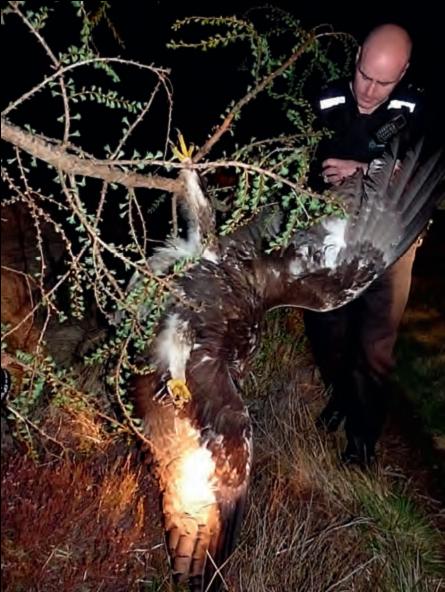
Here’s a photo showing how well golden eagles are looked after on some Scottish grouse moors. This one was found critically injured on Buccleuch Estate last aututmn – he had been shot and left to die, although it is not known on whose land he was shot. He is currently recuperating with the SSPCA after undergoing life-saving surgery. Needless to say, nobody has been charged for this crime.

The shot golden eagle undergoing emergency surgery

RSPB Scotland: 2011 persecution report published

RSPB Scotland has just published its latest report, The Illegal Killing of Birds of Prey in Scotland in 2011. You probably won’t be surprised or shocked by the content, especially if you’ve read the previous 17 annual reviews. In fact, when you read this 18th review, you might get a strong sense of déjà vu.

It opens with a Foreword by Stuart Housden, Director of RSPB Scotland. Apart from the new photo, this foreword looks like a cut and paste job from the 2010 report, with a few words or sentences added or adjusted. To be fair, not much has changed since the 2010 report was published so perhaps he felt justified in repeating what he’d written the previous year.

Then there are RSPB Scotland’s strategic recommendations for addressing raptor persecution. Again, these show a remarkable similarity to the recommendations made in the 2010 report, and also in the 2009 report. The recommendations were / are still good and to see them repeated again is a useful indicator of how little progress has been made by those with the power to push them forward.

Next come the tables showing the confirmed and probable persecution incidents recorded by the RSPB during 2011. It’s these tables that the game-shooting lobby usually object too – they’re especially reluctant to accept the ‘probable’ incidents although to date, they’ve failed to provide a convincing argument to account for any of them.

The data in the 2011 tables demonstrate once again that illegal raptor persecution is widespread, with incidents reported in Perthshire, Angus, South Lanarkshire, Aberdeenshire, Dumfries-shire, East Ayrshire, Borders and Inverness-shire. We counted 15 very familiar-sounding locations within these regions, although there are a few notable absentees this time. Have they stopped their criminal activities or have they just got better at covering up? Time will tell.

Just focusing on the confirmed incidents, in total 17 incidents of deliberate poison abuse were confirmed during 2011, involving 20 victims: 7 buzzards, 4 red kites, 1 golden eagle, 2 peregrines, 2 ravens and 4 other bird species. Sixteen other illegal incidents relating to shooting, nest destruction, and the use of uncovered spring traps or cage traps were confirmed. The victims included 8 buzzards, 2 peregrines, 1 goshawk, 1 sparrowhawk, 2 kestrels and 1 short-eared owl. As in previous years, not all of these incidents were publicised at the time they occurred. It’s a continual disappointment that several years have to pass before the public learns of these appalling crimes.

Once again the occupations and interests of those convicted for illegal raptor persecution crime have been analysed (data from 2003-2011 inclusive). 87% of them were gamekeepers (7% pigeon racers, 3% pest controllers, 3% farmers).
The report includes an interesting case study of poisoned raptors that have been found in recent years on the Glen Kyllachy and Farr Estate near Inverness. Very little of this information has been previously published and certainly this is the first time these photographs have been published. It’s a shame it’s taken several years for the info and images to reach the public domain but nevertheless it’s very encouraging to see RSPB Scotland highlight these cases, especially as Northern Constabulary hasn’t bothered.

All in all the report makes for grim reading, but nobody should be surprised by that. We all owe a large debt of gratitude to the RSPB’s Investigations Team for meticulously collecting these data and especially for making them publically available.

TO DOWNLOAD A COPY OF THE REPORT CLICK HERE

Here’s some media coverage:

RSPB Scotland press release here

BBC news article here

STV news article here

Herald Scotland article here

Scottish Gamekeepers Association: statement here

Scottish Land and Estates: nothing yet

@SNHMedia: “SNH report finds vast majority of gamekeepers highly qualified”. Link to this.

PAW Scotland: nothing yet

RSPB publishes 2010 raptor persecution report

The RSPB has just published its annual report on raptor persecution in Scotland. The report, ‘The Illegal Killing of Birds of Prey in Scotland 2010‘ is the only known published record of all known persecution incidents including poisoning, shooting and trapping, in contrast to the PAW Scotland annual report which only details poisoning incidents. As well as the confirmed incidents of persecution, the report also provides information about ‘probable’ incidents (those where the available evidence points to illegality as by far the most likely explanation but where the proof of an offence is not categorical) and ‘possible’ incidents (where an illegal act is a possible explanation but where another explanation would also fit the known facts).
The report provides details of several confirmed and probable persecution incidents that didn’t make it into the public domain at the time they occurred, including two shot sparrowhawks (Dingwall, Inverness-shire & nr Dolphinton, South Lanarkshire), a goshawk killed in a pole trap (nr Dalwhinnie, Inverness-shire), a shot short-eared owl (Leadhills, South Lanarkshire), 5 separate incidents involving peregrines (Stirlingshire, South Lanarkshire and Dumfries-shire), ‘disappearing’ hen harrier chicks (nr Knockando, Moray), a member of the public witnessing the shooting of a buzzard (nr Leadhills, South Lanarkshire), the discovery of a heavily decomposed buzzard carcass found in a stink pit (nr Dornie, Inverness-shire) and the discovery of a suspected pole-trapping site (nr Dornie, Inverness-shire).

Interestingly, although the report doesn’t go as far as naming estates in most incidents (apart from the reports of successful prosecutions), it does go further than the vague information provided in the annual PAW statistics. For example, in the PAW Scotland ‘Bird of Prey Poisoning Incidents 2006-2010 – Incident Details’ report (that we discussed here in March 2011), there are several cases of buzzard poisoning that were just listed as ‘Tayside’. The RSPB report clarifies this a little bit, and lists the locations as ‘Glenogil’ and ‘nr Kinross’.

This annual report makes for grisly reading, but as the report says, these incidents no longer shock or surprise us. The evidence yet again points to the involvement of people within the game-shooting industry; the latest statistics show that of all those convicted for illegal raptor persecution in Scotland between 2003-2010, 88% were involved with gamekeeping (the rest involved pest controllers, farmers and pigeon racers at 4% each).

The RSPB makes several recommendations in the report that would considerably reduce the difficulty of bringing these criminals to justice. They include recommended action for the police, the crown office & procurator fiscal service, the Scottish government, and representatives from the game-shooting industry. Some of these recommendations have been made before but have apparently remained unheeded.

Well done to the RSPB for publishing this report and for keeping the issue high on the political and public agenda.

The report can be downloaded here

Gamekeeper fined for shooting short-eared owl on Leadhills Estate, South Lanarkshire

A gamekeeper was convicted of shooting a short-eared owl on a Lanarkshire grouse moor in May 2004.

The 23 year old gamekeeper (name removed under the Rehabilitation of Offenders Act 1974) who works for a shoot on Abington Farms Estate (often known as the Leadhills Estate), appeared at Lanark Sheriff Court on 31 July 2005. Two local bird of prey workers told the court how they had seen a short-eared owl fly up from the heather as the keeper drove across the moor on a quad bike. They saw the keeper stop the bike, take out his shotgun and walk towards the spot where the owl had settled on the hillside. When it flew up, he fired three shots at it and it fell to the ground. He collected the spent shotgun cartridges, but failed to find the owl.

After a search of the heather, the two witnesses found the bird, still alive but badly injured. It died a few minutes afterwards. They had recognized the keeper, and used a mobile phone to call Police Wildlife Crime Officer Phil Briggs. Within minutes the Strathclyde Police helicopter was searching the moor, but no one could be found. The keeper was later detained at his home, where clothing was recovered matching the description provided by the witnesses.

The keeper was convicted of killing a short-eared owl under section 1(1)(a)of the Wildlife and Countryside Act, and fined £500. It was his first conviction.

He remained employed on the estate. The area has a long history of confirmed and alleged cases of bird of prey poisoning and persecution.

Short-eared owls nest on the ground and feed almost exclusively on small mammals such as voles. They pose no threat to game birds.

Sea eagle feared killed on Glenogil Estate, Angus

This is the missing sea eagle, known as 'Bird N'

A young white-tailed sea eagle, less than six months old, is feared to have been killed on Glenogil Estate, Angus in the autumn of 2007, according to an article published in The Scotsman. Tayside police apparently received an anonymous tip-off that suggested the eagle had allegedly been shot on the estate. The information correlates with radio tracking data from the bird, who was regularly tracked in the area but whose signal disappeared around the time of the alleged incident, although the signal could have failed as a result of a mechanical malfunction.The young eagle has never been seen again. No arrests have been made.

The sea eagle was one of 15 young birds that were donated by Norway for the East Scotland re-introduction project. The young birds were released in Fife in August 2007, fitted with radio transmitters and wing tags for identification.

Glenogil Estate is owned by multi-millionaire John Dodd, who is reported to take grouse moor management advice from Mark Osborne. Glenogil has been at the centre of previous investigations of alleged wildlife crime offences, and John Dodd was fined £107,000 in 2008 for the suspected use of illegal poisons on raptors.  Dodd is appealing the decision.

For further information about the missing sea eagle: http://news.bbc.co.uk/1/hi/scotland/tayside_and_central/7124862.stm

http://news.scotsman.com/birdsofprey/Claim-and-denial-as-a.3589649.jp