Police interview man re: shot red kite in Nidderdale

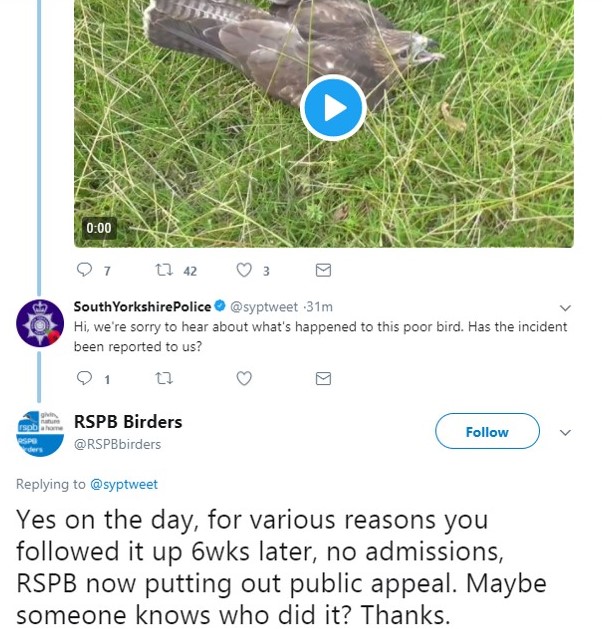
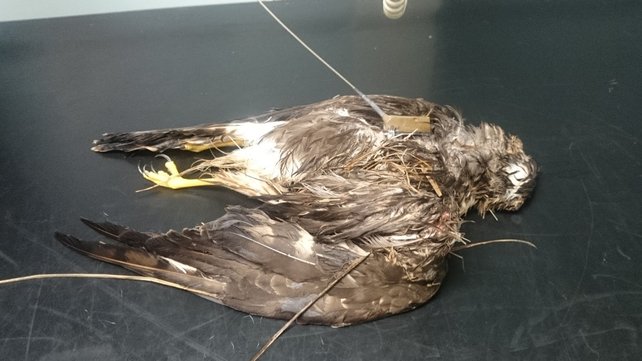
North Yorkshire Police have issued a further appeal for information about the shooting of a red kite in Nidderdale.

The kite was found near Greenhow in Nidderdale on Saturday 11th March 2017 (see here). Since then, a number of rewards have been offered for information leading to the arrest and conviction of those involved. One of these rewards has been offered by local businesses in nearby Pateley Bridge (see here).

Last month North Yorkshire Police interviewed a local man in connection with the incident and now they are appealing again for more information.

PC David Mackay, a Wildlife Crime Officer from the North Yorkshire Police Rural Task Force said: “We have had a good response so far from the public to our appeal for information, and I am urging anyone who has not yet come forward to do so now. This lengthy investigation shows that we take bird of prey persecution extremely seriously“.

North Yorkshire Police is being supported in the investigation by the Yorkshire Red Kites group. Doug Simpson, the Yorkshire Red Kite Co-ordinator, said: “I am pleased to hear of the progress made in this case. I would encourage anyone with any information not yet reported to contact the police as soon as possible.”

Anyone with information is asked to contact Police Wildlife Crime Officer David Mackay:  david.mackay@northyorkshire.pnn.police.uk and quote reference number 12170047155. Alternatively, you can contact Crimestoppers anonymously on 0800 555 111.

The grouse moor areas of Nidderdale and the neighbouring Yorkshire Dales National Park are well known raptor persecution hotspots. In the last ten years (2007-2017), twenty six red kites have been confirmed as victims of illegal persecution in North Yorkshire (18 poisoned, 8 shot). Twenty two of those red kites were killed in Nidderdale or the National Park. Earlier this year the RSPB wrote a blog about red kite persecution in this region and produced this shocking map:

Well done North Yorkshire Police for persistence with this latest investigation (see press release here).

Red kite photo by Richard Stonier

Peregrine shot in Ipswich – police investigation launched

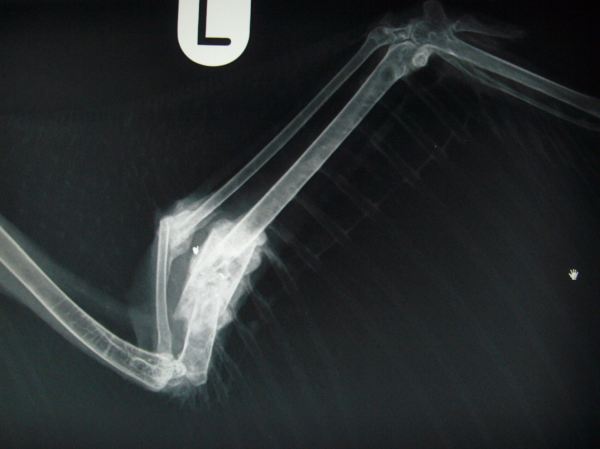
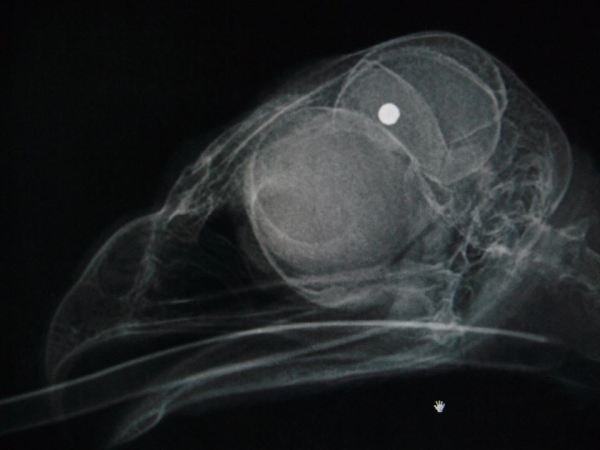
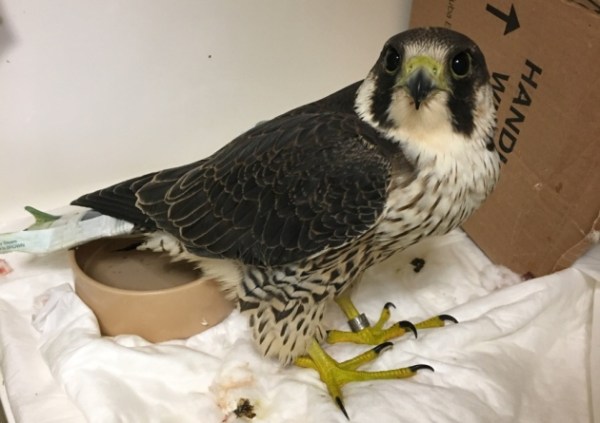
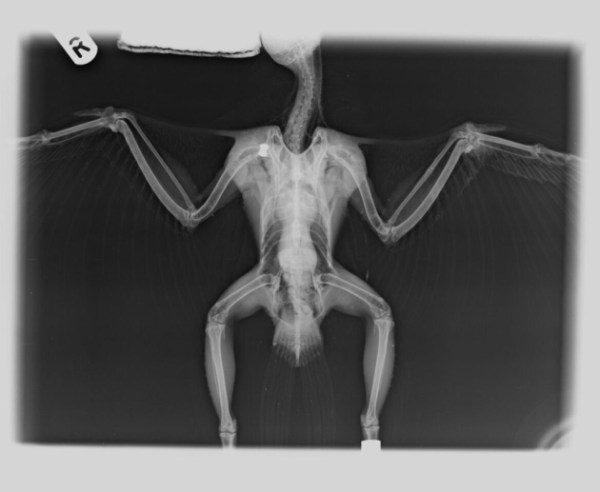
Suffolk Police are investigating the shooting of a young male peregrine in Ipswich.

The bird, one of four to have fledged this year from the Mill Tower at Ipswich Waterfront, was found alive but in an emaciated condition at the weekend. He was taken to Riversbrook Veterinary Practice where an x-ray revealed he had been shot in the leg. Unfortunately he didn’t survive.

Further details in the Ipswich Star here

Photos by Riversbrook Veterinary Practice

There’s nothing ‘draconian’ about licensing game shooting estates

There were a couple of articles published in the Scottish Mail on Sunday yesterday about the possibility (probability) of the introduction of game shoot licensing in Scotland.

The first article didn’t bring anything new to the story; it was just a re-hashed version of who’s said what since Cabinet Secretary Roseanna Cunningham announced a package of new measures to address the on-going problem of raptor persecution and unsustainable grouse moor management. Lord David Johnstone of Scottish Land & Estates talked about maintaining the status quo (i.e. no licensing scheme required), James Reynolds of RSPB Scotland talked about the necessity of introducing a licensing scheme because self-regulation by the grouse-shooting industry has failed, and an unnamed spokesman from the Scottish Gamekeepers’ Association talked about how licensing could have serious consequences for gamekeepers and their families. The two journalists who wrote the article described the Government’s proposed review as ‘the latest blow to landowners following draconian land reforms and the abolition of tax breaks’.

What ‘draconian land reforms’ are those, then? And why should multi-millionaire landowners, whose grouse moors are already subsidised by the public purse, be entitled to tax breaks?

Here’s a copy of the article, and for those who struggle to read it, here’s a PDF version so you can zoom in and increase the font size: MailonSunday1_July162017

The second article was a commentary column written by Carrieanne Conaghan, a gamekeeper’s wife who coordinates the ‘Speyside Moorland Group’ – one of several regional moorland groups closely affiliated with the Gift of Grouse propaganda campaign.

The headline begins: ‘As Draconian new land laws loom…’ These words probably weren’t Carrieanne’s but nevertheless, it’s clear from her commentary that estate licensing isn’t welcomed by gamekeepers because, she says, “For the vast majority of estates who have done nothing wrong and are resolute in their fight against wildlife crime, they would be penalised by strict new controls“.

Unfortunately she doesn’t explain why or how she things law-abiding estates would be “penalised by strict new controls“. The fact of the matter is, they wouldn’t be penalised at all, as the penalities would only be felt by those who continue to illegally kill protected raptors. And quite rightly so. Law-abiding gamekeepers, and their employers, have absolutely nothing to fear from the introduction of a licensing scheme, and you’d think they’d be welcoming it with open arms because if anything, it’ll protect them from being lumped in with the criminals.

Here’s the article and here it is as a PDF: MailOnSunday2_July162017

Carrieanne also claims that, “More worryingly, it [licensing] also brings the potential of gamekeepers losing their homes and livelihoods if a licence to operate was withdrawn“. This is just emotional scaremongering, probably encouraged by the same tosh spouted by SGA Chairman Alex Hogg earlier this year (see here). The only reason gamekeepers would potentially lose their homes and livelihoods would be if they’d broken the conditions of the licence and the subsequent withdrawal of that licence. That principle applies to everybody else in society whose activities are licensed. It’s the risk you run if, for example, you’re a professional driver and you commit road traffic offences leading to the loss of your driving licence. Why should gamekeepers be exempt from regulation when everyone else’s lives are governed by such rules?

Carrieanne claims that the licensing proposal has been brought about by “activists who object to the very existence of grouse moors, whether their opposition is based on a dislike of shooting or the ‘toffs’ who they believe are the only ones who participate“. Actually, the proposal was brought about by ordinary members of the public who are sick to the back teeth of criminal gamekeepers and their employers getting away with the illegal slaughter of protected wildlife, particularly on driven grouse moors.

Carrieanne claims that raptor persecution is “in decline” and that “tough new legislation has had a positive effect“. She also thinks, because her gamekeeper husband told her, that gamekeepers “desire to manage moorland for the interests of all species, whether it be grouse, ground-nesting birds, mountain hares or birds of prey“. Good grief.

She must have missed the Golden Eagle Satellite Tag Review, the findings of which were the final straw for Roseanna Cunningham and which led directly to the current proposition of a licensing scheme. She must also have missed the news that the hen harrier population continues to spiral downwards, thanks in large part to illegal persecution, and the news that peregrine populations continue to decline in areas dominated by driven grouse moors, and the news that the northern red kite population continues to suffer from the impact of illegal persecution on driven grouse moors, and the news that five prosecutions for alleged wildlife crime (all involving gamekeepers or their employers) have all been dropped in recent months, and the news that raptors continue to be illegally shot, even in recent weeks (see here, here) or illegally trapped (see here) on grouse moors up and down the country.

Did anyone see any gamekeepers or any moorland groups condemning these incidents? Where was their uproar? Where was their outrage? How many gamekeepers or members of moorland groups have provided information/intelligence to the police about any of these recent crimes? We’ll take an educated guess – none of them.

Carrieanne is right to be concerned about her family’s livelihood, but it’s not at risk from a licensing scheme, which is neither draconian or unnecessary; it’s actually a long overdue and pretty measured response to decades of criminality and unsustainable practices. Carrieanne’s livelihood is only at risk from those criminal gamekeepers and their employers who refuse to reform and continue to stick up two fingers to the law.

UPDATE 25 July 2017: SRSG response letter here

Short-eared owl shot on Leadhills Estate – police appeal for info

Police Scotland are appealing for information after the shooting of a short-eared owl was witnessed on the Leadhills (Hopetoun) Estate, South Lanarkshire.

According to this article in the Carluke Gazette, the shooting was witnessed about 11.45am on 31 May 2017 (ironically, the day Environment Cabinet Secretary Roseanna Cunningham announced a package of new measures to clamp down on the illegal persecution of raptors on Scottish grouse moors).

The suspect/culprit is described by Police as “being small or medium build, driving a black 4×4 type vehicle with a dark canopy on it. The vehicle thereafter drove off to the B7040 Elvanfoot Road“.

Witnesses are sought, and those with information are urged to call Police Scotland 101 or Crimestoppers on 0800 555 111.

Well done Police Scotland for getting this news out and not sitting on it for three years. More of this, please.

The location given is the same as described in an earlier Police appeal for information following the witnessed shooting of a hen harrier earlier in May 2017 (see earlier blogs here and here).

Here’s a map of the Leadhills Estate (Leadhills Estate in block red, dotted line denotes neighbouring Buccleuch Estate boundary, info from Who Owns Scotland).

And here is a map showing the B7040 Elvanfoot Road, which runs right across the Leadhills (Hopetoun) Estate:

We’ve blogged extensively about this estate (see here) and we’d particularly encourage new readers to have a look at the very long list of raptor persecution crimes recorded (49 incidents [now 50] recorded over the last 14 years see here). There have only ever been two convictions of estate gamekeepers.

We’ll be blogging more about this place shortly.

In the meantime, we need to see an immediate response from the Scottish Government. On 31 May 2017 the Cabinet Secretary told the world that the Government would “Immediately review all available legal measures which could be used to target geographical areas of concern“.

Has that been done? What are the legal measures available, and when will they be implemented?

Law professor comments on inadmissibility of video evidence in wildlife crime prosecutions

As regular blog readers will be aware, the Crown Office & Procurator Fiscal Service (COPFS), the public prosecutors in Scotland, have, in the space of two months, either dropped or refused to prosecute five cases of alleged wildlife crime. These include:

25 March 2017 – gamekeeper John Charles Goodenough (Dalreoch Estates), accused of the alleged use of illegal gin traps. Prosecution dropped due to paperwork blunder by Crown Office.

11 April 2017 – landowner Andrew Duncan (Newlands Estate), accused of being allegedly vicariously liable for the actions of his gamekeeper who had earlier been convicted for killing a buzzard by stamping on it and dropping rocks on to it. Prosecution dropped due to ‘not being in the public interest’.

21 April 2017 – gamekeeper Stanley Gordon (Cabrach Estate), accused of the alleged shooting of a hen harrier. Prosecution dropped as video evidence deemed inadmissible.

25 April 2017 – gamekeeper Craig Graham (Brewlands Estate), accused of allegedly setting and re-setting an illegal pole trap. Prosecution dropped as video evidence deemed inadmissible.

21 May 2017 – an unnamed 66 year old gamekeeper (Edradynate Estate), suspected of alleged involvement with the poisoning of three buzzards. Crown Office refused to prosecute, despite a plea to do so by Police Scotland.

Two of these cases (Cabrach Estate and Brewlands Estate) were dropped due to the COPFS deciding that the use of RSPB video evidence, on which the prosecutions relied, was inadmissible.

There has been widespread public condemnation and political concern about these decisions, especially in the case of the alleged shooting of a hen harrier on Cabrach Estate in Morayshire. The Crown Office has attempted to explain the decisions but many questions remain unanswered for those of us who don’t have the legal expertise, or all the case details, to challenge the COPFS decisions.

We read with interest, then, a blog that was published yesterday written by Peter Duff, Professor of Criminal Justice at Aberdeen University. His blog, entitled ‘The law of evidence, video footage, and wildlife conservation: did COPFS make the correct decisions?‘ deals specifically with the Cabrach & Brewlands cases and can be read here.

We thoroughly recommend reading it. It’s important to read the perspective of an independent, expert academic who has no axe to grind on either side of the debate. It’s hard for those of us who are either tainted by years of frustration about criminal raptor killers getting away with it, or those with a vested interest in raptor killers avoiding prosecution, to take an unbiased view of the law and its application, so Professor Duff’s opinion is a valuable contribution to the debate. Not only that, it’s great to see this issue receiving wider coverage than the usual commentators.

That’s not to say we agree with his interpretation though! In short, Professor Duff concludes that the COPFS decisions were “perfectly reasonable”, and he explains his reasoning for this, but, crucially, some of what he writes does not take in to account previous case law on this issue, perhaps because he was unaware of such cases?

For example, Professor Duff states: ” In my view also, for what it is worth, I agree that the courts would not excuse such an irregularity in obtaining the video evidence and prosecutions would be fruitless“.

First of all, the Scottish courts HAVE excused the irregularity of obtaining video evidence without the landowner’s permission and far from those prosecutions being ‘fruitless’, they actually resulted in the conviction of the accused (e.g. see the Marshall trial here and the Mutch trial here).

During the Marshall trial, there were several hours of legal argument about the admissibility of the video evidence. The Sheriff accepted the video evidence, commenting that the RSPB presence on the gamekeeper’s estate [from where the video was filmed] was “neither illegal nor irregular, and the intent to obtain evidence did not make it so“.  This is no different to the recent Cabrach case.

During the Mutch trial, again involving several hours of legal argument about the admissibility of evidence, the Sheriff accepted that the RSPB had not placed the video camera with the purpose of gathering evidence for prosecution, but they had placed it as part of a legitimate survey in to the use of traps. This is no different to the recent Cabrach case.

There is also an on-going trial at the moment (concerning alleged fox hunting) that relies heavily on video evidence filmed on privately-owned land without the landowner’s permission. The court has accepted the video evidence as admissible (although we can’t comment too much on this as the trial is still live).

So on that basis, we profoundly disagree with Professor Duff’s opinion that covertly filmed video evidence would not be accepted by the Scottish courts. It already has been, on several occasions, resulting in convictions. The question remains then, why did the COPFS decide it was inadmissible? Somebody within the Crown Office (presumably an experienced lawyer from with the Wildlife & Environmental Crime Unit) decided, when this case was first marked, that the video evidence was admissible. It took nine court hearings over a period of a year before the COPFS decided that the video evidence was inadmissible. We still don’t know the basis for that decision. And the other related question to this is why didn’t the COPFS let the court make the decision? It’s this inconsistency of approach that has caused so much confusion, and as Professor Duff writes, ‘bewilderment’.

Professor Duff also writes: “The actions by the RSPB [of placing a covert camera] are a breach of the right to privacy of both the estate owners and their employees (whilst not quite analogous, imagine if your neighbour installed a secret camera to record everything that went on in your garden)“. Sorry, but it’s quite absurd to compare these two scenarios given the size difference between these two types of landholdings. Nobody could argue that placing a covert camera to film somebody’s back garden wouldn’t be a breach of privacy, as you’d reasonably expect to see the human occupants on a daily basis. But on a multi-thousand acre estate, far from any private dwelling? Come on, “not quite analogous” is one hell of an understatement. And not only that, in the Cabrach case, the camera was aimed at the nest of Schedule 1 hen harrier, which by law cannot be approached/disturbed without an appropriate licence from SNH so you wouldn’t expect to film anybody anywhere near the nest.

All in all then, Professor Duff’s interpretation of the law, whilst useful, still doesn’t explain, or justify, the decisions made by the Crown Office in these two cases.

And questions still remain about the decisions to drop the other three cases (gamekeeper John Charles Goodenough of Dalreoch Estates; landowner Andrew Duncan of Newlands Estate; an unnamed gamekeeper of Edradynate Estate), none of which were reliant upon video evidence.

Heads Up for Harriers: Tim Baynes claims illegal persecution an “historical controversy”

Another week and another duplicitous article from Tim (Kim) Baynes, Director of SLE’s Scottish Moorland Group. This guy seems to live in a perpetual state of denial when it comes to the illegal persecution of raptors on driven grouse moors.

This time he’s penned an article for the latest edition of Shooting Times about the ridiculous Heads Up for Hen Harriers project (more on this below).

The front cover of the Shooting Times has a headline banner: “The hen harrier: how much do we really know?”, which laughably infers that the cause of long-term hen harrier decline in the UK is still a bit of a mystery that needs solving, and then inside there’s a two-page spread from Tim (Kim) who suggests that ‘weather’ and fox predation are the big culprits, as recorded by Heads Up for Hen Harrier cameras. Astonishingly, he also claims that the illegal persecution of hen harriers on grouse moors is an “historical controversy”.

You can read the full article here: Shooting Times 7 June 2017_HaveYouSeenAHenHarrier_TimBaynes

Perhaps he missed the Government-commissioned 2011 Hen Harrier Conservation Framework, which set out very clearly what the main issue is: Illegal persecution is the biggest single factor affecting hen harriers and it is having a dramatic impact on the population, not only in northern England but also in Scotland:

  • The potential national hen harrier population in Scotland is estimated (conservatively) to be within the range 1467-1790 pairs.
  • The current national hen harrier population in Scotland as recorded during the 2010 national survey is 505 pairs, more than a 20% decline from the numbers recorded during the 2004 national survey.
  • In Scotland, the hen harrier has a favourable conservation status in only five of 20 regions.
  • Two main constraints were identified: illegal persecution, and in one region, prey shortages.
  • The species is particularly unsuccessful in the Central Highlands, Cairngorm Massif, Northeast Glens, Western Southern Uplands and the Border Hills. There is strong evidence in these grouse moor regions that illegal persecution is causing the failure of a majority of breeding attempts.

Tim (Kim) also appears to have missed the video published by RSPB Scotland last month showing exactly what happens when a camera is installed at a hen harrier nest without the grouse moor owner and gamekeeper’s knowledge:

He must also have missed last month’s news that Police Scotland are investigating the illegal shooting of yet another hen harrier on a grouse moor near Leadhills (see here), which incidentally is alleged to have happened on the estate owned by the Hopetoun family – that’ll be the family of Lord Hopetoun, Chair of the Scottish Moorland Group, of which Tim (Kim) is, er, Director.

The only ‘historical’ aspect of hen harrier persecution is that it’s been going on for over a hundred years. Pretending that it’s now stopped, in the face of such overwhelming evidence to the contrary, is the response of an idiot.

We’ve blogged about the Heads Up for Hen Harriers project many times (e.g. see here, here, here). The idea is that estates give permission for cameras to be installed at active hen harrier nests ‘to help build a picture of why these birds aren’t doing as well as they should be’. The major flaw in this ‘study’ design is that gamekeepers will know on which nests the cameras are pointing, so obviously they’re not going to shoot the adults or stamp on the eggs/nestlings at those sites. Instead, the cameras will record natural failures (e.g. poor weather, predation) and then the grouse shooting industry can use this information to claim that illegal persecution isn’t an issue, but poor weather and predation is. This is exactly what Tim (Kim) Baynes has done in this latest article.

Now, some might argue that having grouse moor owners’ agreement to install cameras at hen harrier nests on their estates is a good thing – at least those nests will be left alone and the birds might be able to produce some young. There is that, of course. But leaving the birds alone long enough to produce fledglings isn’t enough. What happens to those young fledglings once they leave the safety of a monitored nest? You only have to look at what happened to young hen harrier Elwood to answer that question. He survived for approximately two weeks after dispersing from his monitored nest site before un-mysteriously vanishing on a grouse moor in the Monadhliaths – funnily enough in an area where many satellite tagged golden eagles have also un-mysteriously vanished.

Tim (Kim) talks about the number of estates that have agreed to participate this year (at least 15) and makes much of the fact that some of these are grouse moor estates. The same thing happened last year, although what was covered up last year was the fact that only three nests were successful and none of those was on a driven grouse moor. This wasn’t a surprise given that most of the driven grouse moor estates that agreed to ‘participate’ were located in the Angus Glens – an area that hasn’t seen a successful hen harrier breeding attempt since 2006.

What would be more interesting to know is not how many estates have agreed to ‘participate’, which is a largely meaningless figure unless they actually have an active nest, but how many estates have refused to participate? Again, this information is not made public, presumably because it’ll spoil the image of this so-called ‘widespread cooperation’ from grouse moor estates.

We’ve got another question for Tim (Kim). In this article he says:

A better idea of current numbers will emerge when the results of the 2016 UK harrier population survey are published, but the overall picture is expected to be broadly the same in Scotland“.

Really? On what basis is he making this claim? The results of the National HH Survey have not yet been released (held back, we believe, due to the General Election, but due out shortly), so what makes Tim (Kim) think that “the overall picture is expected to be broadly the same in Scotland”? Is this based on factual information or is Tim (Kim) just making up some nonsense to suit his agenda?

It’s not like he/Scottish Moorland Group/Gift of Grouse hasn’t done this before (e.g. see here, here, here).

Shot buzzard successfully rehabilitated and returned to the wild

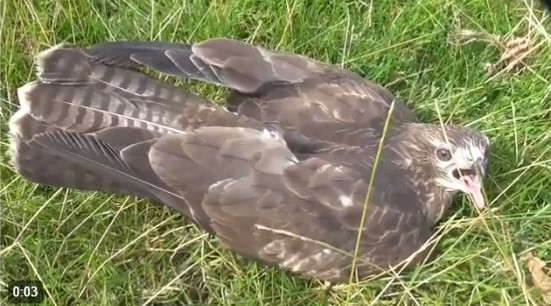
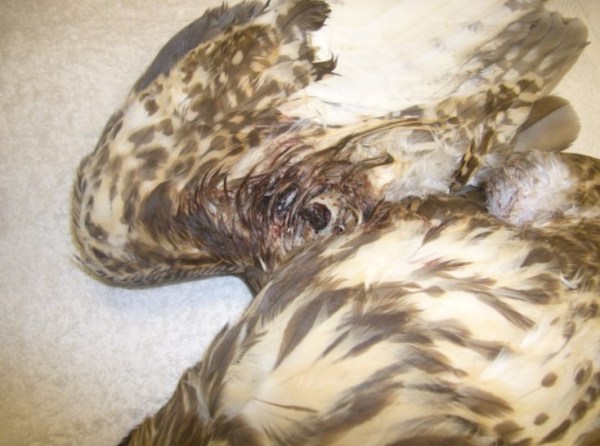
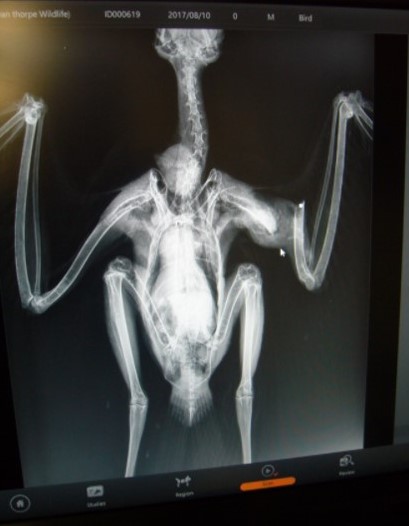
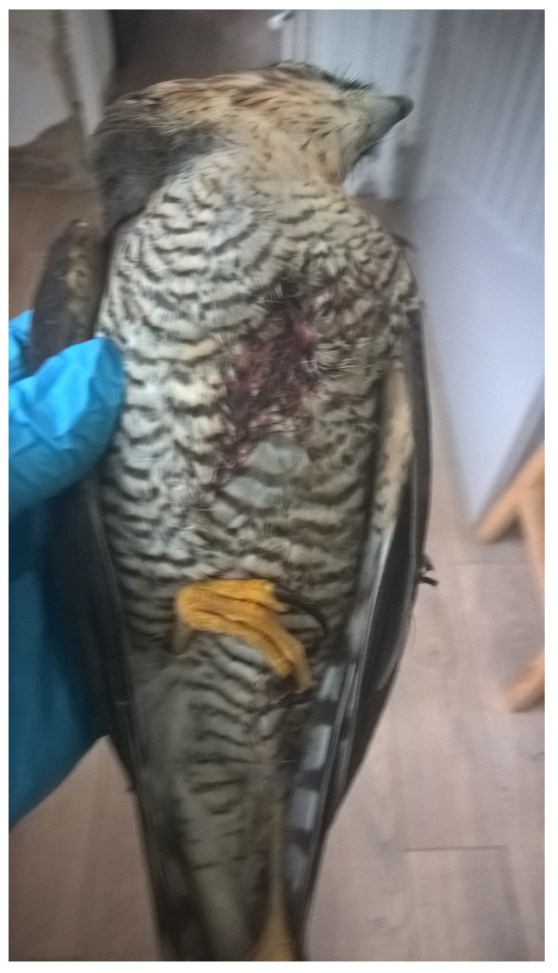
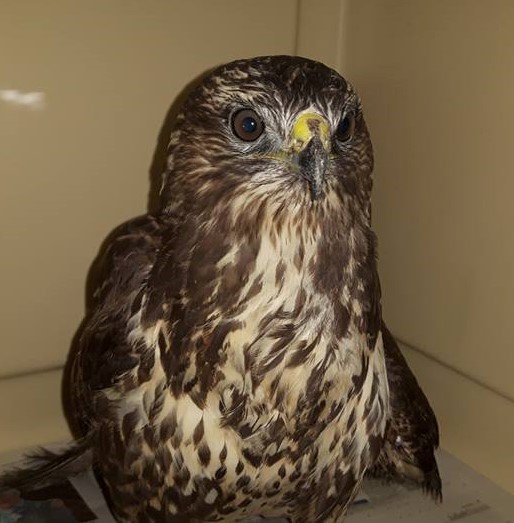
Last month we blogged about this adult female buzzard that had been found ‘down, shocked and injured’ in Norton, North Yorkshire. She has severe lacerations to her head and feet, believed to have been caused by trying to escape from a cage trap. An x-ray also revealed a shotgun pellet lodged on her right leg/foot. (Photos from Jean Thorpe)

The buzzard received medical and surgical treatment from vet Mark Naguib of Battle Flatts Veterinary Clinic and then wildlife rehabilitator extraordinaire Jean Thorpe put in hours and hours of expert care, including even twice daily physiotherapy to stretch the bird’s talons to enable her to stand on her damaged foot. Jean commented, “She looks tatty headed but she is defiant and strong“.

Last week all this hard work paid off and the buzzard was successfully released back to the wild.

More brilliant work from vet Mark Naguib and as for Jean Thorpe, we’re just in awe of her. This remarkable lady has a fundraising page so if you’re able to show your appreciation and support with a donation, please do – SEE HERE.

Crown Office drops 5th case of alleged wildlife crime

Public prosecutors from Scotland’s Crown Office have dropped yet another case of alleged wildlife crime.

According to an article in the Sunday Post (see here), gamekeeper John Charles Goodenough, 32, had been charged after he was allegedly caught with illegal gin traps covered in animal blood, with dead fox cubs found nearby, in May 2016. It is reported Goodenough was employed at the time by Dalreoch Farming & Sporting Estates, owned by the well-connected Wellesley family. It was alleged that Goodenough was using the illegal traps on a neighbouring farm in Ayrshire.

The case was due to be heard at Ayr Sheriff Court on 27 March 2017 but two days prior to the hearing, the Crown Office dropped the case ‘after getting the dates wrong on its paperwork’.

This latest case brings the total of recently abandoned prosecutions for alleged wildlife crime to five. That’s five abandoned cases in the space of two months:

25 March 2017 – gamekeeper John Charles Goodenough (Dalreoch Estates), accused of the alleged use of illegal gin traps. Prosecution dropped due to paperwork blunder by Crown Office.

11 April 2017 – landowner Andrew Duncan (Newlands Estate), accused of being allegedly vicariously liable for the actions of his gamekeeper who had earlier been convicted for killing a buzzard by stamping on it and dropping rocks on to it. Prosecution dropped due to ‘not being in the public interest’.

21 April 2017 – gamekeeper Stanley Gordon (Cabrach Estate), accused of the alleged shooting of a hen harrier. Prosecution dropped as video evidence deemed inadmissible.

25 April 2017 – gamekeeper Craig Graham (Brewlands Estate), accused of allegedly setting and re-setting an illegal pole trap. Prosecution dropped as video evidence deemed inadmissible.

21 May 2017 – an unnamed 66 year old gamekeeper (Edradynate Estate), suspected of alleged involvement with the poisoning of three buzzards. Crown Office refused to prosecute, despite a plea to do so by Police Scotland.

Given how difficult it is to get just one wildlife crime case anywhere near a court, to have five abandoned in the space of two months does not inspire confidence in the criminal justice system.

In fact such was the public concern about some of these cases being abandoned due to the supposed inadmissibility of video evidence, last month the Scottish Parliament’s Environment Committee wrote to the Crown Office to ask for an explanation (see here).

The Crown Office has now responded with this: COPFS letter to ECCLR_EvidenceAdmissibility_May2017

We are not legally qualified to comment in depth about how good or how poor the Crown Office’s response is. If any of our legally-minded readers (Adam?) would like to comment, please do so.

However, what we can say is that this response does not address the question of why the Crown Office made the decision about inadmissibility instead of allowing a court to decide, as has happened in previous cases (e.g. see here).

Nor does this response address the question of why the Crown Office did not believe the RSPB ‘s explanation for their use of video surveillance for monitoring a hen harrier breeding attempt at Cabrach Estate. The Crown Office maintains, without explanation, that the RSPB had installed the video ‘for the purpose of detecting crime’, whereas the RSPB maintains the camera was installed as part of a legitimate monitoring study, an explanation which had been accepted by both the Crown and the court in a similar situation in another case (here).

The RSPB’s case is not so strong in the Brewlands Estate case, where a camera was installed to monitor an illegal pole trap (a trap that the RSPB had since made safe by flicking on the safety catch), although the circumstances might have been different had the police been able to attend the scene as soon as they were notified of an illegally-set trap. Nevertheless, the fact that the Crown Office allowed a year’s worth of court hearings to pass by before deciding to abandon this case, and their unwillingness to communicate their specific concerns to the RSPB, is yet to be adequately addressed by the Crown Office.

The Crown Office’s response also does not explain (although to be fair, it wasn’t asked to) why dropping the prosecution against Andrew Duncan for alleged vicarious liability was deemed to be ‘not in the public interest’, and nor does it explain why a prosecution was not brought against the unnamed Edradynate Estate gamekeeper for the alleged poisoning of three buzzards, despite pleas from Police Scotland to do so.

The Crown Office’s letter to the Environment Committee ends with this:

COPFS remains committed to tackling wildlife crime, including raptor persecution. There is a strong presumption in favour of prosecution in cases reported to the Service where there is sufficient admissible evidence and prosecution is in the public interest‘.

You could have fooled us.

To be honest, as frustrating as it was to see these cases abandoned for what seem to us to be spurious reasons, the Crown Office’s unimpressive performance has probably helped move things along, because these dropped cases came at the time when the Scottish Government was already under severe public pressure to do something other than make vague promises to tackle wildlife crime. That’s not to say we are pleased with the outcome of these cases – far from it – but it’s quite likely that these failed prosecutions helped tip the balance and persuaded the Scottish Government that actually, the current system is failing and they need to find new ways of addressing the problem.

Buzzard found shot dead in Yorkshire Dales National Park

North Yorkshire Police are appealing for information following the discovery of a dead buzzard.

It was found by a farmer in a field off Hawthorns Lane, Gordale, near Malham in the Yorkshire Dales National Park. An x-ray revealed a shotgun pellet lodged in the bird’s head.

Police appeal for information here

The Grough website is also carrying an article about this dead buzzard and has included details of other recently-killed raptors and associated wildlife crime within this National Park:

‘The bird’s death is the latest in a number of incidents of raptor persecution in the Yorkshire Dales. A buzzard that was found with gunshot wounds in the Cowgill area in Dentdale earlier this month and taken to a veterinary centre, where it was expected to make a full recovery.

A tagged hen harrier that went missing in upper Swaledale in December last year and a shot peregrine falcon was found near Grassington in October.

In July, North Yorkshire Police admitted it had been wrong not to pursue a prosecution through the courts of a junior gamekeeper who admitted setting illegal cruel traps on the Mossdale Estate near Hawes. He was given a police caution for the offence.

The incident prompted the Yorkshire Dales National Park Authority chairman Peter Charlesworth to say: “At a time when the Yorkshire Dales is receiving such widespread recognition as a wonderful place to visit, it’s incredibly disappointing that the criminal persecution of birds of prey continues to damage the reputation of the area.

“We know that birds of prey are a big attraction to the millions of visitors that come here, so these acts are causing economic damage as well as appalling harm to wildlife.”’

Peregrine found shot in Ninfield, East Sussex

Press statement from Sussex Police, 25 May 2017:

A protected peregrine falcon has been found shot in Ninfield, East Sussex, sparking an investigation by police and the RSPB.

The bird – a female – was discovered alive but injured by woods at Lunsford Cross on 10 May, and staff from East Sussex Wildlife Rescue & Ambulance Service were called to recover the bird.

An X-ray revealed a recent fracture to its right wing consistent with a shot injury. While undergoing examination, a further three shot gun pellets were discovered: two in the bird’s stomach and one in its left wing. These were considered historic and the vet concluded that the bird had also been shot at an earlier date.

The peregrine has undergone surgery and is recovering at the rescue centre.

Daryl Holter, Wildlife and Heritage Officer for Sussex Police, has urged anyone with information about the incident to come forward.

He said: “Peregrine falcons are a protected species under Schedule 1 of the Wildlife and Countryside Act. It is an offence to intentionally take, injure or kill a peregrine. To shoot it in this way was a vile and senseless act. Had the injured bird not been found it would almost certainly have faced a lingering death, possibly through starvation.”

Chris Riddington from East Sussex Wildlife Rescue said: “The bird is incredibly lucky to have been found and we are liaising with experts with regards to its care. It is still uncertain whether the fracture will heal, but our vets are happy with its progress. It’s hard to believe anyone would shoot a bird – but this is becoming far too common in today’s society. These birds are shot and left to suffer and we have to pick up the pieces.”

Jenny Shelton, RSPB investigations liaison officer, said: “It is appalling to hear that someone has shot a peregrine falcon – a bird which is already of conservation concern in the UK. Peregrines are magnificent, agile birds and will be breeding at this time of year, so taking out this young female may impact her chances of producing young this year.

This incident is part of an ongoing problem with raptor persecution in the UK. This is the fifth report of a peregrine with shotgun wounds we have received already this year, but as yet no-one has been brought to account. This, as most people would agree, is simply not acceptable.”

If you have any information relating to this incident, contact Sussex Police online, email 101@sussex.pnn.police.uk or phone 101, quoting serial 420 of 19/05. Alternatively contact Crimestoppers anonymously on 0800 555 111.

If you find a wild bird which you suspect has been illegally killed or harmed, contact police or RSPB investigations on 01767 680551, or fill in the online form here