Over the last few weeks I’ve blogged about a number of illegally-killed Hen Harriers whose deaths have been barely publicised by the authorities, but instead have been quietly entered onto a Government spreadsheet, months, and sometimes over a year later, with little effort to draw the public’s attention to this ongoing criminality.
There was Hen Harrier ‘Susie’ who was found dead with gunshot injuries on a grouse moor in the North Pennines, here; and Hen Harrier ‘254843’ who was found dead on moorland in the Northumberland National Park with shotgun damage to her satellite tag, here; and a Hen Harrier (ref # HSE 107/913) who was found poisoned on a grouse moor in North Yorkshire having ingested a lethal combination of toxic chemicals known as the ‘Nidderdale Cocktail’, so called due to the frequency it is used as a poisoned bait in the Nidderdale National Landscape, killing multiple birds of prey and even a pet dog, here.
Well, here’s another one.
This time its a young Hen Harrier named Margaret, who was fitted with a satellite tag (Tag ID 254844) by Natural England fieldworkers just prior to her fledging from a nest in Northumberland on 5 July 2024.
Natural England staff ‘lost contact’ with Margaret just three months later on 19 October 2024.
The first we knew about this was in Natural England’s intermittent spreadsheet update in December 2024 about the fate of the Hen Harriers that had been satellite-tagged using public funds. Margaret’s entry read as follows:
‘Lost contact 19 October 2024, Northumberland. Missing Fate Unknown, site confidential – ongoing investigation‘.
Whether that meant her tag had suddenly and inexplicably stopped transmitting, or whether the data showed an unusually long period of being static in one place, wasn’t clear.
We didn’t hear anything more until Natural England quietly updated its spreadsheet in October 2025. Margaret’s entry now reads:
‘Missing Fate Unknown. Suspected illegally killed. Tag found removed. Carcase not found. Grid ref NY878497‘.
So, a year after Natural England ‘lost contact’ with this Hen Harrier, we’re finally given a few more details.
This grid reference is in the North Pennines National Landscape (formerly called an AONB), a region that has long been identified as a Hen Harrier persecution hotspot (e.g. see the RSPB’s damning 2025 report, Hen Harriers in the Firing Line, here).
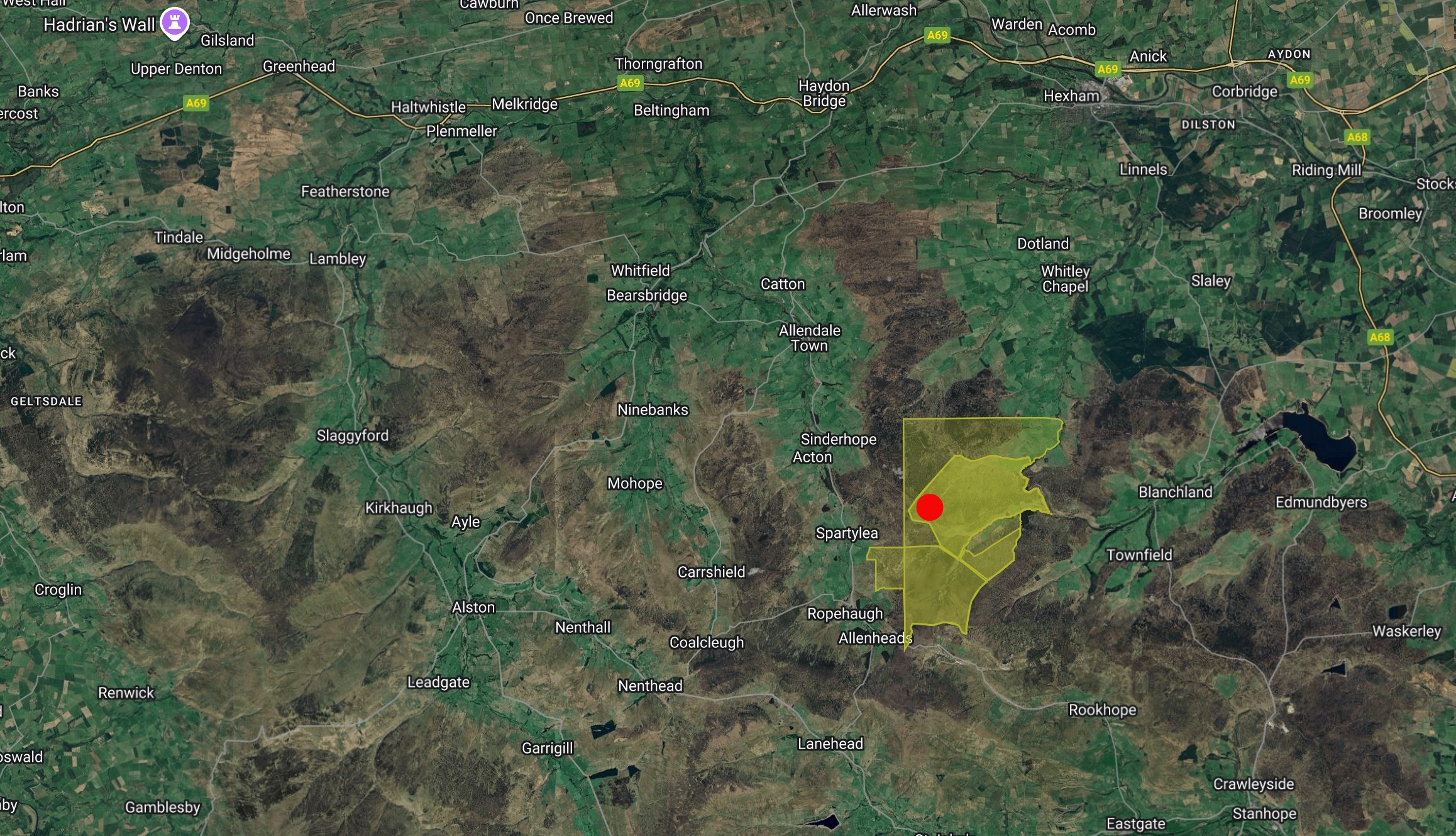
When you zoom in on this map, you’ll be unsurprised to see it is an area dominated by moorland intensively-managed for driven grouse shooting (as demonstrated by the obscene expanse of geometric strips).
According to Guy Shrubsole’s excellent website, Who Owns England?, this grid reference (approximately marked as a red dot on map below) sits on property described as part of the Allendale Settled Estates:
There’s no suggestion that anyone connected to the Allendale Estate is responsible for ‘removing’ Margaret’s satellite tag and/or killing this Hen Harrier. It’s simply a fact that her ‘removed’ satellite tag was found on a grouse moor at this location without any sign of her carcass.
I haven’t seen ANY appeal or press release from Northumbria Police about the suspected illegal killing of this Hen Harrier or the circumstances that led the police to believe her satellite tag had been ‘removed’, presumably cut, over a year ago in October 2024. Not a single word.
I haven’t seen ANY publicity from the National Wildlife Crime Unit-led Hen Harrier Taskforce. This is the specialist group set up explicitly to tackle the ongoing illegal killing of Hen Harriers in England. Not a single word.
I haven’t seen ANY publicity from the police-led national Raptor Persecution Priority Delivery Group (RPPDG), one of whose functions is apparently ‘awareness raising‘ and ‘raising the profile [of illegal raptor persecution] via media exposure‘. Not a single word.
Natural England, who used public funding to pay for the tag, public funding to pay for the fieldworkers to fit the tag to the bird, and public funding to monitor the tag’s subsequent data output, chose not to draw attention to this suspected illegal killing and instead just quietly updated its tag spreadsheet a year later, probably hoping nobody would notice.
I’ve been told by a number of sources that the decision about whether to publicise a crime lies solely with the investigating police force (in this case, Northumbria Police). I’m told that nobody else (e.g. Natural England, National Wildlife Crime Unit’s Hen Harrier Taskforce, the RPPDG) can do this until, or unless, the investigating police force agrees.
That’s understandable in the immediate period after the police have become aware of the crime. They’d want (you’d hope) to be launching an immediate investigation and wouldn’t want the suspects to be alerted because evidence could be removed/hidden before the police have turned up to do a search.
What’s utterly farcical though, is that the investigating police force can ‘sit’ on a case for months, sometimes for over a year, and do nothing, either because (a) their officers are overstretched and don’t have the resources to investigate, (b) their officers are inexperienced or even incompetent, or (c) their officers are corrupt with direct vested interests. Meanwhile, no other organisation, including a specialist police unit, is allowed to mention the suspected crime or appeal for information.
This happens again and again and again with some police forces tasked with investigating raptor persecution on private sporting estates (and some other wildlife crime offences, too, notably fox-hunting). It’s not all police forces by any means – some of them are exemplary and their wildlife crime officers routinely push the limits to try and bring offenders to justice, but some other forces simply aren’t up to the job, for any of the reasons described above.
If it is a ‘rule’ that the investigating police force has supremacy over media output, and other agencies have to sit and wait for a green light that might never come, then this needs to be challenged and changed, especially when there’s a specialist police team waiting on the sidelines ready to act but is effectively handcuffed, blindfolded and gagged. What’s the point of having a specialist team if it doesn’t have the authority to lead on an investigation?
But hang on, Natural England has ‘published’ some details about some of these incidents, albeit very quietly in a spreadsheet that most people don’t even know exists. I suspect they have a duty to do this because public funds are involved.
So why then, in those cases, can’t Natural England accompany that spreadsheet update with a blog, or a press release, or something/anything that would alert the media/public to the ongoing criminality faced by Hen Harriers?
And what’s to stop the other agencies doing likewise? Hen Harrier Margaret ‘disappeared’ and her tag was ‘removed’ over a year ago – you can’t tell me that any publicity now is going to hinder a police investigation!
And besides, I’m blogging about the case, legitimately, using information that’s in the public domain. There’s no reason whatsoever that those agencies can’t do the same.
You’ll be unsurprised to know that Margaret isn’t the last Hen Harrier I’ll be writing about that has ‘disappeared’ in suspicious circumstances in recent months.
I’m also aware that I haven’t recently updated the running ‘death list‘ of missing/dead Hen Harriers…I plan to do this soon but may not get to it quickly as there’s a lot going on right now.





 Raptor Persecution UK