ECCLR session 2: the SGA and their ‘alternative facts’

Two weeks ago the Scottish Parliament’s Environment, Climate Change & Land Reform (ECCLR) Committee held an evidence session to scrutinise the Government’s 2015 annual wildlife crime report.

The evidence session was divided in to two parts – we’ve blogged about session 1 [evidence from Police Scotland and the Crown Office] here.

This blog is about session 2, where witnesses from RSPB Scotland, Scottish Gamekeepers’ Association (SGA), Scottish Badgers and the Bat Conservation Trust were invited to speak.

The video of the session can be watched here and the full transcript can be read here.

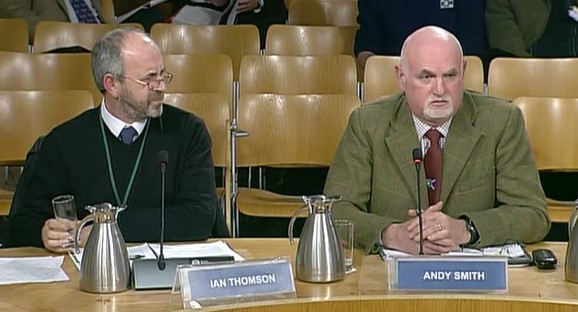
This session was fascinating and we’d really encourage you to read the transcript – and even better, watch the video. There’s too much to blog about here so we’ll just focus on the SGA’s ‘evidence’, which turned out to be a series of ‘alternative facts’, which perhaps isn’t all that surprising although it is of concern when you realise Andy Smith, the SGA rep, was a former police officer for 30 years and so he should be well versed in dealing with actual facts, not made-up ones.

Here are some of the SGA’s alternative facts. This is not an exhaustive list, just the ones that amused us the most:

Alternative Fact #1

According to Andy Smith, the SGA doesn’t support the proposal that the SSPCA should be given increased powers to help investigate wildlife crime because he was told that the SSPCA’s Chief Superintendent traveled to London to listen to the Westminster debate on driven grouse shooting, which, according to Andy Smith, means the SSPCA has an anti-shooting agenda.

The logic Andy Smith used to reach this conclusion is, well, illogical, because plenty of people attended the Westminster debate, including GWCT staff members, who most definitely are not anti-shooting. Anyway, as it turns out, the SSPCA’s Chief Superintendent did NOT travel to London to attend the debate, as he clearly explains in a recent letter to the ECCLR Committee that has been published on the Scottish Parliament’s website:  20170111_mike_flynn_to_convener_regarding_ecclr_meeting_10_january_2017

Alternative Fact #2

According to Andy Smith, “There are places in this country that should have birds of prey – raptors – but do not have them. That includes some RSPB reserves that have the perfect conditions. For example, I do not think that there are very many in Abernethy“.

Oops. There are at least eight species of breeding raptors at the RSPB’s Abernethy Reserve (perhaps more, we haven’t checked), including, er, the world famous ospreys at Loch Garten.

Alternative Fact #3

According to Andy Smith, “We should remember that the Cairngorms National Park has the highest density of eagles in the world“. [Interruption]. “Am I not right in thinking that?“.

Ian Thomson (RSPB Scotland): “No, you are not“.

Andy Smith: “It is certainly where the highest density of eagles is in the UK“.

Ian Thomson: “Harris has the highest density of golden eagles“.

Another commonly repeated myth from Andy Smith. It’s nothing new (e.g. see here, and it was also repeated in the SGA’s most recent edition of its in-house rag Scottish Gamekeeper), but it doesn’t matter how many times it’s repeated, it doesn’t make it factual. The Cairngorms National Park does NOT have the highest density of eagles in the world, nor in the UK. As Ian Thomson correctly pointed out, golden eagle density in the Western Isles (i.e. nowhere near a driven grouse moor) is among the highest recorded, although a few populations in North America have an equally high density.

The truth is that golden eagles in the Cairngorms National Park have one of the lowest rates of site occupancy in the whole of Scotland. Sure, there are breeding golden eagles in the CNP, but as was described in the authoritative Golden Eagle Conservation Framework, the vast majority of those sites are associated with open woodland (i.e. deer forest) where they are generally left alone; they are, with a handful of exceptions, absent from the extensive areas of open moorland managed for driven grouse shooting.

ge-vacant-territories-2003The data in the above table were derived from the 2003 national golden eagle survey. Since then, a 2015 national survey has been undertaken and we await publication of the detailed results, although the preliminary findings have shown that there have been improvements in occupancy in some regions, but not, unfortunately, in the Eastern Highlands, which includes large parts of the Cairngorms National Park and North East Glens, where intensively managed moorland for driven grouse shooting remains the dominant land practice and where illegal persecution continues to constrain the golden eagle population, as well as a number of other raptor populations including peregrine and hen harrier.

The SGA should watch out. With a performance like Andy Smith’s, the Trump administration may well try to headhunt him to join The White House press team.

Another question on withheld raptor persecution data

mark-ruskellWe’ve talked quite a bit on the issue of withheld raptor crime data from the Scottish Government’s 2015 annual Wildlife Crime report. We blogged about it when the report was published in November 2016 (here) and again earlier this month when Mark Ruskell MSP asked for an explanation from Police Scotland during the recent ECCLR Committee hearing on wildlife crime (see here).

This issue was raised again on Thursday during a general question session at Holyrood. The topic of ‘crime recording’ was being discussed and Mark Ruskell took the opportunity to ask a supplementary question:

“The cabinet secretary might be aware that “Wildlife Crime in Scotland—2015 Annual Report” came under scrutiny recently in the Environment, Climate Change and Land Reform Committee. It was revealed that a number of bird of prey persecution incidents from two years ago were withheld from the report despite details from other sources being in the public domain. Will the cabinet secretary undertake to investigate why that information was withheld, and will he say what Police Scotland can do to ensure that wildlife crime reporting is transparent, accurate and has the confidence of the public?”

The Cabinet Secretary for Justice, Michael Matheson, responded as follows:

“Classification and the way issues are recorded in the statistics are developed by statisticians, and the approach must comply with the code of practice that is applied to recording of crime statistics. I have no doubt that if the Scottish crime recording board believes that there is a need for any alterations, it can consider that issue, as we move forward with any changes that could take place. However, I will ensure that Mark Ruskell receives a full and detailed response on the specific nature of wildlife crimes”.

The withholding of the raptor persecution data probably wasn’t due to a faulty classification system developed by statisticians. The missing data included incidents that were very clearly crimes – there’s no ambiguity about whether 4 shot buzzards, a trap containing a live pigeon decoy, and spring traps set in the open, were crimes. They obviously were crimes, even though the police-led investigation didn’t identify the person(s) responsible for those crimes.

We await Police Scotland’s explanation for why these crimes were withheld from the Government’s annual report.

Thanks to Mark Ruskell MSP (Scottish Greens, Mid Scotland & Fife) for his persistence on this issue.

Edward Mountain MSP – the fiercest critic of those committing wildlife crime?

Edward Mountain MSP is a new member of the Scottish Parliament (Scottish Conservative & Unionist Party, Highlands & Islands).

Edward recently wrote a guest article for the Scottish Gamekeepers’ Association’s quarterly rag, Scottish Gamekeeper (Issue 71, winter 2017, page 20). We’re going to reproduce part of that article:

I believe that challenging the ‘spectre’ [of land management reform] is vital, if the very countryside we all value and love is to be maintained. The way to do this is by standing tall and laying out a stall, for all to see the benefits positive management has to offer. The problem is that every time it looks like the right story is being delivered another case of wildlife crime comes to light. If there is any chance of moving forward we must stop these idiots, who believe illegally killing raptors is acceptable.

I therefore would urge all organisations that represent country folk to stand up and let people know all the good work that is being done for conservation. At the same time, they also need to vilify those that break the law.

Over the next 4.5 years I look forward to working with the SGA and I will do all I can to defend the values you and your members believe in. However, I must also say that I will be the fiercest critic of those that jeopardise these values by breaking the law‘.

Good strong words, but will he put them in to action?

His article for the SGA was probably written before he hosted a parliamentary reception at Holyrood for the Scottish Country Sports Tourism Group in mid December 2016 (see here). The reception was to launch the ‘Game for Growth’ initiative that is using public funds to promote country sports providers in Scotland.

We now know that these public funds are being used to promote a sporting agent with a conviction for raptor persecution (see here) and two estates where illegally-set traps have been discovered (see here).

Now’s your chance, Edward – it’s been put on a plate for you. As you’re so publicly supportive of this Game for Growth scandal, are you going to stand up and be “the fiercest critic” of the associated wildlife crimes?

We’ll see.

ECCLR review of wildlife crime report: session 1

Last week the Scottish Parliament’s Environment, Climate Change & Land Reform (ECCLR) Committee held an evidence session in which to review the Scottish Government’s 2015 Annual Wildlife Crime Report.

The archived video can be watched here

The official transcript can be read here: ecclr-transcript-wildlife-crime-10-jan-2017

The evidence session took place in two parts: the first session involved witnesses from Police Scotland and the Crown Office, and the second session heard evidence from RSPB Scotland, Scottish Badgers, Scottish Gamekeepers’ Association and the Bat Conservation Trust.

This blog focuses on session 1 (we’ll blog about session 2 in another blog).

ecclr1

The witnesses in session 1 were Gary Aitken (Crown Office), ACC Steve Johnson and DCS Sean Scott (Police Scotland). DCS Scott has appeared in front of this committee in previous years (when it was the RACCE committee) but this was a first time appearance for ACC Johnson and Gary Aitken.

Session 1 lasted for about two hours and it’s fair to say these witnesses were given quite a grilling. The ECCLR Committee was extremely well informed and in some cases there was some pretty persistent (but respectful) questioning, notably by Mark Ruskell MSP and Claudia Beamish MSP.

We’ve already blogged about part of this session (see here) in relation to Police Scotland’s inability to answer Mark Ruskell’s question about why some confirmed raptor crimes had been withheld from the Government’s 2015 report. We await Police Scotland’s written explanation to the Committee in due course. A similar problem was raised in this session re: the huge discrepancy between the number of crimes against badgers recorded by Scottish Badgers ( n = 42) and those recorded by Police Scotland (n = 5). Again, Police Scotland has been asked to provide a written explanation to the Committee, which will be important because this appears to be a recurring issue. It was good to hear  though, that Police Scotland has recently set up some new reporting mechanisms with Scottish Badgers, as well as training days for officers. Hopefully this will improve communication and understanding between them.

There was good discussion about increased powers for the SSPCA (Police Scotland appears to have softened its stance on this a bit, although we’re all STILL waiting for the Environment Cabinet Secretary to announce the Government’s position on these increased powers), agreement that increased penalties for wildlife crime would be very welcome, and also agreement on the importance of being able to identify accountable individuals for potential vicarious liability prosecutions. All good.

On the whole, Police Scotland and the Crown Office were far more circumspect at this hearing than in previous appearances. We were very pleased to hear ACC Johnson acknowledge that the full extent of wildlife crime in Scotland is an ‘unknown’, in complete contrast to his predecessor’s (ACC Malcolm Graham) ludicrous claims that Police Scotland ‘wasn’t missing much of it’ (see here).

We were also very pleased to hear ACC Johnson’s acknowledgement that the scientific / academic evidence [of the effect of persecution on the distribution and abundance of raptor populations] was a “strong part” of the evidence of wildlife crime.  However, none of this scientific evidence had appeared in the Government’s 2015 annual report and Mark Ruskell MSP asked what progress had been made in assessing this evidence; something ACC Graham had committed to doing last year. The responses from ACC Johnson and DCS Scott were utterly astounding. They both said they’d be happy to look at the scientific evidence ‘if it was brought to their attention’.

What? Are they for real? Are they seriously suggesting they’re unaware of the massive body of scientific evidence? They’re having a laugh, aren’t they?

How many peer-reviewed scientific reports and papers have been published on this issue in the last 20 years? Bloody loads of them! Here’s a list of some of them and hereherehere are some more that have been published in the last year alone and here, here are some preliminary scientific results, all widely reported in the media, that are due to be written up as scientific papers in the immediate future.

Sorry, ACC Johnson and DCS Scott, your claimed ignorance of the scientific evidence just doesn’t wash. Especially DCS Scott, who chairs the PAW Raptor Group, where some of these scientific results have been frequently discussed.

So why claim ignorance? Was it to cover up Police Scotland’s inaction on this issue? If so, that’s not nearly good enough. For two years in a row now Police Scotland has committed to assessing the scientific evidence and incorporating it in to its ‘intelligence-led’ investigations. We, and no doubt the ECCLR Committee, will expect to see progress on this when the Government’s 2016 annual report is published later this year.

Withheld raptor crime data: some info for DCS Scott of Police Scotland

This morning the Scottish Parliament’s Environment, Climate Change & Land Reform (ECCLR) Committee heard evidence on the Scottish Government’s 2015 annual wildlife crime report.

The archived video can be viewed here.

The official transcript can be read here: ecclr-transcript-wildlife-crime-10-jan-2017

The session was dynamite and there are many things to discuss – we’ll be blogging a lot more about this in the coming days but we wanted to start with the issue of withheld raptor crime data.

As some of you may remember, we criticised the Government’s annual wildlife crime report when it was published in November, precisely because we knew that several confirmed raptor crimes had not been included in the data presented to the Government by Police Scotland (see here). At the time, we didn’t elaborate on which specific crimes had been withheld from the report but we argued that the withholding of data completely undermined the public’s confidence in the report’s findings.

We were delighted to see this issue raised at this morning’s evidence session by Mark Ruskell MSP (Scottish Greens), and with devastating aplomb.

In the video link above, the discussion starts at 1:06:31.

Mark asked the Police Scotland representatives (ACC Steve Johnson and DCS Sean Scott) why some raptor crimes that had been recorded by RSPB Scotland had been excluded from the Government’s report. DCS Scott looked blank, and then mumbled something about perhaps the crimes weren’t actually crimes at all so they wouldn’t have been recorded. Mark pressed on and gave DCS Scott specific details about the crimes in question and even showed him a photograph of one of the illegally set traps involved, to check that it was indeed an illegally-set trap and thus a confirmed crime. DCS Scott maintained he didn’t know about these specific crimes, even when Mark gave him more detailed information about the location. This went on for some time and it was excellent to see Mark’s persistence and his unwillingness to be fobbed off. Eventually, DCS Scott committed to finding out about these specific crimes and gave assurance that he would later write to the ECCLR Committee to explain why these data had been withheld from the Government’s report.

To help DCS Scott, here’s some background about these specific crimes:

If you look at Table 19 in the Scottish Government’s 2015 annual wildlife crime report, there is a list of raptor persecution crimes and the data are attributed to Police Scotland. Listed under Lothian & Borders, Police Scotland recorded the following incidents between April 2014-March 2015:

Peregrine shooting (Sept 2014)

Attempted trapping (species not identified) (Sept 2014)

Buzzard shooting (October 2014)

Tawny owl shooting (Dec 2014)

Now, compare the Police Scotland data with the data published in Table 4 in the RSPB’s annual report – ‘The Illegal Killing of Birds of Prey in Scotland, 1994-2014, A Review‘. In that report, listed under Scottish Borders, the RSPB has recorded the following additional confirmed crimes for the same time period, that were excluded from the Police Scotland data in the Government’s annual report:

Crow trap baited with 2 live pigeons, surrounded by 4 set spring traps, nr Heriot (May 2014) – there is even a photograph of this illegally-set trap on page 16)

and

4 x shot buzzards, nr Heriot (May 2014).

pigeon-in-trap-heriot-2014

rspb-table-4

It was later revealed during the second part of the ECCLR Committee evidence session this morning, in evidence given by Ian Thomson (Head of Investigations, RSPB Scotland) that the above offences were uncovered during a Police Scotland-led multi-agency raid on this estate ‘nr Heriot’, so it is somewhat surprising that DCS Scott claimed to have no knowledge about them.

In due course we look forward to reading DCS Scott’s written explanation about why these data were withheld from the Government’s 2015 annual wildlife crime report.

In the meantime, kudos and thanks to Mark Ruskell MSP, who was one of several MSPs who performed exceptionally well at this morning’s evidence session. More on that in later blogs…..

Scottish Environment Committee takes evidence on wildlife crime: Tuesday 10th January

As we blogged last week (here), this morning the Environment, Climate Change & Land Reform (ECCLR) Committee will take evidence on the Scottish Government’s 2015 annual wildlife crime report.

This should be a fascinating session as for the first time, rather than just hearing from Police Scotland and the Crown Office, the Committee will also take evidence from a number of other experts and stakeholders, including RSPB Scotland, Scottish Badgers, Scottish Gamekeepers’ Association and the Bat Conservation Trust. We consider this to be important progress that will help the Committee hold the statutory enforcement authorities to account and we very much welcome it.

As a warm-up to the main event you can read the fairly hard-hitting written evidence submitted to the ECCLR Committee by RSPB Scotland: rspb_written_evidence_ecclr-committee_jan2017

There are a number of extremely well-informed cross-party MSPs on this ECCLR Committee so we anticipate some strong questioning.

The session starts at 09.30hrs and can be watched live on Scottish Parliament TV here.

UPDATE 8pm: For those were unable to watch the live session, the archive video can be watched here. The official transcript can be read here: ecclr-transcript-wildlife-crime-10-jan-2017

ecclr-agenda-2

Environment Committee to take evidence on annual Scottish wildlife crime report

wildlife-crime-review-2015Next week (Tuesday 10 January 2017, 9.30am) the Scottish Parliament’s Environment, Climate Change and Land Reform (ECCLR) Committee will hear evidence about the Government’s recent (2015) annual wildlife crime report.

In the past, this committee (the RACCE Committee as it was then called) has only taken evidence from Police Scotland, the Crown Office, and the Environment Minister. This year it is very encouraging to see that evidence will be heard from a wider range of stakeholders. That’s definitely progress and we applaud it.

The following are due to give evidence at next week’s hearing:

Session 1

Gary Aitken, Head of Wildlife & Environmental Crime Unit, COPFS

Assistant Chief Constable Steve Johnson & Detective Chief Superintendant Sean Scott, Police Scotland

Session 2

Eddie Palmer, Chair, Scottish Badgers

Andy Smith, Committee Member, Scottish Gamekeepers’ Association

Ian Thomson, Head of Investigations, RSPB Scotland

Peter Charleston, Conservation Wildlife Crime Officer, Bat Conservation Trust

This evidence hearing should be fascinating. You’ll remember we blogged recently about the Government’s latest wildlife crime report (here) and we were highly critical of it because, according to RSPB Scotland, a number of raptor persecution crimes had been withheld from the report. We argued that as these were confirmed crimes, and they took place over two years ago, there was simply no justification for keeping them a secret and that by withholding these data, it undermined all confidence in the report’s trend analyses and made the whole process of annual reporting nothing more than a meaningless charade. Let’s hope questions are raised about this issue on Tuesday.

You’ll also remember that we blogged about Scottish Badger’s recent complaints to the Justice Committee about how crimes against badgers were being under-recorded (see here). Scottish Badgers reported 160 confirmed badger crimes over  a period of one year, whereas Police Scotland recorded only seven crimes in the same period, and none of those proceeded to prosecution. Let’s hope this issue is also raised on Tuesday.

The ECCLR hearing will be available to watch live on Holyrood tv and we’ll post a link to it on Tuesday morning.

Scottish Justice Committee examines performance of Crown prosecutors in wildlife crime cases

copfs-logoThe Scottish Parliament’s Justice Committee is in the middle of an inquiry into the role and purpose of the Crown Office and Procurator Fiscal Service (COPFS).

This is a broad inquiry focusing on the core role of the COPFS and examining its effectiveness and efficiency, how well it works with stakeholders and the support it provides to witnesses and victims of crime.

As part of the inquiry, interested organisations were invited to submit written evidence. A full list of these submissions can be found here and we were pleased to see submissions from Scottish Badgers, RSPB Scotland and Scottish Environment LINK, all discussing their concerns about how wildlife crimes are handled. These three submissions can be read here:

written-submission-from-scottish-badgers

written-submission-from-rspb-scotland

written-submission-from-scottish-environment-link

All are well worth a read. The evidence from Scottish Badgers is particularly shocking. Here’s an example:

Our recent analyses of evidence averages 60 reports of badger incidents per quarter – of which 40 are confirmed badger crimes. This is in stark contrast to the 7 badger crimes recorded in police statistics in the year 2013/14, none of which were brought to prosecution‘.

Once again this calls in to question the veracity of the Scottish Government’s annual Wildlife Crime Report, which we’ve already criticised for its exclusion of a number of confirmed raptor persecution crimes (see here). The disparity between the annual crime figures recorded by Scottish Badgers and those recorded by Police Scotland is enormous, and again undermines any confidence that is to be had from the Government’s annual Wildlife Crime Report.

Natural Injustice 1 Feb 2015 cover - CopyAll three submissions to the Justice Committee share a common theme – there is repeated criticism of the chronic lack of communication and engagement from the Crown Office with organisations that have played key roles in wildlife crime investigations. This topic was further discussed during an oral evidence session to the Justice Committee on 29 November 2016. Ian Thomson (Head of Investigations at RSPB Scotland) was invited to speak to the Committee on behalf of Scottish Environment LINK. The video of this evidence session can be viewed here (starts at 11.15 mins) and the transcript of the evidence session can be read here (starts at page 6).

During this oral session, Ian talked at length about the Crown Office’s refusal to communicate, and the subsequent frustration and missed opportunities to learn that this silence engenders. Some members of the Justice Committee seemed pretty shocked by this, and the irony wasn’t lost on them when they were told the (former) Lord Advocate had steadfastly refused to meet with LINK members to discuss a 2015 report (‘Natural Injustice‘) that had flagged up the same communication failures.

Complaints about a lack of communication from the COPFS isn’t just limited to those groups involved with the investigation of wildlife crime. A number of other submissions from completely different sectors, including those involved with rape victims, restorative justice, victim support, and even the covener of a car rally, had also all raised the same point.

Let’s hope that the Justice Committee’s inquiry results in some recommendations to improve this on-going problem, and let’s also hope that the recommendation, if it comes, is not ignored like it was when it was previously made (in relation to the investigation of wildlife crime) in 2008 (see here).

Today’s evidence session on licensing of gamebird hunting: Scottish Moorland Group & BASC

This morning the Scottish Parliament’s Public Petitions Committee took evidence from the Scottish Moorland Group and BASC on the petition to introduce gamebird hunting licencing (see here for background to this petition).

The two witnesses today were Dr Colin Shedden (BASC) and Tim (Kim) Baynes (Scottish Moorland Group, part of Scottish Land & Estates).

kim-colin

The evidence session can be watched on Holyrood TV here and the formal transcript can be read here.

The hearing went pretty much as anticipated, with the main gist being that the two witnesses didn’t think that gamebird hunting licensing was necessary. The ‘evidence’ they used to back up their claim was also predictable.

Dr Shedden asserted that all those who shoot game are already regulated via their shotgun certificates, and that “shotgun certificate holders are among the most law-abiding sector of society and any hint of illegal activity can lead to the right to hold a certificate, and the ability to shoot, being withdrawn“. If only that was true! If Police Scotland did revoke shotgun certificates based on “any hint of illegal activity“, there would be a lot of gamekeepers out of a job!

Tim (Kim) Baynes cherry-picked his way through his ‘supporting evidence’, citing the recent increase in the national golden eagle population (but omitting to mention the consistently low occupancy rate of breeding golden eagles on driven grouse moors in the eastern Highlands – see here) and citing the raptor persecution figures in the Government’s latest wildlife crime report (but omitting to mention that the raptor persecution figures in this report are incomplete as some have been deliberately withheld, rendering any trend analysis a pointless waste of time – see here).

He also claimed that raptor persecution on driven grouse moors was not endemic, as the petitioners had claimed, and he cited the evidence of Assistant Chief Constable Malcolm Graham, who had stated at another parliamentary hearing that wildlife crime reporting levels were NOT the tip-of the iceberg and that Police Scotland was “catching a significant amount of it” [wildlife crime]. What Tim (Kim) forgot to mention was that the quality of ACC Graham’s evidence has been called in to question several times (see here, here and here). He also ‘forgot’ to mention the string of recent scientific publications showing that illegal persecution on driven grouse moors is so rife it is having population-level impacts on a number of species including hen harriers, red kites, peregrines and golden eagles.

He also mentioned several so-called ‘partnership-working initiatives’ in an attempt to paint a picture of productive cooperation – we’ve previously discussed these ‘initiatives’ in detail and not one of them stands up to scrutiny. E.g. Wildlife Estates Scotland (it’s a sham, see our critique here), Heads up for Hen Harriers (it’s a sham, see our critique here), the South Scotland Golden Eagle Project (it’s a sham, see our critique here) and the Eastern Cairngorms Moorland Partnership (it’s a sham, see our critique here).

Tim (Kim) then introduced his ‘four point plan’ which, he said, could “deal with this issue once and for all” (presumably the ‘issue’ he’s referring to is the issue of raptor persecution associated with gamebird hunting). Here’s his plan:

Point 1:We very much support the continued enforcement of wildlife crime” [legislation], ‘including the proposed increase in wildlife crime penalties‘.

We’d agree with him on Point 1, in principle, although we want to see increased efforts in wildlife crime enforcement because the current levels of enforcement are simply not good enough.

Point 2:We would ask for support and development of the Wildlife Estates initiative and the other collaborative schemes and projects going on“.

We don’t support Point 2 because it will not address the problem of raptor persecution on game-shooting estates, especially when some members of this scheme have wildlife crime convictions to their name. This ‘initiative’ is, in our opinion, nothing more than a window-dressing opportunity to disguise the on-going persecution of raptors.

Point 3:The Understanding Predation Project“……”looking at predation and how that can be managed“….”We think that is a very important way of everybody moving forward together“.

We don’t support Point 3, because the Understanding Predation Project is nothing more than an exercise in legitimising the killing of predators for the benefit of game shooting.

Point 4:We would very much like to see greater cooperation between ourselves, the Raptor Study Groups and the RSPB“.

Point 4 is hilarious – especially when you hear the story behind a group of dedicated raptor workers who have recently been ‘thrown off’ their 30-year study site because they dared to question some of the management practices they’d seen on that Scottish grouse moor (which also just happens to be an accredited member of the Wildlife Estates initiative!). Watch for a scientific publication due out in March 2017 that explains all!

Point 4 is also hilarious when you consider that the new ‘partnership-working’ protocols that Tim (Kim) had referred to later in this evidence session in relation to national bird surveys, actually comprised of landowners wanting to exert control on raptor fieldworkers by making sure they sought landowner permission before visiting survey sites. That type of control is never going to be welcomed by raptor fieldworkers who have huge and legitimate concerns about subsequent disturbance (i.e. persecution) at the nest sites of sensitive Schedule 1 species on some of these estates.

MSPs put a number of questions to the two witnesses, asking for clarification on a few points. Of particular note are the well-informed questions posed by the increasingly impressive Alison Johnstone MSP (Scottish Greens).

Her questions included asking Tim (Kim) to explain the reason behind the low occupancy rate of breeding golden eagles on driven grouse moors in the eastern Highlands in contrast with the very high occupancy rate in western Scotland. His answer was evasive, to say the least, although he did confirm that this low occupancy rate had been the same for decades, despite productivity there (when it happens) being the highest in Scotland….thus (probably unintentionally) confirming that illegal persecution has been going on there, for, er, decades! He also said, “It’s a really complicated picture“. Is it? Seems pretty straightforward to us. We’ll come back to this in a later blog as we’ve got some interesting maps to share.

Alison also asked Tim (Kim) whether the recent report demonstrating the persistence of red kite persecution in the north of Scotland flew in the face of his assertion that raptor persecution was in decline? His response was to avoid answering the specific question and instead he waffled on about condemning wildlife crime.

The Petitions Committee then discussed what to do with the petition now that evidence from both ‘sides’ had been heard, and it was agreed that it would now be passed on to the Environment, Climate Change and Land Reform (ECCLR) Committee for further consideration. We don’t know the timescale for that but it is more than likely to feature in the New Year when the ECCLR Committee scrutinises the Government’s most recent report on wildlife crime.

Watch this space.

New report reveals hundreds of raptors illegally killed on game-shooting estates in Scotland

RSPB persecution review 1994 2014Yesterday the RSPB published its latest figures on illegal raptor persecution in Scotland.

Rather than their usual annual review, this time they’ve produced a 20-year review covering the period 1994-2014. This is a really useful exercise as it puts the scale of (known) persecution in to perspective. It’s a sobering read.

A total of 779 birds of prey were confirmed to have been illegally killed during this period, either by poisoning, shooting or trapping. The known victims included 104 red kites, 37 golden eagles, 30 hen harriers, 16 goshawks, 10 white-tailed eagles and 458 buzzards.

In addition to these confirmed victims, a further 171 incidents are documented where poisoned baits and/or non-birds of prey victims were found, including 14 pet cats and 14 pet dogs, and then a further 134 incidents where no victim had been found but clear attempts to target raptors had been uncovered (e.g. illegally-set traps).

The report includes a map showing the landholdings of all known persecution incidents during this period. As ever, it’s pretty revealing, with a handful on the west coast but the vast majority in the uplands of central, eastern and southern Scotland – areas dominated by driven grouse shooting.

RSPB persecution review 1994 2014 map

Drilling down in to the detail, there’s a useful analysis of land-use type of confirmed poisoning incidents between 2005-2014 (219 incidents). A shocking (or not) 81% of confirmed poisoning incidents during this nine-year period were on land used for game-shooting: 57% on grouse moors and 24% on land managed for lowland pheasant shoots. This tells us a great deal about who is responsible for the vast majority of illegal raptor poisoning. Despite their continued denials and protestations, and their increasingly-desperate attempts to minimise the scale of these crimes (“it’s just a few rogues”, “it’s just a small minority”), this graphic exposes the criminality at the heart of the game-shooting industry:

RSPB persecution review 1994 2014 land use

Further damning evidence, which isn’t needed by most of us but for the benefit of those who are still in denial of the bleedin’ obvious, is this graph showing the occupations of those convicted of raptor persecution between 1994-2014. Surprise, surprise, 86% of them were gamekeepers:

RSPB persecution review 1994 2014 occupation

RSPB Scotland is to be commended for publishing this exceptionally detailed and meticulously-researched report. There are a number of things in it that are of particular interest to us and we’ll come back to those in due course. For now though, particular recognition should go to the Investigations team – they may be small in number but their contribution to exposing the disgraceful continuation of illegal raptor persecution in Scotland is enormous. They, and their colleagues south of the border, are worthy of high acclaim. If anybody reading this is in a position to recognise excellence in the field of raptor conservation, e.g. a nomination for an award, this team should be at the top of your list.

So, how has the Environment Minister, Dr Aileen McLeod, responded to such an embarrassing report? She said: “There is no doubt that the figures in this report make for uncomfortable reading, but we have made progress in recent years with the new vicarious liability provisions, the publication of the report from the Wildlife Crime Penalties Review Group, new measures implementing restrictions on the use of General Licences and earlier this year the Scottish Government funded pesticide disposal scheme that removed over 700kg of illegally held poisons in Scotland“.

We have made progress…” Hmm. Let’s have a look:

Vicarious liability – introduced almost 4 years ago and only two successful convictions to date. A slow (but good) start, but we need to see many more convictions.

Wildlife Crime Penalties Review – Commissioned over two years ago, published last month. An excellent report calling for tougher sanctions but we’re waiting to hear whether the Environment Minister will act on the recommendations. Can only be defined as ‘progress’ if she agrees to act.

General Licence restrictions – available to be used against landholdings where raptor crimes committed/suspected from 1st January 2014. So far, only two restrictions have been implemented and those only lasted for six days each before they were suspended as legal arguments continue. A slow start, and the legal challenges were to be expected, but can’t be defined as ‘progress’ unless the restrictions are fully implemented. There should also be a lot more of them.

Pesticide disposal scheme –  implemented this year and resulted in the removal of some illegally-held poisons. That is progress, although it is tinged with frustration that the game-shooting industry was given yet another chance to avoid justice as this scheme (the second of its kind) comes 14 years after the pesticides were originally banned. It’s also interesting to note in the RSPB’s report (page 18) that evidence suggests a number of individuals have retained their illegal stocks. This is supported by more poisoning incidents that have taken place this year, after the disposal scheme ended.

So some progress has been made (and almost entirely due to the efforts of Dr McLeod’s predecessor, Paul Wheelhouse) but it is glacially slow and, so far, has not stemmed the occurrence of illegal persecution, as the damning figures in this report show all too clearly. Much, much more can and needs to be done before we’ll be convinced that Dr McLeod is having any sort of impact. She has, though, announced that tenders have just been invited for a review of game licensing practices in other countries (to inform a possible decision of introducing licensing to game-shooting estates in Scotland), and that’s a good thing, but again, the research needs to be done and then a decision made, which probably won’t happen for a number of years if past performance is anything to go by. She’d find herself with a lot more support if she got on with announcing increased investigatory powers for the SSPCA – the public consultation closed 1 year and 3 months ago – and still we await her decision as the criminals continue their rampage. It’s not impressive at all.

And what of the response of the game-shooting industry itself? Some didn’t bother to publish a statement (Scottish Gamekeepers’ Association), which ironically tells us quite a lot, although they are quoted in an article by STV (see media coverage below) where they revert to type and simply deny the evidence and slag off the RSPB instead. And remember, the SGA is a fully-paid up member of the Partnership for Action Against Wildlife Crime (cough).

Scottish Land and Estates (SLE), another PAW partner, did manage to issue a statement, via their Scottish Moorland Group (see media coverage below). Again, it’s the usual lamentable denial, characterised beautifully by this statement from Director Tim (Kim) Baynes:

Bird of prey deaths……have fallen dramatically over the last five years in particular“.

Er, here are some persecution figures that Kim might want to re-punch in to his calculator:

2012 – 18 confirmed deaths

2013 – 28 confirmed deaths

2014 – 37 confirmed deaths

There’s also this statement:

Our condemnation of wildlife crime is unquivocal...” All very touching but how is that “condemnation” manifested in the real world? It’s been brought to our attention that the current head gamekeeper on a Scottish grouse shooting estate has a (spent) conviction for shooting dead a raptor when he worked on another Scottish grouse moor. How does a criminal with a conviction like that (spent or not) remain employed in the game-shooting industry, let alone get a senior position on another Scottish grouse moor? Was he one of the posse of moorland gamekeepers recently invited to Holyrood to mingle with, and be applauded by, a number of MSPs, as part of the Gift of Grouse propaganda campaign? Surely not…

Download the RSPB report here

Media coverage

RSPB press release here

Statement from Environment Minister Dr Aileen McLeod here

Scottish Moorland Group statement here

BBC news here

STV article here

BBC Radio Scotland (Newsdrive) interview with Ian Thomson, Head of Investigations RSPB Scotland here (starts at 21.50, available for 29 days)

Guardian article here (a mis-leading headline but nevertheless good to see coverage in this paper)