Scottish Parliament considers petition calling for study on economic impact of driven grouse shooting

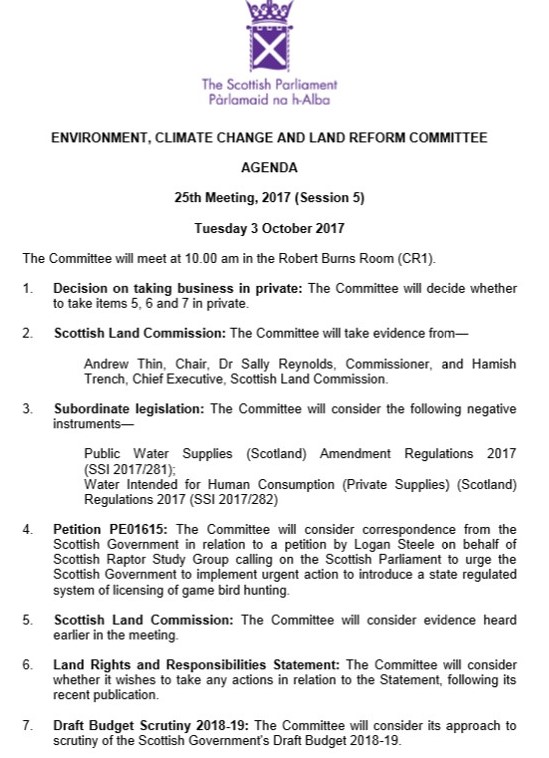
Earlier this year, Les Wallace lodged a petition with the Scottish Parliament’s Public Petitions Committee calling for a comprehensive and independent study into the full economic impacts of driven grouse shooting (see here).

This petition was due to be heard by the Petitions Committee last week but they ran out of time so they deferred their consideration until the next meeting, which took place today.

Basically they agreed that a full independent study was needed but were unsure whether this topic would be covered as part of the Scottish Government’s earlier commitment in May to undertake a review of grouse moor management practices.

There was also confusion as to whether the Scottish Government had actually commissioned this research yet, and the panel agreed to contact the Scottish Government to ask for an update on progress and to ask for a timescale (e.g. start / finish date) of that proposed work.

Good. That’ll be very useful. Environment Secretary Roseanna Cunningham said last week that “good progress is being made” and that she’ll be announcing further details “shortly“. We look forward to hearing more about it.

The Petitions Committee also agreed to write to SNH to ask for their view.

It was noted by the Committee that there had been a number of recent petitions relating to the management of grouse moors and its impact on the environment (e.g. Logan Steele’s petition on behalf of the SRSG calling for the introduction of a game shoot licensing scheme, Harry Huyton’s petition on behalf of OneKind calling for greater protection of mountain hares (we’ll blog more about this soon), and this current petition from Les about the economic impact of driven grouse shooting). Yes, there has been a flurry of petitions – that’s because there is a lot of public concern about what this industry has been allowed to get away with for so very long!

And isn’t it great to see it all being laid bare for political and public scrutiny!

Today’s Petitions Committee meeting can be watched on Scottish Parliament TV here (the discussion about Les’s petition starts at 09.31.21 and ends at 09.36).

Driven grouse shooting & mountain hare culling under more political scrutiny this Thursday

More angst for the dark side this week as yet more political attention is given to driven grouse shooting and mountain hare culling.

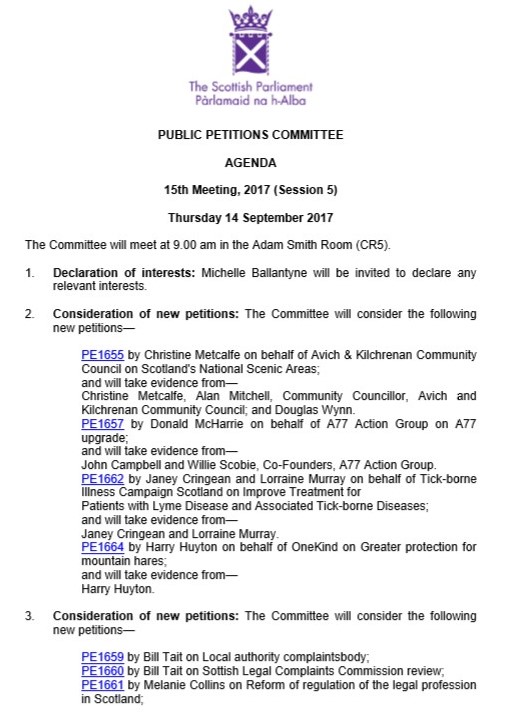
The Scottish Parliament’s Public Petitions Committee will convene on Thursday 14 September to discuss a number of new petitions lodged by members of the public.

We’re interested in two of these petitions:

Petition # PE01663 – Driven Grouse Shooting Study, lodged by Les Wallace.

Petition summary: Calling on the Scottish Parliament to urge the Scottish Government to sponsor a comprehensive and independent study into the full economic impacts of driven grouse shooting.

Petition # PE01664 – Greater Protection for Mountain Hares, lodged by Harry Huyton (of OneKind).

Petition summary: Calling upon the Scottish Parliament to urge the Scottish Government to introduce greater protection for mountain hares on both animal welfare and conservation grounds, which may include: introducing a three-year moratorium on all mountain hare killing, permitting culls and driven hunts only under licence, and ending all culling and driven hunting of mountain hares within Scotland’s National Parks using a Nature Conservation Order.

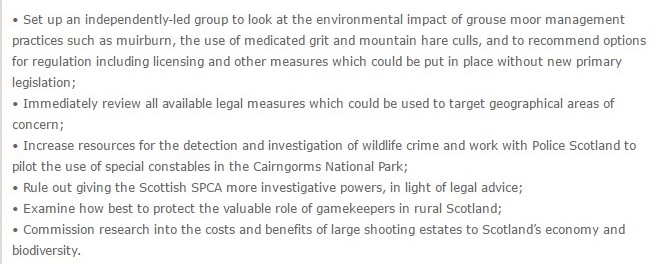
We have no idea how the Petitions Committee will choose to proceed with these two petitions as they are mostly superceded by Environment Secretary Roseanna Cunningham’s surprise announcement in May that she is setting up a review of grouse moor management (which will include mountain hare culling), as well as ‘commissioning research into the costs and benefits of large shooting estates to Scotland’s economy and biodiversity’.

Nevertheless, it is good too see these issues still firmly on the political agenda. Well done, Les & Harry.

We expect this session to be broadcast live on Scottish Parliament TV on Thursday morning and we’ll post the official transcripts as soon as they’re available.

Impromptu demo outside Scottish Parliament, Friday 1pm

In response to last week’s news about missing hen harrier Calluna, who disappeared from a grouse moor in the Cairngorms National Park just a few weeks after fledging, there will be a peaceful protest this Friday outside the Scottish Parliament against the continued persecution of hen harriers.

This demo is a spontaneous response, hastily organised by two ordinary members of the public who have had enough. They don’t have a large campaign fund behind them, nor the resources or experience of a campaigning charity – it’s just them, wanting to make their voices heard at the door of power.

It’s very short notice, but if you’ve had enough of hen harrier persecution and you’re able to support these two people they’ll be outside Holyrood between 1-2pm on Friday 8 September.

#StopKillingHenHarriers


Political silence in response to missing hen harrier ‘Calluna’

Raptor persecution, and particularly the illegal killing of hen harriers, has been identified as a National Wildlife Crime Priority.

Interesting then, that following last Friday’s news that Police Scotland is investigating the disappearance of another missing hen harrier (‘Calluna‘), who vanished in suspicious circumstances on a grouse moor in the Cairngorms National Park in August, the political response has been total silence.

Roseanna Cunningham MSP, the Environment Cabinet Secretary, said nothing.

Mairi Gougeon MSP, the Hen Harrier Species Champion, said nothing.

Alexander Burnett MSP, in whose constituency Calluna ‘disappeared’, said nothing.

The PAW Scotland website, hosted by the Scottish Government, said nothing.

Alexander Burnett MSP (Conservative), presumably no relation to Bert Burnett of the Scottish Gamekeepers’ Association, has spoken before on the subject of illegal raptor persecution, as well he might, given the high number of reported raptor persecution incidents in his Aberdeenshire West constituency, particularly those recorded on grouse moors areas either within or close to the Cairngorms National Park:

Unfortunately, Alexander doesn’t agree that a licensing scheme for gamebird shooting is required. During the recent deliberations of the Scottish Parliament’s Environment Committee, he said the proposed licensing system was “inappropriate, disproportional and unworkable for the issue of wildlife crime that it seeks to address” and he voted for the licensing petition to be dropped in favour of keeping the status quo.

He also told one of his constituents earlier this summer, in response to a letter about the illegal persecution of hen harriers on grouse moors, that:

Game management on grouse moors can make an important contribution to biodiversity by providing cover for wildlife, and through the creation and care of habitats such as woodland, grouse moors, beetle banks and hedgerows‘.

Hmm, that statement sounds familiar. Where have we heard that before? Ah yes, it was part of a standard response trotted out to constituents by a succession of Westminster Conservative MPs last year in the run up to the Westminster ‘debate’ on driven grouse shooting. As pointed out by Mark Avery at the time:

Grouse shooting does not help create or protect woodland – in fact trees are not welcome on grouse moors. Grouse shooting does not create beetle banks – these are conservation measures in arable fields. Grouse shooting does not protect hedgerows – these are not a feature of grouse moors. Take out those errors and your letter says ‘grouse shooting provides grouse moors’.

Have another look at that raptor persecution map of the Aberdeenshire West constituency. If it is of concern to you, and you are one of Alexander Burnett’s constituents, please consider writing to him and ask him to explain the widespread criminality within his constituency, particularly in areas managed for grouse and pheasant shooting, and ask him how he intends to address your ongoing concerns.

Email: Alexander.Burnett.MSP@parliament.scot

Cabinet Secretary Fergus Ewing’s constituency a hotspot for ‘disappearing’ sat-tagged raptors

A few weeks ago we created a map for Mairi Gougeon MSP (Angus & Mearns, SNP) to show her the areas of her constituency where satellite-tagged raptors had either been found illegally killed or had ‘disappeared’ in suspicious circumstances. Unsurprisingly, the main hotspot area was centred on the grouse moors of the Angus Glens.

Mairi, as the Hen Harrier Species Champion, attended this year’s Hen Harrier Day at Loch Leven where she acknowledged the issues and spoke passionately about the need to address illegal raptor persecution. We welcomed her interest and enthusiasm and look forward to seeing her use her position to good effect.

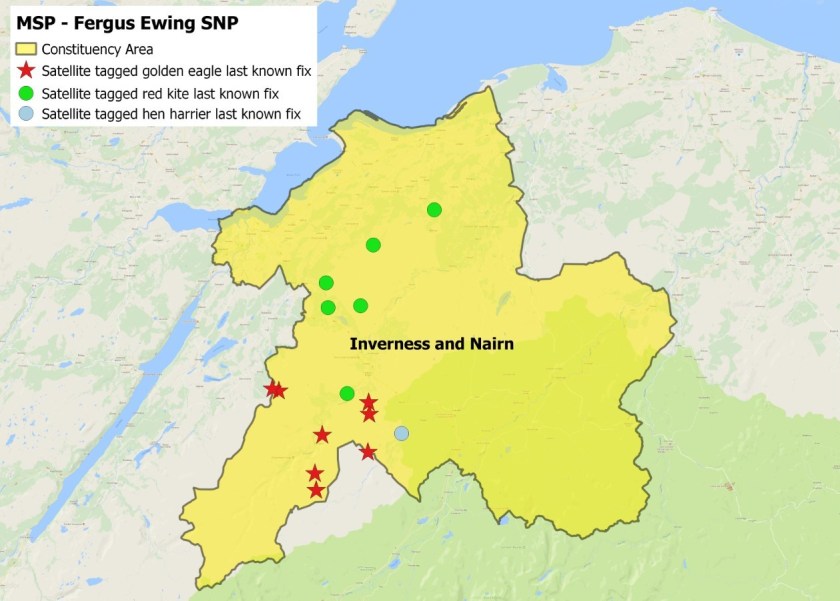
We’ve now created another map, this time for MSP Fergus Ewing’s constituency of Inverness and Nairn. For new readers, Fergus also holds a senior position in the Scottish Government – he is Cabinet Secretary for the Rural Economy and Connectivity.

This latest map is based on data from the recent expert review of golden eagle satellite tag data and also from the RSPB’s recent map showing the locations of ‘disappeared’ or illegally killed satellite-tagged hen harriers and red kites. Here it is, showing the locations of 15 satellite-tagged raptors (8 x golden eagles, 6 x red kites, 1 x hen harrier) that were either illegally killed in Fergus’s constituency or ‘disappeared’ in suspicious circumstances in his constituency:

And just like the map we created for Mairi, the hotspot areas within Fergus Ewing’s constituency all just happen to be on land managed for driven grouse shooting. Imagine that!

Unlike Mairi Gougeon MSP, as far as we can tell, Cabinet Secretary Fergus Ewing has never publicly spoken out about the illegal persecution of raptors on grouse moors, either within his own constituency or beyond (if anyone has any evidence to the contrary we’ll be happy to post it here).

He did, sort of, hint at it in a statement he made about grouse shooting in 2015 when he was Minister for Business, Energy and Tourism:

I am very pleased to be able to extend support to all of those who make a success of fields sports in a professional and responsible fashion. Their efforts bring to Scotland a number of visitors who are very welcome and make a significant financial contribution to the sector”

but you’ll note that he very carefully avoided mentioning raptor persecution crimes or any of the other environmentally damaging effects of intensive grouse moor management.

And he can’t claim that he’s unaware of what’s going on – we’ve contacted him on social media many times about this issue, especially when persecution incidents have been detected in his constituency (most recently in July – see here). He has chosen to ignore us at every turn and has given his full public support to grouse moor management in well known raptor persecution hotspots including the Angus Glens and the Monadhliaths.

If you live in Fergus Ewing’s constituency of Inverness and Nairn, you might want to contact him to ask him what he’s doing about the illegal killing of raptors on grouse moors in this area. He has a responsibility to respond to the concerns of his constituents. Email: Fergus.ewing.msp@parliament.scot

If you don’t live in Inverness and Nairn but wish to raise concerns about the level of illegal raptor persecution on the grouse moors of this Cabinet Secretary’s constituency, please use this email address: Scottish.Ministers@gov.scot [and mark it for the attention of Fergus Ewing].

For far too long we’ve allowed certain politicians to get away with wilful blindness about this ongoing criminality. It’s up to all of us to hold these elected representatives to account.

There’s nothing ‘draconian’ about licensing game shooting estates

There were a couple of articles published in the Scottish Mail on Sunday yesterday about the possibility (probability) of the introduction of game shoot licensing in Scotland.

The first article didn’t bring anything new to the story; it was just a re-hashed version of who’s said what since Cabinet Secretary Roseanna Cunningham announced a package of new measures to address the on-going problem of raptor persecution and unsustainable grouse moor management. Lord David Johnstone of Scottish Land & Estates talked about maintaining the status quo (i.e. no licensing scheme required), James Reynolds of RSPB Scotland talked about the necessity of introducing a licensing scheme because self-regulation by the grouse-shooting industry has failed, and an unnamed spokesman from the Scottish Gamekeepers’ Association talked about how licensing could have serious consequences for gamekeepers and their families. The two journalists who wrote the article described the Government’s proposed review as ‘the latest blow to landowners following draconian land reforms and the abolition of tax breaks’.

What ‘draconian land reforms’ are those, then? And why should multi-millionaire landowners, whose grouse moors are already subsidised by the public purse, be entitled to tax breaks?

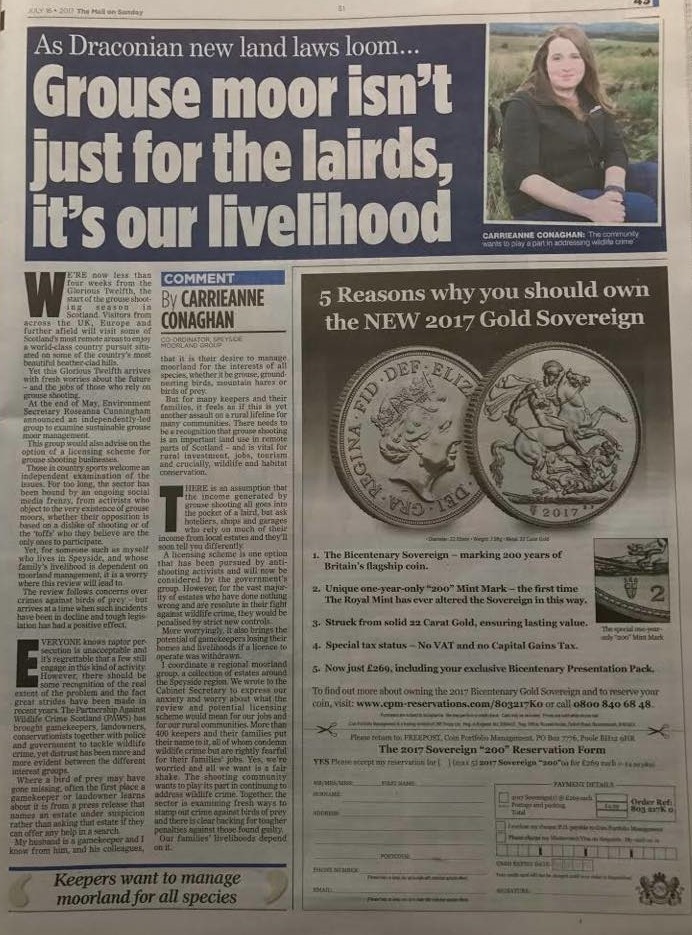
Here’s a copy of the article, and for those who struggle to read it, here’s a PDF version so you can zoom in and increase the font size: MailonSunday1_July162017

The second article was a commentary column written by Carrieanne Conaghan, a gamekeeper’s wife who coordinates the ‘Speyside Moorland Group’ – one of several regional moorland groups closely affiliated with the Gift of Grouse propaganda campaign.

The headline begins: ‘As Draconian new land laws loom…’ These words probably weren’t Carrieanne’s but nevertheless, it’s clear from her commentary that estate licensing isn’t welcomed by gamekeepers because, she says, “For the vast majority of estates who have done nothing wrong and are resolute in their fight against wildlife crime, they would be penalised by strict new controls“.

Unfortunately she doesn’t explain why or how she things law-abiding estates would be “penalised by strict new controls“. The fact of the matter is, they wouldn’t be penalised at all, as the penalities would only be felt by those who continue to illegally kill protected raptors. And quite rightly so. Law-abiding gamekeepers, and their employers, have absolutely nothing to fear from the introduction of a licensing scheme, and you’d think they’d be welcoming it with open arms because if anything, it’ll protect them from being lumped in with the criminals.

Here’s the article and here it is as a PDF: MailOnSunday2_July162017

Carrieanne also claims that, “More worryingly, it [licensing] also brings the potential of gamekeepers losing their homes and livelihoods if a licence to operate was withdrawn“. This is just emotional scaremongering, probably encouraged by the same tosh spouted by SGA Chairman Alex Hogg earlier this year (see here). The only reason gamekeepers would potentially lose their homes and livelihoods would be if they’d broken the conditions of the licence and the subsequent withdrawal of that licence. That principle applies to everybody else in society whose activities are licensed. It’s the risk you run if, for example, you’re a professional driver and you commit road traffic offences leading to the loss of your driving licence. Why should gamekeepers be exempt from regulation when everyone else’s lives are governed by such rules?

Carrieanne claims that the licensing proposal has been brought about by “activists who object to the very existence of grouse moors, whether their opposition is based on a dislike of shooting or the ‘toffs’ who they believe are the only ones who participate“. Actually, the proposal was brought about by ordinary members of the public who are sick to the back teeth of criminal gamekeepers and their employers getting away with the illegal slaughter of protected wildlife, particularly on driven grouse moors.

Carrieanne claims that raptor persecution is “in decline” and that “tough new legislation has had a positive effect“. She also thinks, because her gamekeeper husband told her, that gamekeepers “desire to manage moorland for the interests of all species, whether it be grouse, ground-nesting birds, mountain hares or birds of prey“. Good grief.

She must have missed the Golden Eagle Satellite Tag Review, the findings of which were the final straw for Roseanna Cunningham and which led directly to the current proposition of a licensing scheme. She must also have missed the news that the hen harrier population continues to spiral downwards, thanks in large part to illegal persecution, and the news that peregrine populations continue to decline in areas dominated by driven grouse moors, and the news that the northern red kite population continues to suffer from the impact of illegal persecution on driven grouse moors, and the news that five prosecutions for alleged wildlife crime (all involving gamekeepers or their employers) have all been dropped in recent months, and the news that raptors continue to be illegally shot, even in recent weeks (see here, here) or illegally trapped (see here) on grouse moors up and down the country.

Did anyone see any gamekeepers or any moorland groups condemning these incidents? Where was their uproar? Where was their outrage? How many gamekeepers or members of moorland groups have provided information/intelligence to the police about any of these recent crimes? We’ll take an educated guess – none of them.

Carrieanne is right to be concerned about her family’s livelihood, but it’s not at risk from a licensing scheme, which is neither draconian or unnecessary; it’s actually a long overdue and pretty measured response to decades of criminality and unsustainable practices. Carrieanne’s livelihood is only at risk from those criminal gamekeepers and their employers who refuse to reform and continue to stick up two fingers to the law.

UPDATE 25 July 2017: SRSG response letter here

How divisions within SNP affect rural policy decisions, including tackling raptor persecution

A couple of days ago we read the following short conversation on Twitter, which followed the news that Police Scotland are investigating the shooting of a short-eared owl on Leadhills Estate:

Dominic Mitchell (@birdingetc): Another day on a Scottish grouse moor, another protected bird of prey shot. When will the authorities take effective action to stop this?

Scottish Birding (@birdingscotland): In @strathearnrose [Cabinet Secretary Roseanna Cunningham] I believe we have someone who will act! These morons are simply highlighting the case against themselves.

There’s no doubt in our minds that Roseanna Cunningham is as angry as the rest of us about the continued illegal persecution of birds of prey on grouse moors. Those of us listening to her speech at the SRSG conference earlier this year all saw, heard and felt that anger.

But will she act? Well, her recent announcement of a new package of measures to fight raptor persecution was a sure sign that she intends to act, and a recent tweet from the First Minister’s Special Environment Advisor (David Miller), also in response to a question about what Scot Gov intends to do following the news of the shot short-eared owl on Leadhills Estate, suggests progress is being made:

Trust me. Minds are very definitely focused. Further high level discussions held today. Pushing ahead“.

But as we said when Roseanna announced her package of new measures, we should be under no illusion whatsoever about the dark and powerful influences who will be doing their utmost to disrupt and derail those plans.

Some of those influences will come from external individuals and organisations (no prizes for guessing who), but some of them will also come from within the Government itself. Political divisions within a party are nothing new; we see examples of them all the time. Sometimes they’re just minor squabbles but sometimes they can have enormous consequences.

As an excellent introductory primer to internal SNP divisions, Jen Stout has written an article for the New Statesman. It focuses on why the SNP recently voted, controversially, to lift the ban on tail docking, permitting what many see as a ‘barbaric’ procedure, without anaesthetic, on three-day-old puppies. However, the article also has a broader perspective and Jen ends with this:

The next big showdowns in Holyrood on animal welfare are likely to be just as emotive: the use of electric shock collars on dogs, and the prosecution of wildlife crime (or, how to deal with the fact that poisoned, bludgeoned birds of prey keep turning up on grouse shooting estates). The latter in particular will test, once again, the direction of a party split between appeasing a land management lobby, and meeting the high expectations of its newer members“.

For those of us interested in rural policy decisions in Scotland, and particularly those related to dealing with illegal raptor persecution, it’s well worth taking a moment to consider the political divisions within the SNP because those divisions will undoubtedly make Roseanna Cunningham’s endeavours all the more difficult, and we should all bear that in mind when voicing our criticism. That’s not to say we shouldn’t continue to criticise; on the contrary, the Government should expect to be held to account and public pressure over the last few years has brought things a very long way, but we need to make sure our criticism is aimed at the right target.

Parliamentary question re Crown’s decision to drop wildlife crime prosecutions

The issue of the Crown Office’s questionable decisions to drop five wildlife crime prosecutions in recent months is not going away.

Mark Ruskell MSP (Scottish Greens) has now lodged the following Parliamentary Question:

The answer given by the Lord Advocate to the earlier question to which Mark refers is this:

It’s an interesting question from Mark and we look forward to seeing the answer in due course. Will there be an opportunity to ask for a review of the Crown’s decision to drop any or all five of these cases?

25 March 2017 – gamekeeper John Charles Goodenough (Dalreoch Estates), accused of the alleged use of illegal gin traps. Prosecution dropped due to paperwork blunder by Crown Office.

11 April 2017 – landowner Andrew Duncan (Newlands Estate), accused of being allegedly vicariously liable for the actions of his gamekeeper who had earlier been convicted for killing a buzzard by stamping on it and dropping rocks on to it. Prosecution dropped due to ‘not being in the public interest’.

21 April 2017 – gamekeeper Stanley Gordon (Cabrach Estate), accused of the alleged shooting of a hen harrier. Prosecution dropped as video evidence deemed inadmissible.

25 April 2017 – gamekeeper Craig Graham (Brewlands Estate), accused of allegedly setting and re-setting an illegal pole trap. Prosecution dropped as video evidence deemed inadmissible.

21 May 2017 – an unnamed 66 year old gamekeeper (Edradynate Estate), suspected of alleged involvement with the poisoning of three buzzards. Crown Office refused to prosecute, despite a plea to do so by Police Scotland.

Well done, Mark Ruskell. Good to see there are some decent politicians willing to hold the authorities to account.

Game shoot licensing discussed on BBC’s Landward programme today

Today’s edition of the BBC’s Landward programme had a small feature on proposals for the introduction of game shoot licensing, including contributions from Duncan Orr-Ewing (RSPB Scotland) and Lord David Johnstone (Scottish Land & Estates).

It is available to watch on BBC iPlayer for the next 29 days (Episode 12, starts at 17 mins – here).

We’ve reproduced the full transcript:

Presenter, Euan Mcllwraith: “The majestic golden eagle, soaring above Scottish hills. It’s an iconic image of wild Scotland. But a Government report has found that almost a third of all golden eagles which have been tracked by satellite died in mysterious circumstances, and the majority of those cases were found on land which is managed for grouse shooting. And the demise of the golden eagles has kick-started a re-examination of the way that game shooting is managed.

Game shooting is a major contributor to the Scottish rural economy and supports jobs in rural areas. But the field sport relies on there being a large population of grouse to shoot. The report’s findings led Scottish Environment Minister Roseanna Cunningham to propose an inquiry in to whether or not shooting estates should need a licence to operate.

But why would a licence protect eagles? Well at the moment, if a gamekeeper for example was caught killing a bird of prey, he might be prosecuted and in extreme cases be sent to jail, but the estate would still be allowed to carry on doing business. But the threat of a removal of a licence to operate could prove a more effective deterrent.

The proposal has delighted some groups and horrified others.

With me now are Duncan Orr-Ewing of RSPB Scotland and David Johnstone of Scottish Land & Estates.

Duncan, from your point of view, what’s the attraction of a licence, ‘cos there’s a lot of penalties at the moment, if a keeper gets convicted he goes to jail. Why a licence?”

Duncan Orr-Ewing: “Well, we very much welcome the Cabinet Secretary’s statement that she will look at options including a licensing system. The reason we support a licensing system is because we believe it will raise standards in the grouse moor sector in particular, which has a whole range of problems that have been highlighted in recent years and we think there is a need to reflect the public interest”.

Euan Mcllwraith: “David, from your point of view, you’re not in favour of licences. Why is that?”

David Johnstone: “There’s a number of reasons within that. There’s the SNH report that came out showing licensing going on around Europe, it clearly demonstrated that licensing, wildlife crime still exists in parts of Europe where licensing also takes place. But also we don’t think that it will actually be effective, we think that there are better ways of doing it that will lead to the higher standards that Duncan was talking about, creating good working relationships between ourselves and other stakeholders within, especially the Government”.

Euan Mcllwraith: “But is it not quite simple? If a nightclub has a licence, they break the rules, they go out of business. If a landowner on an estate was seen to be killing birds of prey, which does happen, you cease to have that right to run a business”.

David Johnstone: “This is a very, very different situation because within a nightclub, when a nightclub finishes business, the doors are shut and nobody else is allowed in to that nightclub at all, you control everything that’s going on. Within an estate on land in Scotland, under the 2003 Act, people have a right to roam anywhere, at any time, which we fully support, therefore you have people wandering across the land you’re managing, doing whatever they may wish to do and we have…”

Euan Mcllwraith: “Yeah, but people aren’t going to walk on to an estate and kill a bird, I mean it may happen, but the vast majority…”

David Johnstone: “I’m sorry but we have examples of people who have been interfering with legally set traps and everything else so it does happen, nefarious activity does go on, and that puts at risk people’s livelihood, their jobs, the economy, everything. You’ve got to prove you didn’t do something, as opposed to somebody proving that you did do something”.

Euan Mcllwraith: “Is that a real worry though? That an estate can go out of business, a vital part of the rural economy will cease to exist, on a very low level of proof?”

Duncan Orr-Ewing: “Look, we’re in this position because of a failure of self-regulation, despite repeated public warnings that the estate sector, particularly driven grouse moors, need to get their house in order. They have failed to deliver, that is why we’re at this point.

We believe a system of licensing can be developed, that has the right checks and balances in place, they do it in other countries, we imagine this won’t be done routinely….”

Euan Mcllwraith: “Duncan, David, I think this debate will rage for a long time to come. At the moment it’s in the hands of the Minister who will make a decision in the months and years to come”.

ENDS

When do you think Scottish Land & Estates will realise that the game’s up? That everybody, even the Scottish Government, now accepts the huge weight of evidence showing that illegal raptor persecution is undertaken as a matter of routine on many driven grouse moors?

Does David Johnstone honestly think that anybody is going to believe his inference that 41 satellite-tagged golden eagles ‘disappeared’ in suspicious circumstances on driven grouse moors as a result of ‘nefarious activity’ undertaken by random members of the public?

If he’s so sure of this (without any supporting evidence), then presumably SLE members won’t have any problem accepting the placement of monitoring cameras at raptor nest and roost sites on driven grouse moors? You’d think they’d welcome this measure, which would clear estate gamekeepers from the frame, right? It’s funny then that certain estates continue to refuse to participate in the placement of cameras by SNH’s Heads Up for Harriers project.

Lord Johnstone has used this tactic of blaming members of the public before, when objecting to the introduction of vicarious liability. In 2012 he was cited as saying there was a risk of estates being set up. Five years on, there hasn’t, as far as we are aware, been a single case of an estate being ‘set up’.

Johnstone talks about instances of interference with legally set traps as an example of ‘nefarious activity’. Yes, it does happen, although not as widely as the game-shooting industry claims (see here) and most, no, all of the examples that we’ve seen show vandalism of the trap (thus rendering it inoperable) as opposed to some random person placing illegally-set traps (e.g. pole traps, as pictured above (RSPB photo)) to infer guilt on the estate gamekeepers.

We should really be congratulating whoever is responsible for SLE’s media strategy (‘deny, deny, deny’) because the longer SLE and the grouse-shooting industry takes to accept responsibility, or continues to blame it on others, the more idiotic, the more complicit, and the more incapable of self-regulation, they look, and then the quicker a licensing regime will be imposed.

Former police wildlife crime officer Alan Stewart wrote a blog recently about the grouse shooting industry’s refusal to accept responsibility for raptor persecution and specifically about SLE’s Moorland Director Tim (Kim) Baynes’ accusations against so-called ‘extremists’ (that’ll be us) for ‘derailing progress’. It’s well worth a read – here.

Further comment on admissibility of video evidence from more law academics

Last week we blogged about a commentary from Professor Peter Duff (Aberdeen University Law School) on the admissibility of video evidence in wildlife crime prosecutions (see here).

As a quick summary, we fundamentally disagreed with Professor Duff’s conclusions that “the courts would not excuse such an irregularity in obtaining the video evidence and prosecutions would be fruitless” because the Scottish courts HAVE excused the irregularity of obtaining video evidence without the landowner’s permission and far from those prosecutions being ‘fruitless’, they actually resulted in the conviction of the accused (e.g. see the Marshall trial here and the Mutch trial here).

On the back of that blog, another Aberdeen University Law School academic, Dr Phil Glover, has now written a blog on the same subject – see here and he appears to support the opinion of Professor Duff that the COPFS was correct to apply caution and reject the RSPB’s video evidence as inadmissible. Dr Glover addresses the two case studies we had previously mentioned whereby video evidence had been deemed admissible by the courts (the Marshall and Mutch trials) and his opinion is that the two Sheriffs presiding over these cases were wrong to accept the video evidence.

Dr Glover’s blog is technical, dry, and stuffed with specialist knowledge of the Regulation of Investigatory Powers (Scotland) Act 2000 (RIP(S)A) and the Data Protection Act 1998 (DPA). As such, it is way beyond the scope of our limited knowledge of this legislation and thus we won’t even attempt to critique it. That is not to say it should be dismissed – on the contrary, we welcome the opportunity to read the informed opinion of a law academic, particularly one whose PhD research focused on the very subject of RIP(S)A, and hopefully some of our legally-trained blog readers will be willing to provide a critique.

Another blog has also been published on this subject, this time by Malcolm Combe, a lawyer also working within Aberdeen University’s Law School. Malcolm’s blog (here) is written in a way that is easier (for us) to comprehend and features some pertinent commentary on privacy and the Land Reform (Scotland) Act 2003, of which he has detailed, specialist knowledge.

What is clear from all three legal blogs is that the issue about the admissibility of video evidence in relation to wildlife crime prosecutions in Scotland is complex and confusing and, like most legislation, subject to interpretation, which has led to an inconsistent application in recent years. It has been fascinating to read the opinions and the rationale behind them; it’s a shame that the COPFS has not put as much time and effort in to explaining the recent decisions made by the public prosecutors to drop five wildlife crime prosecutions, leaving many questions still unanswered and public confidence in wildlife crime prosecutions at an all time low.

What is also clear is that the current legislation is practically unenforceable in cases of alleged wildlife crime that takes place on large, remote game shooting estates where the likelihood of anybody witnessing the crime is pretty slim. Back in 2014, when this issue was again at the centre of attention, the then Environment Minister Paul Wheelhouse told a Parliamentary Committee that he was “confident” that surveillance cameras could be used in wildlife crime investigations where it was appropriate and the Lord Advocate had apparently made it clear that the option was available to Police Scotland (see here). Police Scotland had a different view and said, “Police Scotland will not be routinely deploying these tactics” (see here).

So where do we go from here? As both Dr Glover and Malcolm Combe note, there is a wider debate to be had here and maybe, on the back of the recent COPFS decisions, these commentaries from legal academics will prompt a review, leading to much-needed reform. In his blog, Dr Glover makes several suggestions for improvement, and some of our blog commentators have, in previous posts, suggested that a condition of any proposed game shoot licensing scheme could be that landowners have to agree to the installment of cameras at the nests of certain raptor species. A review of this type would come under the remit of the PAW Scotland Legislation, Regulation & Guidance sub-group, whose objectives include:  ‘To review the operation in practice of wildlife legislation and regulations; identify areas for improvement and make recommendations; produce guidance for wildlife crime law enforcement practitioners, land managers and other countryside users‘.

What absolutely cannot be allowed to continue is clear-cut evidence of illegal raptor persecution being routinely dropped on the basis of a legal technicality. If the current legislation doesn’t work (it doesn’t), it needs to be amended. We’ve seen the much-welcomed review of wildlife crime penalties, the recommendations of which have been agreed by the Scottish Government (here) but there’s no point in having stronger penalties as a deterrent if the offender knows that the chances of being caught and receiving the punishment are minimal.