Last November the BBC aired an episode of Highland Cops (Series 2, Episode 4) that featured a Police Scotland Wildlife Crime Officer, PC Dan Sutherland, investigating the suspicious disappearance of a satellite-tagged golden eagle on a grouse moor in the Highlands (available for next 9 months on iPlayer here, starts at 35.15 mins).
The programme followed PC Sutherland, along with an RSPB Investigations Officer, searching the moor for evidence of either the eagle or its tag.
PC Sutherland is an experienced WCO and he explained that this wasn’t the first time he’d been involved in an investigation into this type of incident and he gave a comprehensive commentary on the lengths that offenders will go to to hide the evidence of their crimes (e.g. tags being burned, tags being tied to rocks and dumped in lochs).
He also said: “So within Highlands & Islands, 100% of all birds of prey that are being killed happen on or near land that’s managed for gamebird shooting“.
The Scottish Gamekeepers Association (SGA) lodged a formal complaint to the BBC about what the SGA described in its quarterly members’ rag as having “caused unfair reputation [sic] damage” to the game-shooting industry and wanted the BBC to make “a prominent correction“.
Here’s the response from the BBC’s Executive Complaints Unit, published 13 February 2025:
It shouldn’t come as a surprise to anyone, not least the SGA, that this complaint was not upheld. The Scottish Parliament voted overwhelmingly last year to introduce new legislation (Wildlife Management & Muirburn (Scotland) Act 2024) precisely because raptor persecution, and particularly the illegal killing of golden eagles, persists on many driven grouse moors.
Well done PC Sutherland for saying it as it is, and well done to the BBC for not pandering to the histrionics of the SGA.
Regular blog readers will know that NatureScot made a sudden and controversial decision last autumn to change its approach and amend the brand new grouse moor licences that had been issued to sporting estates in Scotland under the new Wildlife Management & Muirburn (Scotland) Act 2024.
The changes made by NatureScot significantly weakened the licence by changing the extent of the licensable area from covering an entire estate to just the parts of the estate where red grouse are ‘taken or killed’, which on a driven grouse moor could effectively just mean a small area around a line of grouse butts. The licence was further weakened by NatureScot reducing the number of offences outside the licensable area that could trigger a licence revocation.
Photo of a line of grouse-shooting butts by Richard Cross, annotated by RPUK
Freedom of Information responses later revealed that NatureScot had capitulated on grouse moor licensing after receiving legal threats from the grouse shooting industry. Secret and extensive negotiations then took place between NatureScot and a number of grouse shooting organisations, excluding all other stakeholders. NatureScot refused to release the legal advice it had received and on which it had apparently based its changes to the licence.
Thanks to those of you who wrote to the Scottish Government’s Minister for Agriculture & Connectivity, Jim Fairlie MSP, last month to ask what the Scottish Government intended to do to fix the massive loophole that now exists in the amended licence. I’ve yet to see any substantial response from him.
Meanwhile, it seems other politicians have taken a keen interest in proceedings and Colin Smyth MSP (Scottish Labour) has now lodged the following parliamentary questions:
S6W-34517:To ask the Scottish Government whether it will publish the (a) legal and (b) other advice obtained by NatureScot regarding which areas of land should be covered by a 16AA licence under the Wildlife Management and Muirburn (Scotland) Act 2024.
S6W-34518:To ask the Scottish Government what its response is to the reported criticisms from members of the conservation sector regarding the changes made to grouse shooting licences by NatureScot and, in the light of this, what steps it plans to ensure that the operation of section 16AA licences fulfils the intentions of (a) it and (b) the Parliament.
S6W-34519:To ask the Scottish Government on what dates NatureScot met (a) Police Scotland and (b) the National Wildlife Crime Unit before seeking approval for a new grouse licensing condition regarding raptor persecution from land and estates.
S6W-34520:To ask the Scottish Government what its position is on (a) the comment by NatureScot on 19 July 2026 that “raptor persecution undertaken in connection with grouse moor management could take place anywhere on a property, not just on the grouse moor itself”, and (b) whether the Wildlife Management and Muirburn (Scotland) Act 2024 needs to be amended to ensure that the 16AA grouse shooting licence covers an applicant’s whole landholding and not the grouse moor only.
These questions were lodged on 6 February 2025 and answers are expected by 6 March 2025.
There’s more going on behind the scenes. Watch this space.
Regular blog readers will know that I’ve been trying to uncover the reasoning and process behind NatureScot’s sudden decision last autumn to change its approach and amend the brand new grouse moor licences that had been issued to sporting estates in Scotland under the new Wildlife Management & Muirburn (Scotland) Act 2024.
The changes made by NatureScot significantly weakened the licence by changing the extent of the licensable area from covering an entire estate to just the parts of the estate where red grouse are ‘taken or killed’, which on a driven grouse moor could effectively just mean a small area around a line of grouse butts.
Photo of a line of grouse-shooting butts by Richard Cross, annotated by RPUK
NatureScot also added a new licence condition that it claimed would allow a licence revocation if raptor persecution crimes took place outside of the licensable area, but many of us believe this to be virtually unenforceable.
This new condition also means that all the other offences listed in the Wildlife Management & Muirburn Act that are supposed to trigger a licence revocation (i.e. offences on the Protection of Badgers Act 1992, Wild Mammals (Protection) Act 1996, Conservation (Natural Habitats etc) Regulations 1994, Animal Health & Welfare (Scotland) Act 2006, Hunting with Dogs (Scotland) Act 2023) are NOT covered by the new licence condition. The new condition ONLY applies to raptor persecution offences (see previous blogs here, here, here, here, and here for background details).
As I blogged on 18 December 2024, NatureScot was clearly playing for time by stalling on releasing overdue FoI documents that I had asked for to try to find out what was behind the complete mess grouse shoot licensing has become.
Finally, on 19 December 2024, by sheer coincidence, I’m sure, NatureScot provided a response, amounting to 162 pages of internal and external email correspondence between July and October 2024, relating specifically to the changes made to grouse licence conditions.
Here is the cover letter sent to me by NatureScot, explaining what information was being released and what was being withheld
And here is the substantial correspondence that NatureScot had with representatives of the grouse shooting industry prior to NatureScot making changes to the licence:
It’s a lot to take in, and as you can imagine, it’s taken a while for me and my colleagues to digest the contents. To be frank, there’s nothing in the material released that we didn’t know or suspect had probably gone on, but the detail is very enlightening.
It’s very clear that the level of engagement between NatureScot and Scottish Land and Estates (SLE, the lobby organisation for grouse moor owners in Scotland) was truly staggering. SLE (and latterly, BASC) were granted at least eight exclusive meetings with NatureScot staff between 15 July and early October to discuss the grouse licensing issue, without a word to any other stakeholders that this issue was being discussed.
No notes of these meetings, or any of the many phone calls between SLE and BASC and NatureScot staff, has been provided in the FoI response.
Also missing from the FoI response is the legal advice that NatureScot received about making changes to the grouse licence, despite it being clearly critical to NatureScot’s decision making.
However, on the back of that legal advice, it is clear that SLE and BASC were given exclusive previews by NatureScot of proposed changes to the licence to agree before they were implemented.
From the perspective of those of us who campaigned long and hard for a robust system of grouse moor licensing, and engaged diligently with the process of the Wildlife Management Bill as it progressed through Parliament and the subsequent meetings to determine the accompanying codes of practice, I’m not sure how this fits into NatureScot’s oft-repeated claim to seek “openness and transparency”.
The policy intent of the legislation, part of the Wildlife Management and Muirburn Act, which was overwhelmingly passed by the Scottish Parliament, was crystal clear – “to address the on-going issue of wildlife crime, and in particular the persecution of raptors, on managed grouse moors. It will do this by enabling a licence to be modified, suspended or revoked, where there is robust evidence of raptor persecution or another relevant wildlife crime related to grouse moor management such as the unlicenced killing of a wild mammal, or the unlawful use of a trap”.
Given the amount of evidence that SLE was invited to give during the Committee stages of the Bill’s progression, including representations by their legal representative, one wonders why SLE didn’t question the interpretation of the draft legislation defining land to be covered by a licence at that stage?
SLE certainly raised questions and objections about many other aspects of the legislation during that process but maybe didn’t want the kind of public debate in front of MSPs that raising this issue at that time would have led to?
Instead, the land management sector, and in particular SLE, pursued an extraordinary level of behind-the-scenes access to NatureScot staff after the legislation had been agreed through the democratic process, who in turn bent over backwards to accommodate all their demands, simply to head off the threat of legal action over interpretation of the new grouse licensing legislation, specifically how much of an estate should be covered by a licence.
At this point, it’s legitimate to question SLE’s motives for trying to limit the amount of an estate that is licensed. Surely, if an estate’s employees aren’t committing wildlife crime, the extent of the licence shouldn’t actually matter?
Anyway, it’s clear that discussions with SLE about a “legal issue” began in early July 2024, shortly after the period for grouse shooting applications had opened. It’s also apparent that shooting representative organisations were already advising their members via social media to delay submitting applications until the issue that “relates to the area of land to which the licence relates” was resolved.
The FoI documents show that RSPB picked up on this and emailed NatureScot on 18 July 2024 asking for details. The response from NatureScot, sent the following day, appears to be reassuring, stating:
“We are clear that licences we issue should relate to the full landholding and not just land over which grouse are taken and killed, because as you well know, raptor persecution undertaken in connection with grouse moor management could take place anywhere on a property, not just on the grouse moor itself”.
I, and I’m sure most readers of this blog, completely agree with this sentiment. We all know of many, many cases of raptors killed by gamekeepers on grouse shooting estates in places well away from where actual grouse shooting occurs – in woodlands, at nests on crags, in adjoining farmland. I don’t doubt that the majority of MSPs who passed the legislation would also have shared this view. Indeed, why would anyone who genuinely wishes to see raptor persecution addressed not agree?
However, we now know that NatureScot went from saying they were comfortable that the process in place was robust (on 16 July) to bending over backwards to accommodate every suggestion SLE made about new conditions, despite recognising early on that the “policy intent” of the Wildlife Management and Muirburn Act might not be realised if areas covered by licences were too small.
Interestingly, the document also shows that NatureScot’s internally-agreed line of communications (from 19 July 2024) would be that they were “working closely with stakeholders to develop a workable licensing scheme for grouse shooting that supports those who manage their grouse moors within the law and acts as a strong deterrent to raptor persecution”.
Really? This has proven to be completely misleading and disingenuous at best. In reality it’s clear that the only organisations NatureScot was working closely with were SLE and BASC, even giving them advance notice of proposed new licence conditions for their comments and approval.
In contrast, there is no correspondence with the police or NWCU to ask their opinion on the proposed new conditions and their enforceability, or any hint of wider discussion or consultation with any other organisation, despite other’s involvement in giving evidence to Parliament or contributing to the Grouse Code of Practice.
Instead, there has been a concerted effort to placate representatives from the industry responsible for the illegal slaughter of huge numbers of raptors and other protected species, resulting in a significant number of investigations and prosecutions, just to head off legal threats. The rest of the world only became aware of these changes to the licences when it was all cut and dried, a done deal, published on NatureSot’s website.
As I have written before, not only is the area to be covered by a licence down to the whims of the licence applicant, whatever the non-legally binding expectations of the licensing authority that it would include the whole grouse moor, but a new condition that I and many others believe to be unenforceable has been added.
A stinging, but apparently unanswered, email sent from the RSPB to NatureScot on 10 October 2024 sums it up:
“This new ‘wildlife crime licensing condition’ will apply outside of the licensed area of a landholding but only where offences committed are related to management of the grouse moor. In a scenario where a buzzard is found dying in an illegally-set pole trap on a sporting estate, 2km away from the licensed grouse moor, we question what evidence will be required, and how it will be obtained, to allow an assessment if that crime was linked to grouse moor management, particularly if it was an estate that also had pheasant shooting?
“In summary, we believe that this new condition means that establishing a link between raptor persecution offences and grouse moor management, and to act as a meaningful deterrent to wildlife crimes, will now require a burden of proof that will be virtually impossible to achieve”.
So much for these licences being a deterrent to raptor persecution! We also now know that NatureScot didn’t undertake a single measure of compliance monitoring or checks on the use of the 250 licences it issued for the 2024 grouse shooting season (see here).
It’s becoming increasingly apparent that a culture of appeasement to the land management sector has become embedded in NatureScot. I’ll have a lot more to say about this over the coming weeks, (there is an ongoing related issue that has so many similarities but I can’t write about it yet, pending legal advice) but there is a growing sense of unease amongst conservationists with regard to decisions being taken by an organisation that should be leading on protecting Scotland’s wildlife.
In the meantime, concerned blog readers may feel moved to write (politely) to the Scottish Government’s Minister for Agriculture & Connectivity, Jim Fairlie MSP, (email: MinisterforAC@gov.scot) to ask him what he intends to do to fix the huge loophole that NatureScot has created in the first Bill he led on in Government.
I’ll be very interested in the responses you get.
You might also increasingly be thinking that licensing grouse shooting just isn’t going to work, and the whole thing should just be banned. If so, please sign this petition.
Further to the news that Scotland’s new grouse moor licences have already been significantly weakened thanks to legal threats from the grouse shooting industry (see here, here, here and here for background), a blog reader wrote to the Scottish Government to express concern about the restriction in the area now covered by the licence.
This has changed from covering an entire grouse-shooting estate (as initially and reasonably interpreted by NatureScot) to just an unaccetably small part of an estate where red grouse are ‘shot or taken’, which effectively on a driven grouse moor could mean an area around a row of shooting butts.
Grouse moor photo by Richard Cross. Annotation by RPUK
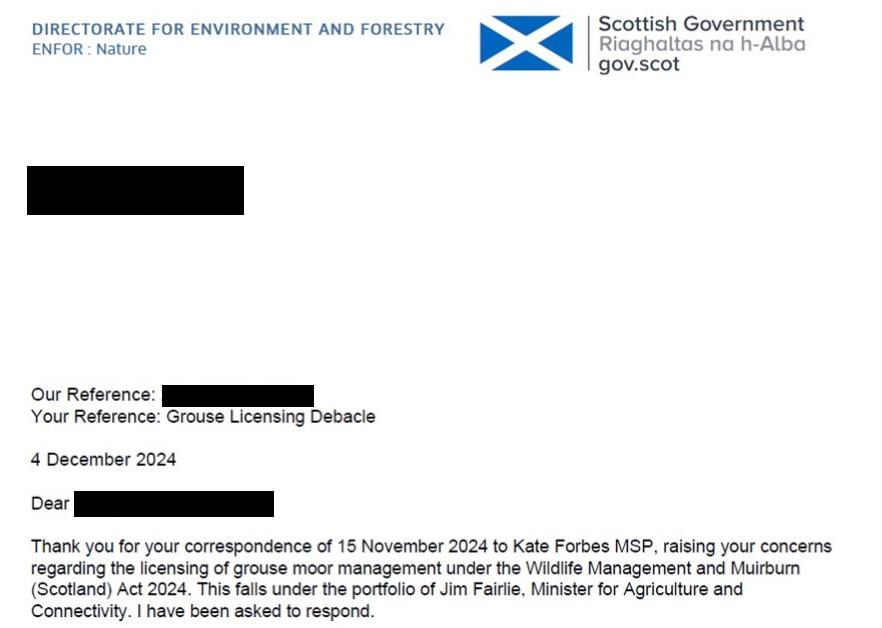
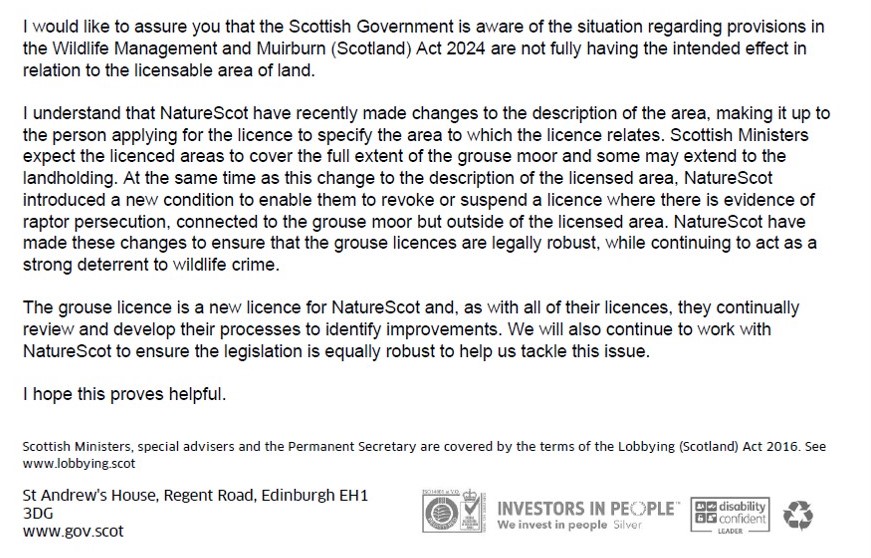
That blog reader has kindly given permission to publish the response received from the Scottish Government’s Wildlife Management Unit:
It’s good to see a formal, public response from the Scottish Government who, up until now, has kept quiet since the news broke about the shambolic new licence condition a few weeks ago.
In its response, the Government uses the same phrasing that NatureScot did in terms of having an ‘expectation’ that the new licensed area would cover the full extent of the grouse moor. As I mentioned previously when NatureScot expressed the same ‘expectation’, I don’t believe this has any legal weight whatsoever because what matters here is the wording of the legislation, not what NatureScot or the Government ‘expects’ to happen.
The Government’s response also doubles down on NatureScot’s claim that the new condition is ‘legally robust‘ and acts as ‘a strong deterrent to wildlife crime‘.
The new condition may well be legally robust (although we don’t know that for sure because NatureScot is yet to release the legal advice it received prior to making this change to the licence) but what it most certainly isn’t is ‘a strong deterrent to wildlife crime‘. It’s nothing of the sort, for all the reasons I discussed here.
What is good about this response though is that the Government understands that the licensing scheme is not having ‘the intended effect‘ of the Scottish Parliament when the legislation was passed in March. That’s a start.
There’s a lot happening behind the scenes to address the ‘vast loophole‘ that’s been left by NatureScot’s flawed attempt at plugging the chasm. I can’t say anything further at the moment but rest assured this issue is receiving close attention from a number of influential and knowledgeable people.
UPDATE 24 January 2025: NatureScot capitulated on grouse moor licensing after legal threats by game-shooting industry (here)
UPDATE 10 February 2025: Parliamentary questions lodged on grouse moor licensing shambles in Scotland (here)
UPDATE 3 November 2025: Breaking news – Scottish Government commits to closing loophole on sabotaged grouse moor licences (here)
The South Scotland Golden Eagle Project (SSGEP) has today announced the death of a young golden eagle after it collided with a wind turbine in Galloway in August this year.
The bird was a three-year old male called ‘Sparky’. He wasn’t one of the eagles translocated to south Scotland from the north by the SSGEP, but rather he fledged from one of the few remaining nests in south Scotland prior to the translocation project, but was carrying a satellite tag provided by that project, which helped in the swift recovery of his corpse.
Of course, Sparky’s death from collision with a turbine blade is a tragedy, but it’s important to view it from a broad perspective.
Golden eagle mortality from wind turbine collisions in Scotland is, thankfully, a rare occurrence. That’s not down to luck, or chance. It’s largely to do with detailed wind farm planning and choosing areas for turbines that are not located in habitats preferred by golden eagles.
A group of expert golden eagle ecologists, collaborating under an umbrella organisation called the Golden Eagle Satellite Tag Group (GESTG) has developed several models to predict significant areas of topographical use by golden eagles based on thousands of satellite tag records. The most recent model, called the GET (Golden Eagle Topographical) model, is now commonly used in Environmental Impact Assessments for judging the potential impact on golden eagles by proposed new wind farm sites across Scotland, and it works pretty well.
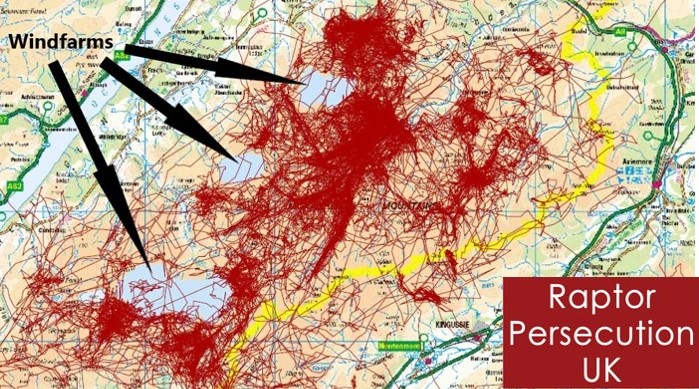
As an illustrative example, here is an image showing the movements of a satellite-tagged golden eagle that Chris Packham and I are tracking in the Monadhliath Mountains, on the western edge of the Cairngorms National Park. The red lines show the eagle’s movements around the footprint of three large windfarms and you can see that avoidance behaviour by the eagle is quite clear. (Thanks to Dr Alan Fielding for the data analysis and map).
This eagle’s avoidance strategy is not uncommon. Peer-reviewed scientific research papers by the GESTG have demonstrated that both young, dispersing non-territorial satellite-tagged golden eagles (here), as well as older territorial satellite-tagged eagles (here) will generally avoid wind farms if they have not been sited in prime golden eagle habitat.
I don’t know much about the Environmental Impact Assessment undertaken for the Windy Rig Wind Farm in Galloway where Sparky was killed but it’s probably worth noting that it was consented in 2017 (and became operational in 2022) at a time when there were very few golden eagles in south Scotland so perhaps golden eagle collision risk wasn’t assessed to be high.
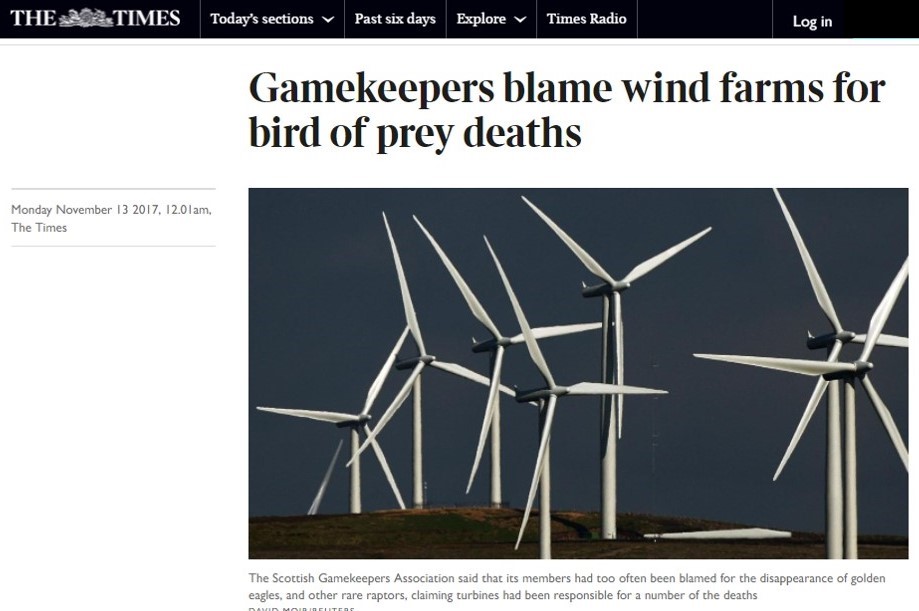
I fully expect the death of Sparky to be pounced upon by the raptor persecution deniers within the game-shooting industry, who will no doubt be jumping up and down, pointing fingers and announcing, ‘There! See? We told you that wind farms are killing golden eagles, it’s not us gamekeepers“, as they’ve been doing for years, for example this headline from 2017:
Alas, for them, the scientific evidence simply doesn’t support their claims (read the two linked papers above and also see Chapter 8 of the authoritative 2017 report by Drs Fielding & Whitfield: Analysis of the Fates of Satellite Tracked Golden Eagles in Scotland, where the authors examined whether any of the 41 tagged eagles that had ‘disappeared’ in suspicious circumstances were within the vicinity of a wind farm (spoiler alert – no, they weren’t, but illegal killing on a number of grouse moors was indicated).
Raptor collisions at wind farms has been a huge problem in some countries, notably in the USA at Altamont Pass in California where a long network of turbines was installed along the very ridgeline that migrating golden eagles use to take advantage of wind updrafts as they fly south. Anti-wind farm campaigners often point to these sites and assume that just because many golden eagles were killed at sites such as Altamont, it must mean that golden eagles are being killed at other wind farm sites. That’s simplistic nonsense, but some from the grouse-shooting industry have jumped on this to try and deflect attention away from the illegal shooting, trapping and poisoning of golden eagles that goes on in Scotland.
But it doesn’t wash anymore, and thank goodness the Scottish Government saw through the propaganda when it made the decision to introduce a grouse moor licensing scheme a couple of years ago.
That’s not to say that we should be unconcerned about golden eagles colliding with turbines – of course it needs to be monitored and the imminent construction of even more on-shore turbines needs to be carefully curated to ensure they’re built in the most appropriate locations, but thanks to ongoing satellite tag data analysis by experts in the GESTG, those potential impacts can be minimised.
It’s a landmark day in Scotland as the new snare ban commences.
A full ban on the use of snares was passed by the Scottish Parliament in March 2024 as part of the Wildlife Management & Muirburn (Scotland) Act (here) and the ban finally takes effect today, 25 November 2024.
This is a significant victory for animal welfare campaigners, especially the League Against Cruel Sports, OneKind and Scottish Badgers, but also many others, who have spent decades putting forward evidence that these devices, recently and cynically named ‘humane cable restraints’ by the game-shooting industry, are actually cruel, indiscriminate and inhumane and have no place in modern society.
Campaigners from OneKind & Scottish Badgers join MSPs to celebrate. Photo: OneKind
The game-shooting industry did its best to disrupt the commencement date. A consortium of the usual suspects (Scottish Land & Estates, Scottish Gamekeepers Association, Scottish Countryside Alliance, BASC Scotland, Scotland’s Regional Moorland Groups and the Scottish Association for Country Sports), joined this time by the National Farmers Union of Scotland, wrote an overly-dramatic letter in October to the Convenor of the Scottish Parliament’s Rural Affairs & Islands Committee to complain about the commencement of the ban.
They suggested that the principles behind the snare ban had ‘not been afforded the customary levels of parliamentary scrutiny’ (even though this subject has been a topic of political debate and public consultation for at least 15 years!), and they complained that Ministers hadn’t conducted a Business & Regulatory Impact Assessment (BRIA) prior to the commencement of the snare ban, and they strongly suggested that this should afford a delay to the commencement of the ban.
The Committee duly wrote to Agriculture Minister Jim Fairlie, who dismissed the concerns:
As of today, the use of snares in Scotland is unlawful. If you find one, take a photograph of it in situ, record the location and report it immediately to Police Scotland and/or the Scottish SPCA. Ask for a reference code so you can follow up on what action was taken, especially if it was found on a grouse-shooting estate (a set snare is a breach of the new licence).
You might decide you want to cut/destroy the unlawful snare. The law on this is murky and open to interpretation. If you are concerned that the snare will remain set/operational and the police/SSPCA can’t attend for some time, I’d suggest your best option (to protect wildlife and to protect yourself from potential legal action) is to advise the police/SSPCA what you intend to do and the reason for that decision, BEFORE you do it. NB: This is not formal legal advice – you are responsible for your own actions!
The controversy surrounding changes to Scotland’s new grouse moor licences continues (see here, here and here for background) and is now being picked up by mainstream media.
TheGuardian‘s Scotland editor, Sev Carrell, wrote about it yesterday and he included quotes from two wildlife charity directors who refer to the situation as a “shambles“.
Anne McCall, Director of RSPB Scotland, is quoted:
“We believe that these changes completely undermine the primary intention of this legislation to tackle raptor persecution and will only give comfort to those who intend to keep killing our birds of prey.
Leaders across the rest of the UK are looking to Scotland and this legislation to show them the art of the possible, with an example that they might soon follow. But the promise of a real deterrent to criminality on Scotland’s grouse moors has been allowed to descend into a shambles“.
Robbie Marsland, Director of the League Against Cruel Sports (Scotland & Northern Ireland) is quoted:
“Deliberately killing a protected bird of prey was a wildlife crime before the new legislation was enacted, and remains so, despite this shambles.
But any suggestion that ‘grouse moor management’ only applies to a small area around the shooting butts is clearly ludicrous. For example, when the league conducted an 18-month survey of six shooting estates we found traps and snares littered across the entire estates“.
An unnamed spokesperson for NatureScot says the revised licences “wererobust“. They’re clearly not!
The article also states that, ‘The Scottish government and NatureScot said they were considering amendments to the act, but refused to specify what would be done’.
Further to previous blogs about NatureScot’s utterly shambolic and unenforceable changes made to the grouse moor licensing scheme in Scotland following a legal threat from the grouse shooting industry (see here and here), this afternoon Scottish Greens MSP Mark Ruskell began the parliamentary process of challenging what he describes as the “vast loophole“.
Grouse shooting butts in Scotland. Photo by Ruth Tingay
Speaking during Portfolio Questions (Justice & Home Affairs) in the Chamber, Mark asked the following question:
“It’s becoming clear that the way land is defined though the Wildlife Management & Muirburn Act has severely compromised the most important legal deterrent to wildlife crime that we have.
So will the Cabinet Secretary discuss with other Cabinet colleagues with a view to bringing in an amendment to the Land Reform Bill to close the vast loophole that now exists?
The illegal persecution of birds of prey clearly must end“.
The Cabinet Secretary for Justice & Home Affairs, Angela Constance, responded:
“Presiding Officer, I will ask Ministers and the Cabinet Secretary responsible for issues in and around land reform to engage directly with the Minister“.
Bravo, Mark! Well done and thank you for picking this up so quickly.
If an amendment is feasible to close the “vast loophole” in the grouse moor licence then the Land Reform (Scotland) Bill seems the obvious vehicle. This Bill is currently at Stage 1 and that stage has to be completed by 28 March 2025. The lead committee scrutinising this Bill is the Net Zero, Energy & Transport Committee of which Mark is a member.
UPDATE 24 January 2025: NatureScot capitulated on grouse moor licensing after legal threats by game-shooting industry (here)
UPDATE 10 February 2025: Parliamentary questions lodged on grouse moor licensing shambles in Scotland (here)
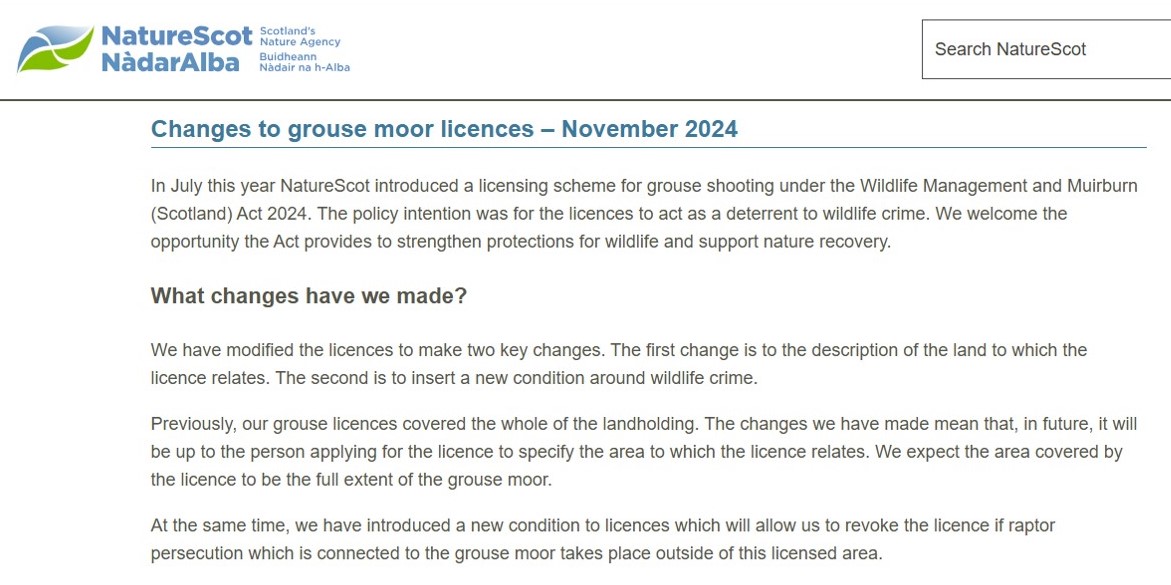
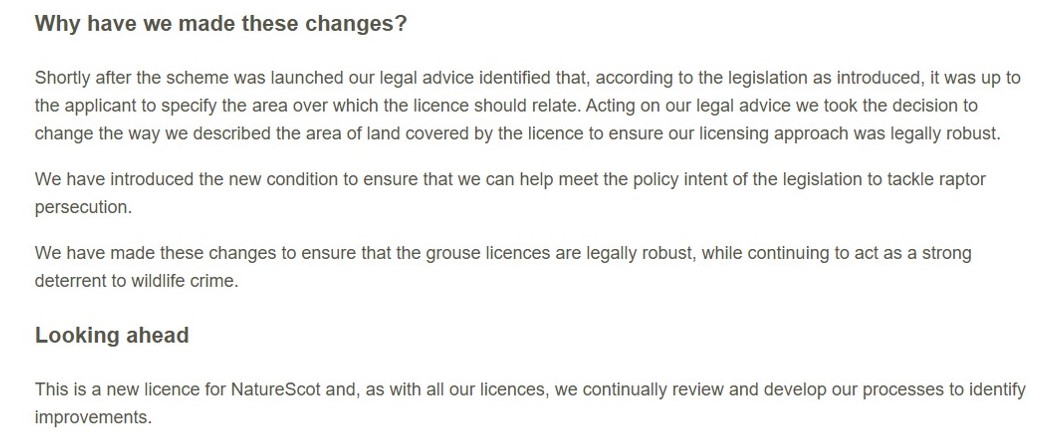
Further to my blog on Monday (here) outlining how Scotland’s grouse moor licensing scheme had already been sabotaged by the grouse shooting industry, today NatureScot has announced the commencement of its utterly shambolic and unenforceable changes made to the licence:
NatureScot is still stating, “We expect the area covered by the licence to be the full extent of the grouse moor“. This ‘expectation’ has no legal weight whatsoever.
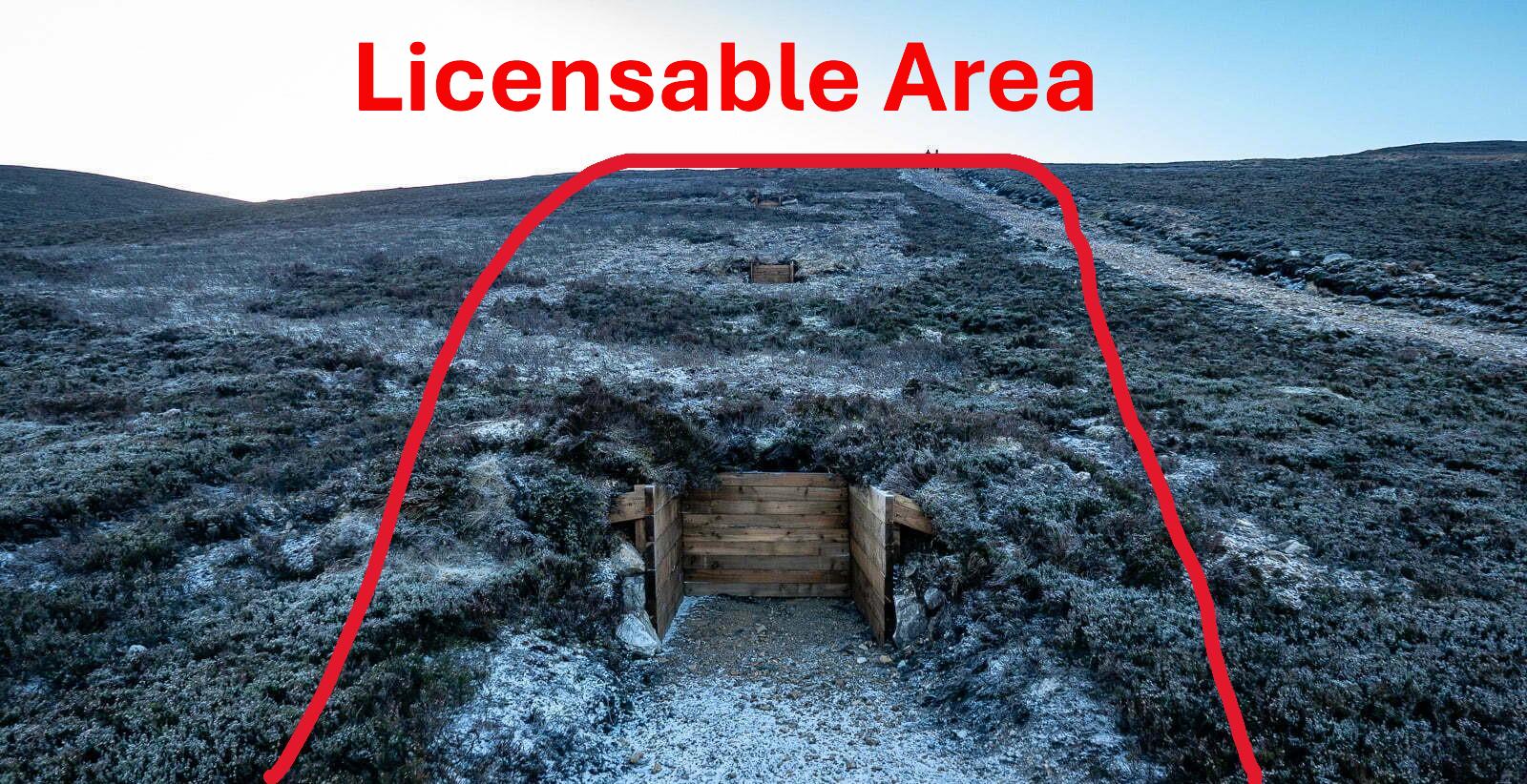
As I discussed previously, the grouse moor owners can simply draw an arbitrary line around their grouse butts, denoting the reach of a shotgun pellet, and argue that THAT is the area where they take/kill grouse and thus that should be the extent of the licensable area:
Grouse moor photo by Richard Cross. Annotation by RPUK
What this means in practice is that if any raptor persecution offences take place outside of that licensable area, the grouse moor/licence holder will not lose his licence because there won’t have been a breach of the new licensing condition.
NatureScot has tried to address this loophole by introducing a second change, which, according to NatureScot, “Will allow us to revoke the licence if raptor persecution which is connected to the grouse moor takes place outside of this licensed area“.
Actually, it won’t, because how on earth will the authorities demonstrate that the raptor persecution crime was “connected to the grouse moor“? On a mixed shooting estate (i.e. the estate hosts grouse, pheasant and red-legged partridge shoots), how will NatureScot determine whether a poisoned golden eagle, found on a different part of the estate away from the grouse moor, was killed in connection to the grouse moor as opposed to ‘in connection with’ the pheasant or red-legged partridge shoot? How will NatureScot determine who laid the poisoned bait?
All the licence holder has to prove in their defence is that they’ve taken “reasonable steps” to prevent raptor persecution on their estate (e.g. their employees all sign contracts swearing to uphold the law), the gamekeepers will all give ‘no comment’ police interviews, and it will be virtually impossible to identify the perpetrator. Any half-decent defence lawyer will shred any attempt made by NatureScot to revoke a licence based on such uncertainty.
It’s exactly the same situation we had before the licencing scheme became enacted, and, incidentally, is exactly WHY the licensing scheme was introduced, to get around these issues!
The other big shocker within these new changes is that all the other offences listed in the Wildlife Management & Muirburn Act that are supposed to trigger a licence revocation (i.e. offences on the Protection of Badgers Act 1992, Wild Mammals (Protection) Act 1996, Conservation (Natural Habitats etc) Regulations 1994, Animal Health & Welfare (Scotland) Act 2006, Hunting with Dogs (Scotland) Act 2023) are NOT covered by this second change to the licence. That second change ONLY applies to raptor persecution offences.
Honestly, these new changes are so, so poorly thought through, and so, so far away from the Scottish Parliament’s intention when passing the Bill, it’s astonishing.
Stand by for more news about this later today…
UPDATE 13 November 2024: Mark Ruskell MSP starts parliamentary process of challenging the “vast loophole” in new grouse moor licence (here)
UPDATE 24 January 2025: NatureScot capitulated on grouse moor licensing after legal threats by game-shooting industry (here)
UPDATE 10 February 2025: Parliamentary questions lodged on grouse moor licensing shambles in Scotland (here)
UPDATE 14 November 2025: Scottish Minister Jim Fairlie provides rationale behind proposed amendment to close loophole on grouse shoot licence (here)
The grouse moor licensing scheme in Scotland, brought in under the Wildlife Management & Muirburn (Scotland) Act 2024 in spring, has already been sabotaged by the grouse shooting industry.
This is breaking news that I presented at the REVIVE conference at Perth Concert Hall yesterday.
Some of the details of this sabotage are still a bit murky – it has all happened behind the scenes and it is proving difficult to get hold of the documents but it is apparent that the grouse shooting industry threatened a legal challenge against NatureScot’s interpretation of the new legislation, relating to the area of land that would be covered by the grouse shoot licence.
As a result of that threat, NatureScot appears to have caved in and has introduced modifications to the licence conditions which significantly narrow the intended purpose and reach of the original licence. However, scrutiny of those new conditions reveal they are utterly unenforceable.
These secret ‘negotiations’ between NatureScot and the grouse shooting industry appear to have been taking place over a number of months, without any consultation with other stakeholders and nor, it seems, with the police, who I understand have advised NatureScot of their concerns about their ability to enforce the new conditions.
I submitted an FoI to NatureScot a few weeks ago when I first became aware of these issues and I asked for the following documents:
A copy of the legal advice NatureScot received in relation to these changes.
A copy of all correspondence between NatureScot and Ministers in relation to these changes.
A copy of all external correspondence in relation to these changes.
A copy of all internal correspondence in relation to these changes.
The deadline for NatureScot’s response was last week. It came as no surprise whatsoever to receive an email from NS last week telling me they needed a further 20 working days to respond.
The lack of transparency around these changes is deeply concerning, especially given the efforts made by Government and its agencies to include the views of all stakeholders as the Wildlife Management & Muirburn Bill made its way through Parliament over the last year or so. These new modifications to the licence conditions look like a stitch-up that’s been concocted between the grouse shooting industry and NatureScot.
What it also shows, in my view, is the grouse shooting industry’s insincerity about tackling raptor persecution on grouse moors. The intent of the Scottish Parliament was clear when it passed the Wildlife Management & Muirburn (Scotland) Act and I have no doubt about its sincerity. What these new licence conditions do is undermine the will of Parliament and effectively negate the effectiveness of the grouse moor licensing scheme.
Work is now underway to address this in Parliament with the RSPB leading the charge. I expect we’ll hear a lot more about this over the coming days and weeks.
For those interested in the details of the licence changes and their implications (as far as I understand them at this stage), you can watch my presentation at yesterday’s REVIVE conference here (starts at 19.42 mins).
UPDATE 13 November 2024: NatureScot announces the commencement of its utterly shambolic & unenforceable changes to grouse moor licensing (here)
UPDATE 13 November 2024: Mark Ruskell MSP starts parliamentary process of challenging the “vast loophole” in new grouse moor licence (here)
UPDATE 15 November 2024: Scotland’s grouse moor licences “allowed to descend into a shambles” (here)
UPDATE 5 December 2024: Scottish Government ‘aware’ of issues with new grouse moor licences (here)
UPDATE 18 December 2024: NatureScot is stalling on releasing overdue FoI documents relating to its grouse moor licensing shambles (here)
UPDATE 24 January 2025: NatureScot capitulated on grouse moor licensing after legal threats by game-shooting industry (here)
UPDATE 10 February 2025: Parliamentary questions lodged on grouse moor licensing shambles in Scotland (here)
UPDATE 3 November 2025: Breaking news – Scottish Government commits to closing loophole on sabotaged grouse moor licences (here)
UPDATE 4 November 2025: Statement from RSPB Scotland Director on proposed amendment to close grouse moor licence loophole (here)
UPDATE 14 November 2025: Scottish Minister Jim Fairlie provides rationale behind proposed amendment to close loophole on grouse shoot licence (here)





 Raptor Persecution UK