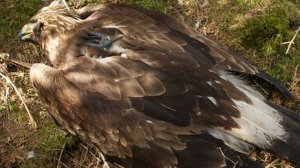
Ah Bert, sorry mate – try again next year?
Tag: scottish gamekeepers association
Fake video stokes anti-eagle rhetoric
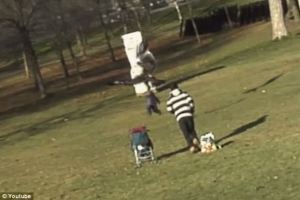
A YouTube video that purports to show a golden eagle attempting to carry off a small child in a semi-urban park in Montreal has gone viral on social media networks. Unfortunately, for the eagle-haters, the video is clearly a fake. It’s not even a golden eagle! Watch the video here.
Unsurprisingly, the Daily Mail pounced on the story, with the headline: “Kidnapper from the skies” and described the golden eagle as “the feathered beast, one of the world’s deadliest birds of prey” (see here). They later updated their story, perhaps realising it was all an elaborate hoax.
Bert Burnett of the Scottish Gamekeepers’ Association was also on hand to offer his customary insightful analysis. Here’s what he posted on the SGA’s Facebook page:
“I have no doubt that the usual idiots will brand this video as a fake but then again they probably don’t believe the holocaust took place either“.
No surprises there – last year the SGA wrote to the Scottish Government about the threat of reintroduced sea eagles eating children in Scotland (see here and here).
Another YouTube video of equal authenticity, showing a baby being carried to an eagle’s nest, can be watched here.
UPDATE ON THE HOAX VIDEO here
Lochindorb Estate hare snare trial: verdict expected today
The long-running hare snare trial is expected to end today if Sheriff Abercrombie has reached a verdict.
We’ve blogged a lot about this case as the verdict could have far-reaching consequences on the way our uplands are managed, with a particular impact on grouse moor management practices.
Earlier posts can be read here (and see links within).
Two weeks ago the court heard the final pieces of evidence from the defence team, which consisted of a string of gamekeepers insisting that the type of snare used in this case is ‘selective’ (i.e. it doesn’t trap any species other than the target species). It must be a magic snare.
Many thanks to the contributor who send us a copy of the Badenoch & Strathspey Herald, dated 22 November 2012, with a summary of the evidence heard in court:
Gamekeepers tell trial of ‘selective’ snares
THREE gamekeepers have given evidence at the trial of a colleague facing allegations of illegal snaring of mountain hares on Lochindorb Estate more than three years ago.
The keepers told Sheriff Ian Abercrombie they had used the type of snare set by David Taylor and caught nothing other than mountain hares.
Former Lochindorb keeper Alexander McConnachie (66), Stuart Kennedy (45), from Tomatin, and Alan Hodgson (54), head keeper at Dalmagarry and a committee member of the Scottish Gamekeepers’ Association with special responsibility for snaring issues, told the trial they had all used the “W” shaped snare, also known as a bow snare, as a means of controlling mountain hares on high ground on their estates.
David Taylor (65), who recently retired from his role as head keeper at Lochindorb, was charged with setting snares on April 14, 2009 on land at Lochan-t-Sidhie which were indiscriminate in which animals they could catch, contrary to the Conservation (Natural Habitats) Regulations which became law in 1994.
The trial, which started in March, reached its sixth day on Friday [16 Nov 2012] when the evidence was concluded.
Sheriff Abercrombie has agreed to written submissions being provided by both the Crown depute fiscal Iain Smith and the defence agent David McKie.
In evidence, Mr McConnachie said he was head keeper on Lochindorb between 1972 and 1993 before the new legislation came into place. He told the trial that where the snares were set, 1,500 feet above sea level, there were very few other species to be found.
Wildlife expert Hugo Straker (57), a senior adviser with the Game and Wildlife Conservation Trust and an expert on snaring law in Scotland, had earlier told the trial that the snares could be selective depending on how and where they were set. He also differentiated between a trap and a snare. In his opinion he said a trap was a spring-loaded device which can kill or trap an animal live while the snare was a “restraining device” which can kill.
Mr McConnachie told the court snares are never referred to as traps. ‘A trap is a mechanical device’, he said. Often they were concealed in a box to trap the targeted species and for the protection of other mammals. Wire cage traps, known as Larsen traps, were also used to control crows.
He said he used the “bow” snare used by Taylor extensively between 1990 and 1993 on Lochindorb because of the increase in tick of the moor.
Asked if he had ever found other animals caught in the snares he replied: “No, never. They are very selective, very humane and highly visible. I never caught anything else in them”.
He said you would get the occasional fox or roe dear [sic] at that level but it was quite rare to see a golden eagle.
Asked by depute fiscal lain Smith if an animal broke a snare how he would know it was a hare that did this. He said there was always evidence of hare fur nearby if a snare broke.
Mr Hodgson said the snares were perfectly legal at the time but gamekeepers had stopped using them because of this court case. He commented: “I would use them again in a minute. They were a brilliant tool. Easy to carry, easy to set and highly visible”.
Mr Hodgson said foxes and deer avoid them because they have forward vision. However, he said: “Hares have blind spots because their eyes are on the side of their heads, unlike predators”. He said he used them for nine years and never once found another species in them.
The trial was told by Mr Straker that since the alleged offence there had been major changes in law governing the use of snares going through parliament and all snares must have stops so mammals caught are not throttled and can be put down humanely. Everyone using them will require to be trained and certificated by a Scottish Government approved body and, from April next year, every snare will carry the operators certification number.
Police Constable Eric Sharkey (45), a wildlife officer with Northern Constabulary, inspected the site after a tip-off from a member of the public.

Scottish gamekeeper convicted of using banned poison
A 78-year old gamekeeper has been convicted of several wildlife crimes, including using the highly toxic banned pesticide Sodium Cyanide.
William (Bill) Scobie appeared at Dumfries Sheriff Court on Monday 29th October and admitted obstructing access to a badger sett at Jardine Hall Estate, near Lockerbie, as well as possession of the banned poison. Earlier media coverage indicated the placing of Cymag at the entrance of a badger sett. This stuff releases lethal cyanide gas on contact with moisture, which is why it’s been banned for several years.
This case has been running for a while; it was first reported by the BBC in July 2010 (see here) but we believe it was held up after the Cadder ruling (see here for an explanation) and it took some time before the case was given the go-ahead to proceed.
Scobie was fined a pathetic £270. The maximum fine for each offence is £5,000 and/or a six-month prison term.
It’s not known whether Scobie is a member of the Scottish Gamekeepers’ Association. If he is, then we’ll be expecting to see a strong signal of zero tolerance from them, including a public statement to confirm that his membership has been terminated. But don’t hold your breath, we’re still waiting for them to issue public statements of condemnation about other Scottish gamekeepers who’ve been convicted of wildlife crimes this year (e.g. see here, here). Oh, and perhaps something about that shot golden eagle found on a grouse moor (here) and the results of their own ‘inquiry’ into the dead golden eagle found in Aberdeenshire (see here).
Excellent work by the SSPCA once again. In their press release, the SSPCA also thank Dumfries & Galloway Police and Procurator Fiscal Pamela Rhodes (once again). She’s obviously very good at her job – wonder why she wasn’t offered that third specialist wildlife crime fiscal position…
SSPCA press release here
Update on ‘missing’ or dead satellite-tagged raptors: golden eagle, Grampian
Let’s start with the sat-tagged golden eagle that was found dead, with two broken legs, in a lay-by in Aboyne in May. This is the eagle whose death was not reported until four months after it was found dead (see here). The evidence suggests this bird was caught in a trap on a grouse moor near to Brechin, Angus and was moved, while still alive, in the middle of the night and dumped in a lay-by in Aberdeenshire and left to die.
This incident prompted widespread outrage and the new Environment Minister, Paul Wheelhouse MSP, was apparently inundated with letters of complaint. Most people who wrote have now received a response, probably all similar to this one (see here). The Minister’s response provoked almost as much fury as the actual death of this eagle, and particularly the second paragraph:
“I agree that the media reports were a terrible story of the suffering of a young golden eagle. The reports may suggest that the circumstances of this incident were suggestive of an offence however there is no hard evidence and it remains possible that there is an alternative explanation. It is therefore inappropriate for me to comment”.
We have since received unverified information (but from several independent sources) that the police have accepted the veterinary evidence that showed this eagle was indeed caught in a trap. We also understand that this veterinary evidence has been passed to the SGA and that apparently they are not disputing the findings (although they have yet to make a public statement – we wait with interest to hear about the findings of their own ‘inquiry’ (see here).
Why then did the Environment Minister’s response suggest that this eagle’s death was not neccessarily linked to a criminal offence? What possible “alternative explanation” is there to account for the death of this eagle? We’d like to hear it, and we’d also like to see details of the veterinary report. If these details can be released to the SGA then they should be released into the public domain for everyone to see. Send your email request to: ministerforenvironment@scotland.gsi.gov.uk
Where’s the promised gov consultation on increasing SSPCA powers?
In light of recent events, showing continued evidence that some Scottish police forces are incapable of taking wildlife crime seriously, even though raptor persecution has been identified as a ‘national wildlife crime priority’, the time is right to once again call for additional investigative powers to be given to the SSPCA.
You may remember we’ve blogged about this before (see here and here for detailed background information), after the former Environment Minister, Stewart Stevenson MSP promised a consultation “in the first half of 2012” to consider this option and ask for the views of the various stakeholder groups. Although we already know that the SGA doesn’t support it (see here). It’s now the second half of 2012, so where is this consultation?
Perhaps we should give the new Environment Minister a nudge in the right direction, or at least ask him when we can expect this consultation to open. Email Paul Wheelhouse MSP directly at: ministerforenvironment@scotland.gsi.gov.uk
Scottish wildcat: going, going….
Scottish wildcats will be extinct in the wild within months, according to a new report (see here and here). Disease and inter-breeding with domestic and feral cats are considered to be main threats, although illegal persecution on sporting estates and farms is also considered to be a problem, according to the Scottish Wildcat Association (here). One academic believes the blame for the demise of the Scottish wildcat ‘can be placed firmly at the door’ of Scottish shooting estates who set thousands of indiscriminate snares every year (see here).
Surprisingly, the Scottish wildcat is not on the SGA’s ‘vermin’ list (i.e. animals that they think should be culled to protect their game stock). Indeed, the SGA was a partner in the Cairngorms Wildcat Project, helping to develop protocols for so-called wildcat-friendly predator control. These protocols included issuing wildcat ID cards to keepers, encouraging them not to shoot on sight if there was any doubt about the species’ identification, and the use of live traps instead of night-time shooting to reduce the risk of a wildcat being shot accidentally (see here for the Cairngorms Wildcat Project Final Report 2012).
However, with the latest estimate of 35 individual wildcats remaining in the wild, is it all a bit too late? The Scottish Wildcat Association are urging ‘bold action’ from SNH and the Scottish Government. Let’s hope they respond accordingly.
Red kites accused of ‘annihilating’ other birds
The Scottish Gamekeepers’ Association is calling for a government probe to investigate the impact of reintroduced red kites in Galloway, following claims that the kites are ‘annihilating’ other birds, including lapwings, oystercatchers and sand martins.
Unsurprisingly, the claims have been made by a farmer, a pigeon racer and a gamekeeper.
Alex Hogg said: “I think everyone would agree that protection of one species, when it is to the detriment of others, is a flawed way to achieve ecological balance“. Er, what, like the protection of 40 million exotic pheasants and unnaturally-high populations of red grouse to the detriment of buzzards, kites, harriers, sparrowhawks, goshawks, eagles, peregrines, owls, corvids, foxes, stoats, weasels? How about a government probe into that?
Hopefully the SGA’s request will be met with the same contempt the Scottish Government gave to their earlier request to evaluate the risk to small children posed by reintroduced sea eagles.
SGA’s article on the red kite ‘problem’ here.
Not counting properly, and accountability
On the subject of counting, in his latest blog the ever-sharp Alan Tilmouth examines Alex Hogg’s apparent inability to count (see here). This is well worth a read if you’re interested in understanding what ‘evidence’ the game-shooting industry uses to support its claims that raptors (especially buzzards) are decimating pheasant poults.
On the subject of accountability, George Monbiot has written a response to Magnus Linklater’s latest attack on the RSPB. This is also well worth a read, especially as Monbiot confirms Linklater’s association with game-shooting and uses it to suggest that journalists should be made to declare their interests so that readers can judge the independence of the journalist’s opinions. Monbiot’s article here.
Predictable shite as grouse season approaches
Yes, it’s that time of year again. The opening of the grouse-shooting season is upon us (although this year it’ll start on August 13th as the traditional opening day of the 12th falls on a Sunday) and the usual suspects are out in force to tell us all how great grouse moors are and how we should all be grateful for the conservation and economic benefits they provide. Not forgetting the predictable swipe at the RSPB along the way.
Shooting Times has an article suggesting that it’s time to sever ties with the RSPB due to their ‘bullying’ ways (see here). The best line has to be this: “For too long we have acted as gentlemen, only for our big-heartedness to be thrown back in our faces“. That’s priceless! Have a look here at an earlier blog we wrote about how the RSPB has been treated by these ‘gentlemen’!
An STV news article (here) has SGA Chairman Alex Hogg telling us how grouse shooting can save the world…or at least the rural economy, calling it a “modern industry” (ahem) and laughably explaining how “People admire Scotland’s diversity of landscape, its well-managed moorlands teeming with wildlife being a huge part of that attraction“!!!
An alternative view of grouse moor management can be found in The Guardian blog (here), where a national campaign against moorland bog-burning is due to be launched with a protest walk over the now infamous Walshaw Grouse Moor this Sunday.