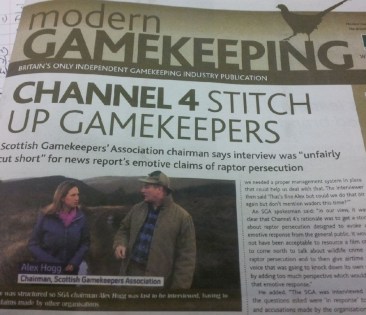
Gamekeepers aren’t persecuting raptors, says SGA’s Chairman

Channel-FourHere’s a preview to tonight’s story on Channel 4 News….watch the video of SGA Chairman Alex Hogg responding to the reporter’s question about whether gamekeepers are poisoning, shooting and trapping birds of prey:

No they aren’t. We would dispute that“.

He can dispute it all he likes – the growing list of convicted gamekeepers tells a different story, and there are currently six on-going court cases to boot, including allegations of illegal trapping, poisoning, shooting and battering.

C4 News article and accompanying 3 video clips available here, including a preview of an interview with RSPB Scotland’s Head of Investigations, Ian Thomson.

Watch Channel 4 News this evening at 7pm for full story.

UPDATE 23.55hrs: Read our comments on the full report here

Environment Minister faces more calls for grouse shoot licences

SRSGWell now this is interesting.

The Scottish Raptor Study Group (SRSG) has called for the Scottish Government to introduce grouse-shooting licences. Many of us have been asking for this action for some time, but to hear it from the SRSG is quite something.

The SRSG, which has been monitoring raptor populations in Scotland since the 1980s, is typically quite a restrained yet highly respected organisation, preferring to work quietly behind the scenes rather than make bold policy statements. You know that things are pretty dire when the SRSG is calling for grouse shooting licencing.

So what’s forced their hand? Well, if you read their letter to the Environment Minister (see here, scroll down to 18th January), it seems that the illegal poisoning of golden eagle Fearnan was the catalyst, as it has been for so many of us. But there’s more to it than that…

Take a closer look at their letter. They refer to a claim made by the Scottish Gamekeepers Association last July that gamekeepers are good for golden eagle conservation. We blogged about that claim here, and you really should read it to understand the context of what the SRSG is saying.

The SGA published a map that attempted to portray the notion that golden eagles were doing ok on keepered grouse moors in the East and Central Highlands (notorious raptor black spots). What the SRSG has done is provide some much-needed context to that map.

According to the SGA, there are ‘at least 55 active golden eagle nests’ in these ‘keepered grouse areas’; the SRSG is saying that there are 52 ‘active nests’ in the area, and of those 52, only 8 are on driven grouse moors. Crucially, the SRSG also includes information about the vacant golden eagle territories in the area – information that the SGA conveniently ‘forgot’ to include. According to the SRSG, there are an additional 57 ‘non-active’ golden eagle nests in this area, and 31 of them (54%) happen to be on driven grouse moors.

Hmm. The picture doesn’t look quite so rosy now, does it?

What also impressed us about the SRSG’s letter is their well-thought-out approach to licensing. They haven’t taken the usual route of calling for a blanket ‘estate-licensing’ system. Instead, they’ve proposed a system whereby the licensing would cover individuals as well as land-holdings (estates), thus side-stepping the predictable ploys that would probably be used by the grouse-shooting industry to avoid being licensed.

The BBC has covered this news story today (see here), and it looks like the RSPB has also called on the government to consider further sanctions.

The pressure is mounting.

Naturally, the SGA and Scottish Land & Estates (SLE) have responded against the proposed licensing sanctions (read the BBC article). Predictably, SLE claim that raptor persecution is in ‘significant decline’ – they are, of course, referring to 2012 figures which did show a drop in reported poisoning figures – and conveniently ignored the 2013 figures which show a 100% increase in poisoning. To be fair, the 2013 ‘official’ figures have not yet been released, but they know fine well what they show and they seem determined to ignore them for as long as possible (i.e. until they’re actually published, which will take place at some point this year).

The SGA meanwhile, suggest that there is ‘perpetual over-regulation’ (of estates) – the truth is somewhat different – game-shooting is probably one of the least regulated industries and what regulation is in place is rarely enforced.

Environment Minister Paul Wheelhouse has responded to the SRSG’s letter and while he hasn’t ruled out licensing, he still seems to be clinging on to previous measures and wanting to give them time to take effect.

We’ll be blogging next week about Mr Wheelhouse’s response to the SRSG’s letter and his response to all those emails he received over Xmas about the death of golden eagle Fearnan. It won’t make for comfortable reading.

Latest measure to tackle raptor persecution now in place

Last July, following a series of raptor persecution incidents, Environment Minister Paul Wheelhouse announced his intention to introduce ‘further measures’ to tackle the ongoing problem (see here).

One of those measures has recently come in to force (as of 1st Jan 2014).

That measure is an enabling paragraph in some of the 2014 General Licences that says this:

SNH reserves the right to exclude the use of this General Licence by certain persons and/or on certain areas of land where we have reason to believe that wild birds have been taken or killed by such persons and/or on such land other than in accordance with this General Licence.

First of all, we applaud Paul Wheelhouse’s intentions, at least, and his determination to make sure this measure has been enacted. Good for him. However, as we blogged at the time, we really don’t see how this latest measure can be enforced (see here for our reasons).

For once, it seems that many of the game-shooting organisations are in agreement with us. Before SNH issued the 2014 General Licences, they had their usual consultation period and asked for comments about this new enabling paragraph, amongst other things (see here). They have just published those consultation responses and all the respondents from within the game-shooting lobby raised many of the same concerns as us.

So, even though this new measure is now in place, it is highly unlikely that it will ever be effectively deployed….a bit like the legislation relating to vicarious liability. We might be wrong, of course, but only time will tell.

In general terms, the 2014 General Licences are not much better than the 2013 General Licences in that many of the previous concerns raised (going back several years!) have still not been addressed. We’ve blogged about this a lot (e.g. see here, here, here, here, herehere, here, here, here, here) and don’t intend to go over all the points again….not just yet, anyway. We understand that SNH is intending to organise further research in 2014 to address many of the concerns, although they said that when they issued the 2013 General Licences and yet here we are, another year gone by and we’re still waiting for that research.

While we wait, it’s worth you having a look at the responses to the 2014 General Licence consultation – especially the response from the Scottish Gamekeepers’ Association, who once again are asking for ‘quota systems’ for buzzards, ravens, pine martens and badgers.

Download the PDF here: Consultation responses to General Licences 2014

Naturally, we’ll be watching with interest to see whether SNH has cause to withdraw the use of the General Licences, on the basis that they have ‘reason to believe’ that wild birds have been illegally taken or killed. The enabling paragraph probably cannot be used retrospectively so we’ll just have to wait until we see the next incident of criminal activity, which probably won’t be too far off, and then we’ll see what happens.


Gamekeepers put under pressure to use poison, claims retired Angus keeper

A retired gamekeeper whose 50-year career included working on Angus sporting estates has claimed that gamekeepers are being put under pressure to use illegal poison to protect grouse stocks, according to an article in today’s Courier (see here).

Colin Gair, 66, says the situation in Angus has deteriorated in the past two years and he is encouraging other gamekeepers to speak out if they are being asked to use poison.

His comments come after the discovery of ‘Fearnan’, the golden eagle found poisoned on a grouse moor in the Angus Glens in December. Fearnan is the latest victim in a long line of alleged poisoning incidents in the area (see here).

Mr Gair deserves a great deal of credit for his willingness to speak out on a subject that is usually vehemently denied by all connected with the game-shooting industry, despite the overwhelming evidence to the contrary, and we applaud his courage.

It’ll be interesting to see whether there’s any response to his claims from certain game- shooting industry organisations that are usually at the forefront of the denials.

UPDATE 10th January 2014: see here

Gamekeeping orgs’ half-witted attempts to blur the truth

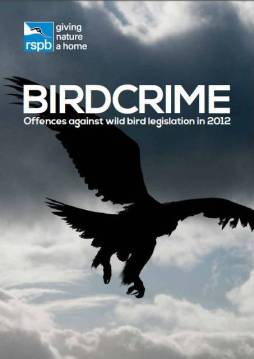
Birdcrime 2012Earlier this month the RSPB published two reports: one detailing raptor persecution crimes in Scotland during 2012 (see here) and one detailing raptor persecution crimes throughout the UK in 2012 (see here).

You’d think that the RSPB’s so-called ‘partners’ in the Partnership for Action Against Wildlife Crime (PAW) would welcome the reports, highlighting as they do the continued criminal persecution of birds of prey. That’s what PAW partners are all about, right? Raising public awareness and finding ways of cracking down on wildlife crime?

Apparently not.

Here is the response of the National Gamekeepers’ Organisation to the RSPB’s UK-wide report. In case they decide to remove it from their website, we’ve reproduced it here:

NGO Comments on the RSPB 2013 Birdcrime Report

Saturday 14th Dec 2013

The National Gamekeepers’ Organisation has issued the following comment on publication of the latest edition of the RSPB Birdcrime Report.

A spokesman for the National Gamekeepers’ Organisation said: “The NGO stands for keepering within the law and automatically condemns illegal activity. That is why the NGO is proud to be a member of PAW – the Partnership for Action Against Wildlife Crime. Furthermore, science has proven gamekeepers to be some of the most effective conservationists working in the British countryside today.

Intriguingly the RSPB’s shrill comments on persecution appear to lack the context that is essential for the public to form its own considered opinion. What the RSPB fails to mention in its news release is that the UK’s bird of prey population, taken as a whole, is thriving, with almost all species at record high levels. 

This seems a curious oversight for a charity required by law to educate the public in a balanced manner. This very important omission is intriguing, given the RSPB’s usually conscientious approach to its work. I believe it is fair to ask whether it’s perhaps to encourage charitable donations to the RSPB in the run-up to Christmas, a time of year when people are quick to put their hands in their wallets?

To view the RSPB 2013 Birdcrime Report News Release visit http://www.rspb.org.uk/media/releases/359085-sixty-years-of-protection-but-the-killing-continues

Good god, where do we start? With the bit about gamekeepers being ‘some of the most effective conservationists working in the British countryside today’?!! Or the bit about how we, the general public, are unable to form our own ‘considered opinion’ because the report apparently ‘lacks context’?!!

How about the statement: “What the RSPB fails to mention in its news release is that the UK’s bird of prey population, taken as a whole, is thriving, with almost all species at record high levels“.

The reason the RSPB ‘failed to mention’ this is probably because it’s a big fat massive distortion of the truth! ‘Almost all species at record high levels‘? That would be ‘almost all species’ apart from golden eagle, white-tailed eagle, hen harrier, red kite, goshawk, peregrine; all of which are being held at unnaturally low population levels thanks to illegal persecution, according to countless scientific studies.

And what on earth does ‘taking the UK’s bird of prey population as a whole‘ mean? Where’s the scientific validity of that? It’s absolutely meaningless pseudo-scientific rubbish! It’s like saying there’s no need to be concerned about the near-extinction of rhinos or elephants in Africa because big mammals ‘as a whole’ are doing ok.

sam4Not to be outdone in the idiot stakes, the NGO’s Scottish colleagues at the Scottish Gamekeepers’ Association have published their own statement in response to the RSPB’s Scotland Persecution report.  We’ve reproduced it here:
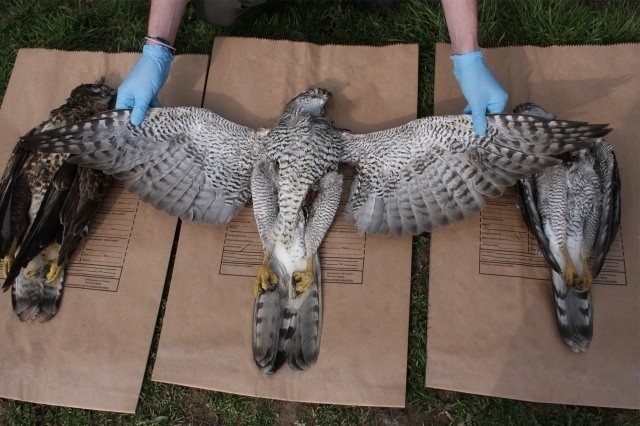
SGA STATEMENT: RSPB BIRD OF PREY REPORT

Following the release of an unofficial report by the RSPB today on the Illegal Killing of Birds of Prey in 2012, the SGA issued the following response. An SGA Spokesman said: “The RSPB has clearly spent a lot of money in writing this report, which entitles them to put forward their own viewpoint. “With this agenda in mind, it is important, that the public refer to the actual crimes, as published annually by the Scottish Government with information provided officially by the Police and SASA, rather than speculative possible or suspected cases, which are clearly going to confuse the public. “All PAW partners, including ourselves, are fully behind the printing of the official statistics annually, based on actual legal cases, and see no reason why this should change. “While we have been encouraged by the progress made, with the official statistics stating a record of only 3 confirmed cases of illegal poisoning of birds of prey in 2012, reports such as this do little other than damage to on-going partnership efforts designed to reduce crimes against birds of prey. “As stated consistently, the SGA continues to advocate legal means to solving countryside conflicts. Because of this, the clarity and impartiality provided by law is important to us.”

Again, not what you might expect from a PAW ‘partner’. According to the SGA, the public are ‘clearly going to be confused’ by the report’s contents. Really? Is anybody ‘confused’? We’re not – the report presents the facts in the most clear way possible – the illegal persecution of raptors continues to take place on game-shooting estates up and down the country. Our raptors are still being poisoned, trapped, shot, and bludgeoned to death on sporting estates and the majority of the criminals are still avoiding prosecution: we call them The Untouchables.

It’s also interesting to see the SGA continue to peddle the myth that poisoning is in decline. According to our 2013 figures, poisoning in Scotland has actually increased by 66% in this, the Year of Natural Scotland, and that’s not including the discovery of poisoned baits…if we included every single poisoned bait found this year (as each one had the potential to kill at least one raptor had the baits not been discovered and removed), then the figure would jump to a phenomenal 1,333% increase in poisoning!!!

The SGA claims that the RSPB’s report does ‘little other than damage the on-going partnership efforts designed to reduce crimes against birds of prey’. We would argue that the SGA’s continued involvement in the PAW Scotland raptor group, and the NGO’s continued involvement in the English PAW group, does little other than taint the credibility of the PAW concept. In fact it doesn’t just taint it – it soaks it in implausibility. The sooner the other PAW partners realise this and vote these gamekeeping organisations off the panel, the better. PAW is not going to achieve anything as long as some of the ‘partners’ continue to deny and distort the facts. Oh, and harbour convicted wildlife criminals.

SGA Chairman’s ignorance could fuel goshawk persecution

The Scottish Gamekeepers’ Association has recently published its autumn magazine. It’s full of quite remarkable material, as you might expect. We’ll be blogging about some of the articles in due course but thought we’d start with the ‘Chairman’s Column’, written by Alex Hogg.

He writes about a few issues but of particular concern to us is what he wrote about goshawks. Here’s an excerpt:

My local newspaper has just published an article on ringing chicks at a goshawk nest on forestry commission ground. In the article, gamekeepers are criticised for persecuting goshawks, without any attempts at providing proof, journalistic balance or an attempt to look at the history of the goshawk in Scotland. For the past 35 years I have lived with goshawks on my doorstep. I strongly believe the goshawk never was indigenous to the United Kingdom and there is absolutely no hard evidence to suggest otherwise. Those that illegally released this species into the British Isles could legitimately be charged, therefore, with a wildlife crime. These nests in the article are in commercial forestry where there is nothing whatsoever for the poor chicks to eat. What happens then? The young make their way out onto keepered ground, managed at significant cost and time to create a richness in biodiversity. Our local red squirrel population is now under severe threat and much of this can be put down to predation by the goshawk. Most raptors will eat what they kill. The goshawk will kill over and over again. The largest number of pheasant poults I lost on a stubble in one strike was 35. God knows what this could mean for our poor Curlews and Lapwings, teetering on the brink. Balance must surely be considered before we lose more precious species“.

Hogg’s display of ignorance about this species is quite staggering. The history of the goshawk in the British Isles, including its indigenous status, has been very well documented in many scientific papers and books, as have the effects of the relentless persecution it has suffered and continues to suffer, as well as its varied diet which changes according to latitude and habitat (he should try reading this and the references listed as a basic introduction).

Such is the concern about ongoing goshawk persecution that the species is listed by the National Wildlife Crime Unit as one of the ‘priority species’ to focus on, along with golden eagle, hen harrier, peregrine, red kite and white-tailed eagle. Every single one of these species is suffering population-level effects thanks to the illegal persecution carried out by those with game-shooting interests. As a participating member of PAW Scotland and PAW Scotland’s Raptor Persecution Group, Hogg should be very well aware of the pressures already facing this species.

For somebody in his position to be writing such unsubstantiated nonsense about an already significantly-threatened raptor is completely unacceptable. There will be some readers of the SGA magazine who will assume that Hogg’s information is reliable and credible and could use it as justification to persecute the goshawk.

Hogg should be hauled over the coals by the PAW Scotland group for such ignorance and irresponsibility.

We’ll be returning to the issue of goshawk persecution by gamekeepers in the very near future…..watch this space.

Gos1


“Raptors are thriving on gamekeepered ground”, claims the SGA

There were some interesting sights at the 2013 Scottish Game Fair in early July, including this poster on the Scottish Gamekeepers’ Association stand, entitled “Record Numbers of Raptor!!”[sic].

SGA Gamefair 005a

Any casual visitors to the SGA stand could be forgiven for thinking that raptors are doing just fine and there’s no cause for concern; that’s the message the SGA clearly wanted to portray. But let’s just look a bit more closely at their ‘information’, shall we?

You might think, given that this was the Scottish Gamekeepers’ Association at the Scottish Game Fair, their raptor figures would just relate to raptors in Scotland. You’d be wrong. Rather disingenuously, they used data relating to raptor figures in the UK as a whole, not just Scottish data, thereby potentially misleading the public to believe that Scotland holds a significantly higher number of breeding raptors than it actually does.

For example, the SGA claims there are 760 pairs of red kites producing 1400+ young per year. Actually, the number of breeding pairs monitored in Scotland in 2012 was 214, with 314 fledged. This is thought to be ‘close to an accurate population estimate’ according to the Scottish Raptor Study Group.

Another example: the SGA claims there are 600 pairs of goshawks producing 1200+ young per year. Actually, the number of breeding pairs in Scotland is more like 150, with an estimated 200 occupied territories in total.

And another example: the SGA claims there are 1600 pairs of peregrines producing 3000+ young per year. Actually, the last national survey of peregrines in Scotland showed 542 breeding pairs, an 8% decline from the previous national survey.

And here’s yet another example: the SGA claims there are 690 pairs of hen harriers producing 1300+ young per year. Actually, the last national survey of hen harriers in Scotland showed 505 pairs, a 20% decline from the previous national survey.

In fact, the data they’ve provided for every species on this list, with the exception of the golden eagle, are a gross exaggeration of the respective Scottish populations of these birds. Did they choose these figures to deliberately mislead the public? Surely not.

In addition to using potentially misleading population figures, the SGA also chose to use data from 2002-2004. That’s a bit odd given that far more up to date data for many species (i.e. from as recently as 2011) are freely available in the public domain (see here). Now, what possible reason could they have for ignoring the more recent facts and figures? Surely nothing to do with the fact that these more recent data directly contradict the following SGA statement:

That whilst most bird species are in decline raptors are at an all time high, since records began”.

Conveniently, this statement fails to mention the 20% decline in the Scottish hen harrier population, and the 8% decline in the Scottish peregrine population, not to mention the severely constrained Scottish populations of red kites, golden eagles and goshawks, all linked to the effects of illegal persecution taking place on gamekeepered land across Scotland. Funny that, isn’t it?

Even funnier is this photo (below), also pictured at the SGA stand. According to this, ‘Raptors are thriving on gamekeepered ground’. Conveniently (again), the list of raptor species they chose to illustrate this lie statement does not include hen harriers, peregrines, red kites, golden eagles or goshawks. Their statement is right up there with another SGA classic: “Professional gamekeepers do not poison raptors” (see here).

SGA Gamefair 006a


Scottish Raptor Study Group ‘intrigued’ by SGA’s eagle nests claim

scotsman_logo_200There’s an interesting letter in The Scotsman today (see here) from the Scottish Raptor Study Group (SRSG). It’s been written in response to the SGA’s claim, last week, that there are ‘at least 55 active golden eagle nests’ on grouse moors in eastern and central Scotland (see here).

Patrick Stirling-Aird of the SRSG writes:

The Scottish Raptor Study Groups (SRSGs) agree with the Scottish Gamekeepers Association chairman Alex Hogg that land management of the right sort can contribute to golden eagle conservation (your report, 6 July).

SRSGs are intrigued by Mr Hogg’s remark that his members in the keepered grouse areas of east and central Scotland have identified at least 55 active eagle nests still in place since 2003. SRSGs will be interested in a comparison of this figure with their own detailed survey records, assessing golden eagle territory occupation and breeding attempts (successful or otherwise) in these areas throughout the ten seasons 2004 to 2013. The comparison will focus particularly on ground still being managed as commercial grouse moor. This should establish whether or not there is a discrepancy (and if there is, the extent of this discrepancy) between SRSGs’ own comprehensively gathered data and Mr Hogg’s figure of 55 active eagle nests.

Historical context is the marked decrease in territory occupation in the areas concerned (revealed by the 2003 census) from the substantially higher levels of occupation recorded in the previous golden eagle national survey years of 1992 and 1982″.

We look forward to seeing the results of this comparison.

Gamekeepers and golden eagles: the facts

The Scottish Gamekeepers’ Association issued a press release this morning about how great gamekeepers are for golden eagle conservation.

They produced the following map in an attempt to suggest that golden eagles are doing well on grouse moors in central and eastern Scotland:

SGA eagle bollocks

They claim that there are at least 55 active golden eagle nests in the keepered grouse areas of East and Central Scotland, based on the results of a ‘survey’ they did, presumably of gamekeepers.

To the uninformed, this map suggests that golden eagles are breeding at a relatively high density on grouse moors in this region. But don’t be fooled! What this map doesn’t show, because of the ridiculous scale at which it has been produced, is the number of vacant golden eagle territories on grouse moors in East and Central Scotland. (It also ignores the grouse moors of Southern Scotland, probably because breeding golden eagles in that area are virtually non-existent, with just a couple of exceptions, but let’s just brush over that shall we?).

There is no disputing that golden eagles do breed successfully on some Scottish grouse moors. That is a fact. There are a number of enlightened land owners who welcome golden eagles on their grouse moors and do an excellent job in providing them with a home and a good supply of food. We’ve blogged about a few of them before and we applaud their efforts. The problem is, there aren’t enough of them. That is also a fact. The best way to demonstrate this is to look at the level of occupancy of golden eagle territories in different parts of Scotland. The following data are from the 2008 Golden Eagle Conservation Framework – a government-funded comprehensive scientific review of golden eagle ecology and conservation in Scotland:

Golden Eagle Territory Occupancy:

Western Isles = 91%

Western Highlands = 89.5%

Argyll West & Islands = 81.5%

Central Highlands = 48%

Cairngorms Massif = 42.4%

North East Glens = 17.6%

That’s pretty stark. Golden eagles in areas of western Scotland (with little if any grouse shooting interests) occupied over 80% of the available territories; golden eagles in the central and eastern Highlands (grouse moor hell) had an occupancy rate of below 50%, and in one region (North East Glens) it was a shocking 17.6%. Why is it that all those available golden eagle territories in the East and Central uplands are vacant? What’s stopping them from breeding there? Hmmm, whatever could it be?

The SGA press release also talks about the ‘stability’ of the golden eagle population over the last 20 years, presumably to make you think that golden eagles are doing ok so what’s all the fuss about? What they fail to say is that that ‘stability’ of approx 430 pairs masks some very big differences in regional abundance. For example, there has been a substantial increase of golden eagles in the Western Isles over the last ~20 years, largely thanks to a reduction in illegal persecution in that region. In contrast, there has been a significant decrease in the number of golden eagles in the central, eastern and southern uplands (hence all those vacant territories), thanks largely to illegal persecution on driven grouse moors. That is a fact, backed up by a suite of scientific peer-reviewed studies. That’s why the population appears to be ‘stable’ – because all the losses in the east are being counterbalanced by the gains in the west.

What the SGA also fail to mention is that the ‘stable’ population of ~430 pairs is nowhere near what the population could be. It’s been estimated that there is enough habitat for at least 700 golden eagle territories in Scotland – the population of ~430 pairs is being suppressed at an unnaturally low level and failing to expand into some areas of its former range. Why? Illegal persecution. Read the Conservation Framework (below) if you want to examine the details. The facts are all there.

Here is a map from the Framework report, showing the conservation status of golden eagles in 2003. Green areas = region in favourable conservation status; Amber areas = region in unfavourable conservation status but failed in only 1 test (i.e. a marginal failure); Red areas = region in unfavourable conservation status, with failure in more than one test. It’s pretty bloody obvious in which areas golden eagles are in trouble – yep, that’s right, areas managed for driven grouse shooting. Another fact.

GE conservation status 2003

There was another element to the SGA’s press statement this morning. They claimed they had recently expelled four (unidentified) members from the SGA club for wildlife offences. If they have done this then it is very welcome news and we applaud them for booting out those criminals. It has been something we’ve been asking them to do for a very long time and hopefully this will be the start of a growing trend.

BBC News article here

Scotsman article here

RSPB response here

Golden Eagle Conservation Framework here

UPDATE 24 January 2014: See here for details of the VACANT golden eagle sites on upland grouse moors.

New petition: SNH, do not licence buzzard culling in Scotland

buzzard 3Following on from the frankly outrageous situation south of the border, where it has been revealed that the UK government’s conservation agency (Natural England) has secretly issued licences, without supporting scientific evidence, to destroy native buzzards’ nests & eggs to protect superabundant foreign gamebirds reared for sport-shooting (see here), a new petition has started in Scotland to let the Scottish government’s conservation agency (Scottish Natural Heritage) know that such a move won’t be tolerated in this country.

Gamekeepers and landowners in Scotland have been lobbying the Scottish government for these licences for at least ten years. For example here is a news report from 2003. We have blogged extensively about the continuous efforts of these organisations who are seemingly hell-bent on continuing the Victorian tradition of killing predators; so far their efforts have been thwarted but for how much longer?

In January this year we blogged about a new scientific paper that discussed how buzzards are only a minor source of pheasant mortality – road traffic, for example, is far more important (see here). We also highlighted in that blog how SGA Chairman Alex Hogg admitted losing 500 pheasant poults to hypothermia last year – perhaps an infestation of buzzards blocked out the sun and caused the low temperatures that killed those young birds.

In March this year we blogged about how Environment Minister Paul Wheelhouse had recently told the SGA that licences to cull raptors would not be issued for the forseeable future due to the on-going incidents of criminal raptor persecution (see here). Since then, there have been a number of persecution incidents – some publicised by the police, some not. There’s one particularly relevant incident that happened before Easter, where, according to local sources, a buzzard was caught in what has been described as an illegal gin trap. It didn’t survive. Why haven’t Police Scotland publicised this incident? In whose interests is it to keep this crime a secret?

It’s a pretty sad state of affairs that this issue is still at the top of the agenda, in this, the so-called Year of Natural Scotland.

Please sign the petition here

You might also want to email Environment Minister Paul Wheelhouse to let him know your views on the issue of buzzard licensing in Scotland and ask him whether he’s aware of the buzzard that was caught in an illegal trap in Scotland more than eight weeks ago:  ministerforenvironment@scotland.gsi.gov.uk