Gift of grouse: their propaganda exposed

The Gift of Grouse – a campaign run by the Scottish grouse-shooting industry to promote the so-called ‘benefits’ of driven grouse shooting, have been well and truly caught with their pants down.

(Gift of Grouse for you anagram fans: to fog figures]

Some of you may remember a story from last year, where the Gift of Grouse made great claims about the number of bird species that had been recorded on three driven grouse moors – Invermark & Glenogil (both in the Angus Glens) and Glenturret in Perthshire. We blogged about these claims (here) and have since made repeated requests to see the actual data/reports (as have others – e.g. Andy Wightman here), but all to no avail. The Gift of Grouse refused to publish the reports and instead pointed everyone to a summary, written by The Gift of Grouse and not by the ecological consultants who had conducted the surveys.

Pay attention to some of the specific claims made in that Gift of Grouse summary about the survey undertaken on Invermark Estate:

The consultants “used a variety of techniques to record birds, butterflies, mammals and other species across 80 sq km of upland habitats which are specifically managed for grouse“.

And

“…..with an overall total of 81 bird species recorded as either breeding on the site or using the area as a valuable feeding resource“.

The clear intention from these statements was for people to believe that these three driven grouse moors support a wide range of avian biodiversity.

Indeed, on the back of these apparent survey results, the Gift of Grouse even held a prestigious Parliamentary reception at Holyrood, hosted by Graeme Dey MSP on 23 November 2015,  with wide media coverage, to “celebrate diversity through grouse moor management“.

The Gift of Grouse have been pumping out this so-called success for a year now, and only the other day they referred to these survey results in another press release (here) when they claimed that ‘raptors are thriving on Scottish grouse moors’ – a press release that was dismissed by RSPB Scotland as “a pile of risible, make-believe tosh” (see here).

Well guess what? It turns out that the Gift of Grouse had good reason not to release the actual survey report from Invermark Estate because if they had, their misinterpretation (we’re being kind) of the data would have been exposed.

Unfortunately for the Gift of Grouse, a new summary report, written by the ecological consultants (Taylor Wildlife) has now been published and it makes for very interesting reading indeed.

Download it here: invermark-wildlife-audit-2015-and-2016

According to the Taylor Wildlife report, there were NOT81 bird species recorded as either breeding on the site or using the area as a valuable feeding resource” in 2015 as the Gift of Grouse had claimed. There were actually only “52 species considered to be breeding on site, 19 additional species noted during surveys as flying over and 10 species documented as incidental sightings“. How on earth can birds recorded as “flying over” a site be listed as “either breeding on the site or using the area as a valuable feeding resource“?!

Furthermore, the survey was not conducted “across 80 sq km of upland habitats which are specifically managed for grouse” as the Gift of Grouse had claimed. According to the Taylor Wildlife report, the habitats surveyed included “blanket bog, bracken, broadleaved and mixed woodland, coniferous woodland, dwarf shrub heath, improved grassland, inland rock and montane heath“. Since when has broadleaved and mixed woodland, coniferous woodland, improved grassland and inland rock been “managed specifically for grouse“?!

That RSPB Scotland quote, “a pile of risible, make-believe tosh” springs to mind.

It looks very much like the Gift of Grouse have misled everyone, including Graeme Dey MSP, doesn’t it? You can make up your own minds whether this misinterpretation of the Invermark survey results was a deliberate and cynical ploy to portray driven grouse shooting in a favourable environmental light, or whether it was just an honest inability to grasp the simple interpretation of bird survey data.

As an aside, it’s also interesting to note that these surveys were conducted as a requirement of the estate claiming Basic Payments. Funny that. Didn’t the grouse shooting industry claim that no public subsidies were used to support driven grouse shooting?

We should make it clear here that we are not having a go at Taylor Wildlife. On the contrary, we thank them for publishing this summary report. This morning, Andrew Whitelee, one of the ecological consultants involved in the survey, wrote a comment on one of our earlier blogs. We’re reproducing it here:

Hello everyone,

I work for Taylor Wildlife, who have been subject to a lot of speculation on this website recently. As with any other ecological consultancy, client confidentiality would normally prevent us from discussing specific surveys and data. However, in this instance the client (Invermark) have made the data public which means I can take this opportunity to clarify a few points. The Taylor Wildlife summary report can be found on this link.

Over the past two field seasons (2015 and 2016) Taylor Wildlife staff have been surveying on the Invermark Estate as part of the Basic Payment Scheme Farm Environment Surveys. This Government scheme requires us to undertake bird surveys using a modified version of the Brown and Shepherd methodology. This methodology is usually used for recording upland waders but for the purposes of the scheme we are required to record all species we encounter on surveys. We are not required to disturb the nests of Schedule 1 birds and our surveyors work completely within the law. The SGRPID/SNH guidelines we (and any other consultancy undertaking surveys) are bound by for the scheme are on the link below (page down to Annex A).

https://www.ruralpayments.org/publicsite/futures/topics/all-schemes/basic-payment-scheme/basic-payment-scheme-full-guidance/eligible-hectares-and-minimum-activity—bps/

As I am sure you will all appreciate, we have no control over how our data is interpreted by others once it is published, so I would ask you to take a look and make up your own mind. At the end of each survey season we are required to submit our data and report to SNH/SGRPID for review. We also give our data to the relevant organisations such as Butterfly Conservation, The Mammal Society or Birdtrack (via the bulk upload option).

There seems to be a misconception that Taylor Wildlife provided the majority of the data used in the Gift of Grouse statement. However, we only collected data on Invermark so that is the only part I can pass comment on. Two years of Invermark data starts to give us a baseline, more data collected in the coming years may help us to identify trends and hopefully provide useful data for informed land management decisions in the future. In my opinion the more data collected in upland environments the better.

If anyone wants to contact me to discuss the above, then please feel free to do so, my email address is andrew@taylorwildlife.co.uk

Andrew Whitelee
Senior Ecologist
Taylor Wildlife

Illegally-set traps on Invercauld Estate: not another cover up?

Cairngorms Invercauld - CopyIn July we blogged about the discovery in June of a critically-injured Common gull that had been found caught in two illegally-set spring traps on Invercauld Estate in the Cairngorms National Park (see here).
We also blogged about a bizarre press statement from Invercauld Estate (issued via the GWCT’s twitter feed) in which they denied any illegal activity had taken place or if it had, it was perhaps a set-up ‘intended to discredit the grouse industry‘ (see here).

We also blogged about the Scottish Gamekeepers’ Association’s response, which was an announcement that they would conduct their own enquiry before commenting further (see here).

We also blogged about Police Scotland’s view that a Common gull had been found caught in an illegally-set trap but ‘despite a thorough investigation‘, Police enquiries had failed to find further evidence to proceed with a potential prosecution and ‘there are at present no further investigative opportunities available‘ (see here).

In September, through a series of FoIs, we uncovered a very interesting letter, dated 27 July 2016 and written by Angus McNicol, who identified himself as the Estate Manager for Invercauld Estate. The letter was addressed to the Cabinet Secretary for the Environment, Roseanna Cunningham. A copy of the letter was also sent to the Cairngorms National Park Authority (CNPA). It was written, in our view, to reassure the Cabinet Secretary and the CNPA that Invercauld Estate takes wildlife crime very seriously and that they’d ‘taken action’ in this case. The specific action taken was unknown (to us) because that part of the letter had been redacted. We’ll come back to this.

Since then, it all went quiet, apart from a persistent rumour (we’ve been told this by five separate, well-informed sources) that a gamekeeper had been sacked as a result of this incident. This claim has also been made on the ParksWatchScotland blog (here), which says: ‘Unusually, the gamekeeper in this case has been dismissed, although he apparently has not been charged‘.

Hmm. Naturally, we wanted to find out if this rumour had any basis.

We knew that Grant Moir (CNPA Chief Executive) had asked for a meeting with Invercauld Estate and the sporting partner ‘to discuss the issue’ of the illegally-set traps – he had said so in a press statement in July (here). Perhaps the minutes from that meeting would reveal whether a gamekeeper had been sacked, so we asked, via FoI, for a copy of those minutes.

We received a response from the CNPA in mid-November which confirmed that two meetings had indeed taken place:

Meeting 1 (22 August 2016) with the following people present: Peter Argyle (CNPA Convener), Grant Moir (CNPA Chief Executive), Hamish Trench (CNPA Director of Conservation & Visitor Experience) and Invercauld Estate’s sporting partner from the Micras beat (his name was not given).

Meeting 2 (25 August 2016) with the following people present: Peter Argyle (CNPA Convener), Grant Moir (CNPA Chief Executive), Hamish Trench (CNPA Director of Conservation & Visitor Experience), the Chair of Trustees for Invercauld Estate (name not given) and the Manager for Invercauld Estate (name not given but presumably this was Angus McNicol, the author of the letter from Invercauld Estate to the Environment Cabinet Secretary).

According to the CNPA’s response to our FoI, ‘The purpose of both meetings was to discuss the recent incident and understand the actions taken by the estate and sporting partner. As a result of the meetings we will now be meeting with the other sporting partners on Invercauld Estate‘.

Interestingly, according to the CNPA, there isn’t a record of the minutes from either of these meetings.

So, we’re still none the wiser about whether a gamekeeper was sacked by Invercauld Estate, which brings us back to that redacted letter from Invercauld Estate to the Cabinet Secretary. Was the readacted part of that letter a statement from Invercauld Estate, saying that they’d sacked a gamekeeper as a result of this incident?

If so, that’s incredible. A wildlife crime took place on Invercauld Estate in June 2016 (that’s undeniable). Has Invercauld Estate identified a suspect and sacked him/her? And if so, does the Scottish Government know about it, does the Cairngorms National Park Authority know about it, and does the Scottish Gamekeepers’ Association know about it (given they were conducting their ‘own enquiry’ in to this incident back in July)?

The question then becomes, does Police Scotland know about it, and if so, will they be prosecuting? If not, why not?

Some transparency about this case wouldn’t go amiss.

Cairngorms National Park mountain hare cover up denied

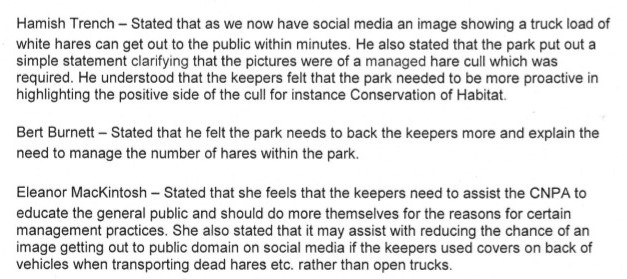
Last week we blogged (here) about an extraordinary comment attributed to Eleanor Mackintosh, a Board member of the Cairngorms National Park Authority (CNPA). During a discussion with the Scottish Gamekeepers’ Association on 29 September 2016, Ms Mackintosh apparently suggested they use covers on the back of vehicles to hide the evidence of mountain hare culls rather than risk photographs being taken of piles of dead hares being transported on open-backed vehicles:

Naturally, most people would expect the CNPA to be clamping down on the mass slaughter of mountain hares on grouse moors within the National Park, not suggesting to gamekeepers that they instead just hide the evidence, so Ms Mackintosh’s comments didn’t go down too well. One of our blog readers, Andy Holden, wrote to Ms Mackintosh to express his disgust and she duly replied as follows:

Dear Mr Holden

Thank you for your recent email in relation to mountain hares in the Cairngorms National Park.

It is my opinion that what I said has been taken completely out of context I am very clear on, and whole heartedly support the CNPA current position on hare culls.

The Cairngorms National Park Authority is clear in its position on mountain hare culling. The CNPA does not support ‘hiding’ in any way the number of hares culled. On the contrary, our advice to land managers is to be more open about the number of hares culled. We recognise that culling hares is legal and that culls can be undertaken for a number of reasons. We do not support large scale culling and endorse the call for restraint made by SNH. We support the ongoing work to develop best practice in counting mountain hare numbers being developed by the James Hutton Institute and GWCT. In the meantime our advice to land managers is to set out clearly why culls are undertaken, share information on the numbers of hares culled and where possible to count hare numbers consistently while waiting for the recommendations on counting methodology from the current research.

The information you refer to is a note by the Scottish Gamekeepers Association of a meeting with CNPA to discuss a number of aspects of the recent National Park Partnership Plan consultation.

Regards

Eleanor Mackintosh

END

Interesting. So Ms Mackintosh doesn’t deny that she made the suggestion, but instead she claims her remarks were taken “completely out of context“. Really? By whom? Not by us – we posted the notes from the CNPA/SGA meeting exactly as they were presented in the FoI response (see photo above).

Perhaps she meant that the notes from the meeting (prepared by the SGA) hadn’t been written up accurately and had reported her comments ‘out of context’? That’s entirely possible, of course, but in this case it seems unlikely.

Why would we say that seems unlikely? Well, because the notes from the meeting, as prepared by the SGA, were emailed to the CNPA on 4 October 2016. The recipients of that email included Will Boyd Wallis (CNPA), Hamish Trench (CNPA), Mike Cottam (CNPA) and someone listed as ‘Eleanor’. Will, Hamish and Mike had all attended the meeting with the SGA, so we assume the person named as ‘Eleanor’ was Eleanor Mackintosh, who was also present at that meeting.

Later that same day, Hamish Trench (CNPA) sent an email back to the SGA (also copied to Will, Mike and ‘Eleanor’) acknowledging receipt of the notes but not accepting them as an accurate reflection of what was said during the meeting by him, Will and Mike. Hamish offered to amend the notes before they were circulated more widely.

On 6 October, Will Boyd Wallis (CNPA) sent an amended version of the notes back to the SGA, and copied in Hamish, Mike and ‘Eleanor’. In this amended version, Will had made several editorial changes to some of the comments, but did not amend the comments attributed to Eleanor. Presumably, as ‘Eleanor’ had been in receipt of all this correspondence, if she thought her comments had been placed ‘completely out of context’ here was the perfect opportunity for her to say so.

She didn’t.

You can read the correspondence between the SGA and CNPA here: cnpa-sga-mtg-29-sept-2016-amendment-of-notes

Now, maybe Ms Mackintosh was away, maybe her internet was down, maybe she didn’t see the notes until they were published on this blog.

Or, maybe, she did suggest that gamekeepers should hide dead mountain hares under covers and now she’s in the middle of a shit storm and she’s looking for a way out.

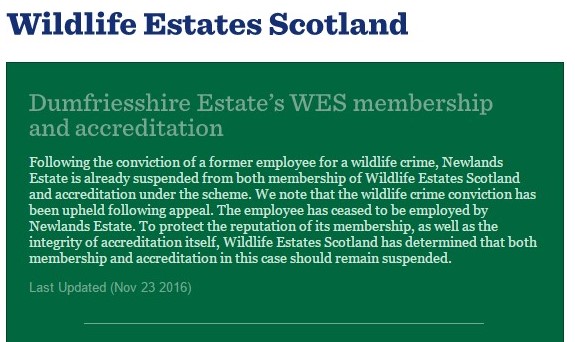
Statement from Wildlife Estates Scotland on membership status of Newlands Estate

Those of you who’ve been following the long drawn-out saga of prosecutions relating to the wildlife crime that took place on Newlands Estate, Dumfriesshire in 2015 will know that we’ve been asking questions of various organisations associated with this estate.

One of those questions has been about the membership status of the Newlands Estate in the ‘Wildlife Estates Scotland (WES)’ scheme, administered by Scottish Land & Estates. Since Newlands Estate gamekeeper Billy Dick’s conviction (for killing a buzzard) was upheld in July this year, we’ve asked this:

‘Will the Newlands Estate’s accredited membership of Wildlife Estates Scotland (WES) now be revoked? The conditions of membership of this scheme include: “the requirements to maintain best practice standards of animal welfare and comply with all legal requirements and relevant Scottish codes of practice”. At the time of Mr Dick’s conviction, a spokesperson for WES said the Newlands Estate’s membership and accreditation of WES had been ‘voluntarily suspended’ pending the outcome of legal proceedings. Well, now the gamekeeper’s criminal conviction for wildlife offences has been upheld, how about answering the question?’

Four months on, and thanks to blog readers for writing to WES, the following statement has appeared on the WES website this morning:

wes-statement-newlands

So, Newlands Estate is still a member of WES, albeit in a suspended state. Presumably, WES is waiting to find out whether the allegation of vicarious liability is proven against landowner Andrew Duncan during forthcoming legal proceedings.

That’s an interesting position for WES to take. A wildlife crime did take place on Newlands Estate and a Newlands Estate employee was convicted for it. Why isn’t that sufficient cause for WES to expel Newlands Estate? Two conditions of WES membership were clearly breached (“the requirements to maintain best practice standards of animal welfare and comply with all legal requirements and relevant Scottish codes of practice“). Whether Mr Duncan is subsequently convicted or acquitted of vicarious liability is irrelevant and will not erase these facts.

Let’s imagine, for example, that Mr Duncan is exonerated and WES decides to lift the suspension on membership. WES will still have a wildlife crime estate on its membership list. How does that ‘protect the reputation of its membership, as well as the integrity of accreditation itself’? Here’s a hint, WES: IT DOESN’T.

Other questions we’ve been asking since Newlands Estate gamekeeper Billy Dick’s failed appeal in July 2016 are yet to be answered:

  1. Is/was criminal gamekeeper William (Billy) Dick a member of the Scottish Gamekeepers’ Association? The SGA refused to comment on Mr Dick’s membership status at the time, saying they ‘wanted to wait until the legal process had concluded’. Well, now Mr Dick’s criminal conviction for wildlife offences has been upheld, how about answering the question? Emails to: info@scottishgamekeepers.co.uk
  2. Will Scottish Land & Estates now expel the Newlands Estate from the ranks of SLE membership? SLE said at the time that Newlands Estate’s membership of SLE had been ‘voluntarily suspended’ pending on-going legal proceedings. Well, now the gamekeeper’s criminal conviction for wildlife offences has been upheld, how about answering the question? Emails to: info@scottishlandandestates.co.uk

Cover up in the Cairngorms National Park!

Well done to Scottish animal charity OneKind for organising today’s protest rally at the Scottish Parliament, enabling campaigners to call on MSPs to put an end to the mass unregulated slaughter of tens of thousands of mountain hares on Scottish grouse moors.

Ingeniously, OneKind replicated the now infamous image of that truckload of dead mountain hares (published here and here earlier this year) with their own truckload of (soft cuddly toy) mountain hares:

onekind-hare-rally-stuart-spray

(Photo from the rally by Stuart Spray).

Environment Cabinet Secretary Roseanna Cunningham addressed the rally and said the Scottish Government opposes mass culls, that legislation to protect mountain hares has not been ruled out, but that the Government needs evidence before it can act.

That evidence might be harder to come by in future. A board member of the Cairngorms National Park Authority (Eleanor MacKintosh) recently suggested to members of the Scottish Gamekeepers’ Association that they literally cover up their mass hare-killing sprees by using covers on the back of vehicles to hide the evidence from prying camera lenses instead of having piles of dead hares on display in open-backed trucks!!!

This information (and other fascinating discussions) was revealed in an FoI asking for information about a meeting between the CNPA and the SGA that was held in September this year. We’ll be blogging a lot more about that in due course.

Vicarious liability prosecution: Andrew Duncan (Newlands Estate) part 9

Criminal proceedings continued on 2 August 2016 against landowner Andrew Walter Bryce Duncan, who is alleged to be vicariously liable for the crimes committed by gamekeeper William (Billy) Dick in April 2014.

Gamekeeper Dick was convicted in August 2015 of killing a buzzard on the Newlands Estate, Dumfriesshire by striking it with rocks and repeatedly stamping on it (see here). Mr Dick was sentenced in September 2015 and was given a £2000 fine (see here). Mr Dick attempted to appeal his conviction but this was refused on 15 July 2016 (see here).

Here’s a quick review of the proceedings against Andrew Duncan so far:

Hearing #1 (18th August 2015): Trial date set for 23rd Nov 2015, with an intermediate diet scheduled for 20th Oct 2015.

Hearing #2 (20th October 2015): Case adjourned. November trial date dumped. Notional diet hearing (where a trial date may be set) scheduled for 18th January 2016.

Hearing #3 (18th January 2016): Case adjourned. Another notional diet & debate scheduled for 11th March 2016.

Hearing #4 (11th March 2016): Case adjourned, pending the result of gamekeeper Billy Dick’s appeal. Another notional diet scheduled for 4th April 2016.

Hearing #5 (4th April 2016): Case adjourned, pending the result of gamekeeper Billy Dick’s appeal. Another notional diet scheduled for 3rd June 2016.

Hearing #6 (3rd June 2016): Case adjourned, pending the result of gamekeeper Billy Dick’s appeal. Another notional diet scheduled for 17th June 2016.

Hearing #7 (17th June 2016): Case adjourned, pending the result of gamekeeper Billy Dick’s appeal. Another notional diet scheduled for 15th July 2016.

Hearing #8 (15 July 2016): Case adjourned. Another notional diet scheduled for 2 August 2016.

At hearing #9 yesterday (2 August), the proceedings moved to trial. An intermediate diet is scheduled for 15 November 2016 (this is a short hearing where the court determines that both the prosecution and defence are prepared for trial). If the intermediate diet goes smoothly, the actual trial has been set for 7th & 8th December 2016.

Vicarious liability in relation to the persecution of raptors in Scotland (where one person may potentially be legally responsible for the criminal actions of another person working under their supervision) came in to force over four and a half years ago on 1st January 2012. To date there have been two successful convictions: one in December 2014 (see here) and one in December 2015 (see here).  One further case did not reach the prosecution stage due, we believe, to the difficulties associated with identifying the management structure on the estate where the crimes were committed (see here).

Following gamekeeper Mr Dick’s failed appeal in July 2016 (see here), we posed a number of questions. These are still to be answered:

  1. Is/was criminal gamekeeper William (Billy) Dick a member of the Scottish Gamekeepers’ Association? The SGA refused to comment on Mr Dick’s membership status at the time, saying they ‘wanted to wait until the legal process had concluded’. Well, now Mr Dick’s criminal conviction for wildlife offences has been upheld, how about answering the question? Emails to: info@scottishgamekeepers.co.uk
  2. Will Scottish Land & Estates now expel the Newlands Estate from the ranks of SLE membership? SLE said at the time that Newlands Estate’s membership of SLE had been ‘voluntarily suspended’ pending on-going legal proceedings. Well, now the gamekeeper’s criminal conviction for wildlife offences has been upheld, how about answering the question? Emails to: info@scottishlandandestates.co.uk
  3. Will the Newlands Estate’s accredited membership of Wildlife Estates Scotland (WES) now be revoked? The conditions of membership of this scheme include: “the requirements to maintain best practice standards of animal welfare and comply with all legal requirements and relevant Scottish codes of practice”. At the time of Mr Dick’s conviction, a spokesperson for WES said the Newlands Estate’s membership and accreditation of WES had been ‘voluntary suspended’ pending the outcome of legal proceedings. Well, now the gamekeeper’s criminal conviction for wildlife offences has been upheld, how about answering the question? Emails to: info@scottishlandandestates.co.uk

We’ll also be watching closely to see whether the Newlands Estate will now be subject to a General Licence Restriction from SNH. If you recall, this restriction may be imposed by SNH where evidence of raptor crime is apparent and it has been available as a sanction for offences committed since 1 January 2014. Mr Dick killed the buzzard on Newlands Estate in April 2014. Although, even if the GL restriction is put in place, the estate can easily side-step it by applying for an ‘individual’ licence instead (e.g. see here).

Had there been a gamebird licensing scheme in place, the Newlands Estate could now have been facing a temporary ban on pheasant shooting for a number of months/years. At the moment, no such licensing scheme exists, but a petition has recently been launched by the Scottish Raptor Study Group, asking the Scottish Government to introduce such a licensing scheme. You can sign the petition HERE

SGA statement re: illegal traps found on Invercauld Estate

Following the news that illegally-set spring traps were found on a grouse moor on Invercauld Estate in the Cairngorms National Park (see here), the Scottish Gamekeepers’ Association has issued a statement.

Are you ready for this?

A Spokesman for The Scottish Gamekeepers Association said: “This is the first we, as an organisation, have heard about this so we will take time to make the appropriate inquiries. The SGA is an organisation which advocates best practice and condemns wildlife crime.”
END
Not exactly an unequivocal condemnation of this wildlife crime, is it? This case is a little bit awkward for the SGA, given their close ties to Invercauld Estate (SGA Vice Chair Peter Fraser worked on Invercauld Estate for 43 years).
Perhaps, like Invercauld Estate, the SGA is going to deny this crime ever happened, a bit like they did when they ‘investigated’ another disgusting wildlife crime (here is the crime, here is the SGA’s response) and another disgusting wildlife crime (here is the crime, here is the SGA’s response).
Or perhaps this time they will admit the crime happened but will suggest that the ‘evidence was planted’, a bit like SGA Vice Chairman Peter Fraser did in this interview when asked about the discovery of three poisoned buzzards and a poisoned raven that were found on Invercauld Estate in 2005 (no prosecutions, natch).
And talking of the SGA condemning wildlife crime, we’re still waiting for a statement from them about the conviction of Scottish gamekeeper William (Billy) Dick, successfully prosecuted for killing a buzzard on the Newlands Estate by throwing rocks at it and then repeatedly stamping on it (see here). At the time of Dick’s conviction, the SGA refused to comment until Dick’s appeal had been heard. As you know, Dick’s appeal was rejected a week ago and his conviction still stands (see here), so where’s the SGA’s condemnation of this gamekeeper’s crimes and where’s the information about Dick’s SGA membership status? Was he an SGA member? Is he still an SGA member?
The SGA’s commitment to condemning and tackling wildlife crime doesn’t look at all convincing, does it? And if it doesn’t look convincing to us, how does it look to the SGA’s membership? Will they think their great leaders are standing strong against illegal raptor persecution and doing all they can to apply peer pressure to eliminate it? On the above evidence, that’s unlikely.
More on the Invercauld Estate case to come….

Conviction upheld for buzzard-killing gamekeeper from Newlands Estate

In April 2016 we blogged about a Scottish gamekeeper who was appealing his conviction for killing a buzzard (here).

In August 2015, gamekeeper William (Billy) Dick, now 26, was found guilty of killing a buzzard on the Newlands Estate, Dumfriesshire, in April 2014. Two witnesses had observed him striking the buzzard with rocks and then repeatedly stamping on it (see here). In September 2015 he was sentenced: £1,500 fine for killing the buzzard and £500 for possession of the dead buzzard (see here).

Mr Dick had maintained his innocence throughout the trial and had claimed he was elsewhere when the offence took place (see here).

Mr Dick’s appeal was heard in May (here) and we’ve been waiting for the written judgement from that hearing. Yesterday, that written judgement was published and Mr Dick’s appeal was thrown out.

The judgement itself is well worth a read (see here) as it explains not only the evidence used to convict Mr Dick, but also the grounds for his appeal, which basically centred on what time Mr Dick and his line manager (Head Gamekeeper) had left a BASC training course in Dunkeld. Mr Dick has always argued he couldn’t have been the person observed killing the buzzard because he was still travelling back to Newlands Estate from Dunkeld at the time the observation was made. The Sheriff in the original trial had preferred the testimony of the two witnesses (tenants on Newlands Estate who knew gamekeeper Mr Dick) to the testimony of Mr Dick and his Head Gamekeeper.

You might think that 21st Century technology could easily have resolved this issue. For example, did the vehicle in which Mr Dick and his Head Gamekeeeper were travelling not pass any Automated Number Plate Recognition (ANPR) cameras enroute from Dunkeld to Newlands Estate? Surely that would have provided conclusive evidence about the timing of their journey? Apparently not.

Mr Dick’s appeal was heard by three senior judges: Lord Carloway (Lord Justice General), Lord Menzies, and Lord Bracadale. In the written judgement, each of these three judges state their individual opinion about the case and explain the reasoning behind their decisions. Two of the judges (Carloway and Bracadale) considered that the appeal should be refused. The other judge, Menzies, considered that there were sufficient grounds for appeal. [Interesting to note, according to Wikipedia, Lord Menzies’ interests include shooting]. The appeal was rejected 2:1 against.

This is a rare success and the SSPCA, Police Scotland, and Crown Office deserve credit for their efforts. Special credit to the two witnesses who risked a lot to bring this criminal to justice.

As Mr Dick’s criminal conviction has now been upheld, presumably this will now allow the prosecution to proceed against Andrew Duncan, the Newlands Estate landowner, for alleged vicarious liability of Mr Dick’s crimes. The case against Mr Duncan has been repeatedly delayed (see here) while Mr Dick’s appeal was underway.

Mr Dick’s failed appeal also leads us back to several questions we asked at the time of his conviction in August 2015. These were:

  1. Is/was criminal gamekeeper William (Billy) Dick a member of the Scottish Gamekeepers’ Association? The SGA refused to comment on Mr Dick’s membership status at the time, saying they ‘wanted to wait until the legal process had concluded’. Well, now Mr Dick’s criminal conviction for wildlife offences has been upheld, how about answering the question? Emails to: info@scottishgamekeepers.co.uk
  2. Will Scottish Land & Estates now expel the Newlands Estate from the ranks of SLE membership? SLE said at the time that Newlands Estate’s membership of SLE had been ‘voluntarily suspended’ pending on-going legal proceedings. Well, now the gamekeeper’s criminal conviction for wildlife offences has been upheld, how about answering the question? Emails to: info@scottishlandandestates.co.uk
  3. Will the Newlands Estate’s accredited membership of Wildlife Estates Scotland (WES) now be revoked? The conditions of membership of this scheme include: “the requirements to maintain best practice standards of animal welfare and comply with all legal requirements and relevant Scottish codes of practice”. At the time of Mr Dick’s conviction, a spokesperson for WES said the Newlands Estate’s membership and accreditation of WES had been ‘voluntary suspended’ pending the outcome of legal proceedings. Well, now the gamekeeper’s criminal conviction for wildlife offences has been upheld, how about answering the question? Emails to: info@scottishlandandestates.co.uk

We’ll also be watching closely to see whether the Newlands Estate will now be subject to a General Licence Restriction from SNH. If you recall, this restriction may be imposed by SNH where evidence of raptor crime is apparent and it has been available as a sanction for offences committed since 1 January 2014. Mr Dick killed the buzzard on Newlands Estate in April 2014. Although, even if the GL restriction is put in place, the estate can easily side-step it by applying for an ‘individual’ licence instead (e.g. see here).

Had there been a gamebird licensing scheme in place, the Newlands Estate could now have been facing a temporary ban on pheasant shooting for a number of months/years. At the moment, no such licensing scheme exists, but a petition has recently been launched by the Scottish Raptor Study Group, asking the Scottish Government to introduce such a licensing scheme. You can sign the petition HERE

New report reveals hundreds of raptors illegally killed on game-shooting estates in Scotland

RSPB persecution review 1994 2014Yesterday the RSPB published its latest figures on illegal raptor persecution in Scotland.

Rather than their usual annual review, this time they’ve produced a 20-year review covering the period 1994-2014. This is a really useful exercise as it puts the scale of (known) persecution in to perspective. It’s a sobering read.

A total of 779 birds of prey were confirmed to have been illegally killed during this period, either by poisoning, shooting or trapping. The known victims included 104 red kites, 37 golden eagles, 30 hen harriers, 16 goshawks, 10 white-tailed eagles and 458 buzzards.

In addition to these confirmed victims, a further 171 incidents are documented where poisoned baits and/or non-birds of prey victims were found, including 14 pet cats and 14 pet dogs, and then a further 134 incidents where no victim had been found but clear attempts to target raptors had been uncovered (e.g. illegally-set traps).

The report includes a map showing the landholdings of all known persecution incidents during this period. As ever, it’s pretty revealing, with a handful on the west coast but the vast majority in the uplands of central, eastern and southern Scotland – areas dominated by driven grouse shooting.

RSPB persecution review 1994 2014 map

Drilling down in to the detail, there’s a useful analysis of land-use type of confirmed poisoning incidents between 2005-2014 (219 incidents). A shocking (or not) 81% of confirmed poisoning incidents during this nine-year period were on land used for game-shooting: 57% on grouse moors and 24% on land managed for lowland pheasant shoots. This tells us a great deal about who is responsible for the vast majority of illegal raptor poisoning. Despite their continued denials and protestations, and their increasingly-desperate attempts to minimise the scale of these crimes (“it’s just a few rogues”, “it’s just a small minority”), this graphic exposes the criminality at the heart of the game-shooting industry:

RSPB persecution review 1994 2014 land use

Further damning evidence, which isn’t needed by most of us but for the benefit of those who are still in denial of the bleedin’ obvious, is this graph showing the occupations of those convicted of raptor persecution between 1994-2014. Surprise, surprise, 86% of them were gamekeepers:

RSPB persecution review 1994 2014 occupation

RSPB Scotland is to be commended for publishing this exceptionally detailed and meticulously-researched report. There are a number of things in it that are of particular interest to us and we’ll come back to those in due course. For now though, particular recognition should go to the Investigations team – they may be small in number but their contribution to exposing the disgraceful continuation of illegal raptor persecution in Scotland is enormous. They, and their colleagues south of the border, are worthy of high acclaim. If anybody reading this is in a position to recognise excellence in the field of raptor conservation, e.g. a nomination for an award, this team should be at the top of your list.

So, how has the Environment Minister, Dr Aileen McLeod, responded to such an embarrassing report? She said: “There is no doubt that the figures in this report make for uncomfortable reading, but we have made progress in recent years with the new vicarious liability provisions, the publication of the report from the Wildlife Crime Penalties Review Group, new measures implementing restrictions on the use of General Licences and earlier this year the Scottish Government funded pesticide disposal scheme that removed over 700kg of illegally held poisons in Scotland“.

We have made progress…” Hmm. Let’s have a look:

Vicarious liability – introduced almost 4 years ago and only two successful convictions to date. A slow (but good) start, but we need to see many more convictions.

Wildlife Crime Penalties Review – Commissioned over two years ago, published last month. An excellent report calling for tougher sanctions but we’re waiting to hear whether the Environment Minister will act on the recommendations. Can only be defined as ‘progress’ if she agrees to act.

General Licence restrictions – available to be used against landholdings where raptor crimes committed/suspected from 1st January 2014. So far, only two restrictions have been implemented and those only lasted for six days each before they were suspended as legal arguments continue. A slow start, and the legal challenges were to be expected, but can’t be defined as ‘progress’ unless the restrictions are fully implemented. There should also be a lot more of them.

Pesticide disposal scheme –  implemented this year and resulted in the removal of some illegally-held poisons. That is progress, although it is tinged with frustration that the game-shooting industry was given yet another chance to avoid justice as this scheme (the second of its kind) comes 14 years after the pesticides were originally banned. It’s also interesting to note in the RSPB’s report (page 18) that evidence suggests a number of individuals have retained their illegal stocks. This is supported by more poisoning incidents that have taken place this year, after the disposal scheme ended.

So some progress has been made (and almost entirely due to the efforts of Dr McLeod’s predecessor, Paul Wheelhouse) but it is glacially slow and, so far, has not stemmed the occurrence of illegal persecution, as the damning figures in this report show all too clearly. Much, much more can and needs to be done before we’ll be convinced that Dr McLeod is having any sort of impact. She has, though, announced that tenders have just been invited for a review of game licensing practices in other countries (to inform a possible decision of introducing licensing to game-shooting estates in Scotland), and that’s a good thing, but again, the research needs to be done and then a decision made, which probably won’t happen for a number of years if past performance is anything to go by. She’d find herself with a lot more support if she got on with announcing increased investigatory powers for the SSPCA – the public consultation closed 1 year and 3 months ago – and still we await her decision as the criminals continue their rampage. It’s not impressive at all.

And what of the response of the game-shooting industry itself? Some didn’t bother to publish a statement (Scottish Gamekeepers’ Association), which ironically tells us quite a lot, although they are quoted in an article by STV (see media coverage below) where they revert to type and simply deny the evidence and slag off the RSPB instead. And remember, the SGA is a fully-paid up member of the Partnership for Action Against Wildlife Crime (cough).

Scottish Land and Estates (SLE), another PAW partner, did manage to issue a statement, via their Scottish Moorland Group (see media coverage below). Again, it’s the usual lamentable denial, characterised beautifully by this statement from Director Tim (Kim) Baynes:

Bird of prey deaths……have fallen dramatically over the last five years in particular“.

Er, here are some persecution figures that Kim might want to re-punch in to his calculator:

2012 – 18 confirmed deaths

2013 – 28 confirmed deaths

2014 – 37 confirmed deaths

There’s also this statement:

Our condemnation of wildlife crime is unquivocal...” All very touching but how is that “condemnation” manifested in the real world? It’s been brought to our attention that the current head gamekeeper on a Scottish grouse shooting estate has a (spent) conviction for shooting dead a raptor when he worked on another Scottish grouse moor. How does a criminal with a conviction like that (spent or not) remain employed in the game-shooting industry, let alone get a senior position on another Scottish grouse moor? Was he one of the posse of moorland gamekeepers recently invited to Holyrood to mingle with, and be applauded by, a number of MSPs, as part of the Gift of Grouse propaganda campaign? Surely not…

Download the RSPB report here

Media coverage

RSPB press release here

Statement from Environment Minister Dr Aileen McLeod here

Scottish Moorland Group statement here

BBC news here

STV article here

BBC Radio Scotland (Newsdrive) interview with Ian Thomson, Head of Investigations RSPB Scotland here (starts at 21.50, available for 29 days)

Guardian article here (a mis-leading headline but nevertheless good to see coverage in this paper)

Golden eagles, the SGA, and porky pies

Fearnan Angus Glens Dec 2013The season of mince pies may be upon us but the SGA is feasting on a hefty pile of pork pies.

An article has appeared on the BBC news website today (see here) based on a claim by the SGA that grouse moors are good for golden eagles, and they justify this by saying their ‘survey’ (whatever that entailed) had found golden eagles nesting in 58 areas managed for grouse shooting.

This may sound familiar to some of you. They made a similar claim back in 2013 (see here), although that time they’d found 55 nesting pairs; a claim we took apart here and here. Rather than having to go over the same old ground, again, please read these previous two blogs on this.

To say that the SGA’s latest claim is disingenuous is putting it mildly. They’ve chosen some of their words wisely, by saying “areas managed for grouse shooting”. This, of course, includes both driven and walked up grouse moors. Had their ‘survey’ included only intensively managed driven grouse moors, their results would look quite different.

As we’ve said before, golden eagles do nest successfully on some driven grouse moors, but these tend to be the exception rather than the rule. The number of vacant, unoccupied breeding territories on driven grouse moors is a bit of a giveaway to the overall picture.

What’s also misleading about their latest figures is that they haven’t included any data about the age of those pairs attempting to breed in areas managed for grouse shooting. Perhaps this was a deliberate exclusion, or perhaps they didn’t collect those data. Why is the age of the birds important? Well, if one or both of the breeding pair just happens to be a juvenile, that’s also a strong indicator that all is not well with the local golden eagle population. We’ve explained this before (see here) but this bit is worth repeating:

‘According to several scientific studies, the occurrence of breeding subadult eagles should actually be used as an early-warning of potential population decline. The reason these Scottish golden eagles are attempting to breed at three years of age is because there is little or no competition for that vacant territory. Why is there little or no competition? Because one or both of the territorial adults have been killed and there are very few non-breeding adults (known as ‘floaters’) around to challenge for the territory. If the population was healthy, it would be these breeding-age floaters that would move in to the territory, not an immature three-year old bird.

An excellent study (Whitfield et al. 2004 – see below) has also demonstrated that subadult and mixed-age breeding golden eagle pairs in Scotland have lower breeding success than adult pairs – a result of inexperience and persecution, seeing as most golden eagle territories in Scotland with subadult breeders are in areas associated with illegal persecution’.

According to a presentation at this year’s recent SOC conference, there is evidence from a number of golden eagle territories on driven grouse moors in Perthshire that show either one or both of the pair attempting to breed is a juvenile. These closely-monitored sites (subject to long-term monitoring by experts from the Scottish Raptor Study Group) are showing an unusually high turnover rate of adult golden eagles. This situation is easily masked by superficial SGA claims that golden eagles are breeding there. To the unsuspecting reader, it will sound like all is rosy but to get to the actual truth you need to look a bit more closely.

Also included in today’s BBC article are the following statements:

“The SGA said numbers of golden eagles were recovering from declines in the 1960s caused by pesticides”

and

“It [the SGA] said the management of grouse moors had helped to increase Scotland’s population of the large raptors”.

This is contrary to decades of peer-reviewed science that shows unequivocally that golden eagle recovery is severely limited in areas managed for driven grouse shooting. It’s outrageous that the BBC website has published these statements without providing an opportunity for any organisation to contest their validity. These statements amount to lies and the BBC should not have published them.

If you’d like to complain to the BBC, and ask them to retract these statements, please contact them here (click on ‘make a complaint’) – http://www.bbc.co.uk/complaints/complain-online/

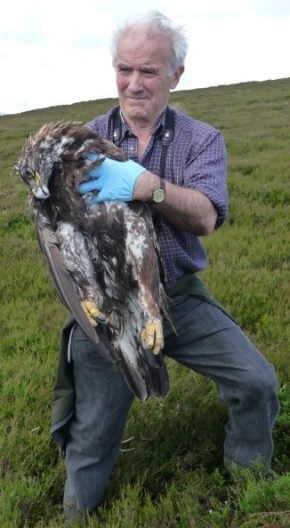
The photograph shows a dead golden eagle called ‘Fearnan’ who was found poisoned on a grouse moor in the Angus Glens in 2013.

UPDATE 5PM: The BBC article has now been updated with a quote from RSPB Scotland, who also dispute the SGA’s findings.

Duncan Orr-Ewing said: “We are not sure where the SGA have got their information, however, if correct their survey highlights only 53% occupancy  of known traditional golden eagle territories in the central and eastern Highlands, far below the natural carrying capacity and continues to indicate that the species is in unfavourable conservation status in this area“.

To read what else he had to say see updated BBC article here