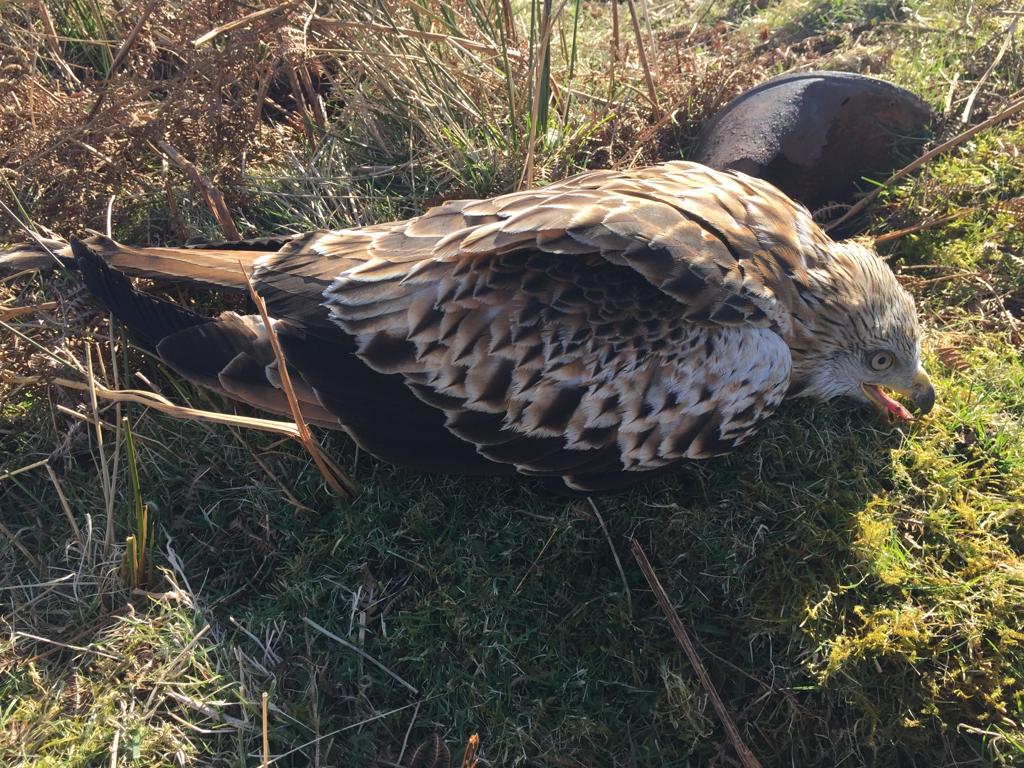
Shot red kite found on a Durham grouse moor is successfully re-habilitated & released back to wild

At the end of March the RSPB issued a press statement about a shot red kite that had been found on a Durham grouse moor (see here).

An x-ray revealed multiple shotgun pellets in the kite’s body, resulting in a fractured wing. The kite was described as ‘fighting for its life’.

After several weeks of expert care and attention by the brilliant Jean Thorpe (Ryedale Wildlife Rescue) and her equally as brilliant colleagues at Battle Flatts Veterinary Clinic, today the red kite was successfully released back to the wild.

The RSPB has released this short video on Twitter:

Durham Constabulary is still appealing for information about the shooting of this kite.

If you have any information, contact Durham Constabulary’s Wildlife Crime Officer, PC Dave Williamson, by emailing david.williamson@durham.police.uk or calling in to Barnard Castle Police Station.

Alternatively, to share sensitive information in confidence, call the RSPB’s Raptor Crime Hotline on 0300 999 0101.

Police Scotland statement on conviction of red kite poisoner, Barry Nicolle

Further to yesterday’s breaking news (here) that wildfowl collector Barry Nicolle had pleaded guilty to multiple wildlife crimes relating to the illegal poisoning of red kites in south west Scotland, Police Scotland has issued the following statement:

Man convicted of killing 15 birds, including five red kites, in Dumfries & Galloway Area

A 67-year-old man has been convicted of killing raptors and other wild birds in the Stewarty area of Dumfries and Galloway between 2019 and 2020.

Barry Nicolle admitted numerous charges at Dumfries Sheriff Court today (Wednesday, 5 April, 2023). He is due to be sentenced on Friday, 19 May, 2023.

The charges related to the reckless use of illegal poison resulting in the deaths of 15 birds, including five red kites. They were recovered within a mile radius of Nicolle’s address, some just a few hundred yards from his property.

A poisoned red kite. Photographer: unknown

Robust policing work in conjunction with forensic science found these birds had not died naturally and had in fact been poisoned with banned substances, including Aldicarb and Bendiocarb.

Wildlife Officer, Police Constable John Cowan, said: “Extensive policing work involving a number of partners, along with forensic science, enabled us to build a case against Nicolle who had been killing protected birds over a number of years.

Not only was there a risk to the rural environment, but also to members of the public handling poisoned birds some of which were found near a primary school.

Police Scotland and the partners we work with treat all types of wildlife crime very seriously and this conviction is a strong message that those who poison wild and protected birds will be robustly investigated.

I would also like to thank the public who provided information that assisted our enquiries. This is vital to our work in combatting wildlife crime.

I would encourage anyone who comes across a protected dead bird or animal to report it to us. Likewise if you have information about wildlife crime please get in touch via 101.”

ENDS

UPDATE 19th May 2023: Monumentally inadequate sentence for Barry Nicolle, serial red kite poisoner in Dumfries & Galloway (here).

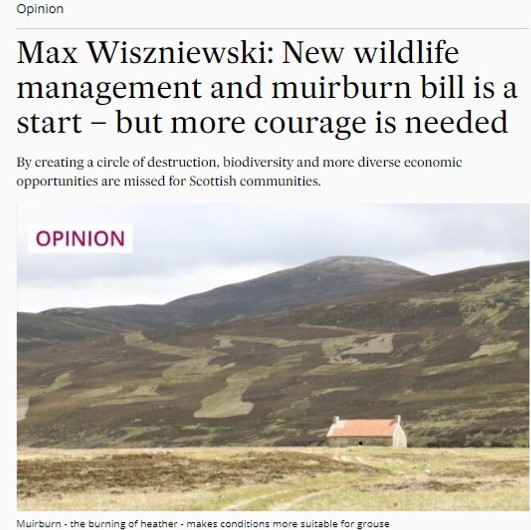
“The shooting industry is laughing in the face of the legislation it will be fighting tooth & nail to oppose” – opinion piece by Max Wiszniewski

There’s a good opinion piece in the Press & Journal today by Max Wiszniewski, Campaign Manager for REVIVE, the coalition for grouse moor reform.

It’s reproduced below:

The systematic, illegal persecution of birds of prey has been a blight in Scotland’s countryside now for decades, so much so that it was described by former first minister, Donald Dewar, as a “national disgrace”.

So, the recent publication of the Wildlife Management and Muirburn (Scotland) Bill, with the primary purpose of tackling wildlife crime, is something to be welcomed.

Yet, on the same day that our new first minister was sworn into office, news broke that another bird of prey – this time a red kite – had been found dead on a grouse moor [Ed: see here]. The shooting industry is laughing in the face of the legislation it will be fighting tooth and nail to oppose.

The new bill proposes to licence the shooting of grouse. If the terms of that licence are broken – such as a licence holder indulging in wildlife crime – then it can be removed.

So far, it seems sensible. But, beyond the illegal destruction of our protected species, hundreds of thousands of foxes, stoats, weasels, crows and so-called “non-target species” like hedgehogs are killed on grouse estates every year, so more grouse can be shot for sport.

Will this unsustainable practice be addressed by the new bill? The answer is: somewhat.

All legal traps will require a “licence”, serial numbers and, presumably, regular checking. Scottish Government oversight of the monitoring of the many thousands of traps on grouse moors to ensure legality will be no easy feat, and it would be expensive to do effectively. Should we be jumping through hoops just so a few people can shoot more grouse for sport?

Bill is an important intervention that should go further

Some big changes in muirburn could be brought about, though. On grouse moors, burning heather shapes the landscape to make it more suitable for grouse – so more of them can be shot.

About 40% of muirburn for grouse has taken place on deep peat, which is an internationally important carbon sequestration resource. Much of it lies in a degraded state on grouse moors, and continued burning is stopping it from regenerating and from rewetting and, therefore, actually emits carbon.

The Wildlife Management and Muirburn Bill proposes an effective ban on peatland burning but, once again, effective monitoring of huge land areas will be difficult and expensive.

Muirburn may still continue under licence in areas with no deep-peat, but should we be dishing out licences when the purpose is increasing grouse numbers for sport shooting? Scotland shouldn’t be pandering to the needs of this cruel, unsustainable and intensively managed industry.

By creating a circle of destruction around huge areas of our land, biodiversity and more diverse economic opportunities are missed for Scottish people and communities.

Overall, this bill as it stands is an important intervention. With a bit more courage to take on large estates and landed interests, it could become the very intervention Scotland’s people, wildlife and environment desperately need.

ENDS

Galloway wildfowl collector pleads guilty to 14 charges relating to the poisoning of red kites

BREAKING NEWS:

Barry Nicolle, a wildfowl collector in south west Scotland, has pleaded guilty to 14 charges this morning at Dumfries Sheriff Court in relation to the illegal poisoning of red kites in the area.

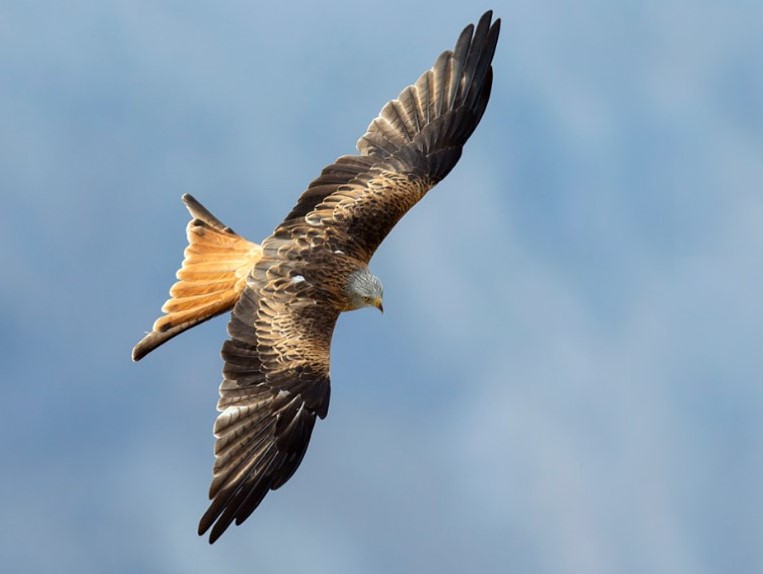
Red kite. Photo: Dick Forsman

Nicolle’s guilty pleas relate to the poisoning of four red kites, placing out poisoned baits, possession of illegal poisons and illegal trap use, according to Ian Thomson, Head of Investigations at RSPB Scotland.

Police Scotland led a multi-agency investigation, assisted by the RSPB, after a number of poisoned red kites were discovered in the area between 2018-2020 (see here, here, here and here for previous blogs).

Nicolle is due to be sentenced on 19th May 2023.

I expect full details of the case will be published post-sentencing.

UPDATE 6th April 2023: Police Scotland statement on conviction of red kite poisoner Barry Nicolle (here)

UPDATE 19th May 2023: Monumentally inadequate sentence for Barry Nicolle, serial red kite poisoner in Dumfries & Galloway (here).

Arrest made in relation to red kite shooting on Lochindorb Estate grouse moor

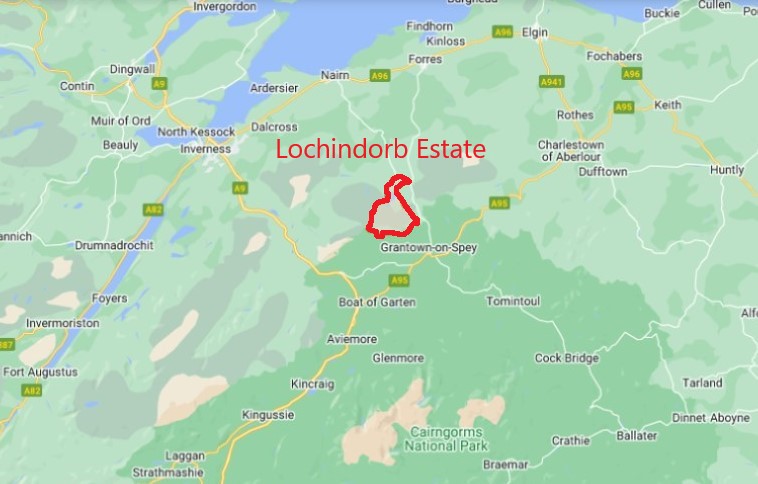
Police Scotland have arrested a 56-year old man as part of their investigation into the shooting of a red kite on a grouse moor on Lochindorb Estate earlier this week.

A rough estimation of Lochindorb Estate boundary at the edge of the Cairngorms National Park

It’s hard to keep up with all the raptor persecution news this week, but this is the red kite that members of the public witnessed being shot on the grouse moor on Monday 27th March 2023 at around 11.15am. The Scottish SPCA attended the scene along with Police Scotland but unfortunately the kite’s injuries were so devastating that the bird had to be euthanised (see here).

Police Scotland issued a very fast appeal for information on Tuesday, saying they were particularly interested in finding witnesses who might have seen quad bikes or off-road vehicles in the area on Monday morning.

Yesterday afternoon (Friday 31st March 2023) Police Scotland issued the following short statement:

Arrest after bird of prey shot near Grantown-on-Spey

A 56-year-old man has been arrested and released pending further investigation after a bird of prey was shot near Grantown-on-Spey.

Officers received a report of a bird being shot around 11.15am on Monday, 27 March, 2023, at the Lochindorb Estate.

ENDS

Great work by Police Scotland. Let’s hope they find sufficient evidence to charge someone for this latest shooting.

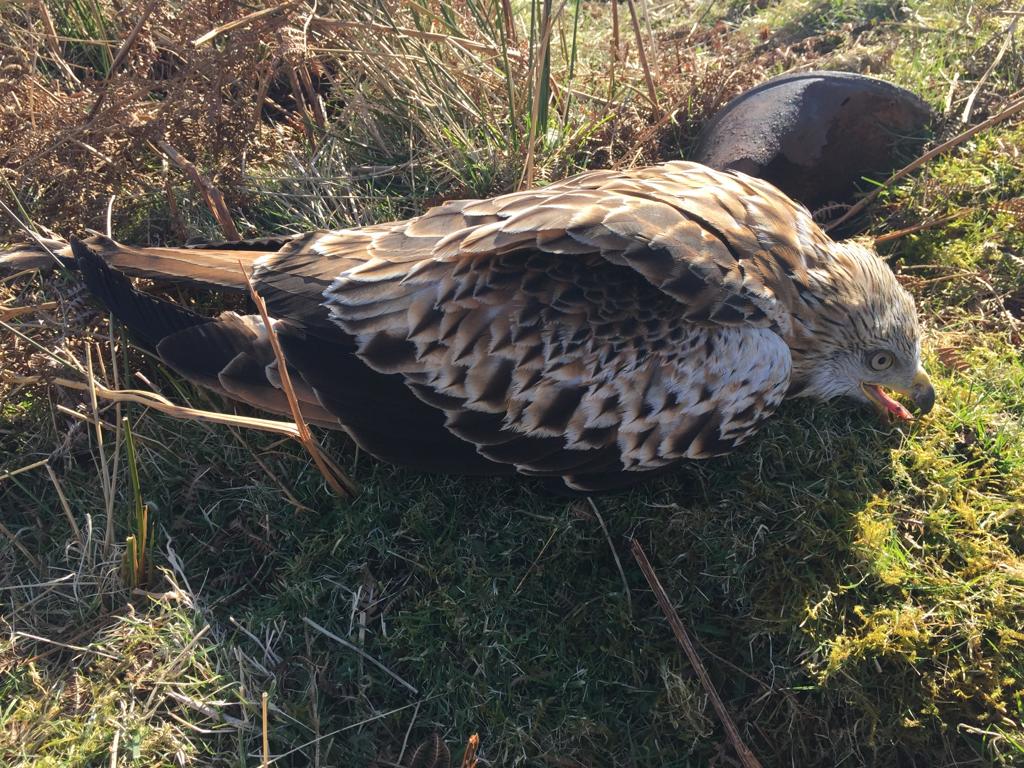
Red kite found shot on a Durham grouse moor is ‘fighting for its life’

The RSPB has just issued the following press release:

RED KITE FOUND SHOT ON GROUSE MOOR IS ‘FIGHTING FOR ITS LIFE’

  • The protected bird of prey was found grounded on a grouse moor in County Durham, in March 2023
  • An X-ray revealed multiple pieces of shot within the bird’s body
  • Durham Police and the RSPB are appealing for information

A Red Kite – a species protected by UK law – was found in Edmundbyers, County Durham in a stricken condition, peppered with shot and is currently fighting for its life in a bird hospital.

A member of the public noticed the bird at the side of a public footpath along Burnhope Burn on 17 March 2023 and reported it to the RSPB. Arriving on the scene, RSPB Investigations Officers found the Red Kite hiding in bracken, alive but unable to fly.

It was taken to a wildlife rehabilitator and looked over by a vet. An X-ray revealed the bird’s entire body was peppered with shot including pieces that had broken its wing.

All birds of prey are legally protected, making it a criminal offence to intentionally kill or injure one, punishable by an unlimited fine or jail.

Red Kites were historically persecuted in the UK but are making a comeback thanks to official reintroduction programmes in recent decades supported by Government. However these birds take a long time to spread out, and illegal killing is preventing the species expanding and gaining a foothold in areas where they were formerly found before they were driven to extinction in England around the late nineteenth century.

This incident comes in the same week when news of another Red Kite was found shot in Grantown-on-Spey, [Ed: see here] in the Scottish Highlands, also in March 2023. Sadly, it had to be euthanised due to the extent of its injuries.

This area of County Durham inside the North Pennines AONB has a history of raptor persecution. In 2021, another red kite was found dead near Edmundbyers, Co Durham having been illegally poisoned. Police-led searches in the area followed last year, however no one was prosecuted.

And in 2020, two Red Kites fitted with satellite tags unexpectedly and inexplicably vanished in the same area: one tag sent its last fix from the Derwent Gorge, the other from a grouse moor near Derwent Reservoir. Neither the birds or their tags were found, and it is believed they were illegally killed.

The link between driven grouse shooting and the illegal killing of birds of prey has been well documented. The RSPB’s latest Birdcrime report showed that 71% of all confirmed incidents of raptor persecution were in connection to gamebird shooting.

Jack Ashton-Booth, RSPB Investigations Officer, said:

The kite is currently receiving the best care, and we understand it has been hopping up onto a perch and feeding itself. However it’s still not out of the woods. We are incredibly grateful to the diligent member of the community who noticed and reported the bird, and urge anyone else who finds a dead or injured bird of prey in suspicious circumstances to do the same. It could save a bird’s life and help us identify a raptor killer at large. We are also hugely grateful to Jean Thorpe, who is caring for the bird, as she has done so many others.

It’s unlikely this Red Kite will have flown far from where it was shot. If you have any information about who might have done this, or know of anyone shooting birds of prey in this area, please get in touch.”

Friends of Red Kites (FoRK), a voluntary monitoring and community engagement organisation based in the North East, commented:

We are sickened to hear that yet another Red Kite has been found on the moorlands of the North Pennines suffering from illegal persecution. Since the re-introduction of Red Kites to the North East of England in 2004, a number of birds have been found dead on or adjacent to these moorlands which are managed for grouse shooting. After nearly 20 years the population of breeding kites has barely advanced above 20 pairs. By comparison, populations of kites in other areas where they have been released, like the Chilterns, are booming. It is a sad indictment on parts of society that the people of the North East are denied seeing these beautiful birds gracing our skies more widely.” 

If you have any information, contact Durham Constabulary’s Wildlife Crime Officer, PC Dave Williamson, by emailing david.williamson@durham.police.uk or calling in to Barnard Castle Police Station.

Alternatively, to share sensitive information in confidence, call the RSPB’s Raptor Crime Hotline on 0300 999 0101.

ENDS

UPDATE 12th April 2023: Shot red kite found on a Durham grouse moor is successfully re-habilitated and released back to wild (here)

Game-shooting industry’s response to news that red kite was shot on grouse moor (Lochindorb Estate)

Further to yesterday’s news that a member of the public witnessed the shooting of a red kite on Lochindorb Estate on Monday morning (see here), I’ve been looking to see how the game-shooting industry has responded to Police Scotland’s appeal for information.

You’ll recall that this is the game-shooting industry whose organisations routinely state they have a ‘zero tolerance’ policy towards raptor persecution, in which case you’d think they’d be quick to condemn this latest crime and call on their members to assist the police in any way they can.

So far, I haven’t found any statements of condemnation on the websites of the Scottish Gamekeepers Association, BASC, or the Countryside Alliance.

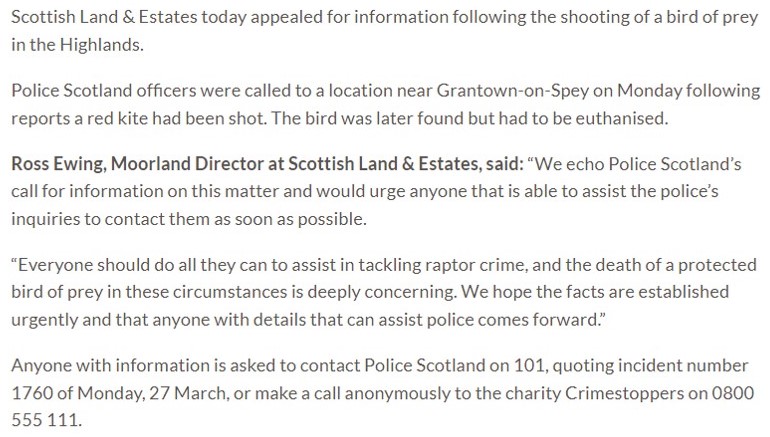
I did find a statement on the website of Scottish Land & Estates (SLE), the grouse moor owners’ lobby group, as follows:

It’s good to see a prompt response from SLE (their statement was published yesterday) and it’s also good to see SLE urging its members and readers to assist with the police investigation.

Although I couldn’t help but notice that Lochindorb Estate isn’t named, and nor is the fact that Police Scotland is particularly interested in receiving information relating to quad bikes and off-road vehicles seen in the area at the time of the shooting.

If anyone does have information, please contact Police Scotland on 101, quoting incident number 1760 of Monday, 27 March, or make a call anonymously to the charity Crimestoppers on 0800 555 111.

Red kite shot on Lochindorb Estate: Police Scotland issue appeal for information

A member of the public witnessed the shooting of a red kite on the Lochindorb Estate yesterday morning. It was recovered by the Scottish SPCA but unfortunately its injuries were so severe it had to be euthanised.

Police Scotland has issued the following appeal for information:

APPEAL FOLLOWING BIRD OF PREY SHOT NEAR GRANTOWN-ON-SPEY

Officers are appealing for information after a protected bird of prey was shot near Grantown-on-Spey.

We received a report of a red kite being shot around 11.15am on Monday, 27 March, on the Lochindorb Estate, Grantown-on-Spey.

It was recovered with the assistance of the Scottish Society for the Prevention of Cruelty to Animals (SSPCA) but had to be euthanized as its injuries were not recoverable.

Community Police Inspector Craig Johnstone said: “The red kite is a protected species and under the Wildlife and Countryside Act 1981 it is illegal to kill them.

I am asking anyone in the local community who may be able to help with our enquiries to come forward. If you were walking in the area on Monday then please let us know if you saw anything.

In particular, if you saw quad bikes in the area or off road vehicles, then get in touch as even the smallest bit of information could assist with our investigation.”

Anyone with information is asked to contact Police Scotland on 101, quoting incident number 1760 of Monday, 27 March, or make a call anonymously to the charity Crimestoppers on 0800 555 111.

ENDS

I applaud this very fast public appeal for information by Police Scotland. It’s in stark contrast to their 19-month silence about a poisoned red kite that was found in the same region in 2021 (see here) and for which they received much deserved criticism.

All credit to them for responding so quickly this time and for naming the estate on which the shooting was witnessed. Bravo.

UPDATE 29th March 2023: Game-shooting industry’s response to news that red kite was shot on grouse moor (Lochindorb Estate) here

UPDATE 1st April 2023: Arrest made in relation to red kite shooting on Lochindorb Estate grouse moor (here)

Fascinating new details emerge about investigation into raptor persecution on Shaftesbury Estate in Dorset

Earlier this year, criminal gamekeeper Paul Allen was sentenced for multiple wildlife, poisons and firearms offences committed on the Shaftesbury Estate in Dorset in 2021 (see here).

He first came to the attention of the police after a member of the public discovered a dead red kite on the estate in November 2020. Tests revealed it contained the poison Bendiocarb and this triggered a multi-agency raid in March 2021 led by Dorset Police’s (now former) wildlife crime officer Claire Dinsdale.

The poisoned red kite found on the Shaftesbury Estate by Dorset resident Johanna Dollerson

Officers found the corpses of six dead buzzards by a pen behind the gamekeeper’s house (tests later showed they had all been shot, including one that was was estimated to have been shot in the last 24hrs). Officers also found the remains (bones) of at least three more buzzards on a bonfire.

A loaded shotgun was found propped up behind a kitchen door (!) and 55 rounds of ammunition were found in a shed. Both the gun and the ammunition should have been inside a locked, specifically-designed gun cabinet, by law. The gun and the ammunition were not covered by Allen’s firearms certificate.

Officers also found a number of dangerous, and banned, chemicals, including two bottles of Strychnine, two containers of Cymag and a packet of Ficam W (Bendiocarb) in various locations, including in a vehicle used by Allen.

Some of you may also recall that Allen was initially charged with killing the red kite, but court records showed that this charge, along with two others, was subsequently dropped minutes before the hearing (see here), probably as some kind of bargaining agreement between the lawyers.

Allen was sentenced in February 2023 and escaped a custodial sentence due to his personal circumstances (see here).

If you recall, the Shaftesbury Estate was also where a young satellite-tagged poisoned white-tailed eagle was found dead, a year later, in January 2022. Tests revealed the eagle’s liver contained seven times the lethal dose of the rodenticide Brodifacoum but Dorset Police refused to conduct a search of the estate, despite already running an investigation into gamekeeper Paul Allen’s crimes on the same estate(!), and they still haven’t provided a credible explanation for that appalling decision (see here).

Now new details have emerged about what was found during the investigation into gamekeeper Allen, thanks to Guy Shorrock, a member of the PAW Forensics Working Group and a former Senior Investigator at RSPB. Guy has written a guest blog for Wild Justice to demonstrate how the Raptor Forensics Fund, initiated by Wild Justice in 2020, has been used to help bring a number of criminal gamekeepers to court.

In that guest blog, Guy discusses the forensic testing undertaken on a ‘cut open’ dead rat that had been found next to the red kite’s corpse. Tests revealed it, too, contained the poison Bendiocarb – in other words, it had been placed as a poisoned bait. Forensic testing also confirmed that the kite had consumed part of a brown rat. You don’t have to be Poirot to piece it all together but even though Allen’s vehicle contained multiple pots of Bendiocarb, this still isn’t sufficient evidence to demonstrate without reasonable doubt that he was responsible for placing the poisoned bait that killed that red kite. This is a very good example of just how high the criminal burden of proof is and why so many prosecutions against gamekeepers have failed.

What has also been revealed is that in addition to being poisoned by Bendiocarb, that red kite also contained NINE times the lethal level of the rodenticide Brodifacoum in its system!! Sound familiar? The dead white-tailed eagle, found on the same estate a year later, contained seven times the lethal dose. To me, this makes Dorset Police’s decision not to search the Shaftesbury Estate even more non-sensical than previously thought.

Wild Justice has asked its legal team to examine Dorset Police’s botched handling of the poisoned white-tailed eagle case and expects to have more news on that in due course.

Meanwhile, I’d really encourage you to read Guy’s guest blog on Wild Justice’s website (here), published this morning, for a fascinating insight into the pain-staking forensic work that goes in to prosecuting those who continue to kill raptors.

The Raptor Forensics Fund, initiated by Wild Justice and supported by donations from the Northern England Raptor Forum, Tayside & Fife Raptor Study Group, Devon Birds, and a number of generous individuals who wish to remain anonymous, is now running low (because it’s been used so often!). Wild Justice intends to top up the fund shortly. If you’d like to donate to Wild Justice’s work, please click here. Thank you.

Dorset Police response to sentencing of criminal gamekeeper Paul Allen

Well it’s taken them long enough, but finally Dorset Police has managed to issue a statement about the conviction and sentencing of criminal gamekeeper Paul Allen, who pleaded guilty to multiple wildlife, poisons and firearms offences whilst working on the Shaftesbury Estate in March 2021.

You’ll recall I was surprised when Dorset Police failed to mention anything about Allen’s forthcoming court appearance and subsequent conviction back in January, despite the force publishing statements about a wide variety of other criminal cases at various stages of progression through the criminal justice system (see here), but at last, they’ve got around to saying something. Although what they’ve chosen to exclude from this press statement is far more revealing than what they’ve chosen to include.

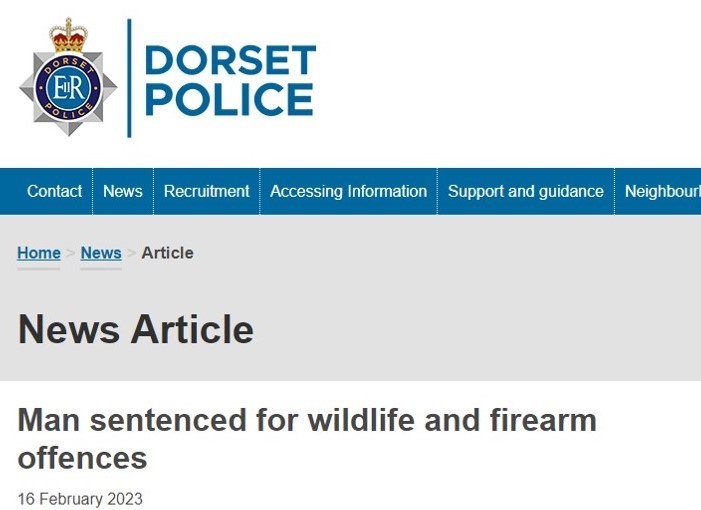
The following statement was published on the Dorset Police website last Thursday:

A man has been sentenced at court for wildlife and firearms offences in East Dorset following a multi-agency investigation led by rural crime officers.

Paul Scott Allen, aged 54, was sentenced at Weymouth Magistrates’ Court on Thursday 16 February 2023 after admitting a total of seven offences at a previous hearing.

The defendant pleaded guilty to two counts of possessing a live or dead wild bird under schedule 1 of the Wildlife and Countryside Act 1981 and two charges of failing to comply with the conditions of a firearms certificate.

Allen also admitted the following offences:

Using a biocidal product in contravention of the Health and Safety at Work Act 1974.

Possessing an unlawful substance under the Plant Protection Products Regulations 2012

Possessing a regulated substance without a licence under the Poisons Act 1972.

Allen was sentenced to 15 weeks in prison, suspended for 12 months. He was also ordered to pay fines and compensation totalling more than £2,900. 

The investigation was launched by Dorset Police’s Rural Crime Team following reports of suspected bird poisonings on a rural estate in East Dorset.

Following work with partner agencies including Natural England and the National Wildlife Crime Unit, a warrant was executed on Thursday 18 March 2021. During searches a number of dead birds of prey were located.

Officers also searched the address of Allen, a gamekeeper at the estate, and found a shotgun and ammunition, which were not covered by the defendant’s firearms certificate. Further enquiries uncovered a number of prohibited toxins at the premises.

Allen was interviewed by officers and – following detailed enquiries and liaison with experts from the Crown Prosecution Service – was charged with the various offences.

Chief Inspector David Parr, of Dorset Police, said: “We take all reports of wildlife crime and rural criminality very seriously. This case has seen us work with partners including Natural England and the National Wildlife Crime Unit to compile evidence before liaising with the Crown Prosecution Service Specialist Wildlife Prosecutor who agreed to the charges against the defendant.

“Wildlife crime remains a key objective of the recently expanded Dorset Police Rural Crime Team and we will continue to work with our partners to investigate criminal offences and deal with offenders robustly.”

Stephanie Bird-Halton, National Delivery Director for Natural England, said following the hearing: “Natural England is determined to tackle the scourge of persecution of our birds of prey. We assisted Dorset Police in this prosecution, gathering evidence and providing specialist technical advice. We are pleased Allen has been held to account for his offences against our wildlife. 

“Without landowners and land managers complying with the law and reporting illegal activity, the impact on our wildlife will continue.

“If members of the public spot birds of prey they suspect may have been poisoned, we would ask them to contact the police, but not to touch the bird.”

Angharad Thomas, the CPS Wessex Wildlife Lead, said: “We work closely with the police on all wildlife related cases to make sure there is sufficient evidence to meet our legal test for prosecution.

“In this case, the review of extensive and complex evidence made it clear that Allen’s offending posed a significant threat to human and animal life, as well as having a negative impact on the countryside.

“Anyone acting otherwise than in accordance with firearms licences or in contravention of laws intended to protect our wildlife and countryside will be prosecuted.”

ENDS

To a casual observer, this press statement is straightforward, detailed and complimentary about a number of partners involved in the investigation that led to a successful conviction. Hooray! Tea and medals all round! But for those of us who’ve taken more than a passing interest in this case, what this statement actually is is petty and vindictive.

Why do I think that? Well, look closely and you’ll see that one of the significant partners in this multi-agency investigation, the RSPB, has been erased completely from the narrative by Dorset Police.

The statement mentions other partners including the NWCU, Natural England and the CPS, but there’s no mention whatsoever of the RSPB or the specialist role it brought to the case, from initial liaison with the (now former) Dorset Police wildlife crime officer, Claire Dinsdale, to helping plan and then conduct the search under warrant of Allen’s premises, to providing expert guidance on what was found, organising the forensics testing on the exhibits, then having considerable input into the file preparation for submitting to the CPS and then considerable liaison with the CPS itself.

As you can see, the RSPB wasn’t just along for the ride, it made an important and weighty contribution to the case, so why has Dorset Police gone out of its way to exclude it? My guess would be that it’s because the RSPB has been extremely supportive of Claire Dinsdale as she continues to battle senior officers over the botched investigation into the poisoned white-tailed eagle (an on-going saga).

I was also amused to read in the press statement the quote from Chief Inspector David Parr of Dorset Police, who said: “We take all reports of wildlife crime and rural criminality very seriously….. Wildlife crime remains a key objective of the recently expanded Dorset Police Rural Crime Team and we will continue to work with our partners to investigate criminal offences and deal with offenders robustly.”

Yeah, right, as long as it doesn’t involve conducting a police search on a shooting estate to look for evidence about who might have poisoned a white-tailed eagle, especially if a gamekeeper on that estate just happens to already be under investigation for multiple wildlife, poisons and firearms offences, and especially if a local Conservative MP has been kicking off about ‘wasting police resources on investigating wildlife crime’. Yeah, apart from that, Dorset Police will ‘continue to work with our partners [apart from the RSPB] to investigate criminal offences and deal with offenders robustly‘.