An all-too rare example of a good gamekeeper came to light in August 2009, when a red kite was rescued by keeper Bob Colyer on the Craigiehowe Mains shooting estate on the Black Isle, Ross-shire.
The recently-fledged young bird, called ‘H’, had crashed into the side of a pheasant-rearing pen and had become entangled in the netting when Bob found him. After carefully removing him, ‘H’ was given a night’s recuperation with the local SSPCA before being released the next day, with no obvious signs of injury.
Bob said: “The kite was looking very sorry for itself when I found it and didn’t seem grateful to be rescued. However, I’m delighted to have been able to help and even more pleased to hear that it has been able to take to the air once more”.
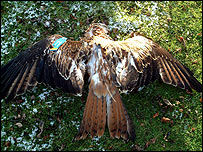
A young male red kite found dead by the side of the road in Callander, Perthshire, in July 2007 had been illegally posioned. Sadly, it wasn’t an isolated incident. A few weeks earlier, two red kite chicks had been found closeby. Tests revealed that one chick had definitely been poisoned; the body of the 2nd chick was too decomposed for analysis. The chicks were unrelated to the dead adult kite.
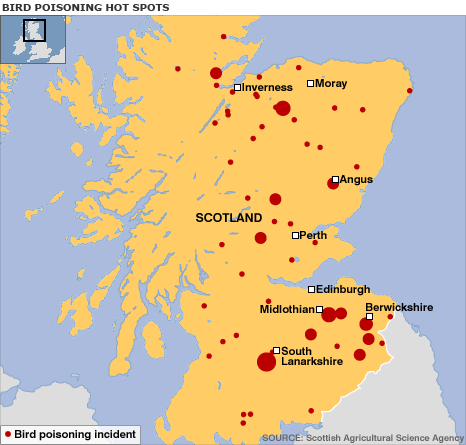
In January 2009, the Scottish government released its ‘Map of Shame’ showing confirmed poisoning incidents between 2004-2008. The map, using data from the Scottish Agricultural Science Agency (SASA), was hailed as a “significant step” in the fight against wildlife crime as it showed the scale of raptor persecution.
In reality, the map doesn’t tell us anything new at all. The RSPB has been producing these maps for years; the difference with this one is that for the first time, the Scottish Rural Property & Business Association (SRPBA) which represents landowners, agreed to its contents.
The map locates 88 incidents in which raptors were poisoned over the previous 5 years, including iconic species such as the golden eagle, white-tailed sea eagle, red kite, buzzard, tawny owl and peregrine.
What the map fails to tell us is the name of the shooting estates involved. What is the point of providing such a vague map? There is no point, other than to confirm what was already known – raptor persecution incidents are widespread across Scotland. If the SRPBA is as committed to stamping out wildlife crime as it claims it is, why wouldn’t it take every opportunity to name and shame those known to be involved?
It is not just wildlife-interest groups that are asking for the estates to be named. In September 2009, MSP Sarah Boyack (Scottish Labour) called for the government to name and shame the offending estates and said taking steps to reduce the number of incidents of wild raptors being shot and poisoned was a “matter of urgency”. http://news.stv.tv/scotland/121040-msp-name-and-shame-bird-killers/
The government is due to release the official 2009 raptor poisoning figures shortly….
August 2007. One of the 30 red kite chicks sent to Ireland in a project to reintroduce the species there has been found shot dead.
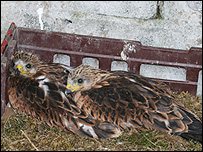
red kite chicks
The kite was among a batch taken from Powys to the mountains of County Wicklow six weeks ago.
Police in Ireland are investigating after it was found with seven shotgun pellets .Tony Cross of the Welsh Kite Trust in Rhayader, who worked on the scheme, said the shooting was a setback but did not “invalidate” the plan.
18/06/2009 A red kite found partially poisoned in Angus has been returned to the wild after being nursed back to health. The young female kite was dazed and exhausted when discovered at Tannadice earlier this month. She was taken to the Scottish SPCA’s Middlebank Wildlife Rescue Centre near Dunfermline where staff feared she had been poisoned.
Tests carried out by the Scottish Government’s Science and Advice for Scotland Agriculture Laboratory confirmed the year-old bird had consumed the banned pesticide alphachloralose.
A tag on the bird’s wing showed she had hatched in Inverness-shire in 2008 and spent the autumn on the Black Isle in Ross-shire before moving to Perthshire for the winter. She has now been fitted with a radio transmitter so her future movements can be followed.
The bird was set free by rangers from the Argaty red kite feeding station, near Doune, in Stirlingshire.
RSPB Scotland’s head of investigations Bob Elliot said she had only survived due to recent good weather. He said: “Alphachloralose tends to bring on hypothermia in its victims. This bird is very lucky that it was found during the warmest week of the year so far, otherwise it would have died.“It’s despicable that yet again some of our most magnificent wildlife continues to be indiscriminately poisoned by criminals who have no regard for our natural heritage or the law.”
No arrests have been made for the poisoning offence.
Police are investigating the suspected poisoning of one of the UK’s rarest birds of prey. The red kite, which had been radio tagged by RSPB Scotland, was found near Tomintoul, Moray in May 2007. A post mortem examination found it had died from ingesting the highly toxic and illegal substance Carbofuran. Grampian Police said it strongly suspected that the red kite had eaten bait laced with the chemical and intended to kill birds of prey.
The dead bird, which had originally come from the Black Isle, was found in dense woodland in the Cairngorm National Park in May. It is believed its corpse had been lying dead at the site since April.
Carbofuran had previously been licensed for use as a root crop insecticide in the vegetable growing industry but its use and even it’s possession is now a crime in the UK
A red kite released in the summer of 2001 as part of a programme to reintroduce the species to Britain was found poisoned later the same year. The rare bird of prey was found in the Balmagie area, north of Castle Douglas in Dumfries & Galloway, and was the 8th red kite to be poisoned in Scotland during 2001. The bird was one of 33 radio-tagged kites released this summer in Dumfries & Galloway. It is the fifth bird of prey that has been found poisoned in the area after the bodies of two buzzards, a tawny owl and a sparrowhawk were found.
Also in 2001, a red kite was found poisoned in the Borders, and six red kites were found poisoned on or near shotting estates in Perthshire, Stirlingshire and Inverness-shire.
Red kites were persecuted to extinction north and south of the border and were reintroduced into Scotland in the late 1980s. In 2001, there were around 40 breeding pairs.
Two birds of prey found dead on a shooting estate were killed by poison, according to the Royal Society for the Protection of Birds.
The RSPB says tests on a rare red kite and a buzzard revealed that they were killed illegally by the pesticide carbofuran.
The red kite had been tagged as a chick and was being tracked.
It was found in remote woodland near Cromdale in Strathspey by RSPB staff. They say no charges will be brought.
Carbofuran is a powerful insecticide which was once used to protect crops and is dangerous to any living creature. It is now totally illegal to use or store carbofuran in the UK .
8 buzzards and 1 red kite were found dead on the Corrybrough Estate, Tomatin, near Inverness in March 1998. One buzzard was found in a spring trap with its legs chewed up. Many of the dead birds were found on a rubbish dump and later tests showed they had been poisoned with Carbofuran.
POLICE forces in Scotland have been accused of failing to tackle wildlife crime after it was revealed that just 24 cases of illegal killing of birds of prey have been taken to court in five years.
Out of 157 cases involving killing the birds – including golden eagles, red kites and hen harriers – just 15 per cent have resulted in court action.
And the average penalty for a crime linked to persecution of birds of prey was just £240, despite the maximum available penalty being £10,000 or a year in jail.



 Raptor Persecution UK