APPEAL FOR INFORMATION AFTER TWO BIRDS OF PREY POISONED IN CASTLE DOUGLAS, DUMFRIES & GALLOWAY
Officers are appealing for information after two birds of prey were poisoned in Castle Douglas.
On Thursday, 10, April 2025, a member of the public found a dead red kite and wood pigeon on Castle Douglas Golf Course.
Following enquiries, it was established that the red kite had been poisoned, and the wood pigeon was used as poisoned bait.
On Tuesday, 15 April, a second dead red kite was found nearby. The two birds have ingested the same type of highly toxic poison, resulting in their death.
National Wildlife Crime Coordinator Detective Sergeant David Lynn said: “Red kites are protected under the Wildlife and Countryside Act and it is illegal to kill this protected species.
“Poisoning a bird or animal is not only cruel and callous, but it can harm other wildlife as well as members of the public. The use of this poison in a public area is extremely dangerous and poses a significant risk to anyone who comes into contact with it.
“Our enquiries are ongoing, and we are working with our partner agencies to establish the full circumstances of this incident. We would urge the public not to handle any dead animals they may find in this area of Castle Douglas, and if there are suspicious circumstances, I would ask you to report this to police.
“I would appeal to anyone with any information about the poisoning of these birds to contact us.”
If you saw anything suspicious or have any information about poisoning in the area, please contact Police Scotland on 101 quoting incident 0785 of 10 April.
Alternatively, you can contact Crimestoppers on 0800 555 111 where information can be given anonymously.
Police Scotland has today issued a short statement as follows:
MEN ARRESTED AND CHARGED FOLLOWING THE DEATH OF RED KITES IN ABERDEENSHIRE
Two men have been arrested and charged in connection with wildlife offences following enquiries into the death of red kites in the Strathdon area of Aberdeenshire in February, 2025.
The men, aged 39 and 42, will be reported to the Procurator Fiscal.
ENDS
You may remember that Police Scotland issued an appeal for information on 28 February 2025 (here) following the discovery of a dead Red Kite that was found shot near the Glenbuchat area of Strathdon, Aberdeenshire, a grouse moor-dominated area on the north-east side of the Cairngorms National Park that has long been recognised as a raptor persecution hotspot.
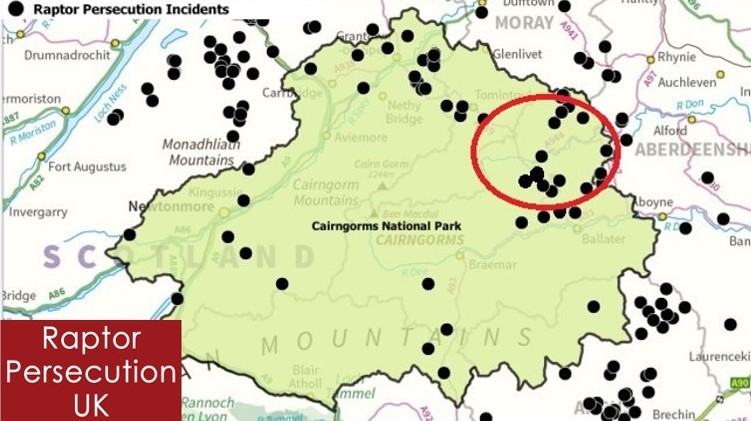
This is a map I published in 2020 following the discovery of a poisoned White-tailed eagle on an unnamed grouse moor in the area (here).
The black dots on the map represent raptor persecution incidents recorded between 2005-2020, based on data from the RSPB, the 2017 golden eagle satellite tag review, and other data in the public domain. The Strathdon area is circled. For more details about some of the previous incidents in the Strathdon area please see this earlier blog here.
It seems apparent that today’s statement from Police Scotland is in relation to their Feb 2025 appeal for information about the shot Red Kite, but note that today’s statement mentions ‘the death of Red Kites‘ (plural), not just one.
Definitely a case to watch closely.
NB: As charges have been laid proceedings are now considered to be live so comments have been turned off.
UPDATE 9 December 2025: Two Scottish gamekeepers on trial today in relation to alleged killing of Red Kites in Cairngorms National Park (here)
UPDATE 9 December 2025: Alleged killing of Red Kites in Cairngorms National Park – trial of two gamekeepers adjourned as Sheriff recuses himself due to RSPB membership (here)
Further to the news about the conviction and sentencing of Lincolnshire farmer/gamekeeper John Bryant for multiple offences at Grange Farms, West Ashby in October 2022, relating to an investigation into the illegal persecution of birds of prey (see here, here and here), Lincolnshire Police’s Rural Crime Team has provided some information about the revocation of Bryant’s shotgun and firearms certificates.
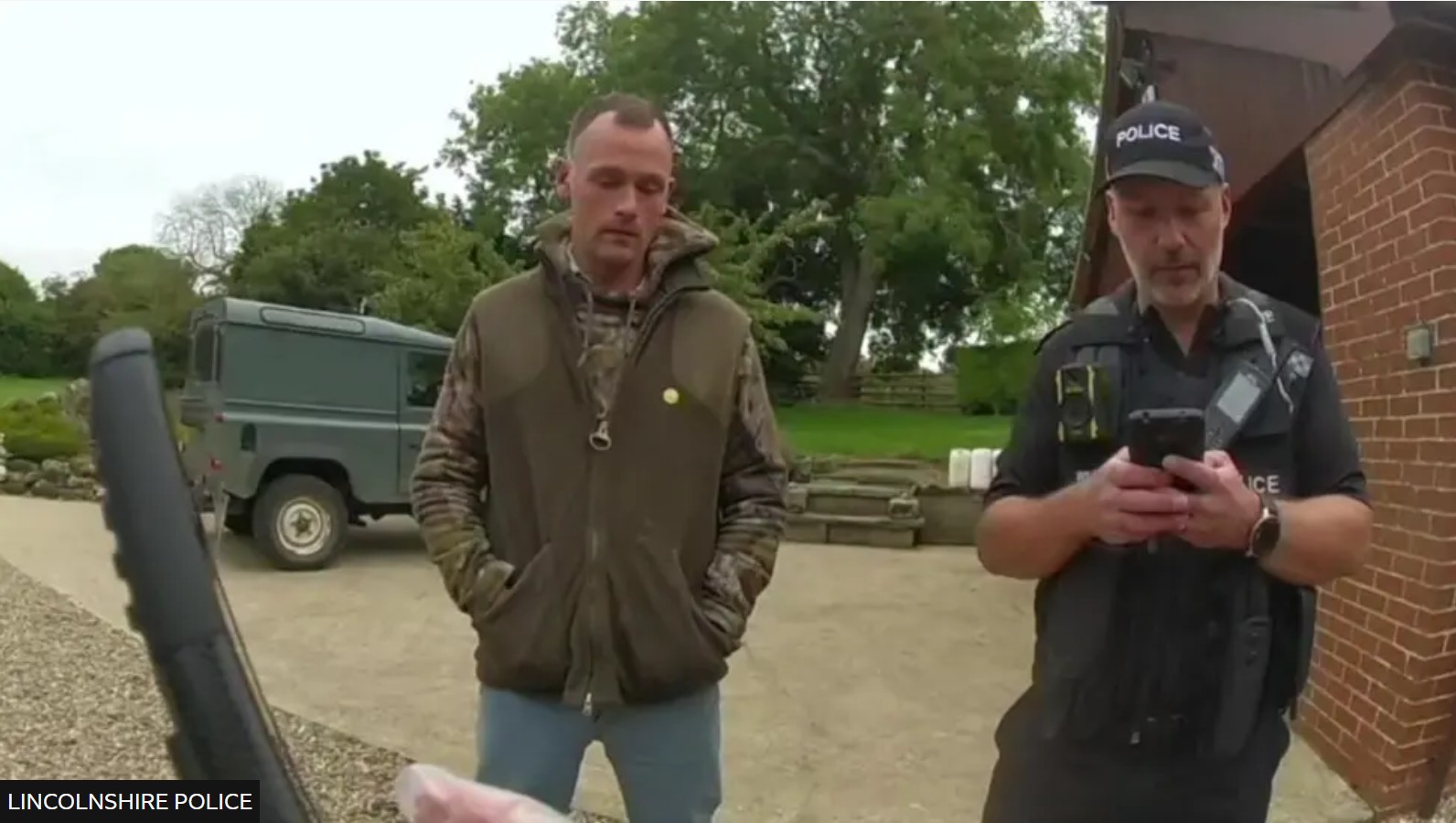
Convicted farmer/gamekeeper John Bryant
“We have been asked about his firearms/shotgun certificates.
“As a direct result of this investigation. Both from matters revolving around the storage and security of firearms and ammunition along with this case being brought against him, his authority to possess firearms and shotguns was also withdrawn. In other words, Lincolnshire Police revoked those certificates so he could no longer possess licensable guns.
“This was contested at Lincoln Crown Court whereby his legal team failed to argue the case and judgement was held in support of the Police decision to revoke them.
“This should also stand as a warning to all certificate holders. One criminal act can easily lose you your right to possess firearms, but also the way you store/secure/keep those firearms can also have a huge detrimental impact on those certificates“.
It sounds then, that in addition to the charges against Bryant for the poison and trap offences, there was also an issue about the storage and security of his firearms and ammunition, although I haven’t seen any report of charges being brought against him for those alleged offences, just a revocation of his licences.
Given that the appeal hearing against his firearms and shotgun licence revocations was held at Lincoln Crown Court (date unknown), this probably accounts for at least some of the reported £100,000 costs incurred by Bryant for his defence, as mentioned in court during his sentencing hearing yesterday.
Looking at the account’s for Grange Farms (West Ashby) Ltd, held on Companies House website, which lists Bryant as one of several Directors (here), the family’s company can easily afford to cover Bryant’s own legal costs in addition to the fine and costs he received from the court (£7,449) from the company’s £1 million+ capital and reserves.
I do wonder about the firearms and shotgun revocations though. Can other family members, residing and/or working at the same property, hold their own certificates and thus legitimately keep firearms and shotguns on the premises? And if so, what measures are taken to ensure John Bryant doesn’t have access to them?
These are genuine questions. I’d welcome the opinion of any firearms experts who might be reading this.
Further to today’s earlier blog on the sentencing of Lincolnshire gamekeeper John Bryant who was found guilty of multiple crimes after a police investigation into the illegal killing of a red kite and two buzzards (see here), the RSPB Investigations Team has issued the following press release:
GAMEKEEPER ORDERED TO PAY OVER £7,000 AFTER BEING FOUND GUILTY OF POISON AND TRAP-RELATED OFFENCES
Numerous birds of prey had been poisoned in the Belchford area of Lincolnshire over a number of years, leading to a police investigation.
Police uncovered large quantities of banned poison and illegal traps on the gamebird shoot.
The RSPB is urging the government to introduce a licensing scheme for all gamebird shooting, with the sanction to remove licences to shoot if wildlife protection laws are broken, and to act as a meaningful deterrent to bird of prey crimes in particular.
After a two-day trial at Lincoln Magistrates’ Court, John Bryant (40), of West Ashby, Horncastle was found guilty on 7 March 2025 in relation to four offences. He was sentenced on 20 March 2025 and ordered to pay £7,449 in total – including £2112 in fines for the four offences, £4,492 in costs and a victim surcharge of £845. The court heard how a number of birds of prey were found poisoned in the Belchford area over several years, and how Lincolnshire Police then led a multi-agency search on a pheasant and partridge shoot at Grange Farms, West Ashby in October 2022 together with the RSPB, National Wildlife Crime Unit (NWCU) and Natural England.
This case is yet another example of why the RSPB is urging Westminster to introduce a system of licensing for gamebird shooting, to afford birds of prey better protection, and to follow Scotland’s lead on licensing all grouse shooting as a positive start.
Bryant, a gamekeeper and farmer, pleaded guilty to two offences relating to the illegal storage and usage of Alphachloralose. Alphachloralose can be legally used as a poison for rodents using products at 4% concentration or lower. However, during a search of his home, police found the poison illegally decanted into pots in the suspect’s vehicle and outbuilding. These two pots were tested under the WIIS (Wildlife Incident Investigations Scheme) run by Natural England, and found to contain banned and highly dangerous levels (85% and 88%) of the deadly substance. Alphachloralose remains one of the most common substances used for poisoning birds of prey.
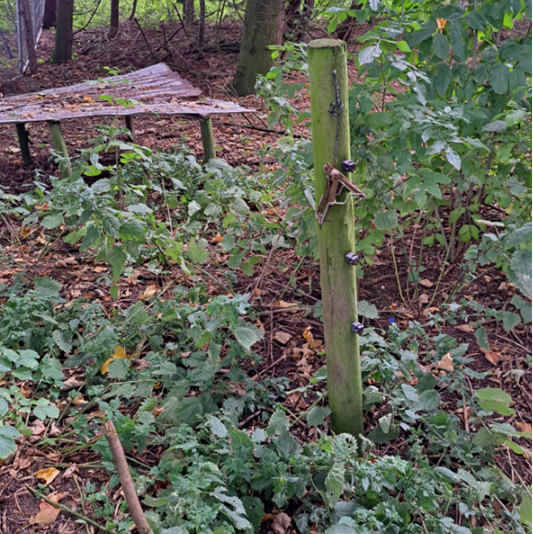
Bryant was also found guilty of two offences relating to the possession of two pole traps, deemed as items capable of committing a wildlife offence. Police found unset spring traps (similar to a powerful mouse trap) hanging from wooden posts at two locations on land managed by Bryant. This set up is commonly recognized as a pole trap, used to catch and brutally injure birds of prey that perch on the post when hunting. Pole traps have been banned since 1904.
Forensic DNA analysis conducted by SASA (Science and Advice for Scottish Agriculture) found traces of Tawny Owl and wood pigeon DNA on one spring trap and the other spring trap tested positive for wood pigeon DNA. Bryant was found not guilty of setting any pole traps.
The District Judge said he found it unrealistic that Bryant would not have known the pole traps were on his land, which had been part of his defence.
Police also found four unset gin traps in an outbuilding belonging to the suspect. Forensic DNA analysis conducted by SASA found bird of prey DNA on three of the gin traps (a mechanical device, illegal in the UK since 1958, designed to catch an animal by the leg using spring-operated jaws). Two had Buzzard DNA on them, with a Sparrowhawk feather identified in the jaws of a third trap. Bryant was charged in relation to possession of the gin traps being items capable of committing a wildlife offence, but was found not guilty.
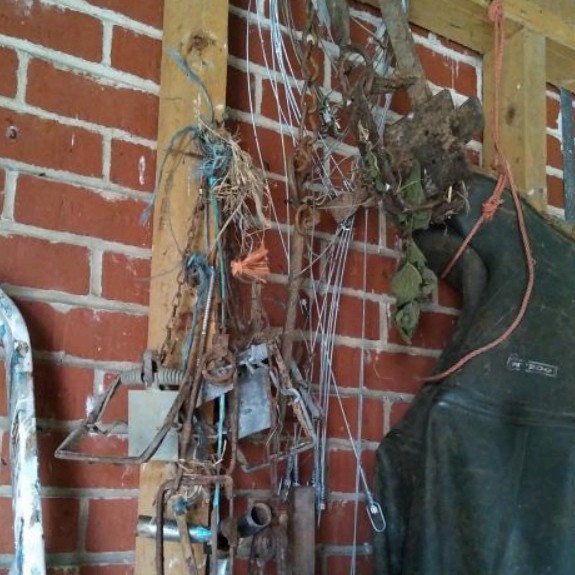
An assortment of traps found in Bryant’s garage. Photo: RSPB
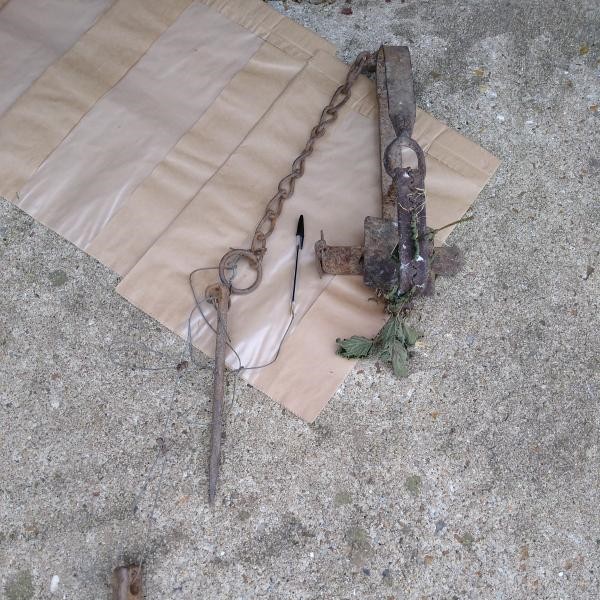
One of the gin traps with what look like relatively fresh nettles caught in the jaw. Photo: RSPB
Several birds of prey have been found poisoned in the Belchford area over a number of years. In 2022 a Buzzard was found poisoned by Alphachloralose. In 2020 another Buzzard was killed having ingested the banned insecticide Aldicarb, and in 2017 a Red Kite was killed by Alphachloralose. Bryant was not charged in relation to poisoning any of these birds.
It is illegal to intentionally kill, injure or take a wild bird in the UK under the Wildlife and Countryside Act 1981. Yet the persecution of raptors persists, particularly in connection with land managed for gamebird shooting. Of all individuals convicted of bird of prey persecution-related offences from 2009 to 2023, 68% have been gamekeepers.
Howard Jones, RSPB Senior Investigations Officer, said:
“This case highlights the immense value of police searches in relation to bird of prey persecution which clearly has been an issue in this area. This search found illegal poisons being used in a hugely dangerous manner, putting the public and wildlife at risk, along with a number of illegal traps.
“We are urging the UK Government to introduce a system of licensing for all gamebird shooting, whereby this licence to operate could be revoked if crimes against birds of prey are detected on an estate. This would set a better precedent and act as a greater deterrent to those tempted to commit these crimes. “We thank Lincolnshire Police, and in particular DC Aaron Flint, on an excellent investigation into this case, demonstrating the value in strong partnership working in tackling bird of prey persecution“.
DC Aaron Flint, Forces Wildlife Crime Officer at Lincolnshire Police, said:
“Unfortunately, this case is just one of a large number of bird of prey poisonings reported in Lincolnshire in recent years. However, the outcome demonstrates that Lincolnshire Police takes bird of prey persecution seriously. We thoroughly investigate any reports that relate to criminal activity around birds of prey. Our message is this: If you commit crimes against wildlife in Lincolnshire, we will identify you and you will be put before the courts.
“This investigation was made possible through close collaboration with multiple agencies, and I want to express my gratitude to the National Wildlife Crime Unit, the RSPB, Natural England, CPS and SASA for their invaluable support. The Forensic Analysis Fund also played a vital role in advancing this investigation“.
Chief Inspector Kevin Lacks-Kelly, Head of the UK National Wildlife Crime Unit:
“Thanks to the work of Police and Partners we have seen justice delivered. This conviction sends a strong message that bird of prey crime will not be tolerated, and you will feel the full force of the national policing capability. These offences are not only cruel, the undermine the conservation of our vulnerable wildlife. These birds should be free for us all to enjoy, not consigned to a police evidence bags.”
If you have information about anyone killing birds of prey which you wish to report anonymously, call the RSPB’s confidential Raptor Crime Hotline on 0300 999 0101.
ENDS
Well done to Lincolnshire Police Rural Crime Team and the partner agencies whose hard work resulted in Bryant’s conviction.
£7,000 is a relatively small fine given the seriousness of Bryant’s crimes, although when compared with some of the recent pathetic fines handed out by courts for wildlife crimes, this figure can be viewed as being substantial.
I’ve also been told by a blog reader who was observing proceedings in court, that it was mentioned that Bryant’s defence costs were £100,000. If that figure is accurate then he certainly has taken a big financial hit.
Earlier this month, following a trial at Lincolnshire Magistrates Court, gamekeeper John Bryant, 40, of West Ashby, Horncastle was found guilty of multiple offences following a police investigation into the illegal killing of a red kite and two buzzards over a five year period (see here).
Sentencing was deferred until this morning.
Lincolnshire Police have just issued the following statement:
MAN SENTENCED FOR POSSESSING DANGEROUS CHEMICALS AND BIRD TRAPS
A farmer and game keeper who used illegal traps and stored dangerous chemicals has been sentenced.
Police officers found the items after an investigation into the deaths of three birds of prey led them to the property of John Bryant from West Ashby in Horncastle.
The 40-year-old pleaded guilty to two charges and was found guilty of two more under the Wildlife and Countryside Act and Healthy and Safety Regulations when he appeared at Lincoln Magistrates’ Court earlier this month.
Investigators found the dead birds – a red kite and two buzzards – just north of West Ashby; forensic analysis determined they had been poisoned.
The findings led officers to execute a warrant and search Bryant’s land on 4 October 2022 where items were found which suggested he was targeting birds of prey using poison and traps.
Lincolnshire’s Rural Crime Action Team was joined by the Royal Society for the Protection of Birds, the National Wildlife Crime Unit, and Inspectors from Natural England to carry out the warrant.
A chemical identified as Alphachloralose – typically used to kill rodents and which is also one of the most common substances known to poison birds of prey – was discovered in a vehicle being used by Bryant with a second tub containing the same product later being found in his garage.
The chemical was highly concentrated with levels found to be over 80% meaning it is a banned and highly dangerous substance.
Illegal traps were also found in the search.
Two pole traps, which are specifically used to kill birds of prey, were recovered at the property at two pheasant release pens and found to contain tawny owl and pigeon DNA.
One of the illegal pole traps found at Bryant’s pheasant pen. These barbaric traps have been banned in the UK since 1904! Photo via Lincolnshire Police
Bryant pleaded guilty to two charges of storing Alpha Chloralose at his home and was found guilty of two charges of possessing a spring trap tethered to a pole. These relate to contravening Health and Safety Regulations and the Wildlife Countryside Act.
He was found not guilty of a further two counts of possessing Alpha Chloralose; two counts of using a spring trap tethered to a pole; and two counts of possessing gin traps.
Bryant was sentenced today and must pay fines of £2112, he must pay costs of £4492 and a victim surcharge of £845.
Due to his conviction, Bryant can no longer use a General Licence to carry out vermin control.
The sentence concludes a lengthy investigation that took years to bring to court and saw Lincolnshire Police work with a variety of partners to bring Bryant to justice.
It showcases the hard work, determination and tenacity of our Rural Crime Action Team and our commitment to protecting the county’s animals, not just its people.
DC Aaron Flint, Force Wildlife Crime Officer, Rural Crime Action Team, said:
“Unfortunately, this case is just one of many birds of prey poisonings reported in Lincolnshire in recent years. However, the outcome demonstrates that we and other agencies will take raptor persecution very seriously.
“We thoroughly investigate any reports that relate to criminal activity around birds of prey.Our message to anyone who unlawfully harms or kills our iconic wildlife is this; If you commit crimes against wildlife in Lincolnshire, we will identify you and you will be put before the courts where the evidence allows.
“This investigation was made possible through close collaboration with multiple agencies, and I want to express my gratitude to the National Wildlife Crime Unit, the Royal Society for the Protection of Birds, Natural England, and the Wildlife DNA Forensic unit at SASA for their invaluable support.
“The Forensic Analysis Fund also played a vital role in advancing this investigation and the Wildlife Specialist at the Crown Prosecution Service.”
Chief Inspector Kevin Lacks-Kelly, Head of the UK National Wildlife Crime Unit said:
“Thanks to the work of police and partners we have seen justice delivered. This conviction sends a strong message that bird of prey crime will not be tolerated, and you will feel the full force of the national policing capability.
“These offences are not only cruel, they undermine the conservation of our vulnerable wildlife. These birds should be free for us all to enjoy, not consigned to police evidence bags.”
Notes
Charges could not be brought under Section 1 of the Wildlife and Countryside Act 1981 in respect of the original three birds of prey as these are time-limited offences.
The Forensic Analysis Fund (FAF) offers financial support to police and customs officers seeking to carry out forensic analysis during a wildlife crime investigation -using funds donated from government departments and non-government organisations. For amounts up to £300 the scheme will cover full forensic costs. For amounts in excess of £300, the scheme will cover the initial £300 plus 50% of the remainder. The fund has been established to encourage the use of forensic techniques to help solve wildlife crimes and comes under the banner of the Partnership for Action against Wildlife Crime (PAW). Many wildlife cases which make use of forensic analysis would otherwise have failed to reach prosecution stage or be eliminated at an early stage. Founded in 2008, the scheme has already provided money to help support over 60 cases.
ENDS
UPDATE 18.20hrs: RSPB statement on conviction of Lincolnshire gamekeeper John Bryant (here)
Another trial and yet another gamekeeper convicted of offences relating to the illegal killing of birds of prey.
The trial of gamekeeper John Bryant, in relation to the illegal killing of a red kite and two buzzards, concluded at Lincolnshire Magistrates Court last week where he was convicted of four of ten alleged offences.
Gamekeeper Bryant, 40, of West Ashby, Horncastle, Lincolnshire had been summonsed to court last September following a police investigation into reports of three birds of prey, a red kite and two buzzards, being poisoned and killed over a five year period between 2017 and 2022.
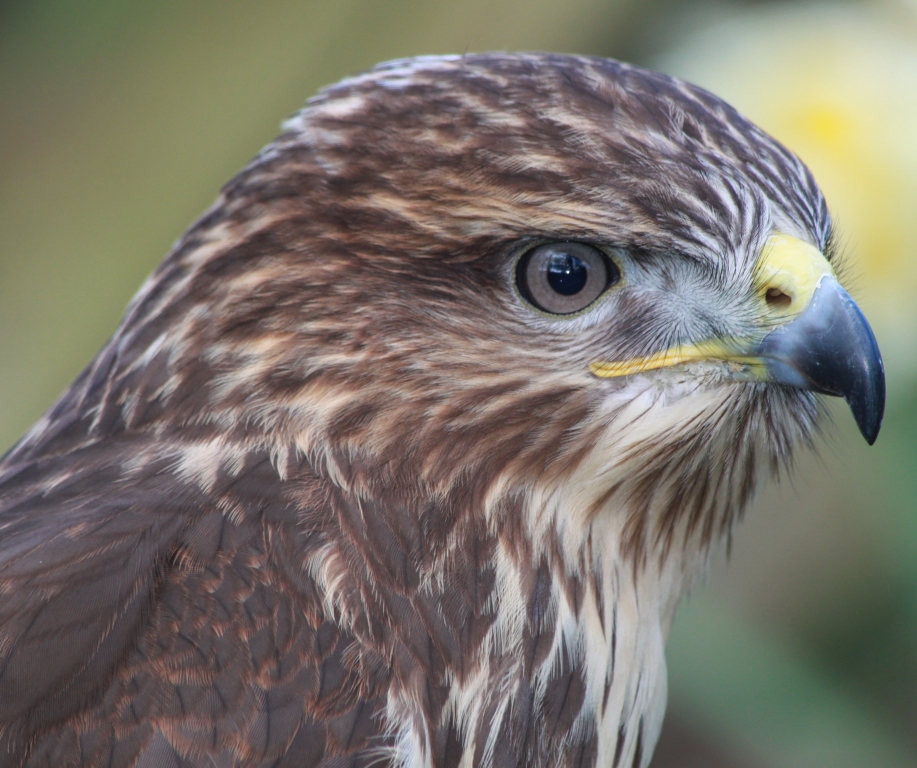
Buzzard photo by Ruth Tingay
Bryant had pleaded not guilty to ten charges (two charges of using a trap to kill or take a wild bird, six charges of possessing an article capable of being used to commit a summary offence, and two charges of contravening health & safety regulations) so he faced trial starting 6th March 2025.
He will be sentenced for the four offences next week when full details of the case and convictions will be published.
UPDATE 20 March 2025: Lincolnshire gamekeeper John Bryant sentenced for crimes relating to raptor persecution – police statement (here).
Many, many thanks to all of you who signed the Northern Ireland Raptor Study Group’s (NIRSG) petition calling for a ban on the possession of dangerous, raptor-killing pesticides.
The petition has just passed its target of 50,000 signatures and the NIRSG has issued the following press release:
The NIRSG held a recent Raptor Conference which provided incredible insights into a range of topics locally and globally. Many of the talks raised a consistent theme of targeted persecution of birds of prey. Not least amongst these was the on-going issue in Northern Ireland of the Possession of Dangerous pesticides.
Some of the NIRSG 2025 conference attendees supporting the call for a ban on dangerous, raptor-killing pesticides. Photo by Marc Ruddock
The NIRSG highlighted that 63 raptors have been killed between 2009 and 2023 with a range of poisons, dominated by Carbofuran which has been banned for nearly 25 years. There have been at least 30 buzzards, 16 peregrine falcons, 13 red kites, 3 white tailed eagles and 1 golden eagle all poisoned in this time frame.
This evidence is collated by the Partnership for Action Against Wildlife Crime in Northern Ireland (PAW NI) and published in raptor persecution reports, which include ‘hotspots’ of illegal killing of our native birds of prey. These reports are publicly available on the PAWNI webpage available here and also aggregated in the RSPB Bird Crime reports available here.
In 2011, the wildlife legislation in Northern Ireland was strengthened, resulting in increased sentences of £5,000 fines (per offence) and up to 6 months imprisonment. The updated laws included a provision to ban the possession of prescribed ingredients under “Section 15B Possession of pesticides harmful to wildlife” of the Wildlife (Northern Ireland) Order 1985 as amended.
As part of that legislation there should have been an attached Order listing the banned chemicals. That list has never been created. Wildlife has continued to be poisoned by these dangerous and banned substances.
The legislation states in Section 15B Part 2: “A prescribed ingredient is one which is prescribed for the purposes of this Article by an order made by the Department; but the Department may not make an order under this Article unless it is satisfied that it is necessary or expedient to do so in the interests of protecting wild birds or wild animals from harm”. [Emphasis added by NIRSG]
There is significant evidence of continued harm from banned pesticides to birds of prey, based on robust post-mortem and laboratory results, which has been published in many reports. We believe it is indeed expedient for Minister Andrew to implement this Order to protect our birds of prey from harm. 50,000 people agree with us. Thank you to everyone who has supported the petition and helped give a voice to our wildlife.
The NIRSG will be seeking a meeting with Minister Andrew Muir to present the petition now that it has surpassed 50,000 signatures.
Following yesterday’s news that a red kite has been found shot dead in the Glenbuchat area of Strathdon (here), the Cairngorms National Park Authority has issued the following statement:
STATEMENT ON RED KITE
28th February 2025
The Cairngorms National Park Authority has issued the following statement in relation to the death of a red kite in the Glenbuchat area of Strathdon:
“The Park Authority have been informed by Police Scotland that a red kite was found dead in the Glenbuchat area of Strathdon earlier this month. Police Scotland have confirmed that the red kite had been shot.
The shot red kite. Photo by RSPB Scotland
“The Park Authority condemns the illegal killing of raptors in the strongest possible terms. Raptor persecution has no place in 21st century Scotland but sadly incidents such as this are still taking place. It is an unacceptable crime that not only harms our raptor populations, but also damages the reputation of those land managers that act lawfully and work hard to care for wildlife.
“We are committed to working with partners to make sure the National Park is a safe haven for raptors and to establish the full circumstances of this incident. Anyone with information is asked to contact Police Scotland on 101, quoting incident number 0846 of Thursday 27 February. Alternatively, you can contact Crimestoppers on 0800 555 111 where information can be given anonymously”.
Press release from Police Scotland (28 February 2025):
APPEAL FOR INFORMATION AFTER BIRD OF PREY SHOT NEAR STRATHDON
Officers are appealing for information after a bird of prey was shot near Strathdon.
On Wednesday, 26 February 2025, we received a report of a red kite having being shot sometime between Monday, 3 and Tuesday, 4 February in the Glenbuchat area of Strathdon after being found by a member of the public.
The bird was recovered with the assistance of the Royal Society for the Protection of Birds (RSPB) where the cause of death was not apparent at that time. Following further investigations, it has been established that the bird had been shot and police were contacted.
Detective Constable Danny Crilley of the Wildlife Crime Unit said: “Red kites are protected under the Wildlife and Countryside Act and it is illegal to kill any protected species.
“Enquiries are ongoing and we are working with our partner agencies to establish the full circumstances of this incident.
“I would appeal to anyone with any information that may assist our investigation to contact us. Your information could be vital in in establishing what has happened. If you were in the Glenbuchat area on Monday, 3 or Tuesday, 4 February, and saw anything suspicious or have any information about shooting activity in the area, please contact us.
“Anyone with information is asked to contact Police Scotland on 101, quoting incident number 0846 of Thursday, 27 February. Alternatively, you can contact Crimestoppers on 0800 555 111 where information can be given anonymously.”
ENDS
First of all, well done to Police Scotland for issuing a speedy appeal for information, just two days after being notified about this shot red kite.
It’s not clear from the press release whether this shot raptor was found on or next to a grouse moor. However, the ‘Glenbuchat area of Strathdon’ is certainly in close proximity to land managed for driven grouse shooting.
The Strathdon area of the Cairngorms National Park has long been recognised as a raptor persecution hotspot, as this map demonstrates:
This is a map I published in 2020 following the discovery of a poisoned White-tailed eagle on an unnamed grouse moor in the area (here).
The black dots on the map represent raptor persecution incidents recorded between 2005-2020, based on data from the RSPB, the golden eagle satellite tag review, and other data in the public domain. The Strathdon area is circled.
Those incidents in Strathdon include a poisoned raven (2006), a poisoned common gull (2006), multiple poisoned baits (2006), a shot buzzard (2009), a poisoned golden eagle (2011), a poisoned buzzard (2011), poisoned bait (2011), a shot short-eared owl (2011), two satellite-tagged golden eagles ‘disappearing’ (2011), another satellite-tagged golden eagle ‘disappearing’ (2013), a satellite-tagged white-tailed eagle ‘disappearing’ (2014), a goshawk nest shot out by masked men (2014), a shot goshawk (2016), another satellite-tagged golden eagle ‘disappearing’ (2017), a satellite-tagged hen harrier ‘disappearing’ (2018), another satellite-tagged hen harrier ‘disappearing’ (2019), and another satellite-tagged hen harrier ‘disappearing’ (2020).
Nobody was prosecuted in any of these cases.
The Strathdon area was also identified as a golden eagle persecution hotspot in the Scottish Government-commissioned scientific report, Analyses of the fates of satellite-tracked golden eagles in Scotland, published in 2017 and eventually leading to the introduction of the grouse moor licensing scheme in 2024:
It would be interesting to know whether this shot red kite was found on or next to a grouse moor and if it was, whether an associated grouse moor licence will be revoked as a consequence, which was the clear intention of the Scottish Parliament when it voted through the Wildlife Management & Muirburn (Scotland) Act 2024 almost a year ago last March.
My guess is that it won’t lead to a licence revocation, even if the red kite was found on or close to a grouse moor, because it will be virtually impossible to connect its death to the management of the grouse moor (as the new, shambolic and unenforceable licence condition now specifies).
Just like the shot osprey found in the Angus Glens on the opening day of the grouse-shooting season in August 2024 (here) and the shot peregrine, also found in the Angus Glens, in September 2024 (here), there won’t be any consequences for those responsible.
The raptor killers are still at, and they’re still getting away with their crimes.
For those who think the grouse moor licensing scheme is failing, and that the Scottish Government hasn’t shown any signs of intending to fix it even though it acknowledges there are issues (e.g. see here), there’s an alternative option – and that is to ban driven grouse shooting.
Wild Justice currently has a live petition calling for such a ban. It’s been supported by 67,432 members of the public so far but needs 100,000 signatures to trigger a Parliamentary debate. Please sign here to support it.
UPDATE 1st March 2025: Cairngorms National Park Authority condemns latest shooting of red kite (here)
UPDATE 2 May 2025: Two men charged in relation to illegal killing of Red Kites in Cairngorms National Park (here)
UPDATE 9 December 2025: Two Scottish gamekeepers on trial today in relation to alleged killing of Red Kites in Cairngorms National Park (here)
UPDATE 9 December 2025: Alleged killing of Red Kites in Cairngorms National Park – trial of two gamekeepers adjourned as Sheriff recuses himself due to RSPB membership (here)
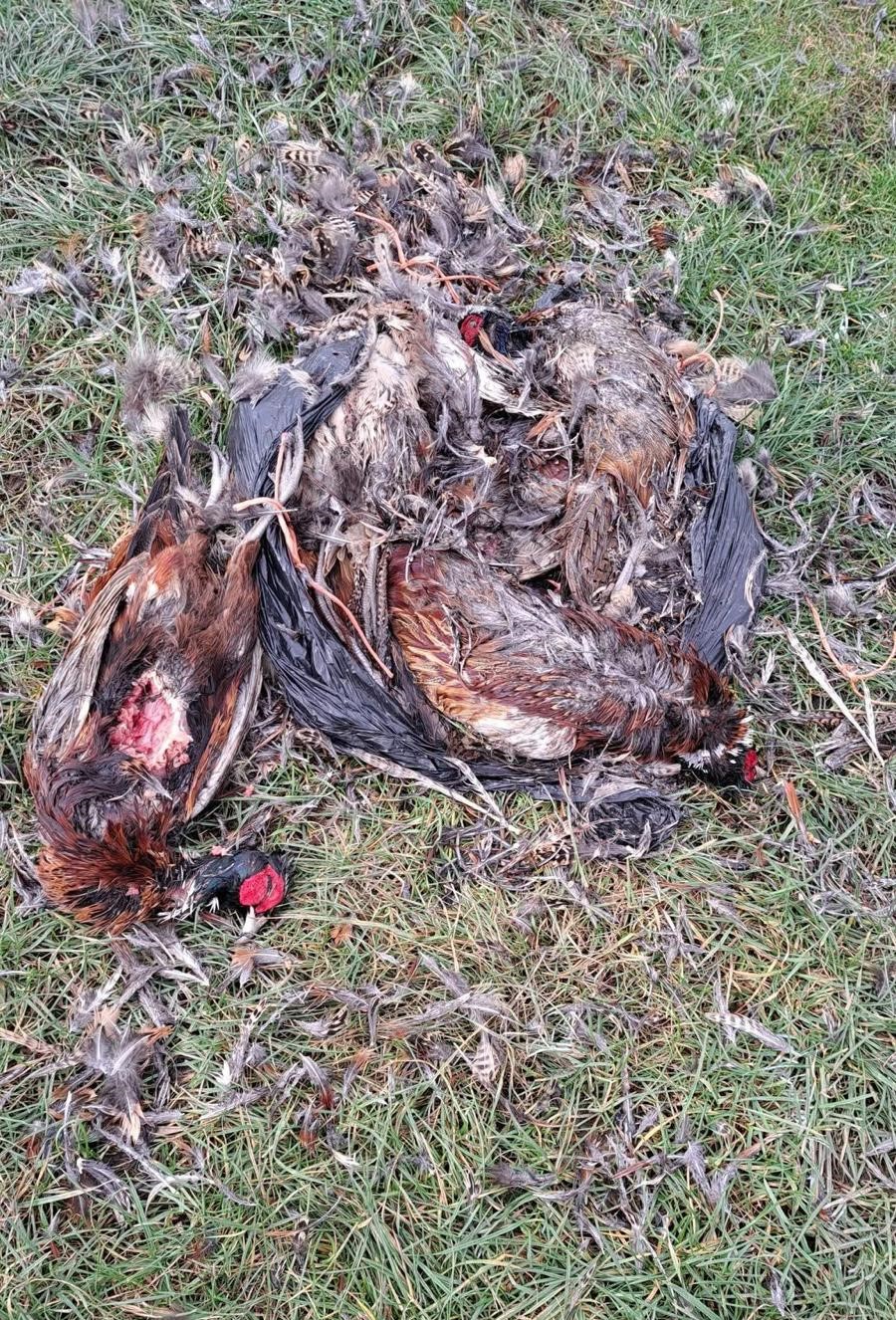
Hot on the heels of my recent blog about the discovery of shot & dumped pheasants and geese in Nottinghamshire (here), another fly-tipping incident has been reported, this time involving the dumping of four shot pheasants inside a black plastic bag in Lincolnshire.
These were discovered on 16 Feb 2025 by a member of the public at the edge of farmland in Bourne, Lincolnshire. The finder said the bag had split open and she’d observed red kites feeding on the carcasses, evidenced by the amount of plucked feathers next to the bag. What’s the betting these pheasants were shot with toxic lead ammunition, now slowly poisoning the native wildlife? If the lead poisoning doesn’t get them, the Avian Influenza probably will.
The orange baler twine shown in the photograph is indicative that these pheasants had been killed on a nearby shoot (gamebirds are often tied together in a brace with baler twine and hung up to allow the air to get to them). It’s likely these four birds were given to a shoot participant to take home and he/she decided to dump them instead because they’d already served their purpose as live targets shot for entertainment.
Regular blog readers will know that the dumping of shot gamebirds is a common and widespread illegal practice that has been going on for years, despite the repeated denials by the shooting industry. Who else do they think is doing this if not the people involved in gamebird shooting?! The disposal of animal by-products (including shot gamebirds) is regulated and the dumping of these carcasses is an offence.
Previous reports include dumped birds found in Cheshire (here), Scottish borders (here), Norfolk (here), Perthshire (here), Berkshire (here), North York Moors National Park (here) and some more in North York Moors National Park (here) and even more in North Yorkshire (here), Co. Derry (here), West Yorkshire (here), and again in West Yorkshire (here), N Wales (here), mid-Wales (here), Leicestershire (here), Lincolnshire (here), Somerset (here), Derbyshire’s Peak District National Park (here), Suffolk (here), Leicestershire again (here), Somerset again (here), Liverpool (here), even more in North Wales (here) even more in Wales, again (here), in Wiltshire (here) in Angus (here), in Somerset again (here), once again in North Yorkshire (here), yet again in West Yorkshire (here), yet again in mid-Wales (here), even more in mid-Wales (here), more in Derbyshire (here), Gloucestershire (here) more in Cheshire (here), some in Cumbria (here), some more in the Scottish Borders (here) and again in Lincolnshire (here) and in Nottinghamshire (here).
Unless someone was seen dumping these shot gamebirds there’s no way of knowing who did it or from which gamebird shoot they originated. There’s no requirement for shoot managers to fit identifying markers to their livestock, which would make them traceable, because gamebird ‘livestock’ absurdly changes legal status to ‘wildlife’ as soon as the birds are released from the rearing pens for shooting (see Wild Justice’s blog on Schrodinger’s Pheasant for details).
Obviously, it’s irresponsible (and illegal) to dump shot gamebirds at any time but especially so when the UK Government (and Scottish Government and now also the Welsh Government) has declared a nationwide Avian Influenza Prevention Zone (AIPZ) due to the heightened risk of the spread of highly pathogenic Avian Influenza (Bird Flu) amongst captive and wild birds.
These declarations make it a legal requirement for all bird keepers to follow strict and enhanced biosecurity measures to help protect their flocks from the threat of Avian Influenza. In some areas, the risk is considered so severe that mandatory housing measures have also been declared.
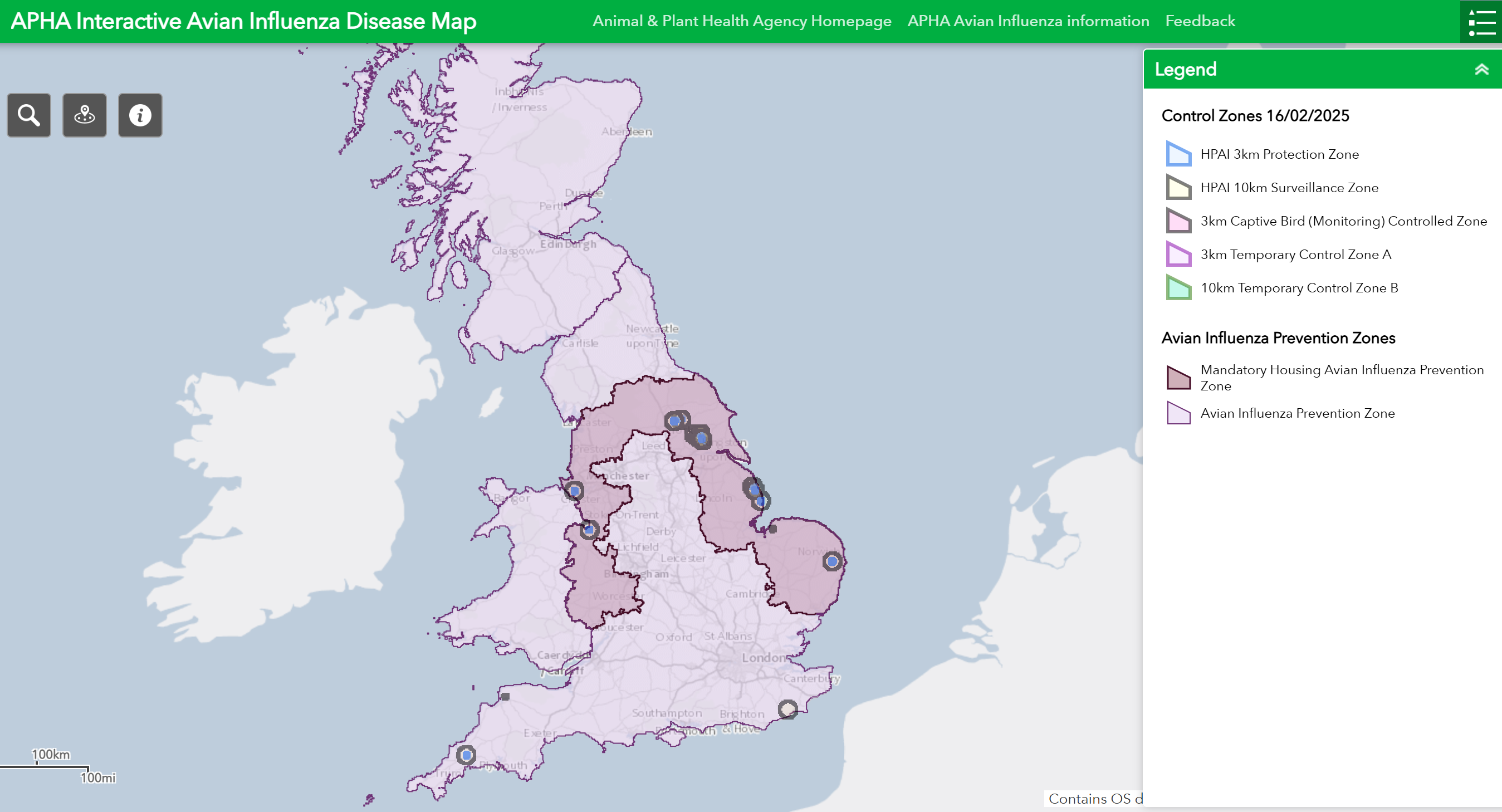
The Mandatory Housing Avian Influenza Prevention Zone was previously declared in the East Riding of Yorkshire, City of Kingston Upon Hull, Lincolnshire, Norfolk, Suffolk, Shropshire, York and North Yorkshire. However, as of 16 February 2025, this has now been extended to cover Herefordshire, Worcestershire, Cheshire, Merseyside and Lancashire, as shown on this map:
The latest dumped pheasants found inside a black sack were discarded in Bourne, Lincolnshire, which also happens to be inside the regional Mandatory Housing Avian Influenza Prevention Zone.
I can’t imagine that the farmers in this area, who are having to implement the very highest levels of biosecurity measures and cover the financial strain of all that entails, will be impressed with the thoughtless, feckless and unaccountable actions of the gamebird shooting industry who yet again do what they like, when they like and to hell with the consequences because there aren’t any.





 Raptor Persecution UK