Another huge penalty for raptor poisoning offence in Spain

There have been a number of raptor poisoning cases in the news recently, including the illegal killing of a white-tailed eagle found on a grouse moor inside the Cairngorms National Park in Scotland (here), the mass poisoning of 23 buzzards in a field in Co Cork, Ireland (here), the poisoning of four peregrines on Guernsey in the Channel Islands (here), the poisoning of a family’s pet dog, believed to have consumed a poisoned bait intended for birds of prey in Nidderdale, North Yorkshire (here), the poisoning of a buzzard found dead on a grouse moor in the North York Moors National Park (here), the poisoning of a buzzard in Nidderdale, North Yorkshire (here) and the suspected poisoning of numerous raptors in Derbyshire including three peregrines, two buzzards and one kestrel, all pending toxicology results (here). More on some of those suspected cases shortly.

The connecting feature of all these incidents is that, in all probability, the poisoners will evade justice.

[Illegally poisoned sea eagle. Photo by Police Scotland]

It’s incredibly rare to secure a conviction for poisoning birds of prey in the UK, mainly due to the difficulty of securing sufficient evidence to link the crime to the actual individual who laid the bait. For example if the poisoned bait had been laid out on a large game shooting estate there could be numerous suspects (e.g. gamekeepers), who will all give ‘no comment’ interviews to the police, thus making it virtually impossible for the police to determine which one of them should be charged.

And even in a case where three golden eagles were found illegally poisoned on the same grouse moor, and an enormous stash of banned Carbofuran poison was found in the gamekeeper’s locked shed, reportedly to which only he had the key, he still wasn’t charged with killing those eagles, only for possession of the banned poison (see here).

There have been a few successful prosecutions for raptor poisoning over the years, but the subsequent penalties have been so utterly feeble they simply haven’t acted as a suitable deterrent for others (e.g. see here, here and here).

Meanwhile, over in Spain where tackling the illegal killing of birds of prey is taken seriously with, for example, the deployment of specialist poison detection dogs, resulting in massive fines, custodial sentences and extended hunting disqualifications for those convicted of laying poisoned baits (e.g. see here, here, here, here), another poisoner has just been sentenced this week.

According to these articles (here and here), an unnamed farmer has just been convicted of poisoning two red kites in Cabeza de Buey (Badajoz) in 2018 and has been ordered to pay a 20,000 EURO fine (the estimated value of the two red kites). He also received a two-year hunting disqualification.

Compare that response with what we’ve seen in Scotland this last week – an illegally poisoned white-tailed eagle, killed with a banned pesticide, found dead inside a National Park in an area where at least seven eagles have now been either illegally killed or have disappeared in suspicious circumstances.

There was a wholly inadequate response from a junior Environment Minister (here) followed by total silence from the Environment Cabinet Secretary and the First Minister, despite unprecedented public uproar urging action (see here and here).

Interesting, isn’t it?

Dog poisoning confirmed in Nidderdale raptor persecution hotspot

In April during lockdown, two pet dogs became ill during a walk in Pateley Bridge in Nidderdale. One of them (Molly) subsequently died and the vet suspected poisoning.

[Molly (left) and Poppy, photo via North Yorkshire Police]

Samples were submitted for toxicology, although analysis was delayed due to Covid19. Meanwhile, North Yorkshire Police issued a warning notice (here) for local residents to take extra care, especially as illegal poisoned baits had been used in the area many times before, killing birds of prey, especially red kites (here).

Just a couple of weeks ago North Yorkshire Police, along with poisons experts from Natural England and persecution experts from RSPB, conducted high profile raids at several Nidderdale addresses as they continue to investigate ongoing poisoning crimes (see here).

The toxicology results confirmed that Molly had died after ingesting what has widely become known as the ‘Nidderdale Cocktail’ – a lethal combination of four pesticides (Bendiocarb, Chloralose, Isophenphos and Carbofuran) that has been identified in a number of raptor persecution poisoning crimes.

It’s interesting to note that this particular ‘cocktail’ isn’t restricted to use in Nidderdale; it has also been used on several estates elsewhere in England and Scotland. Wouldn’t it be fascinating to see whether there was a common link between these various estates, you know, something like a shared agent or perhaps a gamekeeper who’s worked on all the estates?

On Wednesday, North Yorkshire Police issued the following press release seeking more information about the poisoning of Molly:

Police appeal for information after dog dies from suspected pesticide abuse

Properties searched as investigation into poisoning continues

North Yorkshire Police is appealing for information as part of an ongoing investigation into the poisoning of two pet dogs, believed to be as a result of pesticide abuse.

On 23 April 2020, two spaniel dogs fell seriously ill immediately after a walk, with their owner, in the countryside near Pateley Bridge. The dogs were rushed to the vets and whilst one of the two recovered, the second was so severely ill that she did not survive.

The incident was reported to the police and local area searches conducted, as a well as a warning put out to other dog owners. Samples taken from the dog which died were submitted to the Wildlife Incident Investigation Scheme (WIIS) administered by Natural England and the results showed the presence of four pesticides. The dog had a significant quantity of Bendiocarb in its system, along with smaller quantities of Chloralose, Isofenphos and Carbofuran. The tests concluded that exposure to these pesticides most likely caused this dog’s death and the severe symptoms suffered by the second dog.

The same combination of four poisons have been found to cause the deaths of two red kites and a buzzard in Nidderdale since 2016, with other cases of poisoned birds of prey in the area also involving one or more of the chemicals involved.

North Yorkshire Police Inspector, Matt Hagen, explains:

The fact we have seen this same combination of chemicals, the ‘Nidderdale cocktail’ as it is sometimes known, also cause the death of birds of prey in this same location would indicate that the poisons have been deliberately left in a place where they could be found by wildlife and unfortunately in this case, domestic pets.

Pesticide abuse of any kind will not be tolerated and we are doing everything we can to try and find those responsible.”

Following receipt of the test results and acting on local intelligence North Yorkshire Police conducted searches at a number of properties in the area with assistance from Natural England and the RSPB.  Unfortunately none of these searches resulted in any further evidence as to how these poisons reached the two dogs or who may have been responsible for this suspected pesticide abuse so officers are now appealing for information from the public.

Mark Thomas, Head of Investigations at the RSPB, said:

Nidderdale is surrounded by grouse moors and sadly we know from experience, and from the government’s own data, that there is a strong correlation between raptor persecution and driven grouse shooting. Carbofuran is one of the most commonly-abused substances in the poisoning of birds of prey. It is a highly toxic, banned substance, putting wildlife, pets and people at risk. This is not the first time harmful substances have been found left out in the open and sadly it unlikely to be the last. This reckless and irresponsible behaviour, which had led to the death of a beloved family pet, cannot be allowed to continue.”

Whilst Chloralose is licenced for use in England in a low concentration as a rodenticide, Bendiocarb, Isofenphos and Carbofuran are all banned from use in the UK. None of these chemicals should ever be used in an environment where domestic animals and/or wildlife should come into contact with them.

Anyone misusing or abusing pesticides may be committing a variety of offences. If you come across an object, often an animal carcass, which you believe may be contaminated with a pesticide or other poisons, do not touch it. Take as many photos and details as you can and report this to the police as soon as possible.

Dog owners worried by this incident should take care to keep their dogs on a lead or within sight and under control at all times when taking them for a walk. Dogs should only be walked on public rights of way or other land where the owner has permission to be.

Anyone with any information which could help the police in this investigation should call 101, quoting reference: 12200068444 or if you wish to remain anonymous call Crimestoppers on 0800 555 111.

ENDS

The RSPB also published a blog about this case, which includes comments from Molly’s owners (see here).

There’s also good coverage in the Yorkshire Post (here).

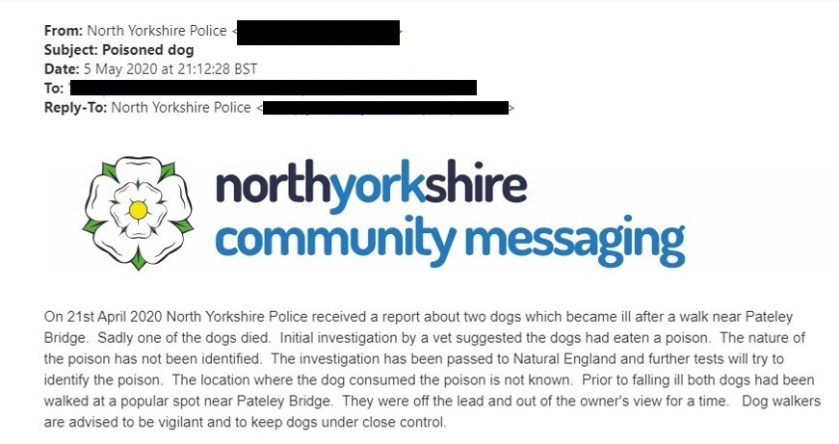
North Yorkshire police warn public of potential poisonous baits at Pateley Bridge

North Yorkshire Police are warning the public of potential poisonous baits at Pateley Bridge in Nidderdale following the suspected poisoning of two dogs in April. [August 2020: See update at foot of blog]

The following message was emailed to members of the local community last week:

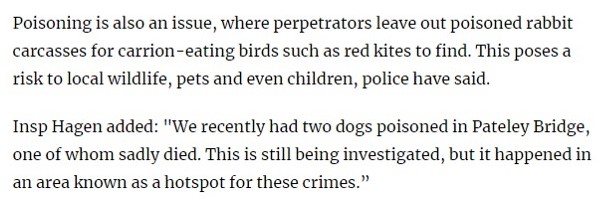
This suspected poisoning incident was referred to by the Police in a recent Yorkshire Post article about raptor persecution in the area:

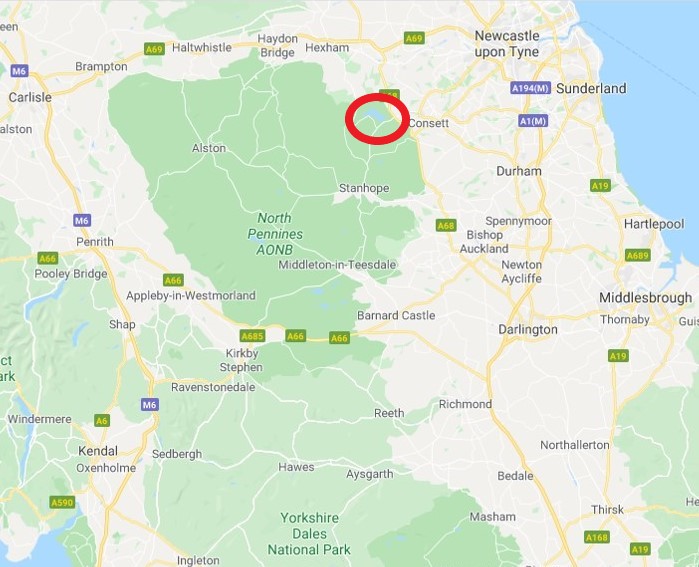
Nidderdale residents will be used to receiving these warnings; there have been several in recent years (e.g. see here, here, here, here, here, here, here) as illegal poisonous baits have been used routinely to kill off red kites inside this AONB and the surrounding area (e.g. see here).

Dog walkers are urged to keep their pets under close control and report anything suspicious to the police. DO NOT HANDLE A SUSPECTED POISONOUS BAIT – some of the chemicals used as poison are so dangerously toxic they have been banned from use in the UK.

UPDATE 1 August 2020: Dog poisoning confirmed in Nidderdale raptor persecution hotspot (here)

Birds of prey still being killed despite lockdown

Since lockdown began in March there’s been widespread concern that the illegal persecution of birds of prey would escalate, especially on grouse moors (e.g. see here) where fewer people are around to witness the crimes and/or the aftermath.

The UK’s grouse moors have been the epicentre of raptor persecution crimes for years; Mark Avery astutely described the National Parks that are dominated by grouse moors (e.g. Yorkshire Dales, North York Moors, Peak District, Cairngorms) as “massive wildlife crime scenes” (see here).

But of course, the threat to UK raptors isn’t just restricted to areas managed for driven grouse shooting. These birds are targeted and killed in the lowlands too, and quite often (although not exclusively) on land being managed for pheasant and partridge shooting.

Just two weeks ago a red kite was reported as shot on land managed for pheasant shooting, with another two birds also suspected to have been shot at the same location (see here).

It seems that the conservationists’ concerns were well founded. Despite the country being in the midst of a national crisis, and despite the shooting industry’s claims to have a ‘zero tolerance’ of raptor persecution (see here), the killing continues.

Police Supt Nick Lyall, Chair of the Raptor Persecution Priority Delivery Group (RPPDG, the so-called partnership that aims to tackle the illegal killing of raptors) tweeted this yesterday:

Nick singles out North Yorkshire but we’re also aware of a spate of other suspected raptor persecution crimes during lockdown, in a number of other counties across England and Scotland. Most of these have yet to be publicised as police investigations continue but hold on your hats, folks, when they are finally publicised the list is going to be long and damning.

Satellite-tagged red kite ‘disappears’ on grouse moor in North Pennines AONB

Press release from RSPB (30 April 2020)

Red kite vanishes in suspicious circumstances

Durham Police, the RSPB, the North Pennines AONB Partnership and Friends of Red Kites are appealing for information following the disappearance of a red kite in County Durham.

The young bird was fitted with a satellite tag at Rowlands Gill, near Gateshead in June 2019 by Friends of Red Kites (FoRK) with NERF support. It has been monitored since by the RSPB.

[Red kite ‘KK’ being fitted with a satellite tag as a nestling. Photo via RSPB]

The bird, nicknamed ‘KK’, toured northern England, making it as far as the Peak District, then returned north and has been faithful to the Derwent Valley region ever since.

KK’s tag had been functioning normally until it suddenly and unexpectedly stopped transmitting. The last fix came from an area of driven grouse moor near the Derwent Reservoir on 17 April. It has not been heard from since.

Emma Marsh, RSPB England Director, said: “If you’ve seen a red kite wheeling high overhead you’ll know that they’re splendid birds. They enrich our landscapes and bring joy to many.

When a tag which has been functioning reliably suddenly cuts out, this gives us immediate cause for suspicion. The additional fact that the tag’s last data fix came from an area dominated by driven grouse shooting rings serious alarm bells.

The connection between driven grouse shooting and the illegal killing of birds of prey has been well documented. Sudden, unexplained disappearances of tagged birds of prey are happening far too often in these landscapes. Satellite tags continue transmitting even after death, so if this bird had died naturally we would expect to be able to recover it.”

Red kites are specially protected under the Wildlife and Countryside Act (1981) which makes it an offence to deliberately kill or injure this species. Those found to have done so could be given an unlimited fine and/or a prison sentence.

Harold Dobson, spokesman for the Friends of the Red Kites, said: “It’s 15 years since the first red kites were re-introduced in the Lower Derwent Valley. They are faring well in the valley itself and we enjoy watching these impressive, majestic birds of prey.

As mainly scavengers, the red kites are of no threat to anyone. However, we fear that human persecution is preventing them from naturally expanding their range: since 2010, seven red kites have been found poisoned or shot near the Derwent Gorge and surrounding Durham Moorland. We fear that this may be the tip of the iceberg and that many more persecuted kites are never found.”

Inspector Ed Turner, the lead for wildlife and rural crime for Durham Constabulary said: “The fate of this red kite is not yet clear, we are working with the RSPB to establish what has happened since its transmitter unexpectedly stopped on 17 April 2020. Until we can rule out the possibility that a crime has not been committed, then we will be taking this matter very seriously and if anyone has any information please contact the police quoting 22042020-0078.

Chris Woodley-Stewart, Director of the North Pennines AONB Partnership, said: “Though the fate of this bird isn’t certain, the fact that it was carrying two reliable trackers means this looks very like a crime may have been committed. This is an area where a significant number of kites have been shot or poisoned and we’d really appeal to anyone who knows anything that might help shed light on this incident to come forward.”

If you have any information about this incident, please contact the police on 101, quoting the reference number 22042020-0078. Alternatively, if you have information about birds of prey being killed or targeted near you, please call the RSPB’s confidential Raptor Crime Hotline on 0300 999 0101.

ENDS

Red kite found shot dead on land managed for pheasant shooting in Wales

Three red kites have been found dead on land managed for pheasant shooting in Wales.

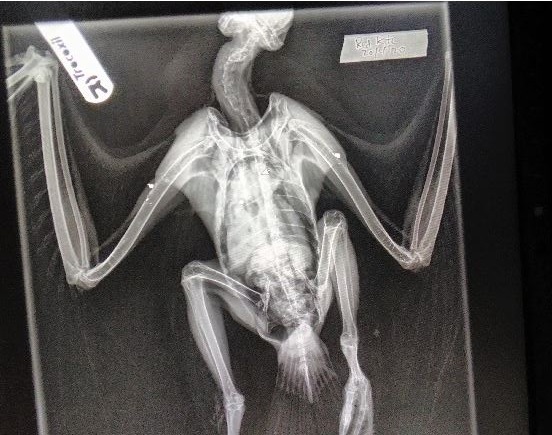
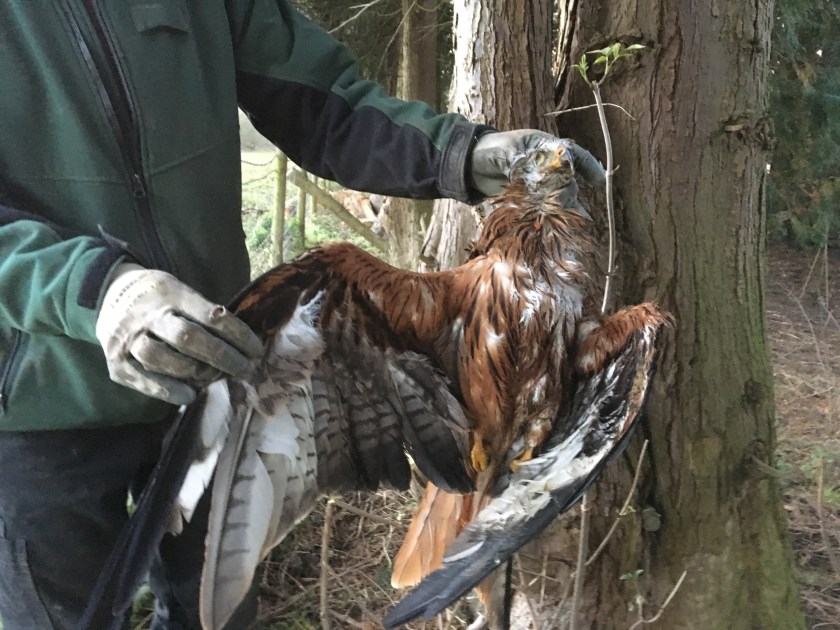
On Sunday (19 April 2020) two corpses were found by a member of the public and photographed but then ‘disappeared’ before they could be collected. A third corpse was found by TV presenter Iolo Williams and an x-ray confirmed it had been shot.

[The shot red kite found by Iolo Williams]

The RSPB and Dyfed-Powys Police have today issued the following appeal for information:

RED KITES SHOT IN POWYS

Police and the RSPB are appealing for information regarding the shooting of one red kite, and the suspected shooting of two more in Wales.

A protected red kite was found shot dead in Tregynon, near Newtown, Powys on Sunday 19 April 2020. At least two more are suspected to have been illegally killed in the area, which is managed for pheasant shooting.

A local woman found the two dead red kites while out walking with her family on 19 April. She photographed the birds and planned to return the next day.

She posted her photographs on social media, where they came to the attention of wildlife presenter Iolo Williams. The former RSPB employee ventured out that same evening to the location the birds had been seen, but when he arrived the bodies had disappeared. However, he discovered a third bird lying dead on the ground. The body was x-rayed and found to contain three pieces of shot in its chest and each of its wings.

Police officers conducted a patrol of the area but uncovered no leads. They are now appealing to the public for information.

All birds of prey are protected by the Wildlife and Countryside Act 1981. To intentionally kill or injure one is a criminal offence and could result in an unlimited fine or up to six months in jail.

Julian Hughes, head of species at RSPB Cymru, said: “Red kites have made a comeback in Wales after a collaborative effort by farmers, conservationists and communities. For most of us, the sight of these glorious birds – recognisable by their long wings and forked red tail – is a source of joy. They should be celebrated, not persecuted“.

Iolo Williams, broadcaster and former RSPB species officer, said: “The red kite is Wales’ national bird and many of us remember it being incredibly rare and confined to mid-Wales. Hundreds of landowners, wardens and volunteers worked incredibly hard for so many decades to ensure the kite population thrived that I am both baffled and disgusted by this horrific incident.”

PC Charlie Jones, of the Dyfed-Powys Rural Crime Team, said: “It is illegal to intentionally harm or kill a red kite, or any other bird of prey, making this an act of criminality. Wales is home to a significant population of breeding red kites and therefore we take any offences against them very seriously, and wish to hear from anyone who has information which may help with our investigation.”

If you have any information relating to this incident, call Dyfed-Powys Police on 101.

If you find a wild bird of prey which you suspect has been illegally killed, email RSPB Investigations on crime@rspb.org.uk or fill in the online form: https://www.rspb.org.uk/our-work/our-positions-and-campaigns/positions/wildbirdslaw/reportform.aspx

ENDS

Red kite shot and killed in Leeds

West Yorkshire Police press release (15 April 2020)

APPEAL TO PUBLIC AFTER RED KITE SHOT & KILLED IN LEEDS

Police are appealing for information after a protected bird of prey was shot and killed in Leeds.

The red kite was found by a walker on the evening of Friday, April 10, in the Carlton Moor area, close to Leeds Bradford Airport and the High Trees Garden Centre, in Otley Old Road.

He retrieved the dead bird and contacted Yorkshire Red Kites who, with support from the Harewood Estate, arranged for x-rays which showed the presence of at least 12 shotgun pellets.

Officers from Leeds District Wildlife and Rural Crime Team are investigating the incident and would like to hear from anyone who witnessed anything suspicious in the area around the time.

They are also calling on the public to assist their work to combat offences against birds of prey by supporting the national Operation Owl initiative which helps people to recognise and report any suspicious activity and play their part in bringing those responsible for such crimes to justice.

Sergeant Dave Lund, West Yorkshire Police Force Wildlife Officer, said: “People will be understandably appalled that someone has shot and killed one of these majestic birds that are such welcome sight in our skies.

We are investigating this incident and would like to hear from anyone who saw anything unusual in the area or who has any information that could assist in identifying the person responsible.

We need the public to be our eyes and ears in support of our work to tackle wildlife crimes such as this and we would encourage anyone who does pick up on anything in their area to report it so we can take appropriate action alongside our partner agencies.”

Since their reintroduction into Yorkshire, starting in 1999, many kites have been shooting victims. At least 13 are known to have died of their injuries whilst several others either recovered or had been victims of illegal poisoning but had been found to be carrying lead shot from non-fatal shooting incidents.

Doug Simpson, Yorkshire Red Kites Co-ordinator, said “It appears inevitable that we will continue to have a small number of people who persist in flouting the law which protects our wildlife. It once again raises the question of the suitability of some people to be licensed to own guns. This is not the first time that kites have been targeted at their nests – a particularly sickening and cowardly thing to do.

Counting this latest victim, no fewer than 47 Red Kites have been confirmed as victims of illegal persecution since releases began in Yorkshire in 1999. That roughly half of them have been found by people out walking in the countryside shows the importance of everyone keeping their eyes open for anything untoward and reporting it.”

Anyone with information which could relate to this incident is asked to call West Yorkshire Police on 101 quoting crime reference 13200186201 or online via www.westyorkshire.police.uk/101livechat

Anyone wishing to remain anonymous can call the RSPB’s confidential Raptor Crime Hotline on 0300 999 0101.

ENDS

Red kite found shot in Herefordshire

The RSPB and West Mercia Police are appealing for information after a dead red kite was discovered in Herefordshire on New Years Eve.

[The shot red kite. Photo from RSPB]

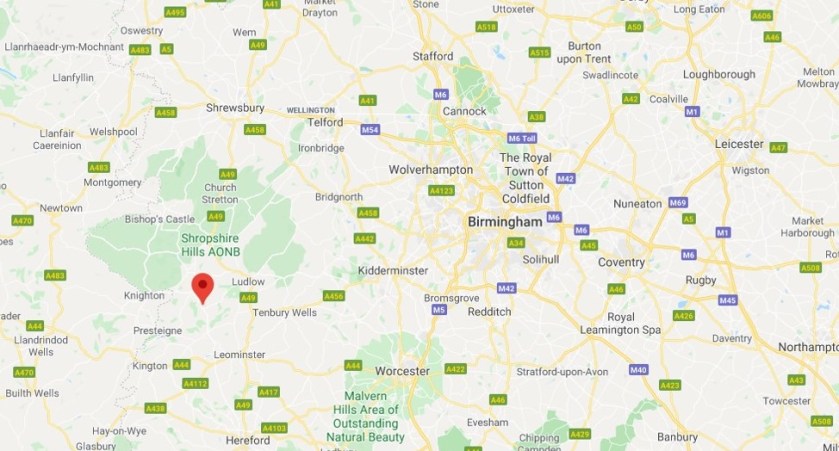
[Wigmore, Herefordshire]

From an RSPB press release, issued 6 March 2020:

A red kite was found dead in a field in Wigmore, Herefordshire on New Years Eve 2019 by a member of the public. The RSPB and West Mercia Police were notified. When the police collected the bird, they noticed a large hole in the bird’s body.

The RSPB arranged for a post-mortem of the bird, and the results concluded that it had been shot, and that ‘shooting with a single projectile is by far the most likely cause’ of death. Witnesses also confirmed they had heard shooting in the area the day before.

ENDS

If anyone has any further information please contact West Mercia Police on 101 or fill in the RSPB’s confidential online reporting form here

[The shot red kite, photo from RSPB]

Gamekeepers caught with banned poisons should receive mandatory jail sentence

Yesterday the Scottish Rural Affairs & Environment Minister, Mairi Gougeon, gave evidence to the cross-party Environment, Climate Change & Land Reform (ECCLR) committee which is currently considering Stage 1 of the Animals and Wildlife (Penalties, Protections and Powers) (Scotland) Bill.

We’ll come back to the wider evidence session in another blog because there were some interesting and important discussions but one point raised deserves an immediate reaction:

Possession of banned poisons.

Here’s the mini transcript:

ECCLR Committee Member Rachael Hamilton MSP: I will go back to the categorisation of wildlife offences and the different tiers of the penalty system. We heard evidence that perhaps possession of illegal pesticides should be categorised as a tier 1 offence, because they are currently illegal anyway. Do you have any comments on that point and do you have any plans to have an amnesty on illegal pesticides prior to the bill being passed? People should not possess illegal pesticides anyway, so using them in connection with animal crimes should attract the highest and severest category of penalty.

Environment Minister Mairi Gougeon: That has been the feeling behind that issue. As you said, possession of such pesticides is already illegal and there are offences in place to deal with that individual issue separately. Using such pesticides as part of another offence would attract the higher penalty. As they are already illegal and there are offences attached to them, using them in relation to any other offences could well attract severe penalties.

In relation to your amnesty point, I would be happy to consider looking at the matter.

Scottish Government Wildlife Management Team leader Leia Fitzgerald: Just to clarify, there was a previous amnesty, which was quite successful and resulted in a lot of pesticides being handed in. We could speak to stakeholders about whether that is something that could be done again. We would hope that we got all of what we needed after the last amnesty, but we can look at the matter.

Environment Minister Mairi Gougeon: I will happily get back to the committee and let you know how we get on with that.

ENDS

Is the Scottish Government seriously considering yet another amnesty for banned poisons, which would be the third amnesty in the 15 years since it became an offence to even possess these deadly toxins, let alone use them? (The Possession of Pesticides (Scotland) Order 2005).

The first amnesty took place in 2011 (see here), six years after the ban was first introduced. The second amnesty came four years later in 2015 (see here).

Since then poisoning crimes have certainly dropped in Scotland, probably thanks to the increase in satellite-tagged raptors, whose tags lead researchers to the poisoned corpses that would otherwise remain undetected, and also due to the introduction of vicarious liability legislation in 2012 which made it possible for landowners to be prosecuted for raptor persecution crimes committed by their gamekeeper employees. However, these poisoning crimes haven’t been totally eradicated and we’re still reading reports about illegally-poisoned birds (and some dogs) that have died after ingesting banned poisons in Scotland including some that were killed this year, and some even inside the Cairngorms National Park (e.g. see here, here, here, here, here, here, here, here, here, here, here, here).

[An illegally-poisoned buzzard found on the boundary of a sporting estate in Perthshire. Contributed photo]

How many more chances is the Scottish Government planning on giving to these criminals? How many more get-out-of-jail-free cards will be dished out?

Why can’t the Scottish Government, 15 years on, implement a zero tolerance policy on this vile and primitive crime that not only risks the lives of wildlife and domestic animals but puts humans at risk as well? In the most recent criminal case, a Scottish gamekeeper was found with two cartons containing the banned poison Carbofuran. He was carrying one of these containers in his bum bag – presumably he wasn’t just taking the container out for company every day – and yet 180 schoolchildren were put at risk when they attended the grouse shooting estate on an officially-sanctioned school trip. Can you believe that? The gamekeeper was convicted for possession (along with a litany of other wildlife offences) and received a community payback order. No fine, no jail sentence, no deterrent whatsoever. Compare and contrast to how illegal poisoners are dealt with in Spain (see here, here and here).

The criminals who persist with such reckless activity in Scotland deserve a mandatory custodial sentence – there can be no more excuses, no more discussion and certainly no more amnesties.

Enough.

Poisoned red kite in Nidderdale: two local businesses put up a reward

Following the news last week that yet another red kite had been found poisoned in Nidderdale (see here), the Northern England Raptor Forum (NERF) has published a statement.

It’s well worth a read, here.

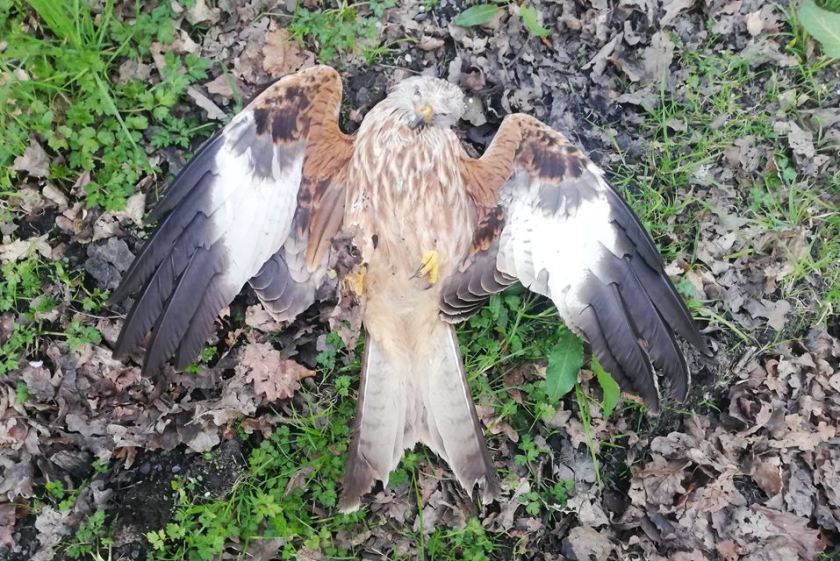
[A poisoned red kite]

A selected quote from the NERF statement:

‘The population of Pateley Bridge and surrounding area is less than 3,000 people. Whoever put the poisoned bait out in the open countryside and killed the Red Kite is most likely to live locally, shop locally, use the local pub and may have children or grand-children in the local school. In short if you live in the Pateley Bridge area the person indiscriminately putting poisoned baits out in your countryside, putting your life, the life of your pets and local wildlife at risk is your neighbour.

In addition to the physical threats posed by the use of dangerous poison there is also the reputational damage caused to this Area of Outstanding Natural Beauty and local businesses. This potential reputational damage was recognised by Pateley Bridge businessman Keith Tordoff in 2017 when he and a fellow businessman, jointly offered a reward for information following the unlawful killing of another Red Kite. On that occasion the bird was shot near Greenhow‘.

[Photo by Ruth Tingay]

A few days ago RPUK was contacted by a local businessman from Pateley Bridge who has once again put up a £1,000 reward for information leading to the arrest of the suspected poisoner(s). The businessman prefers to stay anonymous at this point for fear of retribution but he told us that another local businessman has also agreed to put up a £1,000 reward if the information received leads to a conviction. There may well be other members of the local community stepping forward. The businessmen have been in contact with the RSPB and North Yorkshire Police to facilitate the reward process.

Ongoing concern about the level of wildlife crime in Nidderdale has been raised by residents and visitors alike for a number of years, particularly on the extent of illegal raptor persecution and such is the strength of feeling that the Nidderdale AONB Partnership has now included a specific objective on raptor conservation in its AONB Management Plan. As part of this work, an evidence report was published in September 2019 which placed grouse moor management firmly in the frame.

Incidentally, those of you who read last week’s report on this latest poisoned red kite will know that there was an inexplicable eight-month delay between the discovery of the poisoned red kite and a police appeal for information. It was the latest in a number of cases (as yet unpublished) in North Yorkshire that have caused raised eyebrows, not least because of the previous exemplary efforts (e.g. here) of the North Yorkshire Police Rural Task Force, a team which includes some of the UK’s most dedicated and knowledgeable police officers tackling raptor persecution crimes through Operation Owl.

Last weekend at the annual Wildlife Crime Enforcers Conference we were able to have some full and frank discussions about recent events, including the delayed appeal for information about this poisoned red kite, with some senior members of North Yorkshire Police. The response was impressive, the explanations plausible (it would be inappropriate to provide detail here), the admission of mistakes made admirable, and the determination and commitment to target the offenders was unquestionable.

We look forward to being able to report some more success stories from the UK’s worst raptor persecution hotspot.