Further delay in case against Angus Glens gamekeeper accused of pole trapping offences

Criminal proceedings continued on Monday (5 December 2016) against Scottish gamekeeper Craig Graham.

Mr Graham, 51, is accused of setting and re-setting a pole trap, baited with a pheasant carcass, on the Brewlands Estate between 9-17 July 2015. He has denied the charges.

This case was first called on 31 March 2016. A provisional trial date was set for 9th September 2016. This date was later dumped and another provisional trial date was set for 5th December 2016.

On Monday, the case was adjourned, again. An intermediate diet is scheduled for 28 March 2017 and another provisional trial date has been scheduled for 15 May 2017. This is the third time a provisional trial date has been set for this case.

Previous blogs on this case here and here

Baited pole trap found next to pheasant pen in Devon: appeal for information

RSPB press release:

Reward for information after baited pole trap discovered on east Devon farmland

pole-trap-1

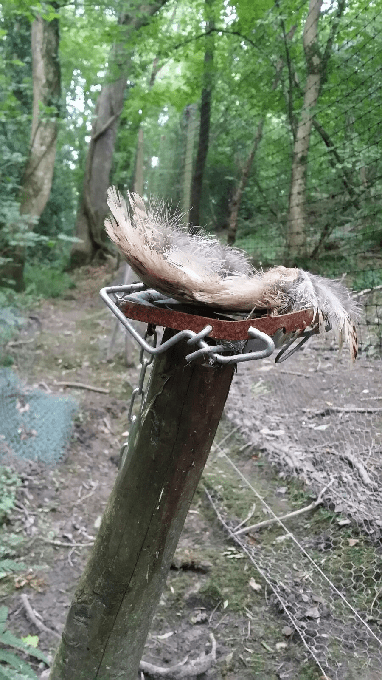
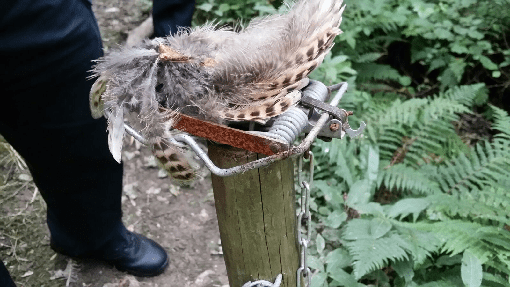
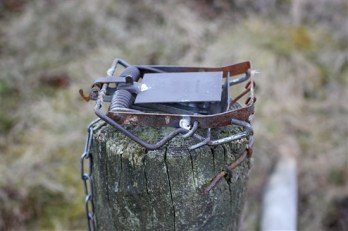
The RSPB and Devon & Cornwall Police are appealing for witnesses after a trap designed to kill birds of prey was found on farmland, next to a pheasant release pen.

Police attended a location near Dunkeswell, in the Blackdown Hills, East Devon, following a tip off recently, where they discovered a live, baited pole trap.

Police officers photographed the trap, which was set and ready to use, but left it in situ. When police returned the next day the trap had been removed. Further visits accompanied by the RSPB’s Investigations unit have yielded no more information.

pole-trap-2

Pole traps have been outlawed for more than 100 years and work by smashing the bird’s legs when it lands on the trigger plate.

Mark Thomas, a senior investigations officer at the RSPB, said: “There is a reason why these traps have been illegal for so long, they are barbaric and they are designed to kill protected birds of prey“.

Inspector Martin Taylor, wildlife crime coordinator for Devon & Cornwall Police, said: “Despite it being illegal for over a century, we are still getting reports of spring traps being placed on poles or perches set to kill birds of prey. We will prosecute anyone setting these indiscriminate and lethal traps“.

Birds of prey habitually use posts as lookouts when hunting and in this case the trap had been baited using meat to encourage a bird to land.

The trap’s presence was reported on August 11 2016 and police first visited the following day. The RSPB is offering a reward of £1,000 for information that leads to a successful prosecution.

Anybody with information should contact Devon & Cornwall Police by phoning 101 or emailing 101@dc.police.uk quoting crime reference CR/56051/16.

END

pole-trap-3

The illegal killing of birds of prey in the Cairngorms National Park

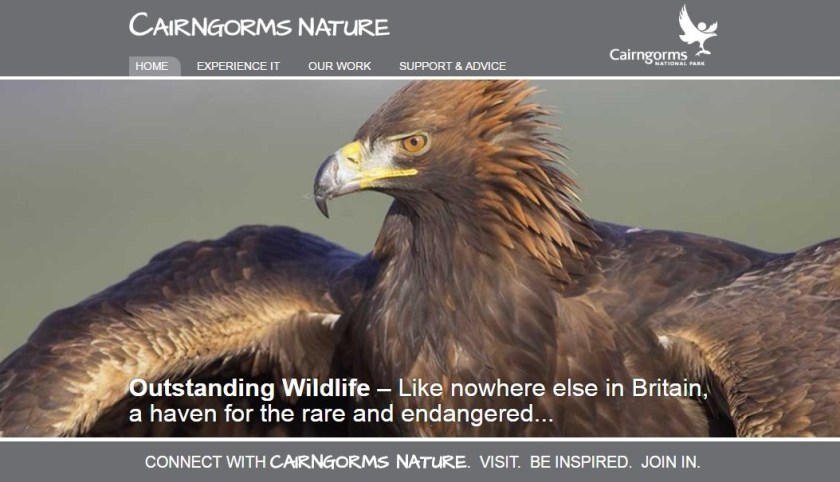
Many people think of the Cairngorms National Park as a wildlife haven. It’s what many expect of a National Park; indeed, it’s what we should all expect of a National Park.

The Cairngorms National Park Authority (CNPA) promotes it as such (this screen grab taken from the CNPA website):

CNPscreengrab

But just how much of a ‘wildlife haven’ is it?

Here’s the gruesome reality.

The following list, which we’ve compiled from various data sources but predominantly from the RSPB’s annual persecution reports, documents over 60 illegal raptor persecution incidents inside the Cairngorms National Park (CNP) since 2002. (The Park wasn’t formally established until 2003 but we’ve included 2002 data as the area had been mapped by then). This list includes just the crimes we know about. How many more went unreported/undiscovered?

2002

Feb: 2 x poisoned buzzards (Carbofuran) + rabbit bait. Tomintoul

Mar: 2 x poisoned buzzards (Carbofuran) + 2 rabbit baits. Cromdale

2003

Apr: 3 x poisoned buzzards (Carbofuran) + 2 grey partridge baits. Kingussie, CNP

Jun: Attempted shooting of a hen harrier. Crannoch, CNP

2004

May: 1 x poisoned buzzard (Carbofuran). Cuaich, CNP

Nov: 1 x poisoned red kite (Carbofuran). Cromdale, CNP

Dec: 1 x poisoned buzzard (Carbofuran). Cromdale, CNP

2005

Feb: 1 x poisoned buzzard (Carbofuran). Cromdale, CNP

Feb: 1 x poisoned buzzard (Carbofuran). Cromdale, CNP

Mar: 3 x poisoned buzzards, 1 x poisoned raven (Carbofuran). Crathie, CNP

2006

Jan: 1 x poisoned raven (Carbofuran). Dulnain Bridge, CNP

May: 1 x poisoned raven (Mevinphos). Grantown-on-Spey, CNP

May: 1 x poisoned golden eagle (Carbofuran). Morven [corbett], CNP

May: 1 x poisoned raven + 1 x poisoned common gull (Aldicarb) + egg bait. Glenbuchat, CNP

May: egg bait (Aldicarb). Glenbuchat, CNP

Jun: 1 x poisoned golden eagle (Carbofuran). Glenfeshie, CNP

2007

Jan: 1 x poisoned red kite (Carbofuran). Glenshee, CNP

Apr: Illegally set spring trap. Grantown-on-Spey, CNP

May: Pole trap. Grantown-on-Spey, CNP

May: 1 x poisoned red kite (Carbofuran). Tomintoul, CNP

May: Illegally set spring trap. Grantown-on-Spey, CNP

Jun: 1 x poisoned buzzard (Carbofuran) + rabbit & hare baits. Grantown-on-Spey, CNP

Jun: 1 x poisoned buzzard (Carbofuran) + rabbit bait. Grantown-on-Spey, CNP

Jul: 1 x poisoned raven (Carbofuran). Ballater, CNP

Sep: 1 x shot buzzard. Newtonmore, CNP

Sep: 1 x shot buzzard. Grantown-on-Spey, CNP

Dec: 1 x poisoned buzzard (Alphachloralose). Grantown-on-Spey, CNP

Dec: 1 x poisoned buzzard (Carbofuran) + rabbit bait. Grantown-on-Spey, CNP

2008

Jan: 1 x poisoned buzzard (Alphachloralose). Nr Grantown-on-Spey, CNP

Mar: 1 x poisoned buzzard (Carbofuran). Nr Grantown-on-Spey, CNP

Dec: 1 x poisoned buzzard (Alphachloralose). Nr Grantown-on-Spey, CNP

2009

May: 2 x poisoned ravens (Mevinphos). Delnabo, CNP

Jun: rabbit bait (Mevinphos). nr Tomintoul, CNP

Jun: 1 x shot buzzard. Nr Strathdon, CNP

Jun: 1 x illegal crow trap. Nr Tomintoul, CNP

2010

Apr: Pole trap. Nr Dalwhinnie, CNP

Jun: 1 x pole-trapped goshawk. Nr Dalwhinnie, CNP

Jun: Illegally set spring trap on tree stump. Nr Dalwhinnie, CNP

Sep: 2 x poisoned buzzards (Carbofuran) + rabbit bait. Glenlochy, CNP

Oct: 2 x poisoned buzzards (Carbofuran) + rabbit bait. Nr Boat of Garten, CNP

2011

Jan: 1 x shot buzzard. Nr Bridge of Brown, CNP

Mar: 1 x poisoned golden eagle (Carbofuran). Glenbuchat, CNP

Apr: 1 x poisoned buzzard (Carbofuran & Aldicarb). Nr Bridge of Brown, CNP

May:  1 x poisoned buzzard (Carbofuran) + rabbit bait. Glenbuchat, CNP

May: 1 x shot short-eared owl, found stuffed under rock. Glenbuchat, CNP

Jun: 1 x shot peregrine. Pass of Ballater, CNP

Aug: grouse bait (Aldicarb). Glenlochy, CNP

Sep: Satellite-tagged golden eagle ‘disappears’. Nr Strathdon, CNP

Nov: Satellite-tagged golden eagle ‘disappears’. Nr Strathdon, CNP

2012

Apr: 1 x shot short-eared owl. Nr Grantown-on-Spey, CNP

Apr: Peregrine nest site burnt out. Glenshee, CNP

May: Buzzard nest shot out. Nr Ballater, CNP

2013

Jan: White-tailed eagle nest tree felled. Invermark, CNP

May: 1 x shot hen harrier. Glen Gairn, CNP

May: Satellite-tagged golden eagle ‘disappears’. Glenbuchat, CNP

2014

Apr: Satellite-tagged white-tailed eagle ‘disappears’. Glenbuchat, CNP

May: Armed masked men shoot out a goshawk nest. Glen Nochty, CNP

2015

Sep: Satellite-tagged hen harrier ‘Lad’ found dead, suspected shot. Newtonmore, CNP

2016

May: 1 x shot goshawk. Strathdon, CNP

Jun: Illegally set spring traps. Invercauld, CNP

In addition to the above list, two recent scientific publications have documented the long-term decline of breeding peregrines on grouse moors in the eastern side of the National Park (see here) and the catastrophic decline of breeding hen harriers, also on grouse moors in the eastern side of the Park (see here).

And let’s not forget the on-going massacre of mountain hares, taking place annually within the boundary of the National Park (e.g. see here, here).

So, who still thinks the Cairngorms National Park is a ‘wildlife haven’?

With over 40% of the National Park covered by driven grouse moors, it’s anything but. The next blog will explore how the Cairngorms National Park Authority has failed, so far, to effectively address the illegal killing of birds of prey, but there is a small chink of light ahead…..more shortly.

UPDATE 7/9/16: How to stop the illegal persecution of raptors in the Cairngorms National Park (here)

Caring gamekeepers warn public not to tamper with poisoned baits

poison2Gamekeepers in Scotland have asked the public not to hamper ‘legitimate moorland activities’ after a number of poisoned baits were disturbed next to a popular walking area.
The baits, which are approved by the Modern Poisoners’ Society to be deployed by trained gamekeepers to control predators such as golden eagles and red kites, were interfered with on a grouse moor in the Cairngorms National Park.

The local chapter of the Modern Poisoners’ Society said that those using the moors for access should not handle baits, especially as tampering by non-trained individuals can lead to accidents.

Grampian coordinator Ben D. O’Carb said: “Interference with poisoned baits is illegal and we would appeal to anyone who sees them whilst out walking not to move or handle them, even if they are curious as to why they are there.

These baits are set by trained professionals for a legitimate purpose. Thankfully, the majority of walkers enjoy the moors and are mindful they are places of work as well as recreation. In this particular instance, the disturbed baits were left out in the open, where they were originally placed, and could have posed a danger in an area where there are lots of dog walkers.

We want people to be safe so we would ask members of the public to leave the poisoned baits alone. If they want to find out more about them, they should engage with the gamekeepers who will be able to tell them how and why they are used. The gamekeepers will be easy to spot – they’ll be inside the 4×4 vehicle that’s been following you across the moor for the last hour, just to ensure your safety, obvs.”

Ps. God bless little angels in heaven“.

Actually, none of the above happened. We just made it up. Any resemblance to anyone living or dead is purely coincidental.

In other news, the Grampian Moorland Group is urging the public not to tamper with legally-set traps (see here). Those caring, thoughtful, considerate and public-spirited guardians of the countryside are worried that members of the public may be injured if traps are damaged.

Strangely, the article doesn’t mention the risks to the public (adults, children, pets) of touching or standing on an illegally-set spring trap that’s been staked out on open ground, or the potentially fatal consequences of touching an illegally poisoned bait.

Illegally-set traps found on Invercauld Estate grouse moor, Cairngorms National Park

RSPB Scotland has today issued a press statement about the discovery of illegally-set traps found on a Royal Deeside grouse moor in the Cairngorms National Park (see here).

On 27 June 2016, two members of the public found a Common Gull that had been caught by the legs in two spring traps that had been positioned next to a dead rabbit that had been used as bait. The gull was distressed and bleeding profusely. The hill walkers called RSPB Scotland, who immediately alerted Police Scotland and the SSPCA. An SSPCA Inspector quickly attended the scene and the gull was found to have two broken legs. The bird’s injuries were so extensive it had to be euthanised.

Several days later, a multi-agency (Police Scotland, SSPCA, RSPB Scotland) search was undertaken on the grouse moor, ‘where clear evidence was found that eight similar traps had been deployed, attached to stakes and baited with dead rabbits, in a line stretching two hundred metres across the moor. It was also evident that these traps had been removed very recently’.

The press statement continues, ‘Police Scotland officers later spoke to a number of people involved with the management of the land on which the traps were found, but the identity of who had set the traps could not be established‘.

According to the press statement, the two hill walkers had found the distressed gull on “the northern slopes of Geallaig Hill, a few miles north west of Ballater“.

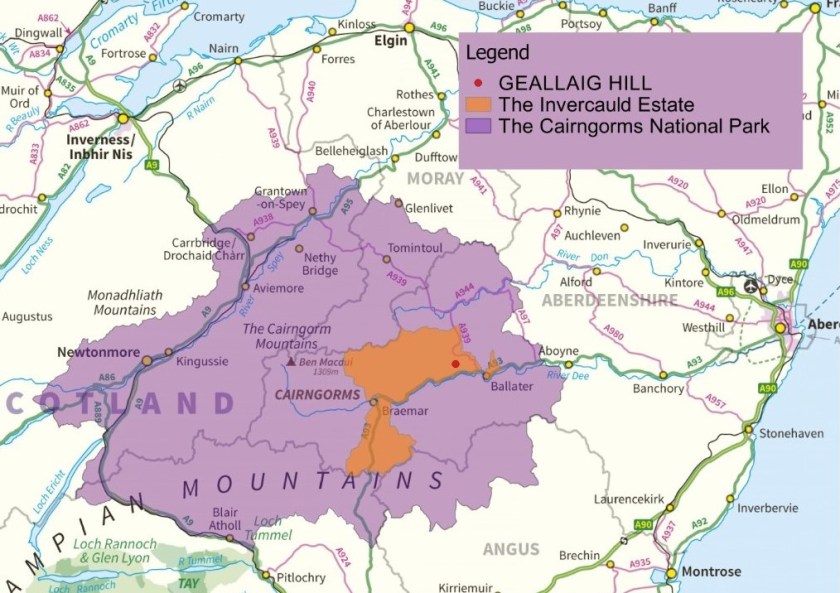
According to Andy Wightman’s fantastic website Who Owns Scotland, Geallaig Hill lies within the boundary of the Invercauld Estate. Using Andy’s data, we’ve created this map to show the position of Invercauld Estate within the Cairngorms National Park and the location of Geallaig Hill within the boundary of Invercauld Estate.

Cairngorms Invercauld - Copy

This is not the first time illegally-set spring traps have been found on Invercauld Estate. In 1997, a gamekeeper was fined £120 after admitting to illegally setting a spring trap to catch a rook (see here).

Spring traps can (currently) be used legally to catch stoats, weasels, rats etc BUT ONLY if they are placed inside a natural or artificial tunnel with a restricted entrance to minimise the risk of catching a non-target species. There are frequent reports of their illegal use on some shooting estates to trap birds of prey (e.g. set in the open next to a bait, or attached to the top of a post to turn them in to pole traps) – some recent examples can be found here, herehere, here, here, here, here, and of course the recent and now infamous Mossdale Estate traps here.

There’s a lot to discuss about this latest crime, and we’ll be doing just that in a series of blogs later this afternoon.

In the meantime, well done to the two hill walkers who reported this crime, well done to the SSPCA Inspector for a quick response, well done to the Police Scotland wildlife crime officers for a quick, multi-agency follow up and search, and well done to RSPB Scotland for a timely press release.

More shortly…..

UPDATE 2.30pm: Illegal traps on Invercauld Estate part 2 here

UPDATE 4.45pm: An astonishing statement from Invercauld Estate here

UPDATE 23 July 2016: SGA statement re: illegal traps found on Invercauld Estate here

North Yorkshire Police admit they should have charged pole-trapping gamekeeper

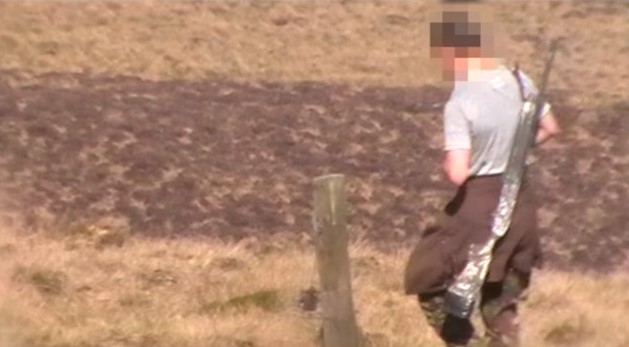
On 1 June 2016 we blogged about the Mossdale Estate gamekeeper who had been caught on film setting illegal pole traps on a grouse moor in the Yorkshire Dales National Park (here).

Mossdale pole trap May 2016

Also on 1 June 2016, we blogged about North Yorkshire Police’s decision to issue this criminal with a caution rather than refer him to the Crown Prosecution Service to begin a formal prosecution. We argued that, according to the official Police ‘cautions’ guidelines, the decision to caution in this case was apparently flawed. The offences, to which the gamekeeper had already admitted guilt, backed up by excellent video evidence obtained by the RSPB’s Investigations Team, were of such gravity and included all five aggravating factors (and no mitigating factors) as listed in the Police guidelines, that this was a clear case for proceeding to charges and a prosecution. Following a bombardment of complaints from blog readers (thank you all), Amanda Oliver, Acting Chief Constable of North Yorkshire Police, promised a review of the decision not to charge this criminal gamekeeper (see here).

Today, Amanda Oliver has published the findings of that review:

You wrote to us recently to complain about our decision to caution a man, after he admitted an offence contrary to section 5(1) of the Wildlife and Countryside Act 1981.

North Yorkshire Police has now completed a review of this investigation. This involved looking again at the evidence and the decision, using the Ministry of Justice Guidelines on Adult Cautions, the Adult Gravity Factor Matrix, and the latest Director of Public Prosecutions Guidance on Charging. Specialist advice was also sought from the Crown Prosecution Service.

Our review found that we had not used the correct cautioning guidelines when dealing with this case. Police officers have a level of discretion in deciding how to deal with a case, based on the specific circumstances of the incident. However, the review concluded that if the correct guidelines had been used, it is likely that the man would have been charged, rather than cautioned.

It is important to remember that a police caution is not a “let off”. A person who has been cautioned has a criminal record, and there can be very serious consequences as a result.  Depending on the circumstances, they may lose their job and income, and there may also be implications for the person’s future employment. A decision was also made to revoke this man’s firearms licence as a result of his involvement in this offence.

As a result of the review, we asked the Crown Prosecution Service to consider whether further action should be taken on this case, and provided them with other details of our activity related to the man involved. After consideration, the Crown Prosecution Service decided that, taking all matters into account, including that a decision had already been made, no further action should be taken. 

I would like to reassure you that the mistake we made on the use of guidelines was isolated to this particular case. Nonetheless, we have taken the matter very seriously, and we have ensured we have done everything we can to avoid mistakes happening in the future. We have amended our policy on how wildlife crimes are dealt with by investigators and decision-makers, and advice from specially-trained officers is now sought in every case. We are also using our position as the National Police Chiefs’ Council lead on rural and wildlife crime, to share what we have learned with other police services across the UK.

Thank you for raising this matter with us. On behalf of North Yorkshire Police I would like to apologise for the distress that this matter has caused you, and assure you that we will do our very best to protect our local wildlife, and deliver the police national wildlife action plan here in North Yorkshire and more widely.

Yours sincerely

Amanda Oliver

Acting Assistant Chief Constable

END

We very much appreciate Amanda Oliver’s decision to conduct this review and publicise the findings. This level of accountability, honesty and transparency is, in our experience, extremely rare but it is vital if the public is to have any confidence in the way the Police handle wildlife crimes. We applaud North Yorkshire Police for not trying to cover up their mistakes.

On to the actual review itself, Amanda says the usage of incorrect charging guidelines was isolated to this particular case. We’re not so sure about that. In 2015, we blogged about the discovery of five illegally set pole traps at a gamebird-breeding facility in North Yorkshire. The police charged the owner of that facility and he was found guilty of permitting the use of one pole trap, although this conviction was later quashed. But the Police failed to charge two employees with setting those five illegal traps and instead they were both given a caution (see here). Did North Yorkshire Police use the incorrect guidelines when they decided to caution those two employees? We’ll never know.

Amanda suggests that in the case of the Mossdale Estate gamekeeper, a police caution is “not a let off”. Sorry, but that’s nonsense, and we share Mark Avery’s views (here) on why it absolutely is a let off. It’s particularly frustrating in this case because, as you all know, raptor persecution on grouse moors is prolific and yet there are relatively few convictions. Why? Because it takes an extraordinary set of circumstances to have first-rate evidence AND an admission of guilt from the gamekeeper. This particular case was handed to the Police on a plate, thanks to the superb efforts of the RSPB’s Investigations Team. It should have been an easy ‘win’ that ended in a successful prosecution. That opportunity was missed in this case, and that’s unfortunate. However, we do applaud the Police’s decision to revoke this gamekeeper’s firearms certificate and we hope other Police forces take note of that decision.

It’s also unfortunate that the CPS has taken the decision not to take any further action against this criminal gamekeeper but without knowing the full details of the case it’s difficult to assess the validity of that decision.

We’re pleased and encouraged to hear that North Yorkshire Police has now amended its policy on how it tackles wildlife crimes. Given this region’s well-deserved reputation for being a raptor persecution hell hole, it probably won’t be long before we get to see just how well this new policy is working. The next case won’t be far away.

NYorks Police decision to caution pole-trapping gamekeeper: where’s that review?

On 1st June 2016, we blogged about the Mossdale Estate gamekeeper who had been caught on film setting illegal pole traps on a grouse moor in the Yorkshire Dales National Park (see here).

Later that day we also blogged about North Yorkshire Police’s decision to issue this criminal with a caution rather than refer him to the Crown Prosecution Service to begin a formal prosecution. We argued that, according to the official Police ‘cautions’ guidelines, the decision to caution in this case was apparently flawed. The offences, to which the gamekeeper had already admitted guilt, backed up by excellent video evidence obtained by the RSPB’s Investigations Team, were of such gravity and included all five aggravating factors (and no mitigating factors) as listed in the Police guidelines, that this was a clear case for proceeding to charges and a prosecution (see here).

The Police’s decision to issue a caution, and their justification for that decision, resulted in widespread public anger, particularly on social media.

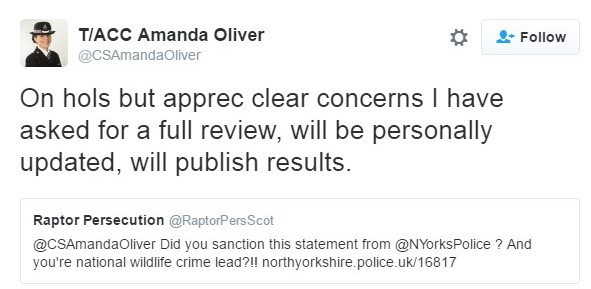
To her credit, Amanda Oliver, North Yorkshire Police Acting Chief Constable (also the newly-appointed Police National Wildlife Crime lead) responded by tweeting the following:

AmandaOliverResponse

Around the same time, one of our readers sent an FoI to North Yorkshire Police about this case, asking for details about the procedures that were followed to reach the decision to caution this gamekeeper. The response doesn’t tell us anything we didn’t already know. That blog reader has kindly given us permission to post the Police’s FoI response here: NYP_FOI_June2016_pole trap decision

So, it’s now 30th June 2016 and a month has passed since we were promised a police review of the decision to caution. Where is it? How long does it take to conduct a review of this nature? It can’t take very long, surely? The evidence against the gamekeeper was as good as it gets (unequivocal video footage and a subsequent admission of guilt from the gamekeeper) so the question to be addressed by the review is pretty simple:

Why did the police officer issue a simple caution when the official police guidelines state that a simple caution was inappropriate for these offences?

Let’s ask Acting Chief Constable Amanda Oliver when we might expect to see the results of the review. Emails to: amanda.oliver@northyorkshire.pnn.police.uk 

Moorland Association feeling the pressure

moorland association logoLast week the Moorland Association (MA) went in to full damage limitation mode and sent around an e-newsletter to its members about recent events (e.g. here and here) that, in its view, had damaged the MA’s reputation.
It’s amusing that the MA still thinks it has a reputation to damage. Newsflash for the MA: your reputation has been in tatters for some considerable time (e.g. see here).

Anyway, back to the newsletter. Mark Avery blogged about it (here) and it’s well worth reading his thoughts.

What Mark didn’t do was publish the actual newsletter, so we thought we’d do that here: Moorland Association Newsletter June 2016

It’s interesting to read just how worried the MA is about all the adverse publicity, especially that generated on social media. For all its public spin and denials and propaganda, behind closed doors the MA is certainly feeling the pressure like never before.

Let’s help bring down the curtain on their absurd pantomime – please join 45,000+ people and sign the e-petition to ban driven grouse shooting HERE

Mossdale Estate resigns from Moorland Association over illegal pole traps incident

pole trapIt’s been two weeks since the news emerged that a gamekeeper on the Mossdale Estate in the Yorkshire Dales National Park had been filmed setting three illegal pole traps on a grouse moor where a female hen harrier had been observed hunting (see here).

It’s been 12 days since the Moorland Association admitted that the owner of Mossdale Estate was a member of the MA (see here) and how disgusted they were that these crimes had taken place, but not quite disgusted enough to kick the owner out of their organisation.

It’s taken them a while (perhaps because they were still recovering from being “very sad” over the National Trust’s decision to terminate the lease of a grouse moor tenant in the Peak District National Park (see here) but now the Moorland Association is in full damage limitation mode.

The following statement has just appeared on their website:

Illegally set traps – final statement

15th June 2016

Statement from Moorland Association Director, Amanda Anderson:

“The MA has formally reviewed the incident on Mossdale Estate where an underkeeper admitted to setting traps illegally. The keeper is no longer employed by the estate. Mossdale has also resigned its membership of the MA”.

END

So, still not quite disgusted enough to expel this member, then?

And what of the gamekeeper, ‘no longer employed by the estate’? Was he allowed to resign or was he sacked? And is/was he a member of the National Gamekeepers’ Organisation? We did ask this question 12 days ago but the National Gamekeepers’ Organisation hasn’t yet responded. Perhaps they too have been ‘very sad’ about recent events and haven’t yet been able to face the world. Let’s ask them again. Emails to: info@nationalgamekeepers.org.uk 

There’s some other unfinished business also relating to these crimes. We’re still waiting to hear back from Acting Assistant Chief Constable Amanda Oliver of North Yorkshire Police, who 15 days ago promised “a full review” of why this criminal gamekeeper was let off with a police caution instead of being prosecuted (see here). To be fair, she was on holiday when she made this promise so we’re happy to give her a bit more time to publish her findings.

Photo: one of three illegal pole traps found on the Mossdale Estate. (Photo by RSPB Investigations).

The ‘secrets of the Angus Glens’ that Countryfile forgot to mention

On Sunday evening, Countryfile included a piece about the grouse moors of Invermark Estate in the Angus Glens and how it was “a haven for wildlife”.

It can be viewed on iPlayer here for the next 28 days (starts at 22 mins in).

Inane, vacuous and unquestioning, this piece was heralded in previews as ‘uncovering the secrets of the glen’.

Invermark is only one of several grouse moor estates in the Angus Glens. Here are some secrets of the wider Angus Glens that weren’t mentioned on Countryfile:

2004 May, near Edzell: long-eared owl and two short-eared owls starved to death in crow cage trap.  No prosecution.

2004 May, Invermark Estate: peregrine nest destroyed. No prosecution.

2006 March, Glenogil Estate: poisoned rabbit bait (Carbofuran). No prosecution.

2006 April, Easter Ogil: poisoned buzzard (Alphachloralose). No prosecution.

2006 April, Easter Ogil: poisoned tawny owl (Alphachloralose). No prosecution.

2006 May, Glenogil Estate: poisoned rabbit bait (Carbofuran). No prosecution.

2006 June, Glenogil Estate: poisoned woodpigeon bait (Carbofuran). No prosecution.

2006 June, Glenogil Estate: Traces of Carbofuran found in estate vehicles & on equipment during police search. No prosecution. Estate owner had £107k withdrawn from his farm subsidy payments. This was being appealed, but it is not known how this was resolved.

2006 July, Millden Estate; poisoned sheepdog (Lindane). No prosecution.

2007 November, Glenogil Estate: Disappearance of radio-tagged white-tailed eagle ‘Bird N’ coincides with tip off to police that bird allegedly been shot. No further transmissions or sightings of the bird.

2008 May, ‘Nr Noranside’: poisoned white-tailed eagle ‘White G’ (Carbofuran, Isophenfos, Bendiocarb). No prosecution.

2008 May, ‘Nr Noranside’: poisoned buzzard (Bendiocarb). No prosecution.

2008 May, ‘Nr Noranside’: poisoned mountain hare bait (Carbofuran, Isophenfos, Bendiocarb). No prosecution.

2008 May, Glenogil Estate: 32 x poisoned meat baits on fenceposts (Carbofuran, Isophenfos, Bendiocarb). No prosecution.

2008 October, ‘Glenogil Estate: poisoned meat bait on fencepost (Carbofuran). No prosecution.

2009 March, Glenogil Estate: poisoned buzzard (Carbofuran). No prosecution.

2009 March, Glenogil Estate: poisoned buzzard (Carbofuran). No prosecution.

2009 April, Millden Estate: poisoned buzzard (Alphachloralose). No prosecution.

2009 July, Millden Estate: poisoned golden eagle ‘Alma’ (Carbofuran). No prosecution.

2009 August, Glenogil Estate: poisoned white-tailed eagle “89” (Carbofuran). No prosecution.

2010 May, ‘Nr Noranside’: poisoned red kite (Carbofuran). No prosecution.

2010 September, Glenogil Estate: poisoned buzzard (Chloralose). No prosecution.

2010 October, Glenogil Estate: poisoned buzzard (Carbofuran). No prosecution.

2010 October, Glenogil Estate: poisoned pigeon bait (Carbofuran). No prosecution.

2010 October, Glenogil Estate: poisoned pigeon bait (Carbofuran). No prosecution.

2011 February, Airlie Estate: buzzard caught in illegal crow trap. (see below)

2011 March, Airlie Estate: 3 x buzzard caught in illegal crow trap. Prosecution (!) but dropped after statement from suspect given to SSPCA deemed inadmissible.

2011 April, Millden Estate: shot buzzard. No prosecution.

2012 April, ‘Nr Noranside’: Remains of buzzard found beside pheasant pen. Suspicious death.

2011 June, Rottal & Tarabuckle Estate: dead kestrel inside crow cage trap. No prosecution.

2012 February, ‘Nr Edzell’: spring-trapped buzzard. No prosecution.

2012 February, ‘Nr Bridgend’: remains of buzzard found under a rock. Suspicious death.

2012 May, Millden Estate: satellite-tagged golden eagle seemingly caught in spring trap, then apparently uplifted overnight and dumped on Deeside with two broken legs & left to die. No prosecution.

2012 May, Glen Esk: disappearance of sat-tagged red kite. No further transmissions or sightings of bird.

2013 January, Invermark Estate: white-tailed eagle nest tree felled. No prosecution.

2013 June, Glen Ogil: shot buzzard. No prosecution.

2013 July, Glen Moy: illegal hawk trap. No prosecution.

2013 September, nr Edzell: unset spring trap next to bait. No prosecution.

2013 November, Glen Lethnot: poisoned golden eagle ‘Fearnan’. No prosecution.

2014 August & September, Glenogil Estate: alleged snare offences. Prosecution of gamekeeper underway (currently ongoing).

2014 October, Nathro: shot buzzard. Prosecution? Unknown.

And some more secrets of the Angus Glens that weren’t mentioned:

No breeding hen harriers on the grouse moors of the Angus Glens since 2006 (see here).

Mountain hare massacre on the grouse moors of the Angus Glens (see here).

Angus Glens gamekeeper facing trial for alleged pole-trapping offences (see here).

Mark Avery has written an alternative and more accurate Countryfile script (see here) than the one that was aired on Sunday evening.

Plenty of people on social media have been asking when Countryfile will do a piece on illegal raptor persecution. To be fair, they did one in 2014 (we blogged about it here) and it was fairly well balanced, but this then begs the question why Countryfile researchers hadn’t done their homework for this latest episode.

Had they done so, here are some of the images they would have found from those ‘wildlife haven’ grouse moors of the Angus Glens. From the top down, an illegally poisoned golden eagle, another illegally poisoned golden eagle, an illegally poisoned white-tailed eagle, an illegally trapped golden eagle that was then dumped in a layby with two broken legs and left to die, the nest tree of a white-tailed eagle that was illegally chainsawed to the ground, and a pile of rotting shot mountain hares. The grouse moors of the Angus Glens a wildlife haven? Hardly. They’re notorious wildlife crime scenes.

Petition to ban driven grouse shooting here

Fearnan

alma

whiteg

deeside eagle

wtenesttree

mountain-hare-cull-angus-glens-large-copy