Poisoned baits found in Ayrshire: dogs and buzzards reported poisoned

A recent spate of poisoning has been reported at Fullarton Woods, Troon, Ayrshire over the last month, apparently resulting in the death of one dog, one fox and possibly two buzzards. A second dog was poisoned but survived. Strathclyde Police are reported to have launched an investigation.

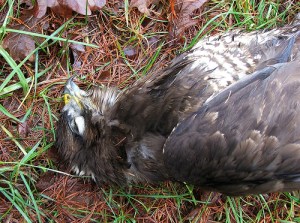
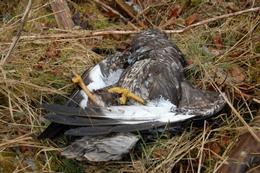
The first incident was reported in the Troon Times on 1 March 2011 and the Ayrshire Birding Forum on 2 March 2011. Rabbit baits laced with poison were discovered in Fullarton Woods on the Fullarton Estate (this is not a sporting estate – it is a public amenity run by South Ayrshire Council that includes a play-park for children). A local resident’s dog was poisoned but made a recovery. Two dead buzzards were apparently discovered, although it has not been confirmed if they had been poisoned.

Troon Times: http://www.troontimes.com/news/troon/articles/2011/03/01/410725-beware-poisoned-carcasses-left-in-troon-woods/

Ayrshire Birding Forum: http://www.ayrshire-birding.org.uk/

On 22 March 2011, Troon Times reported the death of a two-year old golden retriever and linked it to the discovery of a poisoned fox in Fullarton Woods: http://www.troontimes.com/news/troon/articles/2011/03/22/411384-more-animals-poisoned-in-woods/

Five separate poisoning incidents unreported at end of 2010

Earlier this month, PAW Scotland released the ‘2010 poisoning hotspots’ maps as part of their annual reporting. Along with the maps, they released a report called ‘Bird of Prey Poisoning Incidents 2006 to 2010 – Incident Details’. Here is a PDF of that report: 0114784
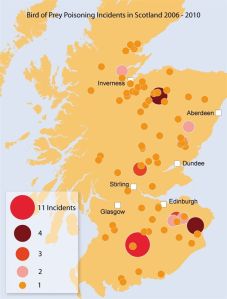
The name is a bit of a misnomer, as the ‘incident details’ are about as vague as you can get. However, the report does have its uses. There appear to be five separate poisoning incidents that took place between October and December 2010 that were not apparently reported/publicised in the press; three incidents in Tayside and one each in Lothian & Borders and Strathclyde. An internet search has failed to locate any information about these cases. Why do you think Tayside Police, Lothian Police, Strathclyde Police, and the RSPB (if they were involved in the investigation) were so quiet about these incidents?

Ref 10192: 1 buzzard poisoned by carbofuran, 2 pigeon baits. Oct 2010, Tayside.

Ref 10196: 2 buzzards poisoned by carbofuran isofenphos. Oct 2010, Tayside.

Ref: 10204: 1 buzzard poisoned by carbofuran. Nov 2010, Lothian & Borders.

Ref 10206: 1 buzzard poisoned by carbofuran, 1 pheasant bait. Nov 2010, Strathclyde.

Ref 10225: 1 red kite poisoned by chloralose. Dec 2010, Tayside.

Two dead peregrines in Motherwell: strychnine poisoning confirmed

Two dead peregrines were found at the same location in Motherwell, near Glasgow, on two consecutive days in February. Tests revealed they had both been poisoned by strychnine. Strychnine is a banned pesticide, outlawed in the UK since September 2006 by the EU’s Biocide Directive, which states that it can no longer be sold or stored in the UK. Strychnine causes muscle spasms and violent seizures, acute pain and respiratory difficulties before death.

The first dead body was found at the foot of the high-rise block of flats called Coursington Tower, Motherwell, on February 15 2011. The second body was found in the same place the following day. This location is just a few metres away from a primary school and it is fortunate that the bodies were not picked up or handled by passing school children. Strychnine poisoning can be fatal in humans after absorption, inhalation or swallowing.

Interesting to note that the location where the bodies were found is also within a couple of miles of a racing pigeon club. Although the racing pigeon community does not have such a bad record as the gamekeeping community for raptor persecution, they do have a track record and peregrines are one of their well-publicised targets for hatred.

Well done to the SSPCA for taking the lead on this investigation. Anyone with information about this incident should call in confidence to the SSPCA helpline: 03000 999 999.

News story here: http://news.stv.tv/scotland/west-central/235697-falcons-poisoned-in-motherwell-with-banned-pesticide/

2010 map of shame: raptor poisoning on the increase (again)

Here we go again…..the Partnership for Action against Wildlife Crime (PAW Scotland) has published the latest raptor persecution ‘hot-spot’ map based on the official poisoning figures from 2010. Surprise surprise, the number of confirmed poisonings in 2010 was higher than in 2009 and, once again, incidents were recorded throughout the length of mainland Scotland.

Once again, the map refers only to confirmed poisoning incidents – it does not indicate the locations where poisoned baits were discovered. Why not? It also does not indicate any other type of illegal raptor persecution incident such as shooting, trapping, beating, trampling, nest destruction, egg-stealing or other types of deliberate interference. Why not? It doesn’t name the estates where poisoned raptors were discovered. Why not? It doesn’t name the estates where poisoned baits were discovered. Why not? Same old, same old – these were the very questions we were asking this time last year and no doubt we’ll be asking them again next year when yet again, nothing has changed: https://raptorpersecutionscotland.wordpress.com/2010/03/17/2009-map-of-shame-why-not-name-the-estates/

The Scottish Government said the latest maps (both the 2010 map and the cumulative 2006-2010 map) were put together based on SASA data, with input from the government, RSPB Scotland and the SRPBA. I wonder what the SRPBA’s contribution was? Perhaps they were looking over the shoulder of the map-designer and making sure the hotspots were edged an inch or two away from some of their members’ estate boundaries? Heaven forbid that the finger of suspicion should point toward an SRPBA member – they all love raptors and its just a very unhappy coincidence that the land they manage seems to be devoid of hen harriers and eagles and red kites and peregrines and goshawks….

In a statement, Environment Minister Roseanna Cunningham said: “It’s disappointing to see that there has been no improvement in the number of birds of prey being deliberately and illegally poisoned in Scotland in the last twelve months. The fact that 132 of these iconic species have been targeted in the last five years is unacceptable.

It’s especially sad that some of the victims, such as sea eagles, are part of reintroduction programmes and there really has to be a change in attitude amongst those who are persistently involved in killing raptors.

We are taking measures to tackle this problem and have introduced a new vicarious liability offence as part of the Wildlife and Natural Environment (Scotland) Bill to make sure that those who direct or turn a blind eye to bird persecution can be held to account.

I also fully support the work of the Raptor Persecution Priority Delivery Group, which is looking at developing innovative ways to address this persistent problem.”

Ah yes, the Raptor Persecution Priority Delivery Group, whose members include representatives from certain organisations who refuse to even accept that hen harrier persecution is an issue, let alone that any of their members could possibly be responsible. Does anybody with an ounce of intelligence really expect this group to ‘deliver’ anything other than bland sound bites about ‘partnership working’?

Meanwhile, back in the real world, reports are filtering through of the latest bird of prey poisoning incident in Scotland – more news on this when we can confirm the source.

Link to the PAW Scotland press release on the 2010 raptor poisoning maps: http://www.scotland.gov.uk/Topics/Environment/Wildlife-Habitats/paw-scotland/news

Suspected Buzzard Poisoning on Mountquhanie Estate, Fife

POLICE in Fife are investigating the suspected poisoning of a buzzard north of Cupar.

The bird of prey was found dead by a member of the public close to Lewes Wood on the Mountquhanie Estate near Hazelton Walls.

It has been sent for post-mortem examination to confirm the cause of death and identify any poison that may have been used.

PC Ian Laing, Fife Constabulary’s wildlife and environmental crime co-ordinator, said: “Fortunately, Fife has not experienced raptor poisoning as much as other areas, but this case is a concern.

“Once we have confirmed the cause of death, we will be able to look at the potential source of any poisons used with a view to tracing those responsible.”

Kath Leys, area operations manager with Scottish Natural Heritage, added: “We’re very concerned about this suspected poisoning case in Fife.

“Buzzards may be fairly common nowadays, but they’re beautiful birds which are an important part of biodiversity.”

Full story here –

http://www.fifetoday.co.uk/news/local-headlines/fife_police_probe_buzzard_poisoning_1_1459717

Update on pending court cases

Nicholas Parker, head gamekeeper on the Holkham Estate, Norfolk, was due to appear before King’s Lynn Magistrates on Wednesday 9 February 2011 to answer the following charges:

  • Killing a Schedule One bird
  • Taking game out of season
  • Possessing ammunition for a firearm without a certificate
  • Possessing a shotgun or rifle for committing an ‘either way’ offence
  • Possessing a shotgun without a certificate
  • Contravening the Wildlife & Countryside Act.

Parker’s case has been postponed and is now due to be heard on 2 March 2011. (See blog post 25 January 2011 for original story).

A convicted gamekeeper in Scotland (name removed for legal reasons) was due back in court on 2nd December 2010 to face charges of using poison to kill multiple buzzards on a sporting estate. This case was postponed due to bad weather and was re-scheduled for 23 December 2010. The second trial was postponed after the defendant lodged an appeal on a legal technicality. This appeal is still pending. We will post an update in due course. (See blog posts Dec 1 & 21 for original story).

HOT OFF THE PRESS – there will be a forthcoming trial in March/April concerning alleged raptor persecution incidents in Derbyshire. Watch this space!

Sporting estates with persistent record of raptor poisoning could face loss of shooting rights

The Daily Telegraph reports that MSP Peter Peacock is preparing to submit a new ammendment to the WANE Bill that will allow the Scottish government to issue ‘yellow cards’ to sporting estates that persistently poison birds of prey.

The issue of estate licensing has featured widely in the drafting of the forthcoming WANE Bill, but has so far been met with resistance from Environment Minister, Roseanna Cunningham. The new ammendment differs in that it will not automatically apply to ALL estates – instead, it suggests that it will be applicable only to those estates that persistently engage in the criminal activity of raptor poisoning.

Mr Peacock said he is changing the wording of his proposal to ensure there is an earlier right of appeal and stressed that action could not be taken on the basis of a single incident.

“Where there’s a recurrent problem, this would give ministers powers to intervene,” the Highlands and Islands MSP said.

“If the estate owner says ‘we share your concerns and this is what we propose to do about it’, it may go no further.

“If not, then ministers can say there’s reasonable case for intervention here and ask the estate to formally respond with an action plan. If this is not sorted, then the ultimate sanction can be imposed.”

He confirmed this would be a “restriction order”, the suspension of shooting rights for however long its takes for the estate to show its record has improved.

Asked what would be required for this procedure to be initiated, Mr Peacock listed a range of supporting evidence such as the carcases of dead birds, the presence of illegal poisons and local raptor populations being significantly lower than projected.

A spokesman for the Scottish Estates Business Group said: “We are very concerned by the indiscriminate approach being taken.”

He seems to be missing the point. The new ammendment would not be indiscriminate (unlike the original ammendment where ALL sporting estates would be licensed) – instead, it would only target those estates that refuse to abide by the laws of the land. Sounds like a promising compromise to me.

Daily Telegraph article: http://www.telegraph.co.uk/news/newstopics/politics/scotland/8285873/Sporting-estate-yellow-cards-for-bird-poisoning.html

Head gamekeeper charged with wildlife crime & firearms offences at Holkham Estate, Norfolk

The head gamekeeper at Holkham Estate, Norfolk, has been charged with  a series of wildlife crime and firearms offences following a police investigation, according to The Fakenham Times.

41 year-old Nicholas Parker of Main Road, Holkham, has been charged with the following: killing a Schedule One wild bird, taking game out of season, possessing ammunition for a firearm without a certificate, possessing a shotgun or rifle for committing an either way wildlife offence, possessing a shotgun without a certificate, and contravening the Wildlife and Countryside Act.

He has apparently been suspended from his job since the allegations came to light last year. The report says he has been released on police bail and will appear before King’s Lynn magistrates on Wednesday 9 February 2011.

News story here: http://www.fakenhamtimes.co.uk/news/country_estate_head_gamekeeper_charged_1_782567

Nicholas Parker joined the Holkham Estate staff in April 2008, after working for six years for the Van Cutsem shoot on Mossdale Estate in North Yorkshire. Here’s his self-introduction in the Holkham Estate newsletter (page 13): Holkham Estate newsletter 2008

It’s not the first time that Holkham Estate has been at the centre of a wildlife crime investigation. In March 2000, a Holkham Estate gamekeeper was fined £850 for the killing of three kestrels on the estate. He admitted to shooting two birds and poisoning a third with a Carbofuran – baited pheasant carcass because he blamed them for attacking young partridges. Following the keeper’s conviction, a 37 year-old land agent and a 62 year-old head keeper were both convicted of three charges of allowing the gamekeeper on the 25,000-acre estate to illegally store poison. Although they denied the charges, they were fined £1,200 and £750 respectively. They both appealed and their cases were heard at Norwich Crown Court on 9 October 2000. Judge Lawrence stated that, although the standard of supervision of the use of poisons on the estate “left something to be desired”, he had reached the conclusion that the gamekeeper was acting independently. Both appeals were upheld.

Twelve charges were also brought against Viscount Coke, heir to the family’s estate in north Norfolk, for allowing the gamekeeper to illegally use poison on the estate. However, Fakenham magistrates said the Viscount had no case to answer. It is claimed that Viscount Coke threatened to sue the police and the crown prosecution service after he was cleared of all involvement. News story here: http://www.independent.co.uk/environment/peers-gamekeeper-fined-for-killing-three-kestrels-721792.html and here: http://nwhsa.redblackandgreen.net/convicted_gamekeepers.htm

It’s very interesting to note that the name of the convicted gamekeeper appears in the latest edition of the Holkham Estate newsletter (Winter 2010) – still employed there then, even with a criminal conviction? So much for estates wanting to rid the industry of those who persecute raptors!

The now 45 year-old Viscount Coke appears to be quite a character. Educated at Eton, he was apparently a former page of honour to the Queen. He took over the estate when his father retired in 2007 and lives with his family in Holkham Hall on the estate. It has been reported that he is a principal trustee and spokesperson for the charity Songbird Survival – notorious for its views against raptors: http://www.againstcorvidtraps.co.uk/songbird_survival/bloodsports

According to the current Holkham Estate website, nine gamekeepers are employed and “a predator control programme is exercised within the law”: http://www.holkham.co.uk/html/farming.html

A former head keeper at Holkham is Simon Lester, now head keeper at the Langholm Moor Demonstration Project in Scotland. Simon & the Viscount’s father, the Earl of Leceister, express their views about raptors in a revealing article here: Holkham Estate partridges & raptors 2006

buzzard poisoners in Derbyshire get away with it

On 30 April 2010, an article was posted on this blog about an investigation by Derbyshire police into the apparent poisoning of six buzzards. Here’s a quick re-cap:

On 22 February 2010, two dead buzzards were found in Jebbs Lane, Idridgehay, nr Ashbourne in Derbyshire. The birds were believed to have been poisoned. On 7 April 2010, a further four buzzards were found dead nr Kirk Ireton, just a few miles away from the dead buzzards that had been found in February. These four buzzards were also believed to have been poisoned, and were found next to a dead pheasant, believed to have been used as a poisoned bait.

In a recent report, the following details have emerged on the outcome of this investigation:

Feb 22 2010: 2 dead buzzards found on the ground and chicken bait found in a tree. Analysis has confirmed a residue of Carbofuran in the gizzard of both birds, which is likely to be the cause of death. As the police have failed to identify a suspect, this case is now closed“.

April 7 2010, link to Feb 22 case: 4 buzzards found dead, 2 baits (pheasant & hare). Six buzzards have now been found on this estate. The estate is trying to make the shooting part of the estate viable and new gamekeepers have been employed. Analysis has confirmed a residue of Carbofuran in the crop content of the birds. The amounts are significant and are likely to be the cause of death. An advisory letter to dispose of Strychnine found has been sent and complied with. This case is now closed“.

So, six buzzards are confirmed to have been poisoned by Carbofuran (a banned pesticide) and two poisoned baits were found on the same sporting estate within a small period of time. The name of the estate has not been published (surprise!). Presumably, a search of the un-named estate failed to uncover any stocks of Carbofuran, but did uncover a stock of Strychnine. Strychnine is also a banned pesticide, outlawed in the UK since September 2006 by the EU’s Biocide Directive, which states that it can no longer be sold or stored in the UK. Instead of being prosecuted for this illegal stash, the criminals get sent an ‘advisory letter’. No action is taken against them for the six illegally poisoned buzzards.

And if you think this is an unacceptable outcome, the news we will release shortly (about another case) will blow your mind….

illegal poisoning hampers red kite population growth in Scotland

On the face of it, Scotland’s red kite population appears to be doing well. Red kites used to be a common and widespread feature of our countryside, but became extinct in almost the entire United Kingdom in the early 1900s, after gamekeepers persecuted them to oblivion. A national reintroduction project began in 1989, bringing kites from mainland Europe and releasing them at strategic locations throughout the country.

Figures just released from the 2010 breeding season show that in Scotland, the numbers of breeding pairs are thought to be at their highest level since the project began in 1989. 166 breeding pairs were located, and 291 young fledged – an increase on 2009 figures.

However, recent scientific research has shown that the Scottish red kite population is not growing as rapidly as a similar reintroduced population in southern England, mainly due to the continued use of illegal posion being laid out in the Scottish countryside. As kites are a scavenging species, they are particularly susceptible to feeding from poisoned baits. At least 6 red kites were poisoned in Scotland in 2010 – and these were just the ones that were found. The illegal poisons Carbofuran and Aldicarb were responsible for their deaths. We also know about several more red kites that had been found dead in suspicious circumstances but that the police chose not to investigate. In addition to the illegal poisoned baits, 11 young kites died after eating prey that contained high concentrations of legal rodenticide. Although legal, there are still precautions needed when using rodenticides and efforts are being made to ensure that those people using this method of poison are fully aware of the user guidelines, especially about placement of the bait.

In addition to illegal and legal poisoning, in recent years Scottish red kites have also been killed illegally by being shot, and by being caught by the legs on a spring trap and being clubbed to death.

BBC News story: http://www.bbc.co.uk/news/uk-scotland-highlands-islands-12088673