Peregrine poisoning incidents not made public until 15 months later

An article published in the Scotsman last week reports on two peregrine poisoning incidents that took place in April and May 2010, that have only just been made public.

The birds were found dead at a quarry in the West Lothian town of Kirknewton, and both had been poisoned by the banned pesticide Aldicarb. The head of one of the peregrines had been severed and removed – possibly as a trophy.

The two incidents only came to light after the publication last week of the government’s 2010 poisoning report. Lothian & Borders police have not identified any suspects. Perhaps if they’d publicised the incidents at the time they occurred they may have got some leads.

Full story in the Scotsman here

More raptor poisonings in Ireland

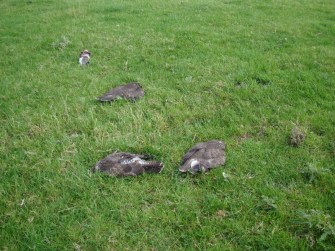
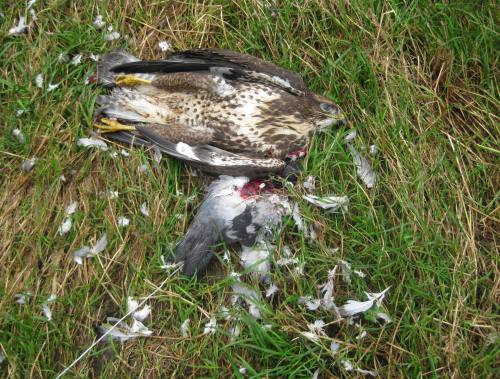
Two young buzzards and a sparrowhawk have been illegally poisoned in Ireland. The bait this time? Live pigeons, that were smeared with the banned pesticide Carbofuran, tethered to the ground with wire with their wings clipped.
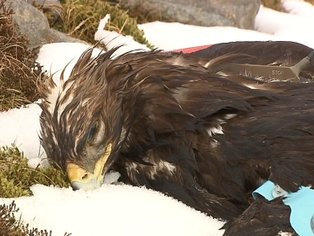
These disgraceful events were discovered last month near Roscrea, close to the Offaly and Tipperary border. Two young volunteers from the BirdWatch Ireland Raptor Conservation Project were alerted to the scene by a local farmer. They tell the story here, illustrated with some pretty graphic photographs.

How many more of these disgusting incidents have to be reported before there is a crackdown? Whether it be Ireland, Northern Ireland, England, Scotland or Wales. IT HAS TO BE STOPPED!

Thank you to the contributor who sent us this link.

Are the raptor poisoners in Scotland changing their bait?

Are the raptor poisoners in Scotland changing their bait? Maybe they are, according to an article published in the Guardian on Wednesday:

Rat poisons are posing a significant threat to wild animals because they are being misused or even deliberately abused to target birds of prey, wildlife experts fear.

Figures published on Wednesday on wildlife poisoning in Scotland identify legally available rodenticides as the cause of death of 15 birds of prey, including nine red kites and three sparrowhawks, and six mammals, including two dogs and a cat.

At least one case, where six red kite chicks were killed by extremely high levels of rat poison, has been identified as “suspicious” by the Scottish government’s testing laboratory. Several chicks were seen bleeding from their beaks before death.

The laboratory, Science and advice for Scottish agriculture (SASA), also said that it had detected rodenticide traces in 38% of the 214 dead animal livers it tested last year, with 32 buzzards, 17 red kites and 10 sparrowhawks testing positive. Kites and buzzards are scavengers, so will prey on dead or poisoned rats, but SASA believes its data suggests that rodenticides are now extremely widespread in the foodchain.

One of the chemicals found repeatedly by SASA is only licensed for indoor use [Brodifacoum]. Mike Taylor, head of pesticides and wildlife at SASA, said: “We’ve certainly got evidence of widespread exposure and it’s of concern, but it’s very difficult to enforce because it’s very difficult to collect dead or dying rats [to study].”

Alex Hogg, chairman of the Scottish Gamekeepers Association is reported as saying he had never been aware of rodenticides being  used to deliberately target birds of prey.

To read the full article in the Guardian, including quotes from the National Farmers Union Scotland and the RSPB, click here.

To download the advisory leaflet, ‘Rat Poison and the Threat to Wildlife’, click here.

Scotland’s shame: 2010 poisoning figures published

Today the Scottish government has published its latest report on animal poisoning in Scotland. The figures relate to recorded incidents in 2010 and demonstrate a sharp rise in the number of wildlife poisonings, including the widespread illegal poisoning of raptors. The report shows that 69% of all ‘abuse’ cases involved the poisoning of birds of prey, covering a wide area including Borders, Dumfries & Galloway, Highland, Lothian, Strathclyde and Tayside. The illegal pesticide Carbofuran was detected in half of these incidents. The raptors that tested positive for poisons included 40 buzzards, 4 golden eagles, 1 sea eagle, 1 kestrel, 5 barn owls, 2 tawny owls, 2 peregrines, 21 red kites and 11 sparrowhawks.

Unsurprisingly, some are trying to play down the appalling statistics. The Scottish Land and Estates Chairman, Luke Borwick, is reported to have said that the organisation is working hard to reduce such incidents “…and there is evidence these joint efforts are beginning to pay off“. He was referring to what he called a “significant decrease” (in illegal raptor poisonings) in the first half of 2011. The Environment Minister Stewart Stevenson also made the same comment. Unfortunately, we are not able to make the assessment for ourselves because the published government figures for 2011 only cover the period January to March 2011. However, the figures for this three-month period tell a very different story to the one that Luke and Stewart are pushing: they include 3 buzzards, 1 golden eagle, 1 red kite and 2 peregrines all illegally poisoned in the first three months of 2011 (see here for earlier report). Hmmm.

There are other reactions from various bodies, including the RSPB, the Police and the Scottish Environment Minister – these can be read on the BBC website here and the Scottish government website here.

To read the depressing SASA government report with all the gory details, click here.

SGA call for buzzard, badger and raven culls (again)

The following article was published in the 10 August 2011 edition of Country Life:

The Scottish Gamekeepers’ Association (SGA) is renewing calls for licences to control buzzards. In a survey of some 950 gamekeepers across Britain, 76% said buzzards had a detrimental effect on game birds and 63% said they had a negative effect on wildlife. Sparrowhawks and goshawks were considered a similar nuisance, but marsh harriers, merlins, barn owls and ospreys were viewed more benignly, and the majority of keepers said kestrels and red kites had little or no adverse effect. More than 70% said badgers are a serious problem and the figure for pine martens was even higher on those estates that have them. Charles Nodder, political advisor of the National Gamekeepers’ Organisation, commented: “The idea that keepered land is a raptor desert is nonsense. But keepers understand the countryside and there is a clear indication that certain species are prevalent and having a deleterious effect on wildlife”.

The SGA came close to getting buzzard-control licensing in 2009, but incidents of raptor poisoning – including that of a golden eagle – weakened the case. SGA chairman Alex Hogg says: “We’ve lost the plot when it comes to the control of buzzards, badgers and ravens. Their populations need to be properly assessed each year and, if necessary, action should be taken to redress the balance. There’s no doubt buzzards have changed their predatory habits in the past 30 years. ‘Rogue’ buzzards have learned to predate chicks – and not just game birds: I saw one take three lapwing chicks. We don’t want to shoot every buzzard in Britain, we just want to control the rogue ones, but birds of prey are ‘sexy’ birds and nobody wants to take the first step to control them”.

The encouraging aspect of the survey was the spread and volume of wildlife; 83% of shoots reported the presence of lapwings, 75% had skylarks and 79% cuckoos. The geographic area covered – 1.3 million hectares (3.2 million acres) – is significant, too: five times that of the area of designated nature reserves, more than 13 times that of the RSPB reserves and nearly 60% of national parks.

The ‘survey’ referred to in the article was the ‘survey’ we discussed here on 21 July 2011. Since then, the report has been made public. You can read it, along with an interesting and entertaining discussion about its credibility, here.

Dead red kite is suspected poisoning victim

Toxicology tests are underway on a dead red kite found on farmland in the village of Glaston, Rutland. It is suspected to have been poisoned. Two other poisoned kites were found dead in the area three years ago. In August 2008 a red kite was discovered to have been poisoned by the banned pesticide Carbofuran in a rabbit bait at Glaston. In September 2008, another kite was poisoned with Carbofuran at Seaton, Rutland (see here for details of these two incidents). The lab results from the latest dead kite have not yet been released.

Leicestershire police wildlife crime officer, Neil Hughes, is asking for locals to contact him to report any other poisoning incidents in the same area, such as cats and dogs. Contact Neil: 0116 222 2222.

Story in the Rutland Times here

No vicarious liability for England

Richard Benyon MP, the DEFRA Minister for the Natural Environment and Fisheries, doesn’t see any need to follow Scotland’s lead of introducing vicarious liability to make landowners legally responsible for incidents of raptor persecution that occur on their estates.

On 30 June 2011, Labour MP Angela Smith (Penistone & Stocksbridge, South Yorkshire) asked the following question: Only two weeks ago, a gamekeeper was convicted for illegally killing birds of prey in my constituency. Is it not time to think about introducing a vicarious liability offence to ensure that landowners and estate managers supervise their gamekeepers more closely and more effectively?

Richard Benyon’s response: There are very good laws in place to punish the illegal killing of any animal. If they are not being effectively enforced, they must be and we will take steps to make sure that happens. However, this is a good opportunity to applaud gamekeepers for the wonderful work they do in providing excellent biodiversity across our countryside.

It was reported in the Telegraph last year that Mr Benyon is a ‘keen grouse-shooter’ (see here).

Perhaps Mr Benyon hasn’t looked at the national poisoning statistics of the last few years. If he had, he couldn’t have failed to notice how many of these confirmed incidents were now listed as ‘closed’ before any enforcement action was taken! (see here for 2008-2011 database).

Perhaps we should all be writing to Mr Benyon, to point him in the direction of these official statistics and to ask him what ‘steps he will take’ to ensure that effective law enforcement is taking place? Here’s his email address: richard@richardbenyon.com

Welcome to the inglorious twelfth!

Today is the inglorious 12th, the start of the four-month grouse shooting season in the uplands of northern England and Scotland. Today, and for many days to come, ridiculously rich people will dress up in clownish outfits and head for the moors in the hope of shooting dead some birds. Many will pay an estimated average of £15,000 for the experience. I wonder how many of them will enjoy the sight of a hunting hen harrier or a golden eagle quartering across the moor? Very few, infact probably none of them because scientific evidence shows that hen harriers and golden eagles have been exterminated on most grouse moors in the UK, with just a few notable exceptions. Has anyone been convicted? One person was once convicted for killing a hen harrier, and that’s it. Nobody has ever been convicted for killing a golden eagle (someone was once taken to court a few years back but the case was dropped). Even though several dead eagles and the UK’s biggest stash of the poison they died from were all found on a sporting estate last year, still nobody has ever been convicted.

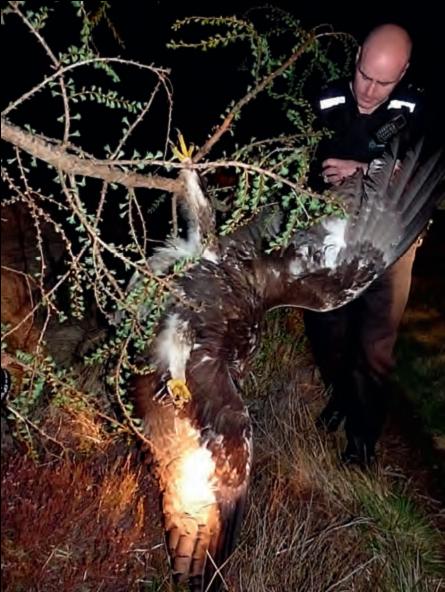
Four years ago today, this golden eagle (pictured) was found dead in Peebleshire. She was one half of the last breeding pair of golden eagles in the Borders. She had been poisoned by the banned pesticide Carbofuran and was found dead under her nest tree. Her death caused outrage and triggered the thematic inspection into the prevention, investigation and prosecution of wildlife crime in Scotland (read the resulting 2008 ‘Natural Justice’ report here). This report highlighted the problems that stand in the way of effective wildlife crime law enforcement in Scotland. Four years later, many of the same problems still exist. Nobody has been charged with the illegal killing of that female golden eagle in Peebleshire and according to a report by the Wildlife Incident Investigation Scheme, the case is now closed.

Since the year she was killed (2007), how many other protected raptors have suffered the same fate? The following have all been confirmed poisoned in Scotland over the last four years – the vast majority of them were found dead on grouse moors:

8 golden eagles, 3 sea eagles, 63 buzzards, 25 red kites and 8 peregrines.

These numbers do not account for birds that were trapped, shot, or had their heads smashed in with a shinty stick while their broken legs were pinned in an illegal spring trap. Nor do they account for the ‘missing’ birds – including over 2,000 hen harriers.

Today, the grouse-shooting industry will have filled the media with stories about how ‘great’ grouse moors are for conservation, how ‘great’ grouse shooting is for the economy, how ‘great’ grouse-shooting is for biodiversity. Fortunately, the general public are becoming wise to the propaganda.

It’s just ‘a few rogues’

One of the most significant barriers to ‘sorting out’ the widespread illegal persecution of raptors in Scotland is getting anyone to accept responsibility for these crimes. Previous analyses by the RSPB have shown an irrefutable link between illegally-killed raptors and the game-shooting industry (e.g. see here). Time and time again, scientific peer-reviewed studies have also shown the incontrovertible relationship between areas that are ‘missing’ breeding raptors such as golden eagles and hen harriers, and areas managed as sporting grouse moors (e.g. take a look at the government-funded Conservation Framework Reports for the golden eagle and hen harrier as a starter).

Despite the long-standing and highly-regarded body of evidence, the game-shooting industry continues to refuse responsibility. The latest article in the Scotsman (see here) provides a perfect example of this.

It’s a handful of “rogue estates” carrying out poisonings, say the gamekeepers. It’s a “handful of estates” says David Hendry of the Cardney Estate. It’s “a minority” says Susan Davies of Scottish Natural Heritage. It’s a “tiny minority” according to the SGA response to the article on their Facebook page.

It’s an interesting choice of words isn’t it? The term ‘rogue’ is often used in a jocular sense in today’s society – “Oh, he’s just a loveable rogue”, meaning yes an individual is bending the rules but he’s not doing any real harm, he’s alright really. The term ‘rogue’ is also used to infer just one or two individuals (e.g. it was a rogue crocodile, or it was a rogue tiger that attacked the man), as is the term ‘a handful’. What is a handful? One or two? Not more than five? Not more than ten? The term ‘minority’ (depending on the context) refers to less than the majority.

Do any of these words adequately describe the extent of illegal raptor persecution on Scottish sporting estates, or are they just words used to deflect the increasingly obvious conclusion that illegal raptor persecution is endemic across many sporting estates? Let’s look at the stats.

This blog has been accused of using out-of-date information to create the false illusion of widespread raptor persecution. It’s a valid criticism in some ways as our Named Estates page dates back to incidents that were recorded in 1979. Actually it only includes one record from 1979 but to be fair the list does include a lot of reported incidents from the 1980s and 1990s. These early reported incidents were only used to illustrate the historical nature of illegal raptor persecution – i.e. it’s been going on for decades, but to be completely upfront we have since indicated which of those estates are known to have since changed hands (and thus potentially changed their ‘management’ practices). So, let’s just look at reported incidents from the last two years – that is, from January 2009 to March 2011, the most up-to-date figures available in the public domain.

During this period, twenty-six named locations have been identified as places where dead raptors have been reportedly found in suspicious circumstances. Most were poisoned but ‘a handful’ were shot or trapped and one (on Logie Estate) was found dead but the cause of death remains unknown. Of these 26 locations, 14 were on named estates: Auch Estate, Edradynate Estate, Farr and Kyllachy Estate, Glenbuchat Estate, Glenogil Estate, Invercauld Estate, *Leadhills Estate, Logie Estate, Millden Estate, Mountquhanie Estate, *Moy Estate, *Redmyre Estate, *Skibo Estate, Strathspey Estate. The remaining 12 locations were un-named and may or may not involve estates: eight in 2010 and four between Jan/Mar 2011. Of course, just because an illegally poisoned, shot or trapped dead raptor is discovered at a location doesn’t necessarily implicate the estate owner, shooting tenant or gamekeeper. It could just be a series of unfortunate coincidences, even though in the Scotsman article David Hendry of Cardney Estate admits that “there are a number of estates using poison still.” On only four of the above estates have gamekeepers been convicted for related crimes (Leadhills, Moy, Redmyre and Skibo).

If we expand the search to the previous five years (2006-2011 – as this is still relatively recent), then obviously the list grows:

*Birthwood Farm, *BlythFarm, *Cabrach Estate, Clova Estate, Dawyck Estate, Dinnet & Kinord Estate, Dunecht Estate, *Frogden Farm, *Glenbuchat Estate, Glenfeshie Estate, Glenogil Estate, Glen Turret Estate, *Innes House Estate. (The ones with an asterisk indicate a conviction during this period).  In addition, a further six un-named locations are reported.

If we remove from this expanded list those estates that were already included in the two-year analysis (i.e. Glenbuchat, Glenogil) then we are left with a total of 25 different estates where dead raptors have been reportedly discovered in suspicious circumstances in the last five years. Add to these the 18 un-named locations and you get a running total of 43 different locations, assuming that all of the un-named locations were different to the named locations.

Forty-three. Is that ‘a minority’? Well yes, in the strictest sense it is because there are hundreds of shooting estates in Scotland. The exact number seems hard to pinpoint but it’s certainly at least in the low hundreds, which means that 43 is a minority in this context. But is it a ‘tiny minority’? Is it ‘a few rogues’? Is it ‘a handful’? No it isn’t. It’s a lot more than that and the game-shooting industry is being disingenuous if it continues to peddle this rural myth. But of course they’ll continue to peddle it because they want us to believe that they’re a law-abiding industry who just happen to want licences to be allowed to legally kill ‘just a few rogue’ raptors.

And what of the locations that haven’t been reported but can be implied by the ‘missing’ breeding raptors reported in the scientific papers? How many of these locations are there? Who knows. One thing is for sure – if the landowners and gamekeepers won’t admit responsibility for the incidents we do know about, they sure as hell aren’t going to admit to the ones we don’t know about! The representative bodies all say they’re working hard behind the scenes to get the ‘rogues’ to stop, but they’ve been saying that for a long, long time and here we are in 2011 and the killing continues up and down the country, with the exception of ‘a handful’ of decent estates who proactively welcome breeding raptors. Why does it continue? Because the majority know they can get away with it, just as they have been doing for the past 50+ years.

RSPB tells estates & landowners to ‘sort out’ illegal raptor persecution

In an article published in today’s Scotsman newspaper, RSPB Scotland has told estates and landowners it is time they “sorted out” the problem of birds of prey being killed.

They place the blame for illegal raptor persecution firmly at the feet of landowners and estates and say that persecution could be halted if landowners were more willing to address the problem. In reply, landowners and gamekeepers say it is just ‘a handful of rogue estates’ involved and that peer pressure is being applied behind the scenes to try and get them to stop. Bob Elliot, Head of Investigations with RSPB Scotland says more needs to be done. “They (estates and landowners) have said they don’t condone it time and time again – but what other industry do you know that wouldn’t have sorted this out by now, internally? Evidence that there is anything changing is very difficult to judge. We need to concentrate on the fact that our species are being targeted illegally and being killed.”

While Elliot is happy that vicarious liability has been included in laws covering wildlife crime, meaning landowners as well as gamekeepers have responsibility for what happens on estates, he says he would like them to be toughened further: “You can charge someone with possession of a banned chemical but there is no equivalent to a charge like ‘going equipped’ or ‘concerned in the use of’.”

The concept of ‘just a handful of rogue estates’ being involved is a familiar one, but when you look carefully at the recent persecution incidents you realise it’s simply not true. The next blog post will investigate this concept in more detail.

Well done to Bob Elliot and his colleagues at RSPB Scotland for continuing to expose the criminal persecution of raptors on sporting estates and elsewhere, and for trying to bring to justice those responsible for these selfish, disgusting crimes.

The article in the Scotsman can be read here.