Suspected poisoning of red kite & buzzard in Herefordshire

A dead red kite and a dead buzzard have been found in Herefordshire in what looks suspiciously like a poisoning incident.

According to an article in the Western Daily Express (here), the carcasses were discovered on farmland at Pontrilas, south Herefordshire, close to a dead pheasant. The farmer took the corpses to a vet but the vet couldn’t find any obvious sign of injury or disease.

The RSPCA is appealing for information, but strangely, the article doesn’t say whether the corpses have been submitted for toxicology analyses. Given the position of the two dead raptors and their proximity to a dead pheasant (commonly used as bait), it seems quite plausible that this could have been an illegal poisoning incident.

Let’s hope the RSPCA contacts the RSPB Investigations team for advice.

Red kite photograph by Drew Buckley.

Petition for increased SSPCA powers handed in to Holyrood

Goddard petition Wheelhouse august 2014A petition calling for increased investigatory powers for the SSPCA was handed over to Environment Minister Paul Wheelhouse last week, with over 6,000 signatures.
The petition was launched several months ago by Andrea Goddard, a volunteer at the Tollie Red Kite Feeding Station, following the illegal poisoning of 22 raptors (16 red kites and 6 buzzards) in March at nearby Conon Bridge – an incident we’ve termed the Ross-shire Massacre. Five months on, nobody has been charged for this appalling crime.

Great effort, Andrea. Story in the Press and Journal here.

The petition coincided with the long-awaited government-led public consultation on whether the SSPCA should be given additional powers to investigate a wider suite of wildlife crimes. The consultation closes next Monday (1st September) and the consultation responses will be published on the Scottish Government’s website by 11th October. Following the government’s decision-making, a full report (on the consultation) has been promised although a time-frame for this has not been provided.

We’d encourage as many of you as possible to contribute to this consultation. If the proposal is accepted, we believe it will bring significant improvement to the enforcement of wildlife crime legislation in Scotland, leading to many more offenders being brought before the courts – see here for our reasoning.

If you’d like to take part, please click here.

Ross-shire Massacre: five months on

It’s been five months since the discovery of 22 dead raptors (16 red kites + 6 buzzards) near Conon Bridge in Ross-shire – an incident we have termed the Ross-shire Massacre.

Since then, we’ve learned that 16 of these birds (12 red kites + 4 buzzards) were killed after ingesting an “illegally-held poisonous substance“. That information had to be dragged from Police Scotland in June, following some pretty outrageous allegations from the game-shooting industry (and at least one MSP) that the birds had been ‘accidentally poisoned’ by eating contaminated meat at the Tollie Red Kite Feeding Station.

Other than that, Police Scotland has refused to provide any further information, other than to say last month that the investigation “was continuing“.

In June, a member of the public made an FoI request to SASA (the government lab responsible for undertaking the toxicology anlayses on these birds) to ask for the name of the poison(s) and the name of the species affected, amongst other things. He received a reply from SASA on 30th June and he was told that it wasn’t in the public interest to disclose such information. SASA claimed that the public interest test was “outweighed by the public interest in ensuring that the ongoing police investigation is not jeopardised and that incomplete data are not released“. The member of the public submitted a request for a review of this decision and on 24th July 2014 he received a response from Hugh Dignon, a senior civil servant. Mr Dignon upheld the decision made by SASA and added:

By withholding evidence that might, if prematurely released, prejudice a live investigation, we are maximising the likelihood that a conviction could be secured if a prosecution is taken forward“.

Come on, Hugh! There’s not a chance in hell of getting a prosecution, let alone securing a conviction, so many months after the crime took place. Who are you trying to kid? And since when has releasing the name of a banned poison ever jeopardised a live investigation? Er, that’ll be never. SASA has, for years, routinely published the name of the poisons that were used in crimes that are still subject to on-going investigations – why is this case so different? Why all the cloak and dagger? What’s to hide?

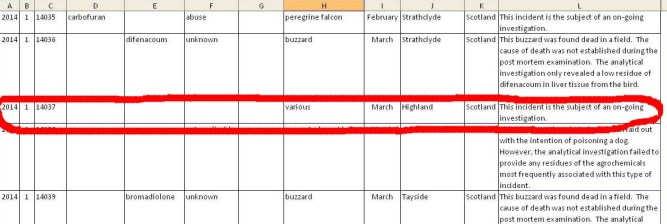
Here’s a screen grab of SASA’s latest poisoning data, which relate to toxicology tests undertaken in the first quarter of 2014. The reference circled in red is the information about the Ross-shire Massacre. SASA has redacted all the detail about the type of poison(s) detected (column 4), whether the incident was ‘abuse/mis-use’ etc (column 6), and they’ve even removed the names of the species they’ve tested – preferring to write ‘various’ instead (column 8). Compare and contrast these redactions to the entry at the top of the image, which relates to a poisoned peregrine found in Strathclyde in February – that case is also an on-going police investigation (ahem) and yet we’re allowed to see the name of the poison (Carbofuran), the type of incident (abuse) and the species affected (peregrine). Astonishing, isn’t it?

 SASA Q1 2014 ROSS-SHIRE MASSACREa

For previous posts on the Ross-shire Massacre click here

More poisoned peregrines in North Wales

North Wales Police are appealing for information following the discovery of a poisoned peregrine in June.

The bird was found at a quarry in Penmaenmawr and toxicology tests revealed it had been poisoned with a rodenticide.

It’s possible then that this was the result of an accidental poisoning (as rodenticides can be used under certain controlled conditions), but the death is being treated as suspicious because two years ago a pigeon was found, at the same quarry, smothered in poison and tethered to a rock – obviously placed as a poisoned bait (see here).

Press release from North Wales Police on the latest peregrine poisoning here.

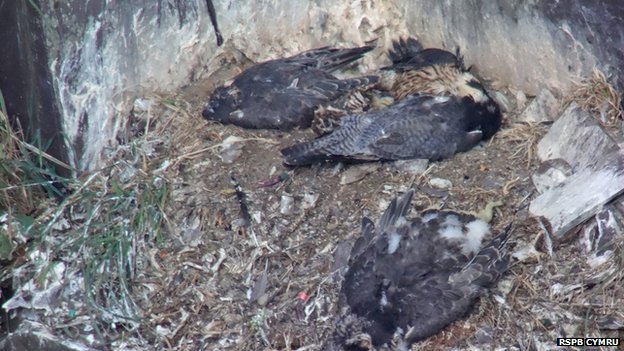
In July this year, four peregrines (3 chicks and 1 adult) were found dead on their nest ledge at a quarry site in the Nantlle Valley, Gwynedd. Police suspect they too had been poisoned (see here).

peregrines x 4 Nantlle valley July 2014

Raven found poisoned at Killard Nature Reserve

raven poisoned KillardThanks to the contributor who sent us a copy of the following article, published in the (County) Down Recorder, 23 July 2014. We’ve shortened it slightly:

The poisoning of a raven at Killard Nature Reserve, County Down, has prompted a police investigation and raised serious concerns amongst environmentalists.

The dead bird was found on 15th March 2014 but it has only now been confirmed that it was poisoned with the banned pesticide, Carbofuran.

Situated at the mouth of Strangford Lough opposite Ballyquintin, where walkers are attracted by the area’s rich wildlife and interesting rock formations, the site is managed by the Northern Ireland Environment Agency (NIEA).

An NIEA spokeswoman said they were “deeply concerned” and advised members of the public at Killard not to pick up any dead wildlife in case they are poisoned. She explained that the raven, protected by the Wildlife (NI) Order 1985, was found by one of their wildlife officers on the cliff top above Benderg Beach.

“The dead raven was found in an unnatural posture which, from experience, led the officer to believe that it may have been poisoned”, said the spokeswoman. “Despite a thorough search no evidence was found that poison had been laid in the reserve. Tests completed in early July revealed that the raven had died as a result of ingesting Carbofuran, a poison banned for use throughout the EU. It is likely that the bird picked this up from a poisoned bait within 100 metres of where the raven was found.

“NIEA is deeply concerned, not only the poisoning of a protected species nesting locally, but also that it took place on or near a protected site where wildlife should be safe”.

NIEA said it wasn’t aware of any other incidents at the reserve but issued the following advice: “Members of the public visiting Killard are asked to avoid handling any dead animals such as rabbits or birds in case they may have been poisoned or baited with poison. Dogs should be kept on the lead and prevented from approaching any such corpses, and dogs are not permitted on the Reserve when livestock graze there over the winter months.

“If members of the public in the Killard and Ballyhornan area do come across any dead crows, birds of prey or foxes, or find any suspicious carcasses or rabbits or chickens covered in granular or powdered substances, or see any suspicious activity which could relate to illegal poisoning, they are asked to contact Downpatrick PSNI”.

A spokeswoman for the RSPB in Northern Ireland said the incident was “very disappointing”.

“All cases of birds or wildlife being poisoned by an illegal substance are worrying, but this incident is particularly concerning because the County Down area is a stronghold for the threatened red kite”, she said.

“Having been persecuted to extinction in Northern Ireland more than 200 years ago, kites were reintroduced here in 2008. Sadly, last year alone around 30% of the breeding population were confirmed poisoned, making it more difficult for the species to thrive.

“Leaving out poisoned bait is an illegal practice as it is indiscriminate and can affect not only scavenging birds like red kites, but also pets, livestock and humans”.

East Scotland sea eagle chick fledges: what fate awaits this one?

For the second consecutive year, a young white-tailed eagle has successfully fledged from a nest in east Scotland.

His sibling, who hatched in 2013, un-mysteriously ‘disappeared’ earlier this year in a notorious raptor persecution blackspot in the Cairngorms National Park (see here and here). He was the first sea eagle to fledge in east Scotland in over 200 years but he didn’t even survive to see his first birthday. His satellite transmitter went silent after he’d visited a driven grouse moor where previously a head gamekeeper had been convicted of poisoning offences (2006), a poisoned golden eagle had been found in 2011 (no prosecution), a poisoned buzzard had been found in 2011 (no prosecution), poisoned bait had been discovered in 2011 (no prosecution) and a short-eared owl had been found in 2011 that had been shot and shoved underneath a rock (no prosecution). The police raided the estate in April this year but found no trace of the eagle.

He might not have been the first sea eagle to fledge in Scotland in over 200 years if another east Scotland pair had not had their nest tree felled by someone with a chainsaw (see here – no prosecution).

The BBC is running an article on this year’s fledgling (see here) and includes a telling remark from RSPB Scotland saying they hoped the young bird would avoid areas where birds of prey have been poisoned or trapped. In other words, steer clear of driven grouse moors.

He’s got at least five years in which to run the gauntlet before he becomes mature enough to breed – we don’t rate his chances much.

Go west, kid, go west.

wtse fife 2014 ian francis

Poisoned bird found on former DEFRA Minister’s grouse moor: why no publicity?

In February 2009, a dead raven was found on a Scottish grouse moor. Nothing surprising about that.

The dead raven was sent off to SASA for toxicology tests and their investigation concluded the bird had died from ingesting the banned poison, Carbofuran. Nothing surprising about that.

There wasn’t any subsequent publicity about this incident. Nothing surprising about that.

There wasn’t any subsequent prosecution. That’s kind of what we’ve come to expect so no surprises there, either.

However, this wasn’t just any old Scottish grouse moor. This was a grouse moor on Glenmazeran Estate in Inverness-shire. Glenmazeran Estate is, according to Andy Wightman’s brilliant website ‘Who Owns Scotland‘, owned by the Englefield Estate Trust Corporation Ltd, c/o Englefield Estate Office, Theale, Reading.

According to further information provided by the Who Owns Scotland website, “Englefield Estate Trust Corporation Ltd is a company registered in England No. 02065923. One of the beneficial owners is Richard Benyon, the Environment & Fisheries Minister in the UK Government (data accurate at August 2011)”.

At the time of this poisoned bird’s discovery, Mr Benyon MP was the Shadow Minister for the Environment, Food and Rural Affairs, until the 2010 general election when he entered Government. He was subsequently appointed the Parliamentary Under Secretary of State at DEFRA, with special responsibility for biodiversity and the natural environment, amongst other things, until he was booted out in Cameron’s reshuffle in October 2013.

While Mr Benyon was in post at DEFRA, the government sanctioned the controversial buzzard ‘management’ trial and committed £375k of taxpayers money to help support it (see here), although they swiftly backtracked after a huge public outcry against the plan (see here). However, the following year Natural England, acting on behalf of DEFRA, decided to go ahead and issue a licence (to a gamekeeper with a past conviction for wildlife crime) to destroy buzzard eggs and nests to protect pheasants (see here).

Mr Benyon also decided there was no need to introduce vicarious liability to England because “there are very good laws in place to punish the illegal killing of any animal. If they are not being effectively enforced, they must be and we will take steps to make sure that happens. However, this is a good opportunity to applaud gamekeepers for the wonderful work they do in providing excellent biodiversity across our countryside” (see here and here).

Mr Benyon also refused to criminalise the possession of the poison Carbofuran in England (see here and here).

These actions can be seen in a whole new light given what we now know was discovered on Glenmazeran Estate back in 2009.

Of course, the discovery of the poisoned raven on Glenmazeran doesn’t mean that Mr Benyon or anyone else connected with the estate was responsible. Some gamekeepers on some estates are known to place poisoned baits along the boundary of an estate, presumably to make any police investigation that much more difficult and to potentially deflect attention on to someone else. Glenmazeran is not known to us as an estate where frequent raptor persecution takes place, but it is situated in a notorious raptor persecution area and several other estates in the area are suspected to be regularly involved with criminal activity and some of them even have convictions for these offences.

What’s intriguing about the Glenmazeran incident is the complete silence about this case. Did the police (it would have been Northern Constabulary at the time) investigate? Did they search Glenmazeran or other nearby estates? Why didn’t they issue any media statements about this discovery? Would public knowledge of this incident have jeopardised Mr Benyon’s political career? It shouldn’t have, as he was never implicated in the crime, so why was it kept quiet?

What we do know is that the ‘landowner’ (whoever that was) was informed about the crime. This from the SASA report:

Raven found dead in remote area. The analytical investigation established that carbofuran poisoning was responsible for the bird’s death. The police have informed the landowner of the incident but the source of the chemical has not been established“.

Fascinating stuff.

Ross-shire Massacre: the pig’s ear of an investigation continues

RK5Ten days ago we blogged about the progress (or apparent lack of) being made in the Ross-shire Massacre case, four months on from the discovery of 22 dead raptors in one of Scotland’s worst raptor poisoning incidents (see here).

A couple of days ago, somebody told us that the ‘official’ number of birds confirmed poisoned was now 16 (12 red kites + 4 buzzards), according to Police Scotland.

We found this news intriguing. Did it mean that the remaining six carcasses (4 red kites + 2 buzzards) had not been poisoned?

No. What it turned out to mean was that toxicology tests on those remaining birds are still “continuing”, according to a news report in The Press and Journal (see here).

Still continuing, four months after discovery? Is that because the poison is proving difficult to detect, or is it because the tests have not been given priority? If not, why not?

What a shambles. And that’s only the start of it…..

Previous posts on the Ross-shire Massacre here

Ross-shire Massacre: 4 months on

It’s been four months since 22 birds of prey (sixteen red kites and six buzzards) were killed in one of the worst poisoning incidents uncovered in Scotland in recent years.

Here’s the latest information about how the police investigation is progressing:

nothing 2

Great, eh?

The Untouchables get away with it. Again.

Tune in next month for more of the same. Probably.

For previous posts on the Ross-shire Massacre click here.

Golden eagles in southern Scotland: the facts and the fiction

A new report has been published today detailing the recovery prospects for golden eagles in southern Scotland.

The SNH-commissioned report has been written by two undisputed experts (Alan Fielding and Paul Haworth), both of whom were involved with the impressive Golden Eagle Conservation Framework report that was published in 2008.

The report has only just been made available on SNH’s website so we’ve not had a chance to thoroughly digest its findings – although we intend to come back to it in due course.

Having skimmed through it, it looks like a very detailed analysis of the various issues that could affect the recovery of this tiny population (see here for a previous blog entry on the perilous state of the golden eagle population in southern Scotland), including, of course, the effect of illegal persecution. This photo below shows the graphic effect of persecution on golden eagles in south Scotland – this one was found shot and critically injured on a driven grouse moor in 2012 – it later died from its injuries – see here.

Wanlock Head GE Oct 2012

If you haven’t read the new report (and let’s face it, not many people will), you might just base your opinion of it on what has been written in the mainstream media, which would be fine if the media reports were accurate, balanced and didn’t contain any lies.

For example, if you read the BBC report, you’d be forgiven for thinking that golden eagles in southern Scotland are only constrained by impoverished habitat and potentially by climate change, lack of prey (apparently due to a loss of gamekeepers!) and afforestation. You’d read that illegal persecution ‘may have been an historical factor’ but apparently it isn’t any more.

Hmm. Is that what the report actually says? Er, no. The report mentions persecution in several areas (Lowther Hills, Tweedsmuir Hills, Ettrick Hills and Moorfoot Hills) and suggests that it needs to be brought under control if golden eagles are to once again survive in these areas.

So if the report didn’t say that illegal persecution ‘may have been an historical factor’ but apparently isn’t any more, then who did?

McAdam 1No surprises…..Doug McAdam, CEO of the landowners’ organisation, Scottish Land and Estates. We  blogged about SLE’s persistent denial of raptor persecution only yesterday (see here) in relation to comments made by SLE’s Moorland Director Tim (Kim) Baynes during a radio debate. It looks like McAdam was sent the same memo – just deny, deny, deny.

This time, however, we intend to do more than just make fun of him – we’re going to complain to the BBC about publishing such nonsense and we’d encourage as many of you as possible to join in. We’ve even prepared some suggested text that you can simply cut and paste if you’re short of time or not sure what to write. Here it is:

Dear BBC,

I wish to make a complaint about the content of an online article about a new report about Golden Eagles in the south of Scotland:

http://www.bbc.co.uk/news/uk-scotland-south-scotland-28320168

In my opinion, a disproportionate amount of space in the written article is given over to comments made by Mr Doug McAdam, the chief executive of Scottish Land and Estates. This is in complete contrast to the amount of space given to the comments by Prof Des Thompson “who led the research” and Mr Ian Thomson of RSPB Scotland.

In addition I am very concerned that the comments attributed to Mr McAdam reflect a falsehood that is frequently stated by his organisation and others who have a long-term political agenda to downplay the issue of persecution of birds of prey. Mr McAdam is quoted as saying, “Where persecution may have been a historical factor, it is clear from the official government data – published alongside our partners in PAW Scotland in March – that the number of such incidents has dropped significantly in recent years.”

In fact, the figures published by the Scottish Government show the opposite to be the case. In the Scottish Government’s wildlife crime report for 2012:  http://www.scotland.gov.uk/Resource/0043/00434716.pdf thirteen birds of prey are listed as being the victims of persecution.

In 2013, twenty three birds of prey were listed as victims:  http://www.scotland.gov.uk/Topics/Environment/Wildlife-Habitats/paw-scotland/types-of-crime/crimes-against-birds/Poisoninghotspotmaps/2009-2013

These figures are nowhere near being indicative of “a significant” decline – in fact they are wholly contradictory of such a claim.

I urge the BBC to remove these erroneous comments from the article, given that they suggest to its readers a picture which is patently untrue.

Yours faithfully, (your name).

Here’s where to send your complaint: https://ssl.bbc.co.uk/complaints/forms/?reset=#anchor  [click on ‘Make a complaint’]

Some links:

BBC news article (and accompanying video) here

SNH press release about the new golden eagle report here

RSPB Scotland press release here

Download the new report here: Fielding & Haworth 2014_Golden Eagles in south Scotland an overview

UPDATE 17.40: Interestingly, the BBC appears to have retracted some of McAdam’s quote, but not the offending part! (Many thanks to those of you have already complained – we can see from our site stats that quite a few of you have done so).

Here’s McAdam’s quote from this morning:

Douglas McAdam, chief executive of Scottish Land & Estates, said: “We have been involved with Scottish Natural Heritage and other partners in this study since its inception as we felt it was crucial to understand the real underlying reasons why Golden Eagles were struggling in certain parts of Scotland.

This thorough and detailed study makes clear that SNH believes that habitat improvements are needed to encourage more breeding golden eagle pairs in the south of the country. We fully support this conclusion and we will encourage land managers to work in partnership with SNH and other bodies to make improvements to these habitats wherever possible.

Other factors, including climate change, lack of availability of prey base for eagles – often because these areas are no longer actively managed by gamekeepers – as well as expansion of forestry and changing land use may also be inhibiting eagle presence in these areas. Where persecution may have been a historical factor, it is clear from the official government data – published alongside our partners in PAW Scotland in March – that the number of such incidents has dropped significantly in recent years. However, everyone remains resolute that where persecution exists it must be eradicated.

Golden Eagles are iconic Scottish birds, adding greatly to Scotland’s natural landscape and welcomed by estates as part of our natural heritage. This study will add greatly to our understanding of what limits the presence of these magnificent birds and should therefore help us to understand how best they can be conserved.”

And here’s what’s currently online at 17.40: 

Scottish Land and Estates chief executive Douglas McAdam said: “Where persecution may have been a historical factor, it is clear from the official government data – published alongside our partners in PAW Scotland in March – that the number of such incidents has dropped significantly in recent years.

However, everyone remains resolute that where persecution exists it must be eradicated.

Golden Eagles are iconic Scottish birds, adding greatly to Scotland’s natural landscape and welcomed by estates as part of our natural heritage.

This study will add greatly to our understanding of what limits the presence of these magnificent birds and should therefore help us to understand how best they can be conserved.”

Come on BBC editors, get your act together!